Saturday, 6 August 2022

More Huckleberry Hound and Augie Doggie Music

There are many stories about the world being a lousy place. I could tell some. You could tell some. But this is a story about the world being a less lousy place because there are still kind and generous people out there.

This blog was started because of an affection for the stock music heard in the backgrounds of the Huckleberry Hound and Quick Draw McGraw shows. To make a long story short, after a search that took several decades, I discovered the origin of the cues, acquired copies where I could and started documenting which ones were heard on specific cartoons, moving my efforts to this blog in 2009.

The easier way, of course, would be to have copies of the cue sheets that Screen Gems had to submit to ASCAP and BMI so royalties could be paid to the composers.

One of the greatest cartoon music scholars out there, if not the greatest, is Daniel Goldmark. He has written several books and, wonderfully, penned a thesis where the appendix contained a list of the music (except that composed in-house) heard in every single Warner Bros. cartoon (except the “Seely Six”) from 1930 to 1969, compiled from cue sheets. This is such an incredible resource. He was also the music coordinator on the Spümcø cartoons “Boo-Boo Runs Wild” and “A Day in the Life of Ranger Smith.” Music by Capitol Hi-Q! (the Smith cartoon opens with ZR-49 LIGHT UNDERSCORE by Geordie Hormel).

After years and years, I finally had the courage to ask Dr. Goldmark—we have corresponded about one his projects—if maybe he had any Hanna-Barbera cue sheets from the Capitol Hi-Q days.

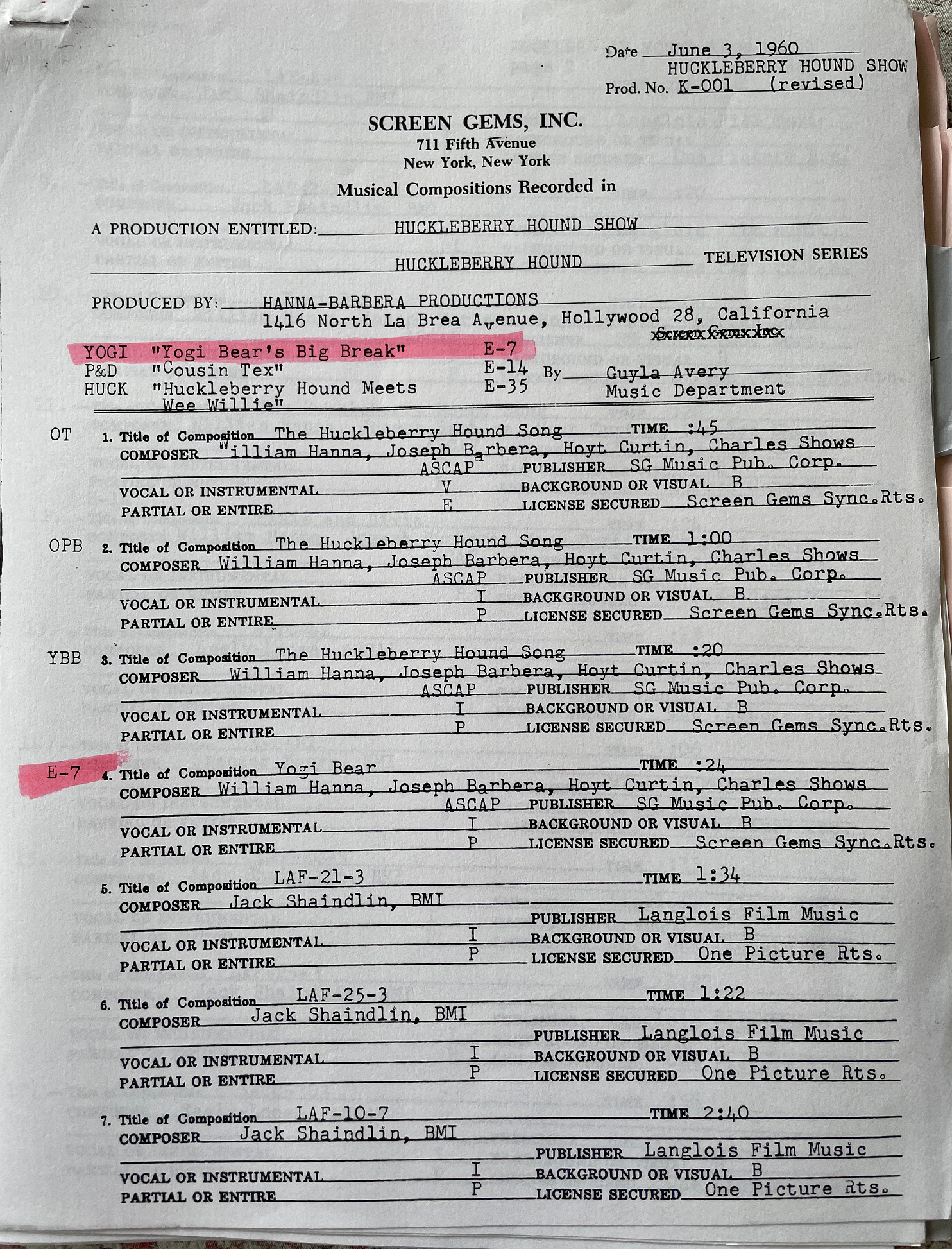
He did. And, to my astonishment and extreme delight, he e-mailed me 135 pages of cue sheets for the first three seasons of the Huck show, before Hoyt Curtin took over. Not for all the cartoons, but a good percentage of the first two seasons.

At last, I could learn the identity of some of the music I have not been able to find.

Here are a few discoveries.

The sheets are for each half hour show. That means they list music for themes and bumpers in addition to the cartoons. The opening themes always run 24 seconds, meaning each cartoon had credits. The sheets also note the order in which the individual cartoons aired. They confirm what many people have said—there was a rotation each week, with Huck being the first cartoon one week, Yogi the next, and Pixie and Dixie the next.

The sheets for the first two years say “revised.” I don’t know why. I do notice some cues on the sheets are different than what you hear in the cartoons from the Huck DVD or any Huck cartoons that aired on American cable TV. I don’t have a copy any more, but a version of “The Runaway Bear” (E-29) was on-line that had a substitution for a Jack Shaindlin cue. Unfortunately, I don’t have a cue sheet for that cartoon.

Guyla Avery, according to the sheets, was part of the studio’s music department. Guyla was actually Bill Hanna’s secretary, and Iwao Takamoto told a story about how Bill would shout at her from inside his office until it was agreed to protect eardrums by installing an intercom. Hanna never quite figured out to operate it, so he continued to yell out at Guyla. She later married artist/designer Alex Toth.

Until June 3, 1960, the studio’s address on the sheets is 1416 N. LaBrea, which was the old Kling/Chaplin studios. The sheets for the third season, starting in September, reveal the company was now operating out of the window-less cinder-block building at 3501 Cahuenga (not to be confused with later new building down the street on Cahuenga we all associate with Hanna-Barbera).

Somewhat maddening is the fact the sheets only list names of music if they don’t contain an alpha-numeric. That means the sheets don’t actually tell us most of the names. For example, a sheet will read “6-ZR-50” and not tell us the name is “Light Underscore.” With that in mind, let me try to clear up the identities of some the music as revealed by the cue sheets.

● Not one, but two short pieces by Raoul Kraushaar were heard on the Huck show. They have an MR prefix: 7-MR-183 COMEDY MYSTERIOSO and 8-MR-377 COMEDY. They were on the Hi-Q reel L-58 published in 1959 and came from the Omar library, co-founded by Kraushaar in 1956 (he is the “R” in “Omar”). They both sound like they were recorded in the back of a room, with a clarinet, strings and muted trumpets. In some cases, they were edited together to sound like one cue. Hi-Q removed them from the library.
● The sad trombone music heard as the sneaky dog limps with a crutch in “Nuts over Mutts” is Jack Shaindlin’s LAF-72-3.
● “Oh Susanna” heard as Cousin Batty chats with Pixie and Dixie is Shaindlin’s LAF-88-7.
● George “Geordie” Hormel is responsible for ZR-21E SUSPENSE when the alien’s spaceship lands in Jellystone Park in “Space Bear.”
● In the same cartoon, the cue that the late Earl Kress said contained the name “Fireman” is LAF-1-2. He never could remember the complete name.
● The light symphonic music, memorably heard as the skunk is flying on a paper airplane in the Augie Doggie cartoon “Skunk You Very Much” is LAF-113-3. The cue sheet lists as the composer “Langworth” instead of Jack Shaindlin, and it doesn’t remind me of any of Shaindlin’s work.
● LAF-6-16 is a mystery. The cue sheets assign the code to two completely different pieces of music; Dr. Goldmark warns that cue sheets are not always accurate. One is the medium circus march that opens “Goldfish Fever.” But it’s also the code assigned to the brief piece in “Rah Rah Bear” where the players enter the field. That cue starts off the same but ends differently than Shaindlin’s “Boxing Greats No. 2.” On top of that, the medium circus march is reported as LAF-1-8 at the end of “Boxing Buddy.” The same cue is at the start of “Mark of the Mouse” but I don’t have a cue sheet for that. I don’t know what to think; I only have the sheets for the three cartoons mentioned above. For now, I will assign both codes to the march and leave the boxing cue without an LAF number.
● Mr. Jinks is sitting in a basket in “Party Peeper Jinks” while LAF-93-2 plays underneath. It starts with a flute and has quacking muted trumpets.
● A cue in the same cartoon between choruses of a birthday song to Jinks is LAF-93-15. It features woodwinds and strings.
● A fast circus-type chase cue called LA-74-4 is heard in a pile of cartoons, in some cases only the second half is used when the melody goes F-G-A-Bb-C and comes back down. Part of it is in the final scene of “Nottingham and Eggs.”
● Shaindlin provides the seagoing medley which opens “Pistol Packin’ Pirate.” It is LAF-65-7.
● The dramatic cue during the showdown between Sheriff Huckleberry (in the cartoon of the same name) and Dinky Dalton is L-31 SOMBER MOVEMENT by Spencer Moore.
● “Brave Little Brave,” with its specialty cues, doesn’t follow the Capitol Hi-Q numbering system. The music for about the first 4½ minutes is a Geordie Hormel piece labelled 11-ZR-K7C. The rest of the music is Q-743 by Spencer Moore. The closest cue I can find is L-744 MELODIC WESTERN UNDERSCORE. Same tempo, same orchestration, same double tom-tom beat, but the melody doesn’t quite match. My guess is the “Q” cues were in the original Capitol “Q” library, which was replaced by Hi-Q in 1956.
● “Show Biz Bear” features silent film serial style music played on an upright piano. These are Shaindlin cues entitled “Silent Movie Piano”; Shaindlin recorded a commercial album of these.
● Clarence Wheeler’s “Woodwind Capers” turns out to be a solo flute, four seconds long. It’s heard in “Hoodwinked Bear.” At least, that is all that was used.
● The version of “La Cucaracha” in several cartoons is an Omar library cue labelled OK-787 by Bill Loose and Jack Cookerly, who later played keyboards for Hoyt Curtin.

Whew! I think that’s it.

All this wonderful information is going to take some time to update the cues on the blog, as I’ll have to change some Quick Draw shows and other Huck cartoons for which I don’t have cue sheets.

People who like lists and lists of cartoons can stand by for just a moment.

You can see most of the music referred to was composed by Jack Shaindlin. We’ve posted about Shaindlin before, but a brief summary of his stock music career is he recorded with the March of Time orchestra for the Lang-Worth Mood Music library in the ‘40s, then formed a library music company in 1947 called Filmusic. The November-December 1952 edition of Film Music revealed:

The Hollywood office of Filmusic Co. of New York is making 1500 recorded selections available for TV and non-theatrical producers. The company, the largest independent music-on-film library in the country, is headed by Jack Shaindlin and features his sound tracks. Mr. Shaindlin has been musical director for the March of Time, Louis de Rochemont and the major studios in the east since 1937. His Filmusic sound track is used exclusively by NBC-TV.
The problem with trying to identify names of his cues (you won’t find my favourite Shaindlin cue, “Toboggan Run” in a copyright catalogue or in the BMI database) is simple. Shaindlin told Business and Home Screen magazine once that “the music was never published and hasn’t been ‘kicked around.’” Filmusic combined with Lang-Worth to become Langlois Filmusic in 1954 and Cinemusic in 1960. Shaindlin seems to have copyrighted only select cues for the sake of royalties, and certainly not the 1,500 mentioned above, including a good many of the ones heard in the Huck and Quick Draw shows.

Here are the Shaindlin cues that have been partially ID’d and a couple that have not been. These were sent to me years ago by Earl. I have held off posting them until I knew what they were, except for one cue he asked me not to post.

One cue I like has been half identified. It is two cues edited together. The first part of it is “Chump Chimp Title.” I have it on a Langlois collection, arranged a little differently but unmistakeably the same music. But my two-part Langlois cue includes “And Some Doings.” That part of the cue is different than what’s heard on the cartoons; that part you can hear at the end of “Baffled Bear,” as Yogi runs a gas station. Included is a vaudeville or circus dance cue that got a workout on the Quick Draw McGraw series; all Earl could remember was it contained “fireman” in the title. I cannot help but wonder if it comes from a different chimp short, The Rookie Fireman, shot in New York in 1936. As noted above, Shaindlin worked on the Shorty the Chimp series, but I can’t find the film on-line. LAF-25-3 is a fun cue, reminding me of little busy animals skipping through the woods. I’ve also attached “Six Day Bicycle Race,” heard several times in the Snooper and Blabber caper “Puss N’ Booty.” If I don’t have the real names, you’ll see quotation marks around fake ones. Don’t accept these as valid.

Two bonus cues are below, thanks to reader Evan Schad. With his help, I acquired a Synchro library 78 rpm disc containing the two Hecky Krasnow cues heard on several Augie Doggie cartoons.


LAF-1-2 "fireman"


LAF-6-16 "circus parade"


LAF-25-3 "dance of the forest squirrels"


LAF-74-2 LICKETY SPLIT


LAF-74-4 "race to the finish"


LAF - SIX DAY BICYCLE RACE


LAF - "the greatest show on earth"


LAF - CHUMP CHIMP TITLE "and other cue"


HAPPY COBBLER


SWINGING GHOSTS


L-71 SOMBER MOVEMENT

Again, I am extremely appreciative to Daniel Goldmark for his generosity and selflessness in providing this valuable documentation.

Since people love lists, here are the cartoons for which we have a list of the cues with production numbers and episode numbers in brackets. Alas, only one of the three Yowp cartoons is present.

E-1 Pie-Pirates (003)
E-2 High Fly Guy (008)
E-3 Tally Ho-Ho-Ho (007)
E-4 Pistol Packin’ Pirate (005)
E-5 Judo Jack (002)
E-6 Little Bird Mouse (007)
E-7 Yogi Bear’s Big Break (001)
E-8 Big Bad Bully (004)
E-9 Slumber Party Smarty (002)
E-10 Kit-Kat-Kit (003)
E-11 Big Brave Bear (006)
E-12 Scaredy Cat Dog (006)
E-13 Baffled Bear (009)
E-14 Cousin Tex (001/012)
E-15 Foxy Hound Dog (005)
E-16 Jinks’ Mice Device (004-021)
E-17 The Ghost with the Most (009)
E-18 The Buzzin’ Bear (013)
E-19 Jiggers It’s Jinks (008)
E-20 The Brave Little Brave (010)
E-21 The Stout Trout (012)
E-22 The Ace of Space (010)
E-27 Jinks the Butler (013)
E-31 Sheriff Huckleberry (005)
E-32 Sir Huckleberry Hound (004)
E-33 Lion-Hearted Huck (002-013)
E-34 Rustler-Hustler Huck (006)
E-35 Huckleberry Hound Meets Wee Willie (001/010)
E-37 Tricky Trapper (003)
E-38 Cock-a-Doodle Huck (008)
E-39 Two Corny Crows (009)
E-40 Freeway Patrol (007)
E-41 Dragon Slayer Huck (012)
E-47 Birdhouse Blues (021)
E-49 Prize-Fight Fright (021)
E-52 Brainy Bear (022)
E-53 Nice Mice (022)
E-54 Postman Huck (022)
E-55 Robin Hood Yogi (023)
E-56 King-Size Surprise (023)
E-60 Robin Hood Yogi (023)
E-61 Scooter Looter (025)
E-62 Mouse-Nappers (025)
E-63 Little Red Riding Huck (025)
E-64 Hide and Go Peek (026)
E-65 Boxing Buddy (026)
E-66 The Tough Little Termite (026)
E-70 Papa Yogi (030)
E-71 Ten Pin Alley (027)
E-74 Show Biz Bear (027)
E-76 King Size Poodle (030)
E-77 Nottingham and Eggs (032)
E-78 Rah Rah Bear (032)
E-79 Hi-Fido (027)
E-80 Stranger Ranger (031)
E-81 Somebody’s Lion (030)
E-82 Batty Bat (033)
E-84 Mighty Mite (031)
E-85 Bear For Punishment (033)
E-87 A Bully Dog (031)
E-89 Bird Brained Cat (032)
E-90 Huck the Giant Killer (033)
E-97 Hoodwinked Bear (037)
E-98 Piccadilly Dilly (037)
E-99 Goldfish Fever (037)
E-100 Snow White Bear (038)
E-101 Wiki Waki Huck (038)
E-102 Pushy Cat (038)
E-103 Space Bear (039)
E-104 Puss in Boats (039)
E-105 Huck’s Hack (039)
E-107 Booby Trapped Bear (041)
E-109 High Jinks (043)
E-110 Legion Bound Hound (041)
E-111 Price For Mice (041)
E-112 Gleesome Threesome (042)
E-113 Science Friction (042)
E-114 Plutocrat Cat (042)
E-115 A Bear Pair (043)
E-117 Spy Guy (044)
E-118 Nuts over Mutts (044)
E-120 Knight School (043)
E-122 Party Peeper Jinks (044)

Sheets are missing for Huckleberry Hound shows K-011, 014 through 020, 024 in the first season, and K-028 through 030, 034 through 036 in the second, and K-040, K-045 to 52 in the third. .

Monday, 1 August 2022

Farewell, Jane Jetson 1.0

July 31st may not have been the birthday of George Jetson, but it was the day after the death of the first woman to play George’s wife.

Comic actress Pat Carroll died on the weekend of pneumonia at age 95.

There are some readers who may have missed the posts some years ago about this, but Penny Singleton was not the first person cast as Jane Jetson. Hank Grant’s syndicated TV column (in the Binghamton Press), dated May 13, 1962, revealed:

Starring “voices” for the new “The Jetsons” animated cartoon series, now signed for Sunday nights on ABC-TV, will be Morey Amsterdam and Pat Carroll. Since they will be required to work only one day a week, Morey will continue as a regular on the Dick Van Dyke Show and Pat hopes to do the same on the Danny Thomas Show.
That didn’t last long. Grant wrote in the Hollywood Reporter two days later:
Casting of voices for Hanna-Barbera’s new “The Jetsons” series is now wide open, even for the top Jane & George Jetson roles. Begging off their firmed deals because of sponsor conflicts were Morey Amsterdam (Dick Van Dyke Show) and Pat Carroll (Danny Thomas Show).
Well, apparently it wasn’t all that tidy. Or placid. Here’s a wire service story from almost a year later.
Cartoon Firm Sued by Two
LOS ANGELES, April 12—(UPI)—Actress Pat Carroll and comedian Morey Amsterdam filed $27,600 suit Friday claiming breach of their contract to do voice characterizations for a television cartoon series.
Miss Carroll and Amsterdam contended in their superior court suit that they entered into a contract last April 28 with Hanna-Barbera Productions to do voice characterizations for the “Jetsons” and were to receive $500 a segment—with a guarantee of 24 segments for 1962-63.
Both said the defendant, Hanna-Barbera, failed to use them for the voice work.
It took months for the case to end up in court. This is from January 25, 1965.
TV firm sued
LOS ANGELES (AP)—Comedian Morey Amsterdam and actress Pat Carroll are seeking $12,000 each from Hanna-Barbera Productions, charging the firm signed them to provide the voices for an animated television show called “The Jetsons”—but used their services only once, not 24 times as called for in their contracts.
The case went to trial Tuesday, Amsterdam and Miss Carroll said their contracts called for them to get $500 each for each of the shows, planned for the 1962-63 season.
The Associated Press reported on January 29th the two of them lost their suits.

When we originally posted about this in 2010, it spurred author and fellow CITR alum Kliph Nesteroff to ask Carroll about it. You can read what she had to say over on his blog.

It took about a month to re-cast the main roles. The TV writer for the Alton Evening Telegraph of June 15, 1962 reported Penny Singleton was now Jane and George O’Hanlon had been hired as George. You’ll notice, by the way, the character was named “George” before O’Hanlon was cast.

The firing wasn’t really a setback for Carroll; she carried on with a long career in live action and animation. But we can’t help but think how different The Jetsons would have been with Carroll and Amsterdam as the lead characters.

Sunday, 31 July 2022

It's George Jetson's What?

No, I am not wishing George Jetson a happy birthday today.

The reason is simple. There’s not a scintilla of proof that his birthday is today.

Some cartoon fans abhor a vacuum. They also love back stories, something in the early days of the Hanna-Barbera studio no one cared about. Bill Hanna and Joe Barbera’s interest was making people laugh, not writing biographies or “bibles” (okay, they were interested in profits, but that’s beside the point).

So someone, somewhere, came up with the idea of spreading word on the internet that George Jetson was born on July 31, 2022. How they picked the date is beyond me, as Mr. Jetson never (as far as I can recall) celebrated a birthday at any time during the 1962-1963 season.

It is true that publicity articles before the series appeared on television set the show in 2062. But that was jettisoned (or is it “Jetsonsed”?) as it was never mentioned in a single cartoon. Why date a show that could possibly run for decades?

One good thing is coming out of all the internet chatter. It gives the Jetsons more exposure, hopefully to young people who have never seen the original series.

Not all the episodes are great, with hoary old plots about the boss coming to dinner and inept women drivers, but the show is worth watching for the futuristic designs. Astro is always funny, and there’s some good satire in Elroy’s TV Show, where activists have sucked all the entertainment (and life) out of television, and Uniblab, where a robot/computer turns out to be a corporate suck-up. And A Date With Jet Screamer features what is basically an early animated music video, courtesy of animator Bobe Cannon during his brief stay at Hanna-Barbera.

However, never it let it be said that Yowp is a wet blanket. Feel free to make this George Jetson Day and celebrate by watching some of the almost-60-year-old cartoons. Or you can listen to a few cues from the series below. I imagine these came from the collection of the late Earl Kress. Hoyt Curtin loved those end-stabs. No, I do not know why the alpha/numeric labels for the cues begin with “V.”


V300


V301


V302


V302A


V302B


V303


V304


V309


V310


V312


V313


V314


V315


V316


V317


V320


V322


V324


V326

Sunday, 17 July 2022

Jailhouse Yock

Remember the gag in Tex Avery’s The Peachy Cobbler (1950) where the elves hammered nails into each other’s butts? The same thing happens in one of the mini-cartoons that ended the Quick Draw McGraw show.

The story has the characters on the show building a brick jailhouse for Quick Draw. Here’s the hammering set up, with Blabber painting on top of a ladder.


Here’s Doggie Daddy’s expression.


And Snooper’s expression. The saucer eyes are held for several frames.


Blabber falls off the ladder. It’s tough to tell with this frame recorded onto VHS but Blab leaves behind a face.


The end gag is cute and pretty much expected in a Quick Draw cartoon. The jail is built. The characters are all trapped inside. “How we get out? There is no door,” says Baba Looey. “Oh, I forgot about that,” admits Quick Draw—but they’ll be out in time for the next Quick Draw McGraw cartoon show.


Does anyone think these are Don Williams’ eyes?


Someone should be in that jailhouse because it’s crime the Quick Draw McGraw show isn’t on home video. The 16mm footage that was dubbed onto these old VHS tapes must be around if the original negatives aren’t, and could easily be included as bonuses on a disc set if the original half-hours can’t be located.

I’m not holding out hope we’ll ever see a home release including these neat little treasures, but it’s good to know collectors have preserved some of them and are letting them be seen on-line. Thanks to Steve Hanson for this one.

Tuesday, 31 May 2022

Top Cat's Debut and What Arnold Stang Hated

Top Cat debuted on the ABC-TV network on Wednesday, September 27, 1961 with the episode “The $1,000,000 Derby.” Like all the Hanna-Barbera cartoons, T.C. was shot in colour but broadcast in black and white.

It would appear some stations aired the series on a different night, as 16 mm. black-and-white prints exist of the show, complete with commercials. One of “Derby” is for sale on-line as of this writing.

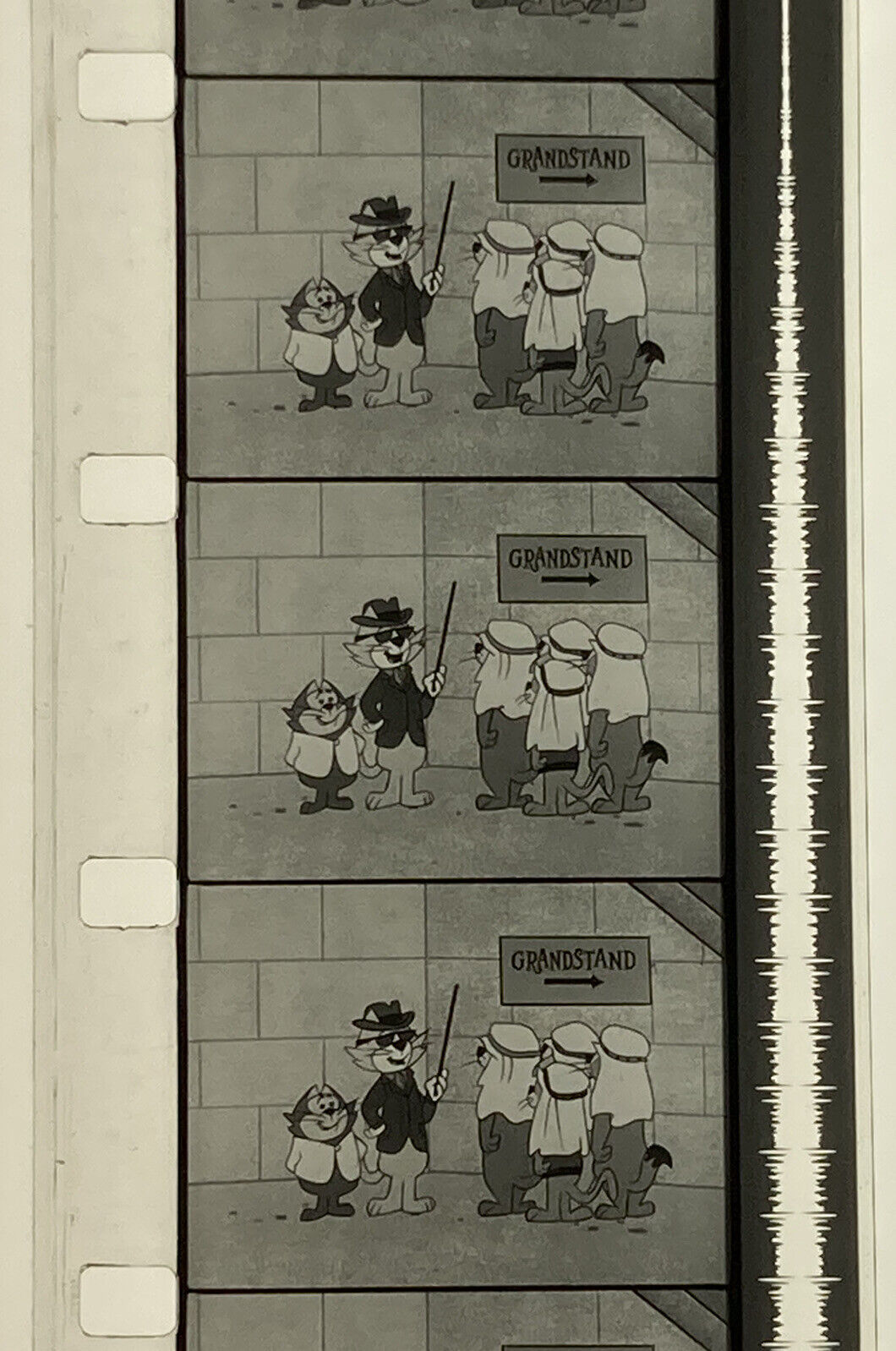
The seller has these neat shots of the actual film. The first film strip below has the unmistakeable earmarks of being animated by Carlo Vinci. The mouth on Top Cat gives it away. He gave Fred Flintstone the same kind of angular expression. Variety’s review at the time claimed Ken Muse animated the episode. I haven’t seen the cartoon in eons, so I don’t know if he worked on it (he animated the series opening), but there is no way Muse did that first scene below.


We mentioned commercials. Here are some frames from a spot for Kellogg’s Special K I’ve never seen before. (Other ads for Bristol-Myers products are live-action). The characters sure don't look like the H-B house style, do they? The teenager looks a bit like Waldo from UPA’s Mr. Magoo shorts.


Below are some frames from the opening and closing. The ABC title card isn’t on the DVD version (the one with the credits all screwed up).


The series leaves me a little cold, despite Top Cat’s cue library by Hoyt Curtin being really enjoyable (especially his mock Gershwin) and a superb voice cast. I love Marvin Kaplan. I love Arnold Stang. What better, then, than to reprint an interview Stang did about the show, and his family. He also makes a startling revelation of one of his best-known on-camera roles up to that time. This appeared in the January 6, 1962 edition of the Charlotte News.


IT’S DISTRESSING
Arnold Stang: Cat's Meow

By VAL CAREW
SPECIAL TO THE NEWS

HOLLYWOOD — Arnold Stang, in his time, has played almost every kind of animal. Currently he is gainfully employed as Top Cat, the title puss on the cartoon show (ABC and WSOC-TV) of the same name.
Playing a cat is, he says, a challenge. Not because of the character's felinity, but because he is just serving as a voice for animation.
"Ordinarily," says Stang, "I act with my body, with my face and with my hands. But here I can only use my voice. It is a great challenge."
WHILE IT IS obvious that Stang likes his job — the hours are good and so is the pay — he is still a bit unhappy that he is not accorded the chances he'd like at heavier parts.
"It is distressing," he admits. "Everybody thinks of me automatically as the character on the Milton Berle show. And I hated that part more than anything I did.
"I quit several times, and the last time I quit I went right into 'The Man With the Golden Arm.' That was a fine picture and I had a fine part.
"I thought that was an important role. And, since then, I have had some other serious things to do on TV, in the movies, on the stage But, despite that, it’s still the Berle thing people remember. And I seldom get thought of in serious terms."
STANG AND HIS family moved to California for the Top Cat assignment. They are all adjusting nicely to the West Coast, although the house they bought burned down in the Bel Air fire.
Happily, they were all away at the time, but they lost everything they owned — including some souvenirs which are irreplaceable, such as a letter from Sir Winston Churchill.
The two Stang children — his 1-year-old son and 1year-old daughter — like the California climate, although they miss their friends back east.
ARNOLD'S SON at the moment wants to be an archaeologist, and "seems to be quite serious about it." The little girl is going through the ballerina stage.
"Up until a year ago," Arnold says, "if you asked her what she wanted to be, she'd say, 'A person.' I always thought that was a very good answer."
Stang has been kept quite busy with things other than Top Cat — he's made three movies and starred in several other TV shows. The Top Cat recording schedule is always arranged to suit him — it can be in the evening or on weekends, if he's otherwise occupied. And he sometimes does three a week, so he can go back to New York for a week or so.
AS FOR STANG'S intimacy with cats — he has none.
"I don't own a cat. I've never owned a cat and I doubt if I ever will own a cat," he says. "We have a dog, you see.
"Actually, I don't think that observing a cat would be of any help to me in this show. The fact that Top Cat is a cat is incidental; he thinks and acts like a human being."


Things looked good for T.C. for a bit. ABC ordered additional episodes but stopped at 30. The ratings weren’t good enough; during one week in San Antonio, the alley cat gang was beaten by a syndicated show. Top Cat was part of an anticipated prime-time animation boom caused by the success of The Flintstones the previous year. Instead, it fizzled and network soured on animation. T.C. was moved to Saturday mornings the following year. With no new episodes (and no residuals for actors), the series was now reasonably cheap and therefore attractive to companies that wanted to aim solely at kids (in other words, no more ads for Alberto VO-5 like in prime time).

The characters have popped up on occasion since the original series 60 years ago but it’s somehow not the same without Arnold Stang and Curtin’s Rhapsody in Blue-ish clarinet opening an episode.

My thanks to Austin Kelly for his tip that resulted in this post. The blog resumes its retirement.

Monday, 23 May 2022

Is There a Plumber in the House?

Fans of early Hanna-Barbera cartoons are the best.

Each of us has our favourite series and characters. The late cartoon writer Earl Kress and I found an instant kinship when I told him my favourite H-B series is the Quick Draw McGraw show. Earl, as you may know, spent what ended up being fruitless time endeavouring to get the series released on home video by Warners, only to run into several roadblocks.

One of them was the location of bumpers—those little cartoons between the cartoons. Whoever was running things at what was left of the studio had no idea where the masters were, or even if they still existed, to Earl’s dismay. Of course, when the series first aired in 1959, 16-millimetre prints were sent to TV stations in the U.S. and elsewhere around the world. The same thing happened several years later when the half-hours were shorn of references to Kellogg’s and syndicated again (Quick Draw also aired on CBS on Saturday mornings in 1966-67).

An early Hanna-Barbera fan with the handle of Steven Hanson has somehow acquired dubs of some of the 16 mm. prints and is braving take-down notices by posting some of the Quick Draw mini-cartoons in his possession. Some are even in colour.

Here’s a shortie. Quick Draw and Baba Looey are fishing in a rowboat that is taking on water (which we can’t see to save some pencil mileage).


Quick Draw’s keen deduction tells him if he shoots a hole in the bottom, that’ll let the water out.


Not quite.


Never fear! Tex Avery is here! Well, kind of. The writer borrows the water-plugging gag from Avery’s Lucky Ducky (1948). I’m pretty sure it predates that cartoon, but that’s the only one I can think of with it.


The Avery version.


Who is the animator of this cartoon? He worked on Lucky Ducky. These odd mouth shapes should give it away.


Mike Lah.

The frames look they came straight from the storyboard without embellishment, though in the first Huckleberry Hound show cartoons (1958), Lah would change mouth shapes on a face with the rest of the body being held on a cel. In this little cartoon, the pinkish snout moves slightly as well (and the water spurt is on a cycle). It’s a shame he decided not to go for funny takes like he did with Mr. Jinks, but gave us Jack Benny-style stares instead. Lah worked freelance the whole time he was at Hanna-Barbera; an offer to be a partner in 1957 fell through.

Oh, the title of this post is Quick Draw’s last line before the fade-out.

If you like Quick Draw, you should be delighted Mr. Hanson has posted these. He also has put up a few Ruff and Reddy half-hours. I find the show a little childish and dull, but it has fans who will be happy to see it. Like the Quick Draw McGraw show, I really, really doubt we will ever see it on home video due to music rights issues, so this will have to do for now.