“MeTV is running old Hanna-Barbera cartoons. What do you think, Yowp?” I have been asked by blog readers. I’m not really sure why anyone is all that interested; like anything else I’ve written about cartoons, you can take my opinion or it leave it.
I’m happy the old cartoons are getting some exposure, and may attract new viewers. It’s no secret there are some series that leave me cold (sorry, Magilla) but there’s nothing wrong with watching the original Huck Hound and Yogi Bear shows, especially in higher definition versions than anyone has seen before. To think that 60-plus years ago, our antenna was pulling in these same cartoons on a black-and-white Philco on channels that were, in some cases, about 120 miles away. (I confess I have not owned a set in almost 30 years so I am not watching MeTV or any TV. Sorry, Philco).
Long-time readers here know my favourite of all the H-B series is Quick Draw McGraw, which MeTV Toons is not airing. I have no inside knowledge about the situation. Perhaps Jerry Beck has some insight. To speculate, it could be a case, like the late Earl Kress told me when he tried to assemble a DVD set of the show years ago, some elements are missing or are in poor shape. And the first two seasons use the Langlois Filmusic library, which could not be cleared for home video use. I suspect Warners would like to recoup some restoration costs through BluRay sales. (The cartoons also feature the Capitol Hi-Q library, but most of the cues are by Phil Green which, the way Earl put it, could be cleared through EMI. Other ones by Bill Loose were a problem).
Like Yogi in hibernation, this poor old blog is supposed to be slumbering peacefully, but Strummer Petersen sent me some of the in-between cartoons that are airing on the Yogi show on MeTV Toons and I felt obliged to post some frames from one of them.
Long before “universes” based on who owns a cartoon, Quick Draw, Yogi and Huck interacted with other characters who appeared on their programme in little vignettes between the cartoons. This makes perfect sense, unlike mushing Jonny Quest and the Snorks in some kind of warped cross-breeding that you’d find in Tex Avery’s Farm of Tomorrow.
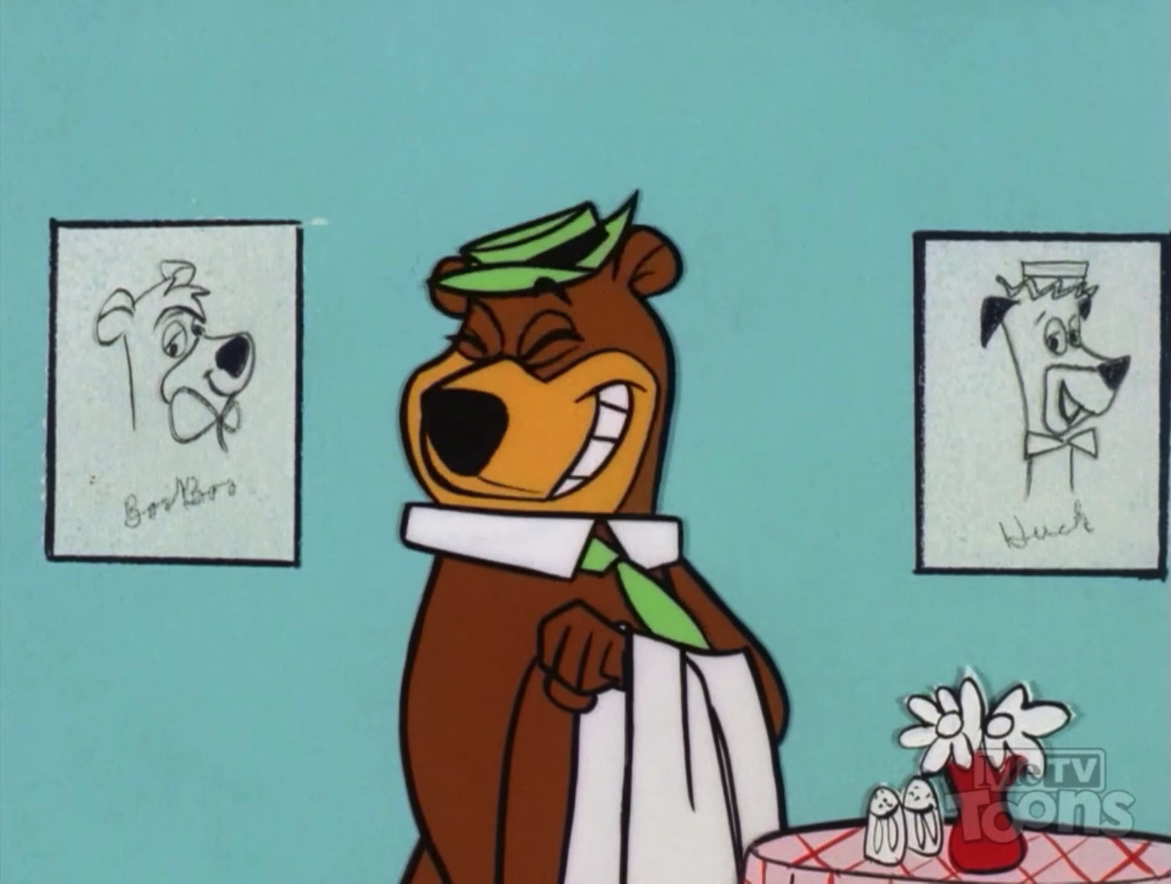
In one of the in-between shorts, Yogi is a waiter in a Brown Derby-like restaurant (at least, judging by the Hanna-Barbera star pictures on the wall). His customer is Yakky Doodle (played by Jimmy Weldon).


“What is the speciality of the house?” enquires the duck.

“Roast duck. What else?” replies Yogi. We get a stretch take out of Yakky, who flies away in horror.


I love Yogi’s quick expression as he realises punking Yakky has been a success. Take that, you annoying duck!

“I can understand his sensitivity,” Yogi confides in us. I feel the same way about bear claws.” He does his Yogi laugh as he swings his head from side to side.


But Yogi, ducks can be eaten. No one eats bear claws. Oh, well.
Ed Love is the animator of this little piece.
MeTV viewers, I hope you enjoy the old cartoons on television once again. Maybe El Kabong will swing onto the small screen in high-def some day.
Update: Reader Matt Hunter tells me a bear claw is like a Danish pastry. I've never heard of it. But now the gag makes sense.
 The Yogi Bear Show wasn’t ready when it went on the air for the first time on this date in 1961.
The problem was simple. Hanna-Barbera didn’t have enough lead time to get the series together.
Kellogg’s and its ad agency, Leo Burnett, had worked out a deal with Hank Saperstein to have a half-hour syndicated slot filled with a new series starring Mr. Magoo, who had been appearing in short cartoons that UPA had been selling to individual stations. But then Saperstein called it off, not liking all the terms of the deal.
Bill Hanna and Joe Barbera quickly filled the breach, announcing on October 12, 1960 that Yogi Bear would be getting his own show. It seems that 3 ½ months wasn’t enough time to get the cartoons together; the company was extremely stretched, with The Flintstones, Huckleberry Hound, Quick Draw McGraw and Loopy de Loop in production. So Yakky Doodle did not appear on the first show (at least in some cities). Fans were treated to an Augie Doggie re-run instead.

Among the stations that aired Yogi on January 30, 1961 were KING-TV, Seattle; KMTV, Omaha; KTVU, Oakland; WBTV, Charlotte; WMCT-TV, Memphis; WDSU-TV, New Orleans; WGR-TV, Buffalo; WSB-TV, Atlanta; WNCT, Greenville, N.C.; WCPO-TV, Cincinnati; KTUL-TV, Tulsa; KRON-TV, San Francisco; WPIX, New York; WPRO-TV, Providence; KELO, Sioux Falls; KOCO-TV, Oklahoma City; KTVT, Fort Worth; KMBC-TV, Kansas City and KFSD, San Diego.
Yogi first appeared on The Huckleberry Hound Show in 1958, but surpassed the blue dog in the Hanna-Barbera star system. The same week his show debuted, he appeared in the Sunday comic section of newspapers across the U.S. And the company’s first feature film, eventually named “Hey There, It’s Yogi Bear” for the star, made it to theatre screens in 1964. Huck was nowhere to be seen (the feature did include a snickering dog which I maintain was inspired by the bulldog in Tex Avery’s Bad Luck Blackie at MGM and later was turned into Muttley).
By 1961, Yogi was firmly entrenched as a denizen of Jellystone Park, with a permanent sidekick and an adversary. When he began in 1958, that wasn’t altogether the case; in fact, Ranger Smith was did not appear in the first season of the Huck show. Yogi was put into various plots, including spot gags as he tried to catch a trout (and failed), attempted to get across a freeway, dealt with an annoying duckling that later evolved into Yakky Doodle and matched wits with that fine dog that deserved stardom, Yowp.
Younger cartoon fans who have been raised on lord-knows-what are still exposed to the rhyming bear. Here is an article about the world’s largest Yogi. I take issue with one of the bullet points. I have never heard Yogi was “inspired by Smokey Bear.” His vocal qualities and costume bear (yuck, yuck, yuck) some similarities to Art Carney’s Ed Norton on The Honeymooners, but a similarly dressed character (silent) appears in Hanna and Barbera’s MGM short Down Beat Bear (1956).
And because someone will mention this if I don’t, the characters were re-worked several years ago in a streaming series.
You can read reviews of all the Yogi cartoons made between 1958 and 1962 on the blog, and more about his show in this post and this post.


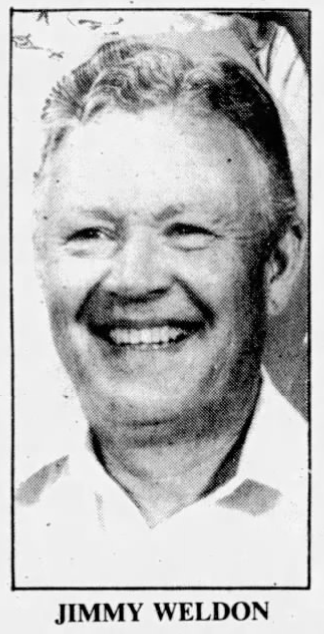
 Time continues to take its inevitable toll on the remaining star voices of the early Hanna-Barbera cartoons. The voice of Yakky Doodle, Jimmy Weldon, has died at the age of 99.
I never had the chance to speak with Mr. Weldon, but all accounts leave the impression he was a kind man who enjoyed entertaining and enjoyed life.
Yakky began life at MGM, when Bill Hanna and Joe Barbera were looking for third characters to play off Tom and Jerry. They came up an orphan duck and cast him in Little Quacker (released in early 1950).  Despite his annoying self-pity, Bill and Joe liked him and put him in eight cartoons. When the MGM studio closed in 1957, the two created H-B Enterprises with director George Sidney. The Huckleberry Hound Show was being developed in 1958, and secondary characters (capable of being marketed) were in need. Barbera came up with a similar duck and put him in two Yogi Bear cartoons (one where he foiled that noble, intelligent hunting dog, Yowp). The following year, he appeared opposite Pixie & Dixie/Mr. Jinks, Snooper & Blabber and Augie Doggie (in three cartoons).
Hanna-Barbera signed a deal in fall 1960 to develop a show around Yogi Bear, and one segment was handed over to the duck, who was re-designed and given a new name (H-B marketing had been calling him “Biddy Buddy”).
Starting at MGM, the duck was voiced by nightclub comedian Red Coffey, and there is at least one between-the-cartoons short where Coffey voices Yakky. But Coffey didn’t take on the role permanently, likely because he was touring the U.S. in "Hellzapoppin'," so Weldon was hired by Barbera in what Weldon called “the most important thing that ever happened to my career.” He was working on television in Fresno and used to fly to Hanna-Barbera for voice sessions. In his own plane!
Yakky benefited from several things, not the least of which was Weldon’s performances coupled with writer Mike Maltese’s downplaying of the “poor, poor me” aspect of the character. Weldon’s Yakky was generally cheerful, sincere and a dedicated friend. These characteristics seem to describe Weldon himself. He made a career later in life as a motivational speaker. This story from the Newhall Signal of Feb. 3, 1992 gives you a bit of insight into Jimmy Weldon.
Weldon energizes seniors’ motivation
By ANDREA MORET
Signal staff writer
NEWHALL — With a flashy smile and a high-energy presentation style, Jimmy Weldon appeared before a group of about 50 seniors last Tuesday like a colorized version of an old black-and-white television favorite.
A motivator, speaker, comedian and actor, Weldon, 68, is perhaps best known for the numerous children's shows of the 1950s he starred in with his duck mascot, Webster Webfoot. But Tuesday, he brought a message of motivation to the audience assembled in the multipurpose room of the Santa Clarita Valley Senior Center.
Frequently addressing the crowd by name and gesticulating his every word, the speaker imbued the 55-plus set with confidence and encouragement in a stirring, often funny, presentation.
"You are the most important person on this earth," he told the seniors. "It's up to us to give the young people today something to live for."
 To Weldon, there is no such thing as retirement. Only what "I used to do and this is what I do now." There is also no such thing as time, only spending time and spending it wisely.
Experience is "just what a guy gets when he no longer needs it"—a lesson well-learned after a youth accident with a lawn mower severed part of his finger.
Weldon spoke of his life experiences from Oklahoma radio show personality to television sitcom star, frequently interjecting adages of heartfelt advice.
"This computer," he said, pointing to his head, "works like the land. I tell young people be careful what you plant up here because it's going to come back to you."
Weldon knew at the age of 7 he would end up in Hollywood one day. It was the day he saw his first motion picture, "Ten Nights in a Bar Room."
A scruffy youth from Chickasha, Okla., he didn't have any special talent other than a voice that he practiced and practiced until he sounded like Donald Duck. Nevertheless, he was determined that voice would buy his ticket to movies.
His brothers laughed at him and his seventh-grade teacher even sent him to the corner when he answered her in "duck voice."
But he persisted, and his efforts paid off when Hollywood started buying into his talent. Eventually, the voice incarnated into Webster Webfoot, a blue-capped, enormous-eyed, yellow-billed duck.
He said he was once asked to speak before a crowd of doctors by a physician intrigued by the idea of a man making a living as a "duck."
Weldon explains in his memoirs, "Go Get 'Em Tiger," how he pulled Webster out of his suitcase and told the 150 doctors and their wives, "this is the little guy I hope will take me to Hollywood one day."
Indeed it did. Fifty years later, Weldon once again pulled his mascot out of that suitcase before the Santa Clarita seniors, but this time with a few memories to share of his experiences in radio, television and movies.
The Webster Webfoot Show, the longest running television show in the Dallas/Fort Worth area, launched a career that would send him to Los Angeles, New York, Fresno and back to Los Angeles.
His career spanned 41 years, taking him to the British Broadcasting Corp., the Royal Academy of Dramatic Arts and the NBC network show, "Funny Boners."
The producers of the hit television show, "Yogi Bear," fashioned Yogi's sidekick, "Yakky Doodle," after Webster Webfoot.
As a youth, his small part in one of the "Our Gang" movies cowered in the shadows of a movie role he later co-starred in with Ronald Coleman [sic] of the hit TV show, "Halls of Ivy."
But it wasn't the movie and television show credits, the introductions to famous people nor the rounds of golf with celebrities that formed the message he has since taken on the road. It was the lessons learned from the underlying factors that helped motivate him along his career journey, he said.
In large letters, Weldon scrawled the word "motivation" on a blackboard, inserting a slash between the “v” and “a” and adding a “c” to the latter part of the word to form "action."
Goals are not enough to realize your dreams, Weldon said. A goal must be followed by a plan, a desire, confidence, determination and a positive attitude.
As parents and grandparents, he told the seniors, "you can plant the seed with young people" and find new purpose in your own lives.
"Don't lose the enthusiasm," he implored. "We're the same ones we were when we were little. We're just a little older."
As for the “Donald Duck” aspect of his voice, Weldon amusingly recounted to interviewer Stu Shostak that Clarence Nash, the voice of Donald, wasn’t happy about it. (Nash never worked for Hanna-Barbera, no matter what the internet may say). He said he and the other actors in each Yakky cartoon worked together in a studio with Barbera directing on the other side of the glass in the control room, gesturing how he wanted the lines read, and reacting whether they were voiced the way he wanted.
 Weldon would have turned 100 on September 23rd. His words about living, live on. And, here and there, so do Yakky’s cartoons where he gets the better of Alfie Gator and Fibber Fox, yells for Chopper, and screeches an off-key version of "Ta-ra-ra Boom-de-ay."
Note: As someone has asked me this, the last pre-1961 Hanna-Barbera actor who is still alive is Elliot Field, who was Blabber Mouse and some incidental characters in the first few episodes of the Quick Draw McGraw show.
 Voices! We need voices!
That was the cry at the newly-founded H-B Enterprises in 1957. Bill Hanna and Joe Barbera went out and found two men who could create just about any voice that was needed in their cartoons—Daws Butler and Don Messick. Eventually, the studio had a number of actors who could fill all kinds of roles; Hal Smith, Mel Blanc, Paul Frees and John Stephenson come to mind.
It’s odd, then, that the studio would hire a man who really only did one voice. We don’t mean Jimmy Weldon, as his Yakky Doodle was a specialty voice. We mean the man who played Yakky’s cohort, Vance Colvig, Jr.
With rare exception, the son of Pinto Colvig voiced the growly Chopper. Odder still was that Vance Colvig was capable of doing all kinds of voices. I don’t know why Joe Barbera didn’t bring him in more often. Perhaps he was just too busy. By 1961, when Yakky first appeared on TV, Vance was on KTLA daily as Bozo the Clown.
He worked on one cartoon at Hanna-Barbera before the Yakky series got underway. The Quick Draw McGraw show was coming on the air in 1959 and Barbera was on the hunt for new voices. Colvig played Tombstone Jones and narrated “Bad Guys Disguise,” the second Quick Draw cartoon that aired.
Here’s a profile (and photo via ABC) of him from the May 18, 1947 issue of Radio Life, a truly wonderful publication which published feature stories on all kinds of people working in radio in Los Angeles. It gives you an idea of the talent he had, and Hanna-Barbera could have used.
What Makes a Gag Man
By Betty Hammer
THE first time we met Vance Colvig, he blew into a restaurant where we were lunching, grabbed a waitress, waltzed the her down narrow aisle between the tables, barked like a dog, told her he was burning with mad desire for her, sat down and ordered a cup of coffee. A friend introduced us. Vance leered like Dracula, grabbed our arm, twisted it around his neck and shouted, "Leave me alone, I tell you," and, turning to the other diners, "She's crazy about me—won't leave me alone!"
By the time his coffee arrived and the waitress had nimbly eluded his clutches, we learned that, naturally, Vance was a gag man and radio actor, that his father was Pinto Colvig, gag man and radio actor; and that he always entered restaurants that way. Then, taking a spoon, he dipped it in and out of his coffee, holding the handle with both hands in the manner of a man rowing a boat and bassoed, "Ai yoock neeyem, Ai yoock neeyem," in a pretty good rendition of the "Volga Boatman." He borrowed a cigarette from us with the words, "No, thank you—never touch 'em," pretended to pound it into his forehead, pulled it out of his ear, stuck it under his lower lip, struck a match and made as if to light his nose. "Been smoking all my life and they never hurt me a bit," he exclaimed as he banged his knee reflex, rose in the air about two feet and emitted a cloud of smoke and a wheeze that sounded like a ship tearing away from its moorings. We learned that he always relaxed with coffee and a cigarette that way.
Calmed Down?
Since that first meeting, we've gotten to know Vance rather well and he no longer goes through quite such an elaborate routine. Now he merely bites us on the neck, tells us we have "dan-n-n-ncing eyes" and begs us to fly with him to San Luis Obispo.
Is Vance Colvig like this because he is a gag writer—or is he a gag writer because he's like this? We're inclined to think the latter. Many a gag man is a pretty Gloomy Gus who saves his humor for a paying job. Vance throws away many a hilarious routine on a group of strangers waiting at a bus stop, merely because he feels like entertaining anyone and everyone—occasionally even when they don't want to be entertained, but that's one of the hazards of the profession.
Or maybe it's inherited. His pop, Pinto, is a well-known cartoonist, gag man and the voice behind many a weird radio and cartoon effect. When producers call Colvig senior for a part he is unable to take because of a previous commitment, he usually refers them to Colvig junior and keeps the work in the family. Recently, the two worked together on the Frank Morgan show as the voice of "Baldy" the sheep dog (Pinto) and 'Filbert" the gopher (Vance)—and in the Capitol record album, "Bozo and His Rocket Ship."
Vance has done the gags for Tom Breneman's "Breakfast in Hollywood" program for the past four years and has contributed laugh lines to the Jack Kirkwood show, Mel Blanc program, Kay Kyser's "College," and "Bride and Groom," in addition to his free-lance work. He has barked for Asta, the dog in the "Thin Man" pictures, done voices for George Pal Puppetoons, played a pig on "Gildersleeve," a dog on the Dinah Shore show, a rooster on the Sinatra show and Japanese villains on "Pacific Story," among many other strange roles.
"I got my first part when I was six months old," he told us when we asked about his career. "It was a movie for Herbert Hoover's relief mission to Belgium during the last war and it showed a poor little starving Belgian baby as contrasted with a laughing, fat, healthy American baby. I was the laughing, fat, healthy American baby." Kid roles in movies followed and Vance supplied juvenile laughs in "Mickey McGuire" and "Buster Brown" comedies.
Can't Tell How Come
How do you get to be a gag man? "I only wish I knew," is Vance's answer. Every time Breneman mentions Vance's name on the air, he receives letters from people who want to become gag men too. It makes him unhappy, because he'd like to be able to say the magic words that lead to radio, but he just doesn't know what they are.
If you who are reading this are incipient gag men, you'll say, "All right then, how did he get started?" And the not-very-glamorous answer is—working in the parking lot at NBC. He started button-holing passing comedians and selling them gags as the poor fellows rushed to rehearsals. It was Kay Kyser who finally decided that the little guy who kept the boys in the parking lot and the big time comedians laughing with his gags and antics might do the same for a nationwide audience. That's how one gag man latched on to radio and that's the only way Vance knows about.
Of course Los Angeles City College helped. Our hero took radio and dramatics courses and graced the casts of "Merry Wives of Windsor," "Romeo and Juliet" and Gilbert and Sullivan's "Gondoliers" ("I played the title role—along with eleven other guys"). He also appeared in a collegiate musical, "Zis Boom Bah!" which was so professional it was booked into the Orpheum Theater and did a bit of touring. Movie star Jeanne Crain was an obscure cast member. Glamorous threesome on the campus in those days was Vance, Donna Reed and Alexis Smith! Vance further informed us that prior to his college days, radio prof Jerry Blunt had turned out such radio talent as writer True Boardman, Elliott Lewis, and Mary Shipp, who is more widely known on the air as "Lady Esther"!
Gives Parties
Vance lives in a fascinating little house perched dangerously high up in the Hollywood hills. His front room contains shelves of books and records and a collection of original ceramics made by a prominent local artist. From the hillside he has gathered bamboo stalks and fashioned them into shades for his windows and porch. He enjoys doing his own cooking and he'll make you a wonderful cup of coffee by grinding the beans in an old- fashioned coffee grinder. He holds an almost permanent open house and is always happy to welcome a friend (or ten) to sit and trade gags for an evening. He has a party almost every Saturday night and the phone rings constantly with calls which usually say, "Vance, I'm coming up tonight but I'm with five other people, and ..." "Swell! Bring 'em up," is the usual answer. Ill-assorted or congenial, he sets them all to playing "Indications," a particularly noisy game with intellectual overtones. Everyone becomes loud and friendly. Once Vance found Fred Beck in one of his Saturday night groups, but can't remember how he got there.
He likes screwball comedy the best and particularly enjoys writing for comedians of that type. His love of music and literature encompasses all types of the two expressions. He is a superb pantomimist and enjoys that particular talent in others. He has boundless enthusiasm and is tremendously encouraging to any expression of talent. His constant companion is a slightly insane red cocker spaniel called O'Malley in honor of the fairy godfather in the "Barnaby" comic strip. O'Malley, according to Vance, loves to chase and retrieve sticks, though he plays on a hillside abounding in rabbits. "If I throw a stick into the bush, O'Malley goes after it, out jumps a rabbit, and O'Malley happily reappears with his stick. Should I try throwing rabbits?" queries Colvig.


Originally, it was cut-and-dried. The various shows had certain characters, though it appears The Yogi Bear Show was rushed into production and not all cartoons were ready when it debuted on January 30, 1961 (the same held true for Yogi’s replacement, Hokey Wolf, on The Huckleberry Hound Show; he finally appeared on the week of March 13, 1961, according to TV listings of the day).
Things started changing in the 1966-67 TV season. Mattel purchased licensing rights to the Huck show from Screen Gems and worked out a rather convoluted co-op ad agreement with Kellogg’s that meant Mattel ads on the Kellogg’s-sponsored Yogi Bear and Woody Woodpecker shows. It would appear, based on a story in Television Age of April 24, 1967, the individual cartoons were made available to stations as well.
But the half-hour Huck show carried on in one form or another into the 1970s and ‘80s. Reader Austin Kelly points out a 16mm reel of the show is being sold on eBay. The unusual thing is it does not contain a Huck cartoon. It has reruns of shorts starring Yogi Bear, Hokey Wolf and Yakky Doodle.
This mean the opening/closing animation had to change. The original from 1958 featured an assortment of Kellogg’s cereal mascots, eg. Tony the Tiger. It was reanimated to include Yakky and Hokey. It would appear the lettering card was re-used from the original closing.
Instead of Tony Junior getting his head bashed leaving the circus tent, Yakky gets the honour. Chuckle, chuckle, chuckle.
There’s not a lot I can remember about these re-worked Huck mini-cartoons. The Kellogg’s rooster still appeared, even if Huck’s door is not in a circus tent any more.
Unfortunately, these frame-grabs from the mini-cartoons are a little ho-hum. Hanna-Barbera and/or Screen Gems didn’t seem to care that Pixie and Dixie weren’t in this cartoon; I couldn’t tell you if they were in the re-worked series.
Oh, the character on the Hokey Wolf title card below isn’t Yowp. It’s 1961 and Hanna-Barbera is already borrowing from itself. In the actual cartoon, some of the dog’s poses look like they came from Snuffles. While the hunter is English like Yowp’s owner, Daws Butler gave him a little faster delivery.
How many of these mini-cartoons are in the Hanna-Barbera archives is, I imagine, anyone’s guess. And I still hold out no hope we’ll ever see future volumes of Huckleberry Hound Show DVDs, including the ones featuring Hokey Wolf and the frames you see above.

In June 1960, a deal was being firmed up between Kellogg’s and Saperstein’s UPA. Variety reported on August 10th the two had a seven-year pact that would see $3,000,000 spent in the first year to put a half-hour Mr. Magoo show on 150 stations, the same as the cereal maker did with the Huckleberry Hound and Quick Draw McGraw half-hours for Hanna-Barbera.
But then Saperstein pulled out. He thought he could get a better financial deal going it alone. And Hanna-Barbera was ready. Both Variety and The Hollywood Reporter told readers in their October 12th editions that Kellogg’s had agreed to sponsor a half-hour Yogi Bear show on 130 stations starting in January 1961, and Snagglepuss and Yakky Doodle would augment the new series.
Yogi’s jump to stardom should not have been a surprise. Yogi was slowly but surely taking the spotlight away from Huck as H-B’s main starring character in syndication. The studio had already decided to make Yogi, not Huck, the star of its first feature film. Yogi was appearing in person (actually, someone in an outfit) at department stores, fairs, and so on. There was plenty of Yogi merchandise in stores and he was on a cereal box. On top of that, Huck didn’t get a syndicated newspaper strip in 1961; Yogi did. And another indicator—in October, Yogi was named chairman of the 1960-61 fund raising drive of the Radio-Television-Recording and Advertising Charities of Hollywood. (What he actually did, I don’t know).
As for Yakky, Bill Hanna and Joe Barbera had plunked the duck in Tom and Jerry cartoons at MGM, then brought him over to their own studio as an occasional character in more than a half dozen cartoons. He was ready for his own series (the only problem was his voice actor, Red Coffey, was on tour, so Barbera hired Los Angeles kids host Jimmy Weldon). And Snagglepuss had appeared on the Quick Draw McGraw show a number of times as an orange antagonist. He was clever with funny dialogue (George Nicholas did a fine job animating him) so he had real possibilities for his own segment.
The Yogi Bear show began appearing in syndication on the week of January 30, 1961. Not all the cartoons were ready, so some were borrowed from the Quick Draw series for several weeks. Yogi continued to appear on the Huck show until the replacement Hokey Wolf cartoons were set to air.
Hanna-Barbera’s PR guru Arnie Carr started plugging away, working the media to get some ink. Hal Humphrey wrote a pre-debut column, while UPI’s Fred Danzig and Jack Gaver both banged out reviews. I’ve found another story from the Copley News Service, published January 28, 1961.
Smarter Than Average
Extrovert Yogi Bear Syndicated Across US
BY DONALD FREEMAN
Copley News Service
HOLLYWOOD, Jan. 27— As his loyal followers always knew it would, being smarter than the average bear has at last paid off in tangible rewards for that blustering furry extrovert known to television as Yogi Bear. Forthwith, amid a fanfare from the trumpets, The Yogi Bear show is syndicated across the land.
This freshly spawned cartoon series evolved logically and inevitably out of Huckleberry Hound the show in which Yogi Bear has played second fiddle for the last 2½ years. Now he has emerged from the wings, a full-fledged bear-type star.
At Hanna-Barbera Productions— headed by Bill Hanna and Joe Barbara, two enterprisingly creative talents responsible not only for Yogi Bear and Hucklebery Hound, but Ruff n’ Reddy, Quick Draw McGraw and the Flintstones as well— the feeling had persisted for some time that Yogi Rear was ripe for bigger things.
"Consider this," said Bill Hanna, a stocky onetime engineer now the partner in a booming $10,000,000 cartoon corporation, "Huckleberry Hound" had an island in the Antarctic named for him and he was tapped as mascot of the Marching and Jazz Society in Hull England.
"BUT BRITAIN’S ENTRY in a recent International model plane race was named Yogi Bear. And a wing of our Strategic Air Command picked Yogi for its mascot.
"Also consider this," put in Joe Barbera, the darkly handsome partner who once worked in a bank and despised every minute of it, "when Huckleberry Hound ran for president last year— he didn't do badly in certain animal precincts, by the way— who was his campaign manager? Yogi Bear."
In common with most creative brains in the animated cartoon dodge, Hanna and Barbera are— well, free souls, blithe nose-thumbers at conventional procedure. For example, interoffice memos are expressly forbidden in their studios.
"If a man dreams up an idea he can barge right into our office," explained Barbera, adding pointedly that no such easygoing policy prevailed in their days at M-G-M. "By the time a producer there had got your memo and sent back his memo and you finally were permitted into the hallowed sanctum of his office, you'd forgotten what you wanted to say in the first place. So, no memos."
FOR SOME 20 YEARS, Hanna and Barbera were teamed at M-G M where their fertile imaginations gave birth to the cat and mouse cartoon series, Tom and Jerry, which brought the studio seven Academy Awards. In 1957 they turned to television writing continually expanding success story, with the new Yogi Bear show being the latest chapter.
There are times when Yogi's fans imperturbably criss-cross the thin stand dividing fancy and reality. Not long ago in a gesture of appreciation, Yogi Bear was awarded a certificate by the superintendent of Yellowstone Park— not Ranger Smith, but the actual superintendent in the real Yellowstone Park— for being “an upstanding example for bears all over the world.”
However, in his notation, the superintendent saw fit to add slyly: "But I'm sure glad that Yogi Bear doesn't live fulltime in my park."

Still, the starring Yogi jettisoned the spot gags and sight gags of the earlier Huck show Yogi. Hanna-Barbera’s cartoons were starting to become dialogue heavy, with characters standing around, with mouths moving on rigid bodies while a character being spoken to blinked his/her eyes to break the monotony. How much more interesting visually they would have been if Mike Lah (concentrating on commercials at Quartet) and Carlo Vinci (moved over to The Flintstones) were still animating the cartoons like they did when Yogi was still with Huck.
We all know that H-B characters ran past the same tree or lamp over and over and over again. Here’s an endless loop from the Yogi show. It’s from Whistle-Stop and Go, a Yakky cartoon animated by Columbia and Warner Bros. veteran Art Davis. It takes 16 frames for Dick Thomas’s background to repeat, with Fibber on an eight-frame run cycle. What I didn’t notice until I put this together is Davis slightly animates Fibber’s whiskers and top hair strands. That kind of thing would have been skipped in the later “faster, cheaper” years.

Want to make money from cartoon characters? You don’t do it with cartoons. You do it with merchandising. Walt Disney knew it. Walter Lantz knew it. Even Charlie Mintz knew it. And so did Bill Hanna and Joe Barbera.
In 1958, the Huckleberry Hound Show became a TV fad. Huck, Yogi Bear, even Pixie, Dixie and Mr. Jinks were bankable characters with loads of licensing potential. But after that? Well....
The marketing people at H-B Enterprises and Screen Gems (and maybe Leo Burnett, the sponsor’s agency) needed more. About all they could was pick out secondary characters that may have had enough popularity (and screen time) to be marketable. Boo Boo was an obvious choice as he appeared in some, but not all, Yogi Bear cartoons that season. After that, it was down to wishes and hopes. Iggy and Ziggy, the crows that harassed Huck, were in two cartoons so they got a push. So was Li’l Tom Tom, the Indian boy; girls love child dolls. And then there was that little duck that came over from MGM and showed up in a pair of Yogi Bear cartoons. If Bill Hanna loved him, the rest of the world could, too. Even Cousin Tex appeared on merchandise, though his time on the screen was limited to one cartoon.
Naturally, I’m saving the best to last.
There were two cartoons in the 1958-59 season (and one in 1959-60) featuring a dog that went “yowp.” That was good enough for appearances in bits of merchandise—a gin rummy game, birthday table cloths and napkins, a Huckleberry Hound/Quick Draw McGraw lampshade, a Huck giant playbook by Whitman, a rubber stamp set, even wash-off tattoos. Not bad for a dog that can only say one word, eh?
Whether Keith Semmel reads this blog, I don’t know, but he found another way kids can play with Yowp at home. A company called Tower Press in Britain came out with a card set to play a variation of Old Maid. Huckleberry Hound “Booby” featured 18 pairs of cards plus two Booby cards (only one was used in the game so it wouldn’t match). Keith points out a fine individual has posted scans of the cards on line. The game was created in 1962 but it still has some minor characters that faded away (except for the annoying duck) as the studio created more and more stars.

Here’s Yogi ironing a shirt he doesn’t wear. There’s also one of the Booby cards.

Pixie and Dixie are playing cricket; ask your English friends what an over is. Huck is a London bobby (not booby) as he was in Piccadilly Dilly. Yakky Doodle was named Iddy Biddy Buddy in the first season of the Huck show before getting his own cartoons in 1961.

Some nice personas for Huck in this set. Wasn’t he a magician in one of those little cartoons between the cartoons?

The kangaroo is Kapow, who bested Jinksie in one solitary cartoon. Iggy is the crow with the straw hat, Ziggy is the other.

Cousin Tex, Li’l Tom-Tom, Jinks in formal wear and a red-eyed Yowp.
Times have changed. I’m not really certain what kids play today. I doubt it’s a two-or-more-person card game. For one thing, young people seem to spend a lot of time alone punching letters on a handheld. And cards are low-tech and, in an era where Donkey Kong is quaint and nostalgic, really old fashioned. But I’d like to think those of us approaching senior citizenship had good times with simple board games and cards, and that’s the main thing. I suspect Hanna, Barbera and Screen Gems were happy about it, too.

 “MeTV is running old Hanna-Barbera cartoons. What do you think, Yowp?” I have been asked by blog readers. I’m not really sure why anyone is all that interested; like anything else I’ve written about cartoons, you can take my opinion or it leave it.