Showing posts with label Ken Muse. Show all posts

Saturday, 13 February 2021

He's Still a Top Cat

It’s tough to say how much the older Hanna-Barbera cartoons are in the public consciousness these days. I don’t watch TV so I couldn’t tell you if any channel is airing them. The Flintstones got a Blu-ray release last year and The Jetsons came out in the same format a year earlier, so the people at Warners still thinks there’s a market for some of the cartoons.

This is a roundabout way of saying I was surprised to see a story the other about some of Hanna-Barbera’s output, including Top Cat. It was in, of all places, The Press and Journal of Aberdeen, Scotland. Granted, it appears to be a column designed to bring about nostalgia in older readers, but it’s better than nothing. You can read it here.

You’ll have a good laugh at how the writer praises Bill and Joe’s Tom and Jerry cartoons at MGM—with a frame from a Chuck Jones Tom and Jerry! And you’d think he’d mention that Ken Muse animated both the MGM Tom and Jerry cartoons and Top Cat (in the frame above, you can see the same expression he gave Tom in a number of theatrical shorts).

Meanwhile, the Gwinnett Daily Post this week had a trivia question about the series.

And over at the
NBC Right Now site, a lifestyles writer has named Top Cat number 86 in its list of the Top 100 TV shows of the ‘60s (people love lists).

Incidentally, The Hollywood Reporter blurbed on July 16, 1961:


Writer-cartoonist Tony Benedict has been signed to a three-year exclusive pact by Bill Hanna and Joe Barbera. As his first assignment, Benedict will tele-script two “Top Cat” shows.

Tony has mentioned to me did work on Top Cat but he wants to make it clear that he started at Hanna-Barbera in 1960 without a contract, first writing and storyboarding the Huckleberry Hound and Yogi Bear shows (he invented Alfie Gator on the Yakky cartoons) and moved on to the half-hour comedy prime-time shows, and others “too humorous to mention,” he tells me. I was hoping he could tell me which T.C. episodes he wrote, as the credits were snipped from the shows some time ago (before the DVD release), but I am awaiting a response.

Thursday, 30 April 2020

Musings About Muse

The cartoons on the Huckleberry Hound, Quick Draw McGraw and Yogi Bear shows were, as layout artist Bob Givens recalled, 500 feet (without titles, I presume). He also recalled Ken Muse was the footage king. Muse would animate a whole cartoon in one week, 100 feet a day. Compare that to 35 feet a week at Fleischers, and that was considered a high figure.

Muse had been animating Mickey Mouse at Disney before he went over to MGM. He did some terrific work there; his animation of the hoity-toity Tom approaching and sitting down at the piano in Cat Concerto and the bee attack reaction on Tom in Tee for Two are excellent. Certainly he didn’t dash out that footage. But at Hanna-Barbera, rarely was his posing or animation expressive. For television, he relied on short cuts which began to epitomise the studio.

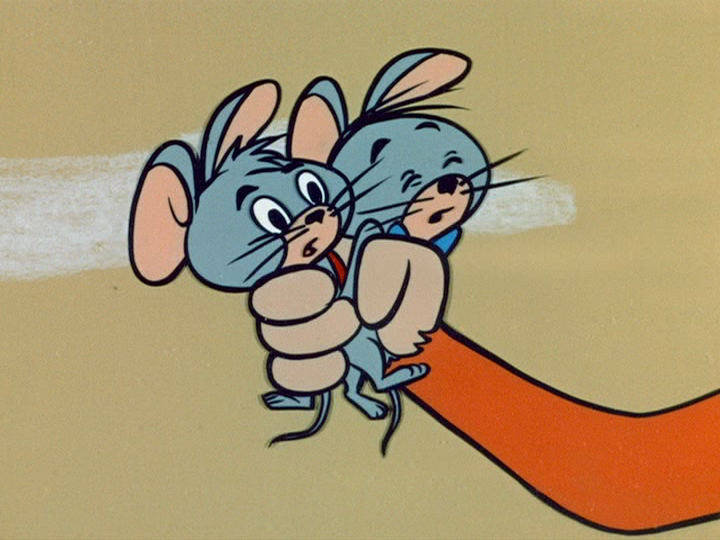
Here are some examples from the Pixie and Dixie cartoon Mouse Nappers (1959). First, we have a walk cycle animated on twos (each drawing is shot twice). Neither cycles nor animating on twos were unusual in the theatrical days. But in this case, director Bill Hanna has the background move very slightly behind each camera shot, enhancing the feeling of movement when the drawing is actually static. The arm, head and mice are rigid, only the body moves.


There are whole scenes at Hanna-Barbera consisting of several dozen frames where characters that are immobile except for eye blinks and very slight mouth movements. All dialogue is done off camera. This is a good footage eater because nothing is really happening. It’s also why Daws Butler and Don Messick were so important to the early cartoons. Their voices had to carry these scenes.


Here’s a dialogue example. Jinks doesn’t move. The only thing that changes are a few mouth positions that Muse uses over again for various vowels and consonants. You’ll notice the two-part upper lip. Muse drew his characters like that at MGM, too.


To make Jink look less static, our old friend the eye blink returns. Muse has open, half-open and closed positions only. The half-open is shot on twos.


As a side note, animator Mike Lah slid the mouth around a character’s face in odd geometrical shapes. His characters didn’t look as sophisticated as Muse’s but he animated extreme drawings which are far more funny to look at than these.

Here’s a six-drawing run cycle. See the curved greyish lines above the legs? Muse does this because the body shapes are on separate cels from the legs. The three body cels are reused to match how the legs are lifted on the left and right side of the meece bodies. Body position 1 is used in drawings 1 and 4, body position 2 in drawings 2 and 5, and body position 3 in drawings 3 and 6. Something difficult to tell below is the meeces are higher in the frame in some shots than others, enhancing the movement.

It’s an awkward description but I hope you get my point.


When you’re churning out footage, niceties such as having the characters in the same position when a shot changes from close to medium are tossed out. That takes planning. Planning takes time. Time slows down the footage count. Here are two examples. These are consecutive frames. The backgrounds don’t even match.


This is one of 66 cartoons made in the first season of the Huck show. Muse animated 29 of them (with assistance by Lah on some). I understand he was paid by the foot, so you can’t blame him for trying to maximise his footage. But, and it’s an age-old lament, you can’t help but wonder how much better the cartoons might have looked if there had been more time to work on them. On the other hand, kids, teenagers and adults laughed at them anyway and made the Huck show a brief, Emmy-winning, cult favourite through the late ‘50s.

Saturday, 30 March 2019

Bear Knuckles Fight

Back in the 1960s, there was one toy that, for me, was a little uncomfortable. Parents bought their kids inflatable punching bags with whatever character the manufacturer was able to license. To the right, you see a newspaper clipping from 1989 with a later version of a Yogi Bear punching bag.

My question is—who would punch Yogi Bear?

Yogi was nice. He was a funny character. He was essentially good. He wasn’t violent or anti-social. Why would anyone want to punch him? Even Ranger Smith never did.

(As an aside, my brother had a Popeye punching bag. Popeye, at least, engaged in fisticuffs. But he was a good guy, too, and liable to whop the crap out of you like he did to Bluto. Who’d want to get into a fight with him?)

There was one Yogi Bear cartoon in the early years that involved punching. Prize Fight Fright wasn’t motivated by violence or revenge. The world’s boxing champ was, for unknown reasons, training in Jellystone Park and piqued Yogi’s interest with a sign offering free meals for sparring partners.

The cartoon was animated by Ken Muse, a real workhorse for Bill Hanna and Joe Barbera starting when he arrived at MGM following the strike at the Walt Disney studio. He did some beautiful work on Tom in some of Hanna and Barbera’s musical cartoons (The Cat Concerto, Texas Tom, Solid Serenade) but, to be honest, when it comes to the Hanna-Barbera studio, I like the animation by Carlo Vinci and Mike Lah (and, later, George Nicholas) a lot more.

As far as I know, the animators at Hanna-Barbera in the 1950s did their own effects animation. Muse had a particular way of drawing impacts. He started with kind of a jagged halo, sometimes solid, which developed a hole in the centre in the next drawing and became a lumpy line in the third.


Here’s another example, with a Yogi head-jerk drawing added.


And another.


Yogi’s an eater, not a fighter, in this cartoon. He doesn’t throw a single punch. However, the plot turns and Yogi is named champion (from a media-staged sparring demonstration?) because the champ bops Yogi’s right glove and centrifugal force does its work.

Here is why Muse was the footage king at Hanna-Barbera. In this part of the scene, there is one drawing of Yogi and two of the champ. The only thing on separate cels are a couple of arms and some effects animation, includings some dry brush.


Every once in a while, Muse comes up with drawings I really like. One is in this cartoon, where Boo Boo accidentally punches Yogi.


No, when I think of Yogi Bear, I don’t think of a fighter. He’s someone who shows up in Cincinnati to show support for kids who are having to deal with diabetes (see top clipping to the right from 2006). He’s someone who shows up at fairs and other events (including store openings) with his pals to entertain his fans (see bottom clipping from 1961).

He’s someone who was given his own cartoon spinoff series, and continued to star on the small screen in various programmes (the less said about some, the better), the Hanna-Barbera studio’s first feature film and, years after being created, a quasi live-action movie. Okay, maybe the last one was really misguided, but isn’t it the human creators of it to blame?

I say again—who would punch Yogi Bear?