Showing posts with label Jetsons. Show all posts

Thursday, 25 December 2025

Yuletide Yogi, Holly Jolly Jetsons and Twisting Tom Cat

Yogi Bear got into the spirit of Christmas (the secular, not religious version), though not on his TV show. A couple of storybooks with Yuletide Yogi were published in the early ‘60s. One was a Little Golden Book which we reprinted in an old post. The other was “Yogi Bear Helps Santa,” a 1962 publication by Whitman Press. The artist was Lee Branscome, who later animated Jonny Quest. It seems to me he had been an in-betweener at Warners; correct me if that’s wrong.

Instead of posting all the pages here, I shall be as lazy as someone who has just feasted on a Christmas turkey and link to a copy at archive.org.

Christmas is not something I celebrate but in the past I’ve posted music and other things as my gifts to you for coming here and reading what I, rather unacademically, have to say. The blog actually ended regular posts in mid-2019 but, as you can see, I have continued with occasional entries here and there. So it is that you’re getting another music post out of me.

This music is courtesy of the late Earl Kress. He dubbed these (judging by the hiss, onto cassette) when he was working on various Hanna-Barbera music projects. It’s a little tough keeping track of what’s been posted on this blog before, but I don’t believe these have been, or appeared in commercial H-B music releases.

Before we get there, let us ask the musical question: have you bought Greg Ehrbar’s book on Hanna-Barbera’s music? You must read this. It has all kinds of information you didn’t know, starting with Scott Bradley’s scores for Bill and Joe at MGM, to the Capitol and Langlois stock music in the first TV cartoons, to Hoyt Curtin and Ted Nichols, to Colgems/Golden Records, to the studio’s decision to get into the rock music business. You can get it right from the publisher, the University Press of Mississippi. It is worth the money.

I don’t have cue sheets, so I cannot tell you if Curtin gave all these cues names. However, a few of them had names when slated.


J-112


J-128


J-200 BOSS'S THEME


J-202


J-205 ROCK AND ROLL


J-206


J-210 ROSEY THE ROBOT ALTERNATE


J-220 JUDY IS SAD


J-220 GEORGE'S THEME


J-228


J-231


J-257


J-258


J-261


JW-10

Now, here’s a piece of music I’d love to post but I have never seen it. A saxophonist named Dave Ede was inspired by Mr. Jinks and the Twist craze popularized by Chubber Checker to come up with “Twistin’ Those Meeces To Pieces”. Ede was the host of the BBC radio’s Go Man Go show. He got together the Rabin Band and together they played a David Wilkinson-composed twist version of “Three Blind Mice.” It was released in mid-1962. Has anyone heard it?

This has been a mixed year for early Hanna-Barbera fans. We have fortunately seen the Blu-ray release of all cartoons in the Huckleberry Hound Show. Seasons two and three had been partly hung up for years because of clearing music composed by Bill Loose and Jack Shaindlin. Unfortunately, we lost writer Tony Benedict and layout artist Jerry Eisenberg this year to failing health.

This blog is still considered finished, but there will be a few posts into the new year.

Friday, 23 September 2022

What the Jetsons Means Today

The Jetsons turns 60 today, a 20th Century show set in the 21st Century that we now watch in the 21st Century.

In 1962, there was still general optimism for the future, that technology would make life simpler and more docile. Today, does anyone look forward to the future? Isn’t mass media filled with future scenes of dystopia, darkness and hopelessness, a feeling that we’re spiralling out of control because humanity has screwed up everything?

The future, at one time, was a huge sales pitch. Exhibitions and world fairs were full of “tomorrow,” generally consisting of improvements in 1950s gadgets that, naturally, you could buy from big American corporations. When corporate America lost its edge in the world market, there was suddenly a lot less talk about the future.

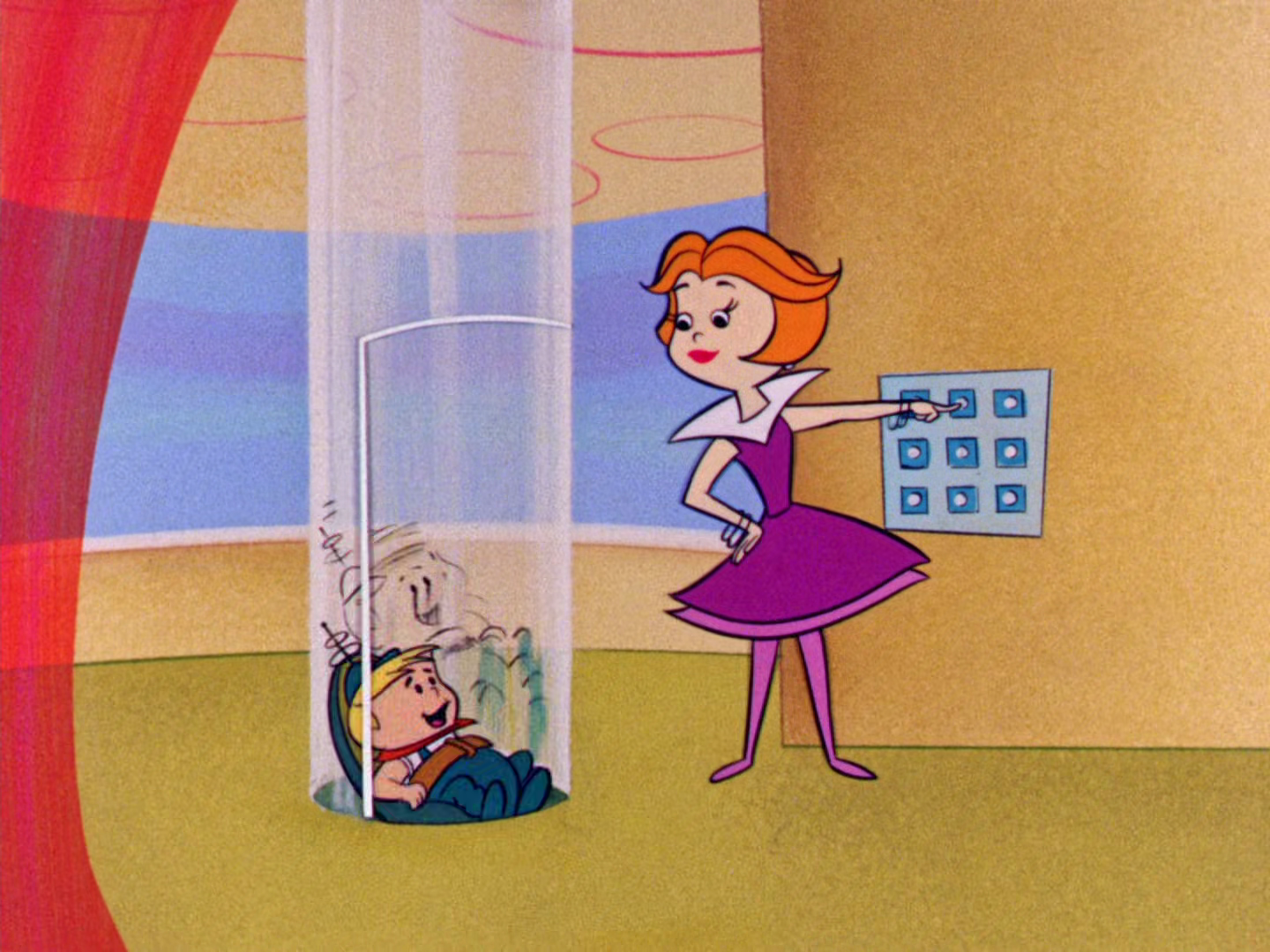
The Jetsons, for viewers today, is a trip back, not a trip forward. A trip to a time of positivity, that our lives would improve. Flying cars to save us time. Food-a-rack-a-cycles to save effort making meals. Three day work-weeks to reduce stress.

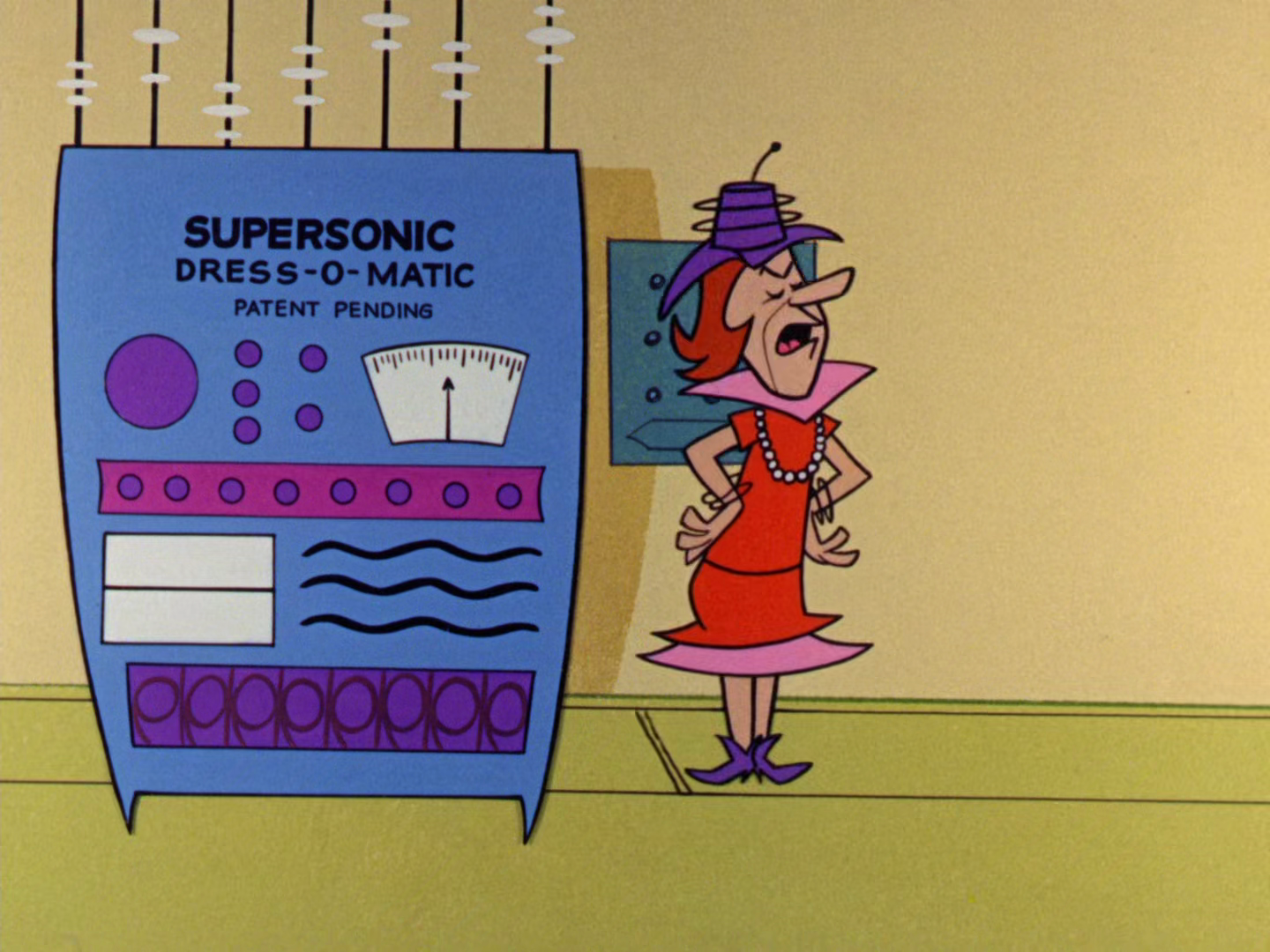
Any disasters on The Jetsons were not a prediction of an inevitably hopeless future ahead for humanity. They were gags. Like the Supersonic Dress-o-matic that takes George Jetson out of his pyjamas and into women’s clothes.

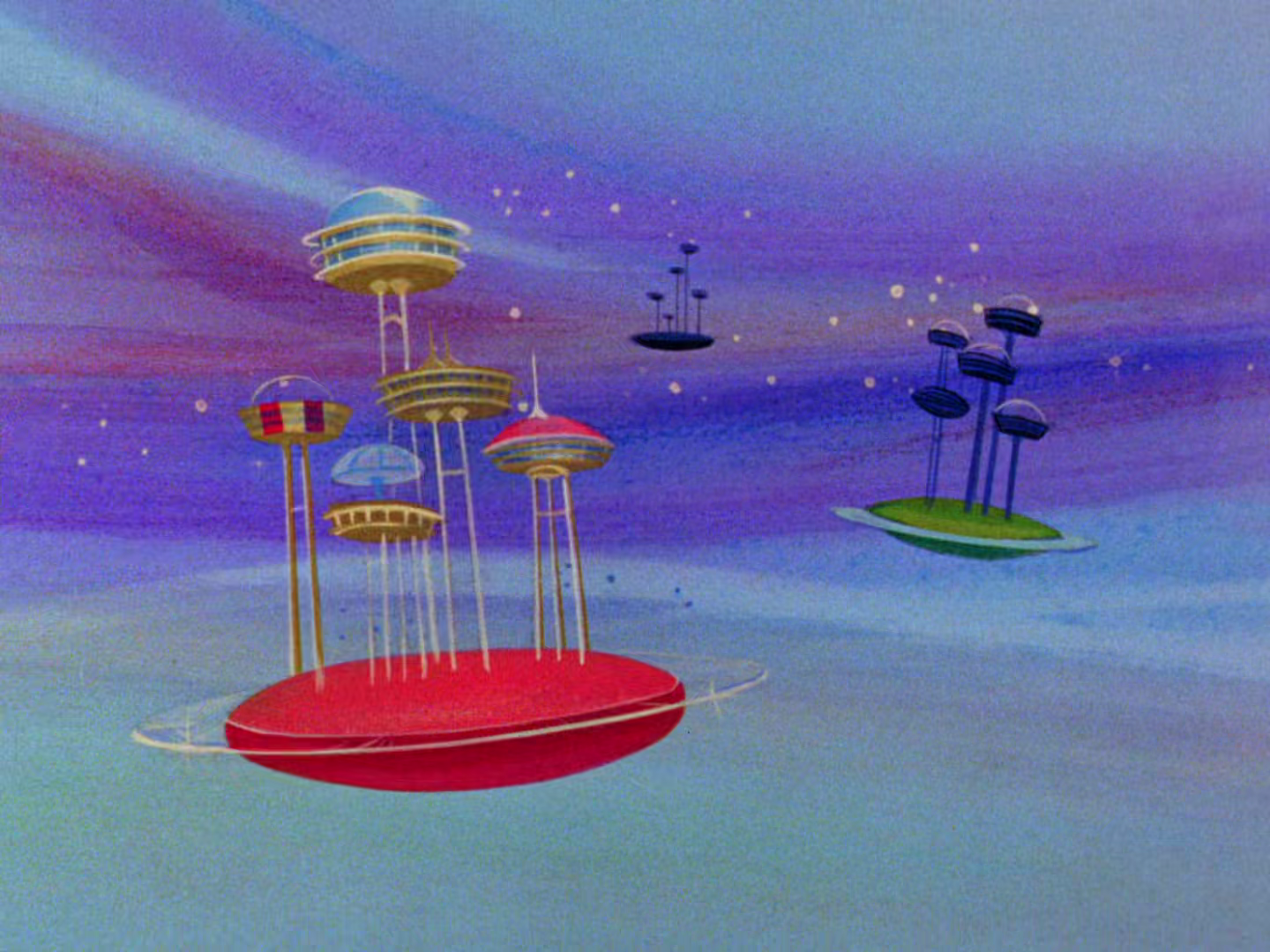
I generally like the series (I’m referring to the original 24 episodes, not the Orbitty Show of the ‘80s). The background art and other settings are great; especially buildings that look like the Space Needle. The writers went through science and technology magazines to get ideas of futuristic gadgets and some are things we use today. Hoyt Curtin and keyboardist Jack Cookerly came up some neat electronic music. Perhaps disappointing are some of tired old sitcom cliches the writers used (including “Honey, the boss is coming home for dinner” and the “suspicion of infidelity” bit), and the fairly lacklustre animation. There was no exaggeration; characters stood and talked and talked, with animators employing their individual style of head and mouth movement.

Here are backgrounds from the first episode that aired. They’re by Art Lozzi. The colour is excellent; some ABC affiliates actually aired the series in colour.


This throwaway background gag reminds of something you might see on The Simpsons 25 years later.


The gag above is from one of my favourite episodes— the debut of Uniblab. Computers took up whole rooms in the early ‘60s, so Uniblab has a huge head. For those who don’t know, the “uni” comes from the Univac, a Remington Rand division which made computers for corporations and the military that operated on punch cards or thick tape. The “blab” part came from the spying computer blabbing information and gossip to boss Spacely. I didn’t need to know about corporate suck-ups at age six; I knew George Jetson was getting screwed around and waited for the plot to play itself out with Univac being the victim of karma.

People like quoting from cartoons, and Barry Blitzer’s script gives viewers a chance. “Spacely’s a stupe,” exclaims Uniblab, which George repeats for the computer’s microphone, as the two play Five Card Satellite.


“Jupiter Gin! Planet Poker!” slurs the brain after getting drunk of Henry’s spiked oil.


I haven’t tried adding up all his scenes, but Carlo Vinci seems to have been responsible for much of the animation in this episode. He had unique mouth and leg shapes and angles. By this time, he was teamed with Disney veteran Hugh Fraser on the half-hour series.


One scene in the cartoon bothers me, and it shows you the limits of limited animation. Uniblab shoots hot coffee over the “board of directors” (presumably from Spacely Sprockets’ parent corporation). They just stand there. There’s no reaction to the liquid, let alone it being hot liquid. It’s completely unrealistic. The studio couldn’t even spend the time making a four-drawing yelling cycle.


Because it is The Jetsons, here is an obligatory shot of a flying car. I hope the exhaust doesn’t kill the ozone layer. Maybe it’s water vapour.


There really isn’t more I can say about the series that what’s been posted on the blog. Each cartoon has been reviewed. We wrote a bunch of posts when the series turned 50. Find one with music HERE. There's a post where Joe Barbera talks about the Space Needle and another about futuristic inventions.

Thursday, 22 September 2022

Promoting George and Jane

The Jetsons started life, according to Bill Hanna at a lunch at the Brown Derby, as a stand-by series just in case TV viewers didn’t warm to Arnold Stang playing a cat.

The lunch was with UPI’s Vernon Scott, likely in November 1961, who reported in early December that “Waiting in the wings should Top Cat become a fallen feline are The Jetsons, The Gruesomes and a medley show starring Cops and Roberts, Bill and Coo Coo, and Casey Jones. Hanna said ‘The Jetsons are the opposite of the Flintstones. They live several centuries in the future and suffer the same nutty family problems as Fred and Wilma Flintstone’.”

At the start, it wasn’t clear when the show was going to air. The Oakland Tribune of February 19, 1962 had it pencilled in on Fridays at 7:30 p.m. opposite Rawhide (CBS) and International Showtime (NBC). Daily Variety, on March 19, revealed: “Rest of the Sunday schedule is fairly well locked in. The Hanna-Barbera cartoon ‘The Jetsons,’ described as the ‘flip side’ of ‘The Flintstones’ and updated to the year 2,000, leads off at 7 p.m.” (A syndicated blurb in the San Antonio Express of April 1 said the series was set “a thousand years hence”). Broadcasting magazine on April 23 put it where it ended up—on Sundays at 7:30 opposite Dennis the Menace (CBS) and Walt Disney (ABC). It estimated production costs at $60,000 an episode, $10,000 less than Dennis.

Sponsors seem to have been found pretty quickly after that. Variety announced on May 2 the show “has been sold to Colgate-Palmolive and Whitehall Laboratories, both through Ted Bates [an ad agency], and Minnesota Mining and Mfg., through McManus, John and Adams [another agency].”

Now that a time slot had been set, it was time to start publicising the show. There was actually something specific to publicise; The Hollywood Reporter’s “TV Writing Deals” column of April 12, 1962 said Larry Markes had been hired to write two episodes. He received the story credit for the debut show with Rosey the robot and the sixth one where George leads a pack of cub scouts on the moon.

Newspapers would get news releases from networks, sponsors, producers, that could be printed verbatim as stories. Here’s one from May. Evidently the publicity department didn’t know George’s employer was “Spacely Sprockets.” I like the way Top Cat is played down, having failed in prime time. You’ll note nothing about the cast as Morey Amsterdam and Pat Carroll were still George and Jane when this release was written
.

‘Jetsons’ Offer Animated Look Into Comedy Future Next Fall
"The Jetsons," a new, half-hour situation comedy series featuring an amiable family of animated characters who live the good life about a century or so in the future, will make its debut on the ABC Television Network next fall as a prime time evening feature.
The program will be telecast Sundays, 7:30 - 8 p.m.
Hanna-Barbera Productions, producers of ABC-TV’s top-rate “The Flintstones,” and regarded as one of the most original production organizations in television, created the new all-family series.
"The Jetsons,” which has been in development for one year, is a light-hearted bit of futuristic fun. It deals with George and Jane Jetson, their cute, teenaged daughter Judy, her kid brother Elroy and the family dog, Astro. In their wonderously wacky world, the surroundings and gadgets have all changed — naturally for the better. But the problems we know and cope with are, to be sure, still around.
George works for Space Rockets Inc. [sic] The Jetsons live in the Skypads Apartments, which rise and fall on huge hydraulic lifts to stay clear of the weather. Jane Jetson dials the family's meals on a food console, solves the servant problem with robot maids. Son Elroy is packed off to school in a convenient pneumatic tube and Judy has her space-age singing idol, one Jet Screamer.
For 20 years at M-G-M, William Hanna and Joseph Barbera produced the "Tom and Jerry" cartoons which won 7 Academy Awards. In 1957, they set up their own studios to produce animated cartoons for television with Screen Gems. Their "Huckleberry Hound," now seen on over 150 stations through the nation, was the first half-hour series in TV to consist entirely of original cartoons.
In the fall of 1960, the H-B team embarked on the first animated series on TV network prime time, "The Flintstones," which returns in the fall with all the woes and fun of the Stone Age for its third season on ABC-TV. Last season, "Top Cat" was a prime-time animated series from Hanna-Barbera Productions.


Another release states: “It is understood that ABC has held open a network slot for ‘The Jetsons’ for a number of months, since the idea for the series was simple pencil sketch on a single sheet of paper. Sponsor interest remained strong during all the months in which Hanna-Barbera were busy putting together a presentation to show them.”

Next came the beloved network custom—The Junket, where entertainment reporters from all over the U.S. were given an all-expenses-paid trip to meet the stars of the coming fall season. Since it’s a little hard to meet cartoon characters, Hanna-Barbera brought out master salesman Joe Barbera and p.r. whiz Arnie Carr to promote, promote and promote The Jetsons. One reporter was from the Birmingham News.


Jetson cartoon this fall will make Glenn look stone age
BY TURNER JORDAN

News radio-TV editor
HOLLYWOOD, Aug. 21—From the first visits to the studios it appears TV is after the family in its entirety as viewers . . . The shows will be aimed at catching the adult audience and the kids as well . . . And if you think you've seen the fantastic, there’s more and more to come . . . We learned this while at the Harna-Barbera studios.
Their new project for this fall is the Jetsons, an animated cartoon in color . . . Col. Glenn’s exploits will look like old stuff as compared to the Jetsons . . . and Joe Barbera and Bill Hanna believe in it enough to think it can buck Walt Disney’s wonderful World of Color . . . Both will be on in Birmingham at the same time after Sept. 21 . . . There are George and Jane Jetson, a son Elroy and the dog, Astro.
When Arnie Carr, publicist, and Joe Barbera told about some of the exploits of this new some of the exploits of this new ABC cartoon series, TV editors were in stitches . . . TV reporters are here from Boston, Pittsburgh, Columbus, Ohio, San Mateo. Calif., and Nashville, Tenn., as well as Birmingham . . . But I thought while we were all laughing of how absurd space flights were several years ago until Alan Shephard, Gus Grissom and John Glenn came along.
IN FACT the only fear Joe Barbera has about the Jetsons is that it may be contemporary before the series runs its course . . . The Jetsons have skypool apartments you can run up and down, to let you out of the smog, as Carr and Barbera pointed out . . . And they do have smog out here as well as we do in Birmingham . . . Penny Singleton, remembered most for her role as Blondie’s wife, is thee wife in this one and her voice should be a riot.
There’s even a record coming out on the Jetsons, and Howard Morris, one of Steve Allen’s old funny men, (or was it Sid Caesar’s?) is the voice of Screamie Jet . . . It’s strictly for the bee-bops . . . And the dance for that era will be the solar swivel, so look out twist . . . The things the Jetsons have are “out of this world” and that is literally and figuratively speaking . . . One of them is a seeing eye vacuum cleaner which has two electronic eyes that seek out dirt and dust and even when the Jetsons aren't looking it sweeps the dust under the rug. And there's a shower that works like a car wash . . . You step on a slide-walk that moves you along, washes you off and puts on the powder and finishes the job at the end of the line. . . . There are many more innovations for the Jetsons, and it will be interesting to watch this show . . . Pretesting has brought out that it’s going to be one of the shows of the fall.
HANNA-BARBERA should be all right, if they can do better than Yogi Bear, Huckleberry Hound, Quick Draw McGraw . . . Of course, I’ve said from time to time cartoons don’t appeal to me except when the grandchildren are around, but I’ll be on the lookout for the Jetsons.
George Jetson has a three-hour, three-day week (that’s bad huh?) and he still complains about a hard day at the office . . . And life is so wonderful in this Jetson age Grandfather doesn’t retire until he’s 110 and still there’s a lot of life left in the old boy . . . There are already by-products of the Jetsons, such as soap, towers, dolls, books and toys . . . And that’s a big item . . . In the year which ended June 1 gross sales from by-products of cartoon characters grossed $39 millions wholesale and Hanna-Barbera and Screen Gems had a take from that of 5 per cent.
Hanna-Barbera are learning about TV cartoons . . . They have moved from a small studio to a bigger one and now are getting away from animal cartoons . : . The Jetsons are the first series I learned about on this trip hut there's more in store. . . . Hope you stick with us on the trip and let us tell you more about this TV town. . . .
Had lunch . . . sitting at a nearby table was Morris [sic] Gosfield, the Doberman of Sgt. Bilko. and the voice of Top Cat [sic] . . . one of which Hanna-Barbera are not too proud . . . It flopped.


Mike Carroll’s column in the Hollywood Reporter on March 21, 1962 had an unusual little item about the show. He said Nanette Fabray had been signed to play a Martian maiden. If she had, the idea was scrapped. The series wasn’t like The Flintstones, which had already succumbed to the age-old ratings gimmick of celebrity guest stars. Additional voices were supplied by cartoon actors and commercial voice over people like Herschel Bernardi and Shep Menken.

By the way, there was a radio show with George O’Hanlon as George who had a wife named Jane and an overbearing boss who kept threatening to fire him. It was Me and Janie, a replacement show for Alan Young on NBC in 1949. You can hear an episode below.


Saturday, 27 August 2022

An Interview With Hoyt Curtin

Times were changing in the late 1950s when it came to background music on television.

Some producers had been relying on leased stock recordings from production music companies. Hiring a composer and orchestra were too expensive and the head of the American Federation of Music, James Caesar Petrillo, was too meddlesome in refusing to lower the potential cost. But by 1959, Petrillo was out because of a scandal, and producers evidently decided the price was right to have someone come in and score themes, bridges, openings, endings and so on. The days of Ozzie and Harriet having music someone heard on Dennis the Menace were about to end.

Hanna-Barbera was one of those producers. Other than opening theme songs, the studio, from Day One in 1957, relied on sound cutters picking music from the Capitol Hi-Q library and Langlois Filmusic (distributed by Capitol) to fill the backgrounds of cartoons.

That day came to an end. In 1959, Columbia Pictures ended its theatrical release agreement with UPA and, in its place, put Loopy De Loop cartoons on the big screen produced by Hanna-Barbera. Why not? It owned part of the cartoon studio.

Bill Hanna and Joe Barbera decided Loopy should have something other than library music enhancing its theatrical shorts. The studio had hired Hoyt Curtin to write themes and arrange variations of them for bumpers. Why not hire him to create a library of cues for exclusive use of (and owned by) Hanna-Barbera?

That’s what it did.

Then H-B got into the half-hour prime-time television business, so Curtin was brought in to write music for The Flintstones then for everything else the studio was producing, music that is familiar to almost everyone of a certain age (the lyrics for some themes may not be, thanks to the production involving the Randy Horne Singers).

At the time, this was all “kid stuff.” No one gave it any serious consideration, especially because it had to do with television. But the kids grew up, they still liked Curtin’s music and some had the smarts to seek out Mr. Curtin for interviews.

This one was reprinted in the September 1992 edition of Film Score Monthly. Curtin’s H-B history is a bit off in places, and he was asked about cartoons outside the scope of this blog, but it’s interesting nonetheless, especially his references to Carl Stalling and Daws Butler. And he’s quite correct about The Jetsons second theme. When it became The Orbitty Show, you can hear the synth where Curtin had used horns in the original.

We’ve skipped the filmography mentioned below. Basically it gives him credit for every single H-B cartoon. According to it, Ted Nichols never existed; Mr. Nichols has his fans, too. And it mentions all the original Hanna-Barbera shows which, outside of theme songs, owe more to Jack Shaindlin, Spencer Moore and Phil Green when it comes to scores.

(The photos comes from a 1972 article in another magazine we have not reprinted on the blog).


HOYT CURTIN
FROM BEDROCK TO HOLLYWOOD


Hoyt Curtin has scored some of the most pervasive material in American culture, being the countless number of cartoons put out by Hanna-Barbera over the last thirty years. He began in the Hollywood of yesteryear, before lone musicians like Fred Mollin could capably score an entire television show or movie with only electronics. All studios had orchestras on call, and it was up to the composers to work with an "in-the-trenches " mentality of a different sort to score the assembly-line material for live players. It created a hectic do-it-yourself scoring schedule which many composers, like Henry Mancini and Jerry Goldsmith, claim to be instrumental in their training.

The following interview was conducted by James Vail for his radio program Cinemusic, which airs in Hammond, Louisiana on KLSU 90.9 FM on Tuesday nights at 9PM, re-run on Sunday at 4PM. The interview is reprinted here with Mr. Vail's permission, as is the mammoth Hoyt Curtin filmography which follows.

Vail: Could you describe your musical background and the events that led to your breaking into the film/television medium?


Curtin: I studied piano all my life, of course, and went to USC’s school of music and studied composition I was very fortunate to study with some very wonderful people because I was supposed to go to Juiliard after the war, on the G.I. Bill, and the man who enters you asked me why I was going to Juiliard [sic] when USC had people like Ernst Toch and the biggies at the time. Why go to Juiliard? They were just very crowded and they didn’t have anyone of that stature. So I called up my friend who let me enroll late at USC and drove back there at about a hundred miles an hour and went to lake my masters degree. It was great! We had some marvelous teachers. I studied with Miklós Rózsa and I just kept writing all I could, trying to get a job and that's not easy.

Vail: I see your first score was for The Mesa of Lost Women in 1952.

Curtin: (laughs) It’s the world's worst film, I think. It was really bad when I wrote it but now it’s worse. As I remember, it was about ladies on an alien planet who turned into tarantulas. I believe that was it. I didn’t have any budget so I had to do it with two pianos. A friend of mine, Ray Rash—one of the real great jazz guys—played the other piano. We really had fun doing that. I started out in what was called the industrial film business, because TV had just started to come in and companies like GE, Ford, and all the rest, they didn't spend their money in television, they spent it in industrial films. I finally got a job, by accident I went up and pounded on the door, literally, and the guy that owned the studio. Ray Wolf, had just fired his musical guy in a great huff. They were friends; that’s the worst kind. They had a big blow-up just the day before and here I am standing with this can of film in my hands that we made at USC. USC has a very good film department. They not only make the films but they have the kids score them. They’re still doing that. In fact I speak at USC, on occasion, and talk to the class that’s doing this. It’s marvelous! How else could you get to score films when nobody's going to ask you to do it for money? So, that part was marvelous. But then the company stopped making them and so I was unemployed, again. A friend of mine suggested I go to a studio called UPA which made the original Mr. Magoo shorts and they hired me to do some shorts. My teacher at the time was working there too. He wrote the one for Gerald McBoing Boing. Do you remember that one?

Vail: Yes I do. It's a fantastic short—exceptional score by Gail Kubrick. [sic]

Curtin: They tried a whole lot of new things. It was a little tiny company stuck behind a building out near Warner Brothers. They cranked out some of the real great stuff. In fact, the first one I did got an Academy Award and the second one got nominated. When Magoo Flew was the one that got the Academy Award. It was wide-screen animation; that shows you how ahead of things UPA was. I started working in TV commercials. That was where I really got going and I worked for a large company that was the “hot" company. That’s what happens these days. The ad agencies get on a company and do all of these ads at this company and if they’re not doing them there, then they’re not being done. I was the composer for Cascade Pictures and I’d write about ten a week. In so doing, I was called out to MGM to do a Schlitz beer commercial and Bill Hanna and Joe Barbera were doing the commercial. We got along and we did a nice job. I didn't think anymore about that and finally the phone rang and it was Bill. He said, "Could you write a tune for that?" I called him back in about five minutes and sang it to him. He said. "Could you record that?" This was the way we started; it was over the phone—go do it! They didn’t have time to do any fooling around — no meetings, forget it. And they were on their way. This was Ruff and Ready [sic], their first one and we did the same thing for The Flintstones. That was supposed to be The Flagstones but somebody didn’t like the word ‘Flagstones’ for some reason and so they made it Flintstones. Yogi Bear and all of them were done over the phone, too.

Vail: The theme songs?

Curtin: Yes. And then, of course, there had to be the cues written. In animation, you don’t have lead-ins and lead outs. You let the action handle it. You score the whole thing. So, each episode had to have 22 minutes of music—that’s a lot. It was an awfully busy time. I was doing all of their writing until about last year.

Vail: At what rate were these TV cartoons being turned out back in the ‘60s?

Curtin: I'm not sure how many in 1960, but I know in 1970 we had nine, count them, new shows, new series. And those all had to be scored immediately. They all aired on the same day in September when the network season started. It was really something to have nine shows going. At times it would take ten of us to write that stuff I would write all the themes and then I had to find guys that could write for animation. It's not like live-action. That was a big chore. We put out an awful lot of music but very little of it was recorded at the studio. The studio had a very nice recording studio there, but it isn't big enough for the band. Originally, we used great big jazz bands.

Vail: What caliber of players did you have in the band?

Curtin: I always had the hottest — Pete Condoli, Conte Condoli. Franke Capp — the drummer, Nick Fortula, Barney Kessel. I always had the names, not because of their names, but because they played great. But see, these are the earlier guys. The later guys were hot, but you wouldn’t know their names as well.

Vail: They were studio musicians?

Curtin: That’s right, but they were the best of them. The whole studio scene comes down to a very few guys because the particular kind of music I was writing was very difficult sight reading; it had to swing. We could only get one shot at it; we usually got a run-through. Then we would record it and go on to the next cue.

Vail: The rehearsals/recordings were pretty much a one-shot deal?

Curtin: That’s right. We recorded usually three times a week, three hours each time. They had a big stack of music in front of them and we just went through it. Everybody was geared-up to work hard, get ten minutes off an hour and then come back and hit it again.

I remember now. I have main titles from 142 different series. You know, Speed Buggy, The Jetsons, of course, and things like Wheelies and the Chopper Bunch [sic], These are the Days, and The Smurfs. It was a big pool of music — just hundreds of hours of it. The studio was recently sold to a group and they brought in their own people and it’s going to be sold again, I believe. I think Universal is going to buy it.

Vail: Was The Flintstones your first Hanna-Barbera TV cartoon scoring assignment?

Curtin: I think it probably was the first big one, but they did Ruff and Ready, Quick Draw McGraw, Hokey Woolf [sic], Wally Gator, Huckleberry Hound — those things were first. Then The Flintstones came. It just took off. It started out in prime time — Friday night. It would go off the air, then be revived, and come back with new episodes. One of the things, I think, that helped the music was that the musicians liked to jam on that piece. I know a lot of recordings have been made of it by jazz groups. It’s fun. I love to hear it.

Vail: How long was The Flintstones’ original run?

Curtin: First they made two, maybe three years of new things. Then it went off for a while and later a large food company picked it up and did a series as the sponsor. Then it would go off and it would come back on again. I don’t think they’ve made any new material for some time, but I notice they are going to do a live-action picture with John Goodman as Fred.

Vail: I seem to recall hearing about that some time ago. Isn’t [Steven] Speilberg [sic] producing it?

Curtin: Yes. It’s going to be a real dynamite thing.

Vail: Are there any hopes of your writing the score?

Curtin: Would that I were. They haven’t asked me, but I'm ready. I’d love to do it.

Vail: Like most kids, I grew up watching Saturday morning cartoons. One of my all time favorites was one of yours, Hong Kong Phooey.

Curtin: It was funny because I remember that one very well. We had decided to write a song and to have Scatman Crothers sing it. I forget if Hanna wrote the lyrics to that or if I did. It didn’t make any difference because we went in as a duo. That was Scatman Crothers’ favorite song, too. We had a big Hollywood Christmas parade here and he was the Grand Marshall and when this guy came up to him to interview him, you know, off the street, he started singing Hong Kong Phooey. He was an awfully good musician and a nice guy. He played great — good guitar player. He sang great and was at his best when he accompanied himself. He was really a good scat singer He was in clubs and doing this and that, but when he did this Hong Kong Phooey thing, from then on do you notice he was a contender as far as motion picture acting is concerned?

Vail: Come to think of it, yes. I can recall seeing him more frequently in the public eye.

Curtin: Well, this all started with Hong Kong Phooey. That was his thing. He said, "I want to sing my theme song” and he would sing that thing.

Vail: Another one of my favorites has once again come back — The Jetsons.

Curtin: The Jetsons was another funny one. Every one of them was funny because you just don’t know what you’re doing and you'd wait to see if it worked out or not. It was a nice little show, just an idea, and I wrote a piece for the main title of it—just cute little cars going around in the air and everything. Everybody looked at the picture after it was done and they said, “Hey, this thing works!” So they had me write a chart to go with the chart that was on it. I think if you listen carefully, you can hear the two bands in there. I put strings and every thing on it with all those runs. When were were recording that, we were listening in the headsets to the original track so we’d stay with it. That’s how that was done. That was a two-part main title. You see, they’d see the picture done and somebody would say. "Hey, this is better that we thought it was going to be. Let’s load the music a little bit.”

Vail: Did you use any electronic instruments for The Jetsons?

Curtin: If you heard the record, we did two versions—a main title, the original around 1960, and then later they made a record. That one. I’m sure, had synthesizers. But I can't make that darn synthesizer swing. I have to have the band. You've got to have the swinging guys.

Vail: I've even played it with a college band and it's a fun chart to play.

Curtin: Awful simple, isn't it? Four notes and forget it. You know, it brings back the memory of writing the damn thing. I didn’t have any idea, I hadn't seen anything. I knew what was going to be on the film. We had one animation director who liked to get a tune, a track, and the track should have action and then when would design the pictures to go with it. And I somehow think I liked that because the music flows. You wrote a piece of music and then he'd put the animation on it. The kind that were tough was when you'd get the animated pictures and you had to match it with the music. There were always compromises to make to hit this and that. You can’t swing, it works but not as well. I like to write a tune, a piece, orchestrate it, make it move and let somebody put the pictures to it

Vail: When you found a certain cue that worked extremely well, be it action, suspense, or whatever, was it ever used again for other cartoons?

Curtin: Yes. The cutters get onto cues that work and those are their special cues. They go into their special bin and when something happens that they need it, they use it. But the musicians union requires that we score each and every thing. Then, if they substituted an old cue, nobody cared.

Vail: The consistency seems to be that most TV cartoons run for one, maybe two seasons and then they're off. Are there any cartoons in the past few years that have "stuck out" from the rest?

Curtin: Well, The Smurfs has done beautifully. It came over from Europe and it was Americanized. Scooby-Doo has done beautifully. The Flintstone Kids is still on. There aren't a lot of them as you say. One of the nicest ones I did went off after one season. A lot of times that happens. Wildfire it was called. The tune was written by Jimmy Webb, an awfully good writer. I didn't write the song, I scored it for him. It was a beautiful thing but it didn’t catch on. And that happened a lot

Vail: You wrote a lovely song for The Last of the Curlews.

Curtin: It was about these two curlews, they were just a pair, and they were flying over a field and this doggoned farmer picks up a shotgun and blows the lady away. It brings a tear to your eyes. Then old Clyde has to go wandering off but there aren’t any other curlews left. He's the last of them. That’s what the song is about

Vail: You also wrote an interesting primitive percussion theme for Korg 70,000 BC.

Curtin: It was live-action and it was about cavemen finding fire and all that good stuff I just thought, why not do it with just percussion and a conch shell? I had to find a guy to play the conch shell, of course. I deliberately played it out of tune. There’s a chord at the end and it’s just a little off, by design.

Vail: Could you describe the main difference in scoring for cartoons and live-action?

Curtin: I would say that you're a lot broader in animation. You haven't got facial movements, body movements, emotions, etc. The guy is thinking, the guy is getting ready to blow the town up or whatever—you haven't got that in animation. In live-action, whole areas might carry without music. Music might be an intrusion. Whereas, in animation, you pretty much have to go wall-to-wall. After you write animation, writing live-action is such a pushover. It's like you could write it with both hands at the same time... and I have, when behind.

Vail: Which do you prefer?

Curtin: Oh, I like the animation when the animation is good and funny like it used to be with this guy, Daws Butler. He was their [Hanna Barbera’s] big voice guy — Yogi Bear, Huckleberry Hound, Quick Draw McGraw. I’d get to listen to his tracks and it was just easy to write the music.

Vail: In the past thirty years, has the TV cartoon evolved for the better or the worse or is it still basically the same?

Curtin: You know. I'm deeply rooted in Bugs Bunny and Carl Stalling and that kind of music. That kind of animation is just too expensive, so that's why we have the look we have now. Some of it is very inventive and some of it isn’t. But, if you ask me which would I prefer to watch, it would be the older stuff, naturally. Think of the things they put into it. The studio was required to have a studio orchestra — on call all the time. They had to be paid for ten hours a week whether they played or not so why not use the orchestra to play. That’s why you had all of those great scores.


Below is an industrial film scored by Curtin in 1959. It looks like American Motors shelled out some pretty good cash to make this, considering it was produced at MGM and has a good size cast for this kind of film. The director, incidentally, is Dave Monahan, who wrote cartoons in the 1930s at Warner Bros.

Monday, 1 August 2022

Farewell, Jane Jetson 1.0

July 31st may not have been the birthday of George Jetson, but it was the day after the death of the first woman to play George’s wife.

Comic actress Pat Carroll died on the weekend of pneumonia at age 95.

There are some readers who may have missed the posts some years ago about this, but Penny Singleton was not the first person cast as Jane Jetson. Hank Grant’s syndicated TV column (in the Binghamton Press), dated May 13, 1962, revealed:

Starring “voices” for the new “The Jetsons” animated cartoon series, now signed for Sunday nights on ABC-TV, will be Morey Amsterdam and Pat Carroll. Since they will be required to work only one day a week, Morey will continue as a regular on the Dick Van Dyke Show and Pat hopes to do the same on the Danny Thomas Show.
That didn’t last long. Grant wrote in the Hollywood Reporter two days later:
Casting of voices for Hanna-Barbera’s new “The Jetsons” series is now wide open, even for the top Jane & George Jetson roles. Begging off their firmed deals because of sponsor conflicts were Morey Amsterdam (Dick Van Dyke Show) and Pat Carroll (Danny Thomas Show).
Well, apparently it wasn’t all that tidy. Or placid. Here’s a wire service story from almost a year later.
Cartoon Firm Sued by Two
LOS ANGELES, April 12—(UPI)—Actress Pat Carroll and comedian Morey Amsterdam filed $27,600 suit Friday claiming breach of their contract to do voice characterizations for a television cartoon series.
Miss Carroll and Amsterdam contended in their superior court suit that they entered into a contract last April 28 with Hanna-Barbera Productions to do voice characterizations for the “Jetsons” and were to receive $500 a segment—with a guarantee of 24 segments for 1962-63.
Both said the defendant, Hanna-Barbera, failed to use them for the voice work.
It took months for the case to end up in court. This is from January 25, 1965.
TV firm sued
LOS ANGELES (AP)—Comedian Morey Amsterdam and actress Pat Carroll are seeking $12,000 each from Hanna-Barbera Productions, charging the firm signed them to provide the voices for an animated television show called “The Jetsons”—but used their services only once, not 24 times as called for in their contracts.
The case went to trial Tuesday, Amsterdam and Miss Carroll said their contracts called for them to get $500 each for each of the shows, planned for the 1962-63 season.
The Associated Press reported on January 29th the two of them lost their suits.

When we originally posted about this in 2010, it spurred author and fellow CITR alum Kliph Nesteroff to ask Carroll about it. You can read what she had to say over on his blog.

It took about a month to re-cast the main roles. The TV writer for the Alton Evening Telegraph of June 15, 1962 reported Penny Singleton was now Jane and George O’Hanlon had been hired as George. You’ll notice, by the way, the character was named “George” before O’Hanlon was cast.

The firing wasn’t really a setback for Carroll; she carried on with a long career in live action and animation. But we can’t help but think how different The Jetsons would have been with Carroll and Amsterdam as the lead characters.

Sunday, 31 July 2022

It's George Jetson's What?

No, I am not wishing George Jetson a happy birthday today.

The reason is simple. There’s not a scintilla of proof that his birthday is today.

Some cartoon fans abhor a vacuum. They also love back stories, something in the early days of the Hanna-Barbera studio no one cared about. Bill Hanna and Joe Barbera’s interest was making people laugh, not writing biographies or “bibles” (okay, they were interested in profits, but that’s beside the point).

So someone, somewhere, came up with the idea of spreading word on the internet that George Jetson was born on July 31, 2022. How they picked the date is beyond me, as Mr. Jetson never (as far as I can recall) celebrated a birthday at any time during the 1962-1963 season.

It is true that publicity articles before the series appeared on television set the show in 2062. But that was jettisoned (or is it “Jetsonsed”?) as it was never mentioned in a single cartoon. Why date a show that could possibly run for decades?

One good thing is coming out of all the internet chatter. It gives the Jetsons more exposure, hopefully to young people who have never seen the original series.

Not all the episodes are great, with hoary old plots about the boss coming to dinner and inept women drivers, but the show is worth watching for the futuristic designs. Astro is always funny, and there’s some good satire in Elroy’s TV Show, where activists have sucked all the entertainment (and life) out of television, and Uniblab, where a robot/computer turns out to be a corporate suck-up. And A Date With Jet Screamer features what is basically an early animated music video, courtesy of animator Bobe Cannon during his brief stay at Hanna-Barbera.

However, never it let it be said that Yowp is a wet blanket. Feel free to make this George Jetson Day and celebrate by watching some of the almost-60-year-old cartoons. Or you can listen to a few cues from the series below. I imagine these came from the collection of the late Earl Kress. Hoyt Curtin loved those end-stabs. No, I do not know why the alpha/numeric labels for the cues begin with “V.”


V300


V301


V302


V302A


V302B


V303


V304


V309


V310


V312


V313


V314


V315


V316


V317


V320


V322


V324


V326

Saturday, 8 August 2020

Astro By Nicholas

If you’ve visited our sister blog, Tralfaz, you’ve seen the masthead with the Jetsons’ Astro (né Tralfaz) on a circular dog-walk treadmill. It comes from Millionaire Astro and is one of a pile of scenes drawn by one of my favourite Hanna-Barbera animators, George Nicholas.

Nicholas arrived at the studio from Disney where he had worked on shorts. Before that he was an animator for Walter Lantz.

The original H-B animators could be pretty distinctive and came up with some funny poses. Unfortunately, as the studio added more and more work, the animation got more and more lacklustre. Still, Nicholas did his best. He loved beady-eyed, wavy-mouth expressions and you can see it in this cartoon.

I haven’t determined how much he animated—I’m not good at picking out H-B animators after about 1960—George Goepper and Bill Keil also handled scenes in this cartoon. But let’s look at part of the last third.

First up, Astro runs into a park, begging Elroy to save him from the dog catcher. Nicholas liked drawing cashew shapes for partially closed eyes. And he goes in for bending the muzzle and flopping down an ear to add to the expression.


Astro is shocked in court.


A defeated Astro is taken away by J.P. Gottrockets, who has been awarded the dog by a Jury-Vac (Gottrockets must be a futuristic J.P. Gottrocks from The Flintstones.


Astro’s expression after learning he will, here forth, be known as Tralfaz.


Here he is on the dog walk.


An in-between of him upset that he’s not at home with the Jetsons.


And angrily chasing Gottrockets.


You can read more about George Nicholas in this post.

As for the name Tralfaz, it had been imported by Mike Maltese from the Warner Bros. cartoon studio. The word had been used there, but dated back even further to Cliff Nazarro’s double-talk act. Read more here and in this follow-up post.

Astro, was more or less, created by Tony Benedict. Iwao Takamoto designed the dog first, then Tony jumped in to create stories for him and give him his personality. Tony was also the creator of Alfie Gator in the Yakky Doodle cartoons and had a hand in the evolution of Hairbrain Hare to Touché Turtle (Hanna-Barbera was never a place to waste ideas so Hairbrain was the basis for Ricochet Rabbit). Tony worked on the last of the Huckleberry Hound cartoons and is still with us. He has a book coming out which we’ll let you know about in good time.

Wednesday, 1 May 2019

The Present Catches Up to the Future

The future used to be fun.

Today the future, it seems, is a negative, hopeless place of doom. In fiction, even superheroes aren’t very heroic. “Poor me,” they wail, in filmed or drawn frames of dark greys and blacks.

But in the days of the Jetsons, the world looked forward to the future. The TV series was really a culmination and digestion of a variety of sources over the 1930s, ‘40s and ‘50s which peered happily into a buoyant Universe of Tomorrow, where life would be relaxing and perfect, thanks to science and technology.

Of course, nothing quite worked according to plan. After all, The Jetsons was a comedy show, so some mechanical slapstick came in handy. And I like the idea that somewhere in the future, there’s a dog named Tralfaz that is too adept at pronouncing the letter ‘r.’

You’ve likely read in this blog and elsewhere about how some of the things foreshadowed on the cartoon series (or something similar) have become reality. Hanna-Barbera found that to be a problem when the series was in production. Here’s Joe Barbera talking about it in the October 7, 1962 edition of the Arizona Daily Star out of Tucson.

Barbera’s comment about the series being talked about as early as 1960 perhaps means a future family was one of the ideas that came up when the studio was batting around concept that eventually became The Flintstones.


Hanna, Barbera Meet Space Age Problems
New Series Depicts Future Family Life

By HAL MARSHALL
Star TV Editor
HOLLYWOOD, Oct. 6—It's tough keeping 100 years ahead of the space age!
Sound incongruous? Not to Bill Hanna and Joe Barbera, producers of the new TV series, “The Jetsons,” which is carried Sunday by KGUN-TV (Channel 9).
The animated cartoon series battered the opposition in the ratings on its first outing. In addition, it is taxing the imagination of Hanna, Barbera & Co., creators of “Flintstones,” "Yogi Bear” et al.
“The Jetsons” depicts family life in the future—100 years or so hence. There's only one hitch, the present keeps catching up with the future. The idea men come up with a new design for space travel or an imaginative home appliance device for the 21st Century home. They get set to use it in the show and then discover there is something in the works—somewhere in the world—similar.
“Two years ago we started talking about this show,” Barbera explains, “and after six months of planning we found ourselves losing the space race in imagination. We had to scrap a lot of ideas. Speeds we planned on using were already being surpassed (in the 20th Century).”
Barbera went on to list other similarities such as designs at the Seattle World's Fair that approximate a few building designs in “The Jetsons.” A space capsule car showroom is similar to one General Motors has on the has on the drawing boards, Barbera learned recently.
All this has convinced Barbera that “everything we think of will be done.”
The Jetson family consists of a father, mother, teenage daughter and son, eight years old. In case you haven't seen the show, the 21st Century offers an unlimited opportunity for visual sight gags. On cookouts, the family goes to the moon. An afternoon field trip for a high school class might include a jaunt to Europe. The family can spend a week end at Las Venus at the Flamoongo Hotel where all the rooms have built-in dealers and slot machine robots that follow the guests.
The Jetsons have a seeing eye vacuum cleaner that seeks out dust and devours it. However, when Jane Jetson isn't looking the electronic cleaner is apt to sweep the dirt under the rug. The Foodarackacycle fixes meals instantly when fed a punch card designating the type of food desired. George Jetson has a mother-in-law-car with a separate capsule in the rear for his wife's mother. If she does too much back seat driving, he can eject her.
The show also spoofs present-day conditions. In “The Jetsons,” football is played by robots—an obvious take off on today's super athletes in the pro league. “Although we'll be loaded with gags, these are basically warm stories about a family,” Barbera added. But he's still amazed about how fast the present catches up with "The Jetsons” of the future.
"We have a story about the grandfather who retires at 110 and wants to keep busy. The other day, I picked up a newspaper and read where someone is predicting it won't be long before the retirement age is 100 years.”

Saturday, 26 January 2019

Joys and Vexations of the Future

Remember the days when everyone looked forward to the future?

Today it seems everyone is negative about what lies ahead for the world. There was a time where people were hopeful that the wonders of technology would make our lives better. Today some are worried about technology enslaving lives.

But let us go back to the future, to coin a phrase. The Jetsons was kind of the culmination of all those magazine stories and industrial short films of the 1950s about the marvels and wonders of tomorrow. Push button food! Flying cars! Minimal work weeks! Tex Avery used the concept to make animated spot films. Bill Hanna and Joe Barbera used it to make an animated sitcom.

Hanna and Barbera were great borrowers. For The Jetsons, they borrowed from themselves. They took the concept of The Flintstones (putting modern suburbia in the Stone Age) and inverted it (putting modern suburbia in the World of Tomorrow). Newspapers across the U.S. published previews of the series. Some of the bigger papers did feature stories, no doubt assisted by Arnie Carr’s publicity department at Hanna-Barbera.

This is from the San Francisco Examiner of December 9, 1962. Joe Barbera has some interesting money quotes. Jimmy Weldon recently revealed on Stu’s Show that Daws Butler made $350,000 in residuals in 1963 alone. My thanks to Kerry Cisneroz for sending me a copy of the publicity drawing with the story.


The Jetsons
They Vacation on the Moon

By Dwight Newton
BILL HANNA and Joe Barbera are a couple of kooks—never conventional, always far out or far in.
Two seasons ago they ventured far inside Paleolithic times to bring forth a Stone Age cartoon series, "The Flintstones."
This season they have gone far out, 100 years or so hence, to create and unreel a giddy cartoon frolic called "The Jetsons," (Sundays, 7:30 p.m., channels 7-11-13-47).
As "Flintstones" was a prehistoric "Honeymooners," the new "Jetsons" is a space age "Father Knows Nothing."
George and Jane Jetson have two young'ns, teen-age Judy and small fry Elroy. The Jetsons' joys and vexations are the same as any of today's tract dwelling families with commuting fathers, but the settings and solutions spring from the wildest dreams of Hanna-Barbera science fiction comedy writers.
"And they've got to be real wild," said Barbera when I dropped by his bustling cartoon factory. "Things are moving ahead so fast these days that anything you think of, it is here."
The Jetsons and their friends drive automobiles that fly, live in space pads, have mechanical maids and take vacations on the Moon. They use slide walks, enjoy wall to-wall television, exercise by pressing push buttons and travel by air tubes.
Save for George Jetson's boss, C. D. Spacely, president of Spacely Sprockets ("Easy on the Pockets"), nearly everyone is slim because, said Bill Hanna. "There are not going to be any fat people 100 years from now."
Plump Mr. Spacely is voiced by Mel Blanc who also does squat Barney Rubble on "The Flintstones." Jane Jetson is voiced by Penny Singleton, the former Blondie of the movies, and daughter Judy is Janet Waldo, the Corliss Archer of yesteryear's radio.
George is George O'Hanlon, a noted off-camera vocalizer, and little Elroy is Daws Butler whose previous voicing credits include a hound named Huckleberry, a bear named Yogi and a horse named Quick Draw McGraw.
"Huckleberry Hound," Yogi Bear" and "Quick Draw McGraw" were also Hanna Barbara creations as was "Ruff and Ready," [sic] their first independent effort. Before that, for 20 years they labored at Culver City, where in 1937 they invented "Tom and Jerry" for Metro-Goldwyn-Mayer. How times have changed!
"Daws Butler was with us there and in a good month we made $250," recalled Barbera. "Last year we paid him $80,000 and he got a lot more from residuals."
At MGM, Hanna and Barbera produced eight short cartoons a year at a cost of about $60,000 for six minutes. They can knock out a half-hour "Jetsons" or Flintstones" for around $65,000. They do it by eliminating intricate details—falling leaves, rippling water, cobwebs, etc.—and by using an efficient assembly line production system that has revolutionized the animated cartoon business.
When they evolved the system for TV they tried to sell it to MGM but the brass there figured they could never meet a weekly TV deadline.
"MGM turned down this whole project, fortunately," said Barbera. "That was our lucky break. We were turned down by nearly every other outfit in Hollywood and then we made a deal with Screen Gems in 14 minutes."
Five years ago they launched "Ruff and Ready" with a staff of five people. Now, they employ 250 people, half of them artists working at home. Next month they move into their own new $1 million building.
You financed it by watching a hound, a bear, a horse, a Stone Age foursome and a Space age family.

Monday, 31 December 2018

Don Lusk

The last surviving animator on The Jetsons’ debut cartoon in 1962 has passed away. Don Lusk was 105.

We know he worked on the “Rosey the Robot” episode because his name is preserved in the cartoon’s review in Daily Variety (whether the frame to the right is Lusk’s, I don’t know). Expert Howard Fein says he also animated on one of my favourite Jetsons, “Elroy’s TV Show.”

Lusk was born in California on October 28, 1913, the second son of Percy Knox and Louise Opie (Ross) Lusk. His father was from Brooklyn and his mother from Canada. His father died when he was young, his mother remarried and was left a widow again. Don was supporting his mother and grandmother while at Disney in 1940, pulling down $3,900 a year. One of his assistants at Disney was Gene Hazelton, who later ran the comic strip department at Hanna-Barbera.

He left Disney to work on shorts at the Walter Lantz studio in the early ‘60s before his stop at Hanna-Barbera. Without getting into an endless list of credits, we’ll simply say he animated on both H-B features of the mid-‘60s—Hey There, It’s Yogi Bear and A Man Called Flintstone.

There are so few veterans of the early days at Hanna-Barbera still around; background artist Sam Clayberger, who worked on some of the first Huckleberry Hound cartoons, died earlier this year, as did Gerard Baldwin, who animated several cartoons on the Huck and Quick Draw shows in 1959 before he left to work for Jay Ward.

Our sympathies go to the Lusk family.

Saturday, 17 November 2018

Tiffany Tiff

There was a time at Hanna-Barbera, writer Tony Benedict says, when all you had to do was please Joe Barbera—and then the company was sold and became corporate. And corporations make decisions based on, well, not based on Joe Barbera. Or common sense.

What was supposed to be the last work on the voice track for The Jetsons: The Movie was apparently done in February 1989; that’s when George O’Hanlon suffered a stroke in the studio after finishing his lines and died in hospital.

But that wasn’t the end of it, as fans discovered starting around May 9th when Daily Variety revealed that singer Tiffany had re-done all of Janet Waldo’s dialogue as Judy Jetson.

Common sense tells you it was a stupid idea. Janet’s voice was recognised by everyone as Judy Jetson’s. And this wasn’t a case of an actress getting older and not being able to do the part. When Janet was hovering around 90, she could still sound pretty much like she did as suburban teenager Corliss Archer on radio in the mid 1940s (which, basically, was Judy’s voice).

The decision, though, made corporate sense. Universal put up money for the Jetsons movie. Universal had a sister record company, MCA. Tiffany was one of its big recording stars. Put some Tiffany songs in the Jetsons movie—cartoons are aimed at kids anyway—release them on MCA and you have instant free advertising via the movie. And, hey, since she’s doing the singing, she might as well do the dialogue, too. In fact, the suits wanted to ditch the Jetsons’ theme and have Tiffany sing something over the titles and credits but were talked out of it by composer/conductor John Debney.

That’s how corporations think.

How and when Miss Waldo was informed about all this, I don’t know. But the decision was crappy for fans and a real insult to her.

Here’s a version of events from the May 23, 1989 edition of the Austin American-Statesman. Joe Barbera sticks to the corporate line.

OUT OF THIS WORLD: Pop music teenybopper Tiffany will be heard as the voice of Judy Jetson in the new Jetsons: The Movie due at Christmastime, according to the Pasadena Star-News.
Meanwhile, Janet Waldo, the original voice of Judy, is on the outs but bears no hard feelings, People magazine reports. Waldo recorded the original voice tracks but says Hanna-Barbera apologetically indicated that Tiffany's label, MCA, which is also producing the movie, wanted the singer to take the role.
"Her voice is so prominent in the musical segments that we decided to feature her in the spoken part as well," said Joseph Barbera, president of Hanna-Barbera Productions. Tiffany will sing three new songs on the sound track of the full-length animated feature.
Waldo, who claims to bear no ill will over the switch, said Tiffany "sings through her nose."
Janet expressed her disappointment in other interviews. This unbylined piece showed up in the St Louis Post-Dispatch on July 26, 1989. (As a side note, Daws Butler died in 1988. Patric Zimmerman was Elroy in this movie).
JANET WALDO THE VOICE OF JUDY JETSON
MOST PEOPLE don't recognize her name or her face, but when she spouts words ala Judy Jetson—her animated counterpart—ears perk up.
"That was the first animated voice I did," says actress Janet Waldo. "My kids grew up with 'The Jetsons' at the same time I was doing the voices for the show. And now, my friends always introduce me as Judy Jetson—everywhere I go." Later this year, Hanna-Barbera animation studios will release the first theatrical motion picture about the space-age family titled "Jetsons: The Movie!"
Jumping Jupiter! This time, however, it is minus the vocal talents of Waldo, whose Judy Jetson was forever the hip teen-ager of the 21st century. Instead, funders of the film decided to use the vocals of rock singer Tiffany to supply the dialogue and vocals.
"I was terribly upset. I was crushed," says Waldo. "This was a part I had created and performed. It's kind of like I've been robbed. And yet, it was the last time the cast was together to record the voices as a family again, ya know?"
Since final recording sessions, George O'Hanlon, the voice of George Jetson, died. Months later Daws Butler, the voice of little Elroy died, and recently Mel Blanc, the man of a thousand voices (including Mr. Spacely), died. Reportedly, Hanna-Barbera has been deluged with negative mail about their "meddling" with a cult hit, which originally aired in 1962 on prime time television.
"The studio told me they want to continue with some more episodes replacing the cast where they need to," says Waldo. "It wasn't necessary to replace me completely. They just wanted to.
"I don't know Tiffany at all, but I don't think of her singing as the Judy Jetson style. She may bring in a new element to the movie, but the film may lose the old element."
Waldo is known to baby boomer cartoon watchers as the voice of Josie from "Josie and the Pussycats," as well as the sexy race car driver Penelope Pitstop. She also supplied the vocals for Wilma Flintstone's rotund mother, a heavy-voiced overbearing mother-in-law to Fred.
Today, Waldo and her husband Robert E. Lee, the playwright known for "Inherit the Wind," live in the Los Angeles area, "around the corner from Steve Allen and Richard Crenna," she adds.
She is supplying voices for TV's "Smurfs" and she recently worked for Disney Studios, for the first time giving life to the wicked Maleficent in some coming cartoon recreations of "Sleeping Beauty."
I’m not a fan of ‘80s pop music (though at least it wasn’t autotuned) so I haven’t much good to say about Tiffany’s singing, but she was unfortunately put in an awkward situation. Here’s a teenager with no acting experience who had to re-record the work of a veteran who was loved and respected by fans. Here’s what she told USA Today’s Steve Jones in a piece published July 6, 1990.
Tiffany Finds New Voice as a 'Toon Teen
When Tiffany started work on Jetsons: The Movie, she wasn't sure how her Judy Jetson voice should sound.
Veteran cartoon actor Janet Waldo had spoken the spacey teen's lines for 28 years, but producers wanted Tiffany for the movie because they planned several musical numbers around Judy.
“I didn't know if I should try to imitate how I thought Judy always sounded or if I should make it `Tiffany does Judy,'” says the 18-year-old singer. “They decided they wanted her to sound a little older, and now she has a more breathy voice.”
Tiffany, who topped Billboard's pop album chart at 16 and had two No. 1 singles, is a longtime Jetsons fan. She had planned to be on just the soundtrack, but the producers let her do the dialogue, too, so that the voices would match.
A novice actress, she was daunted by the studio work, but Gordon Hunt, the film's recording director, helped her grow into the part.
“It was nice having patient people working with me,” she says. “It was hard doing the lines with the right expressions, but slowly but surely they brought it out of me.”
She said the movie will introduce her music both to parents and to kids who were too young to know her when her previous albums came out. None of the three songs she does for the movie will appear on her yet-untitled album set for September release.
Tiffany says that the album is a departure from her previous work, and that she's been working out with weights and aerobics to give herself a new look. She expects to begin touring in January.
“I'm doing R & B now and it is something I've wanted to do for a long time,” she says. “It's going to shock a lot of people.”
Janet Waldo was interviewed after the movie came out. She didn’t bother to see it. Critics gave it mixed to lukewarm reviews. Tiffany’s star had some of the shine off it by that point, so I suspect the throngs of her fans that MCA expected at theatres never materialised. I imagine the film mostly attracted nostalgic Gen Xers who kinda, sorta, remembered the show from their childhood and took their kids in an obligatory hunt for “family” entertainment.

Producer Mark Evanier says that Joe Barbera, in a very classy move, apologised to Janet in front of the who’s-who of the voice acting world who gathered at Don Messick’s retirement party in 1997. He has postulated, and I hope I’m not misinterpreting his comments, that the movie quite possibly wouldn’t have been made had the Tiffster not been involved. Bill Hanna and Joe Barbera were caught in the corporate maelstrom as much as Miss Waldo.

The good thing to me, speaking as a fan, is the large outpouring of support and affection that Janet Waldo received during this whole escapade. As you know, she passed away over two years ago, but people still love her and the original Jetsons TV show. The Tiffany tiff has turned out to be a mere footnote in the show’s history.