Hanna-Barbera needed some outside help to get the Huckleberry Hound Show on the air. Three animators were on staff, but Hanna brought in Mike Lah (their wives were sisters) on a freelance basis to pick up some scenes and a couple of full cartoons.
Lah was employed at Quartet Films at the time; he was the “other” director at MGM when Bill Hanna and Joe Barbera were told the studio was closing, and had worked in various units after his arrival from Disney.
We’ve pointed out a number of early Huck show cartoons where the animation switches for maybe 90 seconds to Lah’s drawings. He’s never credited in those cartoons.
The other day, I was re-watching Scaredycat Dog (Production E-12), and spotted what sure looks like (to me) Lah’s animation; Lew Marshall gets the animation credit on it.
When Jinks tip-toes from behind a house, he has jagged teeth. Lah drew Spike that way in cartoons for Tex Avery at MGM.

Jinks going “boo” looks like Lah, too.

There’s a good deal of pose-to-pose movement by Marshall in this cartoon. In this scene, Lah draws two in-betweens before the dog zooms into the sky. The first lasts three frames, the next is on two frames.


A favourite Lah animation-saver is by holding a character on a cel and moving the mouth in a variety of shapes. You can see it in Pie-Pirates, the first Yogi cartoon; Lah animated it solo.


 >
>

The cartoon ends with the twin-brother, cat-hating dog chasing Mr. Jinks in an endless, four-drawing cycle that takes 24 frames to go past the same point of the background. Here's what it looks like. This is Lew Marshall's work.

Lah’s uncredited animation can be found in other Pixie-Dixie-Jinks cartoons: Pistol Packin' Pirate, Judo Jack, Little Bird Mouse, Cousin Tex, Jinks' Mice Device, The Ace of Space and Jinks Junior.
Before he played a cowardly Great Dane that solved mysteries (I’ve forgotten the character’s name, Scrubby or something), and before he portrayed Astro on The Jetsons, what was the first dog Don Messick voiced at Hanna-Barbera?
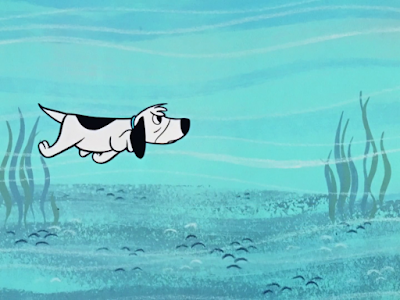
No, the answer isn’t me! Actually, his first pooch was Woolly the sheep dog on Ruff and Reddy, who first appeared on TV on March 22, 1958.
But forget Woolly. Who’s birthday is it today?
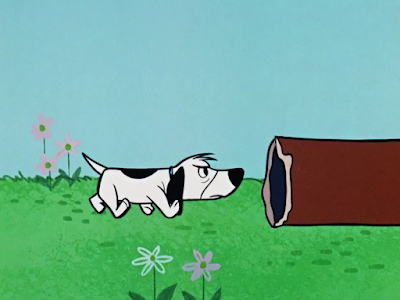
That’s right. Mine. Though judging by George Jetson, fans can just make up their own birthdays for characters and people will swallow it without question so long as it’s on the internet.
It was on this date in 1958 that Foxy Hound-Dog aired on a number of stations where Kellogg’s bought time.
Lew Marshall is the main animator of the cartoon (although the two frames above are by Mike Lah) and he saves Joe and Bill some money by coming up with a few cycles that take up a little more than the first 30 seconds of the cartoon. Here is an endless cycle of my initial run in the cartoon. It takes 32 frames to go from one end of the background to the other. Marshall uses only three drawings; one is used twice to create a four-position cycle, animated on twos.

You’ll notice the inconsistent colour separation. The head/trunk are on one frame, the legs and ears are on separate frames.
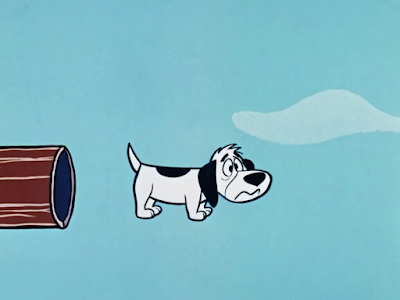
The Yowp debut cartoon has a few things old-time animation fans will remember. There’s a variation of the log-over-a-cliff gag that Tex Avery and writer Dave Monahan pulled off in All This And Rabbit Stew (1941). You’ll remember it from other Warners cartoons. I must have seen that, or the Bugs/Elmer version, as I realise my fate. Even with limited animation, Mike Lah draws a nice little expression. Wile E. Coyote could not have done it better. I emit a forlorn “yowp” before plummeting.
The old drag act appears, too. I think this is the only time Yogi did drag. Unlike similar dress-ups by Bugs Bunny or Woody Woodpecker, it isn’t being used to arouse and confuse but merely as a disguise. These two frames are consecutive. Hanna-Barbera was still employing pose-to-pose movement in its animation.

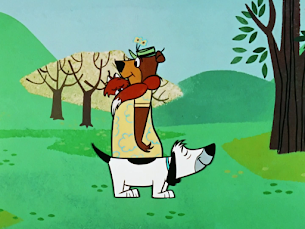
You’ll notice something else. Lah’s animation has my muzzle the same colour as the rest of my body. Marshall’s very is a sporty blue-ish grey. It could be whoever painted the Lah scenes didn’t get the correct colour chart.
There were three Yowp cartoons in all. Duck in Luck first aired on January 26, 1959, where the nemesis was the pre-Yakky Doodle duck, animated by Carlo Vinci. The final appearance came in the second season on Sept. 28, 1959 with Bare Face Bear, animated by Gerard Baldwin. By this time, Warren Foster was the sole writer of the Yogi Bear cartoons and a decision was made to permanently give Yogi (and Boo Boo) a home in Jellystone Park and Ranger Smith as a nemesis. “We’re going in a different direction,” they would say today, as I became unemployed (but that duck later got his own series. Drat!). It’s significant that neither Boo Boo nor Smith are in the final Yowptoon.
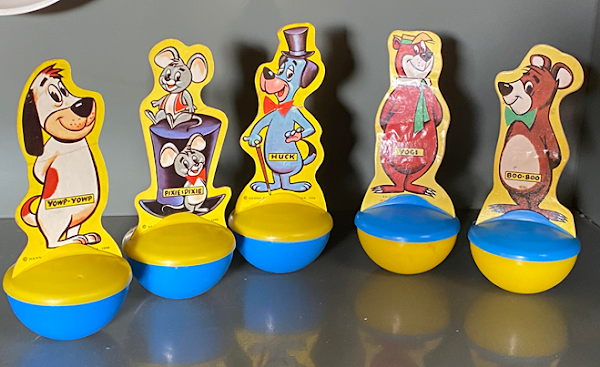
During the first year of the Huck Show, Hanna-Barbera marketed its characters, but since there were only five stars (Huck, Yogi, Pixie, Dixie, Jinks), secondary characters were included to round out things. Yes! There were Yowp toys and games at one time. Above is a Knickerbocker Roly Poly Target Game made in 1959. It came with a gun that shot corks and had some kind of tie-in with Kellogg’s Corn Flakes.
With that, I will wish myself a happy birthday. The blog is pretty much shut down but there are are still a few posts left in storage so we’ll try to get them published.

We know this thanks to the late Earl Kress and all the work he did putting together the Huck Show DVD. Earl was sent a copy of a mimeographed document from the files of the Leo Burnett ad agency dated Aug 3, 1961, with an addendum dated January 22, 1962, listing what it calls “Composition of Units.” It’s something for a real H-B geek, listing production codes for opening/closing titles, sponsor IDs, opening/closing billboards, bridges, the episodes themselves and the individual cartoons.
The latter lists the cartoons made for the show in chronological order. Unfortunately, because this is an agency document and not a studio one, it doesn’t show when production was begun (let alone finished) on each cartoon, which is information I’d be interested in seeing.
I don’t know if the production order has been published anywhere so I’m going to put it up here. The animator credits below are my own.
As always, these kinds of documents lead to questions which, at this late date, can’t be answered. You’ll notice the first 29 cartoons put into production starred Yogi Bear and Pixie and Dixie. The first Huck began with production number 30. Why so late? I’ll avoid speculation. And were more episodes ordered by Kellogg’s after production began? The cartoons that made up shows 22 through 26 were all made pretty much in the order they appeared.
26 episodes allowed two airplays to make up 52 weeks. Eight of the cartoons were reused in episodes, and not near the end of the series.
And you’ll notice Mike Lah appears on most of the earliest cartoons in production. Lah worked on a freelance basis for the studio; evidently he hoped he would be cut in when Bill Hanna and Joe Barbera formed the studio with the financial backing of Columbia Pictures and director George Sidney. It never happened, so he continued his work elsewhere. Animator Mike Kazaleh pointed out some time ago that Lah would be handed a specific chunk of footage in the cartoons, usually somewhere in the middle. I can’t help but wonder if the first cartoons were originally planned to be shorter, then extra gag footage was needed to bring them to about seven minutes (all the cartoons are exactly the same length). I don’t know whether I’ve spotted all the Lah footage; I’m almost certain he did work on a few of the cartoons below where I don’t have him listed (I’ve just finished looking at one that if it isn’t Lah, Ken Muse imitates Lah’s eye and mouth movements instead of his own found elsewhere in the cartoon).
E-1 Pie-Pirates (K-003/017) Yogi/Lah
E-2 High Fly Guy (K-008) Yogi/Marshall-Lah
E-3 Tally Ho-Ho-Ho (K-007) Yogi/Vinci-Lah
E-4 Pistol Packin’ Pirate (K-005) PD/Muse-Lah
E-5 Judo Jack (K-002/15) PD/Muse-Lah
E-6 Little Bird Mouse (K-007) PD/Marshall-Lah
E-7 Yogi Bear’s Big Break (K-001/011) Yogi/Muse-Lah
E-8 Big Bad Bully (K-020) Yogi/Vinci-Lah
E-9 Slumber Party Smarty (K-002/014) Yogi/Marshall-Lah
E-10 Kit Kat Kit (K-003/018) PD/Muse
E-11 Big Brave Bear (K-006) Yogi/Vinci
E-12 Scaredy Cat Dog (K-006) PD/Marshall-Lah
E-13 Baffled Bear (K-009) Yogi/Muse-Lah
E-14 Cousin Tex (K-001/012) PD/Vinci-Lah
E-15 Foxy Hound-Dog (K-005) Yogi/Marshall-Lah
E-16 Jinks’ Mice Device (K-004/021) PD/Muse-Lah
E-17 The Ghost With the Most (K-009) PD/Muse-Lah
E-18 The Buzzin’ Bear (K-013) Yogi/Vinci
E-19 Jiggers..It’s Jinks! (K-008) PD/Marshall
E-20 Brave Little Brave (K-010) Yogi/Muse-Lah
E-21 The Stout Trout (K-021) Yogi/Vinci-Lah
E-22 The Ace of Space (K-010) PD/Muse-Lah
E-23 Jinks Junior (K-011) PD/Marshall-Lah
E-24 Be My Guest, Pest (K-016) Yogi/Vinci
E-25 Duck in Luck (K-018) Yogi/Vinci
E-26 Puppet Pals (K-016) PD/Marshall
E-27 Jinks the Butler (K-013) PD/Muse
E-28 Bear on a Picnic (K-019) Yogi/Vinci
E-29 Runaway Bear (K-015) Yogi/Muse
E-30 Mark of the Mouse (K-017) PD/Vinci
E-31 Sheriff Huckleberry (K-005) Huck/Muse
E-32 Sir Huckleberry Hound (K-004/019) Huck/Marshall
E-33 Lion-Hearted Huck (K-002/013) Huck/Muse
E-34 Rustler Hustler Huck (K-006) Huck/Marshall
E-35 Huckleberry Hound Meets Wee Willie (K-001/010) Huck/Muse
E-36 Hookey Days (K-014) Huck/Vinci
E-37 Tricky Trapper (K-003/K016) Huck/Muse
E-38 Cock-a-Doodle Huck (K-008) Huck/Vinci
E-39 Two Corny Crows (K-009) Huck/Muse
E-40 Freeway Patrol (K-007) Huck/Muse
E-41 Dragon Slayer Huck (K-012) Huck/Muse
E-42 Fireman Huck (K-009) Huck/Muse
E-43 Sheep-Shape Sheepherder (K-017) Huck/Vinci
E-44 Skeeter Trouble (K-015) Huck/Vinci
E-45 Hokum Smokum (K-020) Huck/Vinci
E-46 Hypnotize Surprise (K-020) PD/Marshall
E-47 Bird House Blues (K-021) Huck/Vinci
E-48 Jinks’ Flying Carpet (K-014) PD/Muse
E-49 Prize Fight Fright (K-021) Yogi/Muse
E-50 Dinky Jinks (K-019) PD/Vinci
E-51 Barbecue Hound (K-018) Huck/Muse
E-52 Brainy Bear (K-022) Yogi/Muse
E-53 Nice Mice (K-022) PD/Muse
E-54 Postman Panic (K-022) Huck/Vinci
E-55 Robin Hood Yogi (K-023) Yogi/Muse
E-56 King Size Surprise (K-023) PD/Marshall
E-57 Lion Tamer Huck (K-024) Huck/Lah
E-58 Daffy Daddy (K-024) Yogi/Vinci
E-59 Cat-Nap Cat (K-024) PD/Muse
E-60 Ski Champ Chump (K-023) Huck/Marshall
E-61 Scooter Looter (K-025) Yogi/Vinci
E-62 Mouse Nappers (K-025) PD/Muse
E-63 Little Red Riding Huck (K-025) Huck/Marshall
E-64 Hide and Go Peek (K-026) Yogi/Muse
E-65 Boxing Buddy (K-026) PD/Muse
E-66 Tough Little Termite (K-026) Huck/Muse

There was only one main title and one end title for the Huck show in the 1958-59 season. That means only the regular artists and voice actors were listed (sorry Frank Tipper and June Foray). There were all kinds of mini-cartoons. There were 11 opening and closing billboards, two sponsor IDs, 11 Huck bridges, 11 Pixie and Dixie bridges, 11 Yogi Bear bridges and 11 “opening units” (along with four “closing units”).
Leo Burnett also, at one time, had two 35mm prints of the shows, with another 54 16mm prints in storage (in 1961). It’s a shame the either didn’t exist or weren’t available when the Huck DVD was made so there would have been better quality than some VHS dubs of the programming elements.
The Burnett files have production numbers for all the cartoons in the Huck series (including the Hokey Wolfs). Earl also had a similar document for the Yogi Bear show. If he had one for Quick Draw McGraw, it’s still in his filing cabinet.
My thanks to Denise Kress for going to the time and expense of mailing these to me.


 >
>


