We’ve talked about how the early Hanna-Barbera characters went from one pose to the next without in-betweens. We’ve also mentioned in a previous post that Mike Lah animated movement in his cartoons at the studio that way, and with in-betweens when necessary.
Here are a couple of examples from the debut cartoon of that loveable character, Yowp, Foxy Hound-Dog.
Below are two consecutive frames of Yogi Bear and the little fox. The positions are quite different but action doesn’t look abrupt on the TV screen.


Lah had Yogi run in place in a little cycle of two drawings, shot for two frames (see the first drawing above)

Here’s an in-between as Yogi leaves the scene. Just having him disappear in the next frame would look odd. Some animators, including Lew Marshall earlier in this cartoon, take out the characters in the following frame but have drybrush lines or swirls instead.

Here’s another example from the same cartoon. The first two frames are consecutive, there’s a two-drawing run-in-place cycle, followed by some in-betweens, also animated on twos.


I like this scrambly Yogi.


You’ll notice Lah will draw Yogi in profile or close to it. This enables him to animate various mouth shapes on the face and hold the rest of a character on a separate cel.


To get Yowp to yowp, Lah animates the head. (The legs are on a separate cel and are animated when Yowp walks into the log).


Fernando Montealegre is responsible for the backgrounds. The one with the trees and hills gets a lot of use in this cartoon, and there are several shades of green to avoid monotony. His backgrounds never overshadow the characters, and are simple yet stylish.
This is from Yogi’s first season on the Huckleberry Hound Show. I like these early Yogis before he got yoked to the Boo-Boo/Ranger Smith/Talk-in-Rhyme-All-the-Time format in the show’s second season.
Hanna-Barbera needed some outside help to get the Huckleberry Hound Show on the air. Three animators were on staff, but Hanna brought in Mike Lah (their wives were sisters) on a freelance basis to pick up some scenes and a couple of full cartoons.
Lah was employed at Quartet Films at the time; he was the “other” director at MGM when Bill Hanna and Joe Barbera were told the studio was closing, and had worked in various units after his arrival from Disney.
We’ve pointed out a number of early Huck show cartoons where the animation switches for maybe 90 seconds to Lah’s drawings. He’s never credited in those cartoons.
The other day, I was re-watching Scaredycat Dog (Production E-12), and spotted what sure looks like (to me) Lah’s animation; Lew Marshall gets the animation credit on it.
When Jinks tip-toes from behind a house, he has jagged teeth. Lah drew Spike that way in cartoons for Tex Avery at MGM.

Jinks going “boo” looks like Lah, too.

There’s a good deal of pose-to-pose movement by Marshall in this cartoon. In this scene, Lah draws two in-betweens before the dog zooms into the sky. The first lasts three frames, the next is on two frames.


A favourite Lah animation-saver is by holding a character on a cel and moving the mouth in a variety of shapes. You can see it in Pie-Pirates, the first Yogi cartoon; Lah animated it solo.


 >
>

The cartoon ends with the twin-brother, cat-hating dog chasing Mr. Jinks in an endless, four-drawing cycle that takes 24 frames to go past the same point of the background. Here's what it looks like. This is Lew Marshall's work.

Lah’s uncredited animation can be found in other Pixie-Dixie-Jinks cartoons: Pistol Packin' Pirate, Judo Jack, Little Bird Mouse, Cousin Tex, Jinks' Mice Device, The Ace of Space and Jinks Junior.
Before he played a cowardly Great Dane that solved mysteries (I’ve forgotten the character’s name, Scrubby or something), and before he portrayed Astro on The Jetsons, what was the first dog Don Messick voiced at Hanna-Barbera?
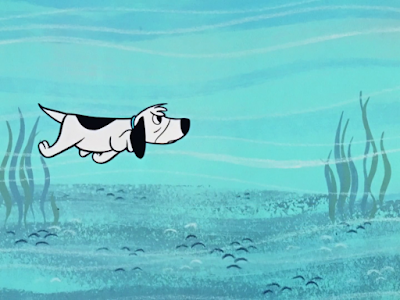
No, the answer isn’t me! Actually, his first pooch was Woolly the sheep dog on Ruff and Reddy, who first appeared on TV on March 22, 1958.
But forget Woolly. Who’s birthday is it today?
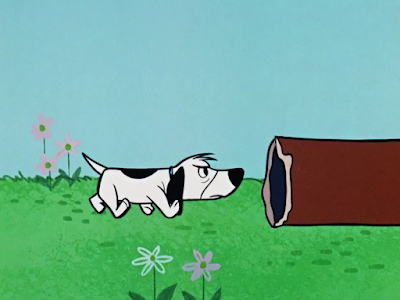
That’s right. Mine. Though judging by George Jetson, fans can just make up their own birthdays for characters and people will swallow it without question so long as it’s on the internet.
It was on this date in 1958 that Foxy Hound-Dog aired on a number of stations where Kellogg’s bought time.
Lew Marshall is the main animator of the cartoon (although the two frames above are by Mike Lah) and he saves Joe and Bill some money by coming up with a few cycles that take up a little more than the first 30 seconds of the cartoon. Here is an endless cycle of my initial run in the cartoon. It takes 32 frames to go from one end of the background to the other. Marshall uses only three drawings; one is used twice to create a four-position cycle, animated on twos.

You’ll notice the inconsistent colour separation. The head/trunk are on one frame, the legs and ears are on separate frames.
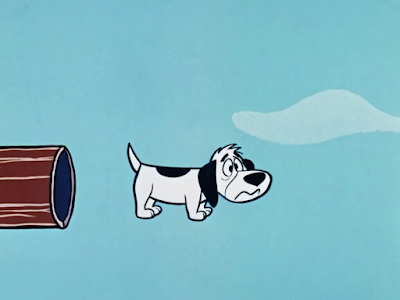
The Yowp debut cartoon has a few things old-time animation fans will remember. There’s a variation of the log-over-a-cliff gag that Tex Avery and writer Dave Monahan pulled off in All This And Rabbit Stew (1941). You’ll remember it from other Warners cartoons. I must have seen that, or the Bugs/Elmer version, as I realise my fate. Even with limited animation, Mike Lah draws a nice little expression. Wile E. Coyote could not have done it better. I emit a forlorn “yowp” before plummeting.
The old drag act appears, too. I think this is the only time Yogi did drag. Unlike similar dress-ups by Bugs Bunny or Woody Woodpecker, it isn’t being used to arouse and confuse but merely as a disguise. These two frames are consecutive. Hanna-Barbera was still employing pose-to-pose movement in its animation.

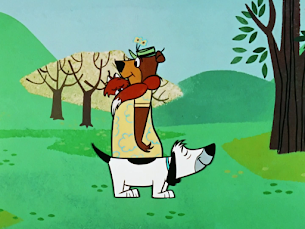
You’ll notice something else. Lah’s animation has my muzzle the same colour as the rest of my body. Marshall’s very is a sporty blue-ish grey. It could be whoever painted the Lah scenes didn’t get the correct colour chart.
There were three Yowp cartoons in all. Duck in Luck first aired on January 26, 1959, where the nemesis was the pre-Yakky Doodle duck, animated by Carlo Vinci. The final appearance came in the second season on Sept. 28, 1959 with Bare Face Bear, animated by Gerard Baldwin. By this time, Warren Foster was the sole writer of the Yogi Bear cartoons and a decision was made to permanently give Yogi (and Boo Boo) a home in Jellystone Park and Ranger Smith as a nemesis. “We’re going in a different direction,” they would say today, as I became unemployed (but that duck later got his own series. Drat!). It’s significant that neither Boo Boo nor Smith are in the final Yowptoon.
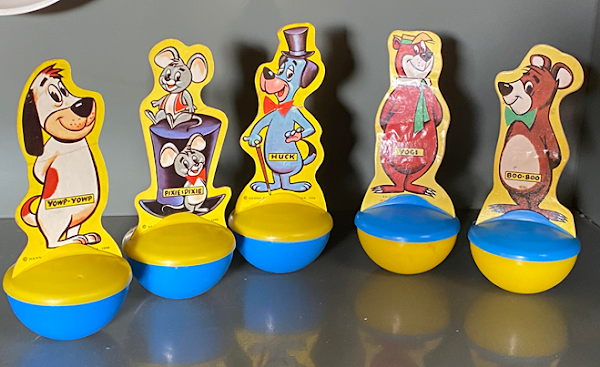
During the first year of the Huck Show, Hanna-Barbera marketed its characters, but since there were only five stars (Huck, Yogi, Pixie, Dixie, Jinks), secondary characters were included to round out things. Yes! There were Yowp toys and games at one time. Above is a Knickerbocker Roly Poly Target Game made in 1959. It came with a gun that shot corks and had some kind of tie-in with Kellogg’s Corn Flakes.
With that, I will wish myself a happy birthday. The blog is pretty much shut down but there are are still a few posts left in storage so we’ll try to get them published.
Fans of early Hanna-Barbera cartoons are the best.
Each of us has our favourite series and characters. The late cartoon writer Earl Kress and I found an instant kinship when I told him my favourite H-B series is the Quick Draw McGraw show. Earl, as you may know, spent what ended up being fruitless time endeavouring to get the series released on home video by Warners, only to run into several roadblocks.
One of them was the location of bumpers—those little cartoons between the cartoons. Whoever was running things at what was left of the studio had no idea where the masters were, or even if they still existed, to Earl’s dismay. Of course, when the series first aired in 1959, 16-millimetre prints were sent to TV stations in the U.S. and elsewhere around the world. The same thing happened several years later when the half-hours were shorn of references to Kellogg’s and syndicated again (Quick Draw also aired on CBS on Saturday mornings in 1966-67).
An early Hanna-Barbera fan with the handle of Steven Hanson has somehow acquired dubs of some of the 16 mm. prints and is braving take-down notices by posting some of the Quick Draw mini-cartoons in his possession. Some are even in colour.
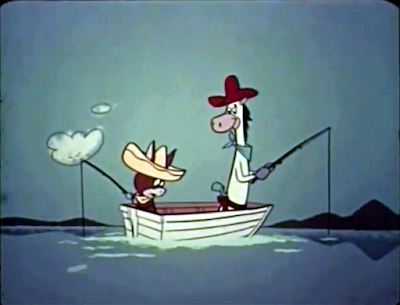
Here’s a shortie. Quick Draw and Baba Looey are fishing in a rowboat that is taking on water (which we can’t see to save some pencil mileage).
Quick Draw’s keen deduction tells him if he shoots a hole in the bottom, that’ll let the water out.
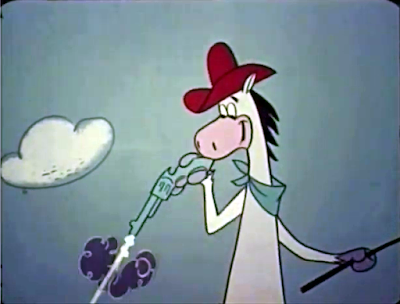
Not quite.
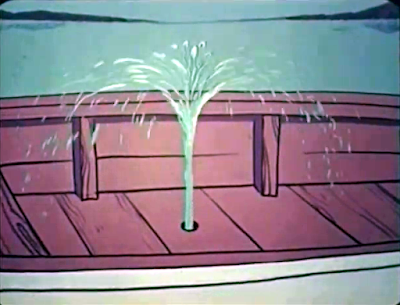
Never fear! Tex Avery is here! Well, kind of. The writer borrows the water-plugging gag from Avery’s Lucky Ducky (1948). I’m pretty sure it predates that cartoon, but that’s the only one I can think of with it.

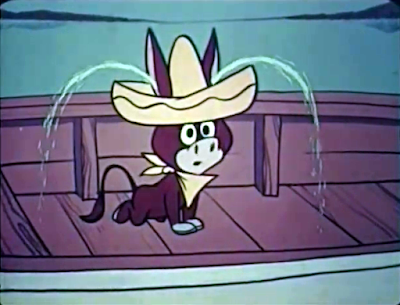
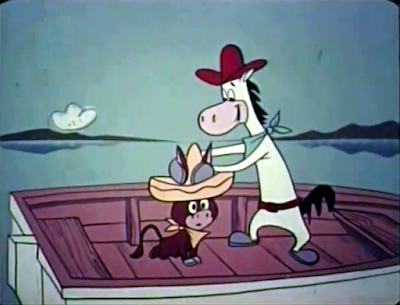
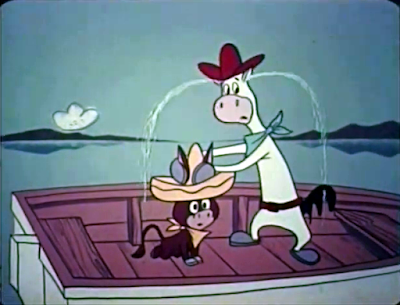
The Avery version.

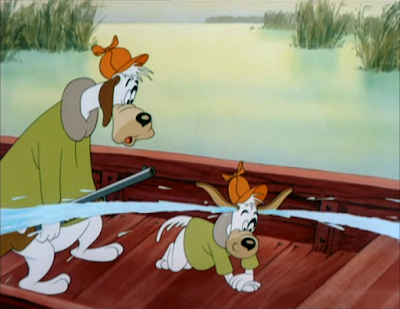
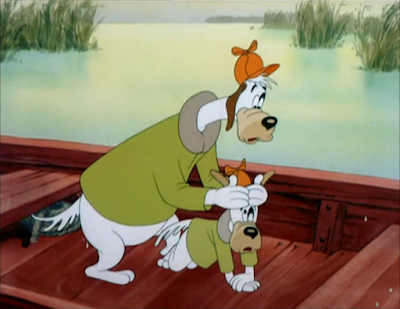
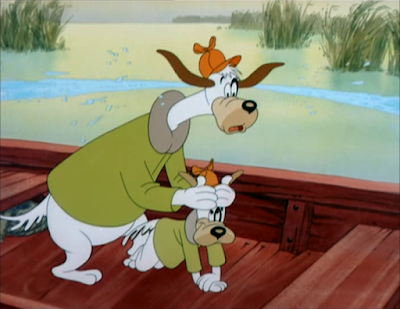
Who is the animator of this cartoon? He worked on Lucky Ducky. These odd mouth shapes should give it away.
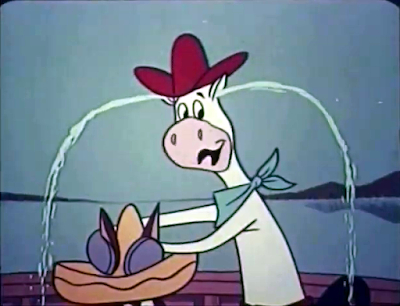
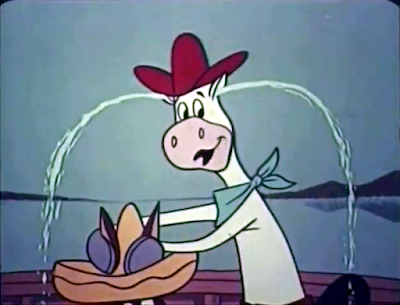
Mike Lah.
The frames look they came straight from the storyboard without embellishment, though in the first Huckleberry Hound show cartoons (1958), Lah would change mouth shapes on a face with the rest of the body being held on a cel. In this little cartoon, the pinkish snout moves slightly as well (and the water spurt is on a cycle). It’s a shame he decided not to go for funny takes like he did with Mr. Jinks, but gave us Jack Benny-style stares instead. Lah worked freelance the whole time he was at Hanna-Barbera; an offer to be a partner in 1957 fell through.
Oh, the title of this post is Quick Draw’s last line before the fade-out.
If you like Quick Draw, you should be delighted Mr. Hanson has posted these. He also has put up a few Ruff and Reddy half-hours. I find the show a little childish and dull, but it has fans who will be happy to see it. Like the Quick Draw McGraw show, I really, really doubt we will ever see it on home video due to music rights issues, so this will have to do for now.
As a cartoon dog, I don’t claim to know very much about judo. But I do know it doesn’t involve grabbing someone by the tail and doing an airplane spin before letting them fly. However, that’s what we see in the Pixie and Dixie cartoon Judo Jack.
Cycle animation is involved in this scene. There are four drawings, each shot twice. Actually, there are two drawings of Mr. Jinks. They’re flipped over and painted on the other side.


And, now, the cycle. This is about the same speed it is in the actual cartoon.

This was the second Pixie and Dixie cartoon put into production. In the first few cartoons made for the Huckleberry Hound Show, the animation is jerky. Hanna and Barbera said over the years that they found that the Tom and Jerry pose reels at MGM, which were devoid of a lot of in-betweens, were pretty funny. That was the philosophy at their own studio to begin with (probably because of budget and time restraints). That means some of the first Yogi Bears and Pixie and Dixies will pop from pose to pose.
Here’s a good example from close to the beginning of this cartoon. The first drawing is on six frames, the next two are both on fours and the last drawing is on fives. There is dialogue but Pixie’s mouth doesn’t move for 19 frames.


The bulk of the animation in this cartoon is by Ken Muse, who animated the first Pixie and Dixie cartoon at Hanna-Barbera (Pistol Packin’ Pirate). He does a Tex Avery-like jaw drop and has a nice crumpled pose of Jinks, but my favourite drawings are by Mike Lah. You can see some of them in this post. On model? Lah doesn’t worry about that sort of thing. I presume Lah did his own effects animation, too, as there are several repeated swirl drawings.


In an earlier post, we mentioned Judo Jack Terry, who was a pro wrestler when this cartoon was made. One of his finishing holds was the sleeper. Judo Jack in this cartoon gives Jinks a sleeper, simply by lightly conking him on the noggin. Here’s Lah’s drawing when Jinks wakes up at Jack’s command. Lah liked open mouths that look like melted geometric shapes.

Judo Jack would never get made today. There are people who have adopted the case-closed attitude that all ethnic stereotypes are racist; a blanket opinion takes no effort. But let’s look deeper. Jack is the hero of the cartoon, something pretty daring considering the Allies had been at war with Japan less than 15 years before this cartoon was made.
During the war, stereotypes were hyper-exaggerated in cartoons (which exaggerate to begin with) to ridicule, belittle, and laugh at the enemy. That’s not the case here; they’re used as a nationalistic identifier, the same way Pixie and Dixie’s Cousin Tex is shown to be a Texan through stereotypes—cowboy hat, branding iron, vocal drawl and so on. The only character who ridicules Judo Jack is Mr. Jinks, and he is ultimately and rightly punished. There’s simply no other way to set up the nature of Jack’s character in a 6½-minute comedy—certainly not in 1958—than to rely on what are some pretty tired clichés that, I hope, have been tossed away for good.

Frank Tipper was responsible for the backgrounds on this cartoon, the earlier Pixie and Dixie pirate cartoon, the later Kit Kat Kit and the first cartoon produced for the Huck show, Pie-Pirates, starring Yogi Bear (at least he’s not credited on others). When he arrived at the studio and why he left is unclear. He very well could have been working freelance; he arrived at Le Ora Thompson's studio in 1957 after two years overseas with Halas and Batchelor and Anigraph Films. Tipper was an Englishman (Manx) who arrived in the U.S. in 1921. Devon Baxter has crafted a nice biography of Tipper at the Cartoon Research blog.
This isn’t among my favourite Pixie and Dixie cartoons—it’s kind of in the also-ran category—but there are enough good elements in it to make it enjoyable TV fare.


