Showing posts with label Top Cat. Show all posts

Sunday, 15 February 2026

Quick Draw on TV?

It would appear fans of Quick Draw McGraw will be able to see the series on TV once again. Eventually.

An announcement on this web site says:

Tubi has confirmed a list of 100 different series from Warner Bros. Animation and Cartoon Network that are joining the free service. The ones in bold join on March 1st. The rest presumably will rollout afterwards.

Quick Draw McGraw is not in bold, so it's anyone's guess when it may appear. It's also your guess whether they will be old TV prints of the cartoons, or if they'll be newly restored, or if they'll be the full half-hours with the interactive bits between Quick Draw and the stars of the other parts of show.

I have no direct knowledge but the appearance may be dependent on Warner's efforts to remaster the cartoons. I thin'.

The list, by the way, also includes Top Cat and The Yogi Bear Show but nothing else before 1961. Still, the announcement will give viewers more cartoons than they can possibly watch.

Saturday, 21 January 2023

High Hopes For T.C.

Bill Hanna and Joe Barbera had high hopes for Top Cat.

The shows starring Huckleberry Hound and Quick Draw McGraw were still attracting audiences in syndication. Both had been nominated for Emmys in 1960—and Huck won. The Flintstones had some critics pouting at the outset, but soon gained an audience. Now, cartoon studios were falling over themselves to put an animated show in prime time. ABC picked up Top Cat.

Considering all that, and the fact the series had plenty of the popular Bilko show mixed into its formula, it shouldn’t lose.

It was likely ABC that set up a junket for entertainment reporters to come to California and find out about its new shows for the fall season. Jim Downing of the Tulsa Tribune was one who took advantage of the freebie and got two columns out of his visit with Joe and Bill as they plugged Top Cat. The first column appeared on June 28, 1961, the next the following day.

It’s a shame the scan of Joe’s drawing of T.C. is poor, but you get the basic idea. The busted hat didn’t make the cut—probably too much pencil mileage involved. And he’s borrowing a sweater from Choo Choo.


FROM TIME to time from now on through the summer I’m going to tell you about the new shows which are scheduled to be introduced on the TV screen next season. I talked with stars and producers of some of them when I was in Hollywood this spring and got a line on a number of them.
You haven’t heard about most of these shows, so I can brag that what you are going to be reading will be real little old scoops on the TV writing gentry.
Let’s start out today with a real scoop. The picture you see here is “Top Cat," star of a coming cartoon series to be seen on ABC-TV this fall.
Joe Barbera, half of the cartoon team of Hanna-Barbera which produces "The Flintstones" among other popular pen-and-ink epics, picked at his lunch at the Tail O'Cock [sic] restaurant—I think that's in Sherman Oaks, Calif., and talked very happily about the success of "Flintstones" and the prospects for "Top Cat.”
"ITS A DAMON RUNYON kind of a yarn,” he explained, rubbing his blue jowls with a talented hand. (He looks pretty much like Fred Flintstone, if you must know.) “Top Cat is the leader of a gang of alley cats and he lives in a garbage can behind a bowling alley. He is trying to improve the standard of living of his pals, see?
“His buddies are Bennie the Ball, Choo-Choo, The Spook, Fancy Fancy and The Brain. He's a real operator—even has a telephone on the pole right by his garbage can. Sometimes his secretary answers it. . .”
“My, my,” I said. “Is he some kind of a nut?”
"WELL, YOU MIGHT SAY SO. He's a kind of an efficiency expert—efficient at conning the general public into supporting him in the style to which he has become accustomed. He— well, here's an example of how he operates: He blows his whistle, see? and times the other cats to see how long it takes ‘em to congregate. No excuses for tardiness."
I said it sounded like he was a Sgt. Bilko type.
“Yeah, that's the idea. In fact, we got one of Bilko's boys— Maurice Gosfield who did the Pvt. Dobermann part— to be the voice of one of the cats. He's Bennie the Brain.” [sic]
So I said that was fascinatin' —but what did Top Cat look like? Barbera took my notebook and scribbled rapidly with a pencil.
"There. That’s what he looks like. That’s the first time we’ve shown him by the way. I guess it’s all right to let you see him now.”
The ABC-TV publicity man who arranged the luncheon-interview was wringing his hands. "We were going to send Jim some nice drawings, glossy prints for good reproduction,” he said. “Later, that is."
“Oh, well, anyway, that's what Top Cat looks like,” said Barbera. "He doesn't have to use this sketch.”
LITTLE DID HE KNOW! MISS an opportunity to reproduce a real Joe Barbera original? From my own note pad? Ha! (I also am treasuring another pair of sketches he made, showing Top Cat’s garbage can-castle.)
Hold your breath until tomorrow and I'll tell you some more about Hanna-Barbera stones factory.


The second column refers to their first studio on Cahuenga, not the one fans would recognise. This was the “window-less bunker,” as layout artist Jerry Eisenberg referred to it. Bill and Joe kept bragging about “no time clocks or memos” but never gave the reason. The bunker was so small, people worked from home. Of course there were no time clocks there.

People are curious about the animating process, so the column gives a brief summary.

My knowledge of Top Cat has huge holes in it, but I don’t recall Barbara Nichols ever voicing a character, though I can see her being cast as Honeydew Mellon. Fans are not helped by the Top Cat DVD having the same end credits spliced onto every cartoon. This is the first time I’ve read that Daws Butler was supposed to voice one of T.C.’s gang. He had been up for the role of Top Cat after Michael O’Shea fizzled out, but Barbera decided Daws was voicing too many lead roles for the studio and hired Arnold Stang, an excellent choice.


BILL HANNA and Joe Barbera produce such pen-and-ink operas as "Ruff and Ready" [sic], "Huckleberry Hound,” “Yogi Bear,” "Quick Draw McGraw” and "The Flintstones” for the panting television public. Now they are working on “Top Cat,” the Bilko-type feline I told you about in Wednesday's column who starts on ABC-TV next season.
These two modest fellows— and they are just that, as nice a pair of guys as you'll ever meet— no longer draw the stuff themselves because they just can’t do that much work. They have a staff of 150 animators, sketch artists, background painters and technicians working like mad to get the strips out. But Bill and Joe still check every detail and either one is capable of filling in anywhere in the production line.
Hanna-Barbera Productions is housed in a couple of one-story buildings sprawled on a hillside at 3501 Cahuenga Blvd. in Hollywood. From the outside the place looks about as impressive as a machine shop.
INSIDE, JOE AND BILL HAVE tiny cluttered, offices and their assistants have even tinier and more cluttered offices. Everything about the place seems miniature after seeing the vast halls of the Disney Studios. Every square foot of space is utilized and everybody works with somebody else's elbow in his ribs. H-B Productions simply has outgrown its quarters, but they're too busy to do anything about it.
"We used to turn out 48 minutes of ‘Tom and Jerry’ cartoons a year for MGM," said Barbera during a luncheon interview. "Now we do twice as much in a week — with half as many people.”
To do that, Bill and Joe have worked out a system which reduces animation to the simplest elements. Their characters don't breathe, for example. And, usually, if one is talking, nothing else is moving about him. Movement is kept to a minimum, in fact. That makes for fewer drawings, faster production.
I have before me as I write this a complete "cell" of a scene from a Flintstones episode. The background is painted (with ordinary house paint, by the way) on white cardboard. Fred Flintstone is walking along in front of his house. He is in three layers. That is, most of him is painted on one transparent sheet of plastic, but his feet are on a second layer and his mouth is on the top layer. To make him talk, all the work needed is to draw his mouth. For walking, merely his feet change. The background is moved slightly each "frame" to make it appear he is walking past it.
All cartoons are done in color, by the way, on the theory that eventually they will be televised in color and also can be adapted for movie theater showing throughout the world.
At the time I interviewed the boys, they did not know who would be the "voice" of Top Cat.
Now it has been decided to give the job to Arnold Stang.
Voices are important in the cartooning business. Dawes Butler [sic] is a busy man at H-B. He does the voice of Yogi Bear and of Huckleberry Hound and will do The Spook, one of Top Cat's buddies. Alan Jenkins [sic], Maurice Gosfield, Herb Vigran, John Stevenson [sic] and Barbara Nichols will contribute their voices to TC (Top Cat) characters.
THE HOURS KEPT BY and Joe and their methods for getting the job done are considered unorthodox even by Hollywood standards. There are no time clocks or memos. If an animator or artist feels he does his best work by coming in at night and working until dawn, that's fine with them. Through a profit-sharing plan, all the employes share in the H-B success.
With nothing but success ahead of them, Bill Hanna (who looks like Barney Rubble) and Joe Barbera can trace their luck back to Huckleberry Hound who started them on the road to the top in 1958. And above each of their desks is a picture of Huckleberry Hound shaking hands with them. The inscription says, “Thank You Huck.”


Top Cat and the other new prime-time cartoons of 1961 failed to get audiences and several retreated to Saturday morning reruns. Some fans say the series was Hanna-Barbera’s best in prime time. “Best” is always debateable, but T.C. and his gang had staying power, were revived on occasion and are still remembered today.

Tuesday, 31 May 2022

Top Cat's Debut and What Arnold Stang Hated

Top Cat debuted on the ABC-TV network on Wednesday, September 27, 1961 with the episode “The $1,000,000 Derby.” Like all the Hanna-Barbera cartoons, T.C. was shot in colour but broadcast in black and white.

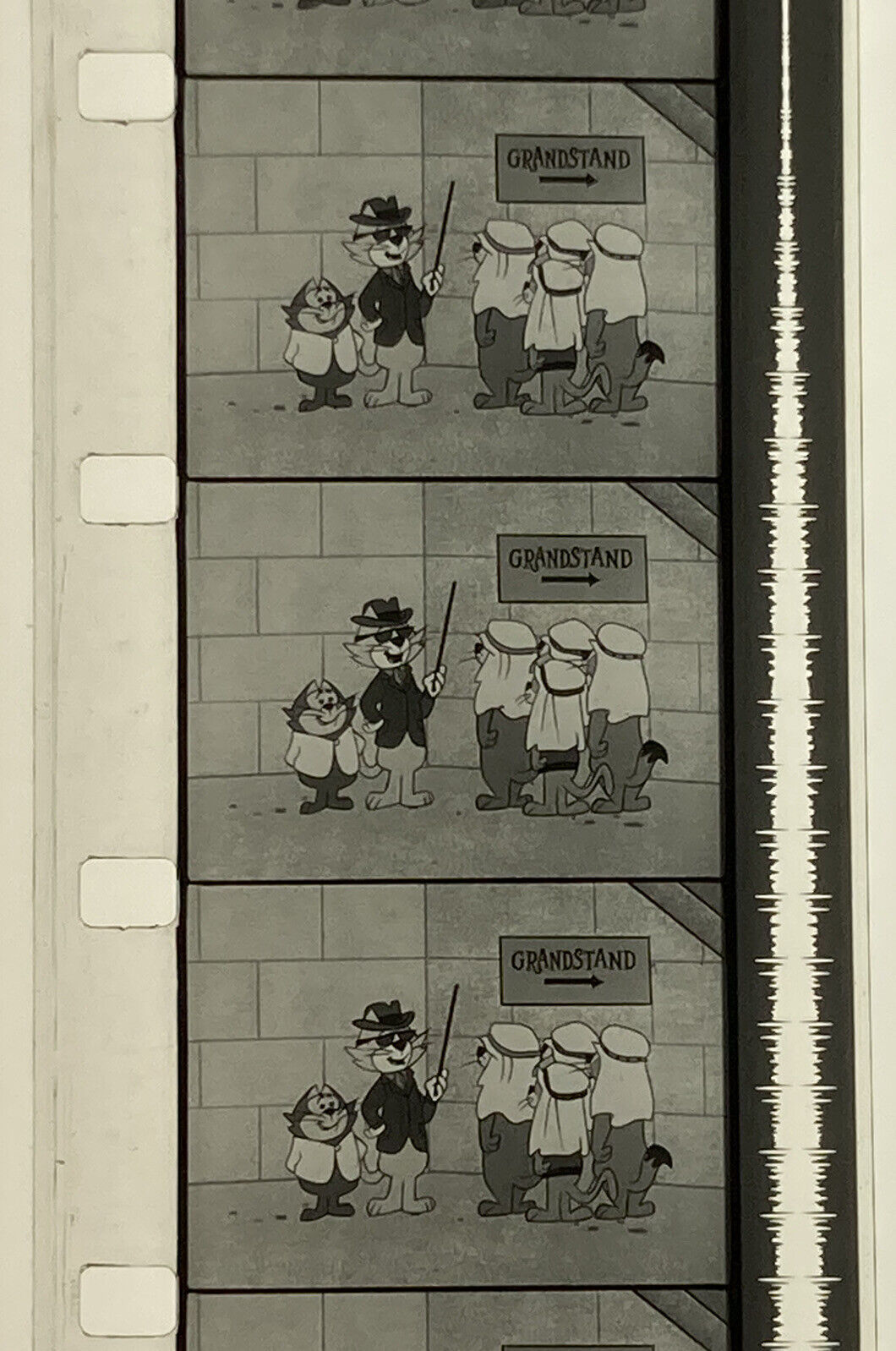
It would appear some stations aired the series on a different night, as 16 mm. black-and-white prints exist of the show, complete with commercials. One of “Derby” is for sale on-line as of this writing.

The seller has these neat shots of the actual film. The first film strip below has the unmistakeable earmarks of being animated by Carlo Vinci. The mouth on Top Cat gives it away. He gave Fred Flintstone the same kind of angular expression. Variety’s review at the time claimed Ken Muse animated the episode. I haven’t seen the cartoon in eons, so I don’t know if he worked on it (he animated the series opening), but there is no way Muse did that first scene below.


We mentioned commercials. Here are some frames from a spot for Kellogg’s Special K I’ve never seen before. (Other ads for Bristol-Myers products are live-action). The characters sure don't look like the H-B house style, do they? The teenager looks a bit like Waldo from UPA’s Mr. Magoo shorts.


Below are some frames from the opening and closing. The ABC title card isn’t on the DVD version (the one with the credits all screwed up).


The series leaves me a little cold, despite Top Cat’s cue library by Hoyt Curtin being really enjoyable (especially his mock Gershwin) and a superb voice cast. I love Marvin Kaplan. I love Arnold Stang. What better, then, than to reprint an interview Stang did about the show, and his family. He also makes a startling revelation of one of his best-known on-camera roles up to that time. This appeared in the January 6, 1962 edition of the Charlotte News.


IT’S DISTRESSING
Arnold Stang: Cat's Meow

By VAL CAREW
SPECIAL TO THE NEWS

HOLLYWOOD — Arnold Stang, in his time, has played almost every kind of animal. Currently he is gainfully employed as Top Cat, the title puss on the cartoon show (ABC and WSOC-TV) of the same name.
Playing a cat is, he says, a challenge. Not because of the character's felinity, but because he is just serving as a voice for animation.
"Ordinarily," says Stang, "I act with my body, with my face and with my hands. But here I can only use my voice. It is a great challenge."
WHILE IT IS obvious that Stang likes his job — the hours are good and so is the pay — he is still a bit unhappy that he is not accorded the chances he'd like at heavier parts.
"It is distressing," he admits. "Everybody thinks of me automatically as the character on the Milton Berle show. And I hated that part more than anything I did.
"I quit several times, and the last time I quit I went right into 'The Man With the Golden Arm.' That was a fine picture and I had a fine part.
"I thought that was an important role. And, since then, I have had some other serious things to do on TV, in the movies, on the stage But, despite that, it’s still the Berle thing people remember. And I seldom get thought of in serious terms."
STANG AND HIS family moved to California for the Top Cat assignment. They are all adjusting nicely to the West Coast, although the house they bought burned down in the Bel Air fire.
Happily, they were all away at the time, but they lost everything they owned — including some souvenirs which are irreplaceable, such as a letter from Sir Winston Churchill.
The two Stang children — his 1-year-old son and 1year-old daughter — like the California climate, although they miss their friends back east.
ARNOLD'S SON at the moment wants to be an archaeologist, and "seems to be quite serious about it." The little girl is going through the ballerina stage.
"Up until a year ago," Arnold says, "if you asked her what she wanted to be, she'd say, 'A person.' I always thought that was a very good answer."
Stang has been kept quite busy with things other than Top Cat — he's made three movies and starred in several other TV shows. The Top Cat recording schedule is always arranged to suit him — it can be in the evening or on weekends, if he's otherwise occupied. And he sometimes does three a week, so he can go back to New York for a week or so.
AS FOR STANG'S intimacy with cats — he has none.
"I don't own a cat. I've never owned a cat and I doubt if I ever will own a cat," he says. "We have a dog, you see.
"Actually, I don't think that observing a cat would be of any help to me in this show. The fact that Top Cat is a cat is incidental; he thinks and acts like a human being."


Things looked good for T.C. for a bit. ABC ordered additional episodes but stopped at 30. The ratings weren’t good enough; during one week in San Antonio, the alley cat gang was beaten by a syndicated show. Top Cat was part of an anticipated prime-time animation boom caused by the success of The Flintstones the previous year. Instead, it fizzled and network soured on animation. T.C. was moved to Saturday mornings the following year. With no new episodes (and no residuals for actors), the series was now reasonably cheap and therefore attractive to companies that wanted to aim solely at kids (in other words, no more ads for Alberto VO-5 like in prime time).

The characters have popped up on occasion since the original series 60 years ago but it’s somehow not the same without Arnold Stang and Curtin’s Rhapsody in Blue-ish clarinet opening an episode.

My thanks to Austin Kelly for his tip that resulted in this post. The blog resumes its retirement.

Monday, 31 January 2022

Leo De Lyon

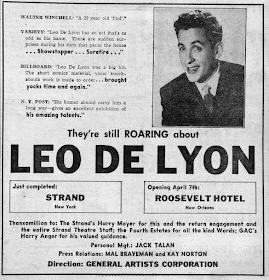
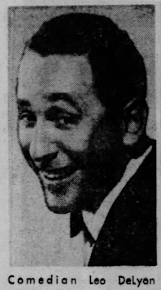
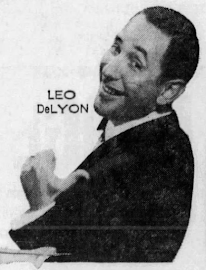
An anonymous note has been left on the blog asking why the death of Top Cat actor Leo De Lyon hasn’t been mentioned here.

It’s pretty simple. I have to know about it. I did not know Mr. De Lyon, nor am I connected with his performers union. He has been out of mind for many people for at least half a century. 50 years ago he was directing an 18-piece orchestra behind the vocal stylings of Sandler and Young. That’s not exactly national television exposure.

As a side note, I remind everyone this blog is, for all intents and purposes, finished. I’ve moved on. I don’t come here now. There are still some finished and half-finished draught posts in my folder than I may get around to putting up (the Tralfaz blog is on auto-pilot until the end of September, though I have banked a number of obits that can be posted).

Anyway, Mr. De Lyon’s union (SAG-AFTRA) reported he passed away last September 18th.

About the only thing most people know about him is he was on Top Cat. I doubt anyone reading here saw him as a regular panelist with Bob Haymes and Dorothy Loudon on “It’s a Business” on the DuMont network starting in March 1952. Or his appearance on Uncle Miltie’s show in 1949 (Dorothy Kilgallen quoted Mr. Berle as saying De Lyon was “a one-man Marx Brothers”). He seems to have spent the bulk of the 1950s in clubs, and made a few talk show appearances in the 1960s.

De Lyon was a case of “fastest rising young comedian.” We find him in June 1948 as part of Paul Whiteman’s stage show in Philadelphia. He was working nightclubs in New York City in less than a year after stops in Toronto, Baltimore and Miami (the last city was likely used to break in his New York act). One of the Philadelphia papers revealed when he was a sailor (submarine service) during the war—and he had to be in his teens then—he stopped in at the Embassy and Little Johnnie’s in Phillie and entertained customers with sketches, impressions and piano playing.

The best profile I’ve found about him is at the start of his career. The New York Daily News published this story on May 15, 1949:


Leo’s Lurid Noises At Last Appreciated
“My getting hooted out of all the basketball games at high school was the cause of it all,” recalls Leo De Lyon, zany young comedian currently featured in the Roxy stage revue. His hop from the Strand to the Roxy, with less than 21 days elapsing in between, chalked up a new mark for the Broadway history hooks. This 23 year old Brooklyn madcap has been tagged “the year’s comedy find” by such theatrical cognoscenti as Arthur Godfrey and Paul Whiteman.
Only six years ago, Leo was a student at Franklin K. Lane High in Dodger-town and was prohibited by the principal from attending any interscholastic basketball game. De Lyon used to hide himself in various shadowed corners of the balcony, wait for exciting portions of the game, and then imitate a referee’s blasting whistle so perfectly, the players on court would halt in their tracks to see who fouled whom. All this just for laughs, and they came in torrents, until Leo was discovered, escorted to the principal’s office and told to stay away front any future basketball contests. So Leo, who shined shoes and sold newspapers after school to increase his meagre allowance, decided he’d eventually try getting paid for his talent at rib-tickling.
Has Huge Range.
De Lyon has a vocal range of 86 notes, all in perfect pitch, which is just two less than the number of ivory-encased do-re-mis on your parlor Steinway, something no Metopera diva can equal. When he toured honky-tonk clubs and resorts in the borscht belt hinterlands late last year, before hitting Broadway, the band musician would tune up their instruments to his voice, tossing aside the accustomed method of using a piano.
The Catskill paths led Leo to his first major break. He was called upon to join Paul Whiteman’s “On Stage America” unit for one week in Philadelphia, although not for the job he thought.
Whiteman needed a substitute pianist and Leo had mastered the art of 88 back in his school days. During one performance, the maestro suddenly realized his show was running short and looked around for a fill-in. When one of his musicians mentioned pianist De Lyon was adept at zany comedy, thanks to Leo’s impromptu pranks back stage, Whiteman grabbed Leo away from the keyboard and told him to “get out there and do anything you want for about five minutes.”
The results were tremendous. Leo tore down the house with his spontaneous bits of trick voice and song, which encouraged the Brooklyn madcap to seek Broadway stage work.
His next stop was Arthur Godfrey’s “Talent Scouts” radio program. It was only a few months ago that Leo appeared on the Godfrey show and won hands down. His mother was so overjoyed she led a parade of some 50-odd De lyon rooters from Brownsville down Broadway with a “the treat’s on me” call. Was Leo’s victory toasted in the chi-chi confines of the Stork or El Morocco? Certainly not. His mother took the neighborhood fan club to a cafeteria on 50th St. and treated one and all to coffee and Danish.


In 1950, De Lyon was performing overseas. One show was at London’s venerable Palladium. In the middle of the decade, he toured Australia with Johnny Ray. At the end of the decade, he was performing at Danish Days in Cedar Falls, Iowa. In January 1961, he emceed at the Minneapolis Auto Show before moving across the U.S. from New York to Los Angeles to try to further his career. By early May, after an appearance at the National Orange Show, he had been cast in Top Cat (along with Michael O’Shea, who was un-cast as T.C. fairly quickly).

After Top Cat failed to catch on in prime time, Leo headed back onto the road for more fairground-type m.c. But Hanna-Barbera wasn’t through with him. Here he is from the soundtrack of the 1966 feature A Man Called Flintstone.


He also contributed incidental voices to The Smurfs.

With his versatile vocal chords (his club act once featured him singing as both Jeanette MacDonald and Nelson Eddy), he was a natural for novelty records, a huge industry in the ‘50s and ‘60s. This was the debut single for Musicor Records, according to writer Al Kooper. The backup band was the Aristocats, a group from Kooper’s home town. The song was copyright August 23, 1960.


In 2020, Leo and his wife moved into a home in Ventura, California. At age 95, the graduate of Julliard tickled the ivories and someone recorded a snippet of him. You can find it on Facebook.

Fans of Top Cat likely know he was interviewed for the DVD set dealing with the series. Over the years, people have posted parts of these great extras on YouTube only to have them taken down. With some trepidation, I link to Mr. De Lyon below and hope it’ll remain.


Someone reading here will wonder who is still around from the early Hanna-Barbera days. Working back from Top Cat, the voice of Yakky Doodle, Jimmy Weldon, will be 99 later this year. I have not been able to determine if the original voice of Blabber Mouse, former KFWB disc jockey Elliot Field, is still enjoying life in the Palm Desert area. He would be turning 95 this year.

Perhaps the most appropriate of the many gigs Mr. De Lyon played was in 1969. He headlined the programme at the all-county meeting of the Westchester Lighthouse at a church in White Plains, New York. The guest speaker at the event was a woman named Mrs. Dibble.

Monday, 27 September 2021

Let's Party With T.C.

What were Bill Hanna and Joe Barbera doing the night Top Cat debuted 60 years ago?

Watching TV, what else?

And so were members of the Hanna-Barbera staff and sundry actors, as detailed in this story in the Pittsburgh Press of October 2, 1961. The series aired beginning September 27th.

The story focuses on the money the studio tied up in the series, hoping to reap profits in all kinds of merchandise. And there were potential BIG profits.

The New Steve Allen Show premiered immediately preceding T.C. I have not been able to discovered what the “animated insert” was that caught the attention of the H-B staff.


FROM HOLLYWOOD
Animated Cartoon ‘Top Cat’ Watched Intensely By 160

$800,000 Investment Spells Reason For Their Interest
By FRED REMINGTON, Press TV-Radio Editor
HOLLYWOOD, Oct. 2—There was something strange and ironic about 160 prosperous, well-dressed adults watching an animated comic strip with silent, fierce intensity.
They were members of the Hanna-Barbera organization, gathered to watch the television debut of their newest property, "Top Cat." For its first appearance they had taken over the Tahitian restaurant on Ventura Boulevard. It's a spectacular place, visible for miles up and down the San Fernando Valley by the great flaming torches which mark its entrance.
The intense preoccupation of these people with an animated cartoon becomes understandable, though, when you consider the finances involved.
“We have $800,000 in this thing before the public has ever set eyes on it,” said Bill Hanna, one of the partners in this fantastically successful firm of animators.
"We are irrevocably committed to making thirty of them at $68,000 a half hour," said his partner, Joe Barbera.
Hanna-Barbera merchandise—Yogi Bear dolls, Flintstone paint sets, etc—last year grossed 43 million dollars. The cartoons are seen in 38 countries by an estimated 300 million people.
This week the Hanna Barbera offices here received, a fan letter on "The Flint-stones"—now also a comic strip in The Press—which they cherish. It was from a viewer in Russia who watches 'The Flintstones" on a TV channel in Helsinki, Finland. The English was faltering, but the Russian got across the idea that like many other people he digs “The Flintstones.”
"I wonder if we've got 'em saying 'Yabba-dabba-doo' in Russian," mused Joe Barbera.
Present for the "Top Cat" kickoff were most of the actors who provide the voices: Arnold Stang who is the title character, a breezy Runyon-esque Manhattan alley cat; Maurice Gosfield who is another of the cats.
The "Top Cat" party had gotten underway at 6 p. m. and was swinging pretty well by air time at 8:30. There was one brief interval during the Steve Allen show, which preceded it, when stillness fell over the room.
This was when Allen introduced a brief cartoon segment on his show. This was a New York-done animation and the California animators of Hanna-Barbera rushed to the room's many TV sets to inspect it.
One kept his face not three inches from the screen during the brief cartoon insert on the Allen show.
"Brush work is kind of rough," he said to a colleague. "But the jokes are good." The other nodded in agreement.
But when "Top Cat" came on absolute hush fell over the room. The lights were lowered. It was like curtain time at a Broadway opening or the first pitch of a World Series.
When it was over there was wild applause. People shook hands with one another, "You got another winner, Joe," someone told Barbera.
"Thanks," he said gratefully. “I like it. You like it. Now if the public just likes it. . .”


By the way, there was a little confusion at the time about the first episode that aired. The ad above lists "The $1,000,000 Derby" (animated by Ken Muse) and that is what Variety reviewed two days later. But there were a few ads with a drawing from "Top Cat Falls in Love" in some papers. It actually aired October 18th. I can only guess the network made a late switch. I don’t know what the production order was.

Top Cat showed up on the 1961-62 prime time schedule along with a host of other new animated series. Networks thought they’d have another Flintstones-like success on their hands. They didn’t. The prime-time animation fad died, though Hanna-Barbera convinced ABC to give it a go the following season with a show just like The Flintstones—except in reverse. It would be set in the future, not the past. It was cancelled before the TV year was up.

But Top Cat was only a failure in prime time. The same 30 episodes were run over and over again for years. It’s never been among my favourite H-B shows, but it has a great cast and wonderful background music by Hoyt Curtin and his session men.


Saturday, 18 September 2021

Promoting Top Cat With Arnold Stang

Top Cat had a top cast.

Marvin Kaplan (Meet Millie) and John Stephenson (The People’s Choice, Bold Venture) had both worked on television series. Leo DeLyon appeared in nightclubs. And since Top Cat was meant to invoke memories of Phil Silvers’ quick-talking Sgt. Bilko, who better to cast as the main sidekick than Maurice Gosfield, who performed the same function on Bilko as Pvt. Doberman.

Casting T.C. himself was a bit of a challenge. Film actor Michael O’Shea was tried out but couldn’t handle the dialogue. You can read more in this post. Daws Butler was tried out but he was already doing a Silvers-like voice as Hokey Wolf. Finally, Arnold Stang won the part.

By 1961, when Top Cat first aired, Stang had distinguished himself on radio, television and film (live action and cartoon). And like many stars, he was pushed out onto a publicity tour for his show. During a stop in his hometown of New York City, the Daily News talked to him about the series, his career, the Hanna-Barbera studio, and cats. It was published November 12, 1961.


Arnold Stang Likes Doing Voice of ‘Top Cat’ on TV
By BEN GROSS

Appearances are deceptive. There's Arnold Stang, for example. For years you've laughed at him; you've thought of him as such a funny, helpless, lovable dope, a pint-sized schlemiel. But you've been wrong. He's really a very smart fellow.
Arnold proved that emphatically, when as a pupil in our town's Townsend Harris High School he won a gold medal for the highest state-wide scholastic average. He also gave evidence of his capabilities through successful appearances on radio shows, among them those of Joe Penner, Henry Morgan and Orson Welles, plus many hilarious TV stints with Ed Sullivan, Perry Como and other stars.
The distraught, squeaky voiced, rabbit-like youth with horn-rimmed glasses seen on television bore no resemblance to the serious, sedate man who sat beside me in the Beverly Hills Trader Vic restaurant. There, amidst the Polynesian surroundings, he told me why after many years of appearing as Arnold Stang, he had consented to become a mere voice, that of the title role in the new cartoon series. "Top Cat" (ABC-TV, Wednesdays, 8:30 to 9 P.M.).
Accepts Challenge
Speaking in low, well-modulated tones, he said simply: "It's a challenge and I've accepted it."
"But aren't you doing what most actors hate to do—eliminating your personal identification?" I asked.
Arnold, a mere five-foot-three and weighing only 103 pounds, squinted his brown eyes and answered: "Although I've been starred and featured, I've never tried to have a show of my own. Doing a series before the TV cameras is the surest way of eliminating yourself.
"Just look at the list of comedians who used to be on the air week after week, years ago—Wally Cox, George Gobel, Henry Morgan and others. They were consumed by television. Jack Benny and Red Skelton are about the only survivors.
Real Characters
"As for 'Top Cat,' in my opinion, it's not only a highly amusing animated feature but it presents characters who are just as real as a show in which people appear before the cameras."
"But the fact is that the audience only hears your voice." I said. "They don't see Arnold Stang." "That's where the challenge comes in," he answered. "Just through my words I have to create a three-dimensional cat out of a one-dimensional picture.
Good Radio Actors
"And believe me, you've got to be a good actor to do that. But come to think of it, that's what performers and sound men had to do all the time in radio. Nothing on the air was ever as funny as some of those sound effects on the old Jack Benny and Fibber McGee and Molly shows."
"How does a fellow act the role of a cat in one of these cartoons ?" I wanted to know.
"It's quite a job." Arnold explained. "But the firm of Hanna and Barbera, who created ‘Top Cat,’ are geniuses when it comes to producing animated cartoons. You know what they did with ‘The Flintstones’ and ‘Huckleberry Hound.’ So they've worked out a good system for their live actors.
‘Story Board’
“First of all, there's a 'story board.’ It's a sheet of paper containing about 30 frames of pictures. These represent the key incidents of the action. While looking at this, we actors have a script of the dialogue; in this way we can visualize the scenes in which our lines are spoken.
"This takes place in a recording studio. We read the script and our words are taped. We convey character through our tones. For example, as Top Cat, I have a low, throaty voice, one that suggests a lovable con man."
"Now that you play a feline, are you fond of cats?" I asked.
"Oh, I like 'em; but I can take ‘em or leave ‘em," Arnold told me. "I've always owned dogs; but some of my best friends have cats."
Cats Aren't Villains
"Why is it that cats are so often portrayed as villains?"
"I don't think they are anymore," he said. "Today, most persons regard cats as very intelligent animals, strong-minded, determined and independent. Why, even such a virile fellow as the late Ernest Hemingway was fond of them.
"Incidentally, this is not the first time I've been associated with an animal. In one show I was the voice of a gorilla, and some years ago, I appeared in an NBC color special, ‘Jack and the Beanstalk,’ in which, believe it or not, I portrayed the giant. And that production had an animal ballet. And guess who played the hind half of a cow? None other than Jason Robards Jr!"
Audience Laughed
The son of an attorney, and the nephew of a man who at one time headed a New York City school district, Arnold was born in Chelsea, Mass. Sept. 28, 1923. Many years ago, he sent from there a postcard to the famous Children's Hour radio show asking for an audition. Getting an affirmative response, he appeared garbed in knickers and wearing glasses, to give a serious reading of Poe's poem, “The Raven.” But his voice was changing at the time. "No sooner had I read the opening line than the audience roared. From that time on, although a serious youngster, I was tabbed as a comedian," Arnold recalled.
Soon he was on radio as a regular with Bob Hope, Eddie Cantor, Fred Allen and Milton Berle. He created what is now known as the "Stang type" of characterization in "Duffy's Tavern" and the "Easy Aces" series. When TV came, Arnold made a hit as Francis, the stagehand, in the Berle shows.
A 'Serious' Actor
Arnold also appeared in many Broadway plays including "Sailor, Beware," and not long ago scored as a serious actor with his moving portrayal of Sparrow in the movie, "The Man With the Golden Arm." His success in that role was one of the highlights of Arnold's life. For despite the laughs he evokes, like most comedians, he has always wanted to be a "serious" actor.
"As a matter of fact, I'm a serious guy," he said. And always a student, he might have added. That's why, after his family had moved to New York, he was able to win that scholastic honor at Townsend Harris High.
Lives on Coast
Following years of shuttling between New York and Hollywood, Arnold, his wife, Jo Anne, and their two children, David, 10, and Deborah, 9, have finally moved to the Coast. There they bought a house in the Bel Air section of Los Angeles which, unfortunately, was destroyed by fire last week.
Stang, unlike some stars, has a special fondness for the press. He said: "My wife once worked for the Sunday section of The News and I met her the first time when she came to interview me for the now-gone Brooklyn Eagle."

Stang was one of a number of actors who fudged about their age, likely to get younger roles in radio in the ‘30s and ‘40s. He was five years older than he let on.

Screen Gems tried a different kind of publicity tour involving Stang before Top Cat aired. Here’s a description from Variety, Sept. 27, 1961.


A Screen Gems Primer On How to Promote A Cartoon ('Top Cat')
ABC-TV is preeming "Top Cat" tonight (Wed.), but there was a problem originally of how to promote the cartoon series via one of tv's traditional pre-preem road tours to warm up local audiences.
Screen Gems, the outfit that sold "Cat" to the web, solved the touring problem. SG flack chief Gene Plotknik, giving his show the edge over the three other cartoon series preeming this fall, got producer Hanna-Barabera [sic] to have Arnold Stang and Maurice Gosfield, the show's main voices, prerecord five-minutes of banter with local tv emcees. Gosfield and Stang ask the questions and spaces are left on the disk for answers, which any local performer can answer.
That accounts for the voice part of promo. As for "bodies," Plotnik got Eaves to turn out costume replicas of the cartoon characters involved, Top Cat and his pal Benny the Ball, which are being bicycled around to ABC affils in special containers. Costumes have been worn by office boys and flack gals at the local station level, who have gestured, mimed and danced to the words of Stang and Gosfield.
The "Cat" has played nine major markets since Aug. 15.
Main trouble? Plotnik says that there were no press interviews as on other promo tours. "With the press these days," he says, "you can't get down the answers in advance."

Despite the fine cast, which also included veteran Warner Bros. character actor Allen Jenkins, and an effective music library by Hoyt Curtin, the show didn’t survive. Daily Variety reported less than two months after Top Cat debuted that ABC was negotiating for a revival of The Rebel to replace the cartoon series in mid-season. That didn’t happen, but ABC announced reruns would appear on Saturday mornings the following year (Variety, March 14, 1962).

Fans will argue the show was just as popular as H-B’s other prime time animated half hours, and they might have a point. Reruns showed up on small screens season after season, first on regular TV then cable; a flash-animated movie was released in 2011; an “origin story” computer-animated film came out to major yawns several years later; and he’s one of the characters in the Jellystone! streaming series.

Arnold Stang is no longer with us (Leo De Lyon is apparently the only cast member who is) but you can always pull out home video with the 30 episodes and enjoy him one more time.

Saturday, 13 February 2021

He's Still a Top Cat

It’s tough to say how much the older Hanna-Barbera cartoons are in the public consciousness these days. I don’t watch TV so I couldn’t tell you if any channel is airing them. The Flintstones got a Blu-ray release last year and The Jetsons came out in the same format a year earlier, so the people at Warners still thinks there’s a market for some of the cartoons.

This is a roundabout way of saying I was surprised to see a story the other about some of Hanna-Barbera’s output, including Top Cat. It was in, of all places, The Press and Journal of Aberdeen, Scotland. Granted, it appears to be a column designed to bring about nostalgia in older readers, but it’s better than nothing. You can read it here.

You’ll have a good laugh at how the writer praises Bill and Joe’s Tom and Jerry cartoons at MGM—with a frame from a Chuck Jones Tom and Jerry! And you’d think he’d mention that Ken Muse animated both the MGM Tom and Jerry cartoons and Top Cat (in the frame above, you can see the same expression he gave Tom in a number of theatrical shorts).

Meanwhile, the Gwinnett Daily Post this week had a trivia question about the series.

And over at the
NBC Right Now site, a lifestyles writer has named Top Cat number 86 in its list of the Top 100 TV shows of the ‘60s (people love lists).

Incidentally, The Hollywood Reporter blurbed on July 16, 1961:


Writer-cartoonist Tony Benedict has been signed to a three-year exclusive pact by Bill Hanna and Joe Barbera. As his first assignment, Benedict will tele-script two “Top Cat” shows.

Tony has mentioned to me did work on Top Cat but he wants to make it clear that he started at Hanna-Barbera in 1960 without a contract, first writing and storyboarding the Huckleberry Hound and Yogi Bear shows (he invented Alfie Gator on the Yakky cartoons) and moved on to the half-hour comedy prime-time shows, and others “too humorous to mention,” he tells me. I was hoping he could tell me which T.C. episodes he wrote, as the credits were snipped from the shows some time ago (before the DVD release), but I am awaiting a response.

Saturday, 27 July 2019

Explaining Cats

Hanna-Barbera made good copy in 1961. The proof is in a search through newspapers as Arnie Carr’s PR department successfully pushed the studio’s newest series, Top Cat. Editor after editor opened up a full page of valuable space to promote the show. Quotes from Joe Barbera, Bill Hanna and/or the show’s stars, accompanied by what must have been a large stack of stills, filled space. In addition, some papers featured a picture of T.C. on the front page of their entertainment pullout section.

It shouldn’t be a surprise. The studio was on a roll. Critics loved the Huckleberry Hound show when it debuted in 1958. The Quick Draw McGraw show got positive ink in 1959 for its gentle satire of TV programming trends. The Flintstones was greeted with mixed reviews in 1960, but quickly became a hit with audiences. Audiences couldn’t get enough Hanna-Barbera cartoons.

Well, actually, they could. Top Cat turned out to be a prime-time failure. Its elements simply didn’t add up to attract a big enough audience. I’ve mentioned before I’ve never warmed to the series, though I love Hoyt Curtin’s tracking library and think T.C. was Arnold Stang’s best cartoon role. But let’s set that aside and bring you a couple of newspaper stories.

Story one was published November 11, 1961. The writer was syndicated; by whom, I don’t know. Interestingly, of the half dozen or so versions of this story I’ve read, each of them has a different publicity photo with it. The second story is from the Pittsburgh Press of December 3, 1961. I’m a little miffed with it because it omits John Stephenson in its profiles of the voice actors. It’s not as if he was obscure; in the 1950s he had been a regular on the sitcom The People’s Choice and hosted Bold Journey for a time. Stephenson began his Hanna-Barbera career with The Flintstones and was the studio’s go-to guy for starring, supporting and utility roles for more than 30 years. The funny thing in the second story is the writer evidently couldn’t make out all the theme song lyrics so he omits one line (all Curtin had to do was change the notes to fit the syllabic emphasis and there never would have been confusion).


'Top Cat' Keeps Things Swinging On Officer Dibble's Alley Beat
BY EDGAR PENTON

HOLLYWOOD—There's an alley somewhere in the heart of New York that's been swinging since September 27. That was the debut date of Hanna-Barbera's Top Cat," Wednesday night cartoon series on ABC-TV. And the alley is the home of T.C. and his rowdy band of fellow felines.
T.C., as he is affectionately called by his friends and cartoon cohorts, heads a quintet of TV's wackiest characters.
There are rotund Benny the Ball, T.C.'s sidekick who's a little slow but far from stupid; Choo Choo, an eager ball of fire with spinning wheels that take him nowhere; Spook, a pseudo-intellectual who's more often in orbit than not; The Brain, so named because of his almost complete lack of thinking power; and Fancy-Fancy, a feline fop who's great with the girls.
THE CLAN'S favorite target is Officer Dibble, the cop on the alley beat who is kept thoroughly confused but undaunted by their adventures.
Top Cat, himself, is a dyed-in-the-wool con man with a heart of gold. His spinning mind, glib tongue and out-of-this-world imagination are dedicated to one proposition to raise the living standard of his fellow cats. He's an opportunist and nimbly aggressive but he'd never hurt anyone.
"Top Cat and his pals live in a New York alley, but it's not a depressing alley," said Joe Barbera. T.C. has seen to it that it has all the comforts that a well-adjusted cat needs. There's a telephone on a nearby pole that's officially for police use only, but T.C. doesn't let this discourage him from making free and frequent use of it.
The lively group gets nourishment, with little effort, from bottle of milk left on neighborhood doorsteps.
"T.C. lives in a magnificent ash can, but when bad weather makes the ash can uncomfortable, he and the group congregate in the basement of a nearby delicatessen.
"Always anxious to improve their minds, the cat sextet studies the newspapers tossed on doorsteps."
WHEN ASKED why they chose alley cats as the heroes of their new half-hour series, Bill Hanna replied, "It's simple. Cats have a lot of personality on which we can capitalize. Stray alley cats, in particular have real living problems with which we feel viewers can easily identify. They're going to understand the gang's struggle for survival and they're going to enjoy the fun they have with their freedom."
Top Cat is a 'doer' and somewhat of a conniver, but he's wonderfully good-hearted.
"All his pals admire T.C.," continued Bill. "His word is law. He's not really a dictatorial leader—his clan is strictly democratic—but a breakdown of the voting would show that Top Cat has 50 per cent of the voting power."
"Even Officer Dibble loves T.C., down deep in his lawman's heart," added Joe Barbera. "Officer Dibble and T.C. are constantly engaged in a battle of wits, and the battles get pretty spicey sometimes.
"Dibble is no fool, nor is T.C. It's easy to see that both of them really love this brain trust battle.
"Arnold Stang, who supplies the voice of Top Cat, refuses to look on cocky T.C. as a cat. "He's a person, one with whom everyone can identify," said Stang.
"HE'S MY IDEA of a perfect television hero," Stang continued. "Viewers will think they know someone just like him, and the chances are they do. It becomes pretty personal at times.
"Take Top Cat's running battle With Officer Dibble. People are bound to love this because T.C., in a completely inoffensive way, flouts the authority that Dibble represents. "T.C. knows that he has to conform, but he, like many of us, would like to break away from the confines of conformity once in a while. He walks a fine line; T.C. never breaks the law, but he manages to make life pretty hectic for the law enforcer.
"You cant help but admire that canny intuition of his. Dibble has many Achilles heels, and T.C. has found most of them."
With Stang's enthusiasm for his role in "Top Cat," and his previous role in the animated series, "Herman the Mouse," the question may arise, "Are you man, cat or mouse?" At the moment, Stang might have a little trouble answering.
Maurice Gosfield, well-known for his role of Doberman in the Sergeant Bilko Show, provides the voice of T.C.'s chief confrere, Benny the ball.
"Frankly, I prefer Benny to Doberman," said Gosfield. "Benny is smarter. That chubby little character has become a real person to me. From now on, every time I go to New York I'm going to expect to see those cats in some alley."
"Benny is a combination aide-de-camp and conscience to Top Cat. Sure, he's somewhat of a dolt, but he always manages to be down-to-earth enough to ask logical questions."
Choo Choo (voice by Marvin Kaplan) is the eager beaver of the group. He's the errand-runner who is so eager that he usually dashes off on a mission without waiting to hear what it is. Spook (Leo De Lyon) is a four-legged beatnik who is trying very hard to be an intellectual. But he can't quite hide his foolishness.
THE BRAIN, also voiced by De Lyon, is described by Leo as "a sort of Nebish of the streets the outdoor-type Nebish. "He's not too bright, but his is an unusual type of stupidity. He knows he's stupid, but he's always in there pitchin'."
Fancy-Fancy (John Stephenson) is the ladies' man of the alley set. He's proud of his irresistible charms, but this is his only asset. Everyone knows that an alley wouldn't be as exciting without at least one lover-type cat.
Allen Jenkins is the voice of Officer Dibble, the upholder of law and order in the alley. This takes him into fascinating side trips in the realm of imaginative cat schemes. "Working with Bill Hanna and Joe Barbera in this series is great," said Jenkins. "I'm proud to be a part of it. Just imagine the built-in audience the series has.
"Out of approximately 170 million people, there must be at least 150 million cat lovers. Now, that's what I call a receptive group. I find that I'm taking the role of Dibble pretty seriously because it's Dibble's responsibility to uphold the two-legged end of the battle of wits.
"I look forward to seeing what new schemes T.C. is going to think up next."

The Men Behind The Voices
By Fred Remington
Press TV-Radio Editor
Top Cat—the most effectual
Top Cat—whose intellectual
Close friends get to call him T. C.
Top Cat—the indisputable
Leader of the gang.
He's the boss, he's the king
But above everything
He's the most tip top
Top Cat.
Yes, he's the boss, he's the king.
But above everything
He's the most tip top
Top Cat.
Top Cat!

WITH THIS swinging theme music, each Wednesday evening at 8:30 (Channel 4) 'Top Cat," one of this TV season's crop of animated cartoon series, makes its appearance.
Like several other cartoon series, "Top Cat" is more of a radio show with pictures than it is a TV program. The voices make it. The pictures, while often inventive, are supplemental.
As with other cartoon series, both in and out of the prolific Hanna-Barbera stable, the voices of "Top Cat" are arrestingly familiar. There is a more than casual touch of Phil Silver's Sgt. Ernie Bilko to the jaunty, angle-man tones of "Top Cat."
(More tantalizing still, however, are the voices in the "Bullwinkle" series on Sunday nights, a production of the colorful Jay Ward studios. The voices are fleetingly, hauntingly familiar, but whom do they remind you of? Red Skelton, among others?)
With the upsurge in popularity of animation series, voice actors have come back into their own to an extent they have not enjoyed since the days of radio drama. Needless to say it also has been a godsend to artists specializing in animation techniques.
Here are the men who provide the voices for the "Top Cat" characters.
Arnold Stang—The voice of TC (Top Cat) has been in show business ever since he mailed a penny post card from his home in Chelsea, Mass., to the Horn and Hardart Radio Hour on a New York radio station, seeking an audition. The audition was granted and Arnold, wheezy and raspy, recited Edgar Allen Poe's "The Raven." He hadn't got beyond, "Once upon a midnight dreary. . . ." before the producers realized they had found a rare radio voice. He was on virtually every big radio hour and was in a number of Broadway shows. His one serious role was as Sparrow in the Frank Sinatra picture, "Man with the Golden Arm." He met his wife, JoAnne, when she interviewed him for the late and lamented Brooklyn Eagle, for which she was a reporter. They have two children, David and Deborah.
Allen Jenkins—The voice of Officer Dibble traveled widely as a youth from Staten Island, where he was born, to Brooklyn, to Nyack and finally into Manhattan. This accounts for the ripe New Yorkese which he has brought to his movie and TV roles. His involvement in a series about cats is fortuitous, for he is a devoted cat-lover. Divorced, he lives alone at Malibu Beach, Calif., his only companion being a 23-pound cat named Smiley.
Maurice Gosfield—The alley in which "Top Cat" makes his residence is, Gosfield asserts, "maybe 44th Street between Eighth and Ninth Avenues because it's not too far from Broadway but still the right area for a neighborhood cop like Officer Dibble." Gosfield, remembered as Private Doberman in Bilko's platoon, is the voice of Benny the Ball. He started in radio thirty years ago.
Marvin Kaplan—The voice of Choo Choo is a protege of Katherine Hepburn, who was struck by him when she saw him perform in a community theater in Los Angelas [sic]. She got him a part in the movie, "Adam's Rib." He did several other movies before switching to TV in the "Meet Millie" series.
Leo De Lyon—Leo is two characters, Brain and Spook. His music teacher in New Jersey discovered in his early childhood that he had perfect pitch. He studied music and his career was suspended by a long tour of submarine service in World War II. After service he worked up a vocal act—he can sing as either a high soprano or a baritone. He believes he may be the only man alive who can hum one tune while simultaneously whistling a completely different one. (If you think that's easy to do, try it.)

Wednesday, 15 May 2019

Arnold Stang on Top Cat

Arnold Stang was busier outside the studio than in it in 1961.

Variety of July 19th of that year reported he was hitting the promo circuit for the animated feature film Alakazam the Great. Then it blurbed on September 29th that he’d be doing the same thing for Top Cat.

Stang was assisted on his tour by Arnie Carr’s press kit. The same phrases and quotes are found in various local newspaper interviews with Stang, such as the tale about “The Raven.”

The column below was published by the Akron Beacon Journal on December 17, 1961. Already, T.C. was in trouble in the Neilsens. The story talks of 28 episodes but a total of 30 appeared in prime time. His selection actually was a complex thing, but he doesn’t get into it in this particular interview. One of the syndication services revealed (this comes from the North Adams Transcript of October 21, 1961):

Arnold Stang was the last actor to have an audition for the voice of "Top Cat," the cartoon feline. Dozens of actors were tested and complete shows were made with other actors Michael O'Shea, Mickey Shaughnessy and Daws Butler. They had about settled on Butler when Stang was given a chance. After one reading, he was signed.
Fred Danzig of UPI reported on May 17, 1961 that Stang had replaced O’Shea. Evidently O’Shea didn’t have the role long. Variety reported on May 9th that O’Shea had the job (there was no mention of Butler but mentioned other actors previously cast).

Top Cat, to me, is one of those the-parts-are-greater-than-the-whole shows. The voice casting was very good and I love the cues Hoyt Curtin wrote for it, but the stories and characters don’t really connect with me. They did with others and T.C. still has a loyal band of fans. Stang does, too. Count me as part of that one.


Stang Is 'Top Cat's' Meow
Work's Steady But Nobody Sees Him
By RICHARD LAKE
After knocking around the comedy world for all but 10 of his 37 years, bespectacled little Arnold Stang finally has landed a steady job in a major role.
But now that he's on television regularly, nobody ever sees him.
Stang provides the voice of ABC's Top Cat in the animated cartoon series of the same name. It's seen here Wednesdays at 8:30 on WEWS. His selection for the role of "Top Cat" was "a complex thing," he quips.
"They called and asked if I'd like to do a show. I said, 'Does it pay? and 'I'll take it'."
Most of his jobs didn't come that easily. Like many other comedians, Stang, at the ripe old age of 10, thought his true calling was serious drama.
The skinny, squeaky-voiced boy stood before producers of a big-time New York radio show and recited Edgar Allan Poe's "The Raven." The producers doubled up with laughter.
"The Raven" isn't supposed to be funny. But Stang's audition fractured them.
"I was heartbroken when they laughed," says Stang. "But the wounds healed quickly when I was given a part on the show."
Somehow it's hard to picture Stang as a show biz VIP.
He's five-three and weighs 120 pounds with his horn-rimmed glasses on.
You could mistake him for a pin boy who has been out of work since automation hit the bowling alleys.
He also has popping eyeballs, a receding chin and a funny voice and could get laughs almost regardless of what he says.
Over the years, Stang has done about everything from acting in soap operas on radio to selling chocolate bars on television.
In radio days, he played Seymour in "The Goldbergs" and Gerald [sic] on the Henry Morgan show. In addition, he made guest appearances with comedians Bob Hope, Eddie Cantor, Milton Berle and the late Fred Allen.
When show business jobs were meager, he delivered telegrams and later packages for a New York ski shop.
For a while he pushed chocolate on a TV commercial. ("Whatta hunk-a-chocolate.")
In one of his first TV roles, Stang became Francis, the wise-cracking stagehand on "The Milton Berle Show."
Now working for Hanna-Barbera Productions, Stang has made 28 "Top Cat" shows and is still putting them out.
"We spend more money on writers alone than many of the big specials on TV," say Stang. "Each show costs about $67,000."
It took a staff of about 200 four and a half months to do 14,000 drawings and the scripts Top Cat has used so far. Dubbing in voices takes another eight hours for each show.
Stang stopped briefly in Cleveland recently to plug the show which apparently needs some sort of a boost. "Top Cat" is opposite the Joey Bishop Show and Checkmate and has the lowest rating of the three.
"I don't believe much in those ratings or that they are necessarily representative of the show's popularity," Stang snaps.
Stang agrees that the success of the "Flintstones" in 1960 brought the onslaught of the animated cartoons this season. However, he says, "The "Flintstones," (no pun intended) is much more "primitive" than "Top Cat."
Does he think there are too many cartoons? "Definitely not!"
"If there are two poorly produced shows on TV then there are two too many, Stang adds. "This goes for any type of show."
Stang feels "Top Cat" is a well-produced family show.
"The dialogue appeals to the adults and the pictures appeal to the children. I think it's a very happy marriage."
Stang uses a new personality for Top Cat to differentiate the cat from his "Arnold Stang type character." "I'm trying to develop new Arnold Stang catch phrases for Top Cat."
"Top Cat is someone the viewers can easily identify with someone else they know. Maybe it's the guy down the street or their boss or even their mother-in-law," he says.
"It's been proven that the shows that last and are popular must have a strong identification with the audience."
After signing for the "Top Cat" role, Stang moved his family from New Rochelle, N. Y., to Hollywood. It was a bad move for the Stangs.
They lost their home in the Bel-Air fire this Fall. "The only one at home was the maid," says Stang.
"That's the thing about these fallout shelters," he quips, "the only people that'll be saved are the maids."
He hopes to rebuild in the Spring.
Stang and his wife JoAnne have a son David, 11, and a daughter, Deborah, 10.
"We spend a lot of time reading, and often in the evening after we've read the paper we'll all sit down and discuss it," says Arnold.
TV is out for the kids on school nights except, of course, for "Top Cat."
What do they think of pop's show?
"They like it," says Stang, "but they let me know when there's something on the show they didn't like."
A confirmed do-it-yourself fan, Stang wired his California home for hi-fi by crawling through the attic "because I didn't want to cut holes in the wall."
He learned his lesson at his New York home. After knocking a hole in the wall, he found a wooden beam that wasn't supposed to be there.
So he called in a carpenter to tackle this job, and then the hole was so big he hired a plasterer to fill it.
In the meantime, Stang bought a large picture to cover the gaping hole.
Besides his work with "Top Cat" Stang is making occasional appearances on other TV shows such as Wagon Train and Ed Sullivan's.
And he's working on an MGM film, "The Brothers Grimm." He plays Rumpelstiltskin.

Saturday, 29 December 2018

Boss Cat

Is it true that Top Cat was really known as Boss Cat when it first aired in England? The answer: yes.

At the time the cartoon series was made, there was a brand of kitty food in the U.K. known as “Top Cat.” The BBC, in an attempt to avoid any hint of commercialism, changed the show’s name to The Boss Cat (and later omitted the article). To the right you see the TV listings for June 13, 1962, which was perhaps when the series made its debut.

This begs the question about how the Auntie aired the cartoon. Was the voice track altered with “Top Cat” removed and a voice edited in saying “Boss Cat?” What about the theme song and the opening and closing titles?

As ridiculous as it sounds, the soundtrack was left intact. Kid audiences were apparently supposed to deal with the confusion by bearing the old British stiff upper lip. The credits were dealt with by having a title card jarringly edited into Ken Muse’s animation.

One English critic was not going to put up with the BBC’s foolishness. Here’s a portion of the television column from The Spectator of December 21, 1962 dealing with, in part, the Hanna-Barbera prime time shows.

Child’s-Play
By CLIFFORD HANLEY

‘TOP CAT’ has returned, an even which clearly has more importance for television’s largest audience than any of the high-toned experiments in drama or education on either channel. Non-human heroes continue to have the edge over mere people among the youngest viewers, and I regularly confirm this old discovery by sitting with my back to the screen and watching my sample audience during the children’s programmes.
‘Top Cat’ interests me strangely too. (The BBC retitles the show Boss Cat, for reasons which I have not discovered.) It seems we aren’t going to have any more Bilko, but the immortal sergeant lives on in this two-dimensional moggie, which doesn’t only speak with Bilko’s voice but has the Bilko character precisely duplicated, including the cunning, the idiot lechery, the gambling fever and the loyal suckers gathered round him.
Is it possible that this represents a Trend? Even the best human series wears out in time...But you never have any trouble, personal-releations-wise, with line drawing....
The case of the Flintstones is not really so different. Barney and his mates are, if I may use the phrase very loosely, original creations. But take away the prehistoric gimmick and all you’ve got left is a perfectly ordinary old-fashioned domestic situation comedy, a Lucy-Joan-Jeannie amalgam. Thus form of entertainment, with human beings, died of inanition over five years ago, but the cartoon reincarnation isn’t only durable, it has capture an intellectual audience which would never have wasted a moment on live Lucy.
As an old cheap gag-writer I find the Flintstones wearisome, and I feel I ought to disapprove of them in principle, as I disapprove of ‘Top Cat.’ All the same, I find myself watching both programmes with a puzzled interest if they catch my eye. I too am a sucker.
Incidentally, Top Cat had unexpected competition on ITV Border Television, which served the area along the England-Scotland boundary. John Holmstrom wrote in the British publication New Statesman in its issue of April 3, 1964, referring to children’s television:
The most entertaining things just now – and it’s a sad reflection on our native talent – are the American animal cartoons. Boss Cat (BBC) is great fun, but A-R’s 5.25 Friday session is richer, featuring Quick Draw McGraw (Eccles-voiced horse sheriff), Snooper and Blabber (imperturbable cat-and-mouse sleuthing partnership) and Auggie Doggie (sneaky pip with moralising Pa). The scripts are splendidly outrageous parodies of favourite Hollywood styles. It’s superb for adults, and kids, missing some of the side-swipes, rightly relish the puns and slapstick.
The BBC put out Boss Cat in August 1967; the show was the network’s third-ranked children’s programme at the time with an audience of 2.4 million (number one, incidentally, was Dr. Who). The series returned, as Boss Cat, to the beeb four years later. In the meantime, the series began airing in November 1969 on R.T.E. in Ireland as Top Cat; certainly the Irish weren’t about to let some Englishmen tell them how to air a TV show. The BBC seems to have continued using Boss Cat as late as 1989, according to listings in The Guardian. However, from what I gather from reader Andrew Morrice, the term fell into disuse some time ago.

One other Top Cat-related note: animation historian Jerry Beck recently told webtv host Stu Shostak that Warner Home Video is putting out Jonny Quest on Blu-ray with the correct closing titles. He says depending on sales, Warner may release “single-season, Hanna-Barbera prime-time series” on Blu-ray as well. Does this mean “Where’s Huddles?” No. Does this mean “Wait ‘Til Your Father Gets Home”? No. That doesn’t leave an awful lot, except for The Jetsons and, yes, Top Cat. Could they be next? Jerry’s not hinting but, and I have absolutely no clue, but as Mr. Kitzel used to say on the Al Pearce radio show, “Hmmmm, could be.....”

Monday, 25 December 2017

Music For Alley and Cat

Christmas was Fred Flintstone’s favourite time of year, sang Alan Reed on a cartoon show quite some years ago, and it may be yours, too. So allow me to thank you for visiting this blog and, again, give you a little gift.


No, this isn’t the gift, but it has been sitting in my computer for a while. Evidently the cast of the Huckleberry Hound Show got sweaters from Perry Como for Christmas. They look like they’re ready to go out as a barber shop quartet (plus one). I don’t know who drew this or what Golden Bubble Bath is, but it’s an attractive drawing.

How about something from Dan Gordon?


Yes, it would be nice to have the full storyboard for Elephant Boy Oh Boy, but only the last page turned up somewhere in my travels. Mike Maltese wrote the story. He would make thumbnail sketches and then Gordon would take them and turn them into something that you see above.

I would like to be able to say I have more stock music from the original Hanna-Barbera series from the Langlois and Capitol Hi-Q libraries to post, but I don’t. Actually, I do have two cues I have not digitised from the Sam Fox library and, to be honest, I doubt I’ll have time to do it. However, thanks to reader J.J. Pidgeon (at least I believe he gave me these), we have some more background music from Top Cat.

I’ve mentioned before I’m not a fan of the series but my favourite H-B cues were written for it. Curtin needed city music for characters with names that evoked Damon Runyon, so he came up with cues with arrangements that evoke George Gershwin and George Shearing. T-10 and T-32 are really good metro chase cues with strings, clarinet and piano. T-113 has a neat jazz trumpet (Pete Candoli, I suspect). T-21 has a great little string line coupled with a baritone sax, while T-27 features an alto sax with piano chords in the background.

There are a few other cues I’ve tossed in because you may have heard them in different H-B shows. T-45 is a violin cue heard in my favourite Flintstones cartoon, Dino Goes Hollyrock, during the sequence where Dino is in studio watching Sassie and her arrogant co-stars shoot a heart-warming scene, and later when Dino films a scene with them.

One cue doesn’t fit in with the rest. Q-11 is a solo flute. You’ll recognise it is playing the Augie Doggie theme and you may recognise it as the music Mr. Jinks played to force the meeces to dance in Pied Piper Pipe (1960). The names are all from Hoyt Curtin’s sessions, except “Pizzi-Cat-o,” which is such a bad pun, it had to be used.

If you’d like to revisit some of our old Christmas posts, go to 2016 here, 2015 here, 2014 here and 2013 here.


T-3

T-4 Pizzi-Cat-o

T-9

T-10

T-21 Top Cat Sunset

T-23 Screwy Ideas

T-27 Lonely Alto

T-32 City Streets

T-34

T-44

T-45

T-101

T-110

T-113

Q-11

Thursday, 27 April 2017

More Safety Tips From Your Hanna-Barbera Friends

Here are the remaining safety posters from Hanna-Barbera from 1965 that we didn’t post yesterday. Parents should be teaching this kind of stuff today. I see adults disobeying some of these traffic ones on an almost daily basis.

These attractive drawings are by Jerry Eisenberg and Iwao Takamoto.

Thanks again to Mark Christiansen for providing these.