Produced and Directed by Bill Hanna and Joe Barbera
 Credits
: Animation – Ed de Mattia; Layout – Tony Rivera; Backgrounds – Art Lozzi; Written By Mike Maltese; Story Director – Alex Lovy; Titles – Art Goble; Production Supervision – Howard Hanson.
Voice Cast: Narrator, Rancher, Jeb, Store Owner – Doug Young; Quick Draw, Baba Looey, Maxie, Zeke, Masked Robber, Singing Cowboy, Chicken, Sniffing Bullet – Daws Butler.
Music: Jack Shaindlin, Phil Green, Bill Loose, Harry Bluestone-Emil Cadkin, Hoyt Curtin, Roger Roger.
Production: Quick Draw McGraw Show M-037, Production J-116 (or J-109).
First Aired: week of February 26, 1961.
Plot: Quick Draw is hired to rid a ranch of Maxie the chicken hawk.
There’s a gag in the Bugs Bunny/Wile E. Coyote cartoon “Operation: Rabbit” (1952) where Bugs quickly puts on a rubber chicken head to fool a rabbit-hunting radarscope, which ends up blasting the coyote instead. In “Talky Hawky,” Maxie the chicken hawk puts on a rubber chicken head to fool a chicken hawk-hunting bullet, which ends up blasting Quick Draw instead.
Both cartoons were written by Mike Maltese, and about half of this one bears a resemblance to the format of the coyote shorts at Warners, as there’s a series of gags where Quick Draw tries to catch the chicken hawk and fails miserably. And it’s a pretty good cartoon. Maltese tosses in some silly dialogue and a ridiculous ending.
The chicken hawk isn’t named in the actual cartoon, but he is on the model sheet. And he is in the cartoon’s summary in the TV listings for the Los Angeles Times the day it was first broadcast. I’m presuming the summaries were provided by the studio to the paper or some kind of newspaper service. Daws Butler gives him the Maxie Rosenbloom voice he used on the “Fractured Fairy Tales” for Jay Ward. So which came first, the chicken or the egg voice?

Maxie’s designed by layout artist Tony Rivera, who gave him huge eyes. There are a couple of odd layouts in the cartoon and I don’t know whether this originally came from Maltese’s storyboard. The chicken rancher and Quick Draw aren’t in perspective. If you could lower the camera on the characters below the bottom of the screen, the rancher would have to be standing on a box to be at the same level as Quick Draw.

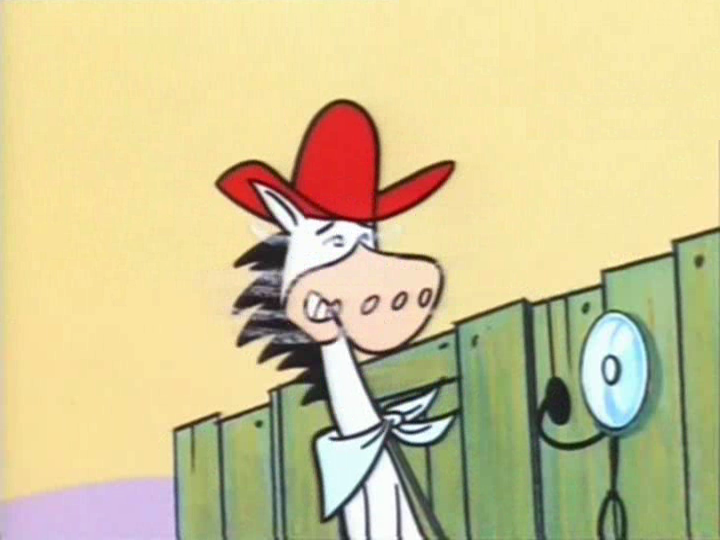
And some of the shots don’t match from medium to close up; I suspect that’s the way Rivera drew them in layout. These are consecutive drawings. When the scene cuts to the close-up, Quick Draw’s facing in a different direction.


Ed De Mattia animated this one. He has distinctive two-drawing head shakes. See the extra lines on the face.


And de Mattia liked two teeth in dialogue. His Baba looks a little off; I can’t really explain it.

The rolling, rosy hills signify Art Lozzi. I like the shades of brown on the dirt. It seems most of the H-B background artists put liver spots on the ground.

A little unusual in this cartoon is the inclusion of Hoyt Curtin’s Quick Draw McGraw theme that was used in the little cartoon vignettes between the cartoons. The following season, H-B would eliminate the use of library music altogether and go with cues by Curtin. There’s also a rare appearance of “Chopsticks” by Roger Roger from the Valentino library to open this cartoon.
 Maltese uses some old tricks at the start of the cartoon. There’s a narrator—it seems to me a majority of Quick Draws featured a narrator—and a repetitive/overly descriptive bit of dialogue. “When gold was in the Old West,” we’re informed, “the gold rush was on. In their hasty greed for gold, the miners overlooked many of life’s necessities.” That’s the cue for an exhausted miner to repeat “In our hasty greed for gold, we plumb forgot to bring something.”
The premise is something that was a reality in the Klondike Gold Rush. Simple foodstuffs went for an exorbitant amount of money. In this cartoon, it’s eggs (‘Easy terms arranged”). And that’s prompted a cattle baron to turn into a chicken rancher. Only one problem. A chicken hawk starts stealing his chickens to get at the eggs (he doesn’t want to eat the chickens themselves, he assures the hens). What’s the rancher to do? He’s urged by a cowboy to call for—and then the cowboy sings the Quick Draw McGraw theme (out of his range).
 Allow me to pause for a moment and point out the difference between a Hanna-Barbera cartoon and a Jay Ward cartoon made at the same time using the same Daws Butler Maxie Rosenbloom voice. Maxie says “Like, I’m a natural-born chicken rustler on account of I’m a chicken hawk. There’s a connection there somewheres.” It’s not unlike a line in Ward cartoon. The difference is a Ward cartoon would immediately cut to another shot or another piece of dialogue. It would treat it as a punch line and move on. But in this cartoon, Maxie tip-toes off-stage, comes back, there’s more dialogue, then the camera fades. And in the background, the slow wa-wa trumpets of Harry Bluestone’s “CB-83A” are heard, which don’t fit snappy dialogue. One of the things that helped the Ward cartoons was they were half the length of an H-B short, so everything was faster. And, as Tex Avery learned directing at MGM, if you pick up the pace of your cartoon, the cartoon generally become funnier.
I’ve mentioned before the huge workload—over 75 cartoons—that Maltese had to churn out in 1959, so he didn’t have time to polish dialogue like he would have writing fewer than ten a year at Warners. Sometimes, Maltese’s work at Hanna-Barbera is really inspired. And, sometimes, it sounds like he’s just moving the plot along or putting in something because he got to put something in there and get on to the next cartoon. The rancher offers Quick Draw $10,000 to catch the chicken rustler.
Baba: Let’s face it, Quickstraw. It’s no chicken’s feed.
Quick Draw: Then I’ll catch that chicken hawk, or my name ain’t Quick Draw “Chicken Rustler-Catchin’ McGraw.
At Warners he would have had time to come up with a sillier (and, therefore, funnier) nickname. And he might have made fun of (or avoided) the tired “chicken feed” pun. Or Chuck Jones would have augmented the pun with a funny pose or bits of personality animation by Ken Harris or Benny Washam. But Maltese doesn’t have that luxury here. Still, he comes up with a funny cartoon. The gags:
 ● A radar-return shooter has a bullet that sniffs out chicken hawks. As mentioned above, Maxie uses a mash to fool it, then pulls a chicken hawk mask over Quick Draw. The bullet does its job. Quick Draw tosses in a “Hold on thar!” I like how Maxie shows up with a pillow case. “Ahem. Pardon the intrusion, gentlemen. But I’m in dire need of loose chicken feathers. My pillow is dreadful unlumpy without ‘em.” “Why, shore, li’l stranger,” replies the dopey Quick Draw, not even knowing he’s dealing with a chicken hawk.
● A TNT-loaded chicken dummy is left by Quick Draw as bait. Maxie’s clued in because he’s watching what’s happening (off-scene). He convinces the rancher it’s one of his chickens. “Thanks, honest chicken hawk,” says the rancher, who gets blasted by Quick Draw. The reward is down to $1.30.
 ● “I’ll do the thinnin’ around here,” cries our hero, who forces Baba to dress up as a hen. Baba replies with a stringer of Desi Arnaz-invoking faux Spanish. Maxie’s fooled (“enough left over for snicky-snacks”) until he sees Quick Draw’s rifle. Naturally, Quick Draw shoots Baba in the butt instead.
● “Quick Draw is, like, shootin’ up your chickens,” Maxie tells the rancher. The reward is down to nothing. Quick Draw’s dander is up (Maltese ran out of funny dialogue again).
● Finally, Quick Draw brings in a banty-fightin’ rooster to battle the chicken hawk. Baba tries to warn him it won’t happen. Cut to a shot of the chicken and an egg. Yes, it’s not a rooster at all. The wind-up gag has Baba and Quick Draw running, then the camera pulls back to show the two of them and the egg (with feet through the shell) doing roadwork as Quick Draw decides to start “trainin’ this little rooster early.” Cut to the egg panting. Cut to Baba’s tag line: “That Quickstraw’s pretty smart. He never winds up with egg on his face.” Iris out.


There’s the usual insult/word turnaround gag. “I theen Quickstraw’s a bird-brain,” laughs Baba. “What did you say?” asks the annoyed Quick Draw. “I said ‘I thin it’s goin’ to rain’.”
This was Maxie’s only cartoon. He joined Scooter Rabbit and Yippee Coyote in the Quick Draw retirement home.
0:00 -
Quick Draw McGraw Sub Main Title theme (Curtin).
0:15 -
CHOPSTICKS (Roger) – Gold miner scene, miners collapse.
0:31 -
C-71 ROMANTIC MAIN TITLE (Loose) – Miners on ground, shot of ‘Eats’ store.
0:47 -
CB-83A MR TIPPY TOES (Cadkin-Bluestone) – Eggs in window, robbery, rancher talks to camera, Maxie steals eggs, rancher talks to cowboy.
1:48 - (THAT’S) QUICK DRAW McGRAW (Curtin) – Cowboy sings Quick Draw theme.
1:53 -
CRAZY GOOF (Shaindlin) – Quick Draw and Baba walk, talk to rancher, bullet scene.
3:59 - jaunty bassoon and skippy strings (Shaindlin) – “My radar chicken hawk gun works,” fake chicken blow-up scene.
5:03 -
GR-472 HICKSVILLE (Green) – Baba-hen scene, Quick Draw talks to rancher.
5:52 - (THAT’S) QUICK DRAW McGRAW (Curtin) – Banty rooster scenes.
6:43 - Quick Draw McGraw Sub End Title theme (Curtin).

 Mike always found a way to inject neat looking extremes and expressions into his work; if only the studio had carried on the same way instead of making its animation smoother and blander. He also found a way to save money. A lot of the time, Mike’s characters never had jaws. He’d animate dialogue by having a black space for an open mouth and change the shape of the space for vowel and consonant movements, sometimes with a line to indicate the upper lip. To the right you see an example from his scene in “Big Bad Bully.” Notice the oval google eyes; you’ll see that in his animation of Yogi in other cartoons.