Saturday, 31 July 2010

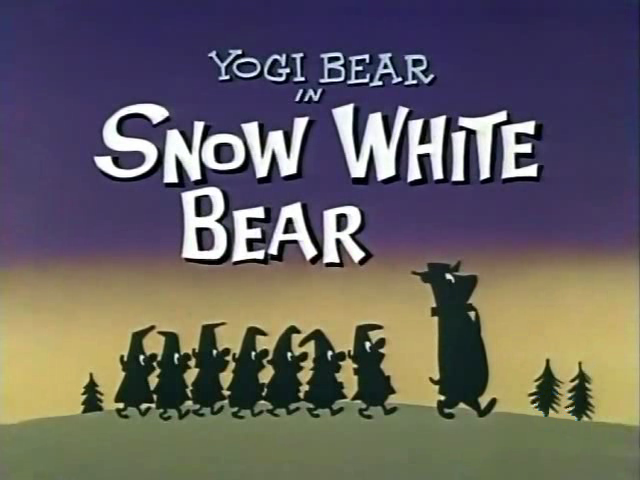
Yogi Bear — Snow White Bear

Produced and Directed by Joe Barbera and Bill Hanna.
Credits: Animation – George Nicholas; Layout – Dick Bickenbach; Backgrounds – Bob Gentle; Story – Warren Foster; Story Director – Alex Lovy; Titles – Art Goble; Production Supervision – Howard Hanson.
Voice Cast: Yogi, Stupid, Lazy, Itchy – Daws Butler; Narrator, Boo Boo, Nutty, Sloppy, Crazy, Prince – Don Messick; Snow White, Gooney, Queen – Jean Vander Pyl.
Episode: Huckleberry Hound Show K-038, Production E-100.
First Aired: week of February 15, 1960.
Plot: Yogi’s hibernation is interrupted by seven dwarves and Snow White.

You’d swear making fun of fairy tales was written into the contracts of the writers and directors at Warner Bros. cartoons since it was done so often and successfully. So it was that when Warner’s writers Mike Maltese and Warren Foster migrated to Hanna-Barbera, they took the successful formula with them.

I hesitate to add to the over-use of the term “cartoon trilogy,” so let me just say that Foster wrote three cartoons where Yogi Bear and Boo Boo had their lives intruded upon by a fairy tale in progress. Two were in the second season of The Huckleberry Hound Show, the third was in the third season and later on Yogi’s own show. For some odd reason, Foster didn’t pick Goldilocks as a target. Instead we got Little Red Riding Hood (Hoodwinked Bear) and the Three Little Pigs (Oinks and Boinks), both with the Phil Silvers wolf that Daws Butler had great fun with. The subject of this cartoon is pretty obvious by its title.

Two were animated by George Nicholas and this is probably the lesser of the two. He stopped using the big mouth movements on Yogi that were so much fun in some of his other cartoons, instead drawing the bear talking in a horseshoe shape out of the side of his mouth. Maybe it was quicker to animate him that way. There are few goofy expressions like you see in Lullabye-Bye Bear. However, Nicholas’ clump of skipping dwarves is a lot of fun. Coincidentally, Nicholas came to Hanna-Barbera from Disney.

The cartoon starts with a friendly narrator informing us, as the shot lingers across Jellystone Park, that tourist season is over. The scene fades to Yogi and Boo Boo doing the little leap-walk of Nicholas, except in this cartoon, Yogi’s hat is bouncing off and on his head. Our hero, naturally, has to fit in his catchphrase “we did better than the av-er-age bears,” adding “I can hardly wait to hi-ber-nate.” So they go into their cave, but their goal is interrupted by the sound of banging at their door.


Boo Boo: Who’s that Yogi?
Yogi: It’s not opportunity. Opportunity knocks only once.

It turns out not to be someone selling “Girl Scout cookies, raffle tickets, light bulbs,” none of which Yogi wants, as he explains to the girl at the door. It’s Snow White, who even bats her eyes for Yogi in a nice subtle bit of animation. Yogi thinks it’s a “tourist kid” playing a joke when she explains she’s looking for the Seven Dwarfs because they’re not at their home. Snow asks Yogi to tell the dwarves that she’s at their place and off she goes. By the way, notice in the frame grab how Yogi, Snow and the tree in the background are at an angle, but not the same one.


Sure enough, Yogi’s sleep is again interrupted by knocking on the door. We can guess who it is before the bear answers it. But since it’s 1960 and sci-fi is still big, he decides they’re “little men from outer space.” (Actually, Yogi’s Space Bear aired on the following week’s show). Warren Foster takes a swipe at Disney giving names to the little men by coming up with his own—Stupid, Nutty, Gooney, Sloppy, Lazy, Crazy and Itchy—with Nicholas coming up with appropriate cycle animation on some of them to prove their point.


He tells them to hit the road back to their place where they’ll find Snow White. Nicholas now comes up with a fast bouncing walk cycle for the dwarves, treating them as one lumpy character, with legs and hats all over. The chant a rhyme—“Ho! Ho! Ho, ho, ho! It’s off to Snow White’s house we go!” They’re landing on the ground in four drawings on twos, but to make the animation less monotonous, Nicholas puts in two extra drawings on twos before they land at the end.


No, Yogi still can’t sleep. “This sounds like a convention of woodpeckers,” he grouses as he is awoken again by the knocking Snow White, wondering if the dwarves showed up. “Grouchy old bear,” she says, after Yogi slams the door in her face (Nicholas has the bear purse his lips as he mimics her). The dwarves hop back into the scene as Snow disappears to head to her own home. Yogi has them wait in his cave while he goes to fetch Snow White and, eventually, sleep.

There’s a little scene which Foster throws in just because it’s silly, not because it advances the plot. The dwarves are in bed with Boo Boo.


Stupid: Of course we’re the Seven Dwarfs. Count us.
Boo Boo: One, two, three, four, five, six, seven, eight. Gosh! That’s right.

Boo Boo counts himself. By the way, could those dwarves look any more like characters in a Hanna-Barbera cartoon?

Yogi arrives at Snow White’s house. Now, let’s look at Nicholas’ approach to limited animation. When Yogi opens the front door, he peers down to see who is inside, then smiles. Sure, Nicholas is only moving the head, and it’s certainly not outrageously well-crafted animated. It’s the fact he does it at all for a subtle effect. He could have simply had the door fly open and left it at that. Just about anyone would have. He’s trying to get as much as he can out of TV-style animation throughout the whole cartoon. I’ve slowed this down a bit so you can see it. It was originally animated on twos.


“I never saw such a moving around gang like this,” Yogi gripes. Then the door knocks again. Yogi does another head shake take, in four drawings on twos. Nicholas has a couple of drawings to get into it, as the bear bends over and moves his butt up slightly. This one has been slowed down a little more.


Then Yogi straightens up in a couple of drawings and the camera moves into a medium shot. Here’s more of Foster’s dialogue.


Yogi: Aw, no. Even here it starts. (sound of door opening, Yogi looks toward door): Who are you?
Queen: I’m the queen around here, you dusty old bear.
Yogi: Oh, boy. The deeper you get in the woods, uh, the more nuts you find.
Queen: None of your lip. I’m looking for Snow White.
Yogi: That figures. The kid is reeeeal popular today.
Queen: Give her this apple when you see her. I’m got to get back and ask the magic mirror on the wall if I’m the fairest one of all. Toodle-loo.
(Queen races away and the door slams shut in her wake).

Yogi decides to eat the “one measly apple. She’ll never miss it.” Here are Nicholas trademarks—the snaky mouth-line and the curly tongue inside the wide mouth.


So Yogi flies onto the bed and passes out. That signals the arrival of... well, you know the story. Look. His right hand has four fingers and a thumb.


Prince: Ah, the Seven Dwarfs’ house! Now, let’s see. Snow White has eaten the poisoned apple and is asleep. Prince Charming—me—enters and kisses her. Yup, that’s it. I got to give her a smooch to wake her up. (leaps into doorway) I am here, Snow White! Your Prince Charming has arr-oh, boy! What an off-beat Snow White. Ewugh! Well, I gotta go through with it. Eeekh!

So the Prince kisses Yogi, the bear awakens, and the guy in “the Hallowe’en outfit” explains who he is. Yogi now starts counting on his fingers (three and a thumb) as he adds up the characters and “remembers the story. We could get a happy ending out of this mess yet.” The Prince appears to be a not-so-distant relative of George Jetson.


Cut to Yogi with the prince and Snow-What’s-Your-Name. And he tells them to live happily ever after. “Some place. Any place! Just make it far away. My achin’ back wants me to hit the sack.”

Yogi walks into his cave. We get another head shake take as he sees the dwarves asleep in his bed. He kicks them out of the cave with a Bilko-style military yell.


Stupid: What a grouchy old bear.
Nutty: They’re always grouchy this time of year.

The annoyed Yogi finally goes back to bed and the bears snore as the camera fades out.

Foster’s script is interesting in that Yogi is peeved throughout almost all the cartoon. He’s not the happy, hungry, Ranger-battling bear which became his formula. He’s a little more upbeat the following season in Oinks and Boinks when the three little pigs put upon him.

Ranger Smith is absent in this cartoon and no mention is made of him.

The background music is pretty familiar, except for the opening music as we see the gate to Jellystone Park and a scan of the forest. It comes from the Capitol Hi-Q ‘M’ series (M-8). I don’t believe this one was used in any other cartoons. Bill Loose wrote a bunch sounding somewhat similar to it; some were labelled ‘Documentary.’ This particular piece was an odd choice, considering the next cue, Loose and John Seely’s ‘Shining Day,’ was used to open a number of Yogi cartoons and would have been effective here. Perhaps the sound cutter was going for a mood change. The cutter also decided to edit together Loose and Seely’s ‘Zany Comedy’ to lengthen it.


0:00 - Yogi Bear sub-main title theme (Hoyt Curtin).
0:14 - C-71 ROMANTIC MAIN TITLE (Loose) – Pan across Jellystone Park.
0:25 - TC-436 SHINING DAY (Loose-Seely) – Yogi and Boo walk into cave, knock at door.
1:01 - L-80 COMEDY UNDERSCORE (Spencer Moore) – “Opportunity” line, Yogi walks to door.
1:11 - C-3 DOMESTIC CHILDREN (Loose-Seely) – Yogi and Snow White talk.
1:52 - 8-MR-377 creepy reverb trumpet music (Raoul Kraushaar) – Yogi wakes up, tells dwarves to get into space ship.
2:19 - TC-303 ZANY COMEDY (Loose-Seely) – Dwarves introduce themselves; bounce off to Snow White’s home, Yogi walks toward bed.
2:52 - TC-303 ZANY COMEDY (Loose-Seely) – “I must be having a night-time-mare”, answers door again.
3:13 - C-3 DOMESTIC CHILDREN (Loose-Seely) – Yogi and Snow White talk, dwarves arrive at Yogi’s.
3:42 - LAF-4-1 FISHY STORY (Jack Shaindlin) – “Can’t you stay put?”, Boo Boo counts dwarves, Yogi goes into Snow White’s home, Queen and Yogi talk.
4:55 - 7-MR-183 creepy reverb trumpet music (Kraushaar) – Yogi eats apple.
5:16 - LAF-27-6 UNTITLED TUNE (Shaindlin) – Prince and Yogi, Yogi walks into cave.
6:22 - LAF-7-12 FUN ON ICE (Shaindlin) – Yogi in cave, kicks out dwarves, Yogi and Boo Boo sleep.
6:58 - Yogi Bear sub-end title theme (Curtin).

Tuesday, 27 July 2010

Why? Why, why, why, why?

Dear Suited Movie Studio Executives,

I am just a humble cartoon fan who, about 1960, first saw Yogi Bear on my parents’ black and white television, just like hundreds of thousands of children across the expanse of our globe. I thought Yogi Bear was funny. So I kept watching.

Even after they stopped making Yogi Bear cartoons, I watched the old ones over and over. Year after year. Decade after decade. I enjoyed the look of the cartoons. I enjoyed the voices and the humour. Yogi Bear is vividly etched in my memory and will be until my memory cells work no longer.

Evidently Yogi Bear is not etched in yours.

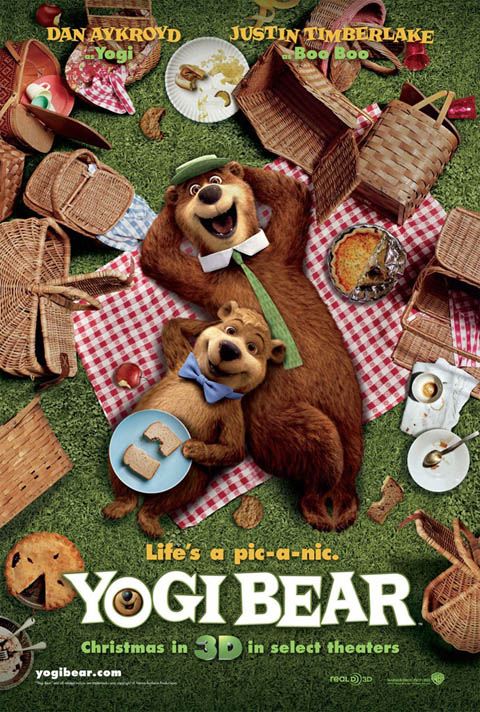
I have seen a poster for a theatrical film you claim features Yogi Bear. It features nothing of the kind. It features a creepy-looking twosome that “bears” no resemblance to anything that I loved in my childhood and still enjoy to this very day. Pardon the “bear” pun. Warren Foster and Charlie Shows would have appreciated it, though I have the suspicion no one connected with your studio knows who they were.

As a fan of Yogi Bear, I would be absolutely delighted beyond belief if your company would spend the money (called a “pittance” in corporate accounting circles) to allow you to release the remaining dozen-plus Yogi cartoons that originally aired during the Huckleberry Hound Show. They were funny and charming. The characters in those cartoons didn’t look like something left on the ground after a poorly-paid teenager got out of a Yogi costume he wore at a mall opening.

I am asking for old Yogi Bear cartoons. I would pay to see them. Or for something new resembling them. I am not asking for what is in your poster. As best as I can tell, no one is.

Sincerely,
Your cartoon friend,
Yowp

Sunday, 25 July 2010

I Wanna Be a Flintstone

The Flintstones has overcome a green space alien, a Shmoo-laden sequel, a kiddie version and a live-action feature movie aimed at the “remember when” crowd (do those EVER work?) to remain beloved even today. The show has even overcome me, as the focus on this blog is supposed to be on the comparatively-neglected short cartoons that preceded Hanna-Barbera’s gamble on a half-hour animated sitcom.

However, the 50th anniversary of The Flintstones is only weeks away (September 30) so I’ll empty the Yowp clipping file of a few stories and surprises now and then until we get there.

It’s always a pleasure to do a search of internet news stories and spot things from the past that are not only not forgotten, but still loved. Such is the case with those folks from Cobblestone County. The first stop in making our case is the Sixth Annual Bedrock Cruise-In which has wrapped up for another year today in Windham Township, Pennsylvania. You can read a little squib about the event here.

It sounds like the kind of small-town, family get-together that I keep hearing doesn’t exist in America any more. And it’s one appropriate for a cartoon like The Flintstones where even the satire was fairly gentle and parents didn’t worry if their kids were watching it. It also shows you how things have changed in the world of television animation. Can you picture an event with a chicken barbeque and a corn-eating contest centred around South Park?

Alas, I not only missed that event, but another one a Pterodactyl Airlines Flight away from Bedrock a weekend ago. For it was there that residents of Castleblayney, Ireland, set a Guinness Record for the number of people dressed as the Flintstones in one place. Perhaps they have an affinity for Hanna-Barbera cartoons because of all the Irish cops in them. Or maybe they wanted to emulate the lyrics of the theme song in having “a gay old time.” I suspect the word “Guinness” prompted them to celebrate their newly-won bragging perch with something a little stronger than Cactus Cola. You can read more here.

Almost 50 years after their creation, Fred and Wilma, Barney and Betty, Dino and Arnold the Paper Boy (okay, maybe not the last one) still inspire the innocent fun that was part of the old TV show. Considering how fast “stars” rise and fall these days (quick—name the winner of American Idol this year), the longevity of the modern stone-age family is something of modern miracle.

Oh, from the folk at the website Cartoon Scrapbook, here are a couple of .wav files.


RISE AND SHINE [Original theme]
(MEET) THE FLINTSTONES

Saturday, 24 July 2010

Huckleberry Hound — Sheep-Shape Sheepherder

Produced and Directed by Bill Hanna and Joe Barbera.
Credits: Animation – Carlo Vinci; Layout – Dick Bickenbach; Backgrounds – Bob Gentle; Story Sketches and Dialogue – Charlie Shows and Dan Gordon; Titles – Art Goble; Production Supervision – Howard Hanson.
Voice Cast: Huck, Sheep, Wolf – Daws Butler; Narrator, Sheep, Shorty – Don Messick.
First Aired: week of January 19, 1959.
Plot: Sheepherder Huck thwarts two sheep-stealing wolves.

For the second time in his debut season, Huck gets to play a shepherd. And for the second time in his debut season, he goes up against a thief with Daws’ Phil Silvers/Ernie Bilko voice. The first time, it was chicken-stealing fox in Cock-a-Doodle Huck. This time, it’s a sheep-stealing wolf. Well, the wolf doesn’t do the stealing. Like Bilko, he cons someone into doing it for him. This time it’s a little wolf (hmm ... a pre-cursor to Hokey and Dingaling, mayhap?) with the voice Don Messick gave to Jack the Robber in Big Brave Bear.

One thing the three cartoons have in common is animation by Carlo Vinci. Carlo drew the most angular-looking versions of the characters of the main three animators on the first season of the Huck show (I’m not counting Mike Lah) but he has the silliest (and jerkiest) animation of the three. You can pretty easily spot a Vinci cartoon. In the first season, he loved to use a thick outer line around characters. He toned it down in the second season.


Also, in the first season, Carlo had a little trick of a character stomping (in a cycle on ones) then running out of the scene. In this cartoon, he does it in reverse. Huck enters the scene, then stomps before stopping. Here’s the slowed-down stomp.


We get a variation on Carlo’s diving exit from the scene, too. Normally, Carlo backs up a character, then stretches them out horizontally in mid-air for a frame, then leaves lines in the next frame. Here, we get the stretch, but the phoney dog’s actually running so in the previous and successive frames, his paws touch the ground.


Carlo loves head shakes to register surprise. These were also two cells on ones in a cycle. This cartoon features six shakes. This one is used three times, slowed down for your viewing pleasure.


Oh, yes, and we mustn’t forget the Vinci teeth. He liked thick ones. Sometimes, he didn’t draw the tooth lines all the way down.


One other ‘surprise’ trick you’ll see in some of Carlo’s cartoons is how he stretches the head up (though it appears to be bigger) and elongates the eyes to register surprise. As a bonus, the cheek ruffs go up, too.


Also something the three cartoons mentioned above have in common is Charlie Shows wrote them (and all cartoons in the first season). Unlike some of Charlie’s cartoons, this one gets into the plot pretty quickly and, despite a fair chunk of dialogue, fits in a good number of sight gags, too.

Shows uses the same opening as he did in Hustler-Rustler Huck, with a narrator over a pan over a sheep-filled canyon bathed in night-time blues, even though the layout and backgrounds are done by different people. We even get the lovely ‘ZR-39 Western Song’ by Geordie Hormel to open both cartoons. Messick has a western lilt to his voice as tells us we’re looking at sheep country.


“Close by,” we’re told, “is the ever-faithful sheepherder. Livin’ the shepherd’s life of peace and solitude.” Huck fits in a “Howdy” in between the narrator’s sentences.


Ah, but not far away in a Yogi-like cave is a pacing wolf, waiting for his cohort to arrive.


“Chiefy” goes over the plan to get the sheep. Now we get two scenes with some reused animation as the wolf listens at the cave entrance. First, Shorty is sent out to lure Huck away by yelling “Wolf! Wolf!” and running away. Instead, he gets shot off camera. “He didn’t chase me, chief” says the little wolf plaintively. Then the wolf paints Shorty as an Indian. More shots off camera. “Another injun bit the dust,” the little wolf explains.


Now, Shorty dresses as a sheepdog (who shouts “Barf”). Huck, who is a dog, treats the disguised wolf like a real dog by playing ‘fetch the stick.’ Is it my imagination, or is there a little bit of Touché Turtle’s Dum-Dum in the design here? Not that it would be a surprise; Bick Bickenbach would likely have had something to do with the designs of both. “And such a honest face,” Huck says to the dog/wolf, who turns to the camera and gives a dirty “hee hee hee.” Surprisingly, Messick doesn’t do his famous doggie snicker for this character.

Huck becomes suspicious when the “dog” fetches a sheep instead of the stick and shoots his tail off for a third time. The wolf then realises he goofed, and should have dressed Shorty as a lamb to mingled with the sheep and use a bell to get them follow him to the cave. “Well, well, there’s the bell,” rhymes the wolf (Charlie Shows at work again). But Huck’s ready as he disguises himself as a large, shotgun-bearing sheep. You can see another Vinci trademark here: the crooked fingers on the wolf.


Here’s what Carlo does to register shock. First, there’s a take when the wolf realises Huck is inside the sheep outfit. Carlo turns him after a bit of dialogue and we get one of his two-cell vibration takes.


And, as an added bonus, this is a slowed-down version of the end of the take.


Shows continues with the running gag, except this time the big wolf is shot in the tail. “Now you know how it feels,” says Shorty.

Finally, the Wolf tries a combination of two things that never worked for Wile E. Coyote—dynamite and a barrel. He lights the barrel of dynamite and, like the Coyote’s boulder in Going! Going! Gosh! (1952), shoves it down a hill toward Huck. But gravity simply takes care of that. The barrel roles past Huck and the sheep, up a hill on the other side and then back down past the sheep and Huck into the wolves’ cave. The explosion is off scene, we just get a hold on the cave entrance, a camera shake, then dust coming out of the cave.


By the way, little lines come out of the barrel when it rolls up and back downhill, like you’d see in a silent cartoon (borrowed from comic strips, I suppose) to indicate noise. Maybe this was an old habit from Carlo’s from his Terrytoon days, but they’re sure superfluous.

The narrator returns to conclude the story. “Like we said, wherever you find sheep, you’ll find a sheep-stealin’ wolf. This is the best gag in the cartoon. There’s a shot of the sheep, who go “Baaaaah”, then a shot of the disgusted wolf, who goes “Bah!”

Then we’re told Shorty has reformed, and we see him in his sheepdog outfit, playing ‘fetch.’ “It’s honest, but what a way to make a living,” he tells us, and barfs as the camera fades out.

The music selection is pretty typical. No, I don’t have the name of that little hiccuppy march with the strings and bassoon by Jack Shaindlin used in a lot of these cartoons. It’s one of my favourite Shaindlin pieces. I hope someone will help me out with that one some day.


0:00 - Huck/Clementine sub main title theme (Hoyt Curtin).
0:27 - ZR-39 WESTERN SONG (Hormel) – Pan over western scenery, Huck says “Howdy.”
1:02 - TC-202 ECCENTRIC COMEDY (Bill Loose-John Seely) – Wolf paces, Shorty crashes into him.
1:29 - TC-201 PIXIE COMEDY (Loose-Seely) – Wolves go over plan, Shorty shot after crying “Wolf!”
2:34 - LAF 10-7 GROTESQUE No 2 (Shaindlin) – Shorty as Indian.
3:08 - LAF-1-1 FISHY STORY (Shaindlin) – Shorty as sheepdog.
4:34 - LAF-25-3 bassoon and zig-zag strings (Shaindlin) – Shorty as sheep.
5:43 - TC-432 LIGHT MOVEMENT (HOLLY DAY) (Loose-Seely) – Wolves with smoking tails, blasting powder scene.
6:45 - TC-202 ECCENTRIC COMEDY (Loose-Seely) – Sheep graze, Wolf goes “Bah”, Shorty in dog costume.
7:10 - Huck sub end title theme (Curtin).

Wednesday, 21 July 2010

But He Was a Great Psychotic Motorboat

There was a time before celebrities had indistinct and uninteresting voices (i.e., today) when anyone could do a passable and instantly-recognisable impression of some well-known show biz figure at will. Cagney, Robinson, Durante, Jolson. Later, it was Shatner, Lynde, Seinfeld. Cartoon characters, too. At least, if they kept it to a catchphrase.

One ventures into dangerous territory if one endeavours to spout more than a few words as John Wayne or Yogi Bear. The longer one talks, the easier it is to lose the voice and start sounding like a semi-detectable, eyeroll-inducing, quasi-impersonation. And that’s perhaps something the casting director at Golden Records should have considered.

Golden Records was a New York-based company that put out seemingly endless numbers of children’s discs in the ‘40s, ‘50s and early ‘60s featuring storybook characters or favourite cartoon stars. The early Hanna-Barbera stars were no exception. Unfortunately, there was a problem. The voices of those characters—Daws Butler and Don Messick—apparently were signed to exclusive kiddie record deals with other companies, so Golden had to make do with its small company of New York actors pretending to be Huckleberry Hound, Yogi Bear and even some of the more obscure characters like Major Minor.

Maybe for a few words, the actors could have pulled it off. For a whole song? As they say in New York—Fawggedabouddit. Some of the results were shockingly inept.

It’s unfortunate because it wasn’t the fault of the voice actors. They certainly had talent; they never would have been hired to begin with in a very competitive environment if they hadn’t. It’s just their talent didn’t include the ability to competently mimic Daws and Don’s cartoon creations.

Golden hired radio actors Gil Mack and Frank Milano to be their male voices. In 1961, the success of the newly-aired Yogi Bear Show prompted Golden to release a children’s LP Bill Hanna and Joe Barbera’s Songs of Yogi Bear and All His Pals. And the lot fell on Milano to replicate the voices of a fair portion of the Hanna-Barbera menagerie. The best part of the album is the cover. Some of Milano’s work is painful, to be charitable.

But before you judge for yourself, let’s read a little about what Milano could do. And he could do a lot. His radio credits include Lux Radio Theatre, Suspense and X Minus One. Two columnists devoted their space to Milano’s special gifts. The first was syndicated by the New York Tribune on June 22, 1952.


Out Of The Air
By JOHN CROSBY

Meet Frank Milano—A Most Versatile Actor
One of the most highly specialized actors around is a man named Frank Milano.
You probably never heard of him, but you’ve certainly heard him. Among the roles he has played (in voice only) are a mouse, a goose, frogs (several of them, them, which shows real talent), a puppy singing “The Star Spangled Banner”, a fish with a high-pitched laugh, a psychopathic motorboat—I’m not making this up, Mannie. He played a psychopathic motorboat—a jet-propelled spoon, an auto starter with a rundown battery, a talking eagle, a talking owl, a stallion fighting a wild boar and a coyote fighting a collie.
ALL GREAT and, in their way difficult roles. However, his best known part—you must have heard this—was the snap, crackle and pop he did for Rice Crispies. Milano took over the chore when Rice Crispies was on the fringe of desperation. They’d tried everything to get their vaunted snapping and crackling on the air. They even, for heaven’s sake, held a bowl of cereal in front of a mike and poured milk on it. Didn’t sound right, as any fool could have told them. Years ago a sound effects man who had tried every possible device to create a sound like clashing swords struck on the unlikely scheme of clashing swords together. This is the last time anything so simple has worked out.
Finally the ad agency decided to create three cartoon characters named Snap, Crackle and Pop. Milano played all three roles, conceivably his greatest.
His particular artistry has stirred his press agent, Eddie Jaffe, into transports of prose not heard in these parts since, as the saying goes, sliced bread.
“Can we fail to do else but salute a man who in a single record album has had to be the voices of a dog, a cat, a lamb, a robin, a goose, two frogs, a horse and four pigs?” inquires Jaffe on an ascending note of esteem.
“Mr. Milano is a gentleman in love with sound. He is stirred to the excitement of a hole-in-one or winning a Pulitzer Prize when he successfully licks the challenge of projecting a lion’s roar or doing a convincing talking eagle.
“His work proves there is imagination and adventure left even in those of us who spend our waking hours in the shadows of the drug store. What adjectives can you find to describe a man who spends hours of his life so he can become a walking encyclopedia of automobile sounds—anything from a Model T to a fire engine? Without Milano, where would the director be who wanted the sound of a dying horse or a humor-loving omnibus—a lovelorn orangutan or an automobile starter with a rundown battery?”
Where indeed? Probably back in Pocono.
MILANO STARTED to be a legitimate actor with aspirations toward Hamlet and that sort of nonsense before he got into his present line of work.
But the going was rough and jobs were not numerous. There were only a few animal imitators around and Milano was encouraged to specialize. He’s very glad he did. “I wouldn’t act a straight line now for anything—even if I still could.”
In the old days of radio, Milano was called whenever they needed animals. Now he works regularly on two shows—the Bobby Benson radio show and the Rootie Kazootie TV puppet show. On the Benson show he’s Bobby’s horse, dog and a skunk (a sort of kissing noise.) On Rootie Kazootie, he not only makes the sound but manipulates two characters—Galapoochie Pup and Poison Zoomack, the villain.
You mustn’t think he has a clear field in this line of work. Milano makes children’s records for RCA Victor twice a year as little Nipper the Pup (who is supposed to be the RCA Victor Trademark dog.) He won the part over 100 other applicants.
Milano started making animal sounds when he was 4 or 5 years old, walking in the woods with his father.
Now he owns his own farm in Hillsdale, N. Y., where he converses with woodchucks and chipmunks. The woodchuck sound is a sort of hollow, knocking sound caused by the animals chomping their jaws together.
Milano was chomping one day, outside his house, when a woodchuck came racing through the grass. Suddenly the beast found he was racing toward Milano, not another woodchuck. He stood paralyzed until Milano stopped chomping. Then he fled. You can get only so close to woodchucks.

And here’s an Associated Press column, dated March 21, 1953.

Frank Milano Can Imitate Anything But Tinkle of Bell
By HAL BOYLE

NEW YORK (AP)—Frank Milano is perhaps the only man in the world who can make a sound like a flying saucer.
“It takes off with a strange whistling, whining noise, like this—OO-OOO-OOO-OOOO—then it becomes supersonic, and you can’t hear it,” he said.
Milano is firmly convinced flying saucers do exist, they are not of this planet, and it is high time us Earth people came to terms with them.
“They are not hallucinations,” he insisted. “I have seen one myself, and my wife has seen several.”
Frank’s ability to imitate the sound of a flying saucer stems from a highly educated set of vocal chords that earn him $35,000 to $50,000 a year. He is one of the nation’s few professional animal imitators and vocal effects artists.
Talented Imitator
Milano, a pleasant, mild-mannered ex-actor, drifted into his specialty by accident. But today radio and television would be hard put to do without him. He does the voice effects for half a dozen programs, ranging from a pup on the Rootie Kazootie show to a live parrot on the Bill Goodwin show.
“I can imitate anything from a cricket to a roaring lion,” Frank said. “I’ve been a gorilla, an elephant, a burro, Rip Van Winkle’s dog, and even a mosquito.”
He has also been the voice of a motor boat with a sense of humor, a wayward bus, a jet- propelled spoon, and an automobile starter with a rundown battery. Oh, yes, he also was a Rice Krispie for a while. His “snap, crackle and pop” performance in that role is, of course, now a part of theatrical history—like Hamlet.
Likes Gadget Stuff
“I like imitating mechanical gadgets,” Frank said, “Right row I’m playing the part of a washing machine — chug, chug, gluggle, gluggle, gluggle. I can also make a sound like a squadron of talking airplanes, but none of the airlines will buy it for a commercial. They say it's too frightening.”
The animals he hates most to imitate are bears. Scratches his vocal chords.
“Animal battles— two stallions fighting it out, or a mountain lion fighting a horse—are hard on my throat, too,” he said. “I guess I like to do dogs best. There are only two kinds of dog barks really — big dog barks and little dog barks.
“Dogs have been very important in my career. Some day I’d like to retire and raise them. I owe them a lot.”
Can’t Imitate Bell
Frank takes his art seriously, goes to endless lengths to be certain his sounds are realistic. His toughest assignment was to imitate a talking eagle.
“I haunted the zoo for days, but the eagles wouldn’t talk, although I tried 300 different sounds on them trying to get them to answer,” he said. “Finally, during a trip to the country, I heard a couple of eagles screeching at night. I got out of bed and screeched back at them until I had the sound down pat.”
All great artists have their sorrows, and Frank has his. There is one sound he has never been able to imitate.
“I can’t tinkle like a bell,” he said. “I have tried and tried, but I can’t make it. So far as I know nobody can. If you could vocalize like a bell—well, you’d really have something, wouldn’t you?”

In reading these stories, if you’re a fan of old-time radio people, you can’t help but feel bad that Milano so badly misses the mark as an impersonator of Vance Colvig, let alone Daws Butler. However, I’ll let you judge for yourself.

We get songs, so to speak, and a Loopy fairy tale. The best tune is the stripped-down combo that chirps out the Yogi Bear Show theme song. None of the rest of the songs come from any of the TV shows and were concocted especially for the record company. If you can listen to them all, and all the way through, you’ve done more than I could.


YOGI BEAR THEME
BEFORE YOGI
CASANOVA OF THE CAVE SET
THE CUTIE OF THE CAVE SET
THE SNAGGLEPUSS MARCH
MAJOR MINOR
EXIT STAGE RIGHT
SNOOPER AND BLABBER
LITTLE FELLER
LIKE A DUCK
FIBBER FOX
ALFY GATOR THE ALLIGATOR
YOGI BEAR PRESENTS CINDY BEAR
INTRODUCING LOOPY DE LOOP
LOOPY DE LOOP MEETS RED RIDING HOOD

Setting aside his unfortunate attempt at emulating Alfie Gator, Milano did have some actual cartoon voice experience. Mark Arnold, author of The Story of Underdog, Tennessee Tuxedo and the Rest, says Milano performed some incidental voices for Total Television. And in an ironic tit for tat, Milano’s “Hamlet” roles—as Snap, Crackle and Pop—were taken over by the
main character actors at Hanna-Barbera: Daws Butler and Don Messick.

If the VoiceChasers web site is correct, this album was close to Frank Milano’s last work. He died in New York on December 15, 1962, age 64, leaving his dogs, owls, woodchucks and psycho motorboats to lesser talents.

And although the album cover is silent, Billboard magazine of the day revealed the identity of the woman lending a drawl to Cindy Bear on this LP. She had a bit of experience in the world of cartoon characters herself, having played Casper the Friendly Ghost and on Little Audrey and Little Lulu shorts for Famous Studios. She’s none other than Cecil Roy.