Wednesday, 19 July 2017

A Ruff Stone


Joe Barbera was a man of many talents. He was quick sketch artist and an able story man. He was a super salesman of the studio’s product (he could sell a network on a cartoon series even when he didn’t know exactly what he was pitching). And he was praised by actors as being an excellent voice director, though he could be tough.

And he seems to have had a great deal of patience.

Reels of early Hanna-Barbera voice sessions (they were recorded on Ampex tape machines) may be buried somewhere, so about the best we can do to give you an idea of what they were like is pass along this story from the Pittsburgh Post-Gazette, August 9, 1960.

Alan Dinehart was hired in April 1960 as an Associate Producer of the Flintstones. He had been an actor and a writer, so it’s no surprise he did a little bit of uncredited voice work on the series. Jerry Mann had met Bill Hanna and Joe Barbera at MGM in the ‘40s where he supplied voices on a few of the Tom and Jerry cartoons that needed them. His acting career went back to his childhood in the early 1920s; he performed a solo act at the pinnacle of vaudeville, the Palace in New York, in 1925. You can read more about him in this post.


With Arf and Aroo-o-o
By ARNOLD ZEITLIN

HOLLYWOOD
JOE BARBERA, curly haired, handsomely tanned, studied the control booth dials, glanced admiringly at the cartoon sketches in his hand and waved a finger at six actors under glass in a Sunset Blvd. recording studio. With calm precision, the actors stepped to three hanging microphones and, in concert, delivered intensely:
“Arf, arf, arf . . .”
“Ruff, ruff, ruff . . .”
“Bowwow, bowwow, bowwow . . .”
“Yeep-yeep, yeep-yeep, yeep-yeep . . .”
“Woof, woof, woof . . .”
“Ar oo-o-o-o, ar oo-o-o-o, ar oo-o-o-o . . .”
Barbera's finger flicked impatiently. The doggie din died.
“I can see,” Barbera said dryly, “none of you ever were in a dog pound.”
● ● ●
IT WAS 11 p. m. To an uninitiated observer it appeared to be the place where Hollywood actors bark off their daily frustrations. But Barbera and his six reasonably human actors had been penned in the small glass-walled studio for nearly four hours recording another episode of the new television series railed “The Flintstones.”
“The Flintstones” is widely ballyhooed as television's first cartoon series for adults. Each episode costs $65,000 to make, nothing: to bark at. You’ll see it Friday at 8:30 p. m. on WTAE, Channel 4, starting Sept. 30.
Each half hour cartoon will tell a tale of Fred and Wilma Flintstone, their neighbors Barney and Betty Rubble, both typical couples—with one difference. They live in the Stone Age. It's sort of "I Love Lucy" with dinosaurs.
● ● ●
ALAN REED and Jean Vander Pyl supply the Flintstones’ voices. The neighbors are Bea Benaderet, a veteran of the "Burns and Allen" show, and Mel Blanc, best known for his crunchy “What's Up, Doc!” greeting as Bugs Bunny.
The show comes from the Joe Barbera-Bill Hanna animation factory which also manufactures "Huckleberry Hound."
The two couples, plus actors Alan Dinehart and Jerry Mann, were in the soundproof studio making the sound track. Barbera was directing. He ordered another round of barking (the plot had something to do with Barney’s being hypnotized into thinking he was a dog and his landing in the pound).
“Seems like we have less dogs this time,” said Barbera, puzzled. More barking.
“Okay (Barbera, now perturbed) who was that fourth dog from the end?”
“ARE THESE all male male dogs?” interrupted Miss Vanderl Pyl, a jolly redhead.
“I don’t know if they let them mix in dog catcher wagons,” mused Barbera.”We don't want any lady dogs.”
“Surely,” said Miss Benaderet, mildly, “you can use a couple of bitches?”
Barbera let the suggestion slide. Miss Pyl, giggling, persisted doggedly:
“Could one be a French poodle?”
● ● ●
BLANC, SPEAKING for two dogs and the pound keeper in addition to his regular role, broke up in the middle of a bark. “What’s the matter?” said Barbera.
Gazing at the clock, Blanc panted, “I’m stir crazy.”
Barbera kept at them. More barking, accompanied by Barbera’s hounding. (“You’re a little, too frantic . . . you sound too hysterical”). He warned Blanc not to sound too old a dog catcher and the dour little man snapped back, “What’s wrong with an old dog catcher?”
● ● ●
AN AD AGENCY man wandered in the control booth. He announced he had found an elephant needed for a commercial film at a farm in the San Fernando Valley. “We drove up the dirt road to a steel gate which hail this huge sign, ‘Beware of Dog,’” he said, slinking his head over the vagaries of Hollywood life, “and not ten feet away was an . . an . . elephant.”
Soberly, Barbera looked up from his script and dials and said, “Did it bark?”
● ● ●
THE FINAL LINK of the script was reached. Barney, supposedly cured of his dogginess, picks up a package in his mouth and trots off. Blanc delivered the effect by talking with, his thumb in his mouth.
Barbera played back the line over the loudspeaker. Then he directed, “I want that last line with a little less finger.”
He got it. The session was over. Another "Flintstones" was born.
● ● ●
ON THE way out, a visitor hesitantly asked Miss Benaderet:
“Don’t you feel odd barking and all this foolishness . . . ?”
“Oh, no, silly,” she said, “It’s wonderful, Just like the old radio days.”
The visiting newsmen proceeded to walk up Sunset Blvd. Meanwhile, Miss Benaderet climbed into her cream colored Caddie and roared off.
Silly? Cadillac? There seemed to be but one answer:
Arf, ruff, bowwow, yeep yeep, woof and aroo-o-o-o-o.

Saturday, 15 July 2017

The Jetsons – Dude Planet

Can someone explain this to me? Why is Jane Jetson, who’s been married to her husband for years, misses and loves him terribly but, at the same time, is so completely untrusting of him that she’s certain he’s fooling around on her?

Doesn’t she know him better than that after all those years?

What a tired old sitcom staple the “jealous wife” is. But writer Walter Black drags it out to put a wrinkle in the plot of “Dude Planet,” the second-last Jetsons episode to air in first-run.

Black, however, anticipates carpal tunnel syndrome caused by too much keyboard bashing in the first part of the cartoon when the snarky Jane is forced by George to visit Dr. McGravity. The difference is Jane’s fingers are tied up in knots from all that button-pressing that’ll happen in homes of the future. Black also anticipates computerised doctor’s exams, though McGravity’s equipment looks a little cumbersome.


There’s now a flashback as Jane relates her woes. Either technology in the future doesn’t work or the Jetsons live in the worst-managed apartment of all time. The retracto bed runs amok and the food machine uncontrollable spits out Venusian toast. Dr. McGravity recommends rest at a getaway dude planet.

Doctor: You like horses?
Jane: I don’t know any.
Jane takes a Bubble cab to a travel agent, who recommends the Beta Bar Ranch on Beta 3. Naturally, everything there is robotic. She invites a hitherto never seen friend of hers named Helen, who is all worn out because her husband commutes from Tahiti to New York every day. Jean Vander Pyl would have been ideal for the role but someone else was cast. Helen is played by Joan Gardner, whose voice appeared in Gay Purree and Mr. Magoo’s Christmas Carol around this time (she also worked opposite Don Messick in her husband’s animated TV opus, Spunky and Tadpole).


On to Act Two, where George, Judy and Elroy are home alone not sure how to work any of the household gadgets, which don’t work properly anyway. The robo-vacuum cleaner sucks up the Jetsons’ cat in its only appearance in the series (a small, kittenish version appears in the closing animation, as you likely know). The cat emerges around a white cloud and sneezes the dust away (Mike Kazaleh points out George Goepper is the animator). The food-omat captures George and the only way he can get out is being run through the wash cycle and the ironer (food of the future is ironed?), the window washer and, finally, the burnt toast ejector.


Meanwhile, back at the ranch (Black resisted the chance to use that cliché), Jane and Helen ride some mechanical horses before being told of the wonders of the Beta Bar (the best gag is the cowpokes coughing while a smokey barbecue sizzles). The stagecoach is, naturally, pulled by a robotic longhorn. And Don Messick breaks into a yodelling falsetto as the Singing Vagabond Cowboy, crooning futuristic lyrics to “Bury Me Not on the Lone Prairie” (rockets, comets and jets are included). Despite all this, Jane misses George. And George misses Jane.


Jane and Helen take in a bucking bronco event before ordering drinks from a drone (talking in Messick’s Uniblab voice) and taking in the Venus Kid failing in an attempt at bulldogging. Jane still pines for George and calls him. I like how the Visiphone taps him to wake him up. George Nicholas animates this part of the cartoon; the beady, pop-out eyes give that away. Helen may have the best line of the cartoon during a John-and-Marsha parody.

George: Jane.
Jane: George.
George: Jane.
Jane: George.
George: Jane.
Jane: George.
Helen (turning to camera): Now that’s what I call racy dialogue.
George doesn’t want Jane to worry, so he pretends he’s partying. That brings about the aforementioned tired story line where Jane works herself to think George is screwing around “with some slinky siren...and I’ll bet she’s a blonde”—even imagining the scene as she cuts short her vacation.
Blonde: My! What fascinating eyes you have, George.
George: Ha. Ha, ha. Well, I just use them for lookin’.
Blonde: Mmmm. Lovely hair.
George: It keeps my head from slipping off the pillow at night.
Jane goes to punch the siren but smashes the Beta 3 car driver on top of the head instead.

Anyway, to wrap up the story, Jane gets home and won’t talk to George, but Henry gets them wrapped up tightly in the now-repaired retracto bed and all is forgiven.

Fernando Montealegre painted some of the backgrounds in this episode, Rene Garcia and Fernando Arce contributing. Here are some captured drawings. Interestingly, there’s no shot of the Skypad Apartments in this cartoon, even though much of the action is set there.


Besides Messick and Gardner, Hal Smith adds some voices as well.

Bill Keil also animated parts of this episode.

Wednesday, 12 July 2017

Yogi Bear Weekend Comics, July 1967

Funny animal cartoonists had to know how to draw more than funny animals. Yes, there were trees, mountains, lakes and other settings. But there were other things. Cars, trucks, trains, airplanes, equipment. There are some fine examples in the Yogi Bear Sunday newspaper comics 50 years ago this month.

I don’t know if Gene Hazelton was responsible for the layouts, but they really are great this month.


Check out the perspective in the comic from July 2nd. Some of the panels are looking from the ground up. Ranger Smith has some interesting fingers; see the first panel in the second row and the final panel.


Cindy Bear is on a pic-a-nic two comics in a row. The dancing, waving Boo Boo in the final panel of the July 9th comic is a nice addition.


The artwork is really nice in this July 16th comic; too bad the scan isn’t the best. The screeching train is beautifully drawn. And what a nice perspective on the tracks in that first drawing of the middle row. The opening panel is, again, well laid out, with a good use of foreground, background and detail. Top work.


Again, a fine job of perspective in the first panel of the second row of the July 23rd comic with Yogi swooshing around the airport control tower. Interesting to see Jellystone Park has not only an airport but a zoo.


By contrast, the backgrounds are much more sparse in the July 30th comic. And now you know how to make a shadow elephant.

Click on any of the cartoons for a bigger view. My thanks again to Richard Holliss for sharing the colour comics from his archive.

Sunday, 9 July 2017

Snagglepuss in Remember the Daze

Produced and Directed by Bill Hanna and Joe Barbera.
Credits: Animation – Bill Keil, Layout – Walt Clinton, Backgrounds – Dick Thomas, Written by Mike Maltese, Story Director – Paul Sommer, Titles – Art Goble, Production Supervision – Howard Hanson.
Voice Cast: Snagglepuss, Dinner Emcee, Turner Backwards – Daws Butler; Major Minor, Win a Million announcer – Don Messick.
Music: Hoyt Curtin.
Episode: Production R-57.
Copyright 1961 by Hanna-Barbera Productions.
Plot: Snagglepuss tries to escape from the Major in a TV station.

This cartoon’s got a lot going for it—Snagglepuss in disguise (including in drag), cameo appearances by Yogi Bear and Boo Boo, and a pile of 1950s TV spoofs. It could very well be a Warner Bros. cartoon. In fact, it was. The story is similar to the 1956 Bugs Bunny/Elmer Fudd short Wideo Wabbit, right down to the hero disguised as Groucho Marx and voiced by Daws Butler. It was written by Tedd Pierce, Mike Maltese’s former writing partner.

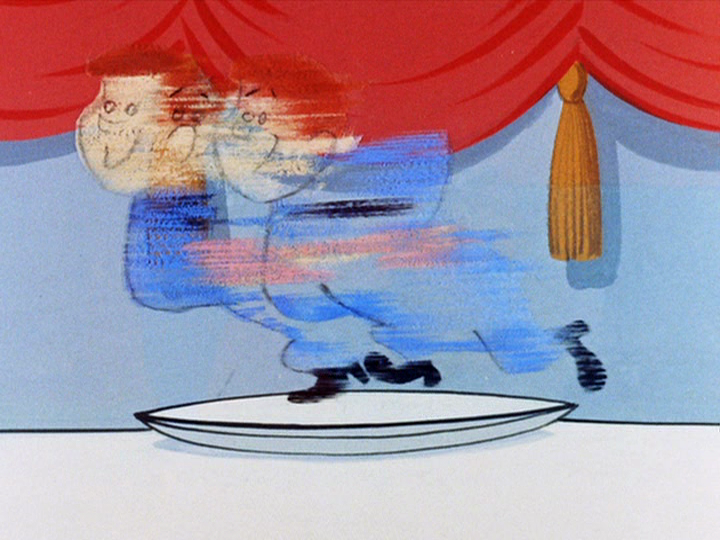
Regardless, this cartoon is still a lot of fun. It starts out as a parody of Ralph Edwards’ weepy reunion show “This is Your Life,” right down to Edwards making an unexpected appearance at a phoney dinner set up for Major Minor (host Turner Backwards is hiding under a food platter dome lid). Like the Edwards show, the honouree is taken to a couch in a TV studio, where the host is carrying a book (labelled “This is Your Strife”) and asks the victim if he recognises an off-stage voice from the past before the person (Snagglepuss, in this case), comes out on set to reminisce. I particularly like how the dinner’s main course is roast aardvark that the Major shot in the Mato Grosso.

Maltese comes up with some great nonsense dialogue. “Heavens to Murgatroyd, Major. Remember the jolly times we had together? Separate, even,” says the off-stage Snagglepuss. There’s also the usual vaudevillian tete-a-tete between the two.

Major: I thought I bagged you in the Bongo. Or did I boomerang you in Bolivia?
Snag: Au contraire, Major. You buckshotted me in the La Banza.
When Backwards points out the Major has never been able to catch Snagglepuss, the mountain lion “interjects an interjection” and points out he’s smarter than the Major. That sets off a chase through the television station that takes up most of the rest of the cartoon. “By Gadfrey,” cries the Major. “I’ll teach you to embarrass me before my millions of TV fans!”

Bill Keil is the credited animator. He worked on shorts at Disney in the 1940s and ’50s, and stopped at Jack Kinney’s studio before moving on to Hanna-Barbera in 1961 (he retired from the studio in 1982). He uses a lot of dry brush and ghosting effects when characters zip off stage.


First off, Snagglepuss appears as a surprise guest as “Nanny,” the Major’s “old nursemaid. Governess, even. Come all the way from Plum-Puddin-on-the-Thames...Coo! You were just a mere crumpet.” Snagglepuss plunks a baby bottle into the Major’s mouth and rocks him to “London Bridge.” “Sleepin’ like a bloomin’ daffodil, he is,” Nanny Snagglepuss tells us. “Sleep tight, ducks.” The Major realises he’s been had and stars firing his rifle at Snagglepuss (“You bounder!” “Exit, boundin’ all the way, stage right.”). The Major then confides in us, “Besides, my nursemaid’s name was Lady Ashtabula. By Gadfrey! She was a smasher.”

The chase is on. First, Snagglepuss disguises himself as an usher (as Bugs did in Wideo Wabbit) directing the Major to the filming of the Wagons West Show. Cut to the Major having been shot in the butt by arrows. I love how the scenery has folds so you know it’s a backdrop.


Next, a You Bet Your Life parody. Snagglepuss is disguised as Groucho welcoming the Major to What’s the Secret Word?.

Snagglepuss: Guess the secret woid and get yourself a new hat.
Major: Huh?
Snag: That’s the secret woid.
(gun on string drops from above and fires at the Major’s pith helmet)
Snag: Get yourself a new hat. You need one. Now, if you’ll excuse me, I must be shoving off. Or is it shovelling snow? Exit, stage right. Or is it stage fright?


Daws sounds closer to Fibber Fox than Groucho during much of the dialogue. The Major’s hat remains shot-up for the rest of the cartoon.

Cut to the next scene. It’s the filming of The Yogi Bear Show, complete with camera and obvious sets. Yogi and Boo Boo engage in some dialogue (as the Yogi show’s main theme plays in the background). When Yogi opens the lid of a pic-a-nic basket, Snagglepuss’ head pops up. “There’s no one here but us chicken sandwiches,” he remarks before more gunfire and the chase resumes. “It could be a major disaster, Yogi” puns Boo Boo. “Don’t worry, Boo Boo,” replies Yogi. “Ol’ Snagglepuss is on his way. Hey, hey, hey!”


Next, to the set of The Horror Show (“Come back here, by toffet!”) .The Major isn’t fooled by Snagglepuss in a Frankenstein’s monster costume. Thence to the set of The Win a Million Show. (“That’s for I’m,” remarks Snagglepuss). It turns out the winner is “that gentleman with the new hat in the first row”—the Major. He wins a million peanuts. Finally, Snagglepuss directs the Major into the Man Into Space Show, where he sets off a rocket and sends the Major into orbit.


The cartoon ends some time in the future with Snagglepuss walking to his mailbox, where he admits he misses the Major. “What doth the mail bringeth? Mayhap a letter from the old potato,” he says to himself. Nope. Turner Backwards pokes his head out of the mailbox, proclaiming “This is your strife!” “Exit, not on your life, stage right,” shouts Snagglepuss, and the cartoon ends with a run cycle. Backwards’ eyes go from little dots at the beginning to flesh-coloured little ovals at the end.


Dick Thomas is the background artist. Here’s his establishing shot from a layout by Walt Clinton, who I believe was spending more time in 1961 on The Flintstones and Top Cat than on the short cartoons.