Wednesday, 9 December 2015

Hanna-Barbera Chugs Along, 1961

1961 may have been the high point in the life of the Hanna-Barbera studio. Its syndicated half-hours were tremendously popular; a third was added in late January. The Flintstones overcame initial grumbles by critics to find an audience and spark a demand by the networks for more animated prime time shows.

Hanna-Barbera now had competitors eager to get a lucrative toe-hold in prime time though, in reality, competition was needed. The studio never could have filled all the time slots that had opened up for animation even if it wanted to. It didn’t have the time and staff. But that didn’t stop it from expanding its production schedule. And the studio had the money to do it, thanks to merchandising.

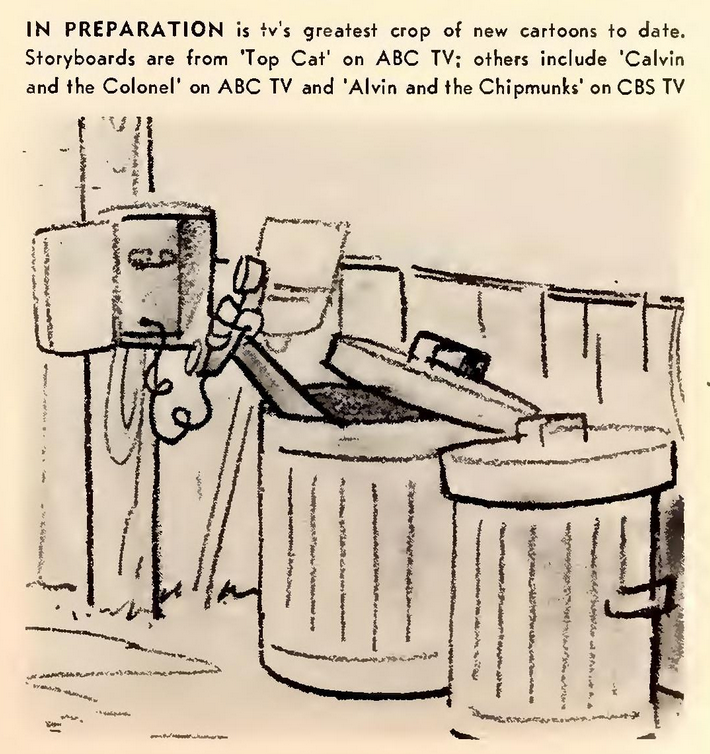
Here’s a story from Weekly Variety of July 19, 1961 taking stock of the studio’s situation up to that point.

How Hanna-Barbera Copes With 50 Hours of Animated TV Film In a Hot Upcoming Cartoon Season
The cartoon series is primetime video's hot half-hour for the coming season. There will be seven animated shows this fall against two last season, but future expansion is iffy. Notwithstanding good old American knowhow (Hollywood and New York), the total resource may have been tapped.
Take the case of Hanna-Barbera, Screen Gem's [sic] subsidiary that's out front in production. Cartoonery will be called on for more than 50 hours of animated film through the season. There will be 30 "Flintstones;" 30 "Top Cats" (new primetime half-hour); and 153 seven-minute shorts for the syndicated "Huckleberry Hound," "Quick Draw McGraw" and "Yogi Bear" (who won his own series last January after a long run as second banana to Huck).
Animated production is measured in footage, and when Bill Hanna and Joe Barbera were turning out theatrical "Tom & Jerry's" for MGM, they averaged about 4,000 feet a year with a staff of 90. With a staff of 165, Hanna-Barbera last week turned out 6,250 feet. It will average close to that through the season. So far, H-B has been able to meet the terrific creative and technical production problems with a lot of ingenuity. A void of talent was created by the sharp sluff of animation in 1957. Technical and writing talents have not come up in the business. H-B, however managed to scare up 40 inkers and painters (mostly women and mostly married) to work part time at home along with a permanent staff of 40.
Cartoon scripting was once a specialty of writers who sketched storyboards with the dialog. To solve the dearth, Hanna-Barbera has contracted with a flock of video's top comedy writers — "typewriter writers"—including Harvey Bullock, Art Phillips, Larry Markes, Syd Zelinka, Kin Piatt, Barry Blitzer, Jack Raymond — all with a string of credits on the top live comics. They continue to write with the rattler, then their stuff is converted to storyboard by the specialists. Voicing is still another problem. A year's search was made for "Top Cat's" mouthpiece. Among hundreds who auditioned were Andy Devine, Mickey Rooney, Jerry Lester, Larry Storch, Mike O'Shay, Max Rosenbloom. Arnold Stang was finally tapped.
Production detail makes the original-for-tv cartoon series the most expensive program. "Flintstones" cost $67,000 a stanza, and the high tab sustains for this season.
There are ways around the big tab. The four to six hours Disney will produce for NBC Sunday night schedule will reportedly be old theatrical film except for six minutes of fresh stuff per show. "Bugs Bunny" is theatrical except for bridges. Scott Ward's "Bullwinkle," slated for NBC Sunday, will be farmed out to Mexico City for production, as is the same shop's "Rocky & His Friends." Merchandising, however, can offset costs. Screen Gems did $40,000,000 gross on Hanna-Barbera character products in fiscal May-to-May, and that was sans "Flintstones." This year for the Christmas trade, there will be "Flintstone" merchandise as well as "Top Cat," "Yogi," "Huck" and "Quick Draw," and SG expects a retail sales total of $80,000,000. Foreign take also is enticing. Hanna-Barbera cartoons are now playing in 37 countries.
Hanna-Barbera seemed to have difficulties with voice casting for prime time. Bill Thompson had been hired as Fred Flintstone but his throat couldn’t handle the voice. Mike O’Shea was given the job as Top Cat before being dumped. And George and Jane Jetson were originally Morey Amsterdam and Pat Carroll, who sued after they were replaced. (One might add John Stephenson to the list, as he lasted only a few episodes as Dr. Benton Quest). T.C. would have been a very different character if Andy Devine or Slapsie Maxie had won the audition.

The reason I say 1961 may have been the studio’s high point is it had received nothing but plaudits up until then (initial grousing in some quarters of the press about The Flintstones notwithstanding). The studio could do no wrong. That changed. Top Cat was only lukewarmly received by critics and audiences. Co-sponsor Bristol-Myers wanted out five weeks into the season. It was Hanna-Barbera’s first prime-time failure. The following year, The Jetsons failed in prime-time. Two years later, Jonny Quest was suddenly shuffled out of its time slot as ABC sacrificed it to save The Flintstones from a butt-kicking opposite The Munsters (and Jonny’s new slot apparently didn’t allow high enough ad billings to make continuing production worthwhile).

Prime time failures claimed Snowball Productions (Beany and Cecil) and Creston Studios (Calvin and the Colonel) and knocked Format Films (The Alvin Show) back into commercial production. But not hardy Hanna-Barbera. It continued making series for syndication (two backed by Ideal Toys) and then pushed open the door on Saturday mornings, changing it from a dumping ground for old theatrical cartoons, reruns of filmed TV shows (eg. Fury) and puppet shows into a haven for first-run, made-for-TV animation that baby boomers still dote about, spurring the growth of Filmation and other studios in the process. Bill Hanna and Joe Barbera moved on rather nicely after being booted from MGM in 1957, and the same from prime-time TV a few years later. At the risk of sounding trite, they weren’t just survivors. They were thrivers.

Saturday, 5 December 2015

Yakky Doodle in Hasty Tasty

Produced and Directed by Joe Barbera and Bill Hanna.
Credits: Animation – Clarke Mallery, Layout – Noel Tucker, Backgrounds – Dick Thomas, Written by Tony Benedict, Story Director – Lew Marshall, Titles – Art Goble, Production Supervision – Howard Hanson.
Voice Cast: Yakky Doodle – Jimmy Weldon; Fibber Fox, Alfie Gator – Daws Butler.
Music: Hoyt Curtin.
Episode: Production R-74, fourth of eight Yakkys in 1961-62 season.

Simple tastes in cartoons, have I. I like settings to be nice and traditional: Fred Flintstone living in the Stone Age, 1960s style, Yogi Bear hanging out with Boo Boo, that sort of thing. I’m afraid I’m not much on the “universe” concept where Hanna-Barbera characters are poured into cartoons together merely because they’re Hanna-Barbera characters. I have no desire or curiosity to see the Herculoids and Scooby Doo in the same cartoon. I realise there are fans who love these kinds of combinations. Good for them. They can have them. I had enough problems with those ‘70s series that shoved together Yogi Bear and all kinds of funny animals and/or humans for the sake of shoving them together. Too many characters who should have been starring got watered down through sheer volume. Again, some fans like those shows, in some cases because of the Saturday Morning Bowl of Cereal Syndrome (nostalgia for an idealised childhood). To each their own.

I don’t mind guest or cameo appearances of characters where they have a real reason to be together. The Flintstones’ mini-cartoon that appeared on the episode of the Jetsons was great. All the characters on the Huckleberry Hound Show appearing in bumpers made sense because they were kind of treated like actors on the same programme who just happened to be around, with Huck decidedly in charge during the segments. And the idea of putting comic villains Fibber Fox and Alfie Gator in the same Yakky Doodle cartoon, Hasty Tasty, worked, too.

There was the danger of Fibber and Alfie cancelling other out, but writer Tony Benedict makes sure each keeps his own well-defined personality and builds a nice little story where the two compete (for a good portion of the cartoon) to capture the duck. There’s the added bonus of Chopper not making an appearance which keeps the plot nice and clean. Instead of the dog battering the stuffing out of the two bad guys, they do themselves in thanks to their own greed and incompetence. And for those of you who dislike or detest the duck, Tony has come to your rescue by not making him win this cartoon; Yakky is still running for his life when seven minutes are up and it’s time for a Kelloggs commercial.

Presumably, the title Hasty Tasty comes from all the run cycles in the cartoon. I didn’t bother to count them. The cycles may have given animator Clarke Mallery extra time for come up with some nice expressions. Mallery was an ex-Disney artist who also was hired to direct part of the Magoo Arabian Nights feature at UPA. The internet says he did a lot of freelance work and as this is his only credit in a Hanna-Barbera cartoon (that I know of), I suspect his work was freelance on this. Up and to the left you see Yakky screeching out the public-domain-so-we-don’t-have-to-pay-to-use-it song Camptown Races. The scene cuts to Fibber’s reaction, first to seeing a potential dinner on a tree branch, and then to the singing. These are consecutive frames.


A couple of exits. First, Alfie drops Fibber out of the frame. The drawing appears on screen for three frames.


Fibber and Alfie zip out of the scene. This one is also on threes.


We had a run cycle of Fibber and Yakky from this cartoon in this post. Here’s a three-drawing run-in-mid-air cycle, one drawing per frame. It seems to me most run cycles are even-numbered.


Random bits of dialogue:


Fibber: Hey, come back little duck! Don’t be chicken. I hate chicken.
Alfie: Good afternoon. As an ardent bird fancier, I have been observing that duck with the abominable voice (breathes). However, my intentions of purely abdominal.
Alfie (chasing Yakky): Consider, for one moment, the contribution you could make to gourmet history.

Among the gags:

● Alfie stops Fibber from chasing the duck with a well-placed frying pan.
● Fibber gets shot by Alfie after putting his mouth at the end of a metal pipe to swallow Yakky (who escapes through a hole).
● Alfie lays on the ground and swallows Yakky running into him. Fibber swats Alfie on the butt to get the duck out.
● Alfie puts his mouth at a drain-pipe exit on the roof of a house but Fibber grabs the pipe and runs into a cave with it, Alfie still attached.


Finally, the two villains agree to work together but start fighting (egged on by Yakky) when they disagree over who is going to eat the duck. The animation’s a little stiff because drawings are re-used but much of the scene is on ones. Occasionally, Alfie will be held in position for two frames while Fibber has a different position in each frame. Note how Alfie maintains his noble bearing except when he’s punched.


“Guess I should go south. I’ll never get a chance to grow up around here. Help! Heeeeeeelp!” screeches Yakky in close-up, as the cartoon fades out.

It’s nice to know several of the people who worked on this 54-year-old cartoon are around. Yakky’s voice, Jimmy Weldon, is still working in his 90s and writer Benedict is blogging about random cartoon things. Animator Mallery died in Los Angeles on July 12, 1993, age 74.

Wednesday, 2 December 2015

Yogi Bear Weekend Comics, December 1965

Yogi shows more ingenuity, but no hibernation, in the comics found in newspapers 50 years ago this month. Of course, four months worth of hibernating comics would get awfully boring.


Nicely rendered bears in the opening long panel in the December 5th comic. Isn’t this kind of like Huckleberry Hound as a dog catcher where you have dogs that are dogs, and a dog that’s humanesque? The writer went into overdrive on the rhymes in the first panel, middle row. The robber shows the evolving designs at Hanna-Barbera; he looks like someone in an Atom Ant cartoon made at this time. Look at Boo Boo’s reactions. Even though he’s not the centre of attention, he’s very much involved in the story.


Not quite winter yet in the December 12th comic as there’s no ice on the water impeding Yogi’s fishing. The art store owner closes his eyes with pride (left panel, last row) over his mobile. Yes, kids, people had them in their homes and banged their heads on them. A dumb invention.


Yogi used little animals for various things in some of the newspaper cartoons and he is at it again in the December 19th comic. In the opening panel, I suspect Yogi is reading Playbear for the articles.


Remember those good old days when you could say “holiday party” and it didn’t turn into a whine-fest? That’s at the centre of the December 26th comic. I don’t know why the “general” (why does a park have a general with a command post?) is crying. Yogi’s right. He got 12 pieces of cake, didn’t he? Cake that makes a FOING! noise, I hasten to add.

Mark Kausler should have full-colour versions of these on his blog. He’s mentioned his personal collection has run out so he won’t be posting more Yogis. It was nice of him to take the time and scan them for everyone. It’s great he saved them for all these years; I had a collection of daily and Sunday Peanuts comics that I put in scrapbooks but threw out years ago once they began to be published in books. Yogi hasn’t been so fortunate.

Next month, Quick Draw and Huckleberry Hound make a guest appearance, there’s more fishing, another FOINGG! and another clumsy Yogi.

Saturday, 28 November 2015

Adventure is My Hobby Storyboard

Cartoon spoofs always have an origin and, occasionally, they can have several inspirations mashed together. In the very early ‘50s, KTTV in Los Angeles broadcast a show called “Mystery is My Hobby.” In 1955, shooting began on a syndicated TV show “Adventure is My Business.” About the same time, John Stephenson hosted “Bold Adventure,” where ordinary people would come on and narrate over home movies of various adventures. These all may have inspired Mike Maltese to come up with the Snooper and Blabber cartoon “Adventure is My Hobby.”

(Some of you may be asking why the plural of “spoof” isn’t “spooves.” I am a cartoon dog, not an English professor).

That cat-loving friend of all cartoon dogs (and cartoon fans), Mark Kausler, has sent me scans of the storyboard drawings from “Adventure is My Hobby.” Other than Daws Butler playing around with a few words, the dialogue is the same as in the finished cartoon. Most of the drawings are, too, though some of the camera instructions aren’t followed. Mark’s note to me:


The drawings of the sea monster are really funny and full of personality. This board is probably Warren Foster's drawings, the last few pages are the Colerase red pencil lines, maybe he didn't have time to graphite over them.

The board doesn’t really need much of an explanation from me. You can read the review of the cartoon in this post.

Here’s a little comparison to show you how well animator Gerard Baldwin stuck to the story drawings. Compare what you see at the left to drawing 3 below.


The director doesn’t cut to a tight shot as per panel 10. Saves a bit of work for the cameraman. And background artist Joe Montell adds a picture to Snoop’s office in panel 12. He changed the light, too. Montell doesn’t seem to have been beholden to the story panels in concocting his backgrounds. He and animator Baldwin ended up in Mexico later that year working on Jay Ward cartoons.


Evergreen trees? That’s for Yogi Bear. Montell goes with a styled elm (panels 20 and 21). Or is it a birch? No matter. The car has become a four-door with those tail lights like a ’54 Cadillac. The instructions “open on small field” and “truck back to l.s.” (long shot) are ignored. A little less camera work gets the cartoon produced faster though, aesthetically, it was probably the right decision. And what was that old saying at Terrytoons? If one mouse is funny, five are funnier? Panel 22 has Montell adding extra milk bottles and newspapers.


Check out panels 31 and 35 and see how they matched the finished cartoon. 31 implies the monster slides in from left of the frame but he pops up instead. And since he’s animated over top of Snooper, the fishing rod is behind him.


Panel 44: the take. Baldwin adds a head shake take, uses the first frame below in the dialogue, and then does the oval mouth/wide eyes take.


Panel 68 is a little different. “Rep. 19” seems to mean to use the background from Scene 19 as that’s what we see. The dots on the trees in the background are a tell-tale sign of Montell’s work; you can see it in his MGM cartoons, too.


Panel 80 has an instruction to, I presume, rotate the camera or whatever is holding the cels and background to a 90 degree angle. In the actual cartoon, the sky/cloud background is panned up instead of across.


The instruction between panels 97 and 98 reads “Fade off Burgess Cel.” Can anyone fill me in on what that means?


There is no camera shake as indicated on panel 110. There is a whip sound effect when Snooper hits the tree, a crash when he hits the branch and a kettle drum when he lands; effects familiar to many H-B cartoons.


Panel 126: Perspective animation? In a Hanna-Barbera cartoon? Nope. I don’t know if there’s a two field pan like the instructions say, but the boat passes the same humpy hill four times.


The chopper in panel 128 inherits the name “J-19” (not the production number of the cartoon) and is on an angle. Note how Baldwin renders 134. He stuck to the panel.


Panel 143: in the cartoon, the monster doesn’t flip over his head like the panel instructs. Got to save on animation, you know.


Panel 150 has Blab talking to the camera. In the cartoon, he’s in profile and turns his head after he’s finished. Not only do no fish food flakes shake from the box during the cycle animation, the sea monster (played by Hal Smith) makes his “bllloooop” sound without any mouth movement. “A penny saved...” says Bill Hanna Ben Franklin.


Mark Kausler is bound and determined to keep me blogging as he has more storyboard goodness from his collection for you. We’ll try to post a Huckleberry Hound board next month.