Thursday, 9 May 2013

Smoking Yogi and and Yoga Yogi

Cigarette smoking was deemed fashionable and sophisticated at one time. Millions upon millions of dollars were spent telling you it was. As Hanna-Barbera fans well know, even Fred, Wilma and Barney chatted, in ungrammatical terms, about the wonders of Winstons.

There was never the temptation to put candy cigarettes in the mouth of baby Pebbles Flintstone, though you could buy them at the corner store when I grew up and they may still be sold somewhere. About the closest thing Hanna-Barbera came up with to make kids emulate their smoking moms and dads was this Cartoon Smoking kit by Elvin.


Something tells me this isn’t the kind of product the company would license today.

My thanks to Bryan Lord, once the proud owner of a nice music blog, for passing this on to me. This gives me a chance to pass on more image files that have been sent to me or I’ve grabbed from some place or another. My apologies as I didn’t note the source of most of these.


Awhile ago, we posted pictures of Huckleberry Hound rugs. Rich Graham of Twining, Michigan sent a note saying his father-in-law was going through the basement and found one. He’s sent this picture along with an ad. Anyone interested in buying the rug?


Hanna-Barbera tried marketing all kinds of concepts to the networks. Not all of them sold. Scott Shaw, I believe, posted these drawings of “Space Cat.” I don’t know anything else about the proposal or if the character was an Iwao Takamoto design. I can hear Howie Morris as the mouse.


Tim Hollis sent this note about the above picture:

In one of the early Jellystone franchise booklets was this stunning shot of the merchandise they offered in their souvenir shops. As you can see, some was produced especially for them (like the green plastic ranger hats), while others were items that had first been available a decade earlier (the Kellogg's mugs, the Yogi/Magilla coloring books, etc). If I'm not mistaken, that Day-Glo pink Yogi poster is the same one that was a major plot element in the Brady Bunch episode that was filmed at King's Island.


The caricatures are a bit spotty in places, but here’s a great TV section cover, no doubt from 1961, promoting “Top Cat” and its actors. The drawing of Maurice Gosfield is pretty good. Like many actors, people’s recognition twigged when they heard his character’s name (Doberman) instead of his own. Marvin Kaplan looks a little too jowly here. Sorry, but I don’t remember who posted this.


Another T.C. cover; this one was purloined from Jerry Beck’s collection.


Tim Tipton put this one up on Facebook. I suspect the studio promotional drawings are by Dick Bickenbach. The Captain ran on the NBC station in Amarillo; the ad is probably from mid-1962.


It’s a bird! It’s a plane! It’s a bear! Here’s Yogi at, I think, one of his Jellystone Park camps posing behind one-time Superman Brandon Routh. Other than working out his forearms, is Brandon doing anything else these days?


This is cute. Someone decided to come up with a drawing based on the similarity between the words “Yogi” and “Yoga.”

And several people want to direct your attention to this Italian car commercial, featuring real-life versions of the Wacky Racers. Well, almost all real life. Is Muttley computer-generated?

My thanks to the generous people who have passed on these things to pass on to you.


Tuesday, 7 May 2013

Yogi Bear Weekend Comics, May 1963

Ranger Smith has a split personality, does he not? One minute, he’s Yogi’s friend. Next minute, he’s Mr. Rule Enforcer. That’s the impression one gets reading the Yogi comics for this month 50 years ago.


On May 5th, we kind of get the friendly Ranger Smith. Did you know his name was Bill? I don’t think there was any real continuity for that sort of thing. The teenagers remind me of Gene Hazelton’s drawings; at least thinking about the Gas Genie that Hazelton came up with in the late ‘50s. And Yogi’s expression in the second-to-last panel is a lot different than the comics that people tell me were drawn by Harvey Eisenberg. The Ranger’s lament toward the end is pretty good.


The best part of the May 12th comic is the look of horror on Louie’s face as he peers through the door of his cafĂ©. You can’t see it too well, but he’s watching through the curtain in the last panel. This comic features the “Yogi is a pain” Ranger Smith. Things evidently have changed since “Yogi Bear’s Big Break” (1958) when the unnamed ranger tried to keep Yogi in Jellystone; Smith is actually happy Yogi has left the park.


Official Smith shows up May 19th, along with Bill Hanna’s beloved Boy Scouts. We get a silhouette panel, too.


Friendly Smith is back on May 26th, enjoying a game of softball with his bear buddies. A nice compact story; the first panel ties in with the final panel. A shame the copy of the last panel isn’t great but you can still get an idea of the composition with Yogi in the foreground and Smith and Boo Boo in the background.

You can click on each cartoon to get a larger image.

Saturday, 4 May 2013

Snooper and Blabber — Big Shot Blab

Produced and Directed by Joe Barbera and Bill Hanna.
Animation – Lew Marshall; Layout – Paul Sommer; Backgrounds – Dick Thomas; Story – Mike Maltese; Story Director – Alex Lovy; Titles – Art Goble; Production Supervision – Howard Hanson.
Voice Cast: Snooper, Blabber – Daws Butler; Scientist – Don Messick.
Music: Jack Shaindlin, Phil Green, Lou De Francesco?
First Aired: week of November 28, 1960 (rerun, week of May 1, 1961).
Episode: Quick Draw McGraw Show M-031, Production J-94.
Plot: After accidentally swallowing an explosion, Blabber forces Snooper to do his bidding or he’ll blow himself up.

Do you realise Snooper swears in this cartoon? Twice?

Actually, he does it in “Fleas Be Careful” as well. I didn’t think anything of it then but then I heard it again in this cartoon and decided to find out what it meant.

Snooper says the phrase “What in tunket…” According to the Old English Dictionary, “tunket” is a euphemism for “hell.” You can read a bit more about it here. Where in tunket Mike Maltese first heard the word, I don’t know, but with his affinity for odd words and phrases, only he would put it in a cartoon.

A week ago, we talked about how Maltese and Warren Foster weren’t above borrowing material from their fellow Warner Bros. writer Tedd Pierce and putting it in Hanna-Barbera cartoons. Maltese has done it in this one. The basic plot owes a lot to the last part of “Mouse Mazurka” (released 1949), where a little mouse drinks nitro-glycerin and then puts himself in harm’s way, forcing a panicked Sylvester to quickly rescue him so there won’t be an explosion. Maltese even uses a couple of Pierce’s gags. It’s sad in a way, for after Pierce’s departure from Warners, he went from freelance job to freelance job, while Maltese and Foster had steady careers at Hanna-Barbera and praise from Joe Barbera in the public press. Even when H-B was looking for writers, there’s no indication Pierce was ever considered.

Here’s the set-up for the plot: Snooper bosses Blab around, telling him to “dust off those habeas corpuscles” among other things. There’s a shot of Blab sweeping, dusting and polishing all at the same time. Snoop sends him out for a sandwich. The disgusted Blab (off camera) slams the door. “And fix that door,” Snoop adds. Blab walks down the street, lamenting he’ll “always be a nobody assistant.” The cityscape is really simple in this one.


While Blab’s out, a meek scientist knocks on the door, demanding protection from international spies for his invention—a peanut loaded with so many explosives, it could “wreak havoc if disturbed in any way.” “Take it back,” yells Snoop. “I’m allergic to wreaked havoc.” He’s offered $30,000 to guard it. “So what’s a little havoc that’s been wreaked?” Snoop rhetorically asks. The scientist leaves. Blab returns and eats the peanut. “Jumpin’ grasshoppers, Blab!” yells Snoop. “You just swalleyed a dangerous explosive that’ll wreak us all to havoc!” “All of a sudden, I feel a surge of power,” Blab tells us after Snooper explains to him that he’s now important “insofar as blowing me to smithereens.”


Most of the rest of the cartoon is taken up with Blab threatening to hurt himself unless Snoop does his bidding or rescues him.

● Blab tells Snoop to clean up the office, or he’ll jump from the top of a filing cabinet (it’s a chest of drawers in “Mouse Mazurka”). “Do my ears receive me?” asks Snoop. Blab jumps (“Smithereenies, here I come!”), Snoop stops him from hitting the floor and the scene ends with Snoop cleaning the office the way Blab was before.
● Blab demands Snooper’s lunch, and starts skipping rope. “Here’s the lunch, Blab! I don’t look good in smithereens.” Snoop fans him after lunch.
● Blab orders Snoop to repeat “Blab is important, Snoop is a nothin’,” or he’ll drop a safe on top of himself (also from “Mouse Mazurka”). Snoop stops the safe with his head and then repeats the phrase to the fade out.


● “You just broke the straw with the camel’s back,” says Snoop when Blab tells him to clean the office a 12th time. Blab doesn’t like the backtalk and jumps out the window of their office on the 84th floor. (84 floors? It must be the tallest brick building in the world.) Snoop refuses to rescue him until the last second. Blab lands on top of his head. (In “Mouse Mazurka,” the mouse leaps from a beam at the top of the room).


● Blab tells Snoop to answer the phone. It’s the scientist on the other end. He says Snooper can forget all about the bomb because it’s lost its power after two hours. Snooper demands Blab remove himself from his desk. Blabber threatens to paddle himself (in the butt, it would appear). Snooper offers to help and kicks him in the rear. Kablam! Unlike “Mouse Mazurka,” the blast doesn’t kill anyone. “Jumpin’ tunkets!” Snooper exclaims as he realises his watch is running a minute fast. But what difference should that make? Didn’t the scientist tell him the peanut (which should have been in some stage of digestion) was now harmless?

The final scene has Blab back sweeping, dusting and polishing. “Anyway, for a while, I was really livin’ it up,” Blabber happily turns to tell us, and he giggles to end the cartoon.

Lots of familiar Phil Green music here. I wish I had the names of those Jack Shaindlin cues, but I have no idea where to find them.


0:00 - Snooper and Blabber Main Title theme (Curtin, Hanna, Barbera).
0:15 - PG-161H LIGHT MOVEMENT (Green) – Blab runs with fingerprint set, Snoop tells him to clean up the place.
0:26 - GR-90 THE CHEEKY CHAPPIE (Green) – “It’s a mess,” door slam, Blab walks on street.
1:00 - GR-93 DRESSED TO KILL (Green) – Blab talks to himself, Scientist scene.
2:07 - ASININE (Shaindlin) – Blab returns, jumping off cabinet scene.
3:22 - GR-80 FRED KARNO’S ARMY (Green) – Lunch scene, Blab drops safe.
4:08 - LFU-117-2 MAD RUSH No 2 (Shaindlin) – Snooper rushes to stop safe.
4:25 - jaunty bassoon and skipping strings (Shaindlin) – Mopping scene, Blab jumps.
4:51 - light symphonic string music (?) – Blab drops, lands on Snoop.
5:29 - PG-161G LIGHT COMEDY MOVEMENT (Green) – Blab on Snoop’s head, phone rings.
5:37 - jaunty bassoon and skipping strings (Shaindlin) – Snoop on phone with scientist, explosion.
6:27 - GR-454 THE ARTFUL DODGER SHORT BRIDGE No 1 (Green) – Smoke clears, Snoop in wreckage.
6:38 - tick tock/flute music (Shaindlin) – Blab cleans.
7:00 - Snooper and Blabber End Title Music.

Wednesday, 1 May 2013

TC in the Mirror

Prime-time cartoons were all the rage in 1961, and the TV Radio Mirror was there to cover the story.

The Mirror was a precursor to the supermarket tabloids of today. It contained newsy items of what was happening in television but was more into stories such as (and these are actual titles) “Why I’m Still a Bachelor”, “Why I Quit The Edge of Night” and “The Day They Told Marty Milner ‘You’ll Never Walk Again’,” interspersed among ads for hair colouring products, tampons and books with marriage advice. The actor profiles are fairly fluffy and far more innocent than the preoccupation with sex, rehab and “celebrity” gossip that seems to circulate in successor publications in this day and age. They’re a great little time capsule and it’s neat to read something about, say, Don Knotts at home.

1961 saw the debut of “Top Cat,” “The Bullwinkle Show,” “The Alvin Show” and “Calvin and the Colonel” in prime-time, thanks to the success of “The Flintstones” and “The Bugs Bunny Show” the season before. The first three soon ended up on weekend mornings and the fourth became an Amos ‘n’ Andy footnote. The Mirror’s fall preview issue had brief mentions of them (with publicity art for “Top Cat” and “Calvin”) and then featured T.C.’s Arnold Stang in a two-page spread in its October edition. One page was a full-colour drawing of T.C. and Benny the Ball. The other had a family photo and the following text about Stang. Fans reading this post probably know all this information but I post it nonetheless.


HOT VOICE FOR A COOL CAT
Arnold Stang’s high-decibel tones send strong and clear from the back fence for a loveable backslid feline

Arnold Stang, the funny little man with the famous falsetto, takes on a new job this fall as the voice of a battling big-city feline known as "Top Cat" or "T.C." to his furry friends in the ashcan set. Stang, who weighs in at 106 and stands five-three, has parlayed this unprepossessing exterior and unique voice into a steady success as an actor-comedian. With oversize lens-less glasses ("Who needs glasses?") perched on his parrot-like nose, Stang has panicked the customers on TV and in movies—enacting roles sometimes requiring comedy facility, sometimes dramatic talent in touching characterizations. . . . Movie-goers may recall him best for his superb acting as Sparrow, the little punk who was Sinatra's sidekick in "The Man with the Golden Arm." TV viewers will probably recall him as the stagehand who regularly frustrated the star on The Milton Berle Show. And, on radio, Stang was well established as Seymour on The Goldbergs. In more recent years, he did a regular comedy stint on Bert Parks' Bandstand show, sandwiched in with numerous dramatic roles on major TV shows. . . . Top Cat is a new cartoon animal comedy series from the Hanna-Barbera studio, which originated that successful Stone Age romp, The Flintstones. Along with "T.C." Stang, there is a roster of famous voices. Benny the Ball, T.C.'s straight man, has the voice of Maurice Gosfield of "Doberman" fame. Allen Jenkins talks for a "human" policeman, Officer Dibble. Fancy Fancy, a feline Don Juan, is played by John Stephenson. Spook and Brain—two far-out cool cats—are spoken for by comedian Leo DeLyon. Choo-Choo, an impetuous tom more daring than wisdom dictates, is voice-fed by Marvin Kaplan. . . . With his commitment for this series, Arnold Stang has moved his family from their home in New Rochelle, near New York, to the Los Angeles area—a cross-country trek which represents a change of home and school life for JoAnne, Arnold's pretty wife, and David Donald, 10, and Deborah, 9 ... as pictured above with "T.C."
_______________________________________________________________________________ Beginning Sept. 27, Top Cat will be seen on ABC-TV, Wednesdays, 8:30 P.M. EDT, as sponsored by Bristol-Myers Company and the Kellogg Co.


The Mirror used its pages for a promo piece on “The Flintstones” earlier in the year but there’s also a mention of the Modern Stone Age Family in an article by Jo Ranson in the December issue, where 10-year-olds talk about their favourite TV shows.

Youngsters of all ages are infatuated with the production of The Flintstones, each episode of which costs $65,000 to produce. Surveys have shown that children will watch cartoons over and over again, each time with glassy-eyed receptivity. This, however, is not true of The Flintstones—this reporter's survey reveals that it is greeted with the enthusiasm children usually reserve only for a super-duper royal banana split.
Joe Barbera, who is responsible for the creative end of The Flintstones, remarked recently: "Cartoons have changed. They've grown up. It is very difficult now to write just for kids. The kids today are too smart. We use updated dialogue, updated situations. Right from the start, we steered away from the icky, juvenile stuff of the past." As a result, The Flintstones has a following from six to sixty. Opined one tousle-haired ten-year-old from Levittown, Long Island:
"Yummy, yummy, yummy! The Flintstones! They're cute! They live in the Rock Age! They are cavemen! They are like cartoons! It's a Suburban Rock Age! It's a half-hour program! It's on at eight-thirty! It's keen! It's yummy! That's all!" This is the manner in which most of the youngster generation appears to express itself about television programing today.

I don’t believe I’ve seen Joe Barbera use the word “icky” before. He wasn’t specific about which cartoons he was referring to. Certainly not Quick Draw McGraw, I imagine. Unfortunately, the word might be used to describe some his own studio’s product in later years.

Tuesday, 30 April 2013

Flintstones Weekend Comics, April 1963

A familiar idea and some great shapes highlight the Flintstones Sunday comics (Saturday in Canada) from 50 years ago this month. Fortunately, only one of the story lines involves Pebbles. Alas, Baby Puss doesn’t even rate a background-of-the-first-panel appearance.


You loved the Flintstone Flyer (nĂ© the Barney Copter). Now, Fred’s come up with his own flying machine in the April 7th comic. I wish I could find decent versions of these on-line to get a better look at the composition. I like how the first panel in the bottom row has the perspective looking up at the action and the next panel’s looking down. It’s followed by a silhouette panel and the crashed copter. Dino makes an incidental appearance in the opening drawing.

By the way, as a comparison, here’s the Flintstone Flyer by the wonderful Carlo Vinci. I’d love to know if Ed Benedict designed it.


“Eugene” rates a mention in the list of Water Buffalo members on April 14th. The coincidence between the name and the fact Gene Hazelton was in charge of the H-B comics is too great. So perhaps he came up with the story. It’s not his artwork; the way he draws eyes on the characters is quite distinctive and you can already see them in the Flintstones daily comics published at this time. You guess is as good as mine who the other Water Buffalos are named for (maybe one is Clarke Mallery).


The highlights of the April 21st and 28th comics are the great shapes; the tied-up dinosaur in the former and the toothy mouth in the latter. Well, and Fred’s expressions in the latter, too. Mr. Slate doesn’t exist yet; Fred has an unnamed boss.

Click on any of the comics to enlarge them. It seems most of the papers available to me on-line didn’t pick up the Flintstones Sunday comics. There are a lot more Yogis out there.

Saturday, 27 April 2013

Huckleberry Hound — Fast Gun Huck

Produced and Directed by Joe Barbera and Bill Hanna.
Credits: Animation – Brad Case; Layout – Walt Clinton; Backgrounds – Dick Thomas, Written by Warren Foster; Story Director – Alex Lovy; Titles – Art Goble; Production Supervision – Howard Hanson.
Voice Cast: Huckleberry Hound, Dying Man, Flesh Wound Bystander, Neighbour, Bar Patrons – Daws Butler; Narrator, Teeny Terwilliger, Shooter, Bar Patrons, Sheriff – Don Messick.
Music: Spencer Moore, Jack Shandlin, Bill Loose-John Seely, Victor Lamont, Geordie Hormel, Sterling Sherwin-Henri Klikman. First Aired: week of January 9, 1961 (rerun week of May 29, 1961).
Episode: Huckleberry Hound Show K-047, Production E-132.
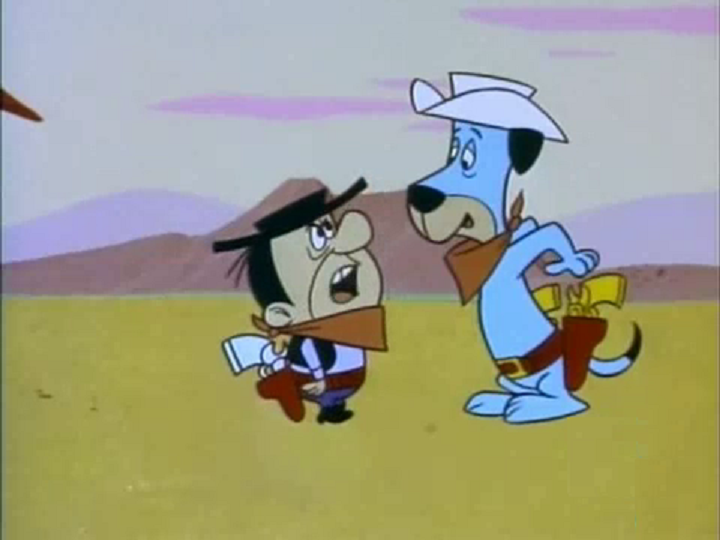
Plot: Huck, the fastest gun in the West, brings in Teeny Terwilliger, the second-fastest gun in the West.

Tedd Pierce was the one writer that Hanna-Barbera didn’t hire from Warner Bros. but that didn’t stop Pierce’s Warner material from showing up at H-B from the writers it did—Mike Maltese and Warren Foster. Maltese decided Sylvester Jr’s back-of-the-hand-to-the-head “Oh, the shame of it!” would work well for Augie Doggie (first used in Pierce’s “Who’s Kitten Who”). In this cartoon, Foster has borrowed a more obscure gag from Pierce. Teeny Terwilliger loads a rifle to shoot Huck. “First, the ball,” he says. “Then the powder. Then the waddin.’ Now, I’ll ram it down tight.” The rifle explodes in Teeny’s face. “I must have done somethin’ wrong. I’ll put in the waddin’ in first this time…” If you don’t recognise the gag, it comes from “The Slap-Hoppy Mouse,” a cartoon released in 1956 where Pierce gives similar dialogue to Sylvester and the same two explosions in the face.

The funniest part of the whole scene is something that Foster came up with himself. While all this is taking place, Huck is completely oblivious to it. He’s entirely wrapped up in his steady line of patter to the bad guy so he has no idea what’s going on around him. Foster comes with some really good bits. The only thing that’s jarring is first few seconds. It’s just plain ugly. Dick Thomas’ background resembles a child’s drawing and the gunman clomping down the street looks like something out of a Gene Deitch Tom and Jerry. But then we get into better stuff.

Actually, the first scene has no direct bearing on the plot. It’s a shootout, with the angle mimicking the title card—we see a guy getting shot (in silhouette, and in cycle animation) through the bow-legs of a gunman. The gagline: “Call me bow-legged, will ya’?” Don Messick digs up his serious narrator’s voice and is accompanied by some very effective stock music. We actually get into the action in the second scene when Messick intones famous names of the Old West, dropping the seriousness to ask “Quick Draw McGraw?” when the inside reference comes up on the screen. We’re now introduced to the Huckleberry Kid, the Fastest Gun in the West. The basic premise of the cartoon is everyone is afraid of whoever the fastest gun is—except the second-fastest, who wants to be number one.

But being the fastest gun has its drawbacks. The narrator points out that Huck is steely-eyed and always ready to draw, and the scene cuts to our hero bouncing up and down on his faithful horse (“named ‘Horse’,” the narrator informs us). Huck looks at us. “You know, this always bein’ ready to draw shore crimps up my arms.” And it also has people high-tailing it out of towns before Huck arrives. “I don’t get it,” Huck tells us. “I read in the papers where the West is really buildin’ up. But all I ever see is empty towns.” And then he tells us his burden, as the corny melodramatic “Winter Tales” plays in the background. “This bein’ fastest gun in the west is a lonesome life. Only ones that’ll speak to me are the lawmen.” And even the sheriff in this cartoon is hiding behind an uprighted saloon table in fear. “Would you please stop that steely-eyed stuff and put your arms down?” the sheriff asks.


Huck agrees to take on the job of bringing in Teeny Terwilliger, the second-fastest gun. “I get so lonesome, I’ll talk to anybody.” Foster makes fun of a Western clichĂ© in the next gag. Huck has his hands ready to draw, walking toward the door, the sound of spurs jingling on the soundtrack. He stops and looks at us. “You know, I just cain’t figure out that jinglin’ noise. I’m not even wearin’ spurs.”

Huck arrives at Teeny’s hideout badly singing a chorus of “Clementine” over some randomly strummed guitar strings. He wants to “talk a bit before blastin’.” Teeny isn’t impressed. He calls Huck a “no-good, wart-headed varmint” (can you tell Foster wrote for Yosemite Sam at Warners? Teeny calls Huck a “horny-toad” later). Huck apparently hasn’t talked to anyone for so long, he has no conception he’s been insulted. “Sure is nice to find a feller that’ll engage in some perlite conversation with you,” he confides to the audience. Teeny looks at us. “Yack, yack, yack. I never heerd nobody yack so much.” Now we get the rifle scene mentioned above.

“I better quit while I’m behind,” Teeny says to us. The cartoon has reached its climax and we get a bizarre gun battle. “I’m fightin’ ya fair and square because I have no other choice,” Teeny says to Huck, who informs the bad guy he has a lightning draw. And he does. A lightning bolt comes out of Huck’s gun and zaps Teeny. It’s a visual pun that you don’t expect. And then Huck has another surprise. In exchange for the return of stolen gold, he offers to retire from the fast-gun racket, making Teeny number one.


The cartoon ends with civilian Huck being greeted by townspeople—and Teeny popping up from inside a rain barrel where he’s hiding. Teeny can’t stand being the Fastest Gun. His friends run away from him. He cries that no one has spoken to him in three months. “Poor feller. I know just how he feels,” Huck says. Then he has an offer for viewers. “If anyone wants to be the Fastest Gun, I can get you a really good deal.” The cartoon ends with Huck winking.

Some appropriate music has found its way onto the soundtrack. The first cue reminds me of Spencer Moore’s material on the Capitol Hi-Q “D” series. I’m missing about a half-dozen reels of the first 20 and I suspect it’s on one of them. A couple of nice Western cues and the tinkly “Winter Tales” work really well. It and “Home on the Range” are among some solo old-time piano cues arranged for the Sam Fox library (“Man on the Flying Trapeze” was another one, but it wasn’t used in cartoons as far as I know).


0:00 - Huckleberry Hound Sub Main Title Theme (Curtin).
0:25 - Dramatic Underscore (Moore) – Gunfight scene.
0:52 - ZR-39A WESTERN SONG (Hormel) – Scroll of names, Huck ready to draw guns.
1:14 - TC-205 LIGHT MOVEMENT (Loose-Seely) – Huck on horse.
1:32 - off-key banjo – Huck sings.
1:42 - TC-205 LIGHT MOVEMENT (Loose-Seely) – Narration, Huck rides in empty town, bar patrons take off.
2:11 - WINTER TALES (arr. Lamont) – Huck regrets being a fast gun, sheriff talks to Huck, “buckin’ for first place.”
3:02 - FM-149 HOME ON THE RANGE (arr. Sterling Sherwin, Henri Klickman) – “Only the fastest gun,” jingling gag.
3:26 - L-1154 ANIMATION COMEDY (Moore) – Huck on horse.
3:33 - off-key guitar – Huck sings.
3:43 - L-78 COMEDY UNDERSCORE (Moore) – “That’s the Huckleberry kid,” “…yack so much.”
4:38 - L-80 COMEDY UNDERSCORE (Moore) – “I’ll put a stop to it,” wadding gag.
5:22 - L-75 COMEDY UNDERSCORE (Moore) – Huck talks about a stagecoach, lightning gun scene.
6:07 - LAF-10-7 GROTESQUE No 2 (Shaindlin) – Huck offers to quit the fastest gun racket, Huck walks down street, talks to off-camera people.
6:33 - LAF-25-3 zig-zag strings/bassoon music (Shaindlin) – Twerwilliger in barrel scene.
7:10 - Huckleberry Hound Sub End Title theme (Curtin).