Saturday, 11 August 2012

Huckleberry Hound — Wiki Waki Huck

Produced and Directed by Bill Hanna and Joe Barbera.
Credits: Animation – Lew Marshall; Layout – Walt Clinton; Backgrounds – Bob Gentle; Story – Warren Foster; Story Director – Alex Lovy; Titles – Lawrence Goble; Production Supervision – Howard Hanson.
Voice Cast: Narrator, Pig, Hog – Don Messick, Huck – Daws Butler.
Music: Geordie Hormel, Spencer Moore, Bill Loose/John Seely, Jack Shaindlin, Raoul Kraushaar.
First aired: week of February 15, 1960.
Episode: Huckleberry Hound Show K038, Production K-038.
Plot: Native Hawaiian Huck tries to catch a pig for a luau.


Writer Warren Foster doesn’t seem to have been able to make up his mind what kind of format he wanted to use for “Wiki Waki Huck.” The first half of the cartoon is a travelogue parody, with Huckleberry Hound ineptly pointing out features of the Hawaiian Islands. The second half is a spot-gag cartoon, with Huck trying different ways to catch a pig, before returning to the travelogue ending. Either Foster couldn’t develop enough pig gags to fill a full short, or he started coming up with a pile of them so he abandoned the idea of a phoney travelogue. Either way, they’re interrelated, so the transition from one to the other and back is smooth.

Lew Marshall’s bobbing nose style of dialogue is noticeable here, and he has several bits of animation he reuses. I like how he stretches the pig’s body as the animal races out of the scene.


The cartoon gets off to a nice start. It opens with shots of Bob Gentle’s renditions of the mainly uninhabited Hawaiian and friendly narration by Don Messick. It also means camera pans and no animation for the first 23 seconds. That’s saving the old budget!

Foster sets up a ridiculous situation at the start. The narrator elucidates on the meaning of the word “Aloha,” then tells us “we are going to meet a real Hawaiian beach boy who will tell us about his lovely islands. Listen as he sings a native chant.” Who’s the Hawaiian beach boy? It’s Huck, with his North Carolina accent firmly in place. And the native Hawaiian chant is “Clementine.” Huck’s firmly convinced in this cartoon he’s Hawaiian, even though it’s pretty evident he’s not.

Huck (to audience): Howdy, and ay-loha to all you there malahinis. Ahuckahula Huckleberry, your pineapple pickin’, genu-wine, Hay-waiian beach boy. And I’m gonna be plumb happy to tell you about our Hay-waiian customs.


To show Huck’s ignorance, Daws Butler has him pronouncing “Hawaii” with a long ‘A’ on the first syllable all throughout the cartoon.

So we get some travelogue spot gags. First, Huck demonstrates surfing. The wave carries him onto the beach and into a tree. Next, he demonstrates a tradition war dance with a sword. The scene is done in silhouette, an interesting difference. Cut to the next scene. The camera pulls back to show Huck in bandages. “It can be lots of fun, especially if you belong to some hospital plan or other,” he informs us.


With those gags out of the way, the cartoon moves into a different direction. Huckahula introduces us to a cute pig, who grins as Huck rubs him with butter. “You know, it kinda works like a sun-tan lotion,” Huck tells us. “It makes him nicely even brown all over when he’s restin’ on them nice hot coals.” The pig shakes his head in realisation. Huck then points to the coals. The pig oinks in fear and runs off. “Don’t you want to be nice and even brown all over?” Huck asks, chasing after him. So now we get spot gags where Huck fails to capture the pig.

|| ● Huck tempts the pig with an apple. When the pig comes “close-ter,” Huck pounces. The buttered, greasy pig slips out of his hands, crashes onto his head and zips away.
● Huck has a string on an apple leading to a barrel in a tree. The pig grabs the apple, the string breaks and the barrel lands on Huck.
● In a great surreal gag, Huck ties an apple to a string in a tree. The idea is the pig will wear himself out jumping to get the apple. Instead, the pig walks down the string, eats the apple and walks back up into the palm tree branches.
● Huck ties a surfboard to a tree to swat the pig as he goes for the nearby bait apple. Huck lets go of the board but the pig’s too fast. The surfboard goes completely around the tree trunk and swats Huck into another tree instead.

● Next, a variation on a Tex Avery gag. Huck sets up an apple at the end of a hollow log and gets ready to stop him with a catcher’s mitt. The pig goes right through the mitt and Huck’s body. “No wonder I couldn’t catch him. I got a hole in my glove.” Huck’s oblivious to the hole in his body. ● Finally, Huck sets up a noose around an apple and hides behind a bush. Huck oinks to lure the pig. Instead, he attracts the attention of a big hog. Huck lassos the hog by the nose and pulls him through the bush. “I kinda ree-membered that piggy as bein’ a might smaller.”


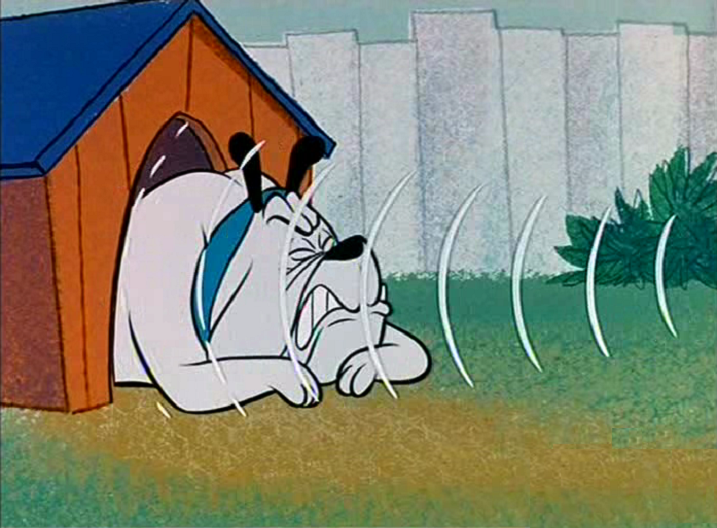
Cut to the little pig happily munching an apple. A blue arm reaches into the scene and grabs the brick of butter. “One side, feller,” says Huck, “I’ve got some butterin’ up of my own to do.” The butter makes Huck slippery enough to avoid the hog which tries to catch him in cycle animation.

We’re now back to a travelogue. The happy narrator returns to bid us farewell, and Huck gives us a “farewell and aloha,” as he runs away, with the hog adding an off-camera “Oink, oink” as the iris closes.

The voice of the hog has me a little baffled. It sounds more like Doug Young than Don Messick, but I can’t see Hanna-Barbera going to the expense of bringing Young in for one cartoon just for a couple of oinks. Messick was capable of a gruff voice in a lower range, so I’m presuming it’s him.

Oddly, no Hawaiian music is in the soundtrack of this cartoon, even though it exists in the Capitol Hi-Q library that the studio licensed. Either the sound-cutter didn’t know about it, or he went with music that was familiar to him. Generally, one cue is used for each scene.


0:00 - Huckleberry Hound Sub Main Title theme (Curtin).
0:05 - ZR-50 UNDERWATER SCENIC (Hormel) – Opening narrations and shots of Hawaii.
0:30 - Clementine (trad.) – Huck sings.
0:38 - TC-204A WISTFUL COMEDY (Loose-Seely) – Huck on beach, to talks to audience.
0:57 - LAF-20-5 TOBOGGAN RUN (Shaindlin) – Huck on wave, crashes into tree.
1:24 - L-80 COMEDY UNDERSCORE (Moore) – Huck with sword.
1:40 - L-1154 ANIMATION COMEDY (Moore) – Huck limps along.
1:47 - C-3 DOMESTIC CHILDREN (Loose) – Luau shot, pig eats apple, pig rubbed with butter.
2:38 - TC-202 ECCENTRIC COMEDY (Loose-Seely) – Huck points, pig runs off camera, Huck shakes head.
2:47 - LAF-20-5 TOBOGGAN RUN (Shaindlin) – Pig runs, Huck crashes into tree.
2:56 - 8-MR-377 creepy muted trumpet music (Kraushaar) – Huck talks to camera, tempt-with-apple scene.
3:32 - TC-437 SHOPPING DAY (Loose-Seely) – Garbage can trap scene, apple in tree scene.
4:36 - 8-MR-377 L-75 COMEDY UNDERSCORE (Moore) – Surfboard scene, hole-in-glove scene.
5:30 - creepy muted trumpet music (Kraushaar?) – Hog grabs apple, Huck grabs butter.
6:13 - LAF-72-2 RODEO DAY (Shaindlin) – Huck butters himself, runs from hog, bids farewell to audience.
6:49 - Huckleberry Hound Sub-End Title theme (Curtin).

Yowp Note: With this post, all the Huckleberry Hound cartoons of the first two seasons have been reviewed.

Wednesday, 8 August 2012

They Made Hanna-Barbera Cartoons

Pictures of Bill Hanna and Joe Barbera abound. They went from television animation pioneers to television animation icons and their images were featured in all kinds of publicity material.

Of course, there was a whole team working under them. Even if anyone paid attention to the credits, few people knew what they looked like. However, some appeared in what I can assume were publicity photos that had been taken in case a newspaper or magazine wanted to run a feature on how cartoons were made.

None of these photos are captioned or dated. I’m sure there will be some people who will recognise the photo subjects and can help identify them. These were taken in the Cahuenga studio.


This is where I show my woeful ignorance of the process of animation. About all I can tell is this is someone is drawing Yogi Bear. I have no idea what the sheet is beside the animator. The someone, by the way is Bob Carr, who started as an assistant at Disney and came over to Hanna-Barbera for the third season of the Huckleberry Hound Show after the layoffs at Disney. You can see Bob’s work on Flickr. Thanks to Mark C. for the ID.


Here’s veteran animator Dick Lundy (he has a tag with his name on the chair) referring to an exposure sheet. He has a turntable to the left of him; to listen to dialogue maybe? I don’t want to guess what’s in a lump in his coffee cup (if I had to, I’d guess a sponge. I hope it’s not coffee).


Here’s Ben Shenkman working on caricatured for a toothy Bill and Joe, who appeared in animated form in the pilot “Color It Happy,” produced in 1965 with the idea that ABC would air the show in the 1966-67 season. Daws Butler is caricatured in the Fall Festival poster with Yogi and Huck. Someone will ID the model sheet of the woman because they’re more into the H-B adventure shows than I am. I think it’s one of the Herculoids; I haven’t seen the show since it aired. Shenkman was an assistant animator from New York who apparently worked at Columbia in the ‘30s, moved to the Schlesinger studio about 1940, and then on to MGM. Thanks again to Mark C. for the ID.


This animator working on Fred Flintstone has no chair but a window overlooking barren hills and power lines. Note the model sheets of Pebbles to the right.


Let’s move to the background department. Here’s Art Lozzi, who joined the studio when it opened in 1957 after a career at MGM with a stop at Disney in between.


I can’t name too many women involved in the production of H-B backgrounds in the early days. Vera Hanson (née Ohman) and Neenah Maxwell were background artists in the first few years. I don’t know if the latter two were still at the studio when these pictures were taken. Sorry the photos are murky since I can’t definitively identify the background drawings or the cel on the bottom photo. However, one helpful reader can and says the cel is Meteor Man of the Galaxy Trio. Thanks, Anon. Further to what Dave Mackey mentioned in the comments, Janet Brown worked on backgrounds on that series. I remember it airing but don’t recall watching it. See the credits below.


These were among the photos that used to appear on the Cartoon Network site and have been rescued from obscurity.

Sunday, 5 August 2012

Yogi Bear, Weekend Comics, August 1962

Cute little creatures, an out-of-character Boo Boo and guest appearances highlight the weekend Yogi Bear comics 50 years ago this month.


Yogi was always a little sensitive about his weight. In one cartoon, he took exception to being called “dumpy.” In the August 5th comic, a bunch of Hanna-Barbera characters (wait for it!) weigh in on the situation. What’s odd is the ones who appeared on Yogi’s own show aren’t present, but everyone who was on the Quick Draw McGraw show is. And so is Huck, though Mr. Jinks, Pixie and Dixie are missing. Ranger Smith gets the day off.


I wonder how the play on words in the August 12th comic would have translated into other languages. Yogi distracts Ranger Smith so he can get at some unseen pic-a-nic baskets. Silhouette drawing.


Would Boo Boo really laugh over Ranger Smith’s misfortune? Not in the cartoons. But it’s different in this comic from August 19th. The composition in the first and last panels is quite attractive. Notice the woodchucks in the opening panel. It seems fir trees in the backgrounds of Yogi comics have to be drawn at a slight angle. I’m a dope when it comes to figuring out who drew what but I suspect Harvey Eisenberg is responsible for the art here.


A cute armadillo is the highlight of the August 26th comic. Do they really die if they flip over? It seems Fred Flintstone and Barney Rubble aren’t the only ones who bowl in the Hanna-Barbera world. And Bugs Bunny isn’t the only animated character who makes a turn in a city in the American Southwest. Another silhouette panel.

As usual, click on each comic to enlarge it.

Saturday, 4 August 2012

Pixie and Dixie — Pied Piper Pipe

Produced and Directed by Joe Barbera and Bill Hanna.
Credits: Animation – Don Patterson; Layout – Walt Clinton; Backgrounds – Bob Gentle; Story – Warren Foster; Story Direction – Alex Lovy; Titles – Art Goble; Production Supervision – Howard Hanson.
Voice Cast: Pixie, Dog – Don Messick; Dixie, Jinks – Daws Butler.
Music: Bill Loose/John Seely, Hoyt Curtin, Spence Moore, Jack Shaindlin, Geordie Hormel, Raoul Kraushaar?
First Aired: week of September 26, 1960.
Production: Huckleberry Hound Show K-040.
Plot: Getting an idea from the book “The Pied Piper,” Jinks makes a pipe that forces Pixie and Dixie to dance.


Hanna-Barbera cartoons didn’t go in for old song references all that often, but there’s one in “Piped Piper Pipe.” The premise of the cartoon is simple. The evil Mr. Jinks sits down and reads “The Piped Piper of Hamelin,” only to learn that a pipe playing music can control mice. He carves a pipe and tests it on Pixie and Dixie. It works. The meeces can’t stop dancing when Jinksie plays. Regrouping in their mouse hole, the scene opens with:

Dixie: We’ve got to figure out somethin’, Pixie. I’m dancin’ with tears in my eyes.

The song in question is “Dancing With Tears in My Eyes” by Al Dubin and Joe Burke, a waltz written some 30 years before Warren Foster wrote this cartoon. To accent the “tears” bit, Dixie has his eyes closed. The split-in-half triangles for eyes tells you this cartoon was animated by Don Patterson.

This is a pleasant but fairly unspectacular cartoon. Jinks talks to himself (and, by extension, to the viewers). Pixie and Dixie talk to each other. Jinks talks to Pixie and Dixie. By 1960, the Hanna-Barbera shorts were becoming pretty dependent on dialogue. Chases? No long ones in this cartoon; there’s a six-second dollop of Jack Shaindlin’s “On the Run” accompanying the only chase scene. Violence gags? The bulldog next door jumps on Jinks. The meece get smashed with a fly-swatter. That’s it. No fun takes like you’d find in “Uncle Tex” or “Judo Jack” in the first season.


We’ve already explained half the story. Jinks declares the pipe “is the greatest thing since catnip. I’m drunnnk with power!” Dixie gets an idea—he puts a dog whistle into the pipe, so when Jinks blows it, he’ll annoy the bulldog next door and get clobbered. And that’s exactly what happens. And that’s what happens instead of the pipe giving the meece “a terpsichorean time-step.” “It don’t play musical music no more,” says Jinks, just before the bulldog grabs him by the throat. The bulldog only growls in this cartoon; considering the talky nature of the cartoon, it’s a surprise Foster didn’t give him any dialogue but it’s not really needed and there isn’t time for it in the cartoon anyway.

The final scene has one of those story devices that seems to have been popular on “The Flintstones,” where Fred begins to confess something to Wilma that the audience has seen, then the scene cuts to the point where Fred has finished telling the story and says “And that’s the whole thing.” Pixie and Dixie do the same thing here. We never hear the story they tell Jinks and we don’t need to because we know it.

The cartoon ends with a deal. If Jinks breaks his pied piper pipe, the meece will break the dog whistle. Pixie and Dixie toddle off happily as Jinks tells them they’re “good-type meeces, like.” When they’re gone, Jinks reveals to us he’ll make another pipe. Cut to Pixie and Dixie in their mouse hole. Dixie kept part of the dog whistle, just in case. The pair look at the camera and together admit “We just don’t trust that Jinksie.” And the cartoon ends like so many H-B cartoons in the future—with the characters giggling as the scene fades out.

There are six drawings in the little jig that Patterson animates. The first and fourth drawings are held for only one frame, the second and fifth for three frames and the third and sixth are on fours.


There’s a sneak cycle that Patterson draws where Dixie’s leg is extended out and the body brought to it in the next drawing that’s effective.

The most fun part of the soundtrack is to hear a solo flute version of the Augie Doggie theme when Jinks plays his pipe. It’s a rare departure from the stock music and a conscious decision would have been made to use it. Stock music wouldn’t have worked, even if the Capitol Hi-Q “X” series had a solo flute or recorder piece. Old familiar favourites make up the rest of the score. “On the Run” is only used for the brief period when Pixie and Dixie are actually running.


0:00 - Pixie and Dixie Main Title theme (Curtin-Hanna-Barbera-Shows)
0:12 - C-3 DOMESTIC CHILDREN (Loose) – Jinks reads Pied Pipe Story, makes pipe.
1:17 - Augie Doggie Theme (Curtin) – Jinks plays flute, meece dance, drop off table.
1:41 - L-80 COMEDY UNDERSCORE (Moore) – Jinks tells meece he has a secret weapon, meece look at book, no cotton in the medicine cabinet, Jinks brings down fly swatter.
3:05 - LAF-2-12 ON THE RUN (Shaindlin) – Pixie and Dixie run into hole.
3:11 - creepy muted trumpet music (Kraushaar?) – Jinks talks to meece at hole entrance.
3:18 - Augie Doggie Theme (Curtin) – Jinks plays flute, swats meece.
3:26 - creepy muted trumpet music (Kraushaar?) – Jinks is drunk with power, Dixie tests dog whistle.
3:58 - TC-204A WISTFUL COMEDY (Loose-Seely) – Pixie and Dixie on window sill, Jinks snoozes,
4:48 - ZR-52 LIGHT QUIET (Hormel) – Dixie tip-toes to dog whistle, meece run away.
4:59 - L-78 COMEDY UNDERSCORE (Moore) – Jinks wakes up, Dog stomps on Jinks, Meece make deal with Jinks, Jinks breaks flute, Meece break whistle.
6:15 - LAF-7-12 FUN ON ICE (Shaindlin) – Jinks promises to make new pipe, Dixie saves part of whistle, meece giggle.
6:56 - Pixie and Dixie End Title theme (Curtin).

Wednesday, 1 August 2012

The Cartoon Classroom

Television as babysitter? Yakky Doodle as educational TV? Yes and yes, according to Jayne and Neal’s dad—Joe Barbera, that is.

By 1964, puppet shows and old films were giving way on Saturday morning television to cartoons—a good percentage of them made by Hanna-Barbera. The studio had been in operation for seven years. A lot of the print columns in years previous had concentrated on the “first” angle—first made-for-TV cartoon series, first prime-time cartoon series, that sort of thing. Joe and Bill Hanna still used that concept to push “Jonny Quest” and the Alice in Wonderland TV special but needed to find a different gimmick to sell their product to viewers. So they tried to tell the world their cartoons were educational.

Joe kinds of skirts past an explanation of how his studio’s cartoons were educational in this UPI column that appeared in newspapers starting December 24, 1964. After all, Pixie and Dixie aren’t exactly the Muppets teaching kids how to count on the yet-to-be-invented Sesame Street, though you could practice your counting watching how many times the same tree passed behind them when they ran from Mr. Jinks.


Two richest baby sifters boss a cartoon factory
By VERNON SCOTT
UPI Hollywood Correspondent

HOLLYWOOD (UPI) — The country’s richest baby sitters—and most active—are Joe Barbera and Bill Hanna of the Hanna-Barbera cartoon factory.
At some time or other throughout most of the day little kids plop themselves—or are locked into playpens—in front of a television set to be babysat by Hanna-Barbera productions.
It beats paying a teen-ager, and it relieves mothers of entertaining their offspring.
The tots are exposed to whole gallery of wacky characters Quick Draw McGraw, Touche Turtle, Yogi Bear, Peter Potamus, Ruff & Reddy, Magilla Gorilla, Wally Gater [sic], and, well, you get the idea.
These far-ranging cartoon animals survive a series of misadventures that make their soap opera competition pale by comparison. In all there are 13 half-hour series beaming around the country on various channels and different times of the day.
In 52 countries
They are seen in 52 countries and by some 350 million persons (although mostly kids in this country) according to Joe Barbera, a handsome, articulate man whose fine Italian hand is unerringly on the pulse of the nation’s smallfry.
In addition to the daytime shows, H-B also produce “The Flintstones” for nighttime adult viewing and a new and revolutionary cartoon series titled “Johnny Quest.” [sic] The latter is a half-hour adventure drama involving serious plots and new techniques in cartooning
“We’re very proud of this one,” Barbera said during a Brown Derby lunch. “It’s costing one-third more than we expected, but it's worth it. The idea is giving birth to three new shows, too.”
Hanna-Barbera have been approached time and again to put together a Disneyland-like park incorporating their myriad cartoon characters. Plans are in the works now to make it a reality.
“We have 320 full-time artists working on our cartoons right now,” Barbera said. “But we’re planning to produce our first live feature film, starring real actors.”
Says cartoons educational
Barbera is convinced his cartoons—the ones that do the baby-sitting during the day—are contributing to the education of the play-pen set.
“There are no sponsors for three-year-olds and under,” he explained “There isn’t a broad enough audience The sharp kids of four and five today wouldn’t put up with nursery rhyme stuff. They’re too hip; they've seen much more sophisticated things.
“So the real little ones have to watch our shows produced for older children and adults. It brings them along much more quickly than you’d suspect.
“They're not only entertained by our shows, they’re educated as well. Our aim is to reach all age groups, and I think that’s exactly what we’re doing.”

Thinking it over, I learned the following things from Hanna-Barbera cartoons:

● There will be flying cars in the future.
● How to sing the Kellogg’s jingle (even though I didn’t eat their cereal).
● New words like “meeces” and “pic-a-nic” and phrases like “Now just a rock-pickin’ minute!”
● There was a god in Egypt named Anubis (okay, that one’s really true).
● Daws Butler was one of the best voice actors on the planet and Mike Maltese was a funny man (for really true again).
● Adding a little green alien to a series means it’s run out of ideas (far too true).

But, more importantly, I laughed or smiled a lot at some silly stuff on the screen, and eventually learned that people need to stop and do that in their lives every once in a while. I learned it from Quick Draw McGraw and Daffy Duck and the Fleischer version of Popeye, and Rocky and Bullwinkle, and many others. Cartoons may not be educational, but they spread happiness to millions and considering how life can get, that’s something just as good.

Sunday, 29 July 2012

Slick City Slicker Storyboard

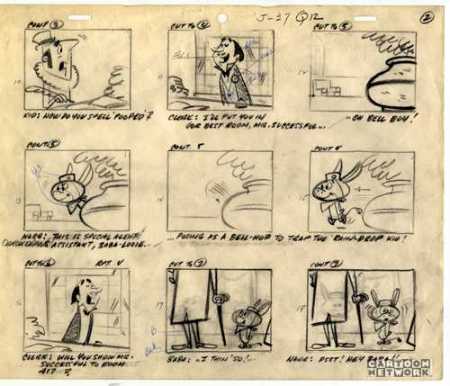
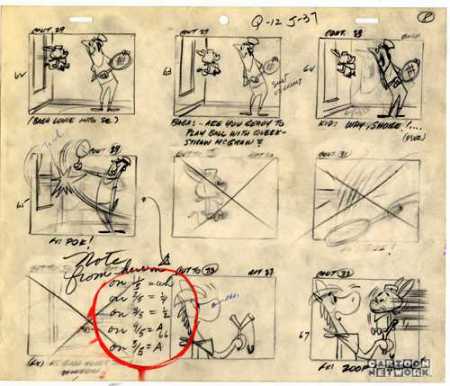
There was once a place in the U.S. called ‘The Cartoon Network.’ It didn’t have tween-boy shows called “Dude, What Would Happen?” and “Build Destroy Build.” It had nothing but cartoons. Old ones, even. And its web site had great old pictures of people who worked at Hanna-Barbera, like Dick Bickenbach and Carlo Vinci. And it even had cartoons themselves and storyboards from a few of them.

Below is part of the storyboard from “Slick City Slicker,” the cartoon we reviewed yesterday. The size of the pictures is really small, but that’s what was on the site.

I suppose the board was drawn by Alex Lovy elaborating on sketches from Mike Maltese. Many of the character poses were maintained in the cartoon, but the opening pan is quite different. Background artist Bob Gentle used only one side of the street (the distance had islands near the harbour) with a huge house on Nob Hill on the right and the hotel on the left. Homes were in between and streetcar tracks were on the curving road. I suspect the detail in the drawing of the Raindrop Kid walking into the home is in the actual cartoon, if a decent version of it were to be seen.

The big mouth, close-eyed version of Quick Draw in the fourth set of panels is pretty funny. And the word “Kapok” when Raindrop smacks Baba with the racket is pure Maltese.