Thursday, 17 June 2010

What Hath Charlie Shows Wrought?

Mark Kausler, I believe it was, commented several months ago here about Charlie Shows and wondered what it was he actually did on The Huckleberry Hound Show. It’s a pertinent question. Certainly I don’t think Mark would be impertinent to a famous Hanna-Barbera cartoon dog such as myself.

Shows was a man of many careers, as you shall read, but his credit on the Huck show simply read ‘Dialogue.’ In the later syndicated cartoon credits, it was coupled with ‘Story Sketches’ and the name of Dan Gordon, who was well-known as a sketch artist. Shows aspired to be a cartoonist and certainly could draw, as you can see by this panel (right) from a WW2-era periodical.

Years later, in his 1996 autobiography, Bill Hanna gave Shows credit for “story and script material.” But while contemporary newspaper articles you can read on this blog have Joe and Bill praising the work of Gordon, and the writing of Mike Maltese and Warren Foster, not a word is mentioned about Charlie Shows. The impression Barbera leaves is that one Joseph Roland Barbera was responsible for the story ideas for all the cartoons. So where does that leave Shows? Surely H-B Enterprises wouldn’t spend its meagre start-up capital for someone who only came up with a few lines to shoehorn into preconceived stories?

Similarly, Hoyt Curtin has told about how he dashed off the theme for The Huckleberry Hound Show. Hanna takes credit in his book for the lyrics. But ASCAP, the composer’s society, also lists Shows as a co-writer, and therefore entitled to royalties. Both Hanna and Curtin were silent about his role.

But let’s spend some time telling you about Charles W. Shows via several newspaper stories. If you want a chronological biography, you’ll have to snip together bits from the various writes.

Shows was a native of El Paso, born May 15, 1912. The Los Angeles City Directory for 1942 reveals he was working as a trainman for the Southern Pacific Railway. But that career was left out when he got big play in his hometown’s Herald-Post on February 5, 1951:


EI Pasoan Scores with Coast Television show
Charles Shows Gets Academy Award
A former El Pasoan has been honored by the Academy of Television Arts and Sciences in Hollywood. He is Charles Shows, writer-director of the television children’s show, “Time for Beany.”
For the second straight year, “Time for Beany” won the annual Emmy award as the best children’s program in the United States.
Winning Academy awards is a habit with Shows, who graduated from Paso High School. For two and a half years he was an El Paso police officer.
Shows has won four Academy Awards. Two of these were as writer of “Time for Beany.”
Writes Animal Pictures
Formerly he wrote the motion picture series for Paramount called “Speaking of Animals.” That series won two awards from the Motion Picture Academy and was consistently in the top 10 of its kind in both the United States and England.
Shows received his early training as a writer in El Paso.
He is the son of Mr. and Mrs. J. C. Shows, longtime El Paso residents, who formerly lived at 514 North Mesa avenue. They recently moved to Mississippi.
Seeks Hollywood Career
Shows left El Paso to seek a career in Hollywood and started by writing humor for magazines. His sense of humor attracted a Paramount producer who signed him to write Paramount short subjects.
During the four years Shows wrote for Paramount, he received credits on 30 Paramount shorts and also wrote two feature pictures, one starring Bob Burns, and another starring Stuart Erwin.
Pioneers in Television
Realizing the power of the new medium of television, Shows left Paramount and started writing for Paramount television station KTLA in Hollywood. In its first year, “Time for Beany” became an outstanding TV show on the West Coast. It is seen elsewhere in the nation on film.

Why did Shows leave Beany? The Los Angeles Times of July 1, 1952 said he was “branching out for himself.” But author-voice artist Keith Scott revealed Shows was upset with his $75-a-week salary from producer Bob Clampett, who apparently took in six figures a week from the popular puppets (Bill Scott complained to Clampett on Shows’ behalf—and his own—and was promptly fired). Perhaps he had six-figure visions of his own for he came up with his own puppet show. Whatever the reason, Shows—in character—hinted that something happened, in this story from the Long Beach Press-Telegram dated January 16, 1952:

Former Police Officer Creates ‘Patches’ on TV
By TOM E. DANSON
HOLLYWOOD. My little friend, the mythical “Wacky Rabbit,” got me off into a corner the other day to tell a lot of secrets about his creator, Charles Shows, who is responsible for the “Adventures of Patches” television show T-viewed every week day over KNBH, Channel 4, at 6 p. m. Never expecting to wind up in show business or television, Charles Shows set the first “bricks of experience” in his present foundation as a police detective in his hometown of El Paso, Texas. It was while in this public service (that Shows refers to as accepted out of necessity) many of the gimmicks of confidence games and criminal procedures came to his attention.
Thus, when he first scripted the original of the now very popular TV show, “Racket Squad,” this past experience was indeed a great help. Shows, meanwhile, has sold the rights to this program to Hal Roach on a royalty per picture basis.
“Want to know how Charlie got started in animal and children characters in TV?” Wacky asked me (and I’d be nuts if I thought that Wacky could talk, but he did—and I listened!) “well Shows came to California in 1940 with the express desire of getting into Disney Studios, because he also was a cartoonist and an artist. This didn’t work, but he did get a job at Paramount Studios writing animal shorts titled “Speaking of Animals’.”
Wacky giggled and snorted a few times and continued. “We’re almost getting up to the time where I come in—but not quite.
Charlie wrote and directed the ‘Beany’ show from the time it started up until about three months ago, when he . . .”
About that time Shows walked in and interrupted with. “Guess I’d better take over now before Wacky gets everything all mixed up. Yes, after ‘Beany,’ I got the idea of ‘Patches.’ I felt there was a definite need for a good, clean, moral children’s show—completely without violence or anything frightening — with a heavy accent toward fantasy and imagination.”
Thus, “The Adventures of Patches” was born with the imaginary rabbit as a vehicle to take the young lad on his many and strange adventures.
Sets are by Bill Oberlin, who lives in Glendale, and the actors are Don Messick as “Patches,” Larry Harmon as “The Wacky Rabbit,” and the “Scarecrow,” music is by Eddie Baxter, who reads directly from the script, fitting the proper organ moods to the situation.

Messick, I’m sure you know. Oberlin later worked for Jay Ward. By a twist of fate, Harmon hired Shows after his stint at Hanna-Barbera to write Popeye TV cartoons.

Shows managed to syndicate Patches with Ainsworth TV in October 1952 but was at Disney by 1954 and Hanna-Barbera three years later, with a brief stop working for Shamus Culhane in between.

By 1963, it seems Shows either tired of show biz or couldn’t get a job. So back he went to El Paso, where the Herald-Post took up his life’s tale on June 12, 1963. The way Charlie tells it, he was the one who came up with the plots for H-B cartoons. And he explains how.


Writer Who Started Career in El Paso Seeks and Finds Fortune in Hollywood
By SANDY McDONALD
Almost 30 years ago, a young writer began his career in the Sports Department of The Herald-Post. He went away to seek his fortune. He found it.
Charles Shows said Herald-Post Sports Editor Bob Ingram gave him the push he needed.
“I was just out of high school and I wasn’t too sure I could write,” he said. “Bob helped me learn some of the secrets of writing and told me I had what it took to make the big time. He advised me to go to a city where writers were in greater demand than El Paso.
“I’M GLAD I took his advice. He said he was going to be here a long time, and I see he was right.
“After a couple of years with the El Paso Police Department, I went to the West Coast. In 1944 a short I wrote for Paramount Pictures took an Oscar.
“From this show, ‘Speaking of Animals,’ I got ideas that I was able to use on ‘Ruff and Ready,’ [sic] ‘Huckleberry Hound,’ ‘Yogi Bear’ and other shows that I have written.
“The most popular show I wrote was ‘Racket Squad’ which was based on things I learned while I was on the El Paso Police Force. I sold this to Hal Roach in 1948 and it is still on the air. I think it is one of the oldest shows on television.
“WITH MORE than 1500 show credits behind me I think I can say the life of a television writer is not glamorous. It is hard work. A man must work at least eight hours a day writing, regardless of how he feels. Once you learn to write, you can write humor even though you feel so sick you can hardly move.
“Under the pressure of trying to write hours of material a week, you can’t produce quality scripts. You just fall into the formula stuff you know will work. If you want to know what is really wrong with television, this is it. A man can’t afford to spend months on a story to make it right for the pay for a single script. There are a few dedicated writers who will work on one show a week, but most of us can’t afford it.
“A MEDIOCRE story is often used because the writer is such an extrovert that he is able to sell the script by his acting out the roles before the buyer. The buyer doesn’t realize until after he has purchased the show that it is really bad.
“A lot of time is spent with the people who buy the scripts. Many really good writers let all of the soft living of the Coast, with its parties and swimming pools, go to their heads. They are ruined after about a year and end up as hack writers.
“In order to write successfully in the big markets of television, a writer must work hard every day. He must keep up his contacts, or he won’t sell. It is a tough, dog eat dog, life.
“IN 1957 Joe Barbera and Bill Hanna came to me with an idea they had for an animated series. We made ‘Ruff and Ready’ first. On the basis of that show, Kellogg's decided to buy a series. We worked out ‘Huckleberry Hound’ which won an Emmy as the best children’s series in 1959.
“I received three Emmys for the series I started, ‘Time for Beany.’ The first one was in 1950. It won the following two years in its category.
“The best outfit I worked for as Walt Disney. He believes writers and producers are a class apart from the rest of his people. I produced 22 shows for him and enjoyed it very much. At first I worked as a writer, then moved on up until I was one of the few writer-director-producers in the industry.
"WHEN YOU have an idea for Walt Disney you go in and tell him what you want. If he likes it you have the authority and budget in a few minutes. From there it is up to you. You make a good show your own way. If you think it takes a three-day week to do it, you work that way, but it had better be good. Disney will not tolerate a failure. The first bad one and out you go.
“The last job I did was in France, producing films for American television. It sounded like an adventure, so I left for Europe. I also produced an hour film for French TV starring Simon [sic] Signoret.
“I decided to retire to my old home town of El Paso. I am writing a joint American-French movie script. I might try selling some articles to magazines. I wanted to rest and do some serious writing.”

Shows’ view of the Rio Grande didn’t last long. Back he went “to the soft living of the Coast” to work for Hanna-Barbera Records. He also wrote a book on Walt Disney in 1980 and plugged it in a story in the San Diego Union-Tribune of Feb. 6, 1980. Not a word he wrote about Hanna-Barbera cartoons. But, remarkably, the role he played in other things had ballooned over the ensuring years, to hear Shows tell it. The article by Carol Olten reads, in part:

Shows was hired by the Disney Studios after “Time for Beany,” the early television series which he wrote and directed, skyrocketed in the ratings. He had developed “Beany” on a lark and a bet that the show wouldn’t last two days.
“I had been writing a television show called “Speaking of Animals,” he revealed. “Another fellow came to me with this character named Beany. He wanted funny stuff and Beany talking back and forth with other characters like ‘Kukla, Fran and Ollie.’ I started writing real smart aleck stuff and ended up with a complete, 15-minute story every night with little cliff-hanger endings. It swept the town.” “Beany” also won an Emmy Award but Shows didn’t make any money in the razzle-dazzle days of early television, he said. “I was always signing my stupid name in the wrong places.”
Shows also wrote and made a pilot called “Don’t Be a Sucker.” Later, he said, it was swiped out from under him and became the immensely popular “Racket Squad.” Similar circumstances developed with “Bozo the Clown.” “I wrote 104 of those things and was so stupid I gave them away,” he said.

There’s an irony that Shows avoids mentioning Clampett’s name. Clampett became notorious for claiming to have created or developed every major character at the Schlesinger Studio. Not only does Shows claim he was the creator of Racket Squad (as opposed to the ‘humble scribe’ he originally made himself to be), on his own web page he made the remarkable statement:

Charles Shows originated the popular cartoon series, “The Flintstones”.

Shows’ web site went off-line after his death but thanks to the magic of archive.org, you can see his home page HERE and his Flintstones claim HERE.

Shows died in Cathedral City, California on October 27, 2001. He left behind a grandson, a motivational speaker you may have heard about named Tony Robbins.

So, what was it Shows did on The Huckleberry Hound Show? Was he responsible for the story-lines, gags, Yogi’s rhymes, the catchphrase “I hate meeces to pieces!”? We’ll probably never really know. I’d like to think he was one of a number of talented people who joined together to create lasting memories for several generations of cartoon lovers. And that’s a pretty good legacy to me.

Saturday, 12 June 2010

Huckleberry Hound — Barbecue Hound

Produced and Directed by Bill Hanna and Joe Barbera.
Credits: Animation – Ken Muse; Layout – Dick Bickenbach; Backgrounds – Art Lozzi; Story Sketches and Dialogue – Charlie Shows and Dan Gordon; Titles – Art Goble; Production Supervision – Howard Hanson.
Cast: Narrator, Dog – Don Messick; Huck, cop – Daws Butler.
First Aired: January 26, 1959.
Plot: Huck tries to stop a dog from stealing his barbequed steak

Suburbia was rife with possibilities for 1950s animated satire or even lampooning, so it’s a shame Hanna and Barbera didn’t grab the opportunity to do that with this cartoon. Putting Huck in the middle of a narrated spot-gag piece on barbequing could have been pretty funny, and it’s the kind of cartoon that Charlie Shows had written for Yogi Bear.

Instead, we get Huck taking on what would be a stock Hanna-Barbera character for years—the snickering dog. Well, not at the beginning of the cartoon. It starts out like a little spot gag opus, but it’s actually a case of Joe Barbera once again going back and borrowing from the M.G.M. days—in this case, a gag from Barbecue Brawl (1956), a truly disjointed cartoon with no story credit.


The short opens with a pan across a lazy suburban weekend afternoon. Thin trails of smoke rise above Art Lozzi’s elm trees, and the happy voice of Don Messick and the pleasant domestic music of Bill Loose and John Seely fill the air. “One of America’s favourite outdoor sports is the backyard barbeque,” exclaims the cheerful voice, and then the shot dissolves to Huckleberry Hound rolling his frying rig onto the back lawn. We get a good look at it. For seven whole seconds, nothing is on the screen except the shot of the barbeque as the narration carries the cartoon.


Messick sets up the opening gag by understating the actions of Huck on the screen as he adds wood and coal to his barbeque and lights a match. We can anticipate the result. This, more or less, is the opening of Barbecue Brawl, in a scene by Ken Muse (you can see the “Muse teeth” on Spike, below right) who also animated this cartoon. To add to the similarity, Daws Butler voices both Huck and Spike, the latter getting a Jimmy Durante voice like the one H-B later transplanted into Doggie Daddy.


With that out of the way, the cartoon gets into the real plot which is borrowed from the last part of Barbecue Hound when Spike is trying to protect his barbequed steak from the clutches of ants, which was actually a reworking of the ending of Pup on a Picnic (1955), the first cartoon where an H-B character used the word “pic-a-nic” (Spike, not the yet-to-be-invented Yogi Bear). But I digress.

The narrator and camera shot both announce the arrival of the steak which grabs the immediate attention of the dog next door. Here’s the odd case of the same species where one acts doggish and another that acts human (Huck), but Huck’s character is so clearly defined, no one really thinks about it.

“It won’t be long now. Yummy, yummy!” says the narrator as Huck watches the sizzling steak. The dog helpfully barks indicating to Huck to add salt and turn it over. “Next thing you know,” remarks Huck, “he’ll be telling me when the steak’s done.” And he does in a variation of the old ‘watch dog’ joke. Oh, and he takes off with the steak. “You know sumpin’? They sure do make dogs smarter ‘n’ they used to,” ironically observes the hound.


“But a true blue barbequer never gives up,” states the narrator. And neither does the dog. First, Huck plays ‘Fetch the Ball’ with the dog, who manages to grab the second steak after turning around and tossing the ball for Huck to fetch. Next, he somehow gets the barbeque up a tree (“Dogs can’t climb trees,” advises the narrator) but the dog chops it down and runs off with the meat, though we never see the tree fall or the resultant damage; the camera stays on the dog with the axe and the next shot is reused running-away animation.


Because there’s so much padding, we’re already at the second-last joke. The dog starts to use magnetism to attract the metallic barbeque away from the rifle-clad Huck but he stops it, turns it around, and jumps on it. Down the street goes Huck, riding the barbeque past the same house ten times with the off-camera dog racing after him. “Too smart for you, eh doggie?” he shouts at the pooch when, as you might guess, the sound of a police siren is heard. It’s a traffic cop pulling him over for having “no nothin’” after the somewhat ironic question “Where’s the fire, Speedy?” (after all, Huck is on a barbeque).


The ending is reminiscent Dragon-Slayer Huck, where friend and foe get together indoors to eat broiled food. “Although barbequing is best outdoors,” the narrator informs us, “there are times when you can’t be outdoors.” This is one of them as Huck has landed in jail. So he’s barbequing indoors. But his happiness is interrupted by the sound of barking. The dog is shoved in the cell with him for having no license or leash. Huck decides “like a good barbequer” that he’s licked but, as usual, isn’t bothered about it in the slightest. So he asks the dog how he’d like his steak. The dog finally bark-speaks “Well done!” turns to the camera and snickers in the way we’ll come to see time and time again from different Hanna-Barbera characters for several decades to come. You can read more about it at THIS post.

Nothing really surprising about the music in this cartoon; all the main first-season Huck composers are represented. Huck hums ‘Clementine’ under the opening Loose-Seely music as he brings out the barbeque.


0:00 – Huck-Clementine sub main title theme (Curtin).
0:26 - TC-436 SHINING DAY (Loose-Seely) – Huck blows himself up with barbeque flame.
0:45 - MY DARLING CLEMENTINE (Trad.)
1:32 - PIXIE PRANKS (Shaindlin) – Huck brings out steak, dog grabs steak.
2:54 - LAF-5-20 TOBOGGAN RUN (Shaindlin) – Dog runs away, Huck talks to camera.
3:06 - ZR-52 LIGHT QUIET (Hormel) – Huck and dog play ball.
4:26 - L-81 COMEDY UNDERSCORE (Moore) – Huck in tree, dog chops it down.
5:24 - TC-303 ZANY COMEDY (Loose-Seely) – Huck on guard with rifle, dog brings out magnet.
5:40 - SF-10 SKI(ING?) GALOP (Lou De Francesco) – Barbeque attracted by magnet, Huck rides barbeque; pulled over by cop.
6:17 - TC-204A WISTFUL COMEDY (Loose-Seely) – Cop writes ticket, Huck in jail, cell door opens.
6:47 - bassoon and zig-zag strings (Shaindlin) – Dog shoved into cell, snickers to audience.
7:10 - Huck sub end title theme (Curtin).

Thursday, 10 June 2010

Call it “Manna”-Barbera

It’s an understatement to say Daws Butler was part of the success of the early Hanna-Barbera cartoons. Since the animation wasn’t—and couldn’t be—as intricate as the old theatricals airing on TV in the late ‘50s, Bill and Joe had to rely on design and, especially, the soundtrack. They were fortunate enough to hire the best TV cartoon voice in history (Daws) and the two of the best writers in cartoon history (Mike Maltese and Warren Foster) to put words in Daws’ mouth.

Up to the time of Jonny Quest, there was no end of eagerly-worded publicity about each new Hanna-Barbera show (it’s significant that when the cartoons went downhill, the publicity started vanishing). TV animation was still a new field and the H-B shows, starting with Huckleberry Hound, got plenty of ink. And when the wire service writers ran out of things to say about the shows, they profiled the chief voice artist on them.

The writings of Hal Humphrey of the Associated Press have been featured on these pages before. Humphrey seems to have become more jaded about Hanna-Barbera as time went on, but here’s an uncynical column he banged off about Daws. This is from newspapers of January 25, 1961. What’s interesting to me is how Daws prepared for his roles, and his candour about how much he was being paid.


If You Hear Voices, Chances Are They'll All Belong To Daws Butler
By HAL HUMPHREY

It was only a matter of time before Yogi Bear got his own TV show. The kid has a barrel of talent, and his work on the Huckleberry Hound Show was bound to set him up for the big break.
The Yogi Bear Show begins next week on 160 of the country’s TV stations, replacing Woody Woodpecker and, as some nut once said, “That’s show biz.”
I went to the Hanna-Barbera studios to interview Yogi before he gets all wrapped up in his new starring vehicle. When talking to Yogi, one discovers himself talking also to Huck Hound, Mr. Jinks, Quick-Draw McGraw, Baba Looey, Super Snooper, Blabbermouse, Augie Doggie, Snagglepuss and Sniffles [sic].
A short, modest fellow by the name of Daws Butler not only does the voices for the above-mentioned stars, but has a repertoire of assorted “extra” voices which numbers around 300.
It is a routine day for Daws to sit closeted in a sound studio recording dialogue tracks for three or four hours. These tracks are then played by the animators, who draw the characters and action to match the voices.
DAWS WILL READ and record the dialogue of as many as six or seven characters in one seven-minute cartoon. As he takes on the voice of each, he assumes many of the physical gyrations and movements which he mentally attributes to each “actor.”
When doing Yogi, for example, Daws throws out his chest and gesticulates like any normal cartoon bear.
“I’m not really a Method actor,” says Daws with a sly grin, “but Yogi speaks with a kind of elongation of the vowels, and this calls for diaphragm control. I do it better by standing up and making like a guy with a big chest expansion.”
When Bill Hanna and Joe Barbera, who head up Hollywood’s most successful cartoon factory, dream up a new character for any of their TV properties, Daws will go home, set up his own tape machine and record a series of voices.
BARBERA WILL listen to these the next day.
“I want this bulldog dumb, but not that dumb,” he may say, and Daws changes his vocal range to boost the dog’s IQ.
Besides Daws, the studio has Don Messick (Boo Boo Bear), Doug Young (Doggie Daddy) and Jean Van der Pyle [sic] (feminine characters) doing voices. Daws, however, carries the big load, and last year he animal-talked his way into about $150,000 with the Hanna-Barbara enterprises.
In addition to that income, Daws earns several other little nest eggs by doing voices for such TV commercials as the “Snowdrift” man and others.
He doesn’t consider himself an actor, and although he lives well in Beverly Hills with his wife and four boys, Daws is not the ostentatious or Hollywood type. He never has hired a press agent to trumpet his accomplishments;
“IN MY NAIVE way,” says Daws, “I always believed that publicity would come naturally as a sort of reward for honest work performed. Needless to say, I’ve bought the Brooklyn Bridge three times and am dickering for it again right now.”
When he comes home at night to the wife and four sons, Daws says he feels like any carpenter (“Better say ‘a good carpenter,’ huh?”).
His earnings will go up now that Yogi Bear is hosting his own show, because Daws also works like a carpenter—by the day. He prefers not to be under contract He can be more independent, he says, and can pick his work wherever he likes.
LIKE HIS ex-partner, Stan Freberg, who used to work with him on TV’s old Time for Beany puppet show, Daws is a clever creator of commercials for TV and radio. He gets a fancy fee from ad agencies for just sitting in a two-hour session while they pick his brains.
The session is taped, so if they want anything else from Daws the flag on the meter goes down again.
How does Daws get this way?
He graduated from cartooning in his home town, Chicago, then tried night clubs with comedy and impersonations. When he hit Hollywood, radio discovered Daws and his assortment of voices and dialects. It was just a short leap from there to cartoon voices and a home in Beverly Hills.

Figure in your head how much Daws’ fees would be in today’s dollars. “Manna”-Barbera, indeed! He was worth every penny.

Saturday, 5 June 2010

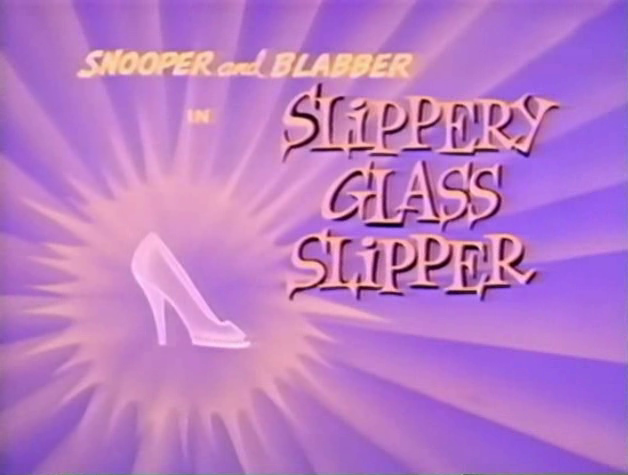
Snooper and Blabber — Slippery Glass Slipper

Produced and Directed by Bill Hanna and Joe Barbera.
Credits: Animation – Lew Marshall; Layout – Bick Bickenbach; Backgrounds – Bob Gentle; Story – Mike Maltese; Story Director – Alex Lovy, Titles – Art Goble; Production Supervision – Howard Hanson.
Voice cast: Announcer, Messenger – Hal Smith; Snooper, Blabber, Prince, dog – Daws Butler; Wanda Wandwaver, Ugly Sister, Pretty Sister – Jean Vander Pyl.
First aired: December 22, 1959.
Plot: Snooper and Blabber try to track down the owner of a glass slipper with the help of a magic wand.

So, you’ve got to write something like 26 detective cartoons, in addition to about the same number of father-son sitcom spoofs and western parodies. What do you do? If you’re Mike Maltese, newly-arrived at Hanna-Barbera from Chuck Jones’ unit, you decide that animation will, like history, repeat itself. You dig out tried and true ideas from your career at Warner Bros., call in Dan Gordon and start working on a storyboard.

One of those ideas is fairy tales. You name it—The Three Bears, The Three Little Pigs, Snow White, there doesn’t seem to be any end to re-telling those beloved fables by plopping in your favourite cartoon character to screw around with them. Maltese did that thrice in the first season of Snooper and Blabber, first with Switch Witch (Hansel and Gretel), then with Fee-Fi-Fo-Fumble (Jack and the Beanstalk) and finally with Slippery Glass Slipper, the subject of which should be known to anyone age three and up (parents do read fairy tales to their youngsters these days, don’t they?).

Besides Cinderella and Dragnet, Maltese heaps in another little send-up at the start. He opens the cartoon with the almost obligatory closing-in shot of the Snooper sign with the eye ball; this time, it’s on the front door of his office.


Announcer: Good evening, folks. Welcome to the ‘Surprise the Citizen’ programme. Tonight, we’re about to surprise that intrepid private eye, Super Snooper, and ask him all about himself. Aren’t we mischievous? (laughs).

For those of you too young to know, Maltese has taken a swipe at the entire programming roster of the incredibly successful Ralph Edwards Productions. ‘This is Your Life’ surprised ordinary people and celebrities alike by finding them, then dragging them on stage in a studio to tell their life story through friends who would join them on camera. ‘Truth or Consequences’ featured audience members attempting embarrassing stunts if they couldn’t answer Edwards’ unanswerable question, as he looked toward the studio seats and chuckled “Aren’t we devils?”

The shot from dissolves from a close-up on the door to a pan of Snooper’s office, which has an interesting angular layout you can see below but not so well during the pan. The camera rests on Blabbermouse, playing with a yo-yo. Snoop’s not there? No matter, Blab volunteers to field the eager announcer’s questions. Was there a case involving royalty? Sure there was. Blab pulls out the file on the ‘If the Shoe Fits, Wear It Caper.’


Now Blabber narrates the story-within-a-cartoon, which begins with Snoop and Blab on the water fishing in Upper Credonia. Their unsuccessful angling is interrupted by one of Maltese’s oddball sight gags—a messenger wearing a naval outfit and riding a pontoonish bicycle on the water. Maltese combines it with one of his typical redundant dialogue gags:


Blab: When, suddenly, we got a hurried call from the palace.
Messenger: Here’s a sudden hurried call from the palace.

The message is from Prince Ofafeller (Maltese would use A Prince of a Fella’ as the name of his Snow White spoof in the second season). Snoop puts their motorboat in gear and the next scene places them in the Prince’s chamber, also laid out with a bit of diagonal perspective. Ofafeller wants them to find the girl whose foot fits a glass slipper that was lost at the Royal Dance and offers them one million credolians.


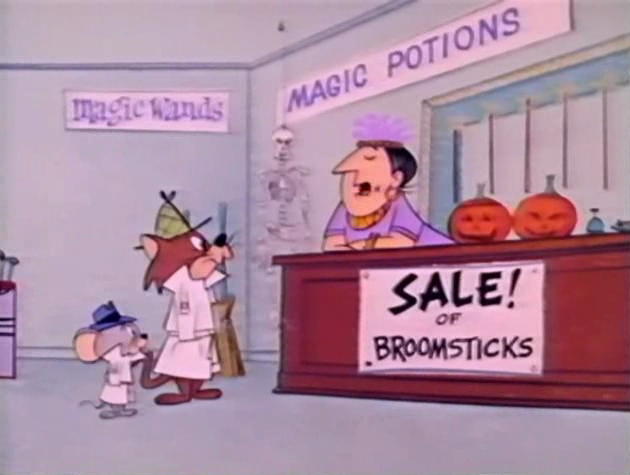
Since the scenario reminds him “of the old Cinderella caper,” the first thing Snooper does is check the Yellow Pages for fairy godmothers. And there just happens to be a listing for one at 462 Witch Way. That’s their next stop. This gives Maltese a chance to pull out his ersatz Dragnet witness-questioning dialogue, complete with monotone witness—in this case, Wanda Wandwaver. Jean Vander Pyl gives her a Brooklyn accent, always popular in cartoons.


Wanda: Yeah, I remember her. She ordered the whole woiks. White mice, pumpkin, glass slippers. You know, the whole woiks.
Snoop: Yes, m’am.
Wanda: I want you to know I run a respectable place here. I want ya to know that.
Snoop: Yes, m’am.
Wanda: I use an honest wand in my woik. I want ya to know that.
Snoop: M’am, yes.
Wanda: I don’t want any trouble with the police.
Snoop: Who does? By the way, could you tell us where she lives?
Wanda: With an ugly sister, down at the waterfront.
Snoop: Thanks (grabs wand) I’ll just mark this wand Exhibit ‘A’ and return it later. Hold on to Exhibit ‘A’, Blab.
Blab: Right, Snoop.
Snoop: Oh, uh, by the way, I needn’t precaution you about leavin’ town.
Wanda: I’m stayin’ right here, I hate to travel. Ask anybody. “She hates to travel,” they’ll tell ya.
Snoop: Yes, m’am.

The two detectives walk along a city street. Blabber wonders how the wand works. “You tap somebody on the noggin and presto!” answers Snoop. So Blab tests it out and changes Snooper into a weiner-shaped white mouse. For some reason, the magic makes him nude except for a deerstalker cap. “Sorry, Snoop,” sadly remarks Blab as he changes him back.

The next stop is at the home of the ugly sister. Vander Pyl uses the dumb voice she’d later put in the larynx of the mama bear in A Prince of a Fella’. Snoop pretends to be a salesman giving away a free pair of shoes if the sister’s foot fits the glass slipper. She insists it fits even though she can’t even get her big toe in it. Snoop asks if there’s anyone else in the house. “Only my younger sister whom we can lock up in the tower because I’m jealous of her great beauty,” is the reply. Snooper heads up the stone steps to the tower.


Snoop: Man, she’s so ugly, she’ll never grow old. She’ll just “ug” away.

Snooper is quickly stopped from getting in to see the younger sister because of a barking guard dog. No problem. Snoop has Blab turn him into a mouse again. The great mouse-ized detective is then small enough to indulge in a familiar cartoon gag. He secretly wraps a string around various objects and ties one end to the dog. The other end is attached to a rock which Blab shoves off a dock into the water. The force pulls the dog through all the objects and into the ocean.


Now Snooper is able to get to the pretty younger sister who tries on the slipper. And viola! (as Snoop said earlier in the cartoon) It fits. So the case is closed. But leave it to Blab to louse up things.


You see, the dog pulls himself out of the water and growls at Blab. He quick-thinkingly tells the dog to “fetch the stick”—which happens to be the wand. Blabber throws it on a heap of garbage being hauled away by a truck, which the dog chases after. “I lost it,” wails Blab when Snooper asks him where the wand is that can change him back to “me big, handsome self.”

“Good grief! What happened after that?” the shocked announcer asks Blab, whose story has ended and the final scene of the cartoon takes place back in the office. We soon get the answer as Snoop rolls in inside a pumpkin-coach a la Cinderella. No, Blab hasn’t found the wand. “Well, hurry it up, pal. How much cheese do you think I can eat?” says hot dog-shaped rodent Snoop as the iris closes. (Blabber, being a mouse, ought to know the answer to that one).


Snooper doesn’t use his “Halt in the name of (fill in the blank)” catchphrase in this one.

The title card is very similar to Desperate Diamond Dimwits earlier in the series, except a diamond has the irradiated lines.

Most of the music is by Phil Green, with two cues by Jack Shaindlin, including a fast circus romp used in all three series on the Quick Draw show.


0:00 - Snooper and Blabber Main Title theme (Hoyt Curtin).
0:05 - GR-75 POPCORN SHORT BRIDGE No 1 (Green) – Office door, pan across office to Blab.
0:21 - GR-456 DOCTOR QUACK (Green) – Blab talks to announcer, close-up of photo album.
0:50 - GR-90 THE CHEEKY CHAPPIE (Green) – Snooper and Blabber fish, messenger arrives, motorboat leaves.
1:23 - GR-85 THE BRAVEST WOODEN SOLDIER BRIDGE No. 1 (Green) – Prince holds up slipper.
1:37 - GR-93 DRESSED TO KILL (Green) – Snooper agrees to take the case.
1:55 - GR-333 BUSTLING BRIDGE (Green) – Phone book scene.
2:15 - GR-87 SKELETON IN THE CUPBOARD (Green) – Magic shop scene, Blab zaps Snoop with wand.
3:08 - GR-348 EARLY MORNING (Green) – Snoop turned into mouse.
3:30 - GR-453 THE ARTFUL DODGER (Green) – Ugly sister tries on slipper, dog chases Snoop out of home, Blab turns Snoop into a mouse.
4:44 - GR-93 DRESSED TO KILL (Green) – Snoop ties string around a bunch of things and attaches it to dog.
5:24 - GR-454 THE ARTFUL DODGER BRIDGE No 1 (Green) – Blab tosses rock off dock.
5:28 - fast circus music (Shaindlin) – String pulls dog into ocean.
5:40 - PG-160G LIGHT MOVEMENT (Green) – Girl fits into glass slipper.
5:56 - COMEDY SUSPENSE (Shaindlin) – Dog growls at Blab, Blab throws wand on top of garbage truck.
6:27 - ASININE (Shaindlin) – Snoop enters office in pumpkin coach.
6:49 - Snooper and Blabber end title theme (Curtin).

Saturday, 29 May 2010

Pixie and Dixie — Lend-Lease Meece

Produced and Directed by Bill Hanna and Joe Barbera.
Animation – George Nicholas; Story – Warren Foster; Titles – Art Goble; Production Supervision - Howard Hanson (no credits).
Voice Cast: Pixie, Charlie, Pathetic Mouse – Don Messick; Jinks, Dixie – Daws Butler.
First Aired: Week of December 20, 1959.
Plot: Jinks loans Pixie and Dixie to the cat next door then has to fight to get them back.

George Nicholas did some marvellous stuff when he first arrived at Hanna-Barbera, though there’s no way it had the fluidity or style of his work at Disney. But his characters are expressive. You know exactly what they’re thinking. That’s why people accepted and liked the Hanna-Barbera characters, even though they weren’t drawn with the same intricate design or movement that the studio’s animators used at their former workplaces, especially in the 1940s. Look at how Nicholas draws Jinks below. There’s no mistaking his emotion.


Lend-Lease Meece was apparently the first Pixie and Dixie cartoon that Nicholas worked on and joined well with Warren Foster (and whoever did the layouts) in coming up with a nice cartoon. It opens with a moving van pulling up to the Jinks and meece residence. The camera closes in on a window and the shot dissolves to Jinks staring out it talking to himself (and the audience) as the camera trucks in for another close-up. That’s fairly elaborate camera-work for an H-B cartoon.

Someone has moved into “the domicile-type house next door” and Jinks decides to move to another window to get a closer look. Nicholas gives us some nice posing. He comes up with a wide-mouthed, floppy-tongue Jinks and then, later, a look of relief as the cat’s body collapses in the window sill.


Jinks discovers a dog hasn’t moved next door, but “a real cool cat” has. Yes, it’s our old friend, the brown cat with the bow-tied collar and Don Messick’s back-of-the-throat voice who we saw in Mouse-Nappers. This time, his name is Charlie instead of Shortie. Jinks welcomes him to the neighbourhood and offers him anything he needs. Nicholas invents a low, loping walk for Jinks, who has a cross-eyed look.


Charlie stops Jinks and explains there is something. He’s worried about being kicked out of his home because it’s too new to have mice in it. Jinks volunteers to loan him Pixie and Dixie. Evidently, Foster was a big fan of the Phil Silvers show because this is one of several cartoons where he calls the meece out of their hole with “Hi-Yup-Oh-Yee-Ya!” shout like Bilko used to assemble his motley troops on the double at Fort Baxter.

Jinks orders the mice to go next door until Charlie get some of his own. Pixie and Dixie rejectedly walk away. But they brighten when they’re told there are three meals a day and get a look at their “mouse house.”


Of course, in return, the meeces have to be chased by Charlie, so they both do a rehearsal, where it’s evident they’re play acting.

Two weeks pass, and Pixie and Dixie haven’t been returned. So Jinks goes over to reclaim them, hinting what he wants.


Jinks: Mice today, huh? Looks like it’ll be mice tomorrow, too.
Charlie: Thanks for the weather report, but I’m busy. So long. (slams door in Jinks’ face).

Jinks peers in the window and waves hello to Pixie and Dixie, who are riding on a wind-up toy car.

Pixie: Hey, Dixie, look! It’s ... what’s-his-name.
Dixie: Oh, yeah, the cat next door. Hi, mac!
Jinks (to camera): Mac? The cat next door? How could they forget so soon?


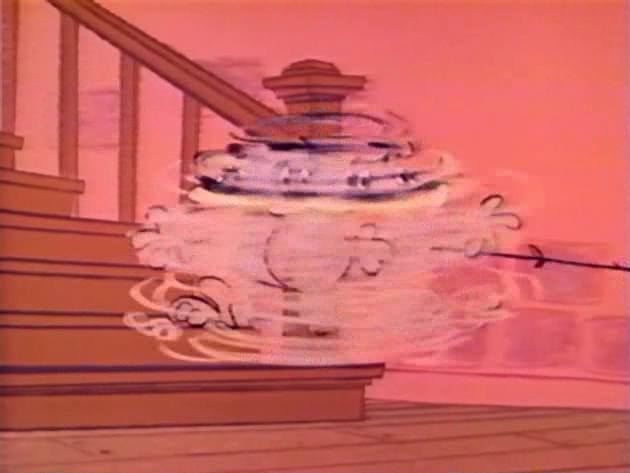
Jinks hammers on the door more insistently and we get the yelling animation you saw at the beginning of this post. He shoves his way into the home and goes to the canopied entrance of the mouse hole, then does his Bilko yell again. “Whatever you’re selling, we don’t want any,” says Dixie. “Yeah. Come back after the holidays,” adds Pixie. Undaunted, Jinks grabs the mice from their home, telling them “the holidays is like over.”

Jinks stomps back (the shot shows only the upper half of his body) toward his house but now the clobbering and namely calling is on. Finally, the two cats call a truce and agree to let the mice decide where they want to live.


Jinks: Do you natterally want to live in a atmosphere of love and affection with your pal Jinksie? Or, uh, do you wanna, pardon the expression, like, live with...
Mice (pointing to Charlie) : Him!!
Jinks: I do not accept that. (points at Charlie) You brainwashed them meeces.

Now the clobbering resumes. Pixie and Dixie remark to each other about how it’s nice to feel wanted. At that moment, the most pathetic mouse in cartoon history walks into the scene and feebly moans that no one wants him and he’s never had a home, with appropriate tear-jerking stock music playing in the background. Jinks yells at Charlie to stop the bashing and suggests he take home the pathetic mouse instead.

The cartoon concludes with a worn-out looking Jinks being told by Pixie and Dixie they were only having fun with him and they’d never leave him, while the pathetic mouse hugs Charlie going in the other direction, squeaking that he’s never been so happy, like he’s about to cry. This is a real tour de force for Messick. He goes from the growly cat voice to a high-pitched squeal for the mouse, one after another. Messick’s really a marvel.


Foster would re-work the plot of the rich cat next door who acquires Pixie and Dixie until Jinks fights to win them back in Plutocrat Cat later in the same season, except the mice express boredom once they get to the home of the gravel-voiced brown cat in that one.


0:00 - Pixie and Dixie main title theme (Curtin).
0:14 - TC-432 HOLLY DAY (Loose-Seely) – Jinks watches van pull up; goes to window.
0:37 - C-3 DOMESTIC CHILDREN (Loose-Seely) – Jinks greets Charlie; agrees to lend Pixie and Dixie.
1:34 - LAF-25-3 bassoon and zig-zag strings (Shaindlin) – Jinks kicks mice out of house.
2:24 - LAF-27-6 UNTITLED TUNE (Shaindlin) – mice knock on door, go into luxury pad.
2:58 - ZR-47 LIGHT MOVEMENT (Hormel) – Charlie chases mice, mice in beds.
3:22 - TC-202 ECCENTRIC COMEDY (Loose-Seely) – Jinks goes to Charlie’s; gets door slammed in face.
3:58 - L-81 COMEDY UNDERSCORE (Moore) – Jinks sees mice in window; demands meeces back, does Bilko yell at mouse house entrance.
4:44 - LAF-25-3 bassoon and zig-zag strings (Shaindlin) – Cats fight over mice.
5:23 - LAF-21-3 RECESS (Shaindlin) – Jinks asks mice where they want to live; doesn’t accept decision.
5:45 - L-75 COMEDY UNDERSCORE (Moore) – Jinks and Charlie fight.
6:01 - sad solo violin and trombone music (?) – Pathetic mouse tells his tale of woe.
6:34 - LAF-7-12 FUN ON ICE (Shaindlin) – Jinks takes Pixie and Dixie home, Charlie promises hot meal to pathetic mouse.
6:58 - Pixie and Dixie end title theme (Curtin).