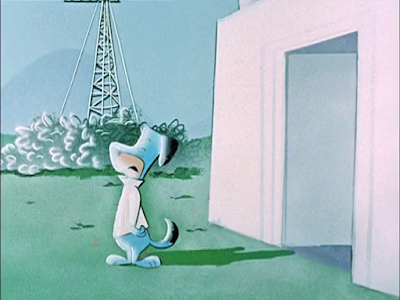
No, I am not wishing George Jetson a happy birthday today.
The reason is simple. There’s not a scintilla of proof that his birthday is today.
Some cartoon fans abhor a vacuum. They also love back stories, something in the early days of the Hanna-Barbera studio no one cared about. Bill Hanna and Joe Barbera’s interest was making people laugh, not writing biographies or “bibles” (okay, they were interested in profits, but that’s beside the point).
So someone, somewhere, came up with the idea of spreading word on the internet that George Jetson was born on July 31, 2022. How they picked the date is beyond me, as Mr. Jetson never (as far as I can recall) celebrated a birthday at any time during the 1962-1963 season.
It is true that publicity articles before the series appeared on television set the show in 2062. But that was jettisoned (or is it “Jetsonsed”?) as it was never mentioned in a single cartoon. Why date a show that could possibly run for decades?
One good thing is coming out of all the internet chatter. It gives the Jetsons more exposure, hopefully to young people who have never seen the original series.
Not all the episodes are great, with hoary old plots about the boss coming to dinner and inept women drivers, but the show is worth watching for the futuristic designs. Astro is always funny, and there’s some good satire in Elroy’s TV Show, where activists have sucked all the entertainment (and life) out of television, and Uniblab, where a robot/computer turns out to be a corporate suck-up. And A Date With Jet Screamer features what is basically an early animated music video, courtesy of animator Bobe Cannon during his brief stay at Hanna-Barbera.
However, never it let it be said that Yowp is a wet blanket. Feel free to make this George Jetson Day and celebrate by watching some of the almost-60-year-old cartoons. Or you can listen to a few cues from the series below. I imagine these came from the collection of the late Earl Kress. Hoyt Curtin loved those end-stabs. No, I do not know why the alpha/numeric labels for the cues begin with “V.”
Remember the gag in Tex Avery’s The Peachy Cobbler (1950) where the elves hammered nails into each other’s butts? The same thing happens in one of the mini-cartoons that ended the Quick Draw McGraw show.
The story has the characters on the show building a brick jailhouse for Quick Draw. Here’s the hammering set up, with Blabber painting on top of a ladder.
Here’s Doggie Daddy’s expression.
And Snooper’s expression. The saucer eyes are held for several frames.
Blabber falls off the ladder. It’s tough to tell with this frame recorded onto VHS but Blab leaves behind a face.
The end gag is cute and pretty much expected in a Quick Draw cartoon. The jail is built. The characters are all trapped inside. “How we get out? There is no door,” says Baba Looey. “Oh, I forgot about that,” admits Quick Draw—but they’ll be out in time for the next Quick Draw McGraw cartoon show.
Does anyone think these are Don Williams’ eyes?
Someone should be in that jailhouse because it’s crime the Quick Draw McGraw show isn’t on home video. The 16mm footage that was dubbed onto these old VHS tapes must be around if the original negatives aren’t, and could easily be included as bonuses on a disc set if the original half-hours can’t be located.
I’m not holding out hope we’ll ever see a home release including these neat little treasures, but it’s good to know collectors have preserved some of them and are letting them be seen on-line. Thanks to Steve Hanson for this one.
Top Cat debuted on the ABC-TV network on Wednesday, September 27, 1961 with the episode “The $1,000,000 Derby.” Like all the Hanna-Barbera cartoons, T.C. was shot in colour but broadcast in black and white.
It would appear some stations aired the series on a different night, as 16 mm. black-and-white prints exist of the show, complete with commercials. One of “Derby” is for sale on-line as of this writing.
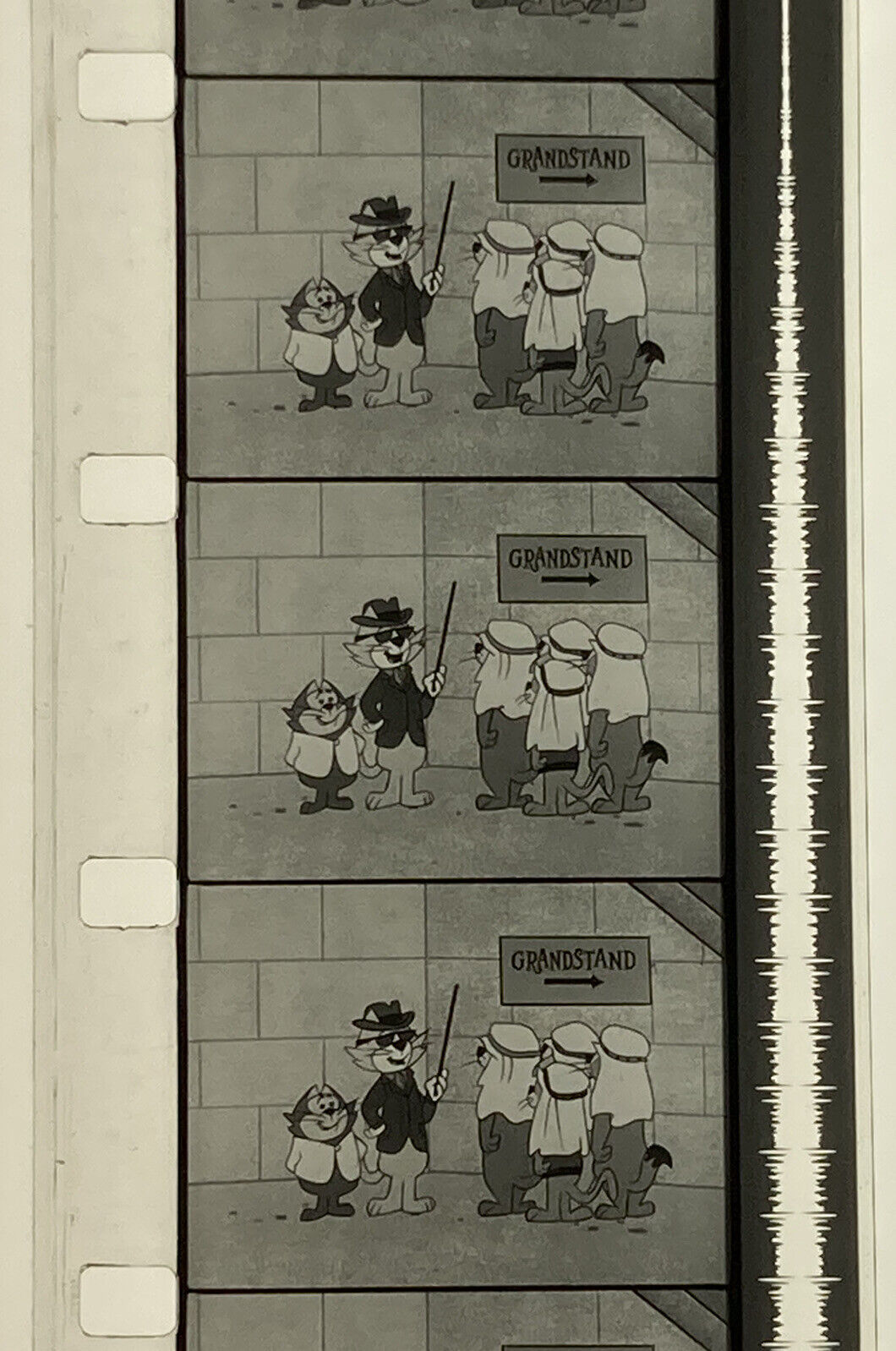
The seller has these neat shots of the actual film. The first film strip below has the unmistakeable earmarks of being animated by Carlo Vinci. The mouth on Top Cat gives it away. He gave Fred Flintstone the same kind of angular expression. Variety’s review at the time claimed Ken Muse animated the episode. I haven’t seen the cartoon in eons, so I don’t know if he worked on it (he animated the series opening), but there is no way Muse did that first scene below.
We mentioned commercials. Here are some frames from a spot for Kellogg’s Special K I’ve never seen before. (Other ads for Bristol-Myers products are live-action). The characters sure don't look like the H-B house style, do they? The teenager looks a bit like Waldo from UPA’s Mr. Magoo shorts.
Below are some frames from the opening and closing. The ABC title card isn’t on the DVD version (the one with the credits all screwed up).
The series leaves me a little cold, despite Top Cat’s cue library by Hoyt Curtin being really enjoyable (especially his mock Gershwin) and a superb voice cast. I love Marvin Kaplan. I love Arnold Stang. What better, then, than to reprint an interview Stang did about the show, and his family. He also makes a startling revelation of one of his best-known on-camera roles up to that time. This appeared in the January 6, 1962 edition of the Charlotte News.
IT’S DISTRESSING Arnold Stang: Cat's Meow By VAL CAREW
SPECIAL TO THE NEWS
HOLLYWOOD — Arnold Stang, in his time, has played almost every kind of animal. Currently he is gainfully employed as Top Cat, the title puss on the cartoon show (ABC and WSOC-TV) of the same name.
Playing a cat is, he says, a challenge. Not because of the character's felinity, but because he is just serving as a voice for animation.
"Ordinarily," says Stang, "I act with my body, with my face and with my hands. But here I can only use my voice. It is a great challenge."
WHILE IT IS obvious that Stang likes his job — the hours are good and so is the pay — he is still a bit unhappy that he is not accorded the chances he'd like at heavier parts.
"It is distressing," he admits. "Everybody thinks of me automatically as the character on the Milton Berle show. And I hated that part more than anything I did.
"I quit several times, and the last time I quit I went right into 'The Man With the Golden Arm.' That was a fine picture and I had a fine part.
"I thought that was an important role. And, since then, I have had some other serious things to do on TV, in the movies, on the stage But, despite that, it’s still the Berle thing people remember. And I seldom get thought of in serious terms."
STANG AND HIS family moved to California for the Top Cat assignment. They are all adjusting nicely to the West Coast, although the house they bought burned down in the Bel Air fire.
Happily, they were all away at the time, but they lost everything they owned — including some souvenirs which are irreplaceable, such as a letter from Sir Winston Churchill.
The two Stang children — his 1-year-old son and 1year-old daughter — like the California climate, although they miss their friends back east.
ARNOLD'S SON at the moment wants to be an archaeologist, and "seems to be quite serious about it." The little girl is going through the ballerina stage.
"Up until a year ago," Arnold says, "if you asked her what she wanted to be, she'd say, 'A person.' I always thought that was a very good answer."
Stang has been kept quite busy with things other than Top Cat — he's made three movies and starred in several other TV shows. The Top Cat recording schedule is always arranged to suit him — it can be in the evening or on weekends, if he's otherwise occupied. And he sometimes does three a week, so he can go back to New York for a week or so.
AS FOR STANG'S intimacy with cats — he has none.
"I don't own a cat. I've never owned a cat and I doubt if I ever will own a cat," he says. "We have a dog, you see.
"Actually, I don't think that observing a cat would be of any help to me in this show. The fact that Top Cat is a cat is incidental; he thinks and acts like a human being."
Things looked good for T.C. for a bit. ABC ordered additional episodes but stopped at 30. The ratings weren’t good enough; during one week in San Antonio, the alley cat gang was beaten by a syndicated show. Top Cat was part of an anticipated prime-time animation boom caused by the success of The Flintstones the previous year. Instead, it fizzled and network soured on animation. T.C. was moved to Saturday mornings the following year. With no new episodes (and no residuals for actors), the series was now reasonably cheap and therefore attractive to companies that wanted to aim solely at kids (in other words, no more ads for Alberto VO-5 like in prime time).
The characters have popped up on occasion since the original series 60 years ago but it’s somehow not the same without Arnold Stang and Curtin’s Rhapsody in Blue-ish clarinet opening an episode.
My thanks to Austin Kelly for his tip that resulted in this post. The blog resumes its retirement.
Fans of early Hanna-Barbera cartoons are the best.
Each of us has our favourite series and characters. The late cartoon writer Earl Kress and I found an instant kinship when I told him my favourite H-B series is the Quick Draw McGraw show. Earl, as you may know, spent what ended up being fruitless time endeavouring to get the series released on home video by Warners, only to run into several roadblocks.
One of them was the location of bumpers—those little cartoons between the cartoons. Whoever was running things at what was left of the studio had no idea where the masters were, or even if they still existed, to Earl’s dismay. Of course, when the series first aired in 1959, 16-millimetre prints were sent to TV stations in the U.S. and elsewhere around the world. The same thing happened several years later when the half-hours were shorn of references to Kellogg’s and syndicated again (Quick Draw also aired on CBS on Saturday mornings in 1966-67).
An early Hanna-Barbera fan with the handle of Steven Hanson has somehow acquired dubs of some of the 16 mm. prints and is braving take-down notices by posting some of the Quick Draw mini-cartoons in his possession. Some are even in colour.
Here’s a shortie. Quick Draw and Baba Looey are fishing in a rowboat that is taking on water (which we can’t see to save some pencil mileage).
Quick Draw’s keen deduction tells him if he shoots a hole in the bottom, that’ll let the water out.
Not quite.
Never fear! Tex Avery is here! Well, kind of. The writer borrows the water-plugging gag from Avery’s Lucky Ducky (1948). I’m pretty sure it predates that cartoon, but that’s the only one I can think of with it.
The Avery version.
Who is the animator of this cartoon? He worked on Lucky Ducky. These odd mouth shapes should give it away.
Mike Lah.
The frames look they came straight from the storyboard without embellishment, though in the first Huckleberry Hound show cartoons (1958), Lah would change mouth shapes on a face with the rest of the body being held on a cel. In this little cartoon, the pinkish snout moves slightly as well (and the water spurt is on a cycle). It’s a shame he decided not to go for funny takes like he did with Mr. Jinks, but gave us Jack Benny-style stares instead. Lah worked freelance the whole time he was at Hanna-Barbera; an offer to be a partner in 1957 fell through.
Oh, the title of this post is Quick Draw’s last line before the fade-out.
If you like Quick Draw, you should be delighted Mr. Hanson has posted these. He also has put up a few Ruff and Reddy half-hours. I find the show a little childish and dull, but it has fans who will be happy to see it. Like the Quick Draw McGraw show, I really, really doubt we will ever see it on home video due to music rights issues, so this will have to do for now.
These days, the internet seems full of people who are prepared to tell you who animated what in old cartoons. There are wonderfully helpful people like Mark Kausler and Mike Kazaleh, who knew and worked with some of the famous old names in the business and easily recognise animators’ styles.
The first season of the Huckleberry Hound Show? It's comparatively easy to determine who worked on each cartoon, besides looking at the credits. The Hanna-Barbera studio had only four animators. Each did some things uniquely. Carlo Vinci’s movement doesn’t look like Ken Muse’s. Mike Lah’s Jinks doesn’t resemble anyone else’s (Lah, arguably, created the best expressions in that first year).
It gets tougher when the studio brought in more and more people, especially on uncredited bits of animation like the openings and closings of Hanna-Barbera’s shows. Muse is distinctive enough that you can tell he animated the opening of Top Cat (T.C. has expressions Muse used for Tom at MGM). Others are a puzzle.
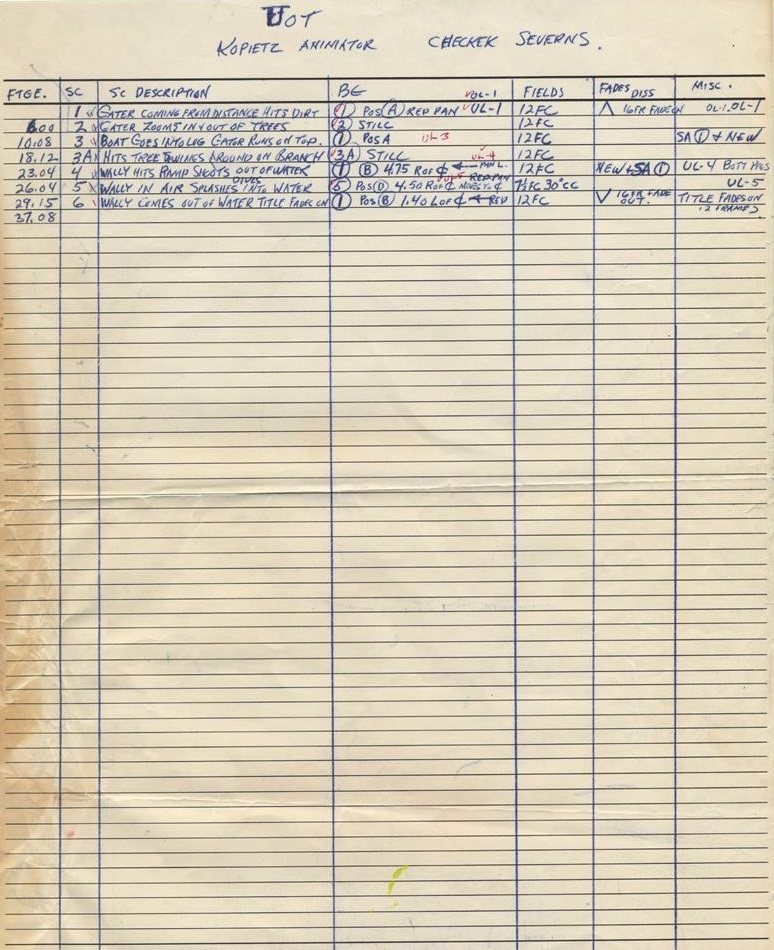
Anyone that wondered who animated the opening for Wally Gator no longer needs to guess, thanks to a note I received from cartoonist and animator Charles Brubaker. His Patreon is here, by the way. During one of his hunts on the internet, he came across the exposure sheet on this post. You’ll notice that the animator listed at the top is Fred Kopietz, a name you generally don’t associate with Hanna-Barbera.
Kopietz is probably best known for his work for Walt Disney, though he’d spent time with Ub Iwerks and Walter Lantz in the ‘30s. He ended up at Hanna-Barbera in 1960 and was originally working on commercials.
He also told historian Mike Barrier:
Bill Hanna had three openings made [for The Flintstones] that they'd intersperse for their shows, and I did two of them. Dick Lundy—I'd animated for him at Disney's, and I gave him the third one, that I couldn't get out on time.
The interview doesn’t mention Wally Gator, but it is worth your time reading it. You can find the transcript here.
Wally, as you probably know, was part of Hanna-Barbera’s first attempt to crack the syndication market without assistance of a sponsor or compiling a formal, half-hour show like Quick Draw. The cartoons were shorter than the ones making up the half-hours and TV stations could either combine them or drop them into kids programming. Touché Turtle and Lippy the Lion were the other two. Did Kopietz animate their openings? Perhaps we’ll find out some day.
Oh, by the way, I have no idea why Wally’s opening and theme song involve a swamp when the series was set in a zoo.
There’s an interesting effect Hanna-Barbera used in the Yogi Bear cartoon “Space Bear” (1959) that was also seen at the end of “Spud Dud” (1960), the first Huckleberry Hound cartoon of the third season.
This is the one with the megalomaniac potato that tries to take over the Earth. Huck traps him in a “spud-nik” that orbits the planet. Our hero advises us the potato is in a dangerous situation because the rocket could explode. Suddenly, a blast sound effect and black and white cards appear on the screen to simulate an explosion. This kind of thing was done in theatrical cartoons, too.
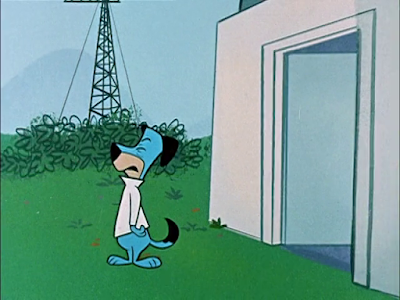
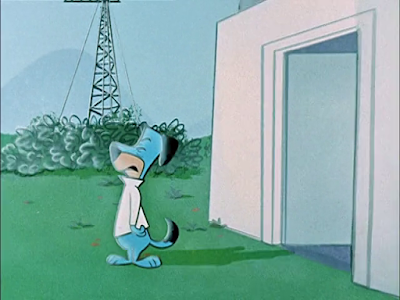
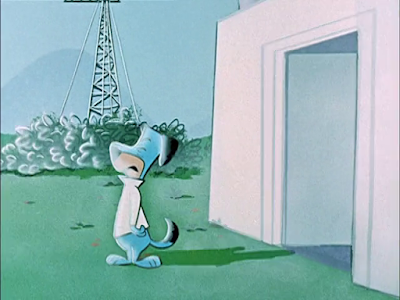
This is followed by a glowing effect, kind of like a glazing. There are several different versions of brightness; here are three of them.
As I’m not a cartoon director nor a cameraman, I don’t know if they opened up the aperture to allow more light in or used an airbrush to make this visual effect. I believe this was the final time the studio tried this.

 No, I am not wishing George Jetson a happy birthday today.
 One good thing is coming out of all the internet chatter. It gives the Jetsons more exposure, hopefully to young people who have never seen the original series.