Monday, 31 January 2022

Leo De Lyon

An anonymous note has been left on the blog asking why the death of Top Cat actor Leo De Lyon hasn’t been mentioned here.

It’s pretty simple. I have to know about it. I did not know Mr. De Lyon, nor am I connected with his performers union. He has been out of mind for many people for at least half a century. 50 years ago he was directing an 18-piece orchestra behind the vocal stylings of Sandler and Young. That’s not exactly national television exposure.

As a side note, I remind everyone this blog is, for all intents and purposes, finished. I’ve moved on. I don’t come here now. There are still some finished and half-finished draught posts in my folder than I may get around to putting up (the Tralfaz blog is on auto-pilot until the end of September, though I have banked a number of obits that can be posted).

Anyway, Mr. De Lyon’s union (SAG-AFTRA) reported he passed away last September 18th.

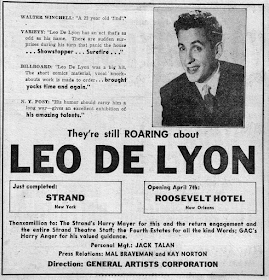
About the only thing most people know about him is he was on Top Cat. I doubt anyone reading here saw him as a regular panelist with Bob Haymes and Dorothy Loudon on “It’s a Business” on the DuMont network starting in March 1952. Or his appearance on Uncle Miltie’s show in 1949 (Dorothy Kilgallen quoted Mr. Berle as saying De Lyon was “a one-man Marx Brothers”). He seems to have spent the bulk of the 1950s in clubs, and made a few talk show appearances in the 1960s.

De Lyon was a case of “fastest rising young comedian.” We find him in June 1948 as part of Paul Whiteman’s stage show in Philadelphia. He was working nightclubs in New York City in less than a year after stops in Toronto, Baltimore and Miami (the last city was likely used to break in his New York act). One of the Philadelphia papers revealed when he was a sailor (submarine service) during the war—and he had to be in his teens then—he stopped in at the Embassy and Little Johnnie’s in Phillie and entertained customers with sketches, impressions and piano playing.

The best profile I’ve found about him is at the start of his career. The New York Daily News published this story on May 15, 1949:


Leo’s Lurid Noises At Last Appreciated
“My getting hooted out of all the basketball games at high school was the cause of it all,” recalls Leo De Lyon, zany young comedian currently featured in the Roxy stage revue. His hop from the Strand to the Roxy, with less than 21 days elapsing in between, chalked up a new mark for the Broadway history hooks. This 23 year old Brooklyn madcap has been tagged “the year’s comedy find” by such theatrical cognoscenti as Arthur Godfrey and Paul Whiteman.
Only six years ago, Leo was a student at Franklin K. Lane High in Dodger-town and was prohibited by the principal from attending any interscholastic basketball game. De Lyon used to hide himself in various shadowed corners of the balcony, wait for exciting portions of the game, and then imitate a referee’s blasting whistle so perfectly, the players on court would halt in their tracks to see who fouled whom. All this just for laughs, and they came in torrents, until Leo was discovered, escorted to the principal’s office and told to stay away front any future basketball contests. So Leo, who shined shoes and sold newspapers after school to increase his meagre allowance, decided he’d eventually try getting paid for his talent at rib-tickling.
Has Huge Range.
De Lyon has a vocal range of 86 notes, all in perfect pitch, which is just two less than the number of ivory-encased do-re-mis on your parlor Steinway, something no Metopera diva can equal. When he toured honky-tonk clubs and resorts in the borscht belt hinterlands late last year, before hitting Broadway, the band musician would tune up their instruments to his voice, tossing aside the accustomed method of using a piano.
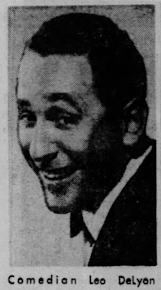
The Catskill paths led Leo to his first major break. He was called upon to join Paul Whiteman’s “On Stage America” unit for one week in Philadelphia, although not for the job he thought.
Whiteman needed a substitute pianist and Leo had mastered the art of 88 back in his school days. During one performance, the maestro suddenly realized his show was running short and looked around for a fill-in. When one of his musicians mentioned pianist De Lyon was adept at zany comedy, thanks to Leo’s impromptu pranks back stage, Whiteman grabbed Leo away from the keyboard and told him to “get out there and do anything you want for about five minutes.”
The results were tremendous. Leo tore down the house with his spontaneous bits of trick voice and song, which encouraged the Brooklyn madcap to seek Broadway stage work.
His next stop was Arthur Godfrey’s “Talent Scouts” radio program. It was only a few months ago that Leo appeared on the Godfrey show and won hands down. His mother was so overjoyed she led a parade of some 50-odd De lyon rooters from Brownsville down Broadway with a “the treat’s on me” call. Was Leo’s victory toasted in the chi-chi confines of the Stork or El Morocco? Certainly not. His mother took the neighborhood fan club to a cafeteria on 50th St. and treated one and all to coffee and Danish.


In 1950, De Lyon was performing overseas. One show was at London’s venerable Palladium. In the middle of the decade, he toured Australia with Johnny Ray. At the end of the decade, he was performing at Danish Days in Cedar Falls, Iowa. In January 1961, he emceed at the Minneapolis Auto Show before moving across the U.S. from New York to Los Angeles to try to further his career. By early May, after an appearance at the National Orange Show, he had been cast in Top Cat (along with Michael O’Shea, who was un-cast as T.C. fairly quickly).

After Top Cat failed to catch on in prime time, Leo headed back onto the road for more fairground-type m.c. But Hanna-Barbera wasn’t through with him. Here he is from the soundtrack of the 1966 feature A Man Called Flintstone.


He also contributed incidental voices to The Smurfs.

With his versatile vocal chords (his club act once featured him singing as both Jeanette MacDonald and Nelson Eddy), he was a natural for novelty records, a huge industry in the ‘50s and ‘60s. This was the debut single for Musicor Records, according to writer Al Kooper. The backup band was the Aristocats, a group from Kooper’s home town. The song was copyright August 23, 1960.


In 2020, Leo and his wife moved into a home in Ventura, California. At age 95, the graduate of Julliard tickled the ivories and someone recorded a snippet of him. You can find it on Facebook.

Fans of Top Cat likely know he was interviewed for the DVD set dealing with the series. Over the years, people have posted parts of these great extras on YouTube only to have them taken down. With some trepidation, I link to Mr. De Lyon below and hope it’ll remain.
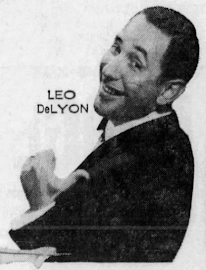


Someone reading here will wonder who is still around from the early Hanna-Barbera days. Working back from Top Cat, the voice of Yakky Doodle, Jimmy Weldon, will be 99 later this year. I have not been able to determine if the original voice of Blabber Mouse, former KFWB disc jockey Elliot Field, is still enjoying life in the Palm Desert area. He would be turning 95 this year.

Perhaps the most appropriate of the many gigs Mr. De Lyon played was in 1969. He headlined the programme at the all-county meeting of the Westchester Lighthouse at a church in White Plains, New York. The guest speaker at the event was a woman named Mrs. Dibble.

Saturday, 15 January 2022

Flintstone Daily Strips, October 1961, Part 2

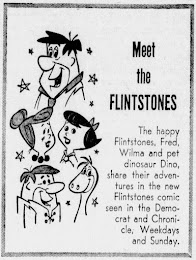
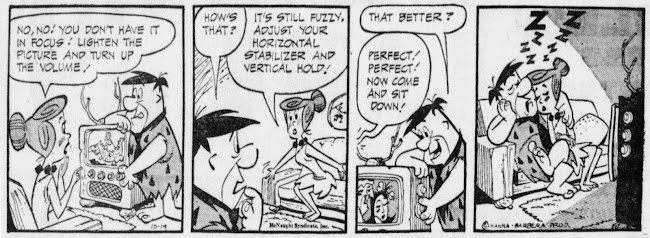
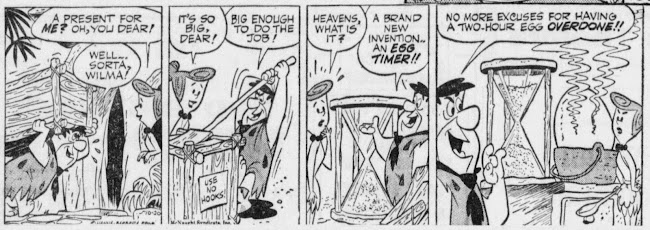
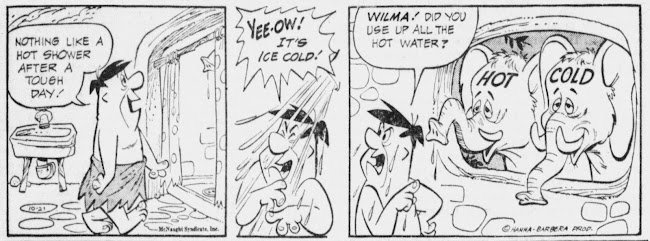
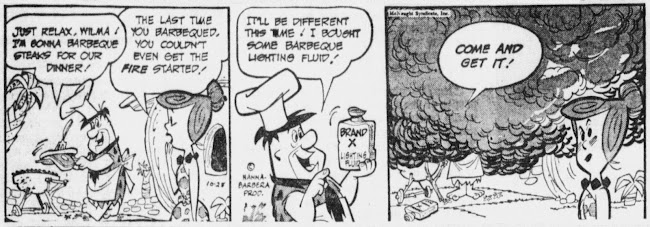
Some standard situations make their appearance in the Flintstones daily comic strip in the final half of October 1961, which was the first month of publication.

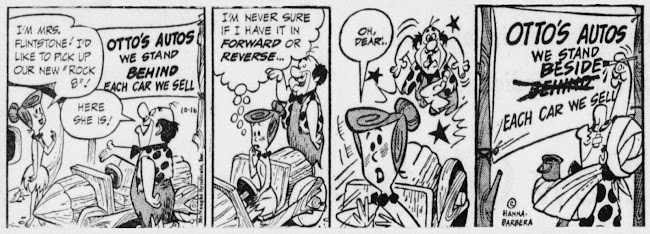
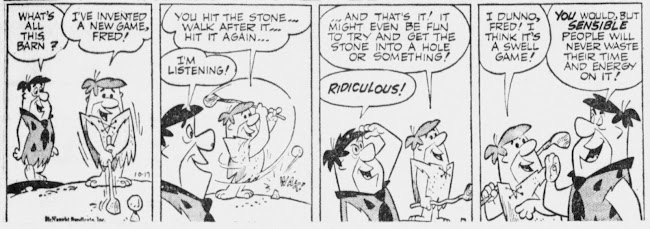
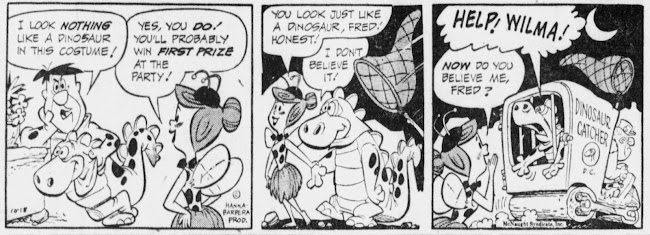
Do people still complain about women drivers? It seems to me ineptness knows no gender these days. On Monday, October 16th, there’s a gag about women drivers. The following day, Fred writes off one of Barney’s inventions which, naturally, is hugely popular in our day and age. Another invention appears on the 20th, while on the 21st, mastodons perform household tasks like they did in the animated cartoons. The Thursday comic has Fred adjusting knobs on his TV, which really is a Stone Age idea (note the elk antlers as antenna on top of the set).

Below are comics for October 16 to 21.


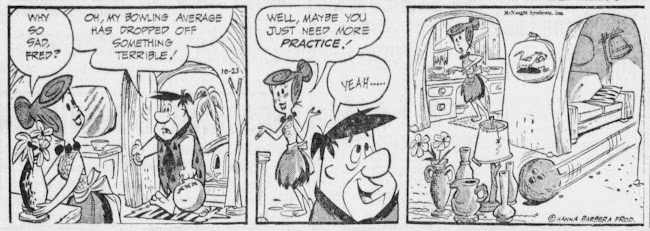
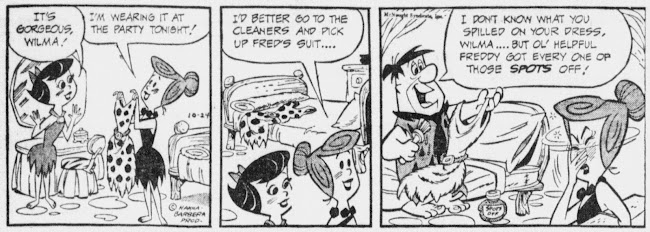
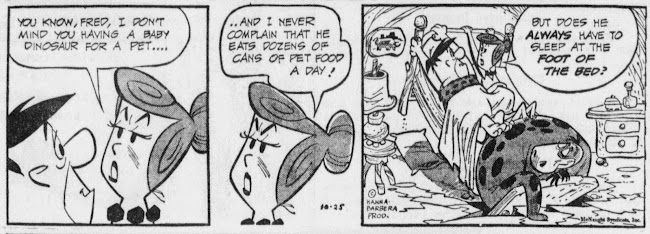
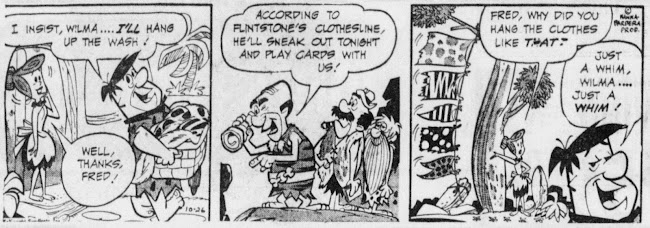
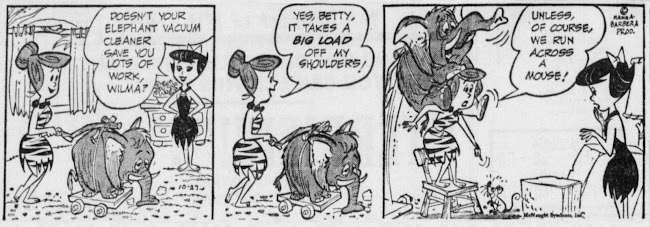
Fred’s love of bowling was in the first Flintstones episode that aired (although it was the third one made) in 1960. Evidently Fred needs a makeshift alley for practice in the comic strip of October 23, 1961. That cartoon also involved Fred sneaking around behind Wilma, which drives the plot of the comic of the 26th. The following day, Wilma has another elephant appliance.

The comics below are from October 23-28.


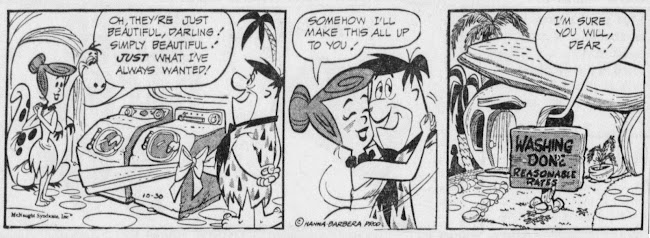
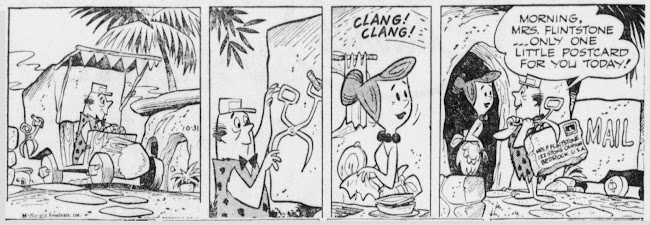
The next two, October 30 and 31, round out the month, with the final one a variation on the huge-slab-newspaper gag in the Flintstones TV debut.


You can click on any of the comics to make them larger.

Saturday, 1 January 2022

Flintstones Daily Strips, October 1961

Over the years, the Yowp blog has posted the Sunday (Saturday in Canada) colour comics starring Yogi Bear and The Flintstones syndicated by McNaught. There were also daily cartoons in the papers as well, a single panel for Yogi and a strip for The Flintstones.

A few of the Yogis have been spotlighted on blogs over the years but I have found few that aren’t photocopies of microfilm, let alone original artwork. However I did find the start of The Flintstones run in scans of one paper which are quite readable.

As you know, this blog has been retired. It was created to identify Capitol music cues in the old syndicated Hanna-Barbera cartoons. That was done some time ago. Some readers like the Hanna-Barbera newspaper comics so I posted them. I’ve had a number of The Flintstones dailies sitting in a draft folder. There’s no point leaving them there, so I’m going to put them up.

The comics first appeared in papers on October 2, 1961. Mercifully, this is before the appearance of Pebbles. As having a child changes the lives of its parents, so, too, does the introduction of a toddler into a cartoon. I much preferred The Flintstones TV series as an adult contretemps, though the battle-of-the-sexes concept was shopworn by the time television arrived. Anyway, there will be no sign of Pebbles below.

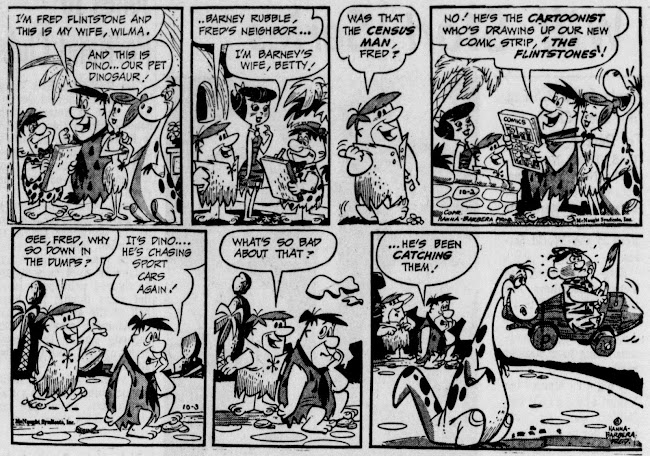
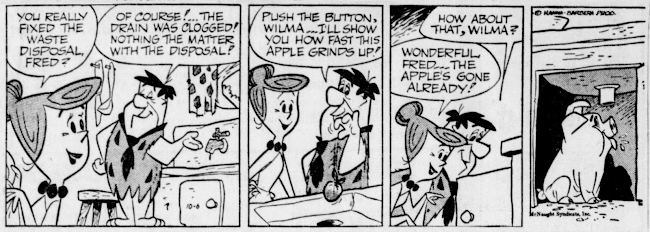
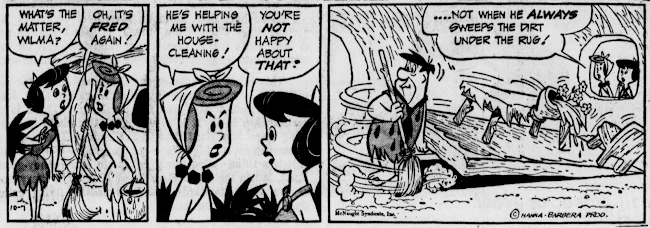
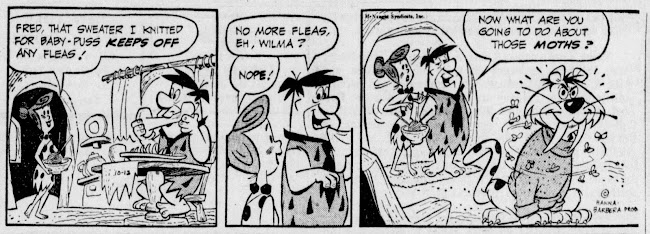
The October 2nd comic is a basic introduction, while the 3rd is a twist on an old gag Jack Benny used on radio about rotund announcer Don Wilson and small cars. October 6th is a familiar gag from the TV show—a domesticated animal does household drudgery. This one is weaker that what you’d see on TV. The animal would be Stone Aged (this one is an ordinary pig) and writer Warren Foster would have it look at the camera and wisecrack something.

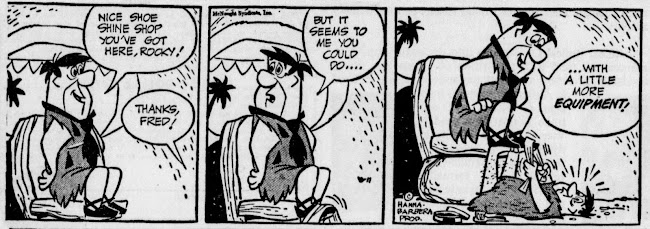
These are from October 2nd through 7th.


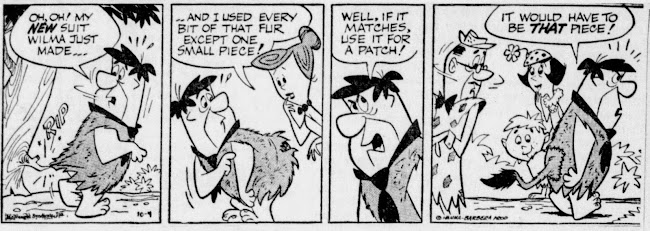
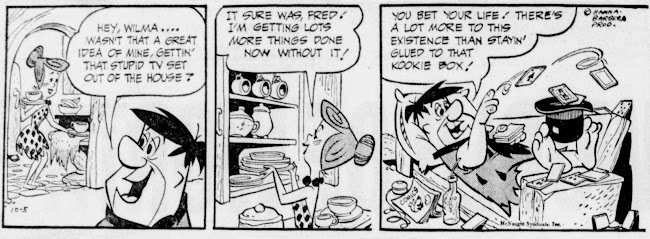
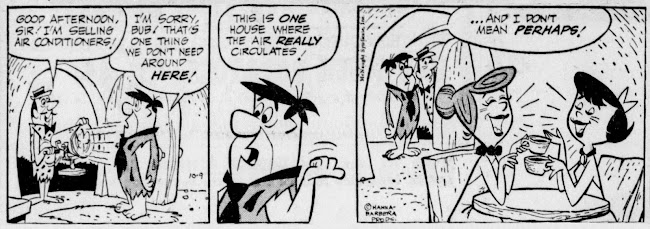
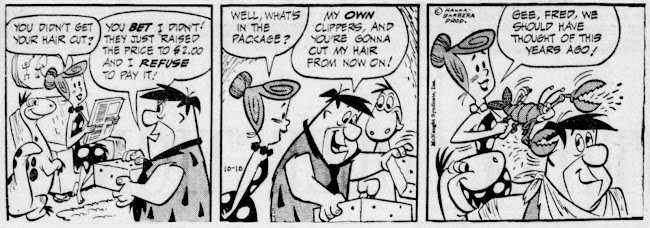
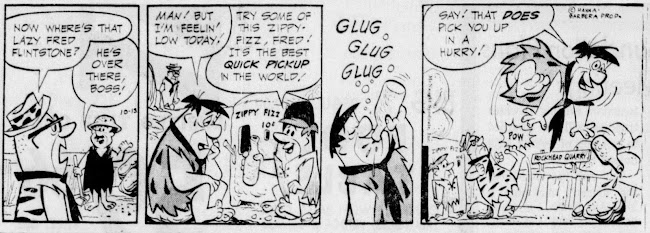
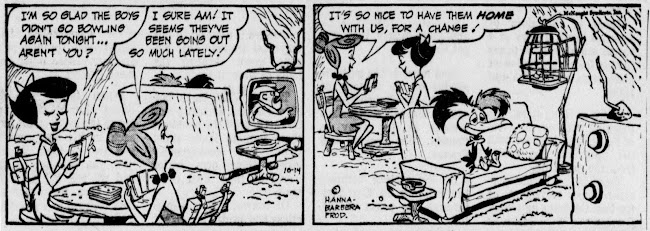
October 9’s comic has what was even an old punchline in 1961—women gossip a lot. October 10 is another variation on animals-doing-chores. October 12 revolves around Baby Puss, who found immortality in the TV’s closing animation but did very little else in the original series. (Oddly, the Jetsons’ cat was the same. It precipitated action over the end titles but was in a grand total of one of the actual half-hour cartoons). October 13 includes an appearance by Mr. Slate (at least that’s who I say it is) and the following day is another husbands-vs.-wives scenario.

These are from October 9 through 16.


Incidentally, the little drawing of Fred’s head and the club came from a different newspaper. I presume it existed in case it was needed to make up the difference in column width and the comic.

I have the rest of the month in a folder and I’ll see if I can find time to post it.

Saturday, 25 December 2021

Jean Vander Pyl

Jean Vander Pyl has a connection to Christmas.

She (her voice, to be specific) was one of the stars of the seasonal film “Santa and the Three Bears,” released independently to theatres in 1970. It was the brainchild of Hanna-Barbera writer Tony Benedict, who pitched it to Joe Barbera. If any company should have come up with an animated half-hour Christmas special that could run on TV every year, you’d think it would be Hanna-Barbera. But Mr. B. didn’t like the story and took a pass on it, so Tony went through some insane circumstances to get it into theatres.

This post, though, is about Jean Vander Pyl.

The four leading actors on “The Flintstones” all came out of radio, but Vander Pyl was the least prominent. Alan Reed co-starred on his own show in the early ‘30s and was a stooge on others. Bea Benaderet was one of the most sought-after secondary players on radio comedies on the West Coast and then appeared on television each week through the ‘50s with George Burns and Gracie Allen. I don’t have to tell you about Mel Blanc.

Vander Pyl appeared in a few top-level shows—surprisingly, one was “Amos ‘n’ Andy”—and was also one of countless anonymous commercial voices. Here’s a United Press article from November 9, 1949 that suggests she was pitching Arrid deodorant when she wasn’t taking up roles. (The Hollywood Reporter ad below is from 1947).

She Wants To Be More than "Half Safe"
By JACK METCALFE
HOLLYWOOD, Nov. 3 (U.P.)— Radio actress Jean VanderPyl, who swears that's the way to spell it, comes up with one of the most unusual complaints in Hollywood or anywhere else, for that matter. She's too successful.
Miss VanderP. is the lithe-tongued, dulcet-voiced lassie who beseeches her audience not to be "half safe."
That and 800 other chores for network moguls ranging from playing an ingenue to one of Macbeth's three witches have boosted her to a spot where her career interferes with her vocational ambitions.
"I just want to be in the movies," she says.
During the 12 long, yearning years she has been on the air, Jean says, she almost would have given her dulcet voice for a chance under the arcs.
It looked like waiting would pay off recently when producer George Mosko cast her in an important role in "Champagne for Caesar."
"I was ecstatic," she recalls. "I leaped at the chance, and leap is the right word. "I was so excited I jumped and fell all over director Dick Whorf."
Miss VanderPyl says she soon landed in gloom, however, because the "important role" turned out to be a "voice."
This young lady from Memphis plays a mysterious voice that takes part in a highly-charged scene with Ronald Colman in a soap tycoon's waiting room.
"I give him that double-syrup inflection which just oozes as it comes out," she says. "But unfortunately I won't see me."
So Jean, listed in the radio casting directory as "girl with sexy voice," faces the day when shell again bury her pretty self in a radio studio.
"I just wish," she comments plaintively, "I could show the world more of Jean VanderPyl than the vocal chords."


Perhaps Vander Pyl’s biggest radio role came as the mom on “Father Knows Best;” the Cincinnati Enquirer called her hiring “A change for the better.” She didn’t make the transition to television when the show appeared there and I don’t know why. This story in the Greenville News of October 18, 1951 talks about how she got it; the last sentence from a similar version in another paper.

Jean VanderPyl Natural In Part
Jean VanderPyl, lovely young actress who has just taken the leading feminine role of "Margaret Anderson", on WFBC's Father Knows Best." (9-9:30 p. m., Thursdays), is more than convinced that truth is indeed stranger than fiction.
When Dorothy Lovett, who has been portraying the mother of "Father's" lively brood on the Thursday evening comedy-drama, found that she had laryngitis and wouldn’t be able to appear on the show, she suggested Jean Vander Pyl as a replacement, because Jean's voice quality is similar to hers. It was a last-minute emergency, and when Director Murray Bolen of "Father Knows Best," got in touch with Jean, an hour before program time the evening of the show, she was busy putting her youngsters to bed. Jean managed to dress, get from the San Fernando Valley to NBC's Radio City in Hollywood and have the script in her hand by the middle of dress rehearsal. The result was that she went on the air in the key feminine role opposite star Robert Young without having even having read the script completely through.
However, Jean's spur-of-the-moment interpretations of Margaret Anderson so impressed the program’s sponsors that she has been signed to portray her on the show regularly. Jean VanderPyl's reaction is that Margaret really should be an easy role for her to portray. Margaret Anderson was supposedly married at 17 and had her first child at 18; Jean was married at 18, and had her first younger at 19. Margaret has three offspring, one of whom is named Kathleen; Jean has three, also, and one is Kathleen! And a recent Father Knows Best script which revolves around Mother’s birthday falls on the day before Miss VanderPyl’s own birthday.


We should pass along something about “The Flintstones.” This feature story is from the Tampa Tribune of May 18, 1986.

THE FLINTSTONES' 25TH ANNIVERSARY CELEBRATION
By WALT BELCHER

Tribune Staff Writer
Oh, those "Stones" they just keep rolling along.
When Fred and Wilma celebrate their 25th year in show business this week, it should be a memorable event. It could rank right up there with that day in 1969 when, upon reaching the moon, astronaut Neil Armstrong repeated Fred's immortal words, "Yabba dabba doo!"
With that simple phrase, Armstrong confirmed Frederick F. Flintstone's place in our hearts and minds. Armstrong didn't have to explain; we knew what he meant.
Fred and Wilma. They're as much a part of our culture as Mickey and Minnie or Dagwood and Blondie.
But for baby-boomers, it may come as a mild shock that 25 years have passed since "The Flintstones" debuted in prime time on network television.
From 1960 to 1966, Fred and Wilma Flintstone romped through 166 half-hour adventures and earned their place forever in our cultural history.
Set in the Stone Age town of Bedrock, "The Flintstones" was a parody of modern sub urban life.
Modeled after Jackie Gleason's "The Honeymooners," the show featured a loudmouthed caveman, Fred, and his long-suffering wife, Wilma. Their next-door neighbors were Barney and Betty Rubble, the Ed and Trixie Norton of cartoons.
Fred, who operated a dinosaur-powered crane at the Rock Head & Quarry Cave Construction Co., was a hopeless social climber, a poor slob who usually blundered his way into trouble.
In addition to the situations, the series included a lot of Stone Age sight gags, such as Wilma's Stoneway piano, a hi-fi on which Fred played his "rock" music (a long-beaked bird served as the needle), Wilma's vacuum cleaner (a baby elephant) and Fred's garbage disposal (a famished buzzard-type bird stashed under the sink). The Flintstones' car was a foot-powered steam roller that flattened out the rocky roads.
"The Flintstones" was one of the first made-for-adult TV cartoons; and it lasted longer than any other prime-time cartoon series.
The original episodes still are playing around the world.
(Locally, "The Flintstones" reruns air weekdays at 7:30 a.m. on WTOG, Channel 44.)
The originals played on NBC [sic], but it is CBS that is paying tribute to this minor classic.
At 8 p.m. Tuesday, Tim Conway, Harvey Korman and Vanna White (from "The Wheel of Fortune") take us on a musical trip down memory lane.
In addition to a "Flintstones" music video, we'll hear from the series' creator, Joseph Barbera, and a few other animated characters, such as Huckleberry Hound, Yogi Bear and Quick Draw McGraw.
Also included is a film clip from Sting's movie "Bring on the Night" in which Sting's band performs the classic "Flintstones" theme song.
Animator Barbera will explain how he and his partner, William Hanna, built a cartoon empire on the success of Fred and Wilma. He also will give the little-known origin of "Yabba dabba doo!"
"I haven't seen it yet, but I had to do Wilma again," said actress Jean Vander Pyl, who has been the voice of Wilma Flintstone for 25 years.
In a recent telephone interview from her San Clemente, Calif., home, Vander Pyl talked about her long-running role.
"I've done other things, including a 20-year career in radio before 'The Flintstones,' and there was some acting on television, but nothing has been as durable or lasted as long as Wilma," Vander Pyl said.
"It was one of the few cartoons that dealt with adult situations. This was a family show with lots of gags that went over the kids' heads, but the adults loved it. These were characters adults could identify with," she said.
Vander Pyl recalled that "The Flintstones" was created for prime time after Hanna and Barbera discovered that 60 percent of adult viewing audience in the 1950s had been watching their afternoon cartoon series "Huckleberry Hound."
Barbera has said in previous interviews that Warren Foster and Mike Maltese, the original writers on "The Flintstones," were masters of satire. They enjoyed creating the Stone Age gags. There were puns on names, too. Over the years, Fred and Wilma entertained numerous guests including Ann-Margrock, Perry Masonary, Ed Sullystone, Cary Granite and Gina Lollobrickida.
"There was a lot of satire in 'Huckleberry Hound' that the writers put in to amuse themselves," Vander Pyl said. "They helped develop the adult audience for the later 'Flintstone' episodes."
She said the shows were situation comedies in animated form.
"And those of us who did the voices were actors, not just voices," she said. "The show used a formula that had been very successful with 'The Honeymooners,' and Fred was very much like Ralph Kramden," she added.
Vander Pyl, who played the original Margaret Anderson on the radio version of "Father Knows Best," said the cast was like a family and had fun with their roles.
The animation was not completed until the actors had read their parts. "People always asked which comes first—the voices or the pictures? The voices come first," she said.
Vander Pyl modeled her Wilma after the flat, nasal sound of Audrey Meadows' Alice Kramden.
The late Alan Reed was the original Fred Flintstone. He was succeeded by Henry Corden.
Veteran cartoon voice creator Mel Blanc played Barney Rubble and the family pet, Dino.
Another veteran of cartoons, Don Messick, provided numerous voices, including Arnold, the paperboy, and many of the Flintstones' prehistoric appliances.
"I also did the voice of the baby, Pebbles, that was added in the later seasons," Vander Pyl said. "My good friend, Bea Benaderet, who worked on 'Petticoat Junction,' was the voice of Betty Rubble. So, we were real friends off stage, too."
Betty also was played by Gerry Johnson and Gay Autterson.
Originally, the Flintstones had only a baby brontosaurus, Dino.
But, in 1962, they had a baby, Pebbles. Their neighbors, the Rubbles, soon adopted a son, Bamm-Bamm, the strongest baby in the world.
In 1967-68, Hanna and Barbera produced a feature-length cartoon film with a spy theme, "The Man Called Flintstone."
In 1971, Pebbles and Bamm-Bamm were seen as teen-agers in their own series on Saturday mornings. Sally Struthers and Jay North ("Dennis the Menace") supplied the voices.
More than a decade later, NBC ordered two hour-long specials, "A Flintstone Christmas" and "Flintstones' Little League."
NBC then ordered new half-hour episodes in 1979 with "The New Fred and Barney Show." Wilma and Betty also were featured in another series, "Captain Caveman."
This fall, yet another series of Flintstone cartoons will be added to the Saturday morning lineup. In "The Flintstone Kids" we'll see Fred and Wilma as toddlers. Vander Pyl won't be doing a baby Wilma voice, however.
"It does seem like every few years, I get called back into the role," she said. "There was talk of a 'Miami Vice' clone with Fred and Barney as policemen, and I've been doing Wilma in commercials."
"Part of the charm was that it wasn't too cartoony. Fred and Wilma seemed like real characters," she said.
"My favorite line is still from the opening show, where Fred comes out on the front lawn, and Arnold the news boy calls out, 'Here's your paper, Mr. Flintstone,' and he tosses out a stone slab that knocks Fred flat. And Fred says, 'I hate the Sunday paper.'
"I still crack up when I see it," she said. "I think other adults howled, too. They knew Sunday papers are like that, and they appreciated the humor, while the kids just laughed at Fred getting knocked down. Slapstick and satire—it was a good combination."


As you likely know, this blog is retired. We’ve been through all the early syndicated Hanna-Barbera that have interested me. However, this post was sitting around Santa Yowp’s bag for some time and has now been delivered.

If you’d like to read more about Jean Vander Pyl, you can check out this post, or go to her name in the TOPICS column and click there.

Monday, 11 October 2021

Unmatched Pilgrim

Grim Pilgrim is, in a way, a Thanksgiving cartoon, as Huckleberry Hound makes peace with an American Indian stereotype—and the turkey they both want to eat—as they all sit down to dinner at the end.

It’s Thanksgiving in Canada today. Canada doesn’t have any pilgrims but there are turkeys in grocery stores or ovens, so we’re marking the occasion with this brief post about the Huck cartoon. You can read a full review of it in this post.

The animator is Ken Muse, who turned out footage faster than anyone at Hanna-Barbera. I’m not an animator and I’m not quite sure how Muse worked, but I get the impression he didn’t make each extreme in consecutive order from start to finish. My uneducated guess is he drew long shots and then went back and did closer shots.

Sometimes, the positions of the characters don’t match when the director cuts from a close shot to a longer one. Here’s an example from Grim Pilgrim. The two frame grabs below are consecutive.


At times, this kind of thing can be really jarring. It’s not so bad here, perhaps because the Geordie Hormel stock music in the background binds the scenes together, or because there’s no change in animators.

You’ll notice the native’s head is a slightly different colour than the rest of his body. Muse animates the head, the rest of body is held on a cel.

I really like the background being panned at the start. The colours are a bit off on this clipped together version. The credits say Dick Thomas painted this. He had arrived at the studio after being laid off at Disney. Before that, he spent many years at Warner Bros., first with Bob Clampett and later settling in with Bob McKimson.


This was the first Huck cartoon put into production in the 1959-60 season. Mike Maltese wrote the first two cartoons of the Huckleberry Hound Show (the other was Yogi Bear’s Lullabye-Bye Bear) until Warren Foster was hired after his gig on Rhapsody of Steel with John Sutherland Productions.

It was also the first Hanna-Barbera cartoon voiced by Hal Smith; a newspaper story earlier in the year said that Joe Barbera was looking for additional voice talent. Smith said he was the first voice of Barney Rubble but when Bill Thompson had problems handling Fred Flintstone’s voice, the two parts were recast (Joe Barbera once said Mel Blanc wasn’t available at first). Despite that, Smith went on to a long career at Hanna-Barbera and turned up at other studios, too.

Anyway, I give Thanksgiving greetings to Canadians and to non-Canadians willing to accept them, and suggest you mark the day watching at least one Huckleberry Hound cartoon.

Sunday, 3 October 2021

On Location With Mike Maltese and Warren Foster

One afternoon in the 1960s, little me was talking to my mother, and I decided to inject some Quick Draw McGraw vocabulary into the conversation. My mother scowled.

“It’s ‘sheep,’ not ‘sheeps’,” she chastised me.

Before I could say anything, my father responded, “He heard that in cartoons. He’s not serious. He knows better.”

My father evidently knew my sense of humour far better than my mother. (And, yes, I did know better).

If I had to analyse where I got my sense of humour, one of the influences would be Mike Maltese. He’s my favourite cartoon writer. He wrote loads of great cartoons at Warner Bros., and then jumped at the chance for more money at Hanna-Barbera in 1958. He was responsible for all 78 cartoons in the first season of the Quick Draw McGraw show (1959-60) and wrote two cartoons for the Huckleberry Hound show until Warren Foster arrived a few months later and took over. Maltese’s name was the one that stood out because I wanted to know who wrote the funny cartoons.

Any time I see an interview with him, or contemporary newspaper stories about him (he died in 1981) it’s always a treat. Columnist John Crosby interviewed him and you can read that post here. I’ve found another newspaper piece. The Oak Leaf, the paper of the U.S. Naval Hospital in Oakland, published a front page story about a visit by Mike. And Warren Foster. Better still, there’s a picture of them! I think the only other pictures I’ve seen of them are in animation history books or studio newsletters. There are several other people in the photo who cartoon fans should know.

Here’s the article from January 8, 1960. I wonder how many of these sojourns were made by Hanna-Barbera staffers.


Jeannie Wilson’s Hollywood Artists Here for Ninth Annual “Operation”
It was mid-December, and here and there throughout the compound people were grouped about artists and models, who appeared to be equally eager to make a success of their work. Other groups watched cartoonists turning out their favorite characters as fast as you could say “Quick Draw McGraw.”
It was Jeannie Wilson’s ninth annual visit to Oak Knoll, and this time her "Operation Art for the Armed Forces" included nine other artists of who happily gave two days of their valuable time and talent to cheer both patients and staff.
A special feature of this year’s visit was the showing of an hour-long cartoon—the popular TV feature, “Huckleberry Hound,” by Warren Foster and Mike Maltese. Mr. Foster is a writer, ideas man, and producer for “Huckleberry Hound” and “Yogi Bear,” and Mr. Maltese produces and directs “Quick Draw” and “Dixie and Pixie.” In addition to showing the film, the two TV cartoon men—sent by Bill Hanna of Hanna, Barbera Productions—explained how the cartoons are animated and distributed several hundred original “cells” used in filming their cartoon features. Each was in full color, attractively matted, and of course autographed by Yogi, Quick Draw McGraw, and others.
Returning artists who have been here enough times to know their way around the compound were Johnny Johnson [sic], MGM portrait artist and background man for MGM’s Tom and Jerry cartoons; Benjamin Duer, nationally-known artist, illustrator, and teacher; and Bill Mahood, portrait artist, who was here for the seventh time and still recalls how faint he became the first time he tried to paint the portrait of an admiral!
First-timers were Maurene McCulley (daughter of the creator of Zorro), whose brush technique won acclaim at a recent “one-man” show at the Hollywood Woman’s Club; Ben Shenkman, who has done portraits and caricatures for Disney and MGM and is now with UPA; Phil Duncan, formerly of Disney and MGM Studios, now owner of TV Cartoon Products and doing UPA cartoons; and Fred Crippen, Magoo artist.
Mrs. Wilson, who recruits the artists from her long list, started the art project 16 years ago and has boosted servicemen’s morale from coast to coast and in Korea.

Johnsen was Tex Avery’s background man at Warners and then MGM. Shenkman drew caricatures at Columbia and then Warners, later surfacing at Hanna-Barbera. Phil Duncan animated some of the mini-cartoons on the Huckleberry Hound Show on a freelance basis, while Crippen left UPA to operate Pantomime Pictures, which made some fine, stylish animated commercials.

The photos accompanied the article.


Since we’re talking about Mike Maltese, here’s a squib from the trade publication, The Ross Report, giving a capsule of information about the The Flintstones. Maltese co-wrote the first episode that aired, “The Flintstone Flyer” (it was not the first cartoon produced) but the bulk of the writing in the first year was done by Warren Foster.


There are several others things interesting here. Distributor Screen Gems doesn’t warrant a mention.

None of the secondary voices mentioned appeared on that first episode. Incidentally, Variety of May 31, 1960 mentioned that Daws Butler, Bill Thompson and Paul Frees had joined the four regular actors.

Hanna-Barbera was indeed in Hollywood, at the Kling studio at 1416 N. La Brea Avenue, but moved on August 1, 1960 to a window-less, cinder block building at 3501 Cahuenga while the Flintstones was in early production. Here's the building as it looks at the time of this post:


The Flintstones didn’t run on the full ABC network. I haven’t checked to see how many affiliates the company had but, by comparison, The Real McCoys began the 1960-61 season on 169 stations, My Three Sons was on 165, while The Adventures of Ozzie and Harriet was picked up by only 136 stations and Alcoa Presents could muster only 116 stations.

And, no, Winstons wasn’t the only sponsor and, yes, cigarette companies spent tons of money advertising on family shows, first on radio and then television (until the ads were banned). Everyone connected with The Flintstones constantly beat the drum that it was an “adult cartoon.”

Maltese left in 1963 to work for Chuck Jones at MGM on a revived Tom and Jerry, returned in a couple of years, and quit Hanna-Barbera again in 1971 because of network interference in his stories. He wrote comic book stories, teamed again with Jones (who apparently threw out his story for a Duck Dodgers sequel).

Layout artist Maurice Noble once wrote: “We were so fortunate to have Mike Maltese, who had a ‘pixie’ quality—by this I mean a twinkle in his eye, a wonderful sense of humor, and a zany slant on things. Full of ideas.”

Cartoon fans were fortunate, too.