Hoyt Curtin may have made as big an impact on Hanna-Barbera cartoons in the early 1960s as anyone else at the studio.
Curtin began writing libraries of underscore music for various series in 1960 but had composed theme songs for the company since its first show, Ruff and Reddy, debuted in 1957. All the great music for Jonny Quest, Top Cat, The Jetsons and The Flintstones was all the product of Curtin and his arranger. Later, things changed as the workload got bigger, and Curtin contracted others to compose for him.
Film Score Monthly profiled Curtin’s work at Hanna-Barbera in its February 2001 issue; he had been dead for only two months. A portion of what’s a very long article is transcribed below.
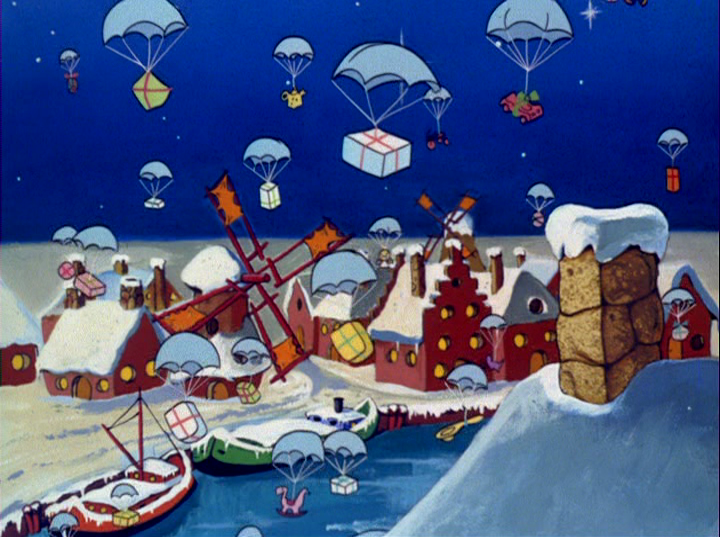
It seems to be a Christmas tradition here on the Yowp blog to include music in our posts of the 25th of December. I’ve posted a number of Curtin cues that aren’t available elsewhere. I don’t have many good ones left but you’ll find them sprinkled in between paragraphs. I haven’t tried to embed a music player; simply click on the title and it should come up in your computer’s player.
Cue V-311
Working with Hoyt Curtin at Hanna-Barbera
By Jeff Bond
When Hoyt Curtin died in December of last year, the world lost a cultural icon. But the composer of such instantly recognizable TV show themes as
Jonny Quest,
The Flintstones,
The Jetsons and
Magilla Gorilla was largely unknown to audiences. The fact that he was often listed as a music supervisor on the various Hanna-Barbera cartoon series he worked on — making it unclear whether or not he had actually composed music on the shows — didn't help matters. Curtin did, in fact, Curtin did, in fact, compose most of the themes and a great deal of the music for Hanna-Barbera cartoons at the end of the 1950s and throughout the 1960s. Over the years he also pulled into his orbit other composers, musical directors, producers and a veteran group of musicians to assist him in supplying music for Hanna-Barbera's massive factory of animation.
Curtin's training for the world of cartoon theme songs couldn't have been more effective: He came from the world of commercial jingles, eventually becoming perhaps the most successful West Coast producer of catchy advertising songs.
Cue J-203
Trained to boil down the appeal of a product in 30 seconds, Curtin applied his knack for simple yet indelible melodies to his first cartoon for for Hanna-Barbera, 1957's
Ruff and Reddy. He went on to provide themes and music for cartoons like
The Huckleberry Hound Show (1958),
Top Cat (1961),
Wally Gator (1962),
Magilla Gorilla (1964),
Peter Potamus (1964),
Yogi Bear (1964),
Frankenstein Jr. and the Impossibles (1966),
The Banana Splits Adventure Hour (1968),
Wacky Races (1968),
The Cattanooga Cats (1969),
Perils of Penelope Pitstop (1969) and
Hong Kong Phooey (1974).
After a period of semi-retirement, Curtin did music supervision and themes for
The Smurfs (1981) and other Hanna-Barbera series. During that period, Curtin worked with such composers as Ron Jones (
Star Trek: The Next Generation,
Family Guy), John Debney (
Spy Kids,
Heartbreakers), Mark Wolfram (
Piercing the Celluloid Veil: An Orchestral Odyssey), Steve Taylor (
Tiny Toon Adventures), John Massari (
Killer Klowns From Outer Space,
The Ray Bradbury Theatre) and Tom Worrall (
The Tom and Jerry Kids Show,
The Wild Women of Chastity Gulch) among others. For some of these composers, working with Hoyt Curtin was their first major gig. And while they generally did not receive screen credit for their work, the job turned out to be an invaluable training ground for future composing [employment].
Some of the composers knew Curtin's reputation and pursued him for the job, while others just knew they might be able to get a job writing cartoon music. "I was familiar with the shows, but I didn't make the connection between Hoyt and the shows," Ron Jones admits. "I was new to the business, but when you watch all that you don't really pick up all the names. You pick up all the bigger names and Hoyt's kind of goes right by you."
Cue J-209A
A Tireless Creator
John Debney was one who was familiar with Curtin's work. "Hoyt was like a Mike Post," Debney says, relating Curtin to the man who has written countless familiar TV themes and acted as a music supervisor and brand name for their background scores. "You know who he is and you know what he's done — and I worked for Mike Post, too.
Hoyt had been around a long long time by the early 1980s, and by that time he had really retired. I certainly knew who he was." Ron Jones became one of the mainstays for Curtin in the early 1980s. "I worked on more than a hundred different series with Hoyt," Jones says. "I worked on
The Smurfs,
Scooby Doo,
The Trolkins,
Richie Rich,
Pound Puppies — the list goes on and on. My resume is so ridiculous with all the listings that people have told me to actually delete stuff — it's like two single-spaced pages of Hanna-Barbera credit. And they're all network shows. The first season I worked for Hoyt, I got a break and went home and was watching TV on a Saturday morning, and I had shows on ABC, CBS and NBC simultaneously."
Cue V-323
Jones was attending a professional arranging school and doing copying to make ends meet when he saw the opportunity to get into animation. "The copyist copied all of Hanna-Barbera's stuff, and I looked at it and thought, I could do that," Jones says. "So I asked if I could deliver it. I cornered Hoyt Curtin and he gave me a shot." At the time Curtin was working with producer Paul DeKorte at Group Four Studios. "At Group Four he'd be on a break and I asked if I could hang out and I'd be asking him little questions. And over a period of sitting there watching I told him I'd been taking film scoring and orchestration and that I understood all this," Jones recalls. "I didn't know that everything was scored with storyboards and cassette-slugged dialogue. He told me to come back next Tuesday, and I came back next Tuesday... and he said to come back next Thursday, and I came back next Thursday... and he told me to come back next Tuesday. The third time, he said, 'Let me go out to my office.' And his office was his Lincoln Continental in the parking lot. He handed me some storyboards and a tape and said, 'Here you go.'"
Cue J-263
Scoring by Numbers
Jones quickly discovered that scoring Hanna-Barbera animation involved more work on the composer's part than he'd anticipated.
"I got home, and the storyboards from Hanna-Barbera are very cryptic," he notes. "You don't really understand what's going on. I was used to film footage but this was ridiculous. The storyboard would say six feet of somebody swishing by, and then it would go to the next panel and it would say the dialogue, and there was no continuous accounting for that time. So I realized I had to take a stopwatch and time that and add up the footage and make this huge map. It took me about four days to figure out how to do that."
Mark Wolfram found the key to entering the world of Hanna-Barbera literally at his feet. "I sent Paul DeKorte a letter at one point and on my demonstration tape I put an example of a commercial I had done for a sneaker called Snorks, which just happened to be a Hanna-Barbera character at the time," Wolfram remembers. "It sat on a shelf for a year and eventually Hoyt heard it and called me up. Hoyt said we should meet, and we had a nice breakfast at Smokey Joe's on Riverside and Coldwater. He filled me in on his career about his early days as one of the biggest jingle guys on the West Coast, and he asked if I wanted to go to work for Hanna-Barbera. At the time Curtin and his crew were working on an updated version of
Jonny Quest, the classic adventure series that had aired in prime time in the '60s.
"The first thing I did was three or four episodes of
Jonny Quest," Wolfram says. "It was kind of adventure music. There were more modern effects around the edges than in the '60s version, some synth drums just for some touches. Obviously at that point we were using EVI or EWI [a woodwind synthesizer] rather than three or four woodwind players, but that was really the only concession to contemporary."
Wolfram was faced with the same working approach Jones and the other composers met. "We basically had to be our own music editors and make our own cue sheets and from that you try and hit as best you could," he explains. "But you didn't want to get too specific because everything would be used for the library, so you tried to serve the episode as best you could but still keep it broad enough to have multiple uses."
Cue J-267
Cartoons Are a Funny Business
John Debney likewise fell into the working routine quickly, sharing scoring duties on individual cartoon episodes with the other composers. "There could be anywhere from three to four of us," he says. "Someone would get four minutes and I'd get three or Ron Jones would get three, and once you had done it for him a number of times and knew what his vocabulary was and knew the kind of endings you had to do, it was very specific the way Hanna-Barbera did it. They were librarying this music and they would use it on other shows, so every few bars you'd have to put a hole in the music because they could take that and cut to another piece of music. It was very formulaic, but it was really fascinating and I learned a lot by doing it."
The sheer volume of music that needed to be produced made a major impact on most of the composers. "I would try to do a minimum of 20 pages a day and during the summer I'd end up working six or seven days a week, so it would be 130 pages of finished score every week," Jones recalls. "Mostly you'd get an act to work on, the whole act or sometimes a whole show. Or sometimes it would just be generic themes, like 'Can you write a bunch of chases? Can you write a bunch of dialogue cues?' because once they had a few shows scored they'd track it. That came in handy when I did
Duck Tales because when I got there, they said, 'How can you score nine shows and track a hundred of them?' and I said, 'Watch.' They'd say, 'Why did you do that Arabian cue?' and 'Why did you do that other and I'd say, 'Look, trust me, you're gonna need that.' All that training really allowed me to envision what needed to be done."
Jones developed his own system for keeping track of exactly what show he was working on at any given time. "You keep a notebook or a manila folder and put the themes in there," he recalls. "They'd be right there next to the piano, and I'd say 'What show are we doing?' and then any shows I'd make up themes [for] I'd put them there too so there'd be a folder with dialogue themes, one with Hoyt's themes, one with my themes and so on."
Though Curtin was only writing bits and pieces and providing show themes by the 1980s, Debney notes that Curtin's work during his first decade or so with Hanna-Barbera was far more extensive and involved a long-standing collaboration William Hanna, a founding partner of the animation factory with Joseph Barbera.
Cue J-278
"I was told by Paul DeKorte that Hoyt used to write most of the music himself," Debney explains. "I got to know Bill Hanna really well too, and Bill would really work with Hoyt on those themes and write lyrics for them even though you might never hear the lyrics. Bill was a musician and an old-school guy and he knew how to read animation charts. He's have storyboarded things for a two minute main title or theme and he'd actually time it out.
Debney notes the Curtin's background in jazz was invaluable both to his jingle work and his fashioning of some of television's snappiest theme songs. "Hoyt was a jazzer," Debney says. "He was a keyboard player for one of the big bands and he was in the service. That's why his music sounds the way it does, he always loved those jazz chords, and they're fabulous."
Cue V-325
Even in the '80s when Curtin wasn't writing most of the music, he conducted all the scoring sessions with a group of veteran players with whom he had long-standing relationships. "Hoyt conducted everything and Paul DeKorte was in the booth," Jones says. "Before MIDI stuff came in, he and Paul DeKorte budgeted things so they could have a pretty good-sized band, but we did
The Smurfs with six violins and a little band, and it was all take-downs of Berlioz and Rachmaninoff and Beethoven.
The Smurfs gig was about how many classical themes can you use, because the Smurfs were these little characters they did in Europe and they tracked it all with classical music." Paul DeKorte was also a talented singer who sang on and contracted vocals for all of Curtin's sessions. "As far as musicians, I recall Gene Cipriano on woodwinds, Frank Capp and Steve Schaeffer on drums, Jerry Hey, Chuck Findley, Rick Baptist and Charlie King on trumpets. Lloyd Ulleate on trombone, Tommy Johnson on tuba and bass trombone, Vince DeRosa on horn, Clark Gassman on keyboards and Chet Record on percussion," Jones says. "The concert master on violin was Sid Sharp."
Cue JW-11
The Boys in the Band
Jones says he learned a great deal of his craft just by talking to Curtin's team members. "We had the best players on earth and that's how I'd learn," the composer says. "I'd write for them, and then I'd talk to Tommy Johnson and say, 'What did you think of my tuba part?' And he'd say he liked this part and maybe I could do this other part better. Or I'd go sit with Chet Record who was the percussionist, who had to play like a million instruments, and I'd say, 'How do you get from the timpani over to the xylophone in time?' and he'd say 'I draw these arrows.' It was like a master orchestration class. I'd work with Lalo Schifrin on these French orchestration books, and then I'd go practice what I learned in terms of transparency and amplitude and intensity with all that writing each week. It was really a school unlike anything I've ever seen. The players were all great sight readers. They all loved the work. He made it fun and musically interesting."
According to the composers, Curtain made the job interesting in other ways as well. "Hoyt used to do certain things," Debney laughs. "I'd finish my allotment for the week, maybe 10 minutes of music, and he'd always call me on a Sunday night as I was getting ready to sit down for dinner and say "Hey, Big John!" You think you could squeeze out another two or three minutes of
Pound Puppies? I always knew he'd call, too, because Hoyt always intended to do some writing himself at that time, but somehow he never got around to it.
Curtin also reportedly had his own idiosyncratic ideas about Los Angeles geography. "He'd always say, 'John, can you come out and meet me halfway?' I lived in Burbank and he lived in Westwood, and 'halfway' would somehow always mean about three minutes from his house," Debney recalls. "But he knew it, he was just a character."
Cue JW-2
Ron Jones points out that Curtin had to try to keep his home life and professional life separate. "His wife thought that music was dirty," Jones says. "That somehow it was the red light district. Hoyt wasn't allowed to keep any musical instruments in the house. He kept a beat-up upright piano, where every third note didn't work, in his hall closet. But he had perfect pitch so he wrote everything from perfect pitch. We'd be at Denny's or Jack's Deli, and he would take the napkin, flip it over, write out the clef and say, 'Here's the bad guy theme' or 'Here's the Smurf lick,' then you'd take the boards and that's what you had to go by."
Debney found himself dealing with Curtin's legacy years later when he wrote the score to the feature-length animated version of The Jetsons. "When I did Jetsons: The Movie, I was in a room with a bunch of suits, and I had gotten the job to score the movie, and it wasn't a great movie but it was a movie," Debney recalls. "They were in this meeting and they went, 'Now what are we gonna do for the main title?' And they all look at me. And I said, 'I think we should do the Jetsons" theme.' And they were like, 'I don't know if we really want to do that. I mean, we do have Tiffany.' They were actually proud of that! I said, 'I really think we should do the theme. I mean I'll use a bigger orchestra and fill it out a bit more, but I think we should stay true to it because when people are in a darkened theater, when this thing comes on, they're going to cheer.' I said, 'If you really want that cheer, you're going to have to play the theme.' They were really fighting me on it. And when I went to the screening and they played the theme, people clapped."
Cue JW-232
The Undying Spirit of Adventure
Debney says he's even seen Curtin's effect on live-action directors who grew up listening to the composer's themes. "When I got called in to work on
Spy Kids I was sitting with Robert Rodriguez and talking, and Rodriguez said, 'Maybe we could have kind of a
Jonny Quest theme,' and my eyes lit up and so did his. He went over to his computer and he had the
Jonny Quest theme on it. He said he used to listen to that while he was writing
Spy Kids."
Debney still carries a flame for Curtin's themes. "For my money I think that Hoyt was completely under-appreciated for what he's done," the composer says. "
The Jetsons,
The Flintstones,
Jonny Quest. . .plus there are ones that you don't talk about but you'd remember if you heard them, like
Magilla Gorilla,
Wally Gator, and all that stuff we grew up on. It's so great and so catchy.
"Hoyt was a great communicator," says Ron Jones. "His themes are like
perestroika—where one word means an entire paragraph. In English we don't have a word for it so I would say in music it's the musical equivalent of direct communication. He would always tell me to keep it simple and that there's a main thing and another thing and that's it—there's nothing else. I never heard anyone else say that except Lalo Schifrin. He would emphasize a lot of melody and then say, 'What else is left?' I try to be in that mold."
Cue P-88
For Mark Wolfram, Curtin's joy in his work made the most lasting impact. "This is a guy who really loved what he did. There were problems on sessions. Things didn't always go the way he wanted to, and he'd have to make some changes. But most of the time this was a guy who was just having a great time. All the musicians felt the same way."
And for a man who could write music that sent chills down the spine (like
Jonny Quest) or simply make the viewer bust out into laughter. Curtin's personal sensibility couldn't have been more appropriate. "He truly was loved, and he was just hilariously funny," John Debney says. "The beauty of Hoyt was that he took the music seriously but he had a great time doing it. He kept it light, and the musicians loved him."
Cue V-303
Since it is Christmas Day, let me extend my thanks to you for reading this blog over the years and wish you a peaceful and healthy 2019. Here’s a great Dick Bickenbach festive season sketch of the Hanna-Barbera stars of 1958 from the collection of Bill Wray.