Saturday, 9 January 2016

Yakky Doodle – Duck the Music

Produced and Directed by Bill Hanna and Joe Barbera.
Credits: Animation – C.L. Hartman, Layout – Paul Sommer, Backgrounds – Bob Gentle, Written by Mike Maltese, Story Director – Paul Sommer, Titles – Art Goble, Production Supervision – Howard Hanson.
Voice Cast: Yakky Doodle – Jimmy Weldon; Chopper – Vance Colvig; Robin, Cat – Daws Butler.
Music: Hoyt Curtin. Episode: Production R-19 (12th of 24 Yakky cartoons in 1961 season).
Copyright 1961 by Hanna-Barbera Productions.

Have you watched those horrible made-for-TV Popeye cartoons from the early ‘60s where a character is in one position and then when the scene cuts to a close-up, they’re in a completely different position? Rushed and sloppy, right? Well, there’s one of those in “Duck the Music,” with animation by C.L. Hartman, who worked on some of those god-awful Popeyes. These are consecutive frames. Even the bushes in the background disappear.


There are some amusing premises in this cartoon but I get fed up with the pity-party duck. “Woe is me. Woe is me!” Yakky moans, walking with his head down. Later in the cartoon: “I’m a disgrace to birdland. So long” and “You promised I could sing on TV. Oh, well. My dreams are shattered.”

The duck can’t handle it when he’s told he can’t sing. Oh, suck it up. So you can’t sing. Big deal. Move on. Honestly, what a whiner.

Mike Maltese finds ways for Chopper to manage to avoid telling Yakky his singing blows. I especially like the one toward the end. Chopper is about to punch the cat.

Chopper: Any last words?
Cat: Go ahead. Get it over with.
(Yakky sings “Clementine”)
Cat: If you can honestly call that good singin’, eh, then you can punch me right in the nose.
Chopper: Uh....I couldn’t be that dishonest.
Fade in to the final sequence where Yakky is in an emptied out TV set, butchering “Camptown Races.” Cut to cats looking as horrified as you can in limited animation of 1961. Cut to Chopper with a nicely timed sight gag.


Chopper ends the cartoon by revealing he’s wearing ear plugs so he can’t hear the duck’s off-key shouts.

Colvig’s performance is pretty good here as he tries to hide his discomfort and avoid expressing how he really feels about Yakky’s caterwauling. And Jimmy Weldon’s off-key singing is good, too (you have to be able to sing to be able to sing off-key like he does).

We mentioned that Yakky sang “Clementine.” He also treats (?) us to a chorus of “(That’s) Quick Draw McGraw.” It’s an inside gag that for viewers should be pleasingly appropriate. If you want to think a bit too much about it, it’s a little odd that the latter sequence shows Yakky riding a make-shift horse when Quick Draw is, of course, a horse who didn’t make a habit of riding his own kind.

If you should feel sorry for anyone in the cartoon, it’s not the self-pitying duck, it’s the cat. All he wants to do is get some sleep. Instead, his ear drums are assaulted by screeching and the rest of him is assaulted by Chopper. Mind you, he threw a tin can at Yakky to shut him up which isn’t all that nice but is likely quite satisfying to those in the audience who aren’t Yakky Doodle fans.

Chopper (after beating up cat off-camera): What are you, a duck hater?
Cat: No, I’m a music lover. (Cat drops backwards to the ground with a thud).
Chopper: Uh, go look at the pretty flowers Yakky. You shouldn’t oughta see this.
Cat: All of a sudden, there’s a duck in my mouth. Ha, ha, ha, ha.
(Chopper punches him in the snout)
Cat: How’s about that? All of a sudden, there’s a fist in my face. (Cat drops backwards to the ground with a thud).
C.L. Hartman’s animation is really jerky in this in spots. The reason seems to be a combination of the cat’s limb movement and odd timing (by Paul Sommer?). The piece of footage below (close to the speed in the actual cartoon) has seven drawings. The second and third are held for two frames, the next (when the cat stares into the dog house) is held for eight, then the next two for two frames.


Daws gives the cat a toned down version of his Jerry Lewis voice (without the inflections and syllable accents). The sound cutter wisely keeps Hoyt Curtin’s stock music (much of it from The Flintstones) off the soundtrack when Yakky is singing.

Wednesday, 6 January 2016

Yogi Bear Weekend Comics, January 1966

It’s winter in Jellystone Park and four of the five comics that appeared in weekend newspapers 50 years ago this month reflect that. Three are on the ice and two involve ice fishing. One featuring birds on a clothesline could have appeared at any time during the year.

Guest appearances every once in a while are nice and we get some this month from Yogi’s “Kellogg’s” comrades and the not-in-animated-cartoons Mrs. Ranger. Boo Boo gets the last two weeks off. Yogi shows his inventiveness in one comic and there’s another rescue comic this month.


Quick Draw McGraw and Huckleberry Hound stop in on Jellystone Park in the January 2nd comic. Note the little bird perched atop the “Yogi Bear” lettering in the opening panel. Yogi and Quick Draw have neat scarves while Boo Boo and Huck keep their bow ties. Apparently, Quick Draw is smarter than the average bear in this comic.


Yogi has his scarf AND his tie in the January 9th comic. It’s a good thing the kid is named “Hugh.” The line wouldn’t have rhymed if he were named Finster. Nice google eyes as Yogi falls through the ice in the centre row.


The friendly denizens of nature once again agree to help Yogi in the January 16th comic. You’d figure if one of the birds was named Bill, another should be named Joe. The way the copyright line is interwoven in the blanket is unique.


The January 23rd comic is my favourite, especially with the tangle of dogs and people in the final panel. That’s an awful lot of drawing. The expressions are nice, too. I like the FOINGG panel next to it. Some more nice expressions. I’ll take a pass on the poetry in the right panel, top row.


Snow bunnies appear to watch the action in the opening panel of the January 30th comic. The panel’s nicely laid out with the ranger station and jeep in the background framing Ranger Smith and Yogi on one side and fir trees framing them on the other. And there’s silhouette action in the middle row. A lot of thought went into these comics.

Next month, a rock band and skateboards. Fortunately, it’s not “Yo Yogi!” (Whew!)

Saturday, 2 January 2016

Cop and Saucer Storyboard

“Cop and Saucer” is among my least favourite Huckleberry Hound cartoons. Instead of being naïve, Huck is just plain stupid. Yes, he’s slow and a little gullible but I have trouble believing he is so dumb he would mistake a metallic thing on a wheel for a human being. But it seems a dope-ish Huck what was writer Warren Foster had in mind at the outset, judging by the storyboard for the cartoon.

That gracious champion of old animation, Mark Kausler, has sent me a copy of the board with this notation:

It's the Huck Hound cartoon "Cop and Saucer" Prod. E83. A month or two ago, you posted some excerpted Huck Hound boards and this artist's style was in a few of the pages. It's a very unusual, almost amateurish style with professional camera directions. This artist drew Huck Hound to look very goofy and kind of "soft", not the hard edged crisp line style that we're used to. The variations in style regarding the look of the metal space man seem to suggest there might be more than one story artist working on this board.
Mark doesn’t believe the drawings are Foster’s, which leaves Alex Lovy and Dan Gordon as suspects, though I’m sure Mark would recognise their styles. But you can tell looking at the pages that some are quickly sketched out with no dialogue while the first page is pretty carefully rendered.

Some of the boards Mark has sent us follow the finished cartoon pretty closely. But this first page sure doesn’t. The opening gag with sirens, crying and the cat stealing milk never made it into the cartoon. And it strikes me that whoever made the drawings weren’t familiar with Hanna-Barbera’s cost-saving techniques. You see buildings (and apparently animation to go with it) in perspective and animation of a cat and his shadow. All of it seems to me to be way too complicated for what the studio was putting on TV. The finished opening narration cuts to the quick. We hear the first line, then Foster substitutes what’s on the rest of the page for two lines and then cuts to introducing Huck as per the second page. To the right you see part of Joe Montell’s background for the opening scene.


Can someone explain to me what’s funny about hat size numbers? The 6 7/8 gag was done to death in cartoons. Fortunately, in the actual cartoon it’s substituted for a variation on the Frank Fontaine sweepstakes winner gag with a number that keeps going on and on.

The radio announcer dialogue (centre panel) is kept but Tony Rivera’s layout is quite different. And the finished cartoon has different dialogue following and Huck screaming up to the saucer in his cruiser. I like the line “Everything looks identified here...” but it got chucked.


You can see how Rivera redesigned the metallic alien. No feet. No mouth speaker. And he doesn’t talk in “reverse track.” Instead, Don Messick invents a kind of electronic noise and “speaks” through the antennae on the alien’s head. The whole dialogue concept of drunk driving was not used; Huck instead wonders who’s illegally parked, asks the alien about the saucer then demands to see his driver’s license. I think the original dialogue’s better. And atypical for Huck, he turns to talk to the audience about the situation.


Other than Huck talks about a license instead of a key, the routine on this page stays intact (including the line of dialogue in the last panel). However, the director cuts to a close shot of Huck during the laser gunfire. And Huck doesn’t go inside the alien and toss out the toy gun. But he does get grabbed by the alien (with a claw instead of a hand), bashed around to pad for time and then tossed against a tree, where he says his judo hold line. And Foster’s weak rock/drinking fountain gag gets cut.


The dialogue isn’t the same but the basis of the bashing and chained to the police car gags are kept. Huck ends the observation to the audience with “I gots ta remember to leave off mah break the next time.”


The duelling/bus gag, the shoot at the camera gag (so old, it’s in 1903’s The Great Train Robbery) and disintegrating mallet head don’t make it into the cartoon. Instead, Huck writes a ticket and the alien’s gun burns a hole in it. Huck hides in the garbage can, not behind it. The tree and brick wall gags die on the storyboard as well. (The “X” next to some panels indicate a fade out-fade in).


The birdhouse gag is modified. You can see how it ended up in the cartoon. I kind of like how the storyboard has Huck imitating a bird to try to fool the alien. The boat gag’s handled differently, with Huck saying “Nothin’ like the peace and quiet of a lake when you gots to do some thinkin’.” The storyline doesn’t follow the various scenes which make up the gag but the end result is the same, though the layout is different. Compare the second panel in the 14th page to what’s in the cartoon. The alien doesn’t run after Huck up the side of the dried lake in the cartoon, the scene cuts to Huck running and deciding to call the sergeant and then dissolves into the next scene where Huck is in his cruiser.


The finished dialogue: “That did it. That did it! That’s police property you just discom-booberated. Now, yer goin’ to have ta take us both to the station in your car.” (Cut to next scene of alien carrying Huck) “I hates ta have to crack down like this, but you asked for it.” You can see the difference in how Rivera handles Huck being taken into the spaceship from what’s in the story panel.


Rivera’s layout sticks to the first story panel on the final page. The cartoon doesn’t cut away to the WBLZ announcer (with a turntable in his studio and a sharp-nosed, bullet-headed operator in the booth), we just hear the dialogue off camera as Huck looks out of the porthole. The camera direction isn’t mentioned on the story board, but the drawing of the Earth and various space objects turns as the camera trucks back. And Huck laugh/cries to end the cartoon.


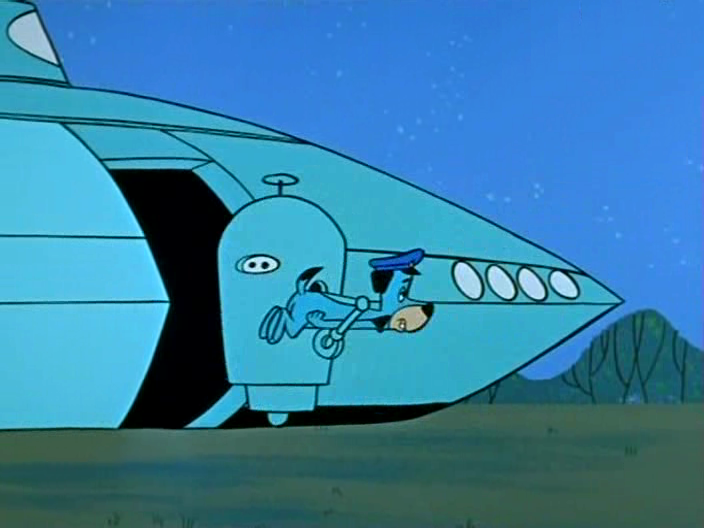
It’s hard to say if the storyboard version of the cartoon is better than the final product. But it’ll remain a mystery about why so many gags and scenes were changed and who changed them. You can read a review of the cartoon in this post.

Friday, 1 January 2016

What's the Story Behind Hanna-Barbera Records?

When you think of Hanna-Barbera and music, you probably think of Hoyt Curtin and those terrific background pieces he wrote for Jonny Quest and Top Cat. Personally, I also think of those great stock music libraries written for (or released by) the Capitol Hi-Q and Langlois Filmusic series heard in the earliest cartoons. You likely don’t think of the Hogs. Or the Guilloteens. Or the Thirteenth Floor Elevators. But you should.

All three were among the bands signed in the mid-60s to contracts with Hanna-Barbera Records.

Yes, in late 1964, while Jonny Quest was teetering on the brink of prime-time cancellation and Secret Squirrel and Atom Ant were in development, Bill Hanna and Joe Barbera decided to get into the record business.

Bill and Joe had been somewhat involved with record labels before. Golden Records in New York had produced and released knock-offs of Hanna-Barbera cartoon themes (and a few other songs based on characters to fill out the sides). And Colpix, Columbia Pictures’ TV music arm, released some cartoon soundtracks (minus the Hi-Q music for contractual reasons) and characters narrating stories. But this was different. The company created a subsidiary to release its own artists. And we don’t mean Daws Butler singing as Wally Gator.

Neither Hanna nor Barbera (unless I missed it) talked about the short-lived venture in their autobiographies, leaving it up to others to explain why they got into music business. Billboard in its issue of January 15, 1965 stated it stemmed from the cartoon producers’ belief “that the promotional sales value of records had hardly been tapped.” The story quoted Don Bohanan, the head of the brand-new subsidiary, that the division not only wanted to release “a powerful children’s line” but “develop strong representation in the popular music field.” And since it was 1965, pop music was starting to change from the yeah-yeah-yeah “bug music,” as it was satirically called on The Flintstones. That meant garage rock and psychedelia, and that’s what Hanna-Barbera Records got into, as Bohanan promised the label “intended to release a minimum of 20 LP’s and 50 to 70 singles a year in the pop music.” The wonderful Spectropop site has more on some of the rather odd releases.

(Billboard reported on December 24, 1964 that since November 1963, Bohanon had been marketing director at Liberty Records, the label that brought you the Chipmunks, and had started with Coral Records around 1954).

What happened to Hanna-Barbera Records? The same thing that happened to Hanna-Barbera Productions. It was officially sold to Taft Broadcasting on December 28, 1966. Within a month a decision was made to have to have any record product concentrate solely on cross-promoting cartoons. The days of a separate subsidiary were done. The company gave up its independent distribution set-up. Bohanan quit (Billboard, May 13, 1967) and by the following December, Paul DeKorte was named supervisor of production for children’s records under Hanna-Barbera Productions, released by the Sunset Records arm of Liberty.

More than 8½ years ago, Kliph Nesteroff wrote a pretty detailed treatise on Hanna-Barbera Records which you can read HERE. You’d figure nothing else was left to be said. But no! Now that Kliph has finished uncovering the sex, drugs and rock-and-roll of stand-up comedy in his new book The Comedians, he’s turning his attention back to Hanna-Barbera Records. Did he dredge up more sex, drugs and rock-and-roll in his research? Well, we know he found the last of the three. And Kliph’s pretty thorough in his interviews and other research, so you can bet he found a lot of other things. He has written a five-thousand word article which, we hope, may be the prelude to another book. You can go to his fine blog site and read about it.