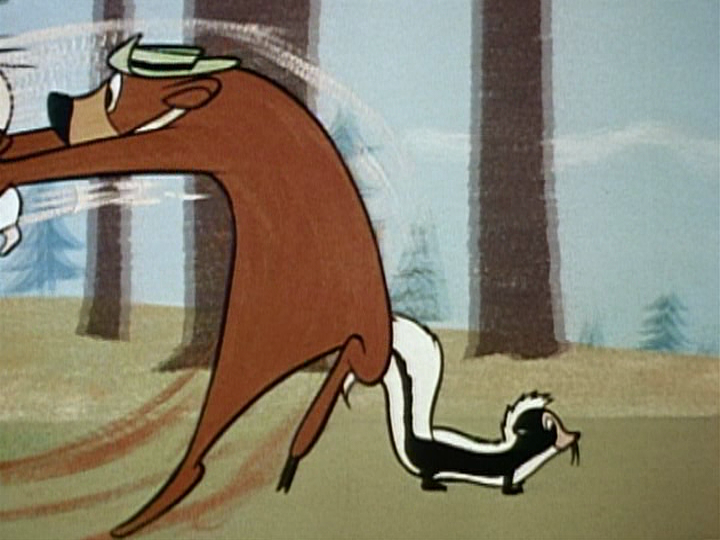
Saturday, 17 March 2012

Augie Doggie — Gone to the Ducks

Produced and Directed by Bill Hanna and Joe Barbera.
Credits: Animation – Ken Muse, Layouts – Dick Bickenbach, Backgrounds – Dick Thomas, Story – Mike Maltese, Story Sketches – Dan Gordon, Titles – Art Goble, Production Supervision – Howard Hanson.
Voice Cast: Augie, Cat Burglar – Daws Butler; Doggie Daddy, Radio Announcer – Doug Young; Duck – Red Coffey.
Music: Phil Green, Harry Bluestone-Emil Cadkin, Jack Shaindlin, Hecky Krasnow.
First aired: week of January 25, 1960 (rerun, week of July 25, 1960)
Episode: Quick Draw McGraw Show M-018, Production J-59.
Plot: An orphan duck moves in to the Daddy home, much to the consternation of Doggie Daddy.

The phone jangled in Mike Maltese’s office. It was Joe Barbera on the line.
“Mike,” asked the boss, “Remember that duck that everyone loved in the Tom and Jerry cartoons?”
“Uh, kind of,” replied Maltese, cautiously.
“And he was a scream when we used him in those two Yogi Bear cartoons last season, right?”
“If you say so, Joe.” Maltese was afraid of what was coming.
“I want you to stick him in a cartoon this season,” Joe suggested, though the tone was more than one of a suggestion.
“How about if El Kabong bashes him with a guitar and we bury him on Tombstone Hill, population one dead duck?” offered Mike.
“Don’t be funny. Well, do be funny. In the cartoons, that is. And find a place for our duck,” Joe firmly stated before hanging up the phone.

Now, this conversation really didn’t happen. For one thing, Maltese may have been working from home in his first couple of years with the studio. But Joe and Bill Hanna loved that duck. He was already part of the studio’s marketing campaign (along with a certain yowping dog) as Biddy Buddy. So Maltese, whether at Barbera’s behest or not, stuck him in this cartoon before reworking him the following season into Yakky Doodle.


Maltese’s duck is pretty much the same as the other versions. He’s an orphan (even coming to tears at the end of one scene about his fate in life) but what’s really odd about him in this cartoon is something that happens at the start. After a beautiful establishing background by Dick Thomas, we find rifle-toting Doggie Daddy and Augie in a duck blind. Augie’s weary from blowing a duck call with no results. Then the happy proto-Yakky strolls into the cartoon. The dialogue.


Duck: Is this a gun?
Daddy: Yes, dis is a gun.
Duck: Are you going to shoot me?
Daddy: Well, now, dat’s dee accepted theory.
Duck: Okay. Go ahead.

The duck then leans against a rock, waiting to get blasted.

What I don’t understand is—why? If this were a Daffy Duck cartoon, we’d know he was merely engaging in a ruse to lull the hunter into a false sense of security only to do something violent to him. That doesn’t happen here. Does he piteously want someone to end his life because he’s an orphan? No, he’s not suicidal. He’s just lonely and wants friends. Does he know that Daddy isn’t going to pull the trigger? Nothing shows that he’s gotten into Daddy’s head and is smart enough to understand his motivation.

Setting that aside, the story is well structured. And, no, Daddy doesn’t shoot him. That would end the cartoon before the two-minute mark. Daddy does the standard cartoon reluctant slow count to three, where a character adds fractions because he doesn’t want to follow through with his threat. In Maltese’s case, he finds something different to use as a gag. One of the fractions is 2 and 17/16ths (which doesn’t exist).

Doggie Daddy tells the duck to go home to mommy and daddy, but then proto-Yakky reveals he has no mommy or daddy. Daddy is unmoved; he saved the duck’s life and that’s enough. Daddy tells the duck he and Augie are going home. The orphan duck now becomes deluded stalker duck, where he has decided he is now a member of the Doggie family and Daddy is his daddy, too. The duck follows along, constantly squawking “goodbye” as a bait-and-switch. When Daddy turns around and informs him they already said “goodbye,” the duck then says “Then I say ‘Hello, I’m glad to see you. Are you glad to see me’?” Daddy’s not. And the duck won’t go away voluntarily. So Daddy uses some “stra-gedy.” He plays “fetch” with the duck. And when the bird goes to get the stick, Daddy and Augie take off in their convertible. Now the duck feels sorry for himself. “Nobody wants an orphan duck,” he says between sniffs.


The next scene’s at home. Daddy is trying to console Augie by saying “a little wild duck belongs in da wild blue yonder.” “But, dad, he’s a tame wild one,” is Augie’s response. Daddy now emulates Jimmy Durante’s mangling of words: “Dat’s an amphibious statement, if I ever hoid one.” The scene’s interrupted by the stalker duck rapping on the window. Daddy gives in and lets him stay for the night.

Well, maybe it’s not for the night. The duck echoes Augie and says “Good night, dear old dad.” Daddy responds “Good night, my sons, my sons,” and muses how to legally adopt a duck before he stops and stares at the camera in shock when he realises what he’s just said. The duck isn’t as much as a pain as he was to Yogi when the bear let him sleep for the night in ‘Slumber Party Smarty’ (Yogi can’t take him anymore so the bear ‘flies south’ for the winter). But he does ask for a drink of water and then never stops drinking. The portion of the cartoon where the duck drinks from an oaken bucket lasts 30 seconds before Daddy finally cracks a line to the camera: “Will morning never come? You’d after 30 seconds, he’d come up with something a little stronger.

The scene is interrupted by a bulletin on the radio about a cat burglar in the neighbourhood (or, as Doggie Daddy says it, “a cat bur-gurglar” like Augie did in ‘Watchdog Augie’ earlier in the season). Sure enough, the cat burglar shows up at the open bedroom window. We know he’s the cat burglar because he goes “meow.” Yeah, it’s hokey but it’s still funny. Half-asleep Daddy think he’s Augie until Augie, in bed, informs him otherwise. Who is it? “I’ll give you a hint. Meow. Meoww. Hiss.” Right on cue, Augie and Daddy cry “The cat burglar!” Augie and Daddy run, but the duck comes to rescue. Reminiscent of the climax of Hanna and Barbera’s ‘Kitty Foiled’ (1948), when the canary flew into a closet, grabbed a bowling ball, and dropped it to stop Tom from getting at Jerry, the duck does the same thing. The only difference is he slams the ball into the crook’s head and does it with superfluous dialogue; the action speaks for itself). See the brushwork before the ball-burglar collision?


The finale has Daddy on the phone to the cops, with the tied-up crook next to him. “Your cat burglar has burgled his last burg,” he says (I think; the Durante voice gets in the way a bit). Pan over to what used to be a watchdog house (Wait a minute. A pair of dogs owned a dog?). “After all,” says Daddy, “How many people (?!) can say dey’ve got a real, genuine watch duck?” The duck ends it in a close-up, barking and then laughing at the camera, as so many future Hanna-Barbera cartoons ended (usually after the words “Scooby-rooby-roo”).


The unnamed duck (he’s not called “Biddy Buddy” on screen after the two Yogi cartoons) returned the following season in ‘Yuk, Yuk, Duck’ and ‘Let’s Duck Out’, in the Snooper and Blabber cartoon ‘De-Duck-Tives’, and the Loopy de Loop short ‘This is My Ducky Day’ (also written by Maltese). It would appear these cartoons were in production before the germination of The Yogi Bear Show, where the duck got promoted to his own series.

A couple of notes about the music. The rendition of ‘London Bridge’ is the same arrangement as another tune used in the H-B cartoons which seems to incorporate the opening bar of ‘London Bridge’ several times. I don’t know which library it’s from. And because Hanna-Barbera licensed the Capitol Hi-Q library, the sound cutter would know the cue when Augie is in bed as ‘5-EM-131E Lullaby’ which is as appropriate as its original name of ‘Bedtime Story.’


0:00 - Augie Doggie Main Title theme (Curtin, Hanna, Barbera)
0:25 - GR-65 BUSH BABY (Green) – Augie and Daddy in duck blind.
0:49 - London Bridge (Trad.) – Duck strolls onto scene.
1:04 - CB-86A HIDE AND SEEK (Cadkin-Bluestone) – Daddy aimed rifle at duck, counts, “2 and 17/16ths.”
1:41 - CB-83A MR TIPPY TOES (Cadkin-Bluestone) – “Two, and, and...,” Duck is an orphan, Duck says “Goodbye.”
2:05 - GR-258 THE TIN DRAGOONS (Green) – Daddy and Augie walk away, duck follows, “We already said goodbye.”
2:20 - GR-155 PARKS AND GARDENS (Green) – “Then I say ‘hello’...,” duck runs after stick.
2:54 - LAF-117-1 MAD RUSH No 1 (Shaindlin) – “And here we go, Augie,” duck sorry for itself.
3:11 - GR-257 BEDTIME STORY (Green) – Augie in bed, duck at window, duck allowed in, wants drink of water.
4:26 - EM-107D LIGHT MOVEMENT (Green) – Duck glugs down water, radio says “Attention!”
5:25 - COMEDY SUSPENSE (Shaindlin) – Announcer warns of cat burglar, burglar breaks into home, rushes off to steal silverwear.
6:24 - fast circus chase music (Shaindlin) – Duck gets bowling ball, drops it on burglar’s head.
6:45 - THE HAPPY COBBLER (Krasnow) – Daddy on phone to police, duck barks like dog.
7:08 - Augie Doggie End Title theme (Curtin).

Wednesday, 14 March 2012

Thumbs Up For Quick Draw

Until The Flintstones arrived in 1960, the television cartoons of Bill Hanna and Joe Barbera enjoyed almost universal praise by critics. Huck Hound was never called “an inked disaster” like Fred Flintstone. The columnists varied, but the reasons for liking the cartoons was always the same.

Hal Humphrey reviewed new H-B cartoon shows a number of times over the first ten years of the studio’s life. Like many critics, he wasn’t altogether impressed by the Flintstones’ debut and became cynical about Hanna-Barbera’s cartoon-as-merchandise machine. But before that, he was caught up in the casual joviality and newness of the syndicated half-hour shows, and the tale of the cartoonists who overcame adversity to put them on the air.

As far as I know, this column from September 25, 1959 is the first time Humphrey looked at the H-B cartoons in print. He was employed by the Los Angeles Mirror News at the time, which syndicated his column.


Viewing TV
New Western Hero

By HAL HUMPHREY

Television watchers in more than 150 cities this week will see a new western hero with a couple of gimmicks which nobody can top. He packs only one six-shooter, but he has four legs. His name is Quick Draw McGraw, and he has four legs because he is a horse. He also has a fearless, but slightly dumb; side-kick called Bobba Looey [sic]. Mr. Looey is a Mexican burro.
Quick Draw McGraw is the latest animated cartoon creation of Bill Hanna and Joe Barbera, whose success on TV already has been assured by such stars as “Ruff and Ready,” [sic] “Huckleberry Hound” and “Yogi Bear.”
In two short years Hanna and Barbera have built a multi-million-dollar TV cartoon business. It is the only one turning out cartoon shows for TV, because practically everyone else in Hollywood said it couldn’t be done. Ensconced in the old brick studio built by Chaplin, this team of veteran cartoon animators now has 150 artists and technicians on their payroll, and offers of more business than they can handle.
THE ONE SPONSOR (Kellogg) for “Huckleberry Hound” and the new “Quick Draw McGraw” series is laying out approximately $12,000,000 annually to syndicate the two shows on TV.
Hanna and Barbera got their big break when MGM studios fired them two years ago. For 20 years they had toiled there as the animators of the famous cat and mouse team, “Tom and Jerry.”
Before their contract at MGM was dropped, Hanna and Barbera tried to talk the studio chiefs into producing new cartoons for TV. Despite their insistence that they had developed a technique which would bring cartoons within a TV budget, MGM didn't believe it could be done without hurting the quality. .
With financial backing from movie producer-director George Sidney, the persistent team decided to go into business for themselves. This was after nearly every TV film studio also had turned them down.
In two years they have produced more cartoon shows for TV than they did in 20 years at MGM. “Everyone in the business predicted we would fall on our face,” Barbera recalls, “because it was considered impossible to do a half-hour, cartoon show every week. Bill and I knew differently.”
THE KEY TO Hanna and Barbera’s conquest of TV is a simple one. They use 80 per cent fewer drawings to animate their work than were previously considered minimum.
“It’s planning that does it,” Hanna explains. “For example, when the action calls for a character to change the expression on his face, we don’t make a whole new drawing of him. We save the body and draw another facial expression to go with it.”
Other short cuts are effected by Hanna and Barbera through the use of dialogue and sound effects. They argue adamantly, however, that the quality of animation is not harmed by their pruning of much artistic detail.
A half-hour of their new “Quick Draw McGraw” still has a production budget of $56,000, but this is less than half of what it would cost to produce it on the old elaborate scale for cartoon animation.
Another important reason for their success is the good taste inherent in a Hanna-Barbera production. Parents and P.T.A. groups have yowled long and loud over the sadism, violence and sex innuendos permeating most of the ancient theatrical cartoons rerun on TV the past several years.
When “Quick Draw McGraw” shoots a bad man, usually just his pride is hurt, or the seat of his pants singed. It’s doubtful either that you’ll ever find him casting lecherous glances at some Betty-Boop saloon hostess.
In spite of such distillation, Hanna and Barbera have injected enough western satire into “McGraw” to make him palatable to adults, who now make up 60 per cent of Huckleberry Hound’s audience. And, unless we’ve flipped our cap, you’ll also enjoy “Snooper and Blabber,” a cat and mouse pair of private eyes who blow their first case. But let McGraw tell you about it. He’s a talking horse.


Setting aside the almost-universal weariness everybody but kids had for the old theatrical cartoons airing on late-‘50s TV, Humphrey’s review still stands. The Huck, Quick Draw and Yogi Bear cartoons (the originals, at least) don’t talk down to anyone and are innocent fun. If they weren’t, you wouldn’t be here reading this now.

Saturday, 10 March 2012

Yogi Bear — Bear on a Picnic

Produced and Directed by Bill Hanna and Joe Barbera.
Animation: Carlo Vinci; Layout – Dick Bickenbach; Backgrounds – Fernando Montealegre; Dialogue and Story Sketches – Charlie Shows and Dan Gordon; Titles – Art Goble; Production Supervision – Howard Hanson (no credits).
Voice Cast: Yogi, George, Mountain Lion – Daws Butler; Child, Ranger – Don Messick; Mother - June Foray.
Music: Bill Loose/John Seely; Spence Moore; Geordie Hormel.
First aired: week of February 1, 1959.
Production E-28.
Episode: Huckleberry Hound Show K-19
Plot: Yogi gets hurt trying to protect a baby neglected by his parents.

It appears Joe Barbera, Charlie Shows, Dan Gordon, et al, must have come up with a pile of jokes involving a child, crappy parents and Yogi Bear getting abused because they managed to fill two cartoons with them. In ‘Daffy Daddy’, the child abuses Yogi. In this one, wild animals and even the parents abuse him; the child just walks around and gets himself into dangerous situations.

There are some other things this cartoon has in common with ‘Daffy Daddy.’ Boo Boo doesn’t appear in either of them, not too uncommon in Yogi’s first season. The woman is actually played by a woman. Voice expert Keith Scott says it’s June Foray in this cartoon, and in listening back to one scene in particular, he’s got to be right. And Carlo Vinci animated both ‘Daffy Daddy’ and this one. This cartoon was never restored for DVD; it may be H-B’s new owners don’t have the master, so it’s very murky. That makes it a little difficult to show you some of Carlo’s trademark effects. In the first season, he did a little two-drawing stomp with characters before they ran out of a scene. Here’s Yogi, slowed down. You can see the big Vinci upper teeth here, too.


There’s another Yogi stomp later in the cartoon but Carlo didn’t reuse the animation. He drew a new one with Yogi’s legs not lifting as high. That’s breaking Bill Hanna’s budget, Carlo!

The earliest H-B cartoons had interesting stylised character designs. There are a couple with rangers that are thin and tubular, almost like cigarettes, with head and body as one. Here’s the ranger in this one. Movement tended to be stylised and jerk from position to position at times. Notice how the ranger’s ear moves and his hair disappears. Not exactly fluid MGM animation, is it?


And how about the stylised family? The designs scream 1950s, don’t they? Not artsy-fartsy stylised like in a Magoo cartoon, but very simple. And a lot more attractive than humans in some H-B series in the ‘60s.


Both Ed Benedict and Dick Bickenbach used turned-up snouts like on George, the dad, in this one. But this looks more like Bick’s work. He used the same design in other cartoons and Ed’s humans are more distinctive.

The cartoon opens with a shot of a background of the entrance to Jellystone Park used in ‘Big Brave Bear’ (also a Bick-Monte cartoon). From what I’ve seen, this is the only time a background drawing was re-used in Yogi’s first season. Next is a shot of a station wagon with three silhouettes in it, with the woman silhouette arguing with the man silhouette about where to go picnicking. The camera stops at a tree. Yogi peers from behind it. This is the early Yogi with the three muzzle spots. “Sounds like a jolly little pic-a-nic group,” he says of the discussion. Barbera and Shows set up the fact early that these parents are jerks.

The generic ranger with Ranger Smith’s voice (Smith wasn’t invented until season two) sends the creeping, tippy-finger-and-toeing Yogi on his way before the bear can mooch their goodies. “Shee, what a grouch,” says the Ed Norton-channelling Yogi who, undeterred, tippy-finger-and-toes back to the picnic area. Barbera sets up the story with a cutaway to a baby bashing his head against a playpen as he tries to fit through the bars. I can’t tell if the kid is saying “Cobba,” “Kwabba” or “Gobba.” Oh, for a glance at the storyboard.

2026 update: Robert Alvarez has at least one page of the story drawings for the cartoon, and he has solved the mystery.


Further proof that these are bad parents is the fact the father’s a noisy eater. Don’t you hate people who smack their lips when they eat, folks? Yogi develops the world’s longest arm as he reaches for a peanut butter and salami “sand-a-wich” (twice to pad for time) only to be swatted away.

Meanwhile, the kid escapes from his pen and starts wandering about. Yogi warns the parents. He’s even polite, even lifting his hat and apologising “Excuse me, ma’am,” to the woman for barging in. Like the parents in ‘Daffy Daddy’, and like parents today who leave their kids in sweltering cars on summer days to go to the bar, they don’t notice and don’t care. The woman even swats Yogi away with some French bread. With her arms up and elbows in, it must be difficult to manoeuvre that loaf.

If the lazy parents read to their kid, he might know what a cat is. It’s obvious that he doesn’t because at this point of the cartoon, he’s wandering after a porcupine, calling it a “cobba, cobba, kitty.” Nice stylised porcupine. Yogi does a stretch-dive exit to rescue the child.


The porcupine stabs Yogi. The kid smiles. He’s as much a jerk as his parents. And to add injury to injury, the mother conks the bear on the head with a log after he safely carries her wayward son back to his playpen.

No sooner does Yogi shrug his comment on the situation to the audience than the child is wandering again. This time the “kitty” is a skunk. Yogi does a swoop, turning rescue, just like he did in ‘Daffy Daddy.’


This time, the mother throws a frying pan at the bear after he deposits the child back in the pen. Lip-smacking dad just keeps eating his watermelon without even glancing up.

The toddling toddler escapes again. Like in ‘Daffy Daddy,’ Yogi decides to let fate take its course. This time, the kid finds a “kitty.” He drags back an angry mountain lion. Yogi decides to get involved and beats up the mountain lion. The action fills up 35 seconds of screen time, most of it behind bushes, so all we see is camera shakes and, above the bushes, drawings of fists, smoke, Yogi’s hat in the air, leaves, stars and the planet Saturn in cycle animation, along with re-used cycles of Yogi and the mountain lion trying to get away. Someone will have to explain the history of drawings of Saturn in comics to signify violence or swearing.

The mountain lion has enough and stretch-dives out of the cartoon. The child is safe. But the parents show up with the generic ranger, complaining Yogi has been bothering the toddler (and trying to swipe a sand-a-wich). The beat-up Yogi reacts to the audience.

Even the ranger doesn’t buy Yogi’s story, accepting the word of the deadbeat parents. But then we get a stomping astonishment take as Yogi and the ranger look off-scene. It’s been slowed down a bit for your viewing.


The toddling toddler is off on his own and dragging back the mountain lion in some recycled footage. There’s a close-up of the lion asking the ranger to do something about the kid. So Yogi’s vindicated in the end. He realises it, too, as he is smiling.

In some of the earliest Yogi cartoons, there are stretches of footage with no stock music underneath. This is one of them. Virtually the whole fight scene has vocal and sound effects, but no music.


0:00 - Yogi Sub Main Title theme (Curtin, Hanna, Barbera, Shows).
0:15 - ZR 51 LIGHT ANIMATION (Hormel) – Car enters Jellystone, Ranger sends Yogi away, Ranger stomps away.
1:08 - no music – “Shee, what a grouch.”
1:11 - TC 201 PIXIE COMEDY (Loose-Seely) – Yogi tippytoes, tries to steal sandwich, child walks.
2:24 - no music – Child walks into tree.
2:27 - TC 300 ECCENTRIC COMEDY (Loose-Seely) – More noisy eating, Mother attacks bear, porcupine scene, Yogi skids to a stop.
3:34 - no music – Mother over playpen.
3:39 - L-78 COMEDY UNDERSCORE (Moore) – “Cobba, cobba,” skunk scene, child escapes from paypen.
4:40 - no music – Yogi resting.
4:44 - L-81 COMEDY UNDERSCORE (Moore) – Yogi lifts legs, kid drags mountain lion behind bushes.
5:14 - no music – Yogi skids to bushes, dives in.
5:21 - L-81 COMEDY UNDERSCORE (Moore) – Yogi fights with mountain lion.
5:26 - no music – fight scene, mountain lion zips away.
5:57 - ZR 51 LIGHT ANIMATION (Hormel) – Yogi with child, parents accuse Yogi
6:17 - no music – Yogi looks at camera.
6:19 - L-1154 ANIMATION COMEDY (Moore) – “OK, buster,” mountain lion talks to range.
6:51 - Yogi Sub End Title theme (Curtin).

Wednesday, 7 March 2012

Jane, Stop This Crazy Birth!

Fred Flintstone started out as an egotistical, hypocritical, sometimes nasty man. Then Pebbles came along and he got watered down—and so did his TV show. And while Hanna and Barbera always had a tendency to kiss up to their sponsors (Kellogg’s), Pebbles marked the sad occasion when a character was created specifically because of a sponsor merchandising deal, not for entertainment reasons.

Pebbles was tolerable, despite all those the eye-rolling doting daddy scenes, because the writers actually came up with some funny cartoons with her in them. But can you imagine a Pebbles-like character in all the other Hanna-Barbera shows? Joe Barbera could.

Here’s a squib for the Radio-Television Daily, dated February 19, 1963.


‘Flintstones’ Baby Portends Rash of Babies for H-B
Hollywood — Hanna-Barbera introduce their new baby, “Pebbles,” for the first time in “The Flintstones” seg, “Dress Rehearsal,” which airs Friday. Plan is to introduce a new baby in all HB’s series within the next two years, according to president Joe Barbara. “Jetsons” most likely will be next to have a new born infant. Name of “Pebbles” was decided as result of a contest.

As Tralfaz the dog once said “Yechhhh.”

I can picture the scene where Jane in a hospital bed at night with a star beaming into her room and calling the baby “Starlight.” And then episodes where Jane’s mother-in-law (played by Verna Felton) barges in to run the house. And little Starlight becomes a kleptomaniac. And little Starlight and the boy kid next door develop voices and sing the pseudo-religious “Let the Sun Shine In,” but it’s all George’s dream and ... well, if Barbera’s going to rip off ideas from The Flintstones ...

It also begs the question—who’d have the baby on Jonny Quest? Maybe it’d be Race Bannon’s previously unknown baby Jessie who turns up and ... no, that would never work.

Anyway, we can all be happy the idea of little Starlight turned into space junk. Evidently, The Jetsons hadn’t been cancelled and moved to Saturday rerun-land by the time the story above was written. It was within a month. Broadcasting magazine had this squib on April 1, though an announcement of a Jerry Van Dyke game show in another story was in the popular press by March 7.


Louis Marx Toy Co., New York, will sponsor The Jetsons on ABC-TV next fall (Saturday, 10:30-11 am EST). The series currently is in ABC-TV’s prime time, Sunday, 7:30-8 pm Agency: Ted Bates & Co., New York.

With that likely went Joe Barbera’s planned doll line and resultant cash windfall. Still, considering how Hanna-Barbera brought in the fuzzy, doll-like Orbitty when it revived The Jetsons in the ‘80s, a little Jetson girl doesn’t sound bad by comparison.

Sunday, 4 March 2012

Yogi Bear, Sunday, March 1962

My favourite Hanna-Barbera character—besides Yowp, of course—is Quick Draw McGraw, so it’s great to see him team with Yogi in one of the Bear’s Sunday comics 50 years ago this month. Unfortunately, the versions I have with the first row of panels aren’t very viewable, so you’re stuck with scans from a paper that only published the bottom two rows.


March 4th sees an anxious and happy Ranger Smith buying Yogi a train ticket and pulling him by the tie to get into his jeep to take him to the train station. There’s a nice drawing of the jeep on an angle on a twisting mountain road in the missing first row. The bottom rows pick up the story on the train which just happens to be owned by the H. and B. Railroad. The crook’s name is a play on Death Valley Scotty, a bit of a fraud artist known in the first half of the 20th Century.


I love the ‘sploosh’ drawing from March 11th. The comic starts out with Boo Boo running into the “bee tree.” The idea of drawing the word “chop” to evoke the sound of the helicopters is interesting.


“King of the Jungle” is showing on March 18th but the movie is for Lodge guests only. So Yogi shinnies up a tree. Lots of variety in the layouts here.


The March 25th comic is somewhat reminiscent of the second-season Yogi cartoon “Lullabye-Bye Bear,” except there’s no sleeping involve. The missing top row has the Ranger annoyed that the un-sleepy Yogi isn’t hibernating. He spots some skiers and gets inspired. The sleepy Ranger trying to wake up with a cup of coffee is a nice extra.

As usual, you can click on any of the comics to make them bigger.

Saturday, 3 March 2012

Snooper and Blabber — Fee-Fi-Fo-Fumble

Produced and Directed by Joe Barbera and Bill Hanna.
Credits: Animation – Carlo Vinci; Layout – Dick Bickenbach; Backgrounds – Bob Gentle; Story – Mike Maltese; Story Sketches – Dan Gordon; Titles – Art Goble; Production Supervision – Howard Hanson.
Voice Cast: Narrator, Giant, Jack, Sir Loin of Beef, both men in Audience, 1st Witness – Hal Smith; Snooper, Blabber, Master of Ceremonies, 2nd Witness – Daws Butler.
Music: Phil Green; Harry Bluestone/Emil Cadkin; Jack Shaindlin.
First Aired: week of Oct. 19, 1959 (rerun, week of April 18, 1960)
Episode: Quick Draw McGraw Show M-004, Production J-24
Plot: Snooper’s hunt for a missing bank building leads him to a beanstalk and a giant.


Apparently, detectives aren’t a bunch of film-noir types like Philip Marlowe, Richard Diamond and Sam Spade. They’re a gaggle of pipe-smoking Englishmen, even in the United States. At least, that’s what writer Mike Maltese would have you think judging by this cartoon.

Mind you, there are a couple of reasons for it. The way the plot plays out, two-fisted, All-American, hard-boiled dicks wouldn’t fit. And Maltese had a love for formal, dowdy old Englishmen sitting around amongst themselves. This is a precursor to the Snooper cartoon The Lion is Busy which aired later in the season, featuring the early version of Snagglepuss and Major Minor and set in the Adventurers Club (itself a precursor to the Snagglepuss series in 1961).

And Maltese had some experience with giants and beanstalks, too, first with Jack Wabbit and the Beanstalk (1943) for Friz Freleng, then the 3D Lumber Jack Rabbit (1954) and the self-referential Beanstalk Bunny (1955), both for Chuck Jones. But the plots in those cartoons make a little more sense than this one. Why did the giant take a bank? It wasn’t to store his gold; Jack grabbed it already. And it wasn’t for revenge; Jack didn’t own the bank. I still don’t get Snooper’s explanation at the end of the cartoon. No matter. Snooper understands it, and that’s all that counts.

There’s no Adventurers Club in this cartoon. It starts outside what looks like a hotel, with Dick Bickenbach supplying an overhead layout. The narrator/announcer tells us it’s an exciting night, as the world’s greatest private eyes are picking the winner of “the coveted gold Pussyfoot statuette awarded to the private eye solving the most difficult case of the year.” It looks like Sir Loin of Beef (Hmm. Mike Maltese seems to have used that name before) is a lock to win the award from his stuffy fellow Englishmen for solving the slippery case of “The Grease Spot Murder Mystery.” But then Snoop takes to the podium and tells his “fellow private eyelids” there isn’t “a participle of doubt” that they’ll change their minds and give him the statue.

Now we go into a flashback with Snoop getting a call to solve a 903. The gag here is the hyper Blabber shouts over and over about a 903, interrupting only to tell viewers matter-of-factly “I always get excited when it’s a 903. They’re the worst kind.”

So off they go, 16 times driving past the same buildings in the background as ‘Desperate Diamond Dimwits’ (which had backgrounds by Fernando Montealegre) and ‘Flea and Me’ (Montealegre again) to get “a private eye-full,” as Blab puts it. This whole scene gives Maltese a chance to imitate clichés from detective shows, including trite dialogue:


Snoop (looking around where bank was): It’s gone alright.
Blab: It sure is missin’.


And later, when questioning “folks in the vicinity”:

Snoop: Excuse me, sir, but—
Man (pointing): It was right over there.
Snoop: Thanks. That helps.
Scene wipe.
Snoop: This is merely routine, sir.
Man (pointing): It was right over there.
Snoop: Every little bit helps, sir.

Then in Dragnet style, Snoop questions Jack, who is pulling a wagon with a bag of gold in it. All he keeps getting for an answer is “I ain’t tellin’.” The camera cuts back and forth to head shots of whoever is talking, breaking up the visuals a bit with the occasional three-character shot. It works really well.

“Just as I elementaried,” Snoop discovers a beanstalk at Jack’s house. The idea of a beanstalk with an elevator appeared in Jack-Wabbit and the Beanstalk and showed up a few years later in Lantz’s Woody the Giant Killer (1947).


Blab: Gosh, Snoop, how do you talk to a giant?
Snoop: Easy, Blab. Just talk big.


The next scene features Snooper and Blabber crawling all over the giant but not knowing it’s him. Blab wakes him up by yelling into an echo-chamber that’s really the giant’s ear (Maltese had an ear-noise gag in ‘Jack-Wabbit’). And there’s a hair-fire gag (just like in ‘Jack-Wabbit’).


The pair try to escape but the giant captures them (calling them “firebugs”) and threatens to squish them. Snooper’s as calm as any detective might be, thanks to his huge ego. Snooper explains who he is and the giant is impressed by meeting his “hero.” Wait. If Snooper’s his hero, how come he didn’t recognise him? Oh, right. Giants in cartoons are never bright.

The final scene has Snooper finishing his story to the anger and scepticism by fellow members of the club. I still don’t get why the giant took the bank. Anyway, Snoop’s still confident. He whistles for the giant to prove his story really happened and the two detectives jump into his hand for a free ride home, but not before Snoop grabs the Pussyfoot statuette to claim for himself.

There’s no “Halt in the name of (blank)” gag in this cartoon, and eyeball on Snooper’s office door, window, wall, etc.

Composer Phil Green used to write ‘suites’ of music and part of the suite contained a series of short bridges, labelled A-F in the EMI Q library. It sounds like a couple were used here but I can’t identify them (the second may be from the ‘Kiddie Comedy Suite’ but I haven’t found it).


0:00 - Snooper and Blabber Main Title theme (Curtin)
0:25 - PG-171 PERIOD FANFARE (Green) – Aerial shot of building, pan shot of statue.
0:40 - CB-90 HAPPY HOME (Cadkin-Bluestone) - Stuffy Englishman speaks, Snoop and Blab talk.
1:11 - CB-83A MR TIPPY TOES (Cadkin-Bluestone) – Emcee introduces Snoop, Snooper at podium, phone rings, Blab blabs about a “903.”
2:01 - PG-? (Green) – Blab talks to camera.
2:06 - LFU-117-2 MAD RUSH No 2 (Shaindlin) – Blab excited about a “903,” Snoop and Blab drive up to bank.
2:23 - GR-74 POPCORN (Green) – Car skids to stop, Snoop talks to witnesses, talks to Jack.
3:25 - PG-168J FAST MOVEMENT (Green) – Car goes to Jack’s place.
3:34 - GR-258 THE TIN DRAGOONS (Green) – Camera pans to beanstalk, Snoop and Blab go into elevator.
4:14 - PG-? (Green) – Elevator goes up.
4:18 - GR-87 SKELETON IN THE CUPBOARD (Green) – Snoop and Blab get out of elevator, Blab on nose, “Go ahead and try it, Blab...”
5:06 - EM-131I EERIE (Green) – “...if it’ll make you happy.” Blab shouts in ear.
5:11 - COMEDY SUSPENSE (Shaindlin) – Giant gets up, fire, Snoop and Blab jump off nose.
5:49 - LFU-117-2 MAD RUSH No 2 (Shaindlin) Snoop and Blab run, Giant grabs them.
5:57 - GR-456 DR QUACK (Green) – Giant talks to Snoop and Blab, Snoop on podium, Snoop whistles.
6:44 - GR-96 BY JIMINY! IT’S JUMBO (Green) – Giant stomps to window, Snoop and Blab on hand, “I forgot something.”
7:02 - GR-79 CUSTARD PIE CAPERS SHORT BRIDGE No 2 (Green) – Snoop runs off hand, returns with statue, cartoon ends.
7:09 - Snooper and Blabber End Title Theme (Curtin)