Saturday, 10 March 2018

Yakky Doodle in Easter Duck

Produced and Directed by Joe Barbera and Bill Hanna.
Credits: Animation – Don Patterson, Layout – Paul Sommer, Backgrounds – Dick Thomas, Written by Warren Foster, Story Director – Alex Lovy, Titles – Art Goble, Production Supervision – Howard Hanson.
Voice Cast: Yakky Doodle – Jimmy Weldon; Cat – Daws Butler; Woman, boy – Jean Vander Pyl; Pet Store owner, Green Cat – Don Messick.
Music: Hoyt Curtin.
Episode: Production R-17.
Copyright 1961 Hanna-Barbera Productions.
Plot: Yakky is an Easter present that its owner’s cat wants to eat.

You know the song:

“We’ve got a Yakky for sale!
A Yakky Doodle for sale!
Won’t you buy him, take him home and try him?
A Yakky for sale!”

Oh, wait. That’s Magilla Gorilla, isn’t it? Pardon my confusion. In this cartoon, Yakky is in the front window of a pet store and no one wants to buy him. In fact, there are a number of familiar routines in this cartoon that pre-date its first appearance on TV (Magilla came a few years later). It seems to me a pet store birdie was part of the plot of Ain’t She Tweet?, a Sylvester-Tweety pairing. The “kiss the little birdie” bit in this cartoon can be found in both Gift Wrapped and Catty Cornered, another couple of Warners cartoons. And two cats struggling over a bird can be found in Truck or Tweet. All of those cartoons were written by Warren Foster, who came up with the story for this one.


Ah, but Warners Bros. isn’t the only studio from where ideas were borrowed. The whole concept of a duck gift for Easter was used in Happy Go Ducky, an MGM cartoon directed by Bill Hanna and Joe Barbera and featuring the duckling that became Yakky Doodle.

Oh, and while we’re talking about borrowing...


The cat appears to be closely related to Mr. Jinks. The Hanna-Barbera house design is pretty obvious.

Instead of a Tweety sandwich, we get a “duck burger.” And the granny in this one clocks the cat with a broom instead of an umbrella, as does the Warners’ Granny. And there’s the “follow that cab” joke where one character is induced to get into a cab. The second character tells the driver to drive off and then the camera moves to show the first character is right behind the second one.


Anyway, it’s all familiar territory for Foster, who I believe only wrote this one cartoon for Yakky. He manages to resist having Yakky call the cat a “bad old puddy tat.”

Should I run down the story? Yakky holds up signs to try to get bought from a store. Finally, a woman comes in to take the duck home as an Easter present for her granddaughter. The woman’s cat (Daws in a watered down version of his Jerry Lewis voice) likes the idea of a duck breakfast. Granny doesn’t. Broom. Yakky feels rejected by the cat and walks out of the house. Granny meanwhile threatens the cat if anything happens to Yakky while she’s gone (no phoney cat-gut violin-string playing like at Warners). Now the cat has to find Yakky. “Quack, quack,” the cat says over and over, looking around the neighbourhood. Cut to a boy. Boy turns to camera. “Poor mixed-up pussy cat.” Nice interruption gag.


A green cat in a garbage can has decided to claim Yakky. The two cats fight over the duck, clobbering each other with something before running away. The cab gag is tossed in. The cuts are pretty quick for a Hanna-Barbera cartoon. The running is accompanied part of the time by the chase variation of “Meet the Flintstones.” Some of the fight is a simple shot of Yakky with the camera shaking; we don’t get to see it.

Fade to Yakky pulling the roughed up Jinks stand-in home. Granny decides because the two get along so well, she’s going to give Yakky to the cat as an Easter present. The cat repeats some earlier dialogue from the green cat—“Ya should’na taken my duck”—to end the cartoon.
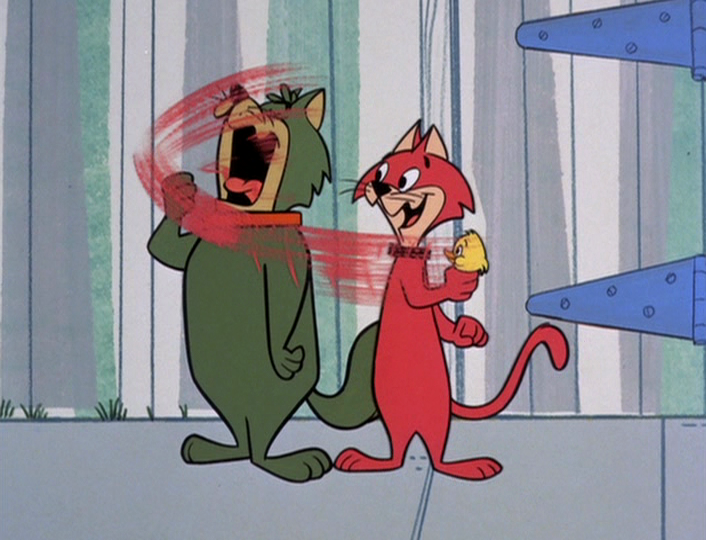
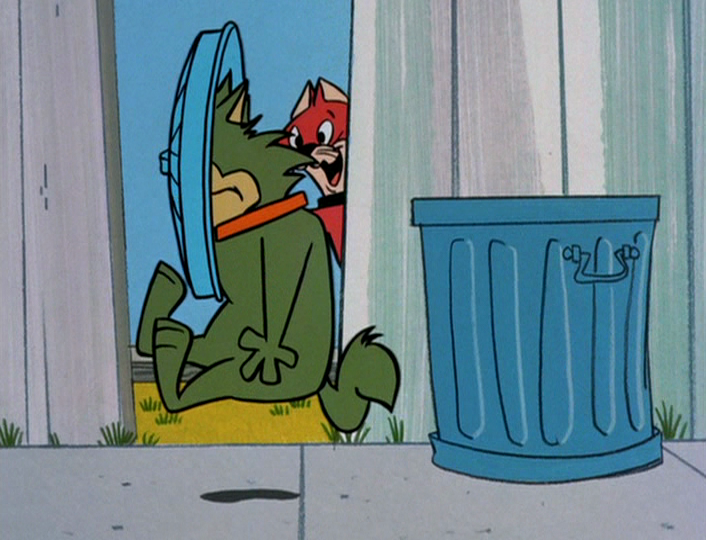


Don Patterson handled the animation. There are a lot of swirls to indicate a character zipping off scene, and only one drawing of multiples when the cat rushes around to make the duck burger.

We’ve now reviewed all the cartoons in the Yakky Doodle series. Maltese wrote the majority, with Tony Benedict spelling him off. What did Maltese think of Yakky? I can’t say for sure, but perhaps it’s telling that in a 1977 interview, when Maltese read a list of series he wrote at Hanna-Barbera, toward the bottom he said “Chopper Dog and Canary.” Canary! Yakky and his predecessor ducks in the MGM theatrical cartoons were doted on by Bill Hanna and Joe Barbera but Maltese didn’t quite recall him. Still, the series has its moments and some praise should go to Jimmy Weldon for his fine voice work. His Yakky is expressive with diction clear enough to comprehend him.

Wednesday, 7 March 2018

Yogi Bear Weekend Comics, March 1968

Climate change affects the Yogi Bear newspaper comics 50 years ago this month—where the chill of winter is in the air with one exception, where it’s suddenly the middle of a hot summer.

Children appear in three of the five stories. There’s no room for Boo Boo this month.

Richard Holliss supplied these comics from his collection.


In the March 3rd comic, there’s a crook in Jellystone Park who’s so dumb, he thinks a bear carries a wallet. Mind you, he’s sitting in the middle of the forest in several inches of snow waiting for someone to rob. We learn Jellystone has an outdoor hockey rink with stands. I don’t know why Yogi just doesn’t dump the guy over the fence in the last panel.


Hockey was on Gene Hazleton’s mind (or whoever else may have written this), as it drives the story in the March 10th comic. We have cutsy animals in the top row and cutsy tykes in the rest of the comic. “Keen-o-neet-o” and “parra-keet-o” has to be the worst.


I like the perspective drawing in the last row of the March 17th comic with Yogi in the foreground and Freddie in the background. The first row is just a bit of filler for newspapers that didn’t run the complete comic.


Would Yogi Bear really whip Ranger Smith? Really? That’s what we get in the March 24th comic.


Maybe that whipping did some good. On March 31st we get the passive version of passive/aggressive Smith. The writer revisits the idea of Yogi Bear telling tall tales about his ancestors. The one kid in the final comic appears to have been reading Peanuts too much.

You can expand each comic by clicking on it.

Saturday, 3 March 2018

Take Me To Your Leader

Were the 1950s the Golden Age of Outer Space? People sure seem preoccupied with it back then, judging by all the movies and TV shows made about it. Even cartoons. Warner Bros., Paramount (Famous) and Walter Lantz all had cartoons about space exploration or aliens. Gerald McBoing Boing ended up on the Planet Moo. And the very first Ruff and Reddy adventure involved robots from the planet Muni-Mula (“That’s aluminum spelled backwards,” Don Messick would remind you).

So it was that space craft and such found their way into a couple of the bumpers on the Huckleberry Hound Show.

Watching this opening mini-cartoon frame-by-frame, you can see how a character will move one body part in the next frame, and then hold it while one or two other parts move in the following frame. Heads are moving in all kinds of directions, too. I admire Frank Paiker or whoever it was working the camera trying to keep all those cel instructions in order.

If you’ve seen some of these great first-season circus setting bumpers, you’ll have noticed Huck stretching his head and rounding his lips to make an “Oooo” sound (as in “cartoon”). Even Yogi does it in this mini-cartoon.


I love Mr. Jinks. Here are some good expressions. Not a lot of animation, but you know what the cat is thinking when he says “Featuring yours truly, Jinks the Vill-i-an.”


Yogi wags his head. Five positions from almost head-on to profile.


Yogi dips his head, looks at his knuckles and scratches them against his body. This is one of those bits of business that add to a character.


The premise behind this cartoon-between-the-cartoons is Huck descends to the ground from his saucer and acts like an alien. “Take me to your leader, Earth folks,” he says to the rest of the cast. Pixie and Dixie beg off. They’re getting ready to show some Pixie and Dixie cartoons. Yogi puts in a word for his cartoons. Huck reveals that he’s the leader, as we’ll see in the next Huck cartoon. The cast, in the saucer, flies left to right across a repeating background. Fade out.

And here’s the evil Jinks, slowed down.

Wednesday, 28 February 2018

Invading the TV Schedule

Huckleberry Hound may have given the first real boost to the Hanna-Barbera empire but, by 1961, he wasn’t number one in the kingdom. Monarchs Bill Hanna and Joe Barbera were putting more of their efforts (and treasury) into their prime-time success, The Flintstones. And not only had Yogi Bear been pulled away from the Huck show into his own, he had been tapped to star in the studio first full-length animated movie. At the end of the 1961-62 season, Huck went into permanent reruns.

We’ve spent pretty close to nine years on the blog passing along ancient articles on the studio in its growing years. Here’s an interesting one from the Philadelphia Inquirer of November 28, 1961. It was a gold strike for Hanna-Barbera. Not only did it give the studio publicity, it was a free plug for a feature story on the Flintstones, Yogi, Joe, Bill, and all in the December 2, 1961 issue of the Saturday Evening Post, which gave H-B even more publicity.

Ingeniously, the Inquirer played Reader’s Digest, boiling down magazine articles for a column as an easy way to fill space on its entertainment pages. All it took was a rewrite. You can read the Post article on Joe Bevilacqua’s web site devoted to Daws Butler, but you can see the “TV Digest” column from the Inquirer below.


Pair of Cartoonists Surprise Themselves With Sudden Riches
HERE'S what one of the Nation's magazines is saying this week about television:
SATURDAY EVENING POST: The most surprised men in Hollywood these days are a pair of middle-aged cartoonists named William Hanna and Joseph Barbera.
Four years ago they were has-beens, bounced out of the movie business with no prospect of future employment. This year, as owners of four fantastically successful television shows plus a major contender, they will gross an estimated $9,000,000.
Leading the list in order of importance on this two-man hit parade is "The Flintstones"—the first cartoon show to make a successful invasion of television's supposedly adult hours.
If it all sounds and looks like a prehistoric version of "The Honeymooners," nobody seems to care. "The Flintstones" finished the 1960-11 season with an audience of 13,882,000 homes, according to Nielsen figures.
The rest of the Hanna Barbera cavalcade is both a cast of characters and a menagerie. The Barrymore of the bunch is three-year-old "Huckleberry Hound," star of a half-hour show which appears weekly on some 180 independent stations.
On another midweek evening, same time, same station, Quick Draw McGraw stalks his man. . .on still a third evening during TV's kiddie hour, Yogi Bear cavorts around Jellystone Park.
• • •
LAST, but by no means least is Hanna and Barbera's economic expectations, is a new half hour, "Top Cat," featuring a band of Dead End cats led by a Bilko-type hustler.
Desperation, plus their own artistic instincts, inspired the partners to create a process which they called "Planned Animation."
Realism was junked for drawings that were broadly comic and basically simple. They worked out short eats. When a character spoke, only his mouth moved. When he walked, only his legs moved.
The result was a seven-minute cartoon which needed only 2000 drawings but still resembled full animation so closely that only a professional could tell the difference.
“The Flints,” as everyone at Hanna-Barbara Productions calls it, cost $65,000 per half hour, making the program one of the most expensive half hours on television. (In full animation it would cost $200,000.)
This year the company will gross around $1,000,000 from television, but the partners swear that profits are low. "We plow every cent we get back into better quality production," Bill Hanna says.
This may well be true of the cash they receive from advertising sponsors. But their animal cartoons are earning them at least $1,000,000 more is other markets, Last year sales of games, soaps, stuffed animals and other toys based on Huckleberry Hound and his entourage totalled $40,000,000.
Their success has inevitably inspired the most sincere form of television flattery—imitation.
There are a swarm of rival cartoon characters on the evening air this evening, ranging from a moose that talks like a man to a trio of chipmunks who cut up like small boys.

Tuesday, 27 February 2018

Huckleberry Vinci

It’s tough to pick a favourite animator who worked at Hanna-Barbera in the 1950s. I can think of several. But only one of them would be celebrating a birthday were he with us today, and that’s Carlo Vinci. He would be 111.

Carlo spent years in the B cartoon studios of New York, Van Beuren and Terrytoons. He worked with Joe Barbera at both of them and in 1956, Barbera offered him a job animating at the MGM cartoon studio. When it folded a year later, Barbera promised him work when the new Hanna-Barbera operation got off the ground. Barbera was true to his old paisano and Carlo stayed at H & B for more than 20 years. Before that he also worked briefly at Disney and for Paul Fennell’s studio on the side.

Carlo plunked out 50 feet a day and wondered why he couldn’t do as well as Ken Muse who churned out twice as much footage, according to layout man Bob Givens. The answer is simple. Carlo used more drawings, and more complete drawings.

Here are some drawings from a scene from Skeeter Trouble (1959). Notice in the sixth frame how Carlo plants the heel with the leg at an angle, and draws Huck with his knee up and leg stretched. You can see the same thing in a bunch of his early H-B cartoons.


My favourite Huck take is in Hookey Days (1959) when the little brats tie him to railway tracks. He thinks it’s all pretend until he realises a train is actually coming toward him. The studio really didn’t go for this kind of animation but I wish it had.


Carlo died on September 30, 1993.

Here’s Harvey Deneroff chatting all too briefly with Carlo at the Animation Guild’s Golden Awards Banquet in 1984.