Wednesday, 11 May 2016

Eternal Run From Kit Kit Kit

We all love how Pixie and Dixie or Mr. Jinks run past the same light socket or lamp or whatever over and over again.

Well, here’s everyone’s favourite meece hater being chased by a robot cat in Kit Kat Kit in an endless Hanna-Barbera loop.

There are only three drawings in this chase cycle. Note the difference in the position of the smeared Jinks feet. Jinks stretches out in one drawing. Meanwhile, the robot goes up in one of the drawings. The animation is by Ken Muse.


It takes 24 drawings (one second of film) for Jinks to reach the same house behind him in the background. Here’s the cycle that ends the cartoon. It’s a little slower than what’s in the cartoon. For all we know, Jinks is still being chased.


The background is by Frank Tipper, the ex Walter Lantz animator who had been working at one of the commercial studios, with the layout by Ed Benedict.

Saturday, 7 May 2016

Yakky Doodle – Whistle-Stop and Go

Produced and Directed by Joe Barbera and Bill Hanna.
Credits: Animation – Art Davis, Layout – Tony Rivera, Backgrounds – Dick Thomas, Written by Mike Maltese, Story Director – Alex Lovy, Titles – Art Goble, Production Supervision – Howard Hanson.
Voice Cast: Yakky Doodle – Jimmy Weldon; Chopper – Vance Colvig; Dog Catcher, Hunter, Fibber Fox – Daws Butler.
Music: Hoyt Curtin.
Episode: Production R-8 (fourth of 24 Yakkys in the 1961 season).
Plot: Chopper gives Yakky a whistle to use when he needs help.
Copyright 1961 by Hanna-Barbera Productions

In The Bodyguard, Jerry the mouse helps Butch the bulldog escape from a dog catcher and, in return, promises to run to him for help if he just whistles. 17 years later, the same plot gets revisited in this cartoon. The difference is the dog in this case (Chopper) gives Yakky Doodle a real whistle to blow for assistance.

Actually, the best version of this plotline was in the great Tex Avery cartoon Bad Luck Blackie (1949), written by Rich Hogan. It’s really unfair to compare a TV cartoon to one of Avery’s greatest pieces of work but Whistle-Stop and Go is plain lame. The clever Mike Maltese just didn’t seem to be terribly inspired by Bill and Joe’s fetish for a little duck.

There’s a sequence where a hunter is trying to get a bead on Yakky, who is jumping up and down blowing his whistle. Chopper rushes into the scene. He grabs Yakky and pulls him away just as the hunter fires and misses. “Are ya hurt, little feller?” asks Chopper. Yakky just shakes his head. Maltese couldn’t be bothered to even work up a quip like he wrote so well at Warner Bros. and for Hanna-Barbera on Quick Draw McGraw. There’s nothing funny or amusing in the whole sequence. Maltese doesn’t even try. It’s like the first half of the cartoon is a long set-up with no pay-off.

One of the things that keeps this cartoon from being a total loss is the appearance of Fibber Fox. I’ve always liked Fibber’s resignation to his fate and how he comments to the audience about it. “Can you guess what’s going to happen now?” he says to us after unexpectedly attracting the revengeful Chopper with a magnet instead of Yakky’s whistle. About 20 frames later—punch in the nose! The ending’s good, too, as Yakky tricks Fibber into being swooped away by the dog catcher (a faint echo of Maltese’s Hubie and Bertie cartoons at Warners. Now if Yakky had played head-games like those two mice, we would have a really good series).

This is a cartoon that will drive continuity freaks nuts. It tells a story of how Chopper and Yakky first met. Except there was at least one other cartoon which did the same thing. How can that be? Simple. No one cared about that kind of stuff then. No one kept track of it. There was no need to. As Yakky writer Tony Benedict puts it: “There were no bibles back then.” Writers were free to create whatever they wanted outside of the basics.

One of the fine veterans of the industry animated this cartoon. You can tell Art Davis’ animation in some of the Hanna-Barbera animal cartoons by the tight curved smile or grin that goes way up into the head. There’s sometimes a little row of teeth.


And some exit-from-scene drawings. The first pair are consecutive frames.


Dick Thomas’ backgrounds feature sketchy grass patches and outlines around bush foliage. For a change, his sky isn’t blue. He uses a drab shade of green. He adds a bit of bright colouring on the flowers to avoid everything looking like part of the same palette.

Joe Ruby, or whoever did the sound cutting on this, inserts Hoyt Curtin’s versions of “Strolling Through the Park One Day,” “Twinkle, Twinkle Little Star” and the William Tell Overture, along with some familiar bassoon cues from other cartoons around this time. And the soundtrack features the standard “Ain’t that cute!” and “Close your little eyes, Yakky. You shouldn’t oughta see...” catchphrases.

Wednesday, 4 May 2016

Yogi Bear Weekend Comics, May 1966

Yes, Yogi Bear can talk. And, yes, he eats sandwiches, pizzas and roast chickens (and puts ketchup on his “fillet mignonnies”). And, yes, he can drive a jeep and pilot a helicopter. I can accept all that. But, for some reason, I find it hard to accept that centaurs and centaurettes are living in Jellystone Park. Or even visiting.

But that’s what we see in the Yogi colour comic for the first weekend of May 50 years ago.


I’d love to know what inspired Gene Hazelton or one of his freelance writers to come up with such an odd, one-off idea. It’s a strange comic. The opening panel reads “By Hanna-Barbera” instead of “Hanna-Barbera’s”, then poppies suddenly appear by going “Ping.” (Poppies? Hmmm). The May 1, 1966 comic ends with both Yogi and a centaur being being hauled off to what they euphemistically called a “rest home” back then.


Yogi’s back to his old self in the May 8th comic, and so is the Hanna-Barbera world. Bill Hanna’s beloved Cub Scouts make another über-cute appearance, as does one of those native stereotypes that seems to inhabit the park. Yogi is rhyming again and a bad pun ends the story. Nary a centaur to be spotted.


A nice Yogi tip-toe drawing ends the May 15th comic with a parrot that you just know would sound like Mel Blanc if this were animated. No need for Ranger Smith when you have “Ranger General” (the military rank given rangers is something idiosyncratic to the newspaper comics).


Here’s where the poor scans by whoever put these on-line really hurt. I’d love to get a better view of the drag racer in the May 22nd comic. Excellent work. Mel Blanc would probably drag out his Frito Bandito voice if this story had been animated. Observe Boo Boo with the hand-to-side-of-head laugh in the final panel. This may be the first Hanna-Barbera comic where diarrhoea is a punch-line.


The May 29th comic includes the Cub Scouts again and some Yogi ingenuity. It seems odd for Boo Boo to make fun of Ranger Smith’s pain; the ranger certainly doesn’t appreciate it. This striped scan is the best version I can find.

Click on any of the comics to see them better.

Saturday, 30 April 2016

Boo Boo and the V.I.V.

Boo Boo never got the spotlight in the Yogi Bear cartoons on TV (though Carlo Vinci gave him some fine angular poses in The Buzzin’ Bear/i>) but he did in one of the Whitman books called Boo Boo and the V.I.V., printed in 1965 by Western Printing.

The illustrator was George DeSantis, who also drew a Golden Book published that year called The Flintstones Meet the Gruesomes and another for Whitman the previous year entitled Pebbles Flintstone Runaway. His name appears in other children’s books of the mid-‘60s but I don’t know anything about him.

His designs of Boo Boo and Yogi are attractive. His Ranger Smith is more stylised than what was in the newspaper cartoons of the time and his other animals are not in the Hanna-Barbera style at all. I really like the foxes.

You can click on the double pages to make them bigger.


Wednesday, 27 April 2016

TV Guide Guides You To Huck

Huckleberry Hound was the Ike Eisenhower of cartoons. “I Like Ike” went the saying. And it seems everyone liked Huck, too (and come to think of it, he did run for president, didn’t he?).

The Huckleberry Hound Show garnered all kinds of favourable reviews shortly after it debuted in fall 1958. We’ve posted a number of them here. There’s one we missed, though, published in the June 25, 1960 edition of TV Guide. Someone who didn’t miss it is everyone’s favourite cartoon historian, Jerry Beck, who has passed it on.

This wasn’t the first time the magazine had written about Hanna-Barbera. It had published a profile of the Quick Draw McGraw Show in its January 23, 1960 edition (with colour frame grabs or set-ups, no less).

Why was Huck so appealing? The unbylined writer pretty much nails it, as did the other reviewers we’ve read. The show was well-designed, the characters sounded funny and were in funny situations. The writing by Warren Foster and Mike Maltese didn’t talk down to kids and was amusing enough for adults (and pretty clever at times) to draw their attention.

Here’s the article. My thanks to Jerry for passing this on so you could read it.


Cartoons are funnier than people. This is something Walt Disney tacitly acknowledges every time he pats his bank book. For further evidence, talk to viewers of Huckleberry Hound, an animated series now being shown on some 180 stations around the country.
The appeal of this weekly half-hour is impossible to pinpoint. For example, the program was nominated for an Emmy by the Academy of Television Arts and Sciences in the category covering children’s shows. Yet the adults who watch the show are its most avid boosters. Give a Hound fan (and the writer obviously is one) an opening and he’ll overwhelm you with futile attempts to re-create in words and gestures what he’s seen on TV.
Like the time Yogi Bear and his little pal Boo Boo crashed the father-son picnic at Jellystone Park. You see, Yogi and Boo Boo are bears and they live in the park and they make life miserable for the park rangers. And are they funny. Honest.
They call the show Huckleberry Hound because that’s the name of the emcee, who happens to be a dog who talks like Andy Griffith. (Yogi, he talks like Art Carney’s Ed Norton). Huck has his own adventures on the show too. Like the time he tried to hold a barbecue in his back yard and another pooch kept stealing the steak. A howl.
Yogi and Huck share the 30 minutes with Pixie and Dixie, who are two mice. These mice—and the sensible plural, meeces, is used on the show to refer to them—make life a veritable dog-pound for a cat named Jinks (he talks like Marlon Brando).
There was the time Jinks got this robot cat to help him catch P. and D., and . . . well, you just gotta see the show.
If the plots sound juvenile, it’s because they are—in the wonderful tradition of the fantasy world of the cartoon. Anything can happen and it does. Defiance of gravity, harmless falls from great heights, complete disregard for time—all the ingredients are there, plus a fine sense of what human nature is all about. Children like the show because of the action and the animals. Violence is present, but in a context so unreal that children recognize it in these situations for the painless foolishness it is. Adults like the show for its subtleties, its commentary on human foibles, its ineffable humor.
The cartoons are drawn in a fine clean hand by a team of talented wits named Bill Hanna and Joe Barbera, who created Ruff and Reddy in 1957, and Huckleberry Hound in 1958. They are represented this year by the animated Quick Draw McGraw, a satirical look at some of television’s best-loved formats. The voices, incidentally, are done for the most part by Daws Butler (he’s Yogi, Huck and Jinks) and Don Messick, who does Boo Boo.
Next season Hanna and Barbera will be bringing us The Flintstones, animated humans in the half-hour format in evening time. Situation-comedy people, look to your ratings.

Saturday, 23 April 2016

View-Master Views

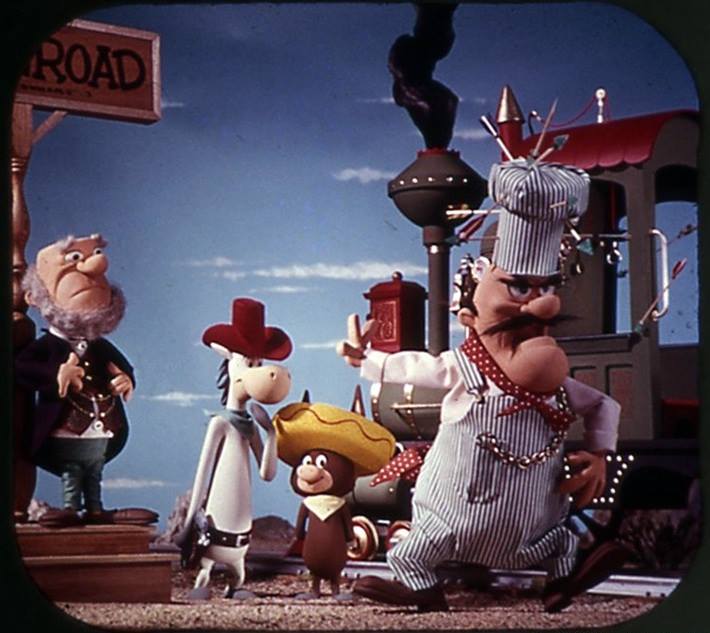
Cartoons and comic books weren’t the only media where you’d find little adventures of the great early Hanna-Barbera characters. You’d find them on View-Master reels as well.

When I was a kid, it took a little bit of getting used to seeing Huck and Yogi in a 3D-like setting after watching them running around flat on TV, but the layouts of the reels are really enjoyable and the craftsmanship is something to marvel at. Eventually, View-Master went to drawings instead of what I guess were little sets but they’re still good.

Could Hanna-Barbera have pulled off, say, a seven-minute Huckleberry Hound cartoon in stop motion, with designs like you see in the View-Master frames? Probably. After all, Gumby was airing at the same time as the original Huck show. And since someone will mention it if I don’t, there was the very imaginative dream sequence in Flintstones on the Rocks where Carlo Vinci’s animation in The Flintstone Flyer was a partial inspiration behind a really fun piece of stop-motion work, arguably the best part of the whole show.

Some of these have been posted here before. They’re provided courtesy of Scott Awley, Dom Giansante and Eric Steadman. I believe Scott went to the trouble of cleaning up a couple of these frames. This is not an attempt to post all the H-B reels but, yes, a fully-restored set of the frames (maybe in a book) would be nice.