Wednesday, 13 March 2013

The Man Who Met Snagglepuss Only Once

Many people from animation’s Golden Age eventually punched time cards at Hanna-Barbera during its first dozen years. Some stayed for long periods. Others seem to have worked on a cartoon or two, possibly on a freelance basis, then moved on. One of them was Gil Turner.

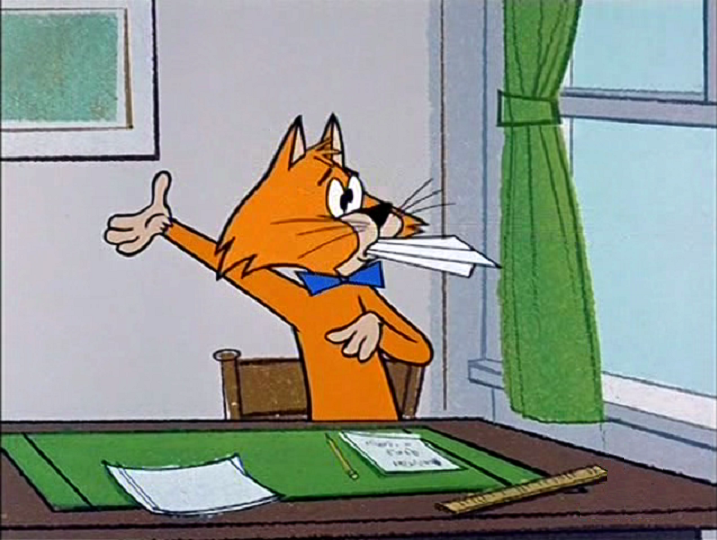
Turner was one of a number of people who moved from studio to studio, though calling him a journeyman animator is perhaps unfair because he was elevated to a director’s chair at UPA. You may know his name from Warner Bros.; he worked in the Hardaway-Dalton unit in the late ‘30s and then for Friz Freleng. You could recall him from Woody Woodpecker cartoons as he had a stop at Walter Lantz in the early ‘50s as well. But he also popped in at Hanna-Barbera and apparently worked on one cartoon—the Snagglepuss entry “Remember Your Lions” (1961), with a funny story by Mike Maltese that’s so Warner-esque (dim adversary fooled by disguises, bad puns), you expect to see a Snag-in-drag scene.

There’s plenty about Turner’s non-theatrical work on the internet. His work in comic books gets more praise than what he did in animated cartoons. David Gerstein, a fine and meticulous researcher in both mediums, noted:


[Turner] successfully turned the LITTLE RED RIDING RABBIT model of the Wolf into Disney's own model. That always amuses me. What I mean is—instead of drawing the Disney Wolf, he drew the Looney Tunes wolf in the Disney wolf's outfit.

But there’s not much biographical information about him, so I’ll post a little bit. I was fortunate to find two newspaper obituaries (see one to the left). And census records have a few things to add.

Gilbert H. Turner was born in December 1, 1911 in Milwaukee, Wisconsin, the eldest of two sons of Charles Edward and Alice Marie (Gilbert) Turner. The family was living in Chatsworth, California by 1920. His father was a warehouse clerk for the Los Angeles County road department before turning to mechanical engineering and then fruit farming. Turner began his animation career at Walt Disney in 1932. The website coa.inducks.org states he spent the years 1936 to 1938 at Jam Handy in Detroit before going to Leon Schlesinger’s studio where he was paid $3900 a year. Martha Sigall relates in her autobiography that Tex Avery played a prank on Turner by filling a bottle in the studio’s Coke machine with alcohol, recapping it, then watching the reaction of Turner, who thought he was drinking pop (Tex Avery’s interview/biography by Joe Adamson has the trick played on Art Goble, but Avery wasn’t sure). Martha also relates how Turner stripped down to his underwear in the un-air-conditioned studio one summer day and someone stole all his clothes—then he got paged to go to Henry Binder’s office immediately. Binder, Schlesinger’s right-hand man, was in on the gag. And if that isn’t enough, she tells how Turner was working one day on a long panorama drawing of birds to be used as a stock shot when paint water from the next floor spilled through a crack and down onto Turner’s drawing. Ah, life in an animation studio!

Unlike many animators, it seems Turner wasn’t drafted during the war. He left Warners to work at J. Richard Weston’s Carry-Weston studio (1357 N. Gordon St. Hollywood) along with ex-Warners staff members Jack Bradbury and Ray Patin, then spent his time either working in comics or animation. One of his more interesting comic strips was “Holly Wood.” The interesting part is it appeared for a time on the Wednesday comic page of the Redwood Journal Press-Dispatch, which appears to have been drawn by people involved in animation, including Patin, Gus Jekel (“Pam”), Jerry Hathcock (“Sleepy Holler”) and Tom Ray (“Starlight,” a celebrity gossip panel). Patin was running his own production house at the time; whether there was a deal between it and the paper, I don’t know. The comic below is from August 23, 1950.


Turner animated Barney Bear in the Lah-Blair unit at MGM then later worked on Barney at Western Publishing. Read more HERE. The ‘50s seem to have taken him to Patin’s studio, UPA, then a brief stop at H-B before heading to Format Films where he directed segments of “The Alvin Show” (1961). Turner retired in Scottsdale, Arizona in 1963 and took up a job with the Richardson Camera Co. That’s where he died of cancer on Sunday, March 19, 1967, about 2½ months after his father. Like Warner’s Tom McKimson and cartoon voice actors Mel Blanc and Walter Tetley, Turner was a member of the Masons. The fraternity conducted his funeral. Like Blanc, he was also an active Shriner. His wife Angelyn returned to Los Angeles where she died in 1988.

His one H-B cartoon is distinctive in that he draws Snagglepuss zipping off camera in outline with brush lines inside. Offhand, I can’t name anyone else at Hanna-Barbera in the first years of the studio (“Flintstones” and before) who did this. Here are some examples.


I should point out the credits may be suspect. Fernando Montealegre is listed as the background artist but there’s one city exterior with a lumpy cloud in the sky that looks like Art Lozzi’s work. Lozzi once said some of his paintings appeared in cartoons which gave the credit to someone else.

Turner’s time at Hanna-Barbara may have been undistinguished due to its briefness, but he did have a long career in cartooning, and he’s a favourite among Disney Wolf comic enthusiasts. It shows the calibre of people Bill and Joe were able to attract.

Saturday, 9 March 2013

Pixie and Dixie — Woo For Two

Produced and Directed by Bill Hanna and Joe Barbera.
Credits: Animation – Bob Carr; Layout – Tony Rivera; Backgrounds – Bob Gentle; Story – Warren Foster; Story Direction – Alex Lovy; Titles – Lawrence Goble; Production Supervision – Howard Hanson.
Voice Cast: Mr Jinks, Dixie – Daws Butler; Pixie, Marcel, Telegram Boy – Don Messick; Brigette – Julie Bennett.
Music: Bill Loose-John Seely, Jack Shaindlin, Spencer Moore, Raoul Kraushaar?, Geordie Hormel.
First Aired: week of December 5, 1960 (rerun, week of April 24, 1961).
Episode: Huckleberry Hound Show K-045, Production E-119.
Plot: Mr Jinks thinks the kitten next door wants to marry him.

There’s a great routine in the climax of the Warner Bros. cartoon “Fool Coverage” (1952, written by Tedd Pierce) where Porky Pig qualifies for an insurance policy payout from Daffy Duck. The list of conditions keeps growing, becoming more and more outlandish and impossible, but Porky meets them all. The same sort of thing happens in this Hanna-Barbera cartoon. Mr. Jinks is challenged to a duel and told to choose the weapons. Jinks tries to come up with one that doesn’t exist so the duel can’t go ahead.

Jinks (confidently): Okay, pops. The weapons I choose are, uh, Turkish duelling pistols.
(Marcel hands him the pistols).
Marcel: Turkish duelling pistols, m’sieur.
Jinks (hesitantly): With p-p-pearl handles?
(Marcel flips over the pistols to show off the handles).
Marcel: Pearl handles, m’sieur.
Jinks: Made in (gulps) 1760?
Marcel: Look at zee date.
Jinks: 1760. Fhoo. (looks at camera) They’re more plentiful than I thought.

Jinksie has always affected hip-type coolness but in “Woo For Two,” he fashions himself a ladies’ man, which fits his personality (more so than the asexual meeces getting excited over a fake girl mouse in “Mouse Trapped” the following season). But his coolness is fake, readily demonstrated by the inept way he tries to impress the kitten when he meets her. And when he’s not around her, he's merely lovestruck.

Much of Warren Foster’s plot is based on misunderstanding, part of which is contrived. He sends a love note to Brigette, the kitten next door. She knows it’s a love note. And she responds to it. But she also knows she’s unavailable as she has a fiancĂ©. Logic would seem to dictate that she’d tell that to Jinks in her response, but she doesn’t. Of course, there wouldn’t be a cartoon if she did, or it’d be considerably different than the one Foster wrote.

This is another cartoon where the meeces maintain a healthy suspicion of the cat during the full seven minutes. Even Jinks says he “likes” the meeces—“and I use that term lucidly”—at the beginning of the cartoon when he surprises them with a large slice of Swiss cheese on a plate. Dixie reveals the reason—Jinks is in love with the heretofore unknown French girl cat next door. He’s been sending her notes. The scene fades to Jinks reading one of them:


Roses are red, violets are blue, like.
How’s about some parlez-vous, like?


Then he folds it up and, ad-libbing another rhyming couplet, tosses it like a paper airplane. It lands at the feet of Brigette. “I must say he writes zee funny love letters. I will invite him over, just to be, uh, zee good neighbour.” Can someone explain why cartoons have a peculiar brand of Frenglish where “the” is pronounced “zee”? In French, “the” is either “le”, “la” or “les.” The “th” digraph is pronounced “t.” Where does “zee” come from? Pepe LePew?

Anyway, the girl cat is played by the lovely Julie Bennett in her only appearance in a Pixie and Dixie cartoon. Somehow, I don’t think Don Messick’s falsetto would have worked as Brigette.

Meanwhile, back at the meeces’ place, Jinks is reading his next soon-to-be-sent letter when a paper airplane response from Brigette flies into the cat’s mouth. “She loves me! She ans-wered my letter,” exclaims the happy Jinks, who sniffs the note. “My favourite perfume! Liverwurst Number 5.” The note begins “Dear Sir” and ends “Respectfully yours.” Jinks misconstrues the formality as love. We next find him in a medium-close shot behind the fence separating his home with Brigette’s. “I’ll just play it cool. Dignified. Sort of the, you know, uh, hard-to-get type.” And that’s when Jinks shouts: “Hiya, Bridget! Bet ya can’t do this!” The cat is standing on his hands twirling his feet, then splits his feet and bounces on his butt.


Brigette’s opinion of Jinks suddenly changes. She seemed a little enchanted with his love letters, but now thinks he’s “zee screwball.” Jinks now gets filled with zee LePew-esque sexual over-confidence. “Well, uh, let’s not fight it, baby. Uh, you know, I mean, this is bigger than two pussycats.” His attempt to kiss Brigette is met with a sock in the face. “Aw, she’s a croquette, like. Leads a guy on and POW!” he tells the meeces in the next scene.


The meeces stroll along the grass, mulling over the situation when Pixie (except it’s Dixie talking with Pixie’s voice coming out of him) notices Marcel, Brigette’s finacĂ©, at the front gate. The two French cats are going to get married today. Meanwhile, Jinks is in his basket, mulling over the situation himself and concludes when Brigette turned him down because of “an engagement” it means the two of them are now engaged. So he bolts for the home next door, where Pixie and Dixie are explaining Jinks’ motivation to the French cats. Marcel decides to “scare heem away”—apparently, an explanatory conversation isn’t a possibility—and that’s when Jinks walks into the scene on his hands. “I see you brought you, uh, brought your father for the wedding. Hiya, pops! You’re not, like, uh, losin’ a daughter, uh, you are gaining a hip cat.” Marcel flips him over and then challenges him to the duel mentioned above. Marcel only shoots a blank at Jinks, which the meeces explain to him after a dying scene. “Well, oh yeah, mm hmm. That explains why there were no holes in my pelt.”


So things are now back to normal. Jinks is chasing the “miserable meeces” with a broom into their hole (Pixie and Dixie pass the same light socket six times before the shot cuts to Jinks running past the same painting three times). But then comes a mysterious telegram. It’s from Cashmiri Lovesong, the big movie star, who wants to see Jinks next week. Well, actually, it’s not. The meeces realise Jinks won’t chase them when he’s in love so they plan to keep stringing him along with phoney telegrams. And they laugh about it as the cartoon fades to black.


The sound cutter didn’t bother hunting around for a lot of music for this one. Jack Shaindlin’s “Recess” is used twice and so are two other cues. We have cue changes in mid-dialogue in some scenes.


0:00 - Pixie and Dixie Main Title theme (Hanna-Barbera-Curtin-Shows).
0:13 - LAF-27-6 UNTITLED TUNE (Shaindlin) – Jinks brings cheese to meeces, love letter sent to kitten, gets return note in his mouth.
1:30 - creepy muted trumpet music (Kraushaar?) – Jinks looks down at note, “come over this afternoon…”
1:56 - LAF-21-3 RECESS (Shaindlin) – “We can converse,” Jinks at fence.
2:31 - LAF-2-12 ON THE RUN (Shaindlin) – Jinks jumps.
2:41 - L-81 COMEDY UNDERSCORE (Moore) – Kitten talks, Jinks slapped, swollen eye.
3:09 - TC-300 ECCENTRIC COMEDY (Loose-Seely) – Meeces walk, Marcel shows up, Jinks in basket, Jinks walks on hands, “Hiya, Pops.”
4:12 - L-81 COMEDY UNDERSCORE (Moore) – “You’re not, like …”, Jinks chooses weapons, Jinks dying scene.
5:20 - TC-300 ECCENTRIC COMEDY (Loose-Seely) – Marcel reveals the bullets are fake, Jinks gets up.
5:45 - ZR-48 FAST MOVEMENT (Hormel) – Jinks chases meeces, broom comes down.
5:54 - LAF-21-3 RECESS (Shaindlin) (Shaindlin) – Shot of meeces in hole, telegram scene, meeces laugh.
6:56 - Pixie and Dixie End Title music (Curtin).

Wednesday, 6 March 2013

Yogi Bear Weekend Comics, March 1963

Ranger Smith returns to Jellystone Park after a number of weeks off—in the comics, at least. He appears in two of the five colour comics pages published in papers on Sunday (Saturday in Canada) 50 years ago this month. He’s back with his blonde wife the following month, but let’s not get ahead of ourselves.

All five are set in Jellystone. All of them have detail in the background but never look cluttered. And a couple have incidental animals; you’ll find them in the Sunday Flintstones comics as well. Boo Boo appears in all but one.


A number of the animated Yogi cartoons featured a grey-haired park superintendent. The March 3rd comic has one. The long final panel has a nice sense of perspective with the rangers in silhouette in the distance and the stuff Yogi has pulled with him in an angle coming into the foreground. I like the top panel, too, with the comic-like diagrams of Yogi. Notice the difference in the ears of Ranger Smith and the grey-haired ranger. The latter has ear innards like Walt Clinton designed in the various H-B animated series.


Hammy Yogi decides to hog his way into a movie, just like in the animated series, except this one’s a mediaeval epic in the March 10th comic. I like how lights, cameras and actors are placed in the background to add to the filmmaking feeling, even in the opening panel. Yogi goes on another rhyme spasm. “Bear”? “Maidens fair”? What maidens? Oh, well.


I wish the version of final panel of the March 17th comic you see here was clearer; it’s a little hard to see the lamb looks somewhat embarrassed. The poses of Yogi throughout the comic are very nice; we even get a three-quarter rear view and an overhead shot in the next panel. You can see his foot sticking up from behind the fence in the bottom row, second panel. A nice little touch. Jellystone evidently isn’t your average national park. It has a Wild West Show. A few weeks earlier, it had a circus.


Oh, Jellystone has its own airport, too. At least it does on March 24th. It’s one thing to draw characters but to be able to draw a solid airplane as well is quite admirable. My favourite drawing, though, is the placid deer looking up to see why leaflets are falling. The slightly-angled trees and the snow-capped peaks were found in a number of Harvey Eisenberg forest settings. The story’s clever and so is the end gag.


Chipmunks watch the opening activities in the first panel of the March 31st comic. I like the sense of depth in the first panel in the second row by having some fir trees in silhouette. I don’t get the last line about trapdoor spiders. Yogi dug the hole, not a spider. Guess I’m being too literal. Notice that Yogi never talks about “pic-a-nic” baskets, just “goodies.” There’s no dot over the “I” in “Yogi” in the first panel, unless the others this month.

As usual, click on each comic for a better look. These are the best scans I could find.

Saturday, 2 March 2013

Quick Draw McGraw — Yippee Coyote

Produced and Directed by Bill Hanna and Joe Barbera.
Animation – Dick Lundy; Layout – Tony Rivera; Backgrounds – ?; Story – Mike Maltese; Story Director – Alex Lovy; Titles – Art Goble; Production Supervision – Howard Hanson. (no credits)
Voices: Quick Draw, Baba Looey, Wagon Master,Yippee Coyote – Daws Butler; Narrator, Banjo Player, Cow – Don Messick.
Music: Jack Shaindlin, Phil Green, Geordie Hormel, J. Louis Merkur, unknown.
First Aired: week of January 16, 1961 (rerun week of May 29, 1961).
Episode: Quick Draw McGraw Show M-033, Production J-101.
Plot: Wagon Master Quick Draw battles cow-rustling Yippee Coyote.

It’s great to see all the elements of a cartoon working together, especially in limited animation where the style of movement can’t be depended on to pick up the slack. That’s what “Yippee Coyote” gives the viewer—convoluted logic, a smart-aleck bad guy who fools the good guy with disguises, a fast line of patter and action, and a silly Jerry Lewis voice from Daws Butler that makes almost any dialogue sound funny with incorrect inflection and emphasis. Even the stock music works well, as Jack Shaindlin’s “Crazy Goof” surfaces in several scenes. The only thing really weak is the ending because it doesn’t resolve anything nor does it top any of the previous dialogue routines.

The incidental character designs and props are by layout artist Tony Rivera. His cow is pretty funny. Very basic design. He gets hauled away, with Don Messick giving out a plantive “Mooo!”


And here are some of Rivera’s settlers. Very stripped down stylistically, much like in “Talky Hawky” that season..


There are no credits on this cartoon but the animator’s unmistakeably Dick Lundy. There’s a little rolling snout thing he does with Quick Draw McGraw in a couple of cartoons, and he does it here when Quick Draw laughs. There are three drawings on threes. I’ve slowed down the animation so you can take a look.

Quick Draw laugh from 'Yippee Coyote'

This is another cartoon with those rose-coloured, shadowed bluffs in the background (see the cow frame above). Art Lozzi may be responsible; the rolling reddish hills elsewhere in the cartoon are the same as in “Talky Hawky.” The clouds, though, in the opening shot, aren’t the lumpy ones that Lozzi drew in other cartoons around the same time. It looks like these ones have been chopped off at the bottom with a ruler.


The opening scene is of a wagon train crossing the prairie. We hear the clip-clop of Geordie Hormel’s “Western Song” (it’s called that even though there are no lyrics). And we hear Don Messick’s straight-forward narration: “Travelling to California in the early days of the West was a long and dangerous journey. Nevertheless, with banjos on their knees, the brave settlers struggled onward, their safe passage entrusted to one man—the Wagon Master.”

Banjos on their knees? That might seem incongruous, except the wagon master gets bashed with one (it makes the El Kabong guitar sound, not that of a banjo) because a banjo player wants to play the cello instead. Already, Mike Maltese is giving us a ridiculous situation. And then the Wagon Master quits after “the dreaded Indian attack” (as both the narrator and then the Wagon Master call it). “You’re not turnin’ chicken, are ya?” asks the would-be cello player. “Yeah,” answers the Wagon Master, and there’s a cut to a shot of him with arrows in his butt. “I just got my tail feathers.”


I can’t help but wonder if Maltese is taking a shot at Hanna-Barbera’s limited animation. The narrator now comes on and states: “And, so, without a wagon master to lead them, the setters didn’t dare move.” Of course they didn’t move. Animating them would cost the studio money (their heads move and that’s it). Quick Draw and Baba Looey join us in the next scene and Quick Draw agrees to accept the job as wagon master after reading a sign (again, no animation involved).


Quick Draw: Folly me, folks.
Baba: But Queeckstraw, how do you know we heading west?
Quick Draw: That’s simple, Baba boy. When we hit the Atlantic Ocean, it’s in the opposite direction.

Now the heckling bad guy shows up. Lundy gives Yippee Coyote a determined walk, ten drawings on twos, scrunched fists, with a stiff leg on four of the drawings. Combine Maltese’s dialogue and Daws’ sing-songy Jerry Lewis voice and you get:

Yippee: Oh joy oh good news. A wagon train, passing under my sly nose, together with a moo cow. I will get the moo cow I should have milk. Then I shall have rosy cheeks and strong bones and be healthy.

There’s more Lewis-like dialogue after Yippee drops the cow he’s pulling up a cliff on Quick Draw and our hero responds with gunfire. “Oh, you got a bang-bang. Don’t hoit me with a bang-bang, Mister.” Then, after a couple of more shots comes a phoney death scene (well, Maltese did write for Bugs Bunny). “Oh, you got me! Already I got pains and lumps and everything!” Quick Draw is annoyed. “I did not touch you,” he rightly states. “I shot in the air.”

Yippee is unfazed by the news. The dialogue and accompanying actions stream onward. “You, sir, shall hear from my solicitors. I’m telling you to your face. (Opens Quick Draw’s mouth) And to your teeth . (Looks down Quick Draw’s throat). And to your tonsils.” An echo gag follows before we quickly cut to the next routine. Quick Draw is fooled by Yippee’s old-timer disguise, a sombrero and a pince nez. Out of nowhere, Yippee pulls out a huge ear horn, shoves it over Quick Draw then shoots into it to “clean” it so he can hear better.


Unfortunately, Maltese has used up his best gags and the cartoon’s got 90 seconds left. So it practically slows to a stop as we get almost nothing but dialogue the rest of the way. First, Yippee runs. Lundy gives him a basic run cycle of eight drawings, two frames to a drawing. But then during a couple of the cycles he substitutes two of those drawings, and the second one has Yippee gliding in mid-air for ten frames. As you know, Hanna-Barbera characters run past the same stuff in the background as the same background drawing is used again and again. Lundy’s timing is such that Yippee’s feet end up in the same place the next time the background drawing starts over again. Quick Draw, still wearing the tuba-sized ear horn, runs into a blue rock. Quick Draw has busted his clavicle. The rest of the cartoon involves Baba laughing at Quick Draw’s misfortune, Quick Draw stalking off in anger but then Yippee benevolently tripping Baba to bust the burro’s clavicle so Quick Draw can laugh at him, thus reuniting the two cohorts. And that’s how the cartoon ends. Baba, for good measure, does a little laughing roll on the ground and chirps out the mock-Spanish words “bustola clavicola.” Baba, as usual, gets in the tag line: “I like that Quickstraw. He always sees the joke. If it’s on the other foot.” Baba’s drawn with large pupils that Lundy (and Laverne Harding) liked using.


What happened to Yippee Coyote? He joined Scooter Rabbit and Max Chickenhawk in H-B obscurity, never to return. Only six more Quick Draw cartoons were made after the second season and Maltese preferred to concentrate on El Kabong taking on characters more suited to a masked avenger.

The opening music choice works is fine but it strikes me as odd that the sound-cutter didn’t use the stock version of “Oh, Susannah” that was in other Quick Draw cartoons, considering the scene’s main gag involves a banjo on a knee. I’ll bet that’s the way Carl Stalling would have done it. The cutter also uses a cue when the wagon train rolls along that starts with a C and an E in half notes, then a G in a full note in the next bar. I don’t know where it came from but it’s from the same place and composer as triumphant trumpet cue in “Legion Bound Hound” and “Missile Bound Cat.” The unidentified cutter also likes changing cues in mid-sentence.


0:00 - Quick Draw McGraw Sub Main Title theme (Curtin).
0:15 - ZR-39A WESTERN SONG (Hormel) – Wagon train, “Whoa!” line.
0:45 - SF-11 LIGHT MOVEMENT/MOUNTAINEERS' HOEDOWN (Merkur) – “We’ll camp here,” Wagon Master clobbed with banjo, Indian attack, “Indians?!”
1:22 - GR-99 THE DIDDLECOMB HUNT (Green) - “What’ll we do, Wagon Master?”, shot of settlers.
1:37 - GR-472 HICKSVILLE (Green) – Quick Draw and Baba walk, “…time we get thar.”
1:58 - GR-99 THE DIDDLECOMB HUNT (Green) – Quick Draw laughs, sign scene.
2:21 - C-E-G western dance cue (?) - Quick Draw leads wagon train.
2:50 - CRAZY GOOF (Shaindlin) – Coyote walking, captures cow.
3:16 - ZR-94 CHASE (Hormel) – Quick Draw and Baba walking, cow hoisted, cow lands on Quick Draw.
3:31 - PG-181F MECHANICAL BRIDGE (Green) – Coyote on bluff, runs off camera.
3:41 - drum kit sound effect – Quick Draw with gun in Coyote’s face.
3:48 - GR-333 BUSTLING BRIDGE (Green) – “Don’t hoit me,” dying scene, Coyote puts nose in Quick Draw’s face.
4:10 - GR-99 THE DIDDLECOMB HUNT (Green) – Coyote/Quick Draw scene, disguise scene.
4:58 - LFU-117-2 MAD RUSH No 2 (Shaindlin) – Coyote runs, skids toward Baba.
5:11 - CRAZY GOOF (Shaindlin) – Clavicle laugh scene, Quick Draw walks away.
6:04 - LFU-117-1 MAD RUSH No 1 (Shaindlin) – Baba runs after Quick Draw, Baba tripped, “That smarts.”
6:18 - CRAZY GOOF (Shaindlin) – “I thin’ I broke…”, Quick Draw laughs, Baba talks to camera.
6:42 - Quick Draw McGraw Sub End Title theme (Curtin).

Wednesday, 27 February 2013

I Hear Voices

You hear their voices on cartoons but, of course, you never see them. They’re the great voice actors that Hanna-Barbera hired. Most of them had training in the days of radio drama and comedy before television bludgeoned it to death. Some did live action television, so their faces may be familiar.


We’ve posted pictures of some of them here before—Daws Butler, Don Messick, Doug Young, the casts of The Flintstones, The Jetsons and Top Cat. And you’ve seen others elsewhere on the internet. But I’ve got a file folder with photos and clippings that I don’t think have been posted, so I’m doing it now.

This is not intended as a complete, definitive photo gallery, so don’t ask “Why isn’t there a picture of Lennie Weinrib?” and then list every cartoon role he ever played. I’m just putting up a miscellany of graphic files I’ve accumulated. Some are trade ads, others are publicity head shots.


Daws Butler improved every cartoon he appeared in, and some needed a lot of help. This shot must be from the early ‘50s when he was working with Stan Freberg, and comes from a biography about him broadcast years ago on PBS. Daws had so many great voices, it’s impossible to pick a favourite. I do have a favourite one-shot voice, though. It’s when Daws did his Fred Allen impression in the Huckleberry Hound cartoon “Skeeter Trouble.” My dad came into the living room when the cartoon was on and remarked that it was Fred Allen. “No, dad, it’s Daws Butler,” I replied. It’s the only time I ever corrected my father; kids didn’t do that back then. But this was important. We were talking cartoons, after all. (You can also hear Daws as Fred Allen in the August 1956 CBS Radio Workshop production “An Analysis of Satire”).


Mel Blanc was the King of Theatrical Cartoon Actors. There was no one better. He was a tremendous actor, yet he failed when handed a starring role in a radio sitcom in 1946, though the one-dimensional characters and trite concept were the reasons. He didn’t work for Hanna-Barbera until The Flintstones came along. He was Secret Squirrel and, well, a bunch of other characters that didn’t do a lot for me. This trade newspaper ad is from 1950, which gives you an idea what roles Mel thought were his most important at the time.


I love Howie Morris. One of the funniest things I’ve ever seen is Howie as Uncle Goopy on the This is Your Life send up on Sid Caesar’s show. His first H-B role, to the best of my knowledge, was Jet Screamer on The Jetsons, though he was pretty funny as Harlan, Cogswell’s lackey. He starred as Atom Ant, tried to enliven Magilla Gorilla cartoons as Mr. Peebles and got a Kellogg’s cereal gig as the voice of Hillbilly Goat, pushing Sugar Stars. He also told off Joe Barbera in language not fit for television, thus resulting in a change of cartoon addresses to the Filmation studio.


Know who this is? He’s in character as Solomon Levy on The Goldbergs radio show. It’s Alan Reed. This trade ad shot is from 1943. He carved out a good radio career before being hired as Fred Flintstone. His best role was probably that of hammy poet Falstaff Openshaw on Fred Allen’s show; the Falstaff voice got recycled as “Frederick” in the first season of The Flintstones. Reed did dialects on radio as well; Pasquale on Life With Luigi may be his best-known one.


This is the guy that Reed replaced as Fred Flintstone because he couldn’t keep enough gravel in his voice during recording sessions. It’s a picture of a young Bill Thompson, who theatrical cartoon fans will know as Droopy (MGM) and J. Audubon Woodlore (Disney). Old radio fans remember his long stint on “Fibber McGee and Molly” starting in the late ‘30s, interrupted by a stint in the U.S. Navy during the war. He was billed as “Jackie Coogan’s Double” at age five and went into vaudeville at 12. The Fibber gig dried up about the time MGM closed its cartoon studio, so Thompson got a job in 1957 as a community relations executive for Union Oil. That’s what he was doing when he arrived at Hanna-Barbera. He starred as TouchĂ© Turtle but didn’t do a lot of work for the studio. He died in July 15, 1971 at age 58.


Paul Winchell entertained audiences on radio, TV and cartoons. His sneering Dick Dastardly on Wacky Races was great, though I suspect his first H-B “appearances” were on The Banana Splits Show (both of which debuted in 1968). Winchell, of course, was Gargamel in the studio’s take on The Smurfs and popped up on other series, and made a fine Tigger for Disney. He was born Paul Wilchinsky and he, his father Sol (a tailor by trade), mother Clara and sister Rita were in Los Angeles by 1940 where Paul was acting in what was left of vaudeville. As you likely know, he was an energetic ventriloquist. You should check out a What’s My Line show where Winchell is on the panel and the mystery guests are Edgar Bergen and Charlie McCarthy. You can read Mark Evanier’s remembrance of Paul Winchell HERE.

Since we’re on the topic of ventriloquists, Yakky Doodle’s voice is still with us. Jimmy Weldon’s fame from his television appearances in California in the 1950s with his puppet Webster Webfoot. This photo is from 1959. Weldon had replaced Shari Lewis on “Hi Mom,” shot in New York, and would very soon be back on the West Coast. Red Coffey had been doing the voice of a little duck in the earliest Hanna-Barbera cartoons but when the duck was given his own series in 1961, Weldon won the role. He’s spent time in retirement, if you want to call it that, as a motivational speaker.

Hanna-Barbera’s utility man was John Stephenson, who came on board after The Flintstones went to air in 1960. Besides Mr. Slate, he grumbled a lot about “if it wasn’t for those meddling kids and their dog,” started out playing Dr. Benton Quest until Joe Barbera or someone decided to replace him with Don Messick, tried out his Cary Grant voice on Top Cat, had supporting roles on Breezly and Sneezly and Squiddly Diddly (yeah, I know, not exactly two of H-B’s greatest), used Paul Lynde-inspired voices in a couple of series and even voiced later incarnations of Doggie Daddy when Doug Young left California in 1966. He seems to have been in every one of those mid-1970s Tom and Jerry TV cartoons, the stiff-looking, talky ones where the cat and mouse are friends. I always enjoyed watching him on Hogan’s Heroes because I recognised his voice from cartoons. He was still doing commercials up to a few years ago as part of Dick Orkin’s stock company and is apparently doing well in his late 80s. The bio is from a mid-‘50s Radio-Television Mirror magazine when Stephenson was on the sitcom The People’s Choice.


I’m not a fan of the Cindy Bear character, but here are some publicity photos of the young woman who played her, Julie Bennett. The first one is from 1950, the second from 1951. I suspect Cindy’s voice was inspired by magnolia-scented Leila Ransom on radio’s The Great Gildersleeve, voiced by Shirley Mitchell (imitating Una Merkel), who had the misfortune of appearing in Hanna-Barbera’s Roman Holidays. Bennett’s first role for the studio was on “Masking For Trouble” (1959), a Quick Draw McGraw cartoon. Her whereabouts today, unfortunately, are unknown.


Okay, I’m cheating now. Gil Mack never appeared in a Hanna-Barbera cartoon. But he voiced a number of H-B characters on Golden Records recorded in New York City. Gil racked up credits on some great shows, as you can see by this 1940 trade newspaper ad, but imitating Daws Butler and Don Messick’s characters wasn’t exactly his forte.


And I’m cheating again. Jack Shaindlin and John Seely never voiced characters but their music was prominent behind the voices on the soundtracks of H-B cartoons from 1957 until Hoyt Curtin started writing underscores in 1960. Biographies of both Shaindlin and Seely have been posted elsewhere on the blog. These are trade ads; Seely’s is from 1961 and Shaindlin’s from probably a decade earlier. This is as good a post as any to put them on the blog.


This is a funny photo I grabbed off Facebook. You know who it is. But someone didn’t. The caption reads:


Broadcasting Archives at the University of Maryland.

One of the joys of being an archivist is finding mistakes and correcting them. We found this photo in the Imogene Coca file, but it's not her. Students of 1950s television or fans of voice actors, might recognize the face as that of Arnold Stang. But when and where did he dress up in drag?

One Google search later and we learned that the picture is from an episode of the "Red Skelton Show," broadcast on April 2, 1957. One of Skelton's recurring sketch characters, "Cookie," is in the Navy and there's a chance for shore leave in Japan as the prize in a drama contest. So Red became a six-foot-three Romeo to shipmate Stang's five-foot-three Juliet.


Arnold Stang had to be a great comedian to be able to hold his own on TV with hammy scene-stealers like Skelton and Milton Berle. Here’s Stang with his alter ego in a more familiar photo you’ve seen here before.


Of course, there were many more actors who settled in front of the microphones at the Hanna-Barbera studios. All of them were talented. All of them made fans laugh, even though they couldn’t see us and, in a case of tit for tat, we couldn’t see them.