Wednesday, 16 February 2011

The Human Friends of Huckleberry Hound

Be at the mercy of Wrong-ipedia and internet Make-it-Up databases no longer. At least, when it comes to who did what on the Huckleberry Hound cartoons.

Viewers of English-language versions floating around in the not-all-that secret passages of the internet have had to settle for credit-less Huck adventures. The same in Spanish. And Portuguese. If you want to know who did what to Huck and when, you’ve had to rely on internet sites that are, at best, full of good intentions and sometimes fairly accurate. And sometimes not.

Ah, but I, Yowp, your favourite cartoon dog, have borrowed Snooper’s deerstalker hat and stalked down (okay, I found them by accident), all four seasons of Huckleberry Hound from Italian television. Yes, they have annoying cartoon bugs. But they all contain full credits, except for one cartoon which someone apparently recorded a little too late.

There are a couple of little surprises here.

2021 update: the Boomerang app has all these cartoons available, including the one with the missing credits. They have been added to this old post. Now, back to 2011....

Somewhere I had read that Mike Maltese worked on the Huck series and that is indeed the case. He wrote what turned out to be the second cartoon aired in the second season, Grim Pilgrim. We’ll never know why he only worked on one cartoon; it could be that Warren Foster hadn’t arrived at Hanna-Barbera yet. From what I can tell, the cartoon was the first one put into production that season. I don’t have a full production number list.

An unexpected name pops up as a layout artist on two of the cartoons—Sam Weiss. I haven’t found any of Sam’s pre-Hanna-Barbera background, but writer Earl Kress points out some people from Playhouse Pictures (at 1401 La Brea) freelanced for Hanna-Barbera (at 1410 La Brea). It could be Weiss was one of them. Like Gerard Baldwin, he found a home at Jay Ward Productions in 1959, was one of the designers of Mister Magoo’s Christmas Carol in 1962 and worked on the original Alvin series for Format Films and Roger Ramjet for Fred Crippen (who also spent time at Ward and UPA). He directed for Stephen Bosustow Productions in the ‘70s and ‘80s. His Los Angeles Times obit is here.

13 cartoons were made in the second season. Hanna-Barbera added to its animation staff that year but neither Baldwin nor George Nicholas was assigned a Huck cartoon. Another 13 cartoons followed in the third season (1960-61) and nine in the fourth and final one (1961-62). Of course, H-B expanded again in the final two seasons and you can see the names of ex-Disney people, including Noel Tucker, John Freeman and John Boersma, replacing familiar names like Carlo Vinci. Readers here are probably familiar with the backgrounds of many of the artists. Ralph Somerville had worked for Fleischer and Lantz prior to World War Two. Paul Sommer had been a director at Columbia during the war years. Don Towsley directed Bob Clampett’s solo effort for Republic, It’s a Grand Old Nag (1947) and animated on Chuck Jones’ Tom and Jerry cartoons in the ‘60s. Hicks Lokey had a long career at Lantz, Fleischer and Disney. Afraid I don’t know anything about James Carmichael. (Note: these are examples, and is not intended to be a full filmography of each and every person listed below).

Hanna-Barbera tried to expand its roster of voice talent in 1959. One of the new hires was comic actor Hal Smith. He appeared in six Huck cartoons, all in the second season. It could be that Don Messick was involved in other endeavours; Smith was used on the Quick Draw and Snooper and Blabber series where Messick didn’t play a main character. Vance Colvig, the voice of Chopper, makes an appearance as a gruff prisoner in the fourth season short Bars and Stripes. No women seem to have invaded Huck’s space; Jean Vander Pyl was restricted to incidental voices on other cartoons.

It’s probably a safe presumption that Warren Foster had his hands full in 1960 and into 1961 with The Flintstones, so Tony Benedict penned a couple of Hucks. Carl Kohler also gets one writing credit. He was a magazine cartoonist, one of the originators of CARtoons in the 1950s. His name appears on two late Warner Bros. cartoons, Chuck Jones’ Martian Through Georgia and Art Davis’ Quackodile Tears (both 1962). And, yes, the credit changes from “Story” to “Written By” in mid-third season.

All nine cartoons in the last season featured cues by Hoyt Curtin; some of them you’ll hear on Top Cat. But there was one cartoon in the previous season where Curtin’s music is hear as well. Otherwise, it’s stock music from Capitol and Langlois.

So, for your information, is a list of the credits of the final three seasons of The Huckleberry Hound Show. I’ve also listed the uncredited voice artists and which cartoons featured the Curtin cues.


SECOND SEASON
Ten Pin Alley Production No. K-027
Animation – Ed Love; Layout – Ed Benedict; Backgrounds – Dick Thomas; Story – Warren Foster; Story Sketches – Dan Gordon; Titles – Lawrence Goble; Production Supervision – Howard Hanson.
Voices: Don Messick; Daws Butler.
Copyright 1959.

Grim Pilgrim Production No. K-028
Credits: Animation – Ken Muse; Layout – Dick Bickenbach; Backgrounds – Dick Thomas; Story – Mike Maltese; Story Sketches – Dan Gordon; Titles – Lawrence Goble; Production Supervision – Howard Hanson.
Voices: Daws Butler; Hal Smith.
Copyright 1959.

Jolly Roger and Out Production No. K-029
Animation – Ken Muse; Layout – Sam Weiss; Backgrounds – Dick Thomas; Story – Warren Foster; Story Director – Alex Lovy; Titles – Lawrence Goble; Production Supervision – Howard Hanson.
Voices: Daws Butler; Hal Smith.
Copyright 1959.

Somebody’s Lion Production No. K-030
Animation – Dick Lundy; Layout – Sam Weiss; Backgrounds – Joe Montell; Story – Warren Foster; Story Sketches – Dan Gordon; Titles – Lawrence Goble; Production Supervision – Howard Hanson.
Voices: Daws Butler; Don Messick.
Copyright 1959.

A Bully Dog Production No. K-031
Animation – Ken Muse; Layout – Tony Rivera; Backgrounds – Joe Montell; Story – Warren Foster; Story Director – Alex Lovy; Titles – Lawrence Goble; Production Supervision – Howard Hanson.
Voices: Daws Butler; Don Messick.
Copyright 1959.

Nottingham and Yeggs Production No. K-032
Animation – Ed Love; Layout – Walt Clinton; Backgrounds – Joe Montell; Story – Warren Foster; Story Sketches – Dan Gordon; Titles – Lawrence Goble; Production Supervision – Howard Hanson.
Voices: Daws Butler; Hal Smith.
Copyright 1959.

Huck the Giant Killer Production No. K-033
Animation – Dick Lundy; Layout – Tony Rivera; Backgrounds – Bob Gentle; Story – Warren Foster; Story Director – Alex Lovy; Titles – Lawrence Goble; Production Supervision – Howard Hanson.
Voices: Don Messick; Daws Butler.
Copyright 1959.

Cop and Saucer Production No. K-034
Animation – Ed Love; Layout – Tony Rivera; Backgrounds – Joe Montell; Story – Warren Foster; Story Director – Alex Lovy; Titles – Lawrence Goble; Production Supervision – Howard Hanson.
Voices: Don Messick; Daws Butler.
Copyright 1959.

Pony Boy Huck Production No. K-035
Animation – La Verne Harding; Layout – Tony Rivera; Backgrounds – Bob Gentle; Story – Warren Foster; Story Sketches – Dan Gordon; Titles – Lawrence Goble; Production Supervision – Howard Hanson.
Voice Cast: Daws Butler; Don Messick.
Copyright 1959.

Pet Vet Production No. K-036
Animation – Carlo Vinci; Layout – Dick Bickenbach; Backgrounds – Dick Thomas; Story – Warren Foster; Story Director – Alex Lovy; Titles – Lawrence Goble; Production Supervision – Howard Hanson.
Voices: Daws Butler; Hal Smith.
Copyright 1959.

Piccadilly Dilly Production No. K-037
Animation – Don Patterson; Layout – Ed Benedict; Backgrounds – Joe Montell; Story – Warren Foster; Story Director – Alex Lovy; Titles – Lawrence Goble; Production Supervision – Howard Hanson.
Voices: Hal Smith; Daws Butler.
Copyright 1959.

Wiki Waki Huck Production No. K-038
Animation – Lew Marshall; Layout – Walt Clinton; Backgrounds – Bob Gentle; Story – Warren Foster; Story Director – Alex Lovy; Titles – Lawrence Goble; Production Supervision – Howard Hanson.
Voices: Daws Butler; Don Messick.
Copyright 1959.

Huck’s Hack Production No. K-039
Animation – Don Patterson; Layout – Dick Bickenbach; Backgrounds – Fernando Montealegre; Story – Warren Foster; Story Director – Alex Lovy; Titles – Lawrence Goble; Production Supervision – Howard Hanson.
Voices: Daws Butler; Hal Smith.
Copyright 1959.

THIRD SEASON
Spud Dud Production No. K-040
Animation – George Nicholas; Layout – Dick Bickenbach; Backgrounds – Art Lozzi; Story – Warren Foster; Story Director – Alex Lovy; Titles – Lawrence Goble; Production Supervision – Howard Hanson.
Voices: Daws Butler; Don Messick.
Copyright 1960.

Legion Bound Hound Production No. K-041
Animation – Ken Muse; Layout – Dick Bickenbach; Backgrounds – Dick Thomas; Story – Warren Foster; Story Director – Alex Lovy; Titles – Lawrence Goble; Production Supervision – Howard Hanson.
Voices: Don Messick; Daws Butler.
Copyright 1960.

Science Friction Production No. K-042
Animation – Ed Love; Layout – Tony Rivera; Backgrounds – Dick Thomas; Story – Warren Foster; Story Director – Alex Lovy; Titles – Lawrence Goble; Production Supervision – Howard Hanson.
Voices: Daws Butler; Don Messick.
Copyright 1960.

Knight School Production No. K-043
Animation – Lew Marshall; Layout – Paul Sommer; Backgrounds – Dick Thomas; Story – Warren Foster; Story Director – Alex Lovy; Titles – Lawrence Goble; Production Supervision – Howard Hanson.
Voices: Daws Butler; Don Messick.
Copyright 1960.

Nuts Over Mutts Production No. K-044
Animation – Ed Love; Layout – Tony Rivera; Backgrounds – Dick Thomas; Story – Warren Foster; Story Director – Alex Lovy; Titles – Lawrence Goble; Production Supervision – Howard Hanson.
Voices: Don Messick; Daws Butler.
Copyright 1960.

Huck Hound’s Tale Production No. K-045
Animation – Ed de Mattia; Layout – Tony Rivera; Backgrounds – Dick Thomas; Story – Warren Foster; Story Director – Alex Lovy; Titles – Lawrence Goble; Production Supervision – Howard Hanson.
Voices: Don Messick; Daws Butler.
Copyright 1960.

The Unmasked Avenger Production No. K-046
Animation – Don Williams; Layout – Paul Sommer; Backgrounds – Dick Thomas; Story – Warren Foster; Story Director – Alex Lovy; Titles – Lawrence Goble; Production Supervision – Howard Hanson.
Voices: Daws Butler; Don Messick.
Copyright 1960.

Fast Gun Huck Production No. K-047
Animation – Brad Case; Layout – Walt Clinton; Backgrounds – Dick Thomas; Written By – Warren Foster; Story Director – Alex Lovy; Titles – Lawrence Goble; Production Supervision – Howard Hanson.
Voices: Daws Butler; Don Messick.
Copyright 1960.

Hillbilly Huck Production No. K-048
Animation – Hicks Lokey; Layout – Paul Sommer; Backgrounds – Vera Hanson; Written By – Warren Foster; Story Director – Alex Lovy; Titles – Lawrence Goble; Production Supervision – Howard Hanson.
Voices: Don Messick; Daws Butler.
Copyright 1960.

Lawman Huck Production No. K-049
Animation – Bob Carr; Layout – Tony Rivera; Backgrounds – Bob Gentle; Written By – Warren Foster; Story Director – Alex Lovy; Titles – Lawrence Goble; Production Supervision – Howard Hanson.
Voices: Don Messick; Daws Butler.
Copyright 1960.

Huck and Ladder Production No. K-050
Animation – Hicks Lokey; Layout – Tony Rivera; Backgrounds – Dick Thomas; Written By – Warren Foster; Story Director – Alex Lovy; Titles – Lawrence Goble; Production Supervision – Howard Hanson.
Voices: Daws Butler; Don Messick.
Copyright 1960.

Astro-Nut Huck Production No. K-051
Animation – Lew Marshall; Layout – Paul Sommer; Backgrounds – Dick Thomas; Written By – Warren Foster; Story Director – Alex Lovy; Titles – Lawrence Goble; Production Supervision – Howard Hanson.
Voices: Don Messick; Daws Butler.
Copyright 1960.

Cluck and Dagger Production No. K-052
Animation – Art Davis; Layout – Paul Sommer; Backgrounds – Art Lozzi; Written By – Warren Foster; Story Director – Alex Lovy; Titles – Lawrence Goble; Production Supervision – Howard Hanson.
Voices: Daws Butler; Don Messick.
Music: Hoyt Curtin.
Copyright 1960.

FOURTH SEASON
Caveman Huck
Animation – George Goepper; Layout – Tony Rivera; Backgrounds – Dick Thomas; Written By – Warren Foster; Story Director – Paul Sommer; Titles – Lawrence Goble; Production Supervision – Howard Hanson.
Voices: Don Messick; Daws Butler.
Music: Hoyt Curtin.
Copyright 1961.

Huck of the Irish
Animation – La Verne Harding; Layout – Noel Tucker; Backgrounds – Bob Gentle; Written By – Tony Benedict; Story Director – Paul Sommer; Titles – Lawrence Goble; Production Supervision – Howard Hanson.
All Voices: Daws Butler.
Music: Hoyt Curtin.
Copyright 1961.

Jungle Bungle
Animation – Ralph Somerville; Layout – Dan Noonan; Backgrounds – Dick Thomas; Written By – Carl Kohler; Story Director – Art Davis; Titles – Lawrence Goble; Production Supervision – Howard Hanson.
Voices: Don Messick; Daws Butler.
Music: Hoyt Curtin.
Copyright 1961.

Ben Huck
Animation – John Boersma; Layout – Tony Rivera; Backgrounds – Art Lozzi; Written By – Tony Benedict; Story Director – Lew Marshall; Titles – Lawrence Goble; Production Supervision – Howard Hanson.
Voices: Don Messick; Daws Butler.
Music: Hoyt Curtin.
Copyright 1961.

Huck’ dé Paris
Animation – Ken Southworth; Layout – Tony Rivera; Backgrounds – Art Lozzi; Written By – Tony Benedict; Story Director – Lew Marshall; Titles – Lawrence Goble; Production Supervision – Howard Hanson.
All Voices: Daws Butler.
Music: Hoyt Curtin.
Copyright 1961.

Bullfighter Huck
Animation – Ken Southworth; Layout – Tony Rivera; Backgrounds – Dick Thomas; Written By – Tony Benedict; Story Director – John Freeman; Titles – Lawrence Goble; Production Supervision – Howard Hanson.
Voices: Daws Butler; Don Messick.
Music: Hoyt Curtin.
Copyright 1961.

Two For Tee Vee
Animation – Don Towsley; Layout – Tony Rivera; Backgrounds – Art Lozzi; Written By – Warren Foster; Story Director – John Freeman; Titles – Lawrence Goble; Production Supervision – Howard Hanson.
Voices: Daws Butler; Don Messick.
Music: Hoyt Curtin.
Copyright 1961.

Bars and Stripes
Animation – John Boersma; Layout – James Carmichael; Backgrounds – Art Lozzi; Written By – Tony Benedict; Story Director – John Freeman; Titles – Lawrence Goble; Production Supervision – Howard Hanson.
Voices: Daws Butler; Vance Colvig.
Music: Hoyt Curtin.
Copyright 1961.

Scrubby Brush Man
Animation – Edwin Parks; Layout – James Carmichael; Backgrounds – Dick Thomas; Written By – Tony Benedict; Story Director – John Freeman; Titles – Lawrence Goble; Production Supervision – Howard Hanson.
Voices: Don Messick; Daws Butler.
Music: Hoyt Curtin.
Copyright 1961.

Happily, there are also some Italian versions of Quick Draw McGraw and Pixie and Dixie on-line (for example, Bob Givens is credited as being the layout artist for Six Gun Spook, so he worked on more than just Augie Doggie). With any luck, complete credits are available for all of them somewhere that we can finally post so those who worked on cartoons that many of us have enjoyed for many years get the recognition they deserve.

Saturday, 12 February 2011

Huckleberry Hound — Piccadilly Dilly

Produced and Directed by Joe Barbera and Bill Hanna.
Credits: Animation – Don Patterson; Layout – Ed Benedict; Backgrounds – Joe Montell; Story – Warren Foster; Story Direction – Alex Lovy; Titles – Lawrence Goble; Production Supervision – Howard Hanson.
Voice Cast: Huck, Captain, Alf – Daws Butler; Dr. Jikkle/Piccadilly Dilly, Narrator, Eddie – Hal Smith.
Music: Spencer Moore, Bill Loose/John Seely, Geordie Hormel, Jack Shaindlin, Raoul Kraushaar.
Episode: Huckleberry Hound Show K-037, Production E-98.
First Aired: week of January 25, 1960 (repeated week of July 18, 1960).
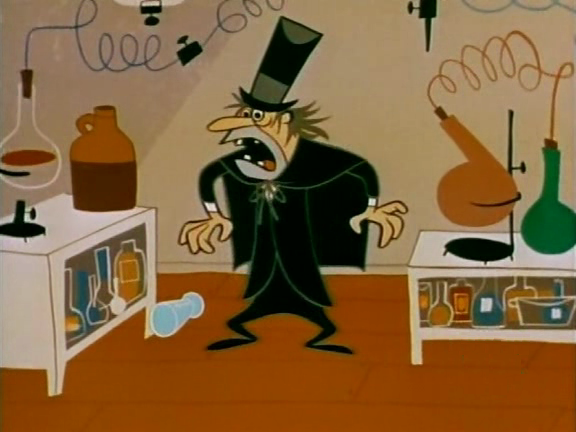
Plot: Clueless London bobby Huck is sent to arrest the raving Piccadilly Dilly, who is really mild-mannered Dr. Jekkle under the spell of his own potion.

Near the beginning of the cartoon, Warren Foster comes up with a great line that had to be over the heads of every North American kid watching. And probably most North American adults.

Huck is deposited in the middle of late 19th century London. He’s ostensibly an English bobby but, incongruously, maintains his North Carolina drawl. After a brief chat with him, the Scotland Back-Yard captain, in profile, turns an eye to the camera and remarks to us:


Inspector: ‘e’s Yorkshire, this ‘un. Can’t hardly understand the blighter.

Now, on this side of the pond, you hear about an “English” accent. But anyone familiar with England, or who has read the opening act of Pygmalion, knows there are accents aplenty in Old Blighty. And if you know anyone from the south of England, it’s a perennial joke among a lot of them that Yorkshiremen have such thick accents, they’re hard to understand. How Foster would have known this beats me, but it’s a pretty astute line on his part.

That may be the most enjoyable part of the cartoon for me but if it’s a little arcane for you, there’s still a lot to like here. Some examples:

Don Patterson’s drawings. The Piccadilly Dilly looks like one of those late ‘50s Lantz studio characters that Patterson would have animated before going to Hanna-Barbera. And the transformations from Jikkle to Dilly and back are fun. Patterson’s taking advantage of limited animation as best as he can. Even the clothes change. The potion makes the Dilly grow a hat and cape.
Hal Smith’s endless crazy laughter as the Dilly.
Huck’s stream of commentary, at no time cluing in to what’s going on. Huck just seemed plain stupid in ‘Huck’s Hack’ but his ignorance is logical here because he doesn’t know what the Dilly looks like and never sees the transformation.
The opening shot.

Joe Montell’s London scenescape is a nice bit of art, especially for an H-B cartoon, and sets a fine tone for the start of the cartoon. The scene fades to two men reading a misspelled sign about the Piccadilly Dilly. Nowhere in the cartoon does it explain what the Dilly is accused of doing. About all he seems to do is laugh and push hats down on top of blue hounds. Alf, the tall one, asks Eddie, the short one, what the sign says. Then we get a close up and Eddie reads a poster we can all read for ourselves and, presumably, both should be able to read for themselves, considering how close to it they are.

Then we get dialogue about a “rich toff” in silhouette. The two “go ‘ome” then another silhouette sweeps into view and we hear crazy laughter. It’s the Dilly.


The scene now cuts to the door outside the office of Doctor Jikkle. The Dilly stops and laughs then goes inside. The cartoon cuts to him drinking out of a tall glass (which he drops to the floor with a breaking sound, though the glass doesn’t break). Now comes the transformation. First heavy breathing, then stomping (in three drawings), then a flash. Here are some of Patterson’s drawings.


The meek and contrite doctor decides he must get rid of the potion so he won’t be tempted. He pours it into a sink. A camera pan shows the sink really empties into a glass jug.

Now we have the scene at the police station where we learn the Dilly “was gadding about again.”


Huck: You all want me to a-rest this pickle-dilly Dilly, sir.
Captain: That’s it. Arrest the blighter. Bring him in. And we’ll give this Piccadilly Dilly chap a taste of Dartmoor Prison, we will.
Huck (to the audience): If’n that there captain feller talked any more British, I wouldn’t know what he was sayin.’

Yes, there is a Dartmoor Prison. It gained fame for a riot in the ’30s and was a locale in one of the many Sherlock Holmes movies with Basil Rathbone.

Huck’s now on a cobblestoned street. The background artist has kindly added some fog effect for atmosphere. The chimes of Big Ben are heard in the background.


Huck: Real quiet in Piccadilly Circus tonight. Not even an elephant in sight.
(The Dilly rushes past him twice, giggling maniacally).
Huck: Yeah. Real quiet. Looks like the Piccadilly Dilly won’t show up.
(The Dilly comes up to him in medium shot, shaking).
Huck: Howdy, mister. Say, uh, did you take note of any suspicious-looking characters around here?

The Dilly laughs and squashes Huck’s helmet on top of him, then lays on the sidewalk, screeching in laughter. Huck decides “he’s kinda high strung” and “cain’t go home in that condition” so he tells the Dilly he’s going to take him to a doctor down the street to get something to quiet him down. Huck strolls off camera which sets up a revelation gag that the Dilly’s the one carrying him.

Huck: I’m right glad he’s comin’ along peaceable-like.

To Dr. Jikkle’s they go, where the crazed Dilly again pounds Huck’s helmet over his head. But just then, the Dilly stiffens. He realises the potion is wearing off. Patterson gives him spiral eyes; he did the same thing to Fred in some early episodes of The Flintstones. Huck pops off his helmet. Now we get a great bit of dialogue. Huck makes it seem like he knows what’s going on when he hasn’t a clue.


Huck: Oh, there you are, doctor. I’m Officer Huckleberry Hound of Scotland Back Yard.
Jikkle: The police! I knew you’d find me sooner or later. In a way, I’m glad. When you mix hydronexitrene and peritone together, you’re bound to get a schizo-frantic reaction. (Huck nods).
Huck: Oh, ever’ time. Ever’ time.
Jikkle: My big mistake was splitting my personality.
Huck: Well, don’t worry, doc. I mean, if it’s only split, you can glue it back together again. T’aint like it got broke off altogether. Now, I’d like to chat some more doctor-talk with you, but I brought you a patient. He’s around here somewheres.
(Huck turns away. The doctor transforms into the Dilly).
Huck: You’ll like him. He’s got a real good sense of humour.
(The Dilly laughs).
Huck: Hold everything, doc. That’s his laugh. He’s close by. (Huck turns his head and sees the Dilly. The Dilly laughs again). I told you he was close by. We bobbies are all trained observers with keen ears.

We get more transformations, laughter, and hat-pushings. Huck frowns a bit at the camera. “You know,” he tells us. “It’s hard to stay mad at a feller with such a refreshing sense of humour.” He cuffs the Dilly and leads him to the door, then blows his police whistle. The captain arrives in a horse-drawn (and metallic) police van. Of course, the Dilly has changed back to the good doctor.

Well, maybe he’s not so good. He suggests the captain come inside to join him in a toast to his health. So much for his contrition about being arrested and his sincerity in getting rid of his elixir of evil. The captain orders Huck to remain outside and be on guard for the Dilly. We hear the sound of glugging as the bored Huck checks his fingernails. Then there’s the sound of two people engaging in wild laughter. Yes, the potion has created two Dillies, who pop their heads out the door. Patterson gives Huck a small scare take and the cartoon ends with the pair laughing and chasing Huck down the street. For some reason, the camera cuts to a solo shot of Huck looking back before the iris closes.


Foster evidently loved the idea of placing a clueless Huck as a Scotland Back Yard investigation in a transformation cartoon. He did it again the following season in ‘Science Friction’ where Dr. Frankly Stein turns an overstuffed wiener schnitzel into a laughing monster-schnitzel (Don Messick supplies the goofy laughter in that one instead of Hal Smith). Foster brought the ‘Dr. Jekyll, Don’t See the Transformation’ idea with him from Warners. It’s the basic plot of the Foster-written Bugs Bunny misstep ‘Hyde and Hare’ (1955) as well as ‘Hide and Go Tweet’ (1960, copyright 1959), which came out after Foster left the Freleng unit for Hanna-Barbera. There’s no story credit on that cartoon and Warners was notorious for leaving the names of ex-employees from its on-screen credits (though it should be pointed out Mike Maltese wrote the last few Freleng cartoons before this one). And Foster brought back the idea for the Loopy De Loop cartoon Two Faced Wolf (1961), except Loopy sees the mild-mannered Doctor Jickyll (played again by Hal Smith) change, and both swallow the transformation potion at the end.

The most fitting bit of music in the cartoon is the middle passage of the light classical-sounding ‘ZR-52 Light Movement’ aka ‘Light Quiet’ by Geordie Hormel. It flutters down the scale and is used when the Dilly and the captain are drinking down the potion.


0:00 – Huck short main title theme (Curtin).
0:14 – L-78 COMEDY UNDERSCORE (Moore) – Englishmen look at poster, Dilly runs into Jikkle’s office.
0:54 – 7-MR-183 creepy trumpet reverb music (Kraushaar) – Dilly drinks potion, dumps potion down drain.
1:18 – TC-432 HOLLY DAY (Loose-Seely) – Police station scene.
2:14 – Big Ben Chimes – Huck looks around in long shot.
2:16 – TC-204A WISTFUL COMEDY (Loose-Seely) – Huck meets Dilly, tells him they’re going to Dr. Jikkle’s.
3:10 – ZR-127 PERIOD CHASE (Hormel) – Dilly carries Huck into office, transforms.
3:33 – LAF-7-12 FUN ON ICE (Shaindlin) – Huck and Jikkle converse, Jekkle transforms.
4:23 – LAF-10-7 GROTESQUE No. 2 (Shaindlin) – Dilly laughs, pushes helmet on Huck, transforms back and forth, Huck cuffs Dilly, takes him to door.
5:36 – ZR-127 PERIOD CHASE (Hormel) – Huck blows police whistle, police van pulls up.
5:41 – LAF-7-12 FUN ON ICE (Shaindlin) – Captain and Huck chat, Captain goes inside for a toast.
6:20 – ZR-52 LIGHT QUIET (Hormel) – Captain and Jikkle drink, Huck hears laughter.
6:38 – LAF-74-2 LICKETY SPLIT (Shaindlin) – Huck’s helmet shoved on him, Dilly and Dilly Captain chase Huck down street.
6:58 – Huck sub end title music (Curtin).

Wednesday, 9 February 2011

Jonny Quest

“You gotta have a gimmick,” the burlesque stripper belted out to the future Gypsy Rose Lee in a famous musical once. And that motto seems to have driven the P.R. department at 3400 Cahuenga Boulevard.

Hanna-Barbera’s first marketing gimmick was the made-exclusively-for-TV cartoon. Lots of press followed. Then the first prime-time cartoon. Lots of press followed. But then the Bill and Joe Media Machine stalled a little. The Jetsons was an invert of The Flintstones. Top Cat? Another prime time cartoon with roots in an old sitcom. Nothing new to report. But then the studio came up with another marketing gimmick—the first high adventure cartoon.

Jonny Quest is a little off the beaten path of the purpose of this blog, which is to look at the comparatively neglected 1950s TV cartoons of Hanna-Barbera. And there’s a great web site completely devoted to Jonny in his various incarnations (only the first one counts), plus a fabulous documentary on YouTube outlining the history and making of the show. But I came across a couple of the aforementioned full-page newspaper features, and thought I’d pass them on. Besides, it’s my blog. So, nyah.

Well, there’s another reason. I love Jonny Quest. I was seven years old when it debuted on channel 4 and we watched it every week. By “we”, I mean “me.” My six-year-old sister was so scared watching the final scene in the Anubis episode when the mummy is walking zombie-like toward the bad guy, she couldn’t watch it any more (yes, I still remember that 46 years later). The Herculoids, she could watch. Jonny Quest, she couldn’t. I’ve never been one with even a remote interest in super heroes or action/adventure stuff, but Jonny Quest was a spellbinding show with stories that kept you watching to see what would happen, a bit of comic relief to break the tension, and characters with realistic traits. It was all held together by Hoyt Curtin’s effective and evocative music. Bleak, foreboding, urgent, triumphant, his cues for Jonny Quest were his finest work. They enhanced what you saw on the screen like all good scores today.

Our first stop is the Press-Courier of Oxnard, California. This was in the paper of August 22, 1964. It’s, more or less, a full-page ad. These drawings accompanied the story. Maybe it’s me, but Jonny’s proportions looking a little off.


High Adventure in Cartoon TV Series
By EDGAR PENTON
The flames of high-adventure entertainment, currently at the ember stage, will be fanned into full blaze when Hanna-Barbera Productions debuts its “Jonny Quest” series over ABC-TV beginning Friday, September 18, at 7:30 p.m.
“Jonny Quest” is the product of over two years of research by Hanna-Barbera artists.
Not only does the Quest series bring up-to-date adventure to television for the first time, it also brings an art style, never seen before in animation.
The style is illustrative rather than cartoon art and every attempt has been made to make “Jonny Quest” visually attractive and exciting.
* * *
YOUNG JONNY (11 years) is the son of Dr. Benton Quest, one of the three top scientists in the world. Because of the nature of Dr. Quest’s work and his importance to the scientific world and mankind in general, Roger “Race” Bannon has been assigned by Intelligence I as a permanent bodyguard for the Quests. He is also a tutor and friend to Jonny, who travels with his father at all times. Haji [sic], an Indian boy adopted by Dr. Quest, and Jonny’s dog Bandit, complete the Quest family album.
With the Quest entry, Hanna-Barbera chalks up several firsts. Most certainly, there has never been anything like “Jonny Quest” on television. In radio’s heyday, adventure shows were listened to with fantastic loyalty and anticipation.
The same fervor held true for the comic strip adventure series.
On radio, the mind’s eye look over and the listener’s imagination was stimulated and transported to the four corners of the world.
Today, on television, the scope and geography of stories is limited. It is financially impossible to take cameras all over the world to recreate locales.
However, via the pen-and-ink magic of artists, viewers will join Jonny Quest as he travels to the North Pole, Tibet, the Sargasso Sea area, India and wherever else their adventures lead them.
* * *
THE STORY behind the scenes of “Jonny Quest” is as exciting as the series itself. The idea actually came from some brilliantly hired illustrative drawings which Bill Hanna and Joe Barbera thought were visually stimulating.
“We somehow wanted to breathe life into those drawings,” says Bill Hanna. “So we developed the idea of animating the characters in a lifelike manner and at the same time making the stories adventuresome and contemporary.”
One of the most interesting aspects about “Jonny Quest” is that the stories are based on fad or possible fact.
Joe Barbera says, “There will be no mad scientists running around ready to blow up the earth with a secret bomb; no monsters from other planets.
“Nothing out of the realm of the believable will happen to the Quests.”
They have taken the harder route to create adventure for today’s children and adults.
“Not only is there no challenge to copying an airplane already in use, but kids are sharp these days and when a plane has been junked, they know it.
“And since we base our series on up-to-the-second stories, we design our own plane—based on the actual aircraft but with a more futuristic look.
“This keeps us one step ahead of our astute audience and make the Quest series even more believable,” says Bill Hanna.
* * *
EXCITEMENT ABOUT the “Jonny Quest” series has permeated the entire studio from the writing and story-boarding through the animating, inking, painting and photographing.
Throughout the studio, famous for its satirical, whimsical, ingenious characters such as “The Flintstones,” Yogi Bear or Magilla Gorilla, writers and artists are busy delving into books on the history of costumes, weapons, planes, boats, science, and world geography in order to come up with original—but accurate—costumes, backgrounds or “inventions,” as well as plots and clever escape ideas.
Although “Jonny Quest” is high adventure, which always means the presence of villains, there will be no violence. Villains will be disposed of in imaginative, clever ways, rather than violent, the creators emphasize.
“It’s easy to whip out a gun and shoot a villain,” says Joe Barbera. “It’s much more difficult and challenging to find unique escape methods.
“Some of our tricks will remind the adults in our audience of the old Doug Fairbanks Sr. methods, which always had a touch of humor about them.
“We are doing the same type of creative thinking in the Quest series. For example, in one episode, we have Haji do the Indian rope trick in order to free ‘Race,’ who is held captive in a room that couldn’t be reached any other way.
“We even have him slide back down the rope. An audience will accept a certain amount of ‘poetic license’ just for the thrill of it. But we never go too far.”
* * *
“IN ONE QUEST sequence,” Bill Hanna continues, “Race rescues Dr. Quest from hostile natives by masquerading as the feared ‘water god’ who lives at the bottom of the ocean.
“To achieve the disguise, Race uses a red berry to dye his body and with the aid of a snorkel swims near the shore.
“When he ‘arises’ at the proper moment, the natives run in terror. In another Quest story, a giant bird flies in front of the villains’ plane, disrupting their hot pursuit of the Quests.”
Whatever rescue or escape method employed by Hanna-Barbera, they have tried to achieve a balance between documentary reality and creative adventure.
All the stories could happen and the producers underscore the “could.”
The stories could be carried on the front pages of next week’s because “Jonny Quest” has to be one giant step ahead all the time.
“A whole new generation of kids and adults who have memories of adventure entertainment is a ready-made audience for ‘Jonny Quest,’” points out Barbera.
* * *
“WE’RE GLAD we can introduce today’s youngsters to the pure type of adventure stories we grew up on,” Bill Hanna continues.
“After all,” Joe interjects, “adventure has a universal appeal. Its appeal is worldwide and knows no age barrier.
“Until now, our kids have not been exposed to this particular type of pure, clean adventure. We are glad to be the first to introduce them to it on television.
“It’s a thrill for us to work on this series, and it’s bound to be a thrill for children and adults to watch.”
It may be that Hanna-Barbera have at long last found out how to bring the color, intrigue and excitement of the Arabian Nights and the flying carpet—(a slow way to go these day) right into the jet age.
“Jonny Quest” may well be the “carpet” for today’s children and adults.

The series had been on the air for a few months when the Independent-Press-Telegram of Long Beach, Ca., published this on Sunday, January 3, 1965:

BERT’S EYE VIEW
‘Jonny Quest’ Combines Scientific Knowledge with Adventure

By BERT RESNIK
TV and Radio Editor
When Joe Barbera claims his new series, “Jonny Quest,” is designed for everybody, he admits there could be a few exceptions.
He’s not sure about those members of the viewing audience who are under four years old.
“But after a child is four years old,” said Barbera, “you better have sharp, intelligent entertainment or they’ll pass you right by.
“At four, they turn on the dial and they’re exposed to reruns of Lucy and Bilko, brilliant satire.
“We cannot have little beetles and elves dancing around on mushrooms and expect to get viewers.”
* * * *
WHAT BARBERA and his partner, Bill Hanna, have come up with in “Jonny Quest,” ABC-TV’s Thursday night COLOR series, is not satire.
It is action-adventure.
It is action adventure that looks futuristic but actually is within the basis of fact.
“We cram into these adventures basic scientific knowledge,” said Barbera.
He likes to think of “Jonny Quest” as a balance between documentary reality and creative adventure.
What viewers think is also important to Barbera.
When he wants opinions along those lines, he asks teenagers. Teenagers’ opinions have more value than adults, he feels, because the youngsters “come right out and let you know.”
His most valued opinion came from a teenager who said:
“Yes, I saw ‘Jonny Quest.’ It’s pretty good. I got to admit it.”
* * * *
BARBERA himself is so pleased with the new style of the series — illustrative rather than cartoon — that he has planned four new series based on the same type of art.
The company, Hanna-Barbera Productions, currently has 13 half-hour series on the air every week.
It is hoping to add an hour show and four half-hour programs next season.
It is a company, incidentally, that has no time clocks and no memos.
People report to work more or less when they want to start, excepting for such personnel as switchboard operators.
The doors to the bosses’ offices are always open and no appointments are set for conferences.
People just barge in and out.
Astonishingly, it succeeds.
Barbera feels a principal reason is that his creative people don’t feel hamstrung.
“Yet they know it is important that they turn the work out,” he said. “And that they do.”

So much for the praise. The media plaudits turned into a media death-watch. TV writer Richard K. Doan pointed out in his column of January 7 the networks were making changes:

At ABC, “The Flintstones,” Thursdays at 7:30 p.m. (EST), and “Jonny Quest,” Fridays at the same hour, will be switched to try to salvage the former show, now bucking CBS’s popular “Munsters.”
“Jonny Quest” is probably headed for the cancellation bone pile.


Mr. Doan was right. The Munsters was more appealing to Jonny’s target audience than Jonny was, and by March, Hanna-Barbera was told the show wouldn’t be picked up for a second season. So Jonny picked up his P.F. Flyers and after a bit of a break from dealing with crazed German barons, Poho and the Yeti, he returned to television on Saturday mornings in fall 1967.

And ABC’s programming strategy worked. The Flintstones was saved for another couple of seasons, though Hanna-Barbera tried to keep the ratings afloat in the final year with the Great Gazoo. Because, you know, you’ve gotta have a gimmick.

Sunday, 6 February 2011

Pixie and Dixie — Hypnotize Surprise

Produced and Directed by Bill Hanna and Joe Barbera.
Credits: Animation – Lew Marshall; Layout – Walt Clinton; Backgrounds – Fernando Montealegre; Dialogue and Story Sketches – Charlie Shows and Dan Gordon; Titles – Lawrence Goble; Production Supervision – Howard Hanson.
Voice Cast: Pixie, Cat – Don Messick; Dixie, Jinks, Rocky – Daws Butler.
Music: Bill Loose/John Seely, Spencer Moore, Jack Shaindlin.
First Aired: week of February 9, 1959 (repeated week of August 10, 1959)
Plot: Those tricky mice Pixie and Dixie hypnotize Jinks the cat with a spinning watch (from the L.A. Times).

Here’s another first-season Pixie and Dixie cartoon that just kind of stops when the time runs out, but there’s a bit of fun stuff going on before it does.

Likely the highlight is Lew Marshall’s goofy little dancing walks he dreams up for Jinks when the cat is under hypnosis. And the other is Daws Butler’s approach to Jinks before he’s put under the spell of Dixie’s pocketwatch.

Joe Barbera liked to go back into his Tom and Jerrys and find something to re-work into a Pixie and Dixie cartoon, and he and Charlie Shows have done it again. Jerry never hypnotized Tom; a surprise, though it seems like that would have been a perfect plot. But in ‘Nit-Witty Kitty’ (1951), Tom thinks he’s a mouse every time he’s bopped on the head. Mix that with the premise of cartoons like Warner’s ‘The Hare-Brained Hypnotist’ (1942) or the best 3-D short of the ‘50s, Lantz’s ‘Hypnotic Hick’ (1953), plus the concept of the disbelieving dog of ‘Roughly Squeaking’ (1946) at Warners, and you get the basis of this cartoon.

The cartoon opens with a bunch of Marshall’s familiar head bobs and a camera error. Pixie and Dixie kibitz about the watch Dixie’s holding and the hypnotism book he’s reading. Then there’s no animation for nine seconds, just a camera pan over to the book title, then a shot of a page in the book that Dixie reads aloud. But when it comes time to pan from the mice to the book, Pixie is standing in a different spot.


Jinks, naturally, is Dixie’s hypnosis victim. What’s unusual is the utter relaxed way it’s treated. It works because Jinks is casual to begin with, but it’s a little odd. When Jinks goes under, there are no jerky body takes and a glassy-eyed “Yes, master” like you’d find just about anywhere else. Daws is laid back about it. “You are a dog,” instructs Dixie. “Uh, sure I am,” Jinks casually says. It sounds like he’s doubting it. But, no, he starts barking like a dog.

But he doesn’t walk like a dog. Marshall comes up with a weird, paws-like-flipper walk for him, three positions on twos.


Jinks flips his way over to an unnamed buddy of his, bites him on the tail and trees him. Nice design by Walt Clinton on the cat, kind of an angular version of a character you might find on the future Top Cat. There’s a floppy ear and bandage on the tail. Jinks moves on to annoy Rocky with his barking. Rocky thinks it’s some kind of game and punches Jinks into a tree, which snaps him out of the hypnotic state. I suspect Marshall’s following Clinton’s layouts here. The dog looks like a streamlined version of a character you might have found in the Avery/Lah unit at MGM. And the rumbled Jinks isn’t bad, either.


The lame part through all this is the completely superfluous commentary by the meece while it’s going on. It gives some variation to the visuals but the plot would work fine without it. Barbera was so used to coming up with stories without dialogue all those years for Tom and Jerry he’s almost writing that way here. Either that, or he’s using the mice to pad the time to seven minutes. Because there really are four gags in the whole cartoon. That’s gag one.

Next Dixie makes Jinks believe he’s a bird. Marshall comes up with a different walk for him, six positions on twos. In one position, he crosses his legs in mid-air. “He’s strictly for the birds,” is the weak-sister line that Shows comes up with Pixie. Did he really think that was a gut-buster? Yikes.


Rocky wallops Jinks again when the cat climb on the doghouse roof and chirps endlessly. Again Jinks lands against the tree and wakes up. “There’s somethin’ goin’ on around here about which I do not comprehend,” the cat remarks to himself. Marshall supplies another funny rumpled landing. That’s gag two.

“Geeee. Some force stronger than I is at work,” says the clueless cat as he once again tries to sleep before Dixie twirls the watch in his face. Ah, but the meece has outsmarted himself this time. He turns Jinks into a mouse, who reaches into Pixie and Dixie’s hole, grabs their last cheese and eats it. In fact, he starts eating all the cheese in the house, shocking Dixie into the realisation that they’ll starve. Charlie Shows brings us some of his famous rhyming couplets: “Shoo, you!” “Stay out of that trap, sap!” Yes, Jinks-as-mouse sniffs out some cheese in a trap, only to get his nose caught and return to his normal cat self. Gag three.


Dixie decides to fess up to Jinks, but the cat doesn’t believe he can be hypnotised. He defiantly twirls the watch in his own face and tells himself he’s a choo-choo train. You know what happens next. “The Pussycat Express leaving on track nine,” is Shows’ latest weak line. Jinks chugs past the alley cat. “Shee,” says the cat, turning to the camera, “Is there a puss-chiatrist in the house?” Gag four. End of cartoon.


Few music beds were used in this cartoon, and we get Bill Loose and John Seely’s laughing clarinets and tippy-toe xylophone twice.


0:00 - Pixie and Dixie instrumental opening theme (Curtin).
0:27 - TC-300 ECCENTRIC COMEDY (Loose-Seely) – Dixie studies hypnosis book, turns Jinks into dog.
1:39 - TC-303 ZANY COMEDY (Loose-Seely) – Jinks goes outside, trees cat, wakes up against tree.
2:51 - TC-201 PIXIE COMEDY (Loose-Seely) – Jinks back in house, turned into bird, Rocky tells him to scram.
4:05 - no music – Rocky tells Jinks to scram, punches him, Pixie says “He even flies like a bird.”
4:18 - TC-303 ZANY COMEDY (Loose-Seely) – Jinks against tree, turned into mouse, grabs cheese from inside mousehole.
5:15 - L-78 COMEDY UNDERSCORE (Moore) – Jinks eats cheese, nose caught in trap, twirls watch.
6:26 – LAF-7-12 FUN ON ICE (Shaindlin) – Jinks laughs at idea of being train, choo-choos past cat in garbage can.
7:10 - Pixie and Dixie closing theme (Curtin).

Saturday, 5 February 2011

It’s Super Bear!

In a stroke of marketing genius, or by sheer coincidence, Yogi Bear hit newspaper comic pages the Sunday after his new show appeared on 180 TV stations across the U.S. (and more in Canada). That means today is the 50th anniversary of Yogi’s appearance in the papers—at least in the United States.

Unfortunately, I don’t have the research tools to answer a lot of obvious historical questions, such as who approached whom about syndicating the strip, and when. However, it’s well-known the McNaught picked up the syndication rights and added newspapers along the way so that by May 1961, one ad boasted Yogi was appearing in 35 newspapers. We can also guess Hanna-Barbera mounted a big push at about this time to get Yogi in print. One comic book site on the internet shows a lovely issue of Dell Comics Yogi Bear No. 4, with a cover date of September 1961. Yowp note: see Joe Torcivia’s note in the comment section about the comic books. Thanks, Joe.

I’m not into comic books like many people reading here so I can’t intelligently add much about Hanna-Barbera’s comic operations. It’s been mentioned on the blog a variety of artists worked on the newspaper comics, including former MGM artist Harvey Eisenberg, and it seems former all-kinds-of-studios artist Gene Hazelton was involved from the beginning.

However, I can tell you Gene (or whoever) lifted ideas from the TV cartoons for the stories of the first few comics. The debut comic on February 5, 1961 borrows the plot of Do or Diet (1961), written by Warren Foster, where Yogi gets revenge after he is snookered into believing he has “picnic-itis.” I like the visual variations from panel to panel. Some drawings are in silhouette, some have forest backgrounds while others use solid colour, and there are a variety of angles.


The second comic of February 12th has an original story, though Yogi was in the child-watching business in a couple of cartoons in his first season (this comic came out during Yogi’s third). You can find head-kerchiefed moms in both.


Yogi Bear’s Big Break, another first season cartoon, was the basis for the next Sunday page on February 19th except, this time, poor Boo Boo gets caught outside, too.


The last comic that came out in February owes its plot to the opening of Loopy De Loop’s third cartoon, Tale of a Wolf (1959) where he helpfully inflates the tire of a stranded woman’s car, though Loopy is always altruistic about those kinds of things. Yogi isn’t.


Newspapers advertised the fact Yogi was coming to their comic pages—not bad for a bear that had just gotten his own TV show—and one actually did an editorial about it. Amidst commentaries about local taxes, federal tariffs, a Portuguese hostage-taking, and a hat trick in a cricket game is this musement from the Ottawa Citizen from February 4, 1961. Only in Canada’s colourless national capital can whimsy be smothered in drabness.

A Welcome To Yogi Bear
Readers of the colored comics section of today’s Citizen will notice the appearance of a new character, to wit, Yogi Bear. This gifted animal, the bane of rangers of Jellystone National Park, has of course become widely and favorable known on television, and his manner of speech is imitated even on some university campuses.
The speech, indeed, is a large part of Yogi’s charm, and some may wonder whether a soundless Yogi will carry such an appeal. Citizen readers will make up their own minds on that point, but previous tests indicate that the true Yogi fan will be content. For Yogi is not rendered exactly speechless; the words are there on paper, and can be heard by the inner ear, much as the reader of a symphonic or string quartet score hears the music without it being played.
As for Yogi in the round, he takes his place among the celebrated rascals who spend an incredible amount of energy and ingenuity in doing something they shouldn’t. He is a bum, but an endearing one.

You will note that Yogi appeared in the Citizen of February 4, 1961, 50 years ago yesterday. He also appeared in the Winnipeg Free Press on the 4th as well. It’s likely because the concept of a Sunday newspaper was quite foreign to parts of Canada in the 1960s; no such thing existed in Vancouver in that decade, either. I can only speculate it was because of the federal Lord’s Day Act. Back then, it was illegal to hold a pro sports event on a Sunday. Shopping was not allowed on a Sunday, let alone going to a bar. And you couldn’t buy a newspaper on a Sunday, either. So you could read Yogi Bear in your local paper a day before the Americans.

The Citizen also gave readers the comic in a full page. All the American papers I’ve been able to find scrunched it down to a third of a page and deleted the first four panels.

As was mentioned in the Flintstones Christmas comic thread, the Yogi newspaper comics were built around Jellystone Park and the other characters from his TV show appeared only on rare occasion. And comics always seem to have a life apart from the animated version. Ranger Smith in the newspapers acquired a wife and child. Though a wife was mentioned in a couple of second season Yogis, later season episodes, like Home Sweet Jellystone (Ranger Smith inherits a castle) and Gleesome Threesome (Ranger Smith goes on vacation) makes it seem the Ranger was single. People weren’t such continuity geeks back then.

The Yogi comic was one more sign that Huckleberry Hound was no longer the reigning star at Hanna-Barbera and his downward spiral escalated in earnest. Sure, he still had his own show, but H-B was concentrating more on the half hours, much like Disney’s attentions toward the end of the ‘30s turned away from the shorts and toward features. The Flintstones got their own daily and Sunday strip in the fall of 1961 and both Yogi and the Bedrock family got feature theatrical film treatment, not Huck. But it seems Huck wasn’t the only pen-and-ink creation that Yogi bested. The local newspaper in Bonham, Texas pointed out on May 14, 1961 that it was picking up the Yogi Sunday comic and dropping Superman. He may not have been able to beat Ranger Smith, but Yogi came out on tops against the Man of Steel.