Friday, 14 May 2010

Monte

One of the unfortunate disadvantages your friendly Yowp has when it comes to getting specific material for this blog is I’m neither in the animation industry nor anywhere close to southern California where the cartoons you read about here were made. So I’m at a loss to help when people ask for information, especially biographical information that’s not available on-line.

I’ve received an e-mail from Maria Enriqueta Guardia at, I think, the University of Costa Rica looking for anything on background painter Fernando Montealegre for an essay. I’m afraid I’m not too helpful. So this is, as the kids say, a shout out to anyone who can provide even a snippet of information about him (I don’t mean the films he worked on; that’s easily found on the web).

You can either post a comment here, or if you wish to e-mail Ms Guardia, send me a note and I can pass on an e-mail address.


John Kricfalusi is one of a number of readers here who is a big fan of the backgrounds in the early Hanna-Barbera cartoons. Monte, Bob Gentle and Art Lozzi were the studio’s main painters in the 1950s and all brought their own particular styles which enhanced the cartoons. John and Art have been in correspondence for a number of years and here’s what Art told him in a comment after this post:


Monte? Fernando Montealegre, Costa Rican, a charmer (at times), a good artist, funny guy, sort of conceited and family-proud. We started the same day at MGM and became close friends. He had studied classical painting in San Jose. When Bob needed assistance, Monte was sent in to help out, following the oldish MGM technique. As I already mentioned, because of the fact that in the new Hanna/Barbera set-up, we had to work fast and simple, we established a style that allowed us both to work on one cartoon without noticeable differences. When we each had a complete cartoon to do, which became more and more frequent, then our styles began to show. But we managed to keep it all Hanna-and-Barbera-identifiable.


Presuming I have the right person in the California death records, Monte was born June 23, 1926. It’s unclear when he arrived in the U.S. He seems to have begun his animation career working on six cartoons for Mike Lah at M.G.M. Then the studio closed and he moved with a number of the artists to H-B Enterprises. He seems to have preferred being credited as ‘Montealegre’ at the newly-formed studio, at least at the outset.


His artistry graced the backgrounds of all the early Hanna-Barbera cartoons and all the studio’s half-hour series—the Flintstones, the Jetsons, Top Cat, Jonny Quest—on features like Charlotte’s Web and The Man Called Flintstone and even the combined live action/animation shows like The New Adventures of Huckleberry Finn. His last work in animation, according to one internet site, was on a 1983 TV special called The Great Bear Scare, directed by Hal Mason, an animator for Walter Lantz in the ‘40s, with animation by Virgil Ross and some other familiar names. Oh, and music was by a chap named Bill Loose.

Monte passed away in Los Angeles on April 29, 1991.


Kevin Langley did a blog post some time ago of some of Monte’s early backgrounds at Hanna-Barbera. You can see them here.

Monte was one of countless talented, but virtually unknown, artists who jumped into the nascent world of television animation from the autumnal years of the Golden Age of Hollywood Animation. Handiwork which provided memories for countless youngsters of several generations is not a bad legacy. And it would be nice to be able to read more about them because there are probably some fascinating stories waiting to be told.

Wednesday, 12 May 2010

The Musical Stylings of Charles Dawson Butler

Daws Butler’s reputation is so dominated by his stellar cartoon voice acting, people forget he had several other successful and lengthy careers. Perhaps the biggest one—at least for a couple of decades—was that of recording artist.

Daws made three types of records during overlapping periods of time. While he was still in radio and working occasionally for Tex Avery at MGM, Daws began lending his voice to children’s records. For example, in late 1950, Belda Records released Daws and Marian Richman in such tales as ‘Three Blind Mice,’ ‘The Enchanted Toymaker’ and ‘The Flying Turtle,’ which came with its own comic book of the story. He moved to the big leagues March 5, 1953 by signing with Capitol, for whom he made such recordings as ‘Peppy Possum’.

Then in October 1953, Daws and Stan Freberg seem to have given birth to the comedy record industry with their Capitol 45 of ‘St. George and the Dragonet’ (Walter Schumann composed the Dragnet theme and had a version of it on the charts at the same time). Daws and Stan went on to record other satires that, in some cases, are even more relevant today (1958’s Green Christmas, for example).

Daws’ third type of recording came after the smash success of Huckleberry Hound when he cut various sides for Colpix (Columbia Pictures’ record arm) of characters of the Hanna-Barbera TV shows (distributed by Columbia).

Some of Daws’ recordings are rare and heard mainly on novelty record shows. But, thanks to the internet, they’re in circulation and we’ll present six eight of them for your listening pleasure. Click on the name of the cut and it should pop up in your media player. I know very little about these but we have experts reading who will no doubt fill everyone in.

Daws recorded a few of his own parodies. Configity-ential! is his take-off of the 1950s scandal rag ‘Confidential.’ Daws uses his Gleason voice here and if you don’t recognise the little old lady with him, you really shouldn’t be reading this blog. The Mr. Worm voice sure reminds me of one Freberg did in the ‘Bridey Murphy’ sketch.


CONFIGITY-ENTIAL!

Next comes The Sixty-Four Million Dollar Question, his travesty of the TV game show ‘The $64,000 Question.’ The voice of Ramsey Cull should remind you of a certain cartoon cat that’s, like, you know, orange and hates meeces to pieces. I like how the announcer is named “George”; George Fenneman was Groucho Marx’ announcer on ‘You Bet Your Life.’ June Foray is Ingrid. Did Billy May do the music on these two?

THE SIXTY-FOUR MILLION DOLLAR QUESTION

The next two are really cute. They feature Daws singing in character using one of his little boy voices that’s pretty close to Elroy Jetson but a little more upbeat. The boy in this case is a duckling named Inky. Who else but Daws would put “peptic ulcers” in the lyrics of a kid’s song? These both have piano accompaniment and a small chorus. The last one refers to “George.” I’d like to think it’s the great George Shearing doing some session work for some extra bucks.

INKY DINKY

LUCKY PIN

Now we come to two songs with Daws as Huckleberry Hound. Hanna-Barbera wasn’t making new Huck cartoons by 1964, but the affable blue dog was still in syndication and still very much a money-making property for the studio. Billboard of December 26, 1964 devoted part of its front page space to this story, which explains the background behind the final records we’re posting. Here’s the relevant portion of the story:

Hanna-Barbera Forms Label; Tap Bohanan
By ELIOT TIEGEL

HOLLYWOOD—Hanna-Barbera Productions, the eight-year-old TV film production firm, is entering the record industry, and has named Don Bohanan to head its new venture. The label will be known as Hanna-Barbera Records.
Bohanan, marketing director for Liberty Records, will move to H-B the first of the year. The label will produce and market material aimed at both the adult and children’s fields. Bohanan’s first duties will be to build his executive team.
Bohanan’s successor at Liberty will be named next week.
“We are setting up an operation to exploit all our cartoon characters and we expect to come out with a complete middle line of low-end, middle-price and class line of products,” said Bill Hanna, co-owner with Joseph Barbera of the successful animation film production company.
“We plan to go into all phases of the record business,” Hanna said. “We have our own recording facilities and are completely equipped to move ahead in that field. We feel our characters, as we have them now and as we continue to develop them, will make good merchandisable material for the kiddie and adult market,” Hanna said.
In the company’s eight years, its growth has been one of Hollywood’s brightest success stories. The Hanna-Barbera touch has been applied to such network TV properties as “Yogi Bear,” “Flintstones,” “Huckleberry Hound” and “Magilla Gorilla.”
In the past, H-B has placed its material with other labels. Through a licensing agreement with Screen Gems, H-B characters were issued on both Colpix and Golden Records. The company recently entered the novelty field through Ned Herzstam’s Merri Records which issued the single “Bingo Ringo,” by Huckleberry Hound.
It is understood Bohanan’s contract with H-B is for three years.

It’s not too clear when Herzstam started Merri. He was a pianist and former WW2 prisoner of war who wrote some songs in the ‘50s and eventually got connected in 1963 to a Los Angeles company called Fink Records. Here are the two Huck-style parodies released by Merri. Bingo Ringo takes aim at Lorne Greene’s ‘Ringo’, the spoken-word 45 that topped the Adult Contemporary and Pop charts in 1964.

BINGO RINGO

And finally, Huck does a beach blanket version of his signature song, Clementine. We get some cheesy, note-bending back-up singers in addition to kind of a lame guitar open. It’s too bad they didn’t stick in a bridge with a wicked surf guitar and a Hammond organ but, as another song of a few years later reminds us all, you can’t always get what you want. If it had been Freberg, he would have found a way to ridicule the whole musical genre, like he did others. Of course, Freberg’s hypothetical 45 would have been aimed at adults; this one isn’t.

CLEMENTINE

It’s a pleasure to hear Daws do the characters he originated. Golden Records apparently cut its sides in New York, with local actor Gil Mack approximating Daws’ voice. Okay, he’s not. Some of Mack’s impressions are downright awful and at least one makes you wonder if he had ever heard the character before. We’ll save those for another time. If nothing else, they—like the six cuts above—make you appreciate the artistry of Charles Dawson Butler.

A Yowp Bonus: At the suggestion of Kliph Nesteroff, broadcaster, researcher, writer and humanitarian cyclist, I have added a third novelty record, I Was a Teenage Reindeer, released in November 1959 on the well-known Dico label.


I WAS A TEENAGE REINDEER

The review of this single in Billboard that month is ridiculously charitable by calling Backus’ performance “Magoo-ish”. It’s so full of Magoo, I keep waiting for him to walk onto an airplane wing and call for Waldo (played occasionally by one D. Butler). Daws doesn’t quite do Jinks, as the pitch is a bit different, but you’ll notice the resemblance.

And since Errol rang up the Yowp All Hits/All the Time request line, here are Daws and the unmistakeable Billy Bletcher in ‘Peppy Possum’, recorded at Capitol’s Melrose Avenue studios on October 21, 1953. It was turned into the soundtrack of a Mel-O-Toon cartoon about 1959-1960. This version skips at the beginning. We even get Daws singing in character, sped up.


PEPPY POSSUM

Daws got credit on the cartoon. Bletcher didn’t. If you go here to the 39:29 mark, you can see it in black and white. The Mel-O-Toons were produced by Art Scott’s studio; Scott had been an assistant to Dick Lundy and Ed Love at Disney in the pre-strike period, and you’ll see his name in credits at Hanna-Barbera, starting with The Flintstones. As for the record, Billy May conducted the orchestra and a member of the string section is Harry Bluestone, who composed his own stock music used by H-B a few years later.

Saturday, 8 May 2010

Quick Draw McGraw — Riverboat Shuffled

Produced and Directed by Bill Hanna and Joe Barbera.
Animation – Carlo Vinci; Layout - Bob Givens; Backgrounds - Fernando Montealegre; Story – Mike Maltese; Story Sketches - Dan Gordon; Titles – Art Goble; Production Supervision – Howard Hanson.
Voice Cast: Quick Draw, Baba Looey, Card Player – Daws Butler; Narrator, Bold Weevil – Don Messick.
Episode: Quick Draw McGraw show M-009, Production J-20.
First Aired: week of Nov. 22, 1959, repeated week of May 30, 1960.
Plot: Quick Draw tries to stop a riverboat gambler from robbing passengers.

Your first reaction watching this cartoon may be like mine—you stop for a moment and ponder the question “I wonder what was the first cartoon to use the ‘five aces’ gag?” Faced with the prospect of writing almost 80 cartoons for the Quick Draw series, and with only limited animation to pull them off, Mike Maltese drew into his Warners memory bank and drew out familiar gags or variations on old gags, augmented with puns. Add to that a bunch of explosion gags and that’s what you get in this cartoon.

For the record, Maltese used the ‘five aces’ gag in the really funny Bugs Bunny vs Riverboat Gambler short Mississippi Hare (1949). The gag’s actually better in that cartoon because Colonel Shuffle’s five aces are topped by Bugs’ six aces. But good guy Quick Draw would never cheat like that, so we unfortunately get a watered-down gag.

There’s another bit of business borrowed from Mississippi Hare—the bad guy is a Southern gentleman, therefore he politely ends every sentence with “Suh.”


I really like some of the designs and colours in this cartoon. In the opening shot, the Memphis Queen is lazily churning down the Mississippi River. The purple clouds are bordered in tan and the bushes along the side are encased in several shades of green and brown. And the river’s not just one blue, either. It’s very attractive.

This is another H-B cartoon which uses drawings of light and shadows for effect. Here’s one where the light shines on the villain, Bold Weevil, as he’s about to fleece someone at cards with the aforementioned aces. And then we get into one of Maltese’s standard set-ups where the characters on screen talk to the narrator:


Narrator: You are watchin’ Bold Weevil, gambler and river pirate, at work.
Weevil (tipping hat): Hi.
Narrator: He has a bold plan up his sleeve to rob the passengers of the Memphis Queen. The very boat he’s riding on.
Weevil (with finger at lips): Shhh.
Narrator: This very night.
Weevil: Aw. Ya big snitch.

If there’s any doubt this is a Carlo Vinci cartoon, the big teeth and the two-frame twitching moustache ought to give it away. Here is a slower version from what is in the cartoon.


The shot cuts to Quick Draw and Baba Looey and sets up a good part of the first half of the cartoon with a punny sight gag. River Agent McGraw, disguised as a riverboat gambler, informs us Bold Weevil isn’t the only one with something up his sleeve. Quick Draw reveals a loaded mini-Derringer up his sleeve. And his pant legs. And his hat. And a bunch of them inside his jacket.


Baba: You’re loaded, Quicks Draw.

Weevil challenges Quick Draw to a game of chance. Here’s the spotlight effect again, this time on our protagonists. Then Maltese brings out the hoary old corn:

Weevil: Name your stakes, stranger.
Quick Draw: Stakes? Well, if it’s all the same to you, I will have a T-bone. Medium raw.

Now comes something really odd. Weevil demands to know who the stranger is and Baba immediately reveals it’s Quick Draw in disguise. Quick Draw confirms it. Then what point is there in putting a disguise in the plot? Everything unfolds the same way if Quick Draw never had one.

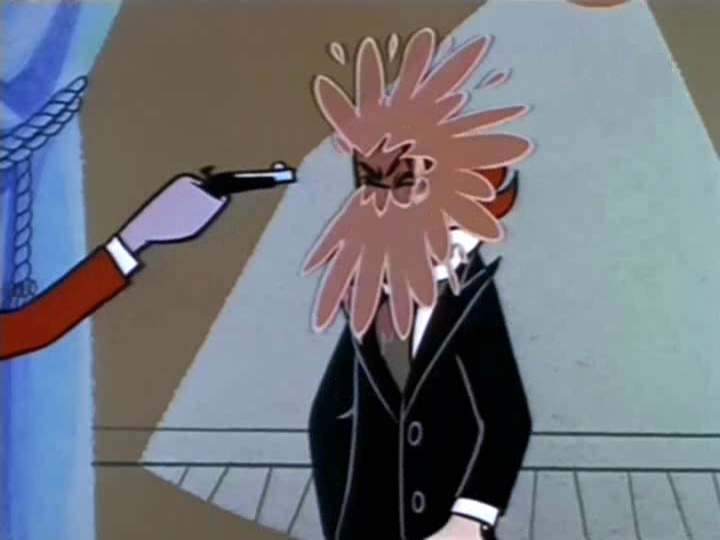
Anyway, now comes the payoff to the earlier set-up. Quick Draw demands to know what Bold Weevil has up his sleeve. Bold Weevil shows him. Naturally, it’s a gun. Notice when it is fired, the background changes to a solid white colour.


Quick Draw decides to fire off all the weapons he displayed in the gag set-up and they all backfire on him. Baba Looey graces us with puns thusly:


Baba: Dun’ you thin’ we should quit while you still got a head, Quicks Draw?
Baba: That’s what I like about Quicks Draw. He’s got a lot up here (points to head). No brains. Just an empty lot.

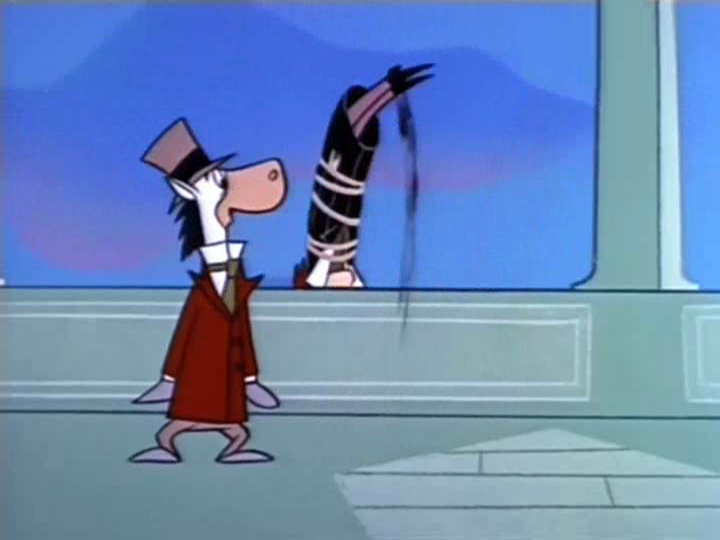
Weevil checks his pocketwatch and announces it’s time for the hold-up and he mustn’t keep the passengers waiting. Quick Draw, in some pre-El Kabong rope-swinging, declares he’s going to “crash through the winder.” We know he’s going to fail because to do it, he’d have to turn and swing in perspective behind him and that would use up Hanna-Barbera’s animation budget for two years. Instead he swings past the hold-up in the background and the momentum lands him inside the top of the paddlewheeler’s smokestack, which is one those familiar-seeming gags I can’t place (in Mississippi Hare, Colonel Shuffle merely ran into the boiler and the smoke from the stacks spewed ‘Yipe’ into the sky). Unlike El Kabong’s mystery rope, at least we know what Quick Draw’s is tied to in this one.


Quick Draw lands in the Mississippi and pulls himself out. There’s a little coda to the scene that’s again a familiar-seeming gag. The top of Quick Draw’s hat pops opens, a fish jumps out and dives back into the water.

Meanwhile, back at the hold-up in the lounge, Weevil is politely asking for valuables when Quick Draw suddenly arrives with his mini-derringer. But, in a variation of the old water-in-the-gun gag that Maltese put in Mississippi Hare (and Avery used before him in Porky’s Duck Hunt), out squirts Mississippi mud. The scene ends with Quick Draw squirting Baba Looey for making fun of him.

Bold Weevil has stolen all the valuables and is about to escape (even though he’s on a boat) “to New Orleans, the Mardi Gras and some jolly fun” when Quick Draw acts. He rolls out a barrel—a barrel full of flat irons, because he’s going to flatten him. And he does. Hmm. It seems this sort of thing has happened in a cartoon before.


Quick Draw: Not only am I fast with a double barrel, but purty good with a single barrel.
Baba: And here comes the barrel!

Yes, the barrel has banged against a post and reversed direction. Our heroes and the bad guy decide to “barrel out of here” by doing a Vinci stretch-dive into the mighty Mississippi.

The final gag sees the camera pull back to reveal Baba Looey rowing himself and Quick Draw down the river on top of a tied-up Bold Weevil, a concept that seems to me was used in later Hanna-Barbera cartoons. So Quick Draw gets his man and comes out on top, which is more than he did in most cartoons that followed.


Much of the music selection is really odd here. Not much of it really suits the riverboat setting, especially the Harry Bluestone-Emil Cadkin sneaky stuff. I don’t know where the instrumental version of Stephen Foster’s ‘Camptown Races’ came from; it might be on the Hi-Q ‘X’ series of specialty music.


0:00 - Quick Draw sub main title theme (Curtin).
0:16 - CAMPTOWN RACES (Trad.) – Narration over shot of riverboat and pan of interior of boat.
0:35 - CB-87A COME AND GET ME (Bluestone-Cadkin) – Weevil cheats at cards, narrator gives away his plan.
1:15 - GR-87 SKELETON IN THE CUPBOARD (Green) – Quick Draw shows off guns.
1:57 - CB-87A COME AND GET ME (Bluestone-Cadkin) – Weevil wants to play cards, gun in sleeve shoots Quick Draw.
2:50 - GR-87 SKELETON IN THE CUPBOARD (Green) – Quick Draw gets shot by own guns, “empty lot.”
3:27 - GR-472 HICKSVILLE (Green) – Quick Draw opens jacket, “I can take it.”
3:46 - CB-86A HIDE AND SEEK (Bluestone-Cadkin) – Weevil checks watch, sticks up lounge.
4:11 - jaunty bassoon and skippy strings (Shaindlin) – Quick Draw swings into smokestack, fish jumps out of hat.
4:52 - CAPERS (Shaindlin) – Weevil demands valuables; splooshed with mud, Baba shot with mud.
5:43 - GR-248 STREETS OF THE CITY (Green) – Barrel scene.
6:34 - ‘FIREMAN’ (Shaindlin) – Quick Draw and Baba on Weevil in river.
7:00 - Quick Draw sub end title theme (Curtin).

Wednesday, 5 May 2010

Daws Tells How It’s Done

There are occasions on the internet when people venture into that foolhardy of game of “Who’s Better—Daws Butler or Mel Blanc?”

It’s a silly question. Both worked in radio. Both voiced cartoons. Both dealt with Bob Clampett in some way.

But both did things the other didn’t and I’d rather not make a comparative qualitative value judgement on each of their other accomplishments. Daws was a writer, a puppeteer (a reluctant one, perhaps), and shared the “how” behind his technical adeptness with many others due to a sense of joy and love. At least, that’s the impression I get. I never had a chance to meet him. Suffice it to say, Daws was more than just a man with funny voices.

Mel, of course, worked on many of the top radio comedy/variety shows and voiced some of the best-loved cartoon characters in history. People at the time knew about it, not only because of Mel’s exclusive billing at Schlesinger (later Warner Bros.) but because of contemporary newspaper pieces, especially at the time he got his eponymous radio show (“second-banana-makes-good” is always a good, if not obvious, angle for a story).

Daws came a little bit later, but also saw a share of syndicated ink. First, it was because of his connection with Stan Freberg, who became an overnight comedy record sensation, and then due to Huckleberry Hound, who became an overnight TV cartoon sensation (“just-who-is-this-guy” is also a good, if not obvious, angle for a story, too).

The Freberg stories are a bit out of the realm of this blog, but I’ve got a small bunch about Daws. I’ll save some for later posts, but we’ll start with this one from AP writer Hal Humphrey, and appeared in papers of January 23, 1961. It’s interesting in that it goes into the “how” of his voice work and voice sessions with Joe Barbera. Perhaps the most remarkable thing is nowhere in the story will you find the words “Art Carney.”


If You Hear Voices, Chances Are They’ll All Belong To Daws Butler
By HAL HUMPHREY

HOLLYWOOD—It was only a matter of time before Yogi Bear got his own TV show. The kid has a barrel of talent, and his work on the Huckleberry Hound Show was bound to set him up for the big break.
The Yogi Bear Show begins next week on 160 of the country’s TV stations, replacing Woody Woodpecker, and, as some nut once said, “That’s show biz.”
I went to the Hanna-Barbera studios to interview Yogi before he gets all wrapped up in his new starring vehicle. When talking to Yogi, one discovers himself talking also to Huck Hound, Mr. Jinks, Quick-Draw McGraw, Baba Looey, Super Snooper, Blabbermouse, Augie Doggie, Snagglepuss and Sniffles [Yowp note: I think Humphrey means ‘Snuffles’].
A short, modest fellow by the name of Daws Butler not only does the voices for the abovementioned stars, but has a repertoire of assorted “extra” voices which numbers around 300.
It is a routine day for Daws to sit closeted in a sound studio recording dialogue tracks for three or four hours. These tracks are then played by the animators, who draw the characters and action to match the voices.
DAWS WILL READ and record the dialogue of as many as six or seven characters in one seven-minute cartoon. As he takes on the voice of each, he assumes many of the physical gyrations and movements which he mentally attributes to each “actor.”
When doing Yogi, for example, Daws throws out his chest and gesticulates like any normal cartoon bear.
“I’m not really a Method actor,” says Daws with a sly grin, “but Yogi speaks with a kind of elongation of the vowels, and this calls for diaphragm control. I do it better by standing up and making like a guy with a big chest expansion.”
When Bill Hanna and Joe Barbera, who head up Hollywood’s most successful cartoon factory, dream up a new character for any of their TV properties, Daws will go home, set up his own tape machine and record a series of voices.
BARBERA WILL listen to these the next day.
“I want this bulldog dumb, but not that dumb,” he may say, and Daws changes his vocal range to boost the dog’s IQ.
Besides Daws, the studio has Don Messick (Boo Boo Bear), Doug Young (Doggie Daddy) and Jean Van der Pyle (feminine characters) doing voices. Daws, however, carries the big load, and last year he animal-talked his way into about $150,000 with the Hanna-Barbara enterprises.
In addition to that income, Daws earns several other little nest eggs by doing voices for such TV commercials as the “Snowdrift” man and others.
He doesn’t consider himself an actor, and although he lives well in Beverly Hills with his wife and four boys, Daws is not the ostentatious or Hollywood type. He never has hired a press agent to trumpet his accomplishments.
“IN MY NAIVE way,” says Daws, “I always believed that publicity would come naturally as a sort of reward for honest work performed. Needless to say, I’ve bought the Brooklyn Bridge three times and am dickering for it again right now.”
When he comes home at night to the wife and four sons, Daws says he feels like any carpenter (“Better say ‘a good carpenter,’ huh?”).
His earnings will go up now that Yogi Bear is hosting his own show, because Daws also works like a carpenter—by the day. He prefers not to be under contract. He can be more independent, he says, and can pick his work wherever he likes.
LIKE HIS ex-partner, Stan Freberg, who used to work with him on TV’s old Time for Beany puppet show, Daws is a clever creator of commercials for TV and radio. He gets a fancy fee from ad agencies for just sitting in a two-hour session while they pick his brains.
The session is taped, so if they want anything else from Daws, the flag on the meter goes down again.
How does Daws get this way?
He graduated from cartooning in his home town, Chicago, then tried night clubs with comedy and impersonations. When he hit Hollywood, radio discovered Daws and his assortment of voices and dialects. It was just a short leap from there to cartoon voices and a home in Beverly Hills.

Maybe it’s significant that Daws’ show replaced Mel Blanc (original voice of Woody). On the other hand, Daws worked on the Woody and other Lantz cartoons starting in the 1950s, so he also replaced himself. So, in a way, we can say Daws and Mel are equal. At least in one aspect. And we can probably stop there and leave it at that and enjoy the work the two of them have left for generations of cartoon lovers.

Saturday, 1 May 2010

Huckleberry Hound — Huck's Hack

Produced and Directed by Bill Hanna and Joe Barbera.
Credits: Animation – Don Patterson; Layout – Dick Bickenbach; Backgrounds – Fernando Montealegre; Story – Warren Foster; Story Director – Alex Lovy; Titles – Art Goble; Production Supervisor – Howard Hanson.
Voice cast: Huck, Cop – Daws Butler; Narrator, Robber, Newscaster – Hal Smith.
Episode: Huckleberry Hound Show K-039, Production E-105.
First Aired: week of Feb. 22, 1960 (rerun, week of Aug. 1, 1960).
Plot: Huck’s first passenger as a taxi driver turns out to be a bank robber.

The true test of a good character is you know what their character is. Say the name “Sherlock Holmes” and just about anyone can describe his many traits. Or “Robin Hood.” Or even “Bugs Bunny.”

Cartoon characters are clearly defined in the minds of animation fans. So clearly, you can read debates and essays about someone in a cartoon not being “in character.” Daffy Duck in the Daffy-Speedy debacles, for one. Some argue the “loser” Bugs or “unmotivated heckler” Bugs are not in character.

And that brings us to this cartoon and why I don’t like it.

Huckleberry Hound has a number of easily-defined characteristics; if he didn’t, he never would have become so popular. He’s a little slow at times, and a little inept. But, to me, Huck is not completely moronic. He is in this cartoon.

As a five-year-old (probably younger), it didn’t take much for me to see someone dressed in a stereotypical robber’s outfit and has a hideout is a robber and not a “bank executive.” Yet a viewer is supposed to believe Huck can’t tell what a little child can tell?

Sorry, Warren Foster. I’m not buying it.

Even the dimwitted Baby Huey at Famous Studios catches on that he’s being duped by a fox. Huck doesn’t even have that going for him. At the end, he has to be told by a newspaper he’s been dealing with a robber. And his Huey-like stupidity is the running gag of the cartoon.

The odd thing is Foster also wrote the really funny ‘The Unmasked Avenger’ where Huck’s pretending to be “a stupid, churlish dolt.” So he doesn’t seem to have been particular about what Huck is and isn’t as yours truly, age 5 (or less).

Foster gets into the cartoon the same way Charlie Shows used to in the first season—with an off-screen narrator. He opens a bunch of cartoons with the phrase “This picture is dedicated to...” and this one is no exception. We’re told it’s dedicated to “...the taxi drivers; those brave men who expertly pilot their passengers safely through the hazards of today’s crowded highway.” By the way, look at how the clouds have the same textured colour in Quick Draw’s Scat, Scout, Scat that we profiled on the blog. Someone can let me know if someone used that as a specific trait when doing backgrounds, or if it’s a product of the layout artist’s feverish brain.

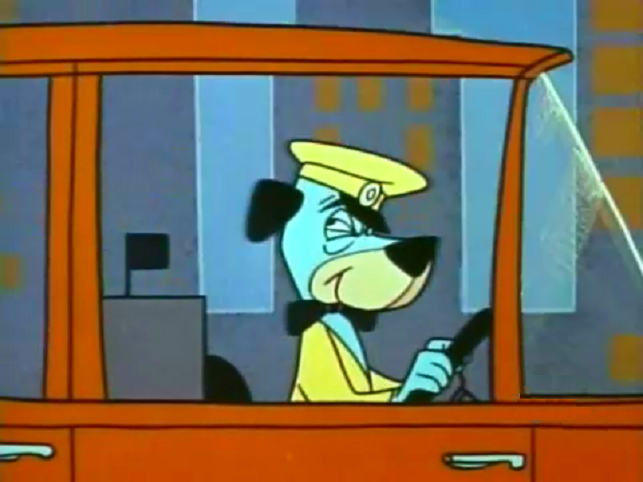
The first gag is almost a given, considering Huck’s driving skills in Freeway Patrol. He’s so busy chatting with the camera about keeping his eyes on the road that he hits something. We don’t know what. The camera shakes and there are crash sound effects but the cab keeps on going before he picks up a fare.

Foster now borrows from his Bugs and Thugs (1954) wherein Muggsy tells the talkative Bugs Bunny to shut up and then, when he doesn’t, to “shut up shuttin’ up.” Except we get “Knock off knockin’ it off!” as Huck rambles about pegging the obvious robber for a “professional man” and a “bank executive.” Look at the expression Don Patterson gives Huck in these two drawings.


The cartoon features an animation shortcut Patterson used in Yogi’s Bewitched Bear. It’s the legless walk cycle. A character’s upper body is moved up and down like a wave across a background with a little scrunching sound to simulate the foot noise. It’s an eight-frame cycle with the seventh drawing held for two frames. It’s tough to judge in stills so you have to compare the robber’s height to the TV antennas.


The robber tosses a brick through a window; we just hear it the smash because there’s no need to spend money animating it. I like the blues in the background here. The robber strolls in to grab some loot while Huck says “Poor feller. Forgot his keys.” Then the alarm goes off, the robber tells Huck to go to “the hideout”, which our hero thinks is a nightclub, and still doesn’t clue in after a gun is put to his head. Or when a radio news bulletin states a robber is in a taxi. How can Huck be that dumb?


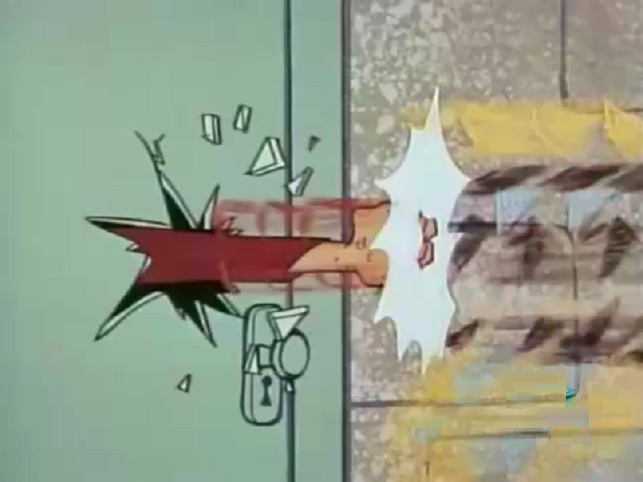
Foster adds an Avery-esque touch to the plot to move the second part of the cartoon. The robber can’t get rid of Huck. You see, the crook went inside the hideout without bothering to pay the $2.30 cab fare. The dopey Huck thinks he just forgot and tries to collect. A fist greets his first request. Then a stove dropped from above.


“Hey, you in the stove!” yells a cop in the best line of the cartoon. The cop asks if a man just ran out of his cab. Huck, with his eyes crossed to accent his stupidity, explains it was someone who owes him cab fare.


Officer: You keep an eye on the house. I’ll call the squad. We’ll get him—dead or alive.
Huck: Shuckins. I don’t really need a poe-lice squad to collect my two dollars and 30 cents.

So Huck goes inside the hideout where the robber’s counting his loot. “Mr. Banker,” he keeps calling him as he asks for his fare. The robber puts a revolver in his nose (with the mandatory horn-honking sound effect) and tells Huck him he knows too much (apparently the robber’s pretty clueless, too) and he’s going to let him have it. And Huck is still too dumb to figure out he’s dealing with a robber.

Their conversation is interrupted by off-screen sirens. The robber goes to look out the window. But he doesn’t run. He uses a slow, medium-shot walk cycle (this one with legs) we’ve seen throughout the cartoon. The cops give him 10 seconds to surrender with the money. I think the layout/background people are going for a spotlight effect with the brown stripes here. Dopey Huck is still going on about his cab fare.

The robber and the cops are engaged in some old-style cinema gunplay. “I’d better stop this before someone gets hurt,” says Huck. And then he still goes on about the cab fare, telling the cops from the window “all this ruckus over $2.30 is ridickuluss.” Evidently the police are fed up with Huck’s stupidity as much as I am because they fire at him in the window. Huck does a silent-filmish jump-into-the-air fright take and we hear the familiar Hanna-Barbera bongo-run sound effect.

Finally, Huck decides to “stop this for the banker’s own good”, whips out a wrench (he’s carrying a wrench?) and clobbers the crook on the head.

We now find ourselves the following day in the final scene. Huck reads aloud a newspaper headline we can see for ourselves and tells us about the $500 reward he’s collected, then cries because he left the meter running in his cab and the amount came to $490. But why would he have to pay? He’s not the fare. And if he owns his own cab, why would it matter? Oh, well. It’s a cartoon not a documentary.


Fortunately, Foster doesn’t seem to have gone with the “stupid Huck” too much more after this cartoon. He did it again two cartoons later with ‘Science Friction’ (a much more attractively-designed cartoon, too) but after that he seems to have settled on using Huck as a guy for whom things just don’t work out quite right or according to plan. It’s a much funnier kind of Huck to me. And more appropriate to his character, too.

I mentioned the kind of clouds that are only found in some Hanna-Barbera cartoons about this era. There are a couple of other background things which I don’t know are specific to one artist or layout guy. You can see the wall shadow in this frame as well as elsewhere in the cartoon. If anyone can tell me if a specific technique was used to make the shadows, please comment. And you also see what I call the “Hanna-Barbera liver spots.” They’re little ovals on the ground or pavement which are supposed to be stones and, I gather, are there to break up the visual monotony.

Noticeable by his absence in this cartoon is Don Messick. Whether he was busy voicing those crappy Spunky and Tadpole cartoons, I don’t know, but Hal Smith was called in to be the secondary voice on several Huck cartoons that aired within weeks of each other, like ‘Pet Vet’ and ‘Piccadilly Dilly.’ It’s possible the voice track for all them was done in one session. Smith demonstrates a talent for a straight read that he doesn’t show often in cartoons. He has a very easy-sounding, pleasant, opening narration.

Some of Spencer Moore’s music in Hi-Q reels L 5 and 6 make up a good portion of the soundtrack here. What’s odd is two of Jack Shaindlin’s standard chase themes—‘Toboggan Run’ and ‘On the Run’—aren’t used as chase music at all. ‘Shopping Day’ was one of the Bill Loose-John Seely “domestics” that was used on the Huck and Yogi cartoons starting in the second season.


0:00 - Huck sub main title theme (Hoyt Curtin)
0:14 - ZR-45 METROPOLITAN (Geordie Hormel) – Long shot of cab driving on streets.
0:26 - TC-437 SHOPPING DAY (Loose-Seely) – Huck talks to audience; crashes; picks up robber.
1:15 - L-80 COMEDY UNDERSCORE (Moore) – Robber gets into cab.
1:17 - L-81 COMEDY UNDERSCORE (Moore) – “Knock off knockin’ it off” dialogue in cab.
1:54 - 8-MR-377 creepy, echoey muted trumpet music (Raoul Kraushaar) – Robber goes into bank; tells Huck to move it.
2:21 - LA-20-5 TOBOGGAN RUN (Shaindlin) – Huck drives robber to hideout.
3:07 - TC-201 PIXIE COMEDY (Loose-Seely) – Huck punched through door, stove dropped on him.
3:53 - L-80 COMEDY UNDERSCORE (Moore) – Cop talks to Huck.
4:27 - L-78 COMEDY UNDERSCORE (Moore) – Huck asks for money from crook in hideout; crook puts gun in Huck’s nose.
4:51 - ZR-47 LIGHT MOVEMENT (Hormel) – Police sirens, robber yells at cops, police start firing.
5:21 - LAF-72-2 RODEO DAY (Shaindlin) – Huck behind chair; yells at cops out window; clangs crook on head with wrench.
6:20 - TC-300 ECCENTRIC COMEDY (Loose-Seely) – Robber falls onto pillow.
6:30 - LAF-2-12 ON THE RUN (Shaindlin) – Huck in cab; reads headline, cries.
6:58 - Huck sub end title theme (Curtin).