Daws Butler once told interviewer Larry King that he did not do “voices.” He did “characters.”
If anyone was the glue that held the Hanna-Barbera cartoons together in the early years, it was Daws Butler. He voiced almost all the starring characters before The Flintstones came along in 1960. Even then he auditioned for Fred Flintstone and, the following year, was briefly picked as the voice of Top Cat.
Whatever he picked up about acting with one’s voice, starting on the stage in Chicago in the mid-‘30s, he passed on to anyone who asked for his help. His cartoon career began after the war; he gave credit to MGM director Tex Avery for picking him (though it is understood he narrated a cartoon for Columbia/Screen Gems before that).
Through the 1950s, when he wasn’t performing in theatrical cartoons, he and Stan Freberg were almost a pair, working on the puppet show A Time For Beany, a bunch of records for Capitol and two radio shows. He deserved a writing credit on Freberg’s 1957 variety show but never got one. Then there were numerous animated commercials on TV that Daws also wrote and lent some voices that would be familiar to Hanna-Barbera and Jay Ward fans not too much later.
Daws talked about the Hanna-Barbera characters in a number of interviews over the years. Here’s one from the Evansville Press of Oct. 30, 1966. By then, others had taken over the lead roles as H-B moved into Saturday morning programming.
Virtually Living the Part Is Key to Success Says ‘Voice’ of 10 Weekly TV Cartoon Shows
By BILL LYON Tri-State Editor
MADISONVILLE, Ky.—You’ve heard Yogi Bear boast of being “better than the average bear.” [sic]
And Mr. Jinks vowing “I hate meeces to pieces.”
And Snagglepuss with his “Exit, stage right.”
Now meet the man behind those voices and expressions, as well as those of a dozen other TV cartoon characters. His name is Daws Butler. He’s a short, barrel-chested man with shaggy eyebrows and a face as elastically expressive as his amazing voice.
Chances are you’ve never heard of Mr. Butler before.
But you, and especially your children, hear him five hours a week on television. He does the voices for 10 different half-hour cartoon shows—Quick-Draw McGraw, Dixie, Hokey Wolf, Blabber-Mouse, Super Snooper, Baba-Looey, Snuffles, Huckleberry Hound, Augie Doggie, Fibber Fox and a few others in addition to the three mentioned previously.
Butler also handles the voices for Cap’n Crunch and Mr. Wiggle in the cereal and Jello commercials. He was in Madisonville the last week with his wife visiting his sister-in-law and her husband, Dr. and Mrs. Selby Coffman.
Butler estimates that since broke in the cartoon field in 1951 with Walter Lantz strips he has provided the voices for over 600 cartoons.
The secret to all those different voice characterizations?
“Virtually living the character," Butler said. ”If I had to act them out physically, I could. When I do Yogi Bear I almost walk like he does. Mr. Jinks the cat talks very slowly. So when I do him my whole body relaxes and goes limp.”
Yogi Bear is probably the most famous of Butler’s voices—he’s been translated into 19 languages in 32 countries, and for a time was the only American show seen on TV in Cuba. But Butler’s personal favorite seems to be Mr. Jinks, the cat who spends his time in a frustrating chase after those two mice, Pixie and Dixie.
“He’s the most elastic character. I talk around his lines and have made him exceptionally verbose . . . while occasionally butchering the English language," Butler said.
Contrary to popular belief, voices of cartoon characters are not dubbed in after the animated strips have been made.
“Most people think that the way it’s done, but it would be too confining. Most of the personality a cartoon character has comes from his voice and his attitude of expression,” Butler pointed out.
“So we read the script and the sound track is made first. The writers and animators watch us read, and pick up some additional ideas for illustrations and lines from our facial expressions. That’s why early radio was such great training because you were acting out the lines to put more feeling in them," Butler continued.
Butler’s next project will be the voices of the scarecrow, tin woodman and the wizzard [sic] in an MGM adaptation of “The Wizard of Oz." It will be released in January. Mel Blanc will do the voice of the cowardly lion.
"The big advantage to doing voices is that, unlike an actor, you don't get stereotyped. I can play a prince in shows like Aesop and Son or Fractured Fables then to Yogi Bear or Quick-Draw McGraw," Butler pointed out.
Daws and his wife live in Beverly Hills. They have four sons—David, Don, Paul and Charles.
“They’ve grown up now, but they’ll be having kids who can watch cartoons on TV, and maybe listen to their grandfather," Butler smiled.
Now, for your listening pleasure, here’s Daws in one of his early West Coast projects. Belda Records were 78s that came with a comic book to read along with the dialogue on the record. The comics were drawn by Tubby Millar, a writer of Warner Bros. cartoons in the ‘30s You can see one page of the artwork to the right. And we have the sound from “Chirpy Cricket,” copyrighted on April 20, 1947. The story is by Frank Bonham.
Here’s an interesting bit from Chuck Cecil’s The Swingin’ Years, a big band show that aired, among a number of places, on Armed Forces Radio. Listen to the minute-long drop-in at 17:05. You’ll recognise the voice. I don’t know the context behind the routine.
And from the late Earl Kress comes this 1986 walk around Daws' studio behind his home.
Not too long after The Huckleberry Hound Show debuted on the week of September 29, 1958, newspaper columnists began praising the series.
An early thumbs-up for Huck and his gang came from the entertainment section of the Tampa Times, where cartoons aired on WFLA-TV on Thursdays in the early evening. The entertainment page on October 18, 1958 included this anonymous review of all the Kellogg’s sponsored shows that aired over the course of the week, but focused on Huck.
Huckleberry Hound Delightful Cartoon
Designed to delight the youngsters, the 6 to 6:30 P.M. spot, Mondays through Fridays on channel 8, will undoubtedly find lots of grownups looking in. The varied program brings everything from a beguiling little cartoon of a hound . . . to the great gift of the imagination Superman. Most of the shows are time-tested favorites of the young-in-heart TV watcher, but the cartoon doggie, Huckleberry Hound, is new and the most enchanting cartoon character to come along since Mickey Mouse.
Huckleberry Hound, complete with a 10-gallon hat and a side arm worn about his fat little middle, is the delightful creation of Bill Hanna and Joe Barbera, who produced and directed the Tom and Jerry cartoons.
Satire in the sketches may go over the heads of the tots in front of the TV . . . but the grownups will love it. And the youngsters will find enough enjoyment in the characters which include Yogi Bear, his patient little friend, Boo Boo Bear; a cantankerous cat, Mr. Jinx and two mice, Dixie and Pixie.
Huck and his friends are appearing every Thursday in the 6 to 6:30 series.
Monday's segment of the show takes viewers to Sherwood Forest, where Robin Hood defends the honor of ladies' fair and strives to keep England free.
On Tuesdays Woody Woodpecker is the star performer. Superman and Wild Bill Hickok share in Wednesday slot, and come Fridays . . . It's Roy Rogers.
Even before this, on the other side of Florida, the Miami News cheered “Wonderful cartoons” next to its highlight listing of the Huck show in its Oct. 9, 1958 edition. The series aired in that city on Thursdays, originally at 7 p.m., on WCKT-TV.
By the end of his show’s first season, Huckleberry Hound was a full-blown fad. This assessment was published in the News on August 13, 1959.
OFFICIAL HONORS Adults Like Huck Hound
By KRISTINE DUNN TV Editor of the Miami News
The college kids of the nation are officially adopting Huckleberry Hound.
Huckleberry Hound, on Channel 7 at 8 tonight, is that Southern-drawling pooch originally designed to amuse the kids.
He's the pen-and-ink child of Bill Hanna and Joe Barbera, the creaters [sic] of Tom and Jerry. Tom the cat and Jerry the mouse have entertained movie-goers during intermissions for the past 20 years. They also brought MGM seven Academy Awards.
But Huck's philosophy—and his friend, Yogi Bear—caught the fancy and affection of adults.
Right here at The Miami News, in fact, a few of our reporters and editors tote about a lofty disdain for television in general. But four words—"It’s Huckleberry Hound time"—will send them sprinting for the tube. The college kids are proclaiming their esteem.
The University of Washington held a "Huck Hound Day" on campus and 11,000 students joined his fan club. Southern Methodist and Texas Christian Universities have dedicated days to Huck this October.
At UCLA, Alpha Tau Omega Fraternity initiated him and hung his portrait over the fireplace. Homecoming Theme
In the Big Ten, Huckleberry Hound is the theme of Ohio State's homecoming celebration.
All the admiration isn't Ivy-League, either.
Bars have been named for him; poker games adjourned for him; airplanes decorated with his picture and speed limits broken for him.
Why?
"Huck is put upon, embarrassed, taken advantage of and thrust into horrendous situations," said one professor. "But he never seems to mind.”
Perhaps his ability not to mind is the key to his infectious popularity.
Hanna and Barbera also turn out the Ruff and Reddy cartoons seen Saturdays at 10:30 a.m. on Channel 7.
The duo used to produce 50 minutes of Tom and Jerry cartoons per year for MGM. Last television season, they did more than 900 minutes of cartoons.
Their 200 employes use more than a full tank-car of ink a year. It takes 90 separate drawings for one laugh movement, and 10,000 individual drawings for a half-hour cartoon sequence.
There was a Florida connection with the Huck show in late 1960. In a third season Yogi Bear segment (just before he got his own show) entitled “Gleesome Threesome,” where Ranger Smith’s vacation in Miami Beach takes a wrong turn when Yogi and Boo Boo check in to his hotel.
TV stations in Tampa and Miami weren’t the only ones in Florida to air the Huck show in 1958. Both WDBO-TV, Channel 6 in Orlando, broadcast the cartoons at 5:30 on Thursdays. WCTV, serving Tallahassee and environs on Channel 6, put on Huck at 5:30 on Wednesdays.
Toward the end of the first season, when the Huck show was in reruns, a Florida department store chain was a little disingenuous in a Miami News ad exhorting fans to “meet huckleberry hound and his friends.” You might think this was an early example of H-B PR maven Ed Justin getting someone to dress up in a Huck costume for a meet and greet. It was too early for that, though. Instead, what fans met were plush dolls, likely the ones made by the Knickerbocker company which coloured Huck red instead of blue (or black-and-white as seen on TV).
As fads are apt to do, Huck’s came to a slow end. Yes, he “ran” for President of the U.S. in 1960, the same year his show became the first cartoon series AND first syndicated series to be awarded an Emmy. But when plans were announced for a Hanna-Barbera cartoon feature, it was to star Yogi Bear. Huck was nowhere to be found. When McNaught decided to syndicate a funny animal comic in the papers, it starred Yogi Bear, not Huck. And when the 1964 U.S. election rolled around, the H-B presidential opponents were Yogi Bear and Magilla Gorilla.
Huck was still on TV, in reruns and in new series where all kinds of characters were lumped together. He still had drawing power to be handed a starring role in the 1988 TV feature—The Good, the Bad, and Huckleberry Hound (with Daws Butler still around to voice the lead character). But Huck didn’t have an “ark lark”—Yogi did. Huck didn’t have Yahooeys competing in a “Laff-a-Lympics”—Yogi did. He didn’t have an “All-Star Christmas Caper”—well, you get the idea. At least he wasn’t saddled with a teenaged version called “Yo, Huck!” (though he was in the supporting cast of the Yogi mall-rat, er, bear, cartoon).
Ruff and Reddy notwithstanding, The Huckleberry Hound Show was Hanna-Barbera’s breakthrough series, giving the studio lots of positive ink. It was in no small measure due to the star of the show.
Augie Doggie and Doggie Daddy had several forefathers that were combined into a pleasant cartoon series.
Bill Hanna and Joe Barbera partly borrowed from themselves, as they had a father-son dog team in a number of Spike and Tyke cartoons they produced for MGM in the mid-‘50s. But they were borrowing even then, as the real origin comes from the Jimmy Durante-Garry Moore radio show. Old vaudevillian Durante always referred to young comedian Moore as “Junior” and proudly exclaimed “Dat’s my boy who said dat!” Younger fans may not know both Spike and Doggie Daddy took on Durante’s voice and delivery, the former from Daws Butler and the latter from former radio actor-turned-trucker Doug Young. (Butler said he recommended Young because he was worried about the effect doing the raspy voice would have on him).
Augie had a bit of Sylvester, Jr. in him, lamenting “dear old dad’s” behaviour. The Augie series was written by Mike Maltese, who didn’t write for Sylvester, Jr., but was at Warner Bros. when the cartoons were made. (It's been pointed out Maltese wrote Goldimouse and the Three Cats, released a year and several months after he left Warners. The slurping kitten was developed a decade earlier in the Bob McKimson unit by Warren Foster).
And the other influence is Maltese himself. Joe Barbera noted in 1959 that Maltese named all the characters. After “Arf and Arf” was rejected, Maltese named Augie for an in-law. And in most of the cartoons, Maltese used the basic formula he put into Wile E. Coyote at Warners—Doggie Daddy’s best efforts and intentions end in unexpected failure. Daddy also comments to the audience an awful lot. Baba Looey does it, too, and so do Blabbermouse and Fibber Fox, also Maltese creations. The idea certainly helps keep the audience engaged with what’s on the screen.
The Hanna-Barbera cartoons relied on dialogue a lot more once Maltese arrived in late 1958 (Foster joined him several months later from John Sutherland Productions) but there are occasionally some good takes. My favourite is by Dick Lundy in Million-Dollar Robbery (1959). Here’s one from the great George Nicholas, who gave Fred Flintstone some fine expressions. This is from Peck O' Trouble (1960), when Augie's presence startles tax cal-cu-culatin' dad. Whether Hanna timed it this way, or Nicholas used some judgment on his own, or both, I don’t know, but the first drawing is held for roughly 24 frames. The others are shot on twos or threes.
You’ll have to forgive the Italian TV bug on the frames, but these are the nicest ones I can find for the cartoon. It’s evident the Augie cartoons were restored at one time, compared to the washed-out versions with the Boomerang bug that may still be on-line somewhere.
Nicholas’ work is easy to spot here. At times, the characters have the beady eyes and big floppy tongues you see in his animation at H-B. There’s a bit of animation where Doggie Daddy stops running, but his long ears keep going and then fall to the side of his head, as in full animation.
There’s even a favourite Tex Avery bit in this cartoon, where Augie races outside onto a knoll away from the house to make a noise so he doesn’t disturb his dad inside. It’s the same kind of gag Avery used in The Legend of Rock-a-bye Point for Walter Lantz. That cartoon gave Maltese a story credit but it’s likely Tex came up with the gag, since he used it at MGM.
Hanna and/or Barbera once said the Augie Doggie series was a spoof of ‘50s sitcoms, but I can’t think of any (that lasted, anyway) involving a single father, other than Bachelor Father with John Forsythe. In drama, there was The Rifleman, and later, I guess you could put Flipper in that classification, but the star wasn’t human.
There’s a moment in another cartoon, High and Flighty, where Doggie Daddy gets emotional, thinking he’s lost his son forever. Despite the hammy music in the background, the scene is treated straight and shows the bond between the two.
The Augie series could get a little out there at times. Outer space was still a big thing in the late ‘50s, so dear old dad deals with a Martian baby in his home, and Augie and Daddy take a trip to Mars to hunt a rabbit with Bugs Bunny-like wiles (and Augie, for good measure, puts his hand to his head and says “Oh, for the shame of it!” like a certain Warner Bros.’ junior cat). The characters remained popular, and appeared in various later Hanna-Barbera “gang” series, with John Stephenson taking over Daddy’s voice after Young moved to Oregon in 1966.
Bob Givens laid out at least five Augie cartoons after he arrived from Warner Bros. in late 1958. He said the Augies and other early Hanna-Barbera cartoons “were kind of fun to do.” And they’re generally still fun to watch. And, after all, who’s going to disagree with the guy who designed the first real Bugs Bunny for Tex Avery?
The Huckleberry Hound Show was a phenomenon. Critics liked it, and even admitted watching it. Colleges formed Huck Hound clubs. An island in the Antarctic was named for the star. It not only was the first cartoon series to win an Emmy, it was the first syndicated show of any kind to do it.
But why?
I could give you a pile of my own reasons, but let’s find out an answer from someone else.
The Huck show was broadcast not only in the United States, but in Canada, Australia and England. It was the subject of Alan Dick’s column in the Daily Herald of London on May 22, 1962.
Magic of Mr. JINKS (AND THE MEECES HE HATES TO PIECES)
FOR millions of youngsters Friday teatime is the peak of the viewing week. Spellbound they watch Yogi Bear's exploits. Which is as it should be, for Yogi is glorious kid stuff.
But I know a minor poet, a university graduate, an American expatriate professional man, two market porters and a road sweeper who contrive to get home in time that evening to join their children round the telly. What is the subtle appeal that unites such an unlikely cross-section? As a member of the Yogi Union in good standing, let me try to the drawing power of these animated animals—Yogi himself and Boo-Boo; Huckleberry Hound, the dog; Mr. Jinks, the cat. and Dixie and Pixie, the meeces Mr. Jinks hates to pieces.
My conclusion is that they have a methodical madness which interprets the subconscious loves and hates of men and nations. Feud
Although it is Yogi Bear who has given his name to the cult, it is Mr. Jinks the Cat who sits most behind the psychiatrist's couch. He is the one who interprets our love-hate libidos, our blood-lusting and our bravado.
His everlasting feud against Dixie and Pixie, the mice, fulfils our human yearning to give the other fellow a bloody nose without really hurting him.
Here is the magic of Mr. Jinks and the meeces he hates to pieces.
They inflict upon one another the most devastating punishment. But after the horrendous impact, both sides testily shake themselves and walk unscathed away.
"I hates meeces to pieces," breathes Mr. Jinks with venom. I despises them mices."
But the day the meeces disappeared. Mr. Jinks moped on his bed, inconsolable with grief. And another day when Mr. Jinks was missing, the meeces went to pieces.
That was the love-hate relationship showing clear. You always love the one you hate.
Yogi Bear sits on the other side of the couch. He is the excitable fall-guy in all of us, the permanent sucker who never learns.
With the dead-pan expression and the self-satisfied voice, with an upward lilt like Schnozzle Durante, Yogi and his little stooge Boo-Boo always become involved.
Yogi is emotional, but self-centred with it. He is forever trying to help, while helping himself. Knight
Huckleberry Hound—who drags out his name like a hunting cry: How-ow-ownd!—is Don Quixote tilting at windmills.
He is the good-natured, love-thy-neighbour, turn-cheek we would all like to be, and aren't.
He is the knight with a broken lance, the prince of derring-don't. When he besieges the wicked knight's castle the portcullis is sure to fall, the moat to drain, the molten lead to pour.
And when he reaches his fair damsel in distress, she turns out to be a toothless hag.
But Huckleberry takes it all with good grace and lives to fight another day.
There they all are, our mixed-up love-hate, do-good, derring-do subconscious selves, scribbled in a psychiatrist's notebook by a gang of shadow animals.
Or are they more real than we like to think? Do we all hate meeces to pieces?
John Stephenson lasted only five episodes before being replaced as Doctor Benton Quest on Jonny Quest in 1964. But another actor on the show got shoved out of a role even faster.
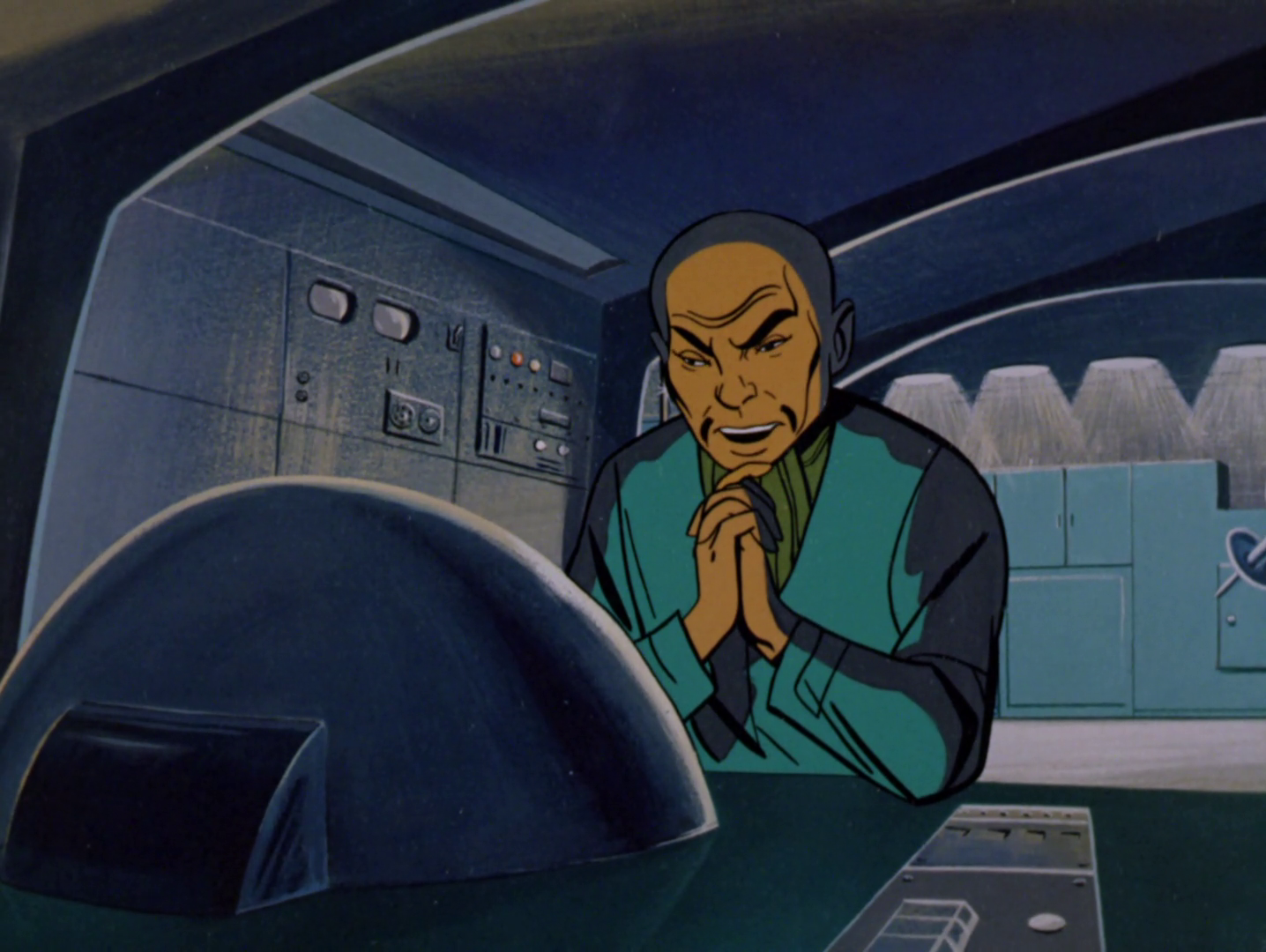
The evil Dr. Zin was played by Vic Perrin. Perrin was constantly in demand on network radio, even into the dying days. But when he was hired in 1947 for the starring role in the Mutual network's The Zane Grey Show, he was fired after the first broadcast. The trade papers said he sounded more like a villain than a hero, so they brought in Jim Bannon.
You can tell from the first sentence that this year marks 60 years since Quest debuted in prime time. I’m an old guy so, yes, I watched it (on a black and white TV) during its original broadcast. I hope to have a post on the debut anniversary. For now, I thought I’d do a post about the man who made four villainous appearances on the show.
I’m not a huge fan of Wikipedia, but in the case of Vic Perrin the entry is very good. It looks like the writer got his information from Perrin’s obit in the Los Angeles Times or the Hollywood Reporter. What you read below comes from other sources.
Victor Herbert Perrin was born on April 26, 1916 in Menomonee Falls, Wisconsin. His father was a travelling hardware salesman. At the age of 19, he was employed at WHA radio in Madison, Wisconsin and a member of the WHA Players. He emceed events and appeared in stage productions including “The Merchant of Venice” and “The Merry Widow.” Newspaper clippings reveal he was still at WHA as late as May 1940.
Next it was off to Sunset and Vine in Hollywood. Broadcasting magazine of May 16, 1942 reported he first found work as a parking lot attendant, then as an NBC page, then joined the announcing staff of the Red network. In July of 1941, he was on the NBC Blue network, where he introduced Hank McCune in a 15-minute weekly show called Pacific Coast Army Camp News and stayed with the network when it was spun off by NBC, eventually being named ABC. Promotion was quick. The trades reported in January 1943 he had replaced Army-bound Dresser Dahlstead as chief announcer of the network. When Dahlstead returned, Perrin quit ABC in October 1945 to freelance.
Perrin did a pile of shows on radio, even into the 1960s. A list would be pointless, though we point out he was a particular favourite of Jack Webb, and cast a number of times on Dragnet, and co-starred with Raymond Burr on CBS' Fort Laramie. There was acting work in television, too; Perrin appeared in both the radio and TV versions of Gunsmoke, among many things. A weekly role on television for a number of seasons was uncredited. His voice was the one you heard at the beginning of Outer Limits. Almost all his work was on the dramatic side, though he did appear in one episode of the sitcom I Remember Joan.
Perrin's first connection with animation I can find was a few years before Jonny Quest. In September 1957, he was the host of the fifth annual Screen Cartoonists Guild's Cartoon Festival.
You wouldn’t find Bugs Bunny or Tom and Jerry at this showing. This was a showcase for studios that made animated commercials. For the record, the studios were: Animation, Inc.; Cascade Pictures (home of Tex Avery); Churchill-Wexler; Fine Arts Productions; Graphic Films; Ray Patin Productions; Quartet Films, Inc.; Shamus Culhane Productions, Sherman Glas Productions; Song Ads, Inc., John Sutherland Productions; Telemation; T.V. Spots, Inc. and Le Ora Thompson and Associates. It would appear Perrin was providing voice-overs for animated spots. To the right is a trade ad from Dec. 29, 1958. (Dick Le Grand and Virginia Gregg were also radio actors; see Mike Tiefenbacher's note in the comments about Gregg's Hanna-Barbera connection).
We briefly pause from our Perrin story to post frames from some of the ads that appeared at the Festival; another one was the famous Jell-O Chinese Baby from Ray Patin Productions. I cannot tell you if he voiced any of them.
The Hollywood Reporter of Nov. 2, 1960 mentions that Perrin was recording seven cartoon spots for Pacific Telephone Yellow Pages, directed for Playhouse Pictures by Pete Burness. The same page revealed on March 16, 1962 that Playhouse's Bill Melendez had Perrin voicing five spots for the Interstate Building Assn. A week later, the Reporter blurbed that Playhouse hired him and Dick Tufeld (the "brought-to-you-by" announcer on The Jetsons) to voice a pair of animated commercials for Southern California Gas, directed by Melendez. And on Nov. 2, 1962, the paper squibbed that Perrin, Lucy Ann Polk and Dick Cathcart were providing voices for Ralston and Foremost commercials; the animation director wasn't revealed.
Unfortunately, information isn’t available about his hiring at Hanna-Barbera and when he recorded the Jonny Quest voice tracks. The episodes he appeared as Dr. Zin were:
● Riddle of the Gold, October 16, 1964.
● The Robot Spy, November 6, 1964.
● Double Danger, November 13, 1964.
● The Fraudulent Volcano, December 31, 1964.
My recollection from the Jonny Quest documentary on-line is series creator Doug Wildey opposed the idea of a regular villain. As it turned out, Dr. Zin was only in four of the twenty-six episodes, though he did return—as did Perrin—when the series was retooled in the 1980s. Perrin played other parts in the original series as well. A sentimental favourite is Perrin as the scheming Dr. Ahmed Kareem in “The Curse of Anubis” simply because at the climax, my sister got so scared, she ran out of the living room vowing never to watch the show again.
We’ll spare you another shopping list of animated accomplishments at Hanna-Barbera and elsewhere, other than to mention his work ranged from comedy (The Hair Bear Bunch and several series with a gangly Great Dane) to action-adventure (Space Ghost). His voice was in a Lutheran-made animated Christmas special with a fine cast that included Don Messick, the wonderful June Foray, Hans Conried, Jerry "We're-not-hiring-you-as-Pebbles" Hausner and Colleen Collins, who was heard in a number of Tex Avery cartoons at MGM. Perrin did a number of live-action religious-based films. Click here for his narration on a half-hour for the Franciscans, with "Good Clean Fun" and other cues from the Impress library in the background, and a role for Pat McGeehan, who voiced a noise-hating bear and other characters for Avery.
Perrin was apparently not interviewed in the popular press about his animation career—he did talk his work on Jonny Quest to Starlog magazine in an issue not available on line—but spoke about commercial acting. Several stories showed up in newspapers in early 1967; I suspect they were releases that came out of the office of his agent, Jack Wormser.
Actor Makes Handsome Sum As TV 'Voice'
VIC PERRIN is one actor who makes more money when he's not seen on camera than when he is.
He belongs to that exclusive breed in show business that has hit it big as the anonymous voices on TV commercials.
Last year Perrin earned in excess of $100,000 of which 80 per cent was from TV (and radio) commercials.
Vic, who has appeared on such TV shows as “The Big Valley,” “FBI Story,” “Gunsmoke,” and “Have Gun, Will Travel,” is never seen in TV commercials on purpose. "MY BELIEVABILITY as an actor is reduced in direct proportion to how often I'm seen in a commercial," he explains.
Perrin is a serious actor and maintains that an acting background is the No. 1 essential to success in the lucrative commercial field.
"I try to give a TV pitch reading the same serious treatment that I would give to a speech by Henry V,” he maintains.
Some professional TV critics maintain that many commercials are better than the program in which they are inserted. Perrin agrees.
"I think there is more creativity going into commercials these days than into many of the programs," he says.
Wormser, by the way, represented a who’s who of cartoon voice actors who worked in commercials, including Mel Blanc. Perrin and Blanc have another connection; as The Hollywood Reporter of Aug. 29, 1972 stated Perrin had been hired as a teacher at the Mel Blanc School of Commercials.
Perrin and Blanc died six days apart. Perrin was 73 when he died of cancer on July 4, 1989.
Hanna-Barbera cartoons have been tarnished with a reputation of little real animation, with a lot of eye blinks and maybe an arm and mouth moving, the rest of the character left on one cel, frame after frame after frame.
I won’t comment about the later cartoons. Going back to the beginning, the first Ruff and Reddy cartoon in 1957 barely had any animation, but it wasn’t as static as Crusader Rabbit. When the Huckleberry Hound Show debuted in 1958, some of the cartoons featured characters that simply popped from pose to pose without any fluidity.
In Huck’s second season, additional artists had been hired and the animation was treated like you would find in a theatrical cartoon. Not often, but it happened. Characters would move in full, sometimes one drawing to a frame. At the same time, director Bill Hanna and his animators would try to get some emotion out of the characters without resorting to a lot of talk (that would change soon).
Here’s an example from the Pixie and Dixie cartoon Hi-Fido, which aired at the start of the 1958-59 TV season. Warren Foster’s plot is simple. The meeces try to drive Mr. Jinks nuts by making the sound of a barking dog through a microphone, meaning the cat can hear a dog, but not see one.
Jinks catches on to what’s happening. But the plot turns and a stray bulldog strolls into the yard and then up to Jinksie in the house.
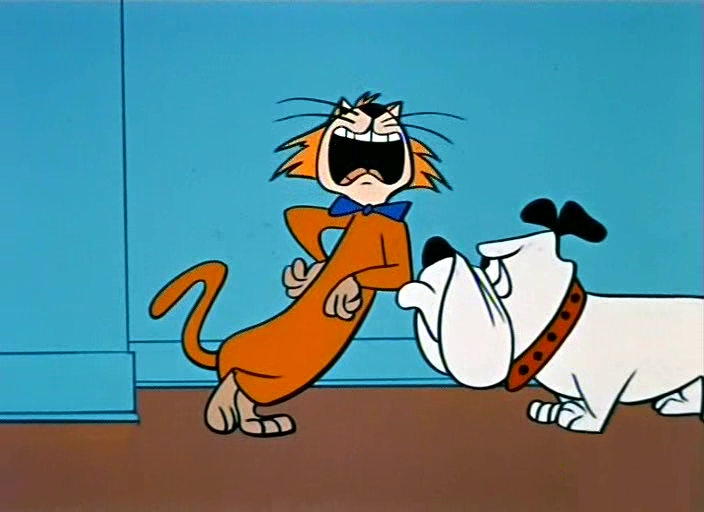
The animator is Manny Perez, formerly of Warner Bros. and, I suspect, working freelance on this cartoon. He employs several drawings, animated on twos, to shift Jinks’ weight from one foot to the other, and lean on the dog. Note that Jinks is drawn in full in each frame. There’s no cheating here.
Mr. Jinks lies to the meeces he was hip to their scheme, and that he “knewwww there was no dog around the house.” Jinks then chuckles about the situation. Here, Perez limits the animation to Jinks’ head in three movements. The cat then looks at the dog and continues to chuckle (the exposure sheet may have screwed up as there is no movement as Jinks laughs).
Then he realises there IS a dog. The drawing below is held for at least 16 frames to establish what’s happening.
The dialogue switches from a chuckle, to a nervous laugh, to crying as the cat expects the dog to maul him.
These are some of the crying drawings. Only the head is animated. No two drawings are used in consecutive frames.
This is where the famous H-B eye-blinks come in. That’s the only animation as the basic pose is held for about 60 frames, or roughly 2 1/2 seconds.
The shock drawing and the back-up-to-the-wall are held for two frames each.
The dog moves in and barks at Jinks. I won’t post them all but Perez uses three barking drawings, with the entire dog moving as in full animation. A Jack Shaindlin cue runs out and a Spencer Moore cue takes over in the background.
You’ll notice the lovely colour on these frames, even though there’s some digital fuzz. It would appear these cartoons were restored either for cable television or for the non-existent second volume DVD set of the Huckleberry Hound Show.

 Daws Butler once told interviewer Larry King that he did not do “voices.” He did “characters.”
 He was in Madisonville the last week with his wife visiting his sister-in-law and her husband, Dr. and Mrs. Selby Coffman.
 Now, for your listening pleasure, here’s Daws in one of his early West Coast projects. Belda Records were 78s that came with a comic book to read along with the dialogue on the record. The comics were drawn by Tubby Millar, a writer of Warner Bros. cartoons in the ‘30s You can see one page of the artwork to the right. And we have the sound from “Chirpy Cricket,” copyrighted on April 20, 1947. The story is by Frank Bonham.