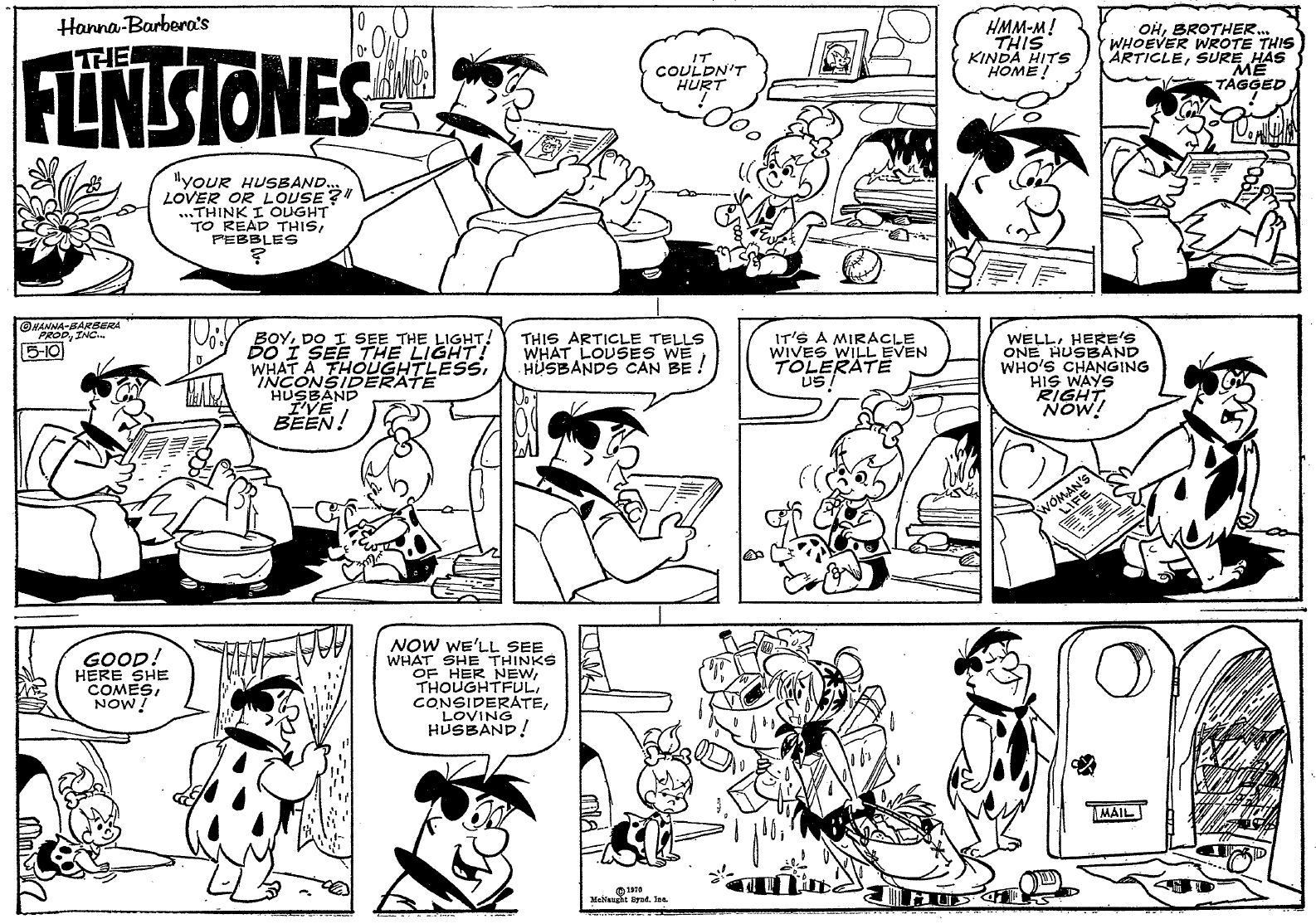
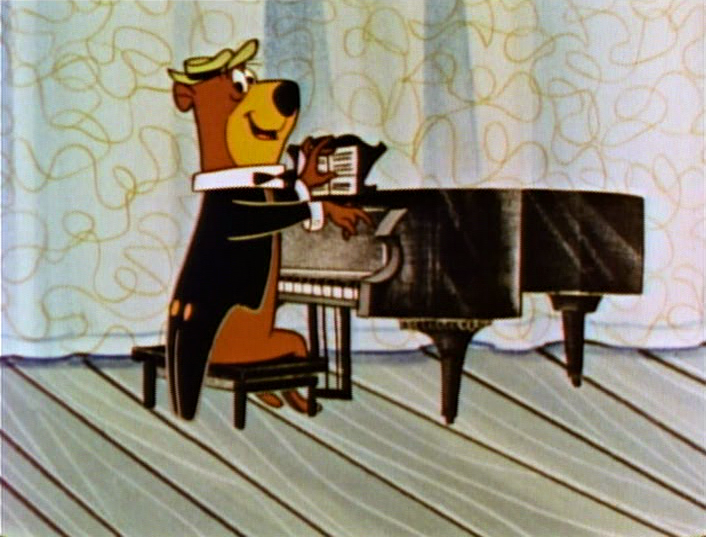
“There’s a western craze, so we created a western cartoon in Quick Draw,” Joe Barbera told the Los Angeles Times at the time. There was more to Quick Draw than that, though. Writer Mike Maltese loved Douglas Fairbanks swashbuckler epics from the silent era, so he added that to the mix and Quick Draw became El Kabong. Maltese found the concept of an amoral dog who went into ecstasy over dog biscuits funny, so he came up with Snuffles. And along the way he invented an orange mountain lion with a touch of Bert Lahr. So it was that the original Snagglepuss appeared on a few occasions on the Quick Draw show before eventually getting a make-over and his own segment with Yogi Bear.
The series aired a year after Huckleberry Hound’s debut. By this time, critics had become huge Hanna-Barbera fans, praising the Huck show for its gentle satire that was adult-friendly (and the fact they weren’t old theatrical cartoons). Some were a little bit TV snobbish, so they appreciated the fact that someone was taking shots at the industry’s clichés (such as detective series and somewhat-incompetent father sitcoms).
Here’s a little summary from the Des Moines Register of November 22, 1959.
TV's '98th Western"
Kids the Other 97
(Exclusive Dispatch to The Iowa TV Magazine)
NEW YORK, N. Y.—Hanna and Barbera, the team that created "Huckleberry Hound" and "Ruff and Reddy," now have a third series on the home screens. It's titled "Quick Draw McGraw" and is a takeoff on westerns, whodunits and situation comedies. The humor appeals to adults. "Quick Draw" is the ninety-eighth western on television. Unlike its predecessors, it's guaranteed to be like all the others, except that it's not self-conscious.
To the despair of his sensible sidekick, Baba Looey, a Mexican burro with a Cuban accent. Quick Draw almost never gets his man.
Second part of the half-hour series features "Snooper and Blabber," a cat and a mouse who wear trench coats and gum soled shoes and run a detective agency.
Hero of the third part, a situation comedy, is Augie Doggie, a dear, cuddly little fellow who is always buttering up Doggie Daddy, an old vaudeville performer with a low boiling point.
Augie brings home such cute playmates as an old beat-up pony or a little Martian boy, and Daddy is so nice about it that Augie calls him "the Daddy of the year."
"Quick Draw" is now being seen on 150 stations. It's not network, and it's not syndication. It's what the sponsor calls "spot-work," and it involves a larger lineup of stations than most network shows.
(In the area served by the Iowa TV Magazine, "Quick Draw McGraw" is seen on eight stations. On Monday it is shown by WOC-TV and WOI-TV. Tuesdays: KMTV, KROC-TV, KVTV and WMT-TV. Wednesdays: KMMT and WGEM-TV. Times vary and are listed in the individual station logs elsewhere In the magazine.)
The The Quick Draw McGraw show came to Canada on January 4, 1960. CBC stations broadcast it at 5:30 p.m. on Mondays. Bob Blackburn of the Ottawa Citizen editorialised about the series on January 12th. He’s one of those guys who kind of approves of it, but wants “adult whimsy.” That sort of thing was tried on the Boing Boing Show on CBS that he lauds. The only problem is kids don’t want “adult whimsy.” They want to laugh.
Cartoons In The TV Age
TV has given the animated cartoon a new look, but it isn't new enough.
I give you as a sample, Quick Draw McGraw (CBOT, Mon. 5.30), who is a cousin of Huckleberry Hound (CBOT, Wed. 5.30).
McGraw just hit the air last week, and already, evidently, has staked a claim on local viewing habits.
McGraw is a horse, and his claim to fame, as I caught it on last night's show, is that he can draw a gun faster than anyone else in the west. Just give a pencil and paper and watch him go. Well, this is a gag that could wear thin after a while, but I'm sure they won't lean on it too long.
Thing is, the show is a hearty spoof of westerns, and it's a spoof that amuses even small kids, and I think this is a very healthy move. I was delighted that (a) the spoofing was going on, and (b) the kids were amused by it.
Better yet, this is not just a simple spoof of one type of show. It's a follow-up to Huckleberry Hound, which is still going, and it spoofs 'em all westerns, adventure, private eye, and the rest. It encourages the kids to develop a good sound derision for all the junk they see on TV.
The fact that Quick Draw McGraw is a simultaneous sequel to Huckleberry Hound indicates that this expensive technique is feasible for TV. Before these series, the animated stuff we had on TV was nothing but the aged movie-house fare that would no longer even serve to divert the youngsters at a holiday Saturday morning cartoon show. They used the hopelessly outdated Felix The Cat things, and only on a Disney-controlled show would you see more recent efforts.
There's a temptation here is reminisce about the movies a few years back, when people who are now grandparents would judge the merits of a movie-house bill considering whether it included a "Silly Symphony" or a "Mickey Mouse" (almost any cartoon was a "Mickey Mouse") before settling on the evening's schedule.
A New And Mobile Peanuts?
More interesting, I think, to note that there's a new era developing in the animated cartoon field, and the above-mentioned programs are the pioneers.
At first look, they're not too encouraging. They're picking up where the movies put childish things behind them and launched adult whimsy of the Gerald McBoing-boing, Mr. Magoo, and that there apartment-house janitor type. They start just below the Tom And Jerry level. The technique is the most modern . . . they produce cheaply but without eyestrain ... but the content regresses a little.
That's okay. They've learned to make the least animation look like the most. Instead of inventing story lines, they satirize the standard TV series, which beg for it. They don't create characters, but father imitations. Augie Doggie's pop sounds like Durante. McGraw's buddy is a natural for Desi Arnaz. Blabber Mouse (I think ... I'm getting all these mixed up) is George Gobel. Yogi Bear is . . . well, listen spot 'em for yourself.
All these are money-saving shortcuts that make original cartoons for TV possible, and they serve very well for the juvenile market that's aimed at right now.
But now that it's been proven feasible to present this type of art on TV, it shouldn't be too long until they start tailoring cartoons for adults (ideed [sic], Quick Draw McGraw and friends come out with some pretty sophisticated lines). Cartoons are the comic strips of TV, and any day now I hope that a Shulz [sic] or a Feiffer or a Kelly is going to emerge in this field, as they did in the comic-strip field and help us see the humor in our daily antics.
The way has been paved.
Arnold Stang was busier outside the studio than in it in 1961.
Variety of July 19th of that year reported he was hitting the promo circuit for the animated feature film Alakazam the Great. Then it blurbed on September 29th that he’d be doing the same thing for Top Cat.
Stang was assisted on his tour by Arnie Carr’s press kit. The same phrases and quotes are found in various local newspaper interviews with Stang, such as the tale about “The Raven.”
The column below was published by the Akron Beacon Journal on December 17, 1961. Already, T.C. was in trouble in the Neilsens. The story talks of 28 episodes but a total of 30 appeared in prime time. His selection actually was a complex thing, but he doesn’t get into it in this particular interview. One of the syndication services revealed (this comes from the North Adams Transcript of October 21, 1961):
Arnold Stang was the last actor to have an audition for the voice of "Top Cat," the cartoon feline. Dozens of actors were tested and complete shows were made with other actors Michael O'Shea, Mickey Shaughnessy and Daws Butler. They had about settled on Butler when Stang was given a chance. After one reading, he was signed.
Fred Danzig of UPI reported on May 17, 1961 that Stang had replaced O’Shea. Evidently O’Shea didn’t have the role long. Variety reported on May 9th that O’Shea had the job (there was no mention of Butler but mentioned other actors previously cast).
Top Cat, to me, is one of those the-parts-are-greater-than-the-whole shows. The voice casting was very good and I love the cues Hoyt Curtin wrote for it, but the stories and characters don’t really connect with me. They did with others and T.C. still has a loyal band of fans. Stang does, too. Count me as part of that one.
Stang Is 'Top Cat's' Meow
Work's Steady But Nobody Sees Him
By RICHARD LAKE
After knocking around the comedy world for all but 10 of his 37 years, bespectacled little Arnold Stang finally has landed a steady job in a major role.
But now that he's on television regularly, nobody ever sees him.
Stang provides the voice of ABC's Top Cat in the animated cartoon series of the same name. It's seen here Wednesdays at 8:30 on WEWS. His selection for the role of "Top Cat" was "a complex thing," he quips.
"They called and asked if I'd like to do a show. I said, 'Does it pay? and 'I'll take it'."
Most of his jobs didn't come that easily. Like many other comedians, Stang, at the ripe old age of 10, thought his true calling was serious drama.
The skinny, squeaky-voiced boy stood before producers of a big-time New York radio show and recited Edgar Allan Poe's "The Raven." The producers doubled up with laughter.
"The Raven" isn't supposed to be funny. But Stang's audition fractured them.
"I was heartbroken when they laughed," says Stang. "But the wounds healed quickly when I was given a part on the show."
Somehow it's hard to picture Stang as a show biz VIP.
He's five-three and weighs 120 pounds with his horn-rimmed glasses on.
You could mistake him for a pin boy who has been out of work since automation hit the bowling alleys.
He also has popping eyeballs, a receding chin and a funny voice and could get laughs almost regardless of what he says.
Over the years, Stang has done about everything from acting in soap operas on radio to selling chocolate bars on television.
In radio days, he played Seymour in "The Goldbergs" and Gerald [sic] on the Henry Morgan show. In addition, he made guest appearances with comedians Bob Hope, Eddie Cantor, Milton Berle and the late Fred Allen.
When show business jobs were meager, he delivered telegrams and later packages for a New York ski shop.
For a while he pushed chocolate on a TV commercial. ("Whatta hunk-a-chocolate.")
In one of his first TV roles, Stang became Francis, the wise-cracking stagehand on "The Milton Berle Show."
Now working for Hanna-Barbera Productions, Stang has made 28 "Top Cat" shows and is still putting them out.
"We spend more money on writers alone than many of the big specials on TV," say Stang. "Each show costs about $67,000."
It took a staff of about 200 four and a half months to do 14,000 drawings and the scripts Top Cat has used so far. Dubbing in voices takes another eight hours for each show.
Stang stopped briefly in Cleveland recently to plug the show which apparently needs some sort of a boost. "Top Cat" is opposite the Joey Bishop Show and Checkmate and has the lowest rating of the three.
"I don't believe much in those ratings or that they are necessarily representative of the show's popularity," Stang snaps.
Stang agrees that the success of the "Flintstones" in 1960 brought the onslaught of the animated cartoons this season. However, he says, "The "Flintstones," (no pun intended) is much more "primitive" than "Top Cat."
Does he think there are too many cartoons? "Definitely not!"
"If there are two poorly produced shows on TV then there are two too many, Stang adds. "This goes for any type of show."
Stang feels "Top Cat" is a well-produced family show.
"The dialogue appeals to the adults and the pictures appeal to the children. I think it's a very happy marriage."
Stang uses a new personality for Top Cat to differentiate the cat from his "Arnold Stang type character." "I'm trying to develop new Arnold Stang catch phrases for Top Cat."
"Top Cat is someone the viewers can easily identify with someone else they know. Maybe it's the guy down the street or their boss or even their mother-in-law," he says.
"It's been proven that the shows that last and are popular must have a strong identification with the audience."
After signing for the "Top Cat" role, Stang moved his family from New Rochelle, N. Y., to Hollywood. It was a bad move for the Stangs.
They lost their home in the Bel-Air fire this Fall. "The only one at home was the maid," says Stang.
"That's the thing about these fallout shelters," he quips, "the only people that'll be saved are the maids."
He hopes to rebuild in the Spring.
Stang and his wife JoAnne have a son David, 11, and a daughter, Deborah, 10.
"We spend a lot of time reading, and often in the evening after we've read the paper we'll all sit down and discuss it," says Arnold.
TV is out for the kids on school nights except, of course, for "Top Cat."
What do they think of pop's show?
"They like it," says Stang, "but they let me know when there's something on the show they didn't like."
A confirmed do-it-yourself fan, Stang wired his California home for hi-fi by crawling through the attic "because I didn't want to cut holes in the wall."
He learned his lesson at his New York home. After knocking a hole in the wall, he found a wooden beam that wasn't supposed to be there.
So he called in a carpenter to tackle this job, and then the hole was so big he hired a plasterer to fill it.
In the meantime, Stang bought a large picture to cover the gaping hole.
Besides his work with "Top Cat" Stang is making occasional appearances on other TV shows such as Wagon Train and Ed Sullivan's.
And he's working on an MGM film, "The Brothers Grimm." He plays Rumpelstiltskin.