Saturday, 11 June 2016

The Jetsons – Astro’s Top Secret

Someone, no doubt, has a list of how many of the Jetsons prime-time cartoons featured the phrase “Jetson, you’re fired!” The number is probably smaller than people think, but because the cartoons have been run over and over and over for 50-plus years, it seems like a lot.

This cartoon features that particular phrase, along with what’s now a tired old plot point of dangling a company vice-presidency as a reward, something which strikes me as something peculiar to the 1950s and ‘60s as desirable.

“Astro’s Top Secret” has its moments; a ‘60s Jetsons episode featuring Astro always has something worth watching. I like the eager Harlan, Cogswell’s assistant, who enthusiastically throws himself into the role of corporate spy by incorporating secret agent cliché dialogue into his spiel because, well, that’s how spies talk. That great comic actor, Howard Morris, provides Harlan’s voice, as well as that of the mock-serious narrator who appears in the first part of the cartoon. There’s a neat bit of timing when Cogswell grills Astro in a dark room under a spotlight. Astro quickly whips out a pair of sunglasses. “No cheating!” says Harlan, who grabs them away. And there’s a vaudevillian bit of corn when Cogswell tells Astro to start talking. So he does. In rowrs, bow-wows and woofs. Cogswell has his assistant Moonstone read back the transcript. “Bow wow, wow wow wow. Wow wow wow, wow...” says Moonstone. You can probably see the gag coming a mile away but it’s funny. Don Messick plays both Astro and Moonstone, but the two characters sound completely different. Astro always sounds exuberant. Moonstone is clinical and earnest as he reads back the indecipherable dog talk. Messick’s a real master.


The story revolves around the old misunderstanding routine. Spacely threatens, yet again, to put Cogswell out of business. Meanwhile, Astro swallows Elroy’s toy space car. Cogswell’s spy, Harlan, sees Astro flying around (powered by the car in his stomach), thinks George Jetson has developed an anti-gravity device, dognaps Astro, who escapes. Cogswell, Spacely and Astro all end up back at the Jetson’s home where the car pops out of the dog. Misunderstanding ended. The ending has Astro swallowing a mini-computer. Yet another misunderstanding at the fade out.

George Nicholas is one of the animators in this cartoon. I can’t pick out the others (see Howard Fein’s always helpful comments below). The characters on this show aren’t designed to have big mouths and floppy tongues, like when Nicholas animates Fred Flintstone or Yogi Bear, but they do have beady eyes and wavy mouths that Nicholas liked to draw.


The cartoon is really inconsistent when it comes to takes. Below are two extremes. They’re a real take because the animator starts with a regular drawing of Astro, then expands his eyes for a number of frames so you get the effect.


To the right is a drawing from when Astro swallows the toy car. There’s nothing wrong with the drawing. The problem is that the other drawings accompanying it look similar so there’s no real take. Even worse is a little later in the cartoon when George realises that Astro is “flying” past him. There’s no take at all. Jetson’s expression doesn’t change. There’s simply a short “sproing” on the soundtrack. That’s one way of handling it, but I’d rather see the animator at work.

Time for some examples of dry brushwork on characters quickly leaving the frame. The characters become outlines or partial outlines to make the exit appear quicker. I’ve always liked the effect. The first two are consecutive frames of Harlan. The final two features the old “Follow that car” gag with the car taking off before the person gets inside. This time, it’s “Follow that dog!” It still works.


Here are some exteriors. I haven’t had time to check to see which other cartoons used the establishing shots of the Skypad Apartments and Spacely Sprockets buildings. The background artist is unknown.


Inventions? Well, there are plenty of visiphones in this cartoon. There’s the golf course that consists of floating platforms of grass (Spacely has a putter that converts to a number 3 driver by pressing a button; balls that drop off the platforms sprout parachutes). Most of all, I really like the sandwich maker in Spacely’s office. Oh, and dig that home computer—with a tape! It must be future retro.


Odds and sods...
● Judy does not appear in this cartoon. However, Janet Waldo makes an appearance as Marilyn, the sexy temptress dog. She talks just like Astro, pronouncing all words with “r” at the start.
● George makes $1,000 a week.
● Spacely and Cogswell drive past the same set of golf greens ten times before the scene changes.
● Music in Hanna-Barbera cartoons was strictly for mood, it wasn’t scored with the drawings in mind like in theatrical cartoons. But there’s one scene where a golf ball hits Spacely on the head and bounces into the hole. Each bounce is accompanied by a declining music stab, so the music matches the animation.
● Several scenes have characters walking behind overlays. It’s nice when Hanna-Barbera cartoons go to the trouble of doing that.


It appears Jerry Eisenberg laid out part of this cartoon. The drawing below matches the visiphone frame above.


The story is by Tony Benedict, who had an affinity for Astro. This isn’t as strong as some of the others featuring Astro, but it’s a pleasant enough half hour to watch.

Thursday, 9 June 2016

Yogi Bear Weekend Comics, June 1966

Someone had an eye for the young ladies as they appear in two of the Yogi Sunday newspaper comics from this month 50 years ago. Mrs. Ranger Smith makes an appearance as well. There are story holes here and there but nothing too distracting.


The June 5th comic ends with a reveal gag. Boo Boo is clearly annoyed in this one; he rarely showed that in the TV cartoons. Yogi has some neat poses. I don’t think the one on the far right panel in the middle row can be physically duplicated, can it?


Very nice angles highlight the June 12th comic. We look up and down at the action, and there’s a good silhouette panel in the first row. I don’t know why Yogi didn’t warn Ranger Smith of the cliff, but we wouldn’t have an end gag if he had.


The June 19th comic has one of my favourite bits of lettering. The name of the strip is spelled out in flowers (as in leis) in the opening panel. Very creative and attractive. Why is Yogi Bear going to Hawaii anyway? And where did he get all that money? (Maybe he set up another wishing well like on TV). Plenty of ladies with four-inch waists on Hawaii, it appears.


The go-go boss sounds of 1966 filled the air in Jellystone Park—a little bit too much—50 years ago this month. Gene Hazelton and his unidentified artist pull off some great poses in the comic of June 26th, complete with an excited tongue. Even the little birdies are groovin’ in the opening panel. And dig that mod mini-skirt and those fab boots! (Yes, people really did talk like that in the ‘60s, at least that I remember).

Click on any of the comics to see it a little bigger and better.

Wednesday, 8 June 2016

A Note To Readers in the Los Angeles area

You should be able to name all of these cartoon characters.


Being cartoons, you can’t talk to them, but if you’re in the Los Angeles area tonight, you have the next best thing. You can hear from three of the men who worked on the early Hanna-Barbera shows, dating back to when Huckleberry Hound was in first-run syndication.


I’ve never had the opportunity of speaking to Willie Ito, but I can vouch that Tony Benedict and Jerry Eisenberg are very nice people with some funny stories about their time at the Hanna-Barbera studio. I won’t be attending the event (the Hollywood Heritage Museum is not dog friendly, according to their web site), but it starts at 7:30 p.m. There may be some tickets at the door. Sorry, mentioning “Yowp” will not get you a discount. It will get you quizzical looks instead.

The “Three Tooners” were a hit at the recent Toronto Animation Arts Festival International and I’m sure they’ll be equally appreciated by audiences tonight in Hollywood.

Saturday, 4 June 2016

Yakky Doodle – The Most Ghost

Produced and Directed by Bill Hanna and Joe Barbera.
Credits: Animation – Allen Wilzbach; Layout – Walt Clinton; Backgrounds – Dick Thomas; Written by Mike Maltese; Story Director – Paul Sommer; Titles – Art Goble; Production Supervision – Howard Hansen.
Voice Cast: Yakky Doodle – Jimmy Weldon; Chopper – Vance Colvig; Fibber Fox – Daws Butler.
Music: Hoyt Curtin.
Episode: Production R-52.
Copyright 1961 by Hanna-Barbera Productions.
Plot: Fibber Fox pretends to be ghost to scare away Chopper so he can eat Yakky.

I really don’t want to dislike Yakky Doodle cartoons. Especially if Fibber Fox is in them. But, boy, this one is boring.

After a while, if you’ve seen enough cartoons, you know what’s going to happen. In this cartoon, Fibber Fox hides in a ceiling light fixture. Do I need to tell you what happens? No, you’ve seen it before, too.

And Mike Maltese has a huge hole in the story just for the sake of the plot. Fibber Fox douses himself with flour to look like a ghost. Fine. He’s ghostly-white in a bunch of scenes. Suddenly, he’s his old self, wearing his turtleneck sweatshirt. How did that happen? When? Why? Well, the why’s easy to answer. Maltese needed to have Chopper discover the “ghost” is Fibber, so he wrote the story where Chopper would see Fibber shaking flour on himself. But the flour had to disappear for that to happen. Even the great Maltese phones it in once in a while, especially in some of these Yakky cartoons.

In the earliest Hanna-Barbera cartoons, you’d see some good takes from Carlo Vinci, George Nicholas or Don Patterson. Even Lew Marshall mangled Mr. Jinks pretty well in the Huck show’s first season in 1958. But in 1961, things were bland, bland, bland. I can understand that maybe the Tex Avery outrageousness of the ‘40s was passé in the post-UPA era but it’s almost like there was a studio directive not to get very over-the-top. This drawing is a fear take of Chopper.


Even worse, the same animation of Fibber jumping, Chopper posing and Chopper running out of scene is used at least three times in the cartoon. It’s like something out of Filmation. I can picture Lou Scheimer watching this and saying “Lower the bar, Joe and Bill! Lower the bar for us!”

Matching shots? Eh, who needs them? These are consecutive frames.


So are these.


Size matters? Not in this cartoon. You can see above that Yakky changes size in relation to Chopper’s head. A couple of examples.


Al Wilzbach’s the animator in this cartoon. Here are a couple of his exit drawings with multiple eyes.


Walt Clinton handles the layouts in this cartoon. I’m not sure how these things were handled, but I guess he was in charge of colours for the characters. I like how Fibber is outlined in red when he’s a ghost. The smash drawing to the right by Wilzbach may be my favourite in the cartoon.

Dick Thomas gets the background credit. I would have guessed Bob Gentle was responsible as he always seemed to get the assignment whenever an old house had to be drawn. Thomas does a very nice job, especially with the establishing shot. I’m sorry I can’t snip together the interior because the characters get in the way.


Same with a couple of the exteriors below. The colours are very effective.


Fibber calls himself a “friendly ghost” (Chopper even blurts out the standard “G-g-g-g-ghosts!” stutter you hear in countless Casper cartoons). I can’t help but think if the writers at the Jay Ward studio did this cartoon, they’d make a self-aware crack about another friendly ghost and being in the wrong cartoon.

Hoyt Curtin’s music is fairly standard issue. You’ve heard the cues on Wally Gator and other short cartoons about this time. It works well enough.

Wednesday, 1 June 2016

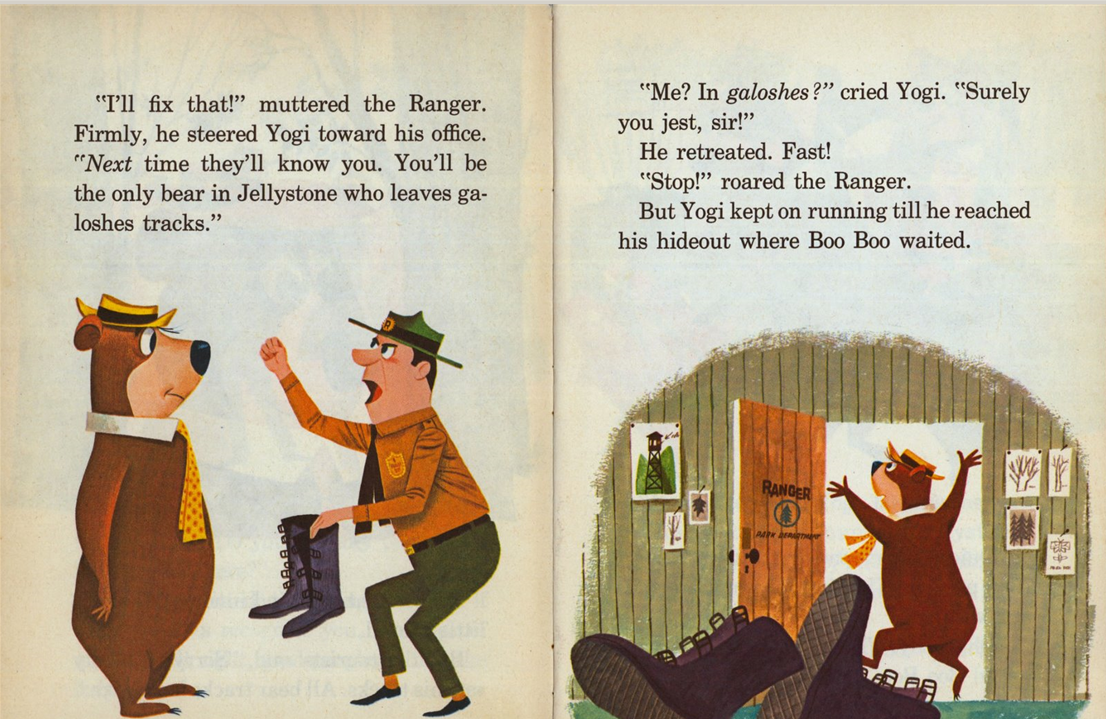
Yogi Takes a Vacation

It’s time for another Yogi Bear kids book.

Yogi Takes a Vacation was published by Whitman in 1965 as part of its “Big Tell-a-Tale” series. The artwork in it is by Art Seiden, who did commercial illustration and began working in the children’s realm in the early ‘50s. His last book was in 1999. You can read a biography of him at this blog.

I must admit his style in this book doesn’t do much for me. I can’t put my finger on it. Maybe it’s the open mouths and odd angles. The drawings just seem a little stiff, certainly more so than the Yogi comics you’d see in the newspapers drawn by people like Harvey Eisenberg, who had wonderful, thoughtful poses (from Gene Hazelton’s layouts, I imagine). The crouching Ranger Smith with the galoshes is, well, odd. Boo Boo’s arm looks broken in one drawing.

The story here is designed for little children as well. Don’t expect Warren Foster-style narration or irony.

Still, it’s worth a glance. You can click on any of the pages to make them larger.