Wednesday, 14 January 2015

Flintstones Comics, January 1965

What’s with the snakes? Several appearances by a snake highlight the Flintstones daily comics from 50 years ago this month, starting Monday, January 4th. Pebbles keeps bugging Dino, and there’s a Bamm-Bamm appearance. Barney only shows up once and there’s no Betty. And no Baby Puss. But plenty of snow.

Click on each week to read it. The January 6, 1965 “La-La” panel is my favourite.


Saturday, 10 January 2015

Yogi Bear — A Wooin’ Bruin

Produced and Directed by Joe Barbera and Bill Hanna.
Credits: Animation – Bob Carr; Layout – Ernie Nordli; Backgrounds – Art Lozzi; Written by Warren Foster; Story Director – Paul Sommer; Titles – Art Goble; Production Supervision – Howard Hanson.
Voice Cast: Narrator, Boo Boo, Ranger Smith – Don Messick; Yogi Bear, Bruno – Daws Butler; Cindy Bear – Julie Bennett.
Music: Hoyt Curtin.
First Aired: 1962.
Plot: Yogi and Bruno vie for the hand of Cindy Bear.

Yogi Bear
c/o Jellystone Park, U.S.A.
January 10, 1962

Dear Yogi,

I realise that we battled each other in a few cartoons and you’re now a big star while I’m languishing in animated obscurity. Let’s set that aside. Early Hanna-Barbera cartoon characters have to stick together. I want to give you some friendly advice.

It’s about Cindy Bear.

Are you out of your mind, Yogi? Did you scarf down some rotten egg sand-a-wiches from a pic-a-nic basket that rotted your brain? Cindy and her Southern debutante voice may have conned Boo Boo into thinking she’s “nice,” but you’re smarter than the average bear. When are you going to wise up and dump that witch? (Feel free to substitute a word that rhymes with “witch.” Warren Foster tells me you’re good with rhymes).

She’s a liar—dare I say, a bear-faced liar—and the proof is in your cartoon “A Wooin’ Bruin.” Remember what she told you? “When you’re ready to go steady, just whistle. I’ll come a runnin,’ Yogi.”

What happened next? Some bear you’d never seen before—one she was seeing behind your back, since she knew the guy—gave her flowers. You whistled. Did she “come a runnin’”? Not a chance. She danced with Bruno instead and didn’t even pay attention to you. Like I said, a lying witch (again, feel free to substitute words).


And what about the game she played? “Whoever brings Cindy the best present is the winner,” she said. Give me something. Me, me, me. All she cares about is herself. You should have told it to stick it up her I-do-declare. But, no. What’d you do? She turned you into a common thief. Stealing a cake? A TV set? Ranger Smith’s car? Even Mr. Ranger knows you’re “not that kind of bear.” But you became that kind. And for what? For someone who fooled around on you behind your back. Yogi, Yogi, Yogi.


Yeah, sure, at the end you won the game, used some wrestling moves to vanquish Bruno (who came away from the off-camera fight without even a scratch) and then took Cindy to the Lover’s Leap parking lot. But did you really win, Yogi? What’s to say she won’t bat her eyes at another bear. Maybe she’s juggling around a few already. Does she deserve your trust any more? I do declare she doesn’t.


And telling Ranger Smith, after he found you inside his car at Lover’s Leap, that you deserve to punished? Where was Cindy to explain things so you didn’t get into trouble? She sure vanished, didn’t she (you’ll notice that you can see her in the car in one drawing but not in the next one for some reason)? Take a hint from “Lover’s Leap” and tell her to jump—if she really loves you. Watch her backtrack. She’s just using you for a role in that big picture of yours that’ll come out in 1964: “Hey There, It’s Yogi Bear.” Even Huckleberry Hound is talking about it, and you know he never says anything bad about anyone.

For your own sake, Yogi, give your love to a pic-a-nic basket, not that two-timing Cindy. Has a pic-a-nic basket ever resisted your charms? Never. Or love the beautiful scenery of Jellystone Park as rendered by Art Lozzi in the opening of “A Wooin’ Bruin.” Art’s great.


By the way, did you really have to say: “...any bear that picks wild flowers is a little too tra-la-la for me.” Snagglepuss talked to me about that. He knows about that tra-la-la stuff, you know. He says the next time you see Cindy, take it on the lam. A lamb sandwich with fresh mint sauce, even.


Take my advice, Yogi. Drop the fickle female. And if you have room for me in another cartoon, call right away.

Your pal,
Yowp

P.S.: Yowp! Yowp!

Wednesday, 7 January 2015

Does Daws Say The Secret Woid?

We featured a Daws Butler story on the Yowp blog today while next door at the Tralfaz blog today, a Groucho Marx interview appeared. So, let’s combine the two.

By a complete and delightful coincidence, the episode where Daws appeared on “You Bet Your Life” has been posted on the internet today. Tune in at around the 8:50 mark. As a bonus, Groucho does all his characters from “The Huckleberry Hound Show.”

This was broadcast May 26, 1960.

Since someone will point it out, Groucho’s announcer, George Fenneman, later landed a gig with Hanna-Barbera in 1963, hosting a half-hour special called “Here Comes a Star” that was a plug for the coming Magilla Gorilla show.


Thanks to Dan Whitworth for spotting this.

A Pageant of Daws Butler

Could the Hanna-Barbera cartoon studio have started out so successfully without Daws Butler?

Daws was entrusted with almost all of H-B’s starring characters over the first three years of the studio’s life. They couldn’t have been in better hands, er, mouths.

Daws didn’t do funny voices. He did voices of characters that said funny things. And, arguably, they may not have been funny if they came from the mouths of other actors. With maybe a rare exception, Daws always knew how to read what was put in front of him. And he could augment it to make it even more amusing.

Hanna-Barbera’s original half-hour syndicated series were instant hits. People started wondering who it was that was playing Huckleberry Hound, or Yogi Bear, or Quick Draw McGraw. Magazines and newspaper wire services started writing about him.

Here’s a portion of a story which ran in Pageant magazine in 1962. It’s only a portion because it was being sold on eBay, and the seller only posted a portion. But I’m putting it up because this may have been the first time Daws talked about doing the characters. And the article was accompanied by drawings of Daws’ characters, and Bill Hanna and Joe Barbera. I’m sorry they’re so fuzzy but that’s the way they came off eBay and as the article was being sold, it’s understandable the scans aren't very high resolution. The Daws drawing doesn’t look all that much like Daws to me, to be honest. If anyone has a complete or better copy of this they have scanned and would like to e-mail me, I’d be happy to receive it and repost so everyone can see it.


THE TV STAR YOU’LL NEVER SEE ON TV
An original script by JANE ARDMORE with animation by BILL HANNA and JOE BARBERA.

THE MAN who reaches more people than any other star on television is Daws Butler.
Never heard of him?
Well, 70 to 80 million people tune in on him weekly. He’s a 45-year-old, small-sized man with a large-sized voice, an expressive face, a puckish sense of humor and a built-in geniality.
Give up?
Daws Butler is the man behind the voices of Huckleberry Hound, Yogi Bear, and Quick Draw McGraw--three of the drollest cartoon-show heroes America’s ever had.
“Huck” is a canine Don Quixote; Yogi is a smarter than “av-er-age” bear and the Number One citizen of Jellystone Park; Quick Draw is the slowest horse in the West.
But these characters do not make up all of Daws Butler’s repertoire: He also dubs the voices of such creatures as Dixie, a precocious “meece”; Mr. Jinx [sic], a “stupidspicious” cat; Baba Looey, Quick Draw’s indispensable side-kick; Super Snooper, a far out feline private eye; and Blabber, his gullible aide, Auggie Doggie, a mischievous pup; Snagglepuss, a flamboyant lion; Hokey Wolf, a fast-dealing wolf; Elroy, boy-of-the-future in the new Jetsons series; and many other incidental cartoon comics in various TV episodes.
So convincing is Butler in these roles that fan mail pours in to these wacky animals by the thousands. Originally, the parts of Hokey, Snagglepuss, and Yogi were minor until

Yowp note: at this point, the article likely goes into how Hokey and Snagglepuss ended up with their own series and Yogi got his own show. And it then went into Daws’ childhood in Chicago, his nightclub act there in the 1930s with the Three Short Waves, his military service, his discharge after World War Two and thence his decision to go west and seek work in radio.

for Hollywood. But it was tough going there in 1945. There were plenty of radio shows on which he would double in brass as a Western Union messenger, a Chinese cook, an aged panhandler, and a nervous newsboy. The tide began to turn with a successful voice-part in a popular children’s show called Time for Beany.
Then Daws met Bill Hanna and Joe Barbera, creators of the Tom and Jerry cartoons for MGM studios.
The association has proved profitable for all. Aside from Wally Gator, two other new shows already are in the works for local-station viewing: Lippy the Lion and Touché Turtle. And Huckleberry Hound and Yogi Bear are now being seen in 35 foreign countries dubbed (not by Daws) in French, Spanish, German, Portuguese and Japanese. Quick Draw, too, is seen in 14 countries.
And for Daws Butler? Over the years, he has lost his shyness—and gained a salary reportedly in the over $100,000 a year class.
As he explains his successful characterizations, “The quickest way to establish a voice is not to just think of how it’ll sound, but what personality it will convey. For Huckleberry, we wanted a comfortable voice. That’s why Joe and Bill sent for me. They remembered a voice I’d used some years before.
“I love what we finally settled on for Huck’s accent; it’s like music—just right for a character who’s interested in everything, a friendly, unsophisticated homespun character who sees no evil, hears no evil, and is always on the brink of disaster. Let someone try to murder Huck; he’ll just think ‘That fella’s got a right good sense of humor, I guess. Just hope nobody gets hurt.’
“For Huck, I use close to my own normal voice register, a middle baritone. For Hokey Wolf, on the same show, I switch to an upper baritone—a head tone for a fast-talking operator who dazzles you with his bridgework. Mr. Jinx, also on the same show, calls for my lowest register and not much push. This cat is pretty limited, reminiscent of the sort of actor who enrolls in a New York method school and comes out with the sweat shirt but no talent. And for Dixie, one of the ‘meece’ in the episode, I used my highest tenor—nasal, wistful, and innocent.”
As he reads the lines, Daws changes physically. His movements, his gestures are totally in character. He feels for each of these animals, and, in the process, some of his own inherent human shyness carries over to endear them to his audience.
Daws loves comedy, loves music, and often thinks out a characterization while listening to a Bach toccata or fugue. He has a warmth for every character, even for heavies, and as he thinks his lines it’s with—he says—a “smiling feeling.”
It tickles him that he’s helped contribute something to the relaxation of adults, and, even more, the relaxation of children, whom he feels have been short-changed on the entertainment front. Daws never plays down. He doesn’t have to. Hanna-Barbera cartoons are devised not for children but for people. As Butler puts it, “We can’t stand intelligence not living up to its responsibility.”
With additional new characters added to his repertoire this fall, Daws will be living up to his responsibility. And he’ll always be looking for the switch. Like Snagglepuss, he begs to differ; he’s a differ-begger.
Daws Butler hopes to spend the rest of his life being heard and not seen.

It’s a little sad reading this story to realise that Daws’ starring days, at least when it came to new roles, were in the past. Hanna-Barbera was about to change the face of Saturday morning TV with series after series of first-run, made-for-kids cartoons. Daws Butler didn’t star as Secret Squirrel or Atom Ant. Or even Squiddly Diddley. Or in the super hero/futuristic shows that came along a few years later. Nor he was a lead in Scooby Doo, the studio’s next monster hit. Other than borrowing from himself to play the Funky Phantom, Daws had to be content with revivals of his old characters in reconfigured new series.

One of the things you’ll come away with reading this article is that Daws Butler was a genuine, friendly, unassuming man. And that’s the impression I get from anybody who knew him. He was generous and helpful. He was a true friend. And through his cartoons and other voice work, I’d like to think that part of him is still with us today.

Saturday, 3 January 2015

Huckleberry Hound — Ben Huck

Produced and Directed by Bill Hanna and Joe Barbera.
Credits: Animation – John Boersma; Layout – Tony Rivera; Backgrounds – Art Lozzi; Written by Tony Benedict; Story Director – Lew Marshall; Titles – Art Goble; Production Supervision – Howard Hanson.
Voice Cast: Huckleberry Hound, Crowd – Daws Butler; Narrator, Loudspeaker Voice, Referee, Mad Barbarian, Lion, Crowd – Don Messick.
Music: Hoyt Curtin.
Production E-181.
First Aired: week of February 5, 1962.
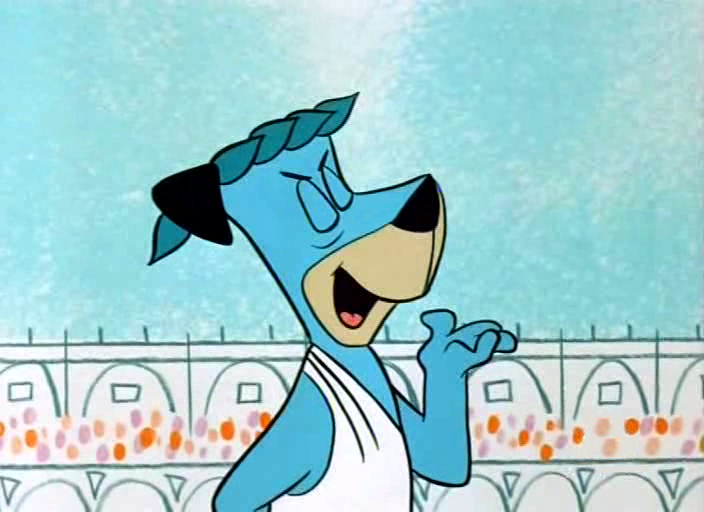
Plot: In ancient Rome, Huck fights the Mad Barbarian.

Note: The title card is missing a yellow-boxed “Hanna-Barbera” above the title. It was on a separate cel.

Muttley and Precious Pupp snickered. But they didn’t wear out their welcome by snickering too often during a cartoon. This cartoon doesn’t have a dog (unless you count the humanised Huckleberry Hound) but it does have a Mad Barbarian who chuckles. And chuckles. And chuckles. 12 times in about five minutes. It’s too much. And it spoils the cartoon.

Tony Benedict follows the 1961 Huck story format. A narrator sets up the cartoon over a pan of a background. Huck and the narrator chat. Huck then takes on another character in a series of spot gags, commenting to us as things go along. This one has the addition of the main story being told in flashback, and then returning to the present at the end. It’s similar to the Yogi Bear cartoon “Hide and Go Peek” (1959), where it turns out a pile of rocks is really a camouflaged elephant. The same sort of thing happens here; Huck is disguised as a statue.

John Boersma receives the animation credit. I’m still trying to figure out whether he’s the only animator who draws the palm-facing-up, little-finger-pointing-upward, gesture. He uses it in a bunch of cartoons and he uses it in this one as well.

Here’s Art Lozzi’s background that opens the cartoon. Tony’s story plunks Huck into the days of Ben Hur (from the 1959 movie of the same name).


Intoning Narrator: Here amid the pomp and splendour of ancient Rome, stood many great monuments to the heroes of the Empire.
(fade into next background drawing)


Intoning Narrator: The great Caesar. The brilliant Augustus. And the most famous of all—Ben Huck.

At this point, Hoyt Curtin’s fan-fare cue is cut off and replaced with a dissonant trumpet making a questioning sound (I can’t explain it, but you’ve heard it on “The Flintstones”). The “statue” says “Howdy, narrator” and kibitzes with the off-screen voice about why he’s “hidin’ out, kinda secret-like.” Then we go into the flashback.

Huck’s off-key version of Clementine this time ends with the lyrics “And her shoes are triple Ceeeee!”

The next little bit may be the best part of the cartoon. Huck arrives at the Roman Coliseum (as the background drawing spells it). “And I outta go on inside so’s that everyone can shout and throw me posies and all.” That’s what they do. “And there’s just one thing about this hero business,” Huck tells us, as flowers start to cover him. “You just got ta like posies.” That’s when he’s clocked with a flower pot containing posies. Tony tosses in some sign gags.


The P.A. announcer/referee now introduces the Mad Barbarian from Gaul (they wear Viking horns in Gaul?) and Ben Huck, from Rome’s East Side. I guess it’s based on New York’s East Side which, judging by the context of the cartoon, must have been a tough place at one time. And, so, the battle is on. I’ll avoid going through all the gags. The inevitable lion shows up (spitting out Huck) and there’s the familiar “tunnel/low bridge” gag where Huck, standing up in a chariot, smashes into the top of the exit because he doesn’t duck.


The cartoon ends with the cartoon back in the present with Barbarian still stalking Huck, who is above him atop a Doric pillar. “With that old Barbarian around loose,” Huck tells Mr. Narrator, “I might could be here a couple of thousand years. So I’d appreciate it if you wouldn’t spread it around.” The iris closes to end the cartoon.

Odds and ends...

● Huck’s vocabulary includes Bugs Bunny’s “stragedy.”
● Our hero mangles the language when he remarks about the Barbarian: “He must have a statistic sense of humor.”
● Daws doesn’t pronounce the “w” in “sword” like he did in countless cartoons, including at least one of Huck’s.
● For a moment, it sounds like Charlie Shows slipped into the writing room, as Huck asks “How about a truce, Bruce?”
● Near the end of the flashback, there’s a little bongo sound effect when the Barbarian runs in place before rushing off scene to find Huck.
● Hoyt Curtin’s trombone stomp that includes a sampling of “English Country Garden” as well as the minor key variation of the Flintstones’ “Rise and Shine” theme are included on the soundtrack.

With this post, we’ve reviewed every cartoon that appeared on the Huckleberry Hound and Quick Draw McGraw series.

Thursday, 1 January 2015

Yogi Bear Weekend Comics, January 1965

The song says “Yogi Bear is smarter than the average bear.” Sometimes, the song is right. Some good examples can be found in the Yogi newspaper comics published on Sundays 50 years ago this month. And during the first two weeks, we get natives from the Jellystone Reservation who omit verbs when they talk.

As usual, you can click on each comic to make it bigger.


January 3rd features a little panel to open the top row for a change. Yogi’s in excellent form in the silhouette panel in the middle row.


An alarm clock isn’t going to get you across the snow, is it? I don’t understand the logic of the deal in the January 10th comic. Notice how the lead dog is glaring at Yogi in the opening panel. The doggie expressions are good in all the panels, especially the last one; the ring of dogs is a nice idea.
No one listens to Boo Boo, do they?


Fine use of perspectives in the final panel of the January 17th comic. Yogi up front confiding in us, the angry animals and the bad guys further behind. It’s my panel pick for the month. The lettering in the first and second panels of the last row is great, too. Yogi doesn’t need a conscience or a ranger in this comic, so they’re both absent.


January is Polar Bear Swim time, so I imagine that’s what triggered the January 24th comic where the ranger gets outsmarted again (though he likely doesn’t know it, seeing he’s not in the final panel. Ranger Smith is “Joe” again. The “Ranger General” in the top row even has a military general’s stars. I don’t understand why military titles are used by the U.S. Park Service in these Yogi comics. Yogi has only two lines of dialogue, but he rhymes in both of them.


Yogi packs his own pic-a-nic lunch in the January 31st comic. Shouldn’t he be hibernating? Oh, yeah, there wouldn’t be a comic for about five months if that were the case. Boo Boo comes up with an amazingly obvious observation in the opening panel.

If you want to get a look at the bottom two rows in colour, pop over to Mark Kausler’s blog. Check out Felix and Krazy Kat while you’re at it.