Wednesday, 17 April 2013

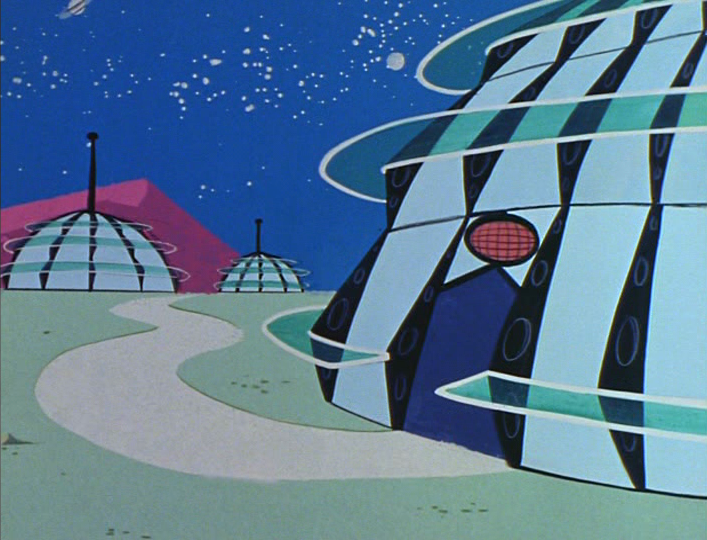
Mars, 1960

Outer space and futurism go hand-in-hand. I mean, you never see astronauts land on a planet where aliens are driving something that looks like a ‘51 Nash.

The Hanna-Barbera studio visualised the ultimate in futurism in
The Jetsons, but it used futuristic designs in some of its earlier space cartoons. In fact, H-B’s first series, Ruff and Reddy began with a space adventure. Aliens invaded Jellystone Park in “Space Bear.” And Snooper and Blabber ended up on Mars in “Outer Space Case” (1960-61 season), a cartoon designed by Don Sheppard with scenes painted by Dick Thomas.


These buildings wouldn’t be too out of place in the Jetsons’ world. The grille on the oval speaker above the door isn’t in perspective but that’s not too big a deal.


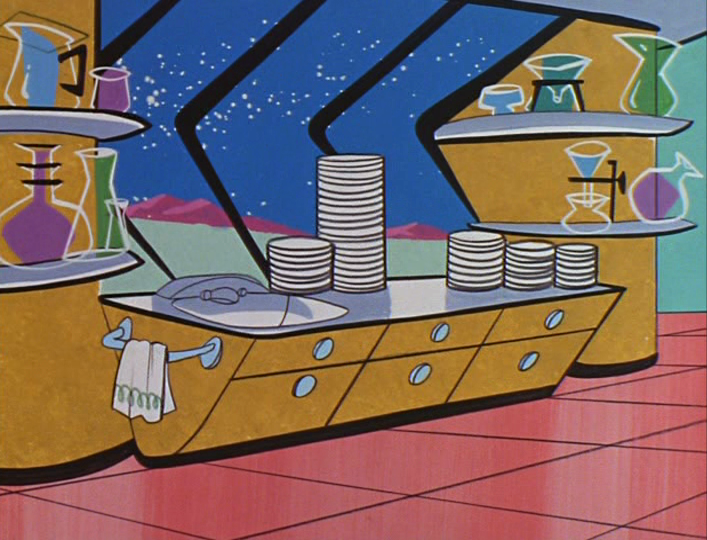
Here are a couple of interiors. The kitchen isn’t as futuristic as Jane Jetson’s, but the floor’s nice and shiny. Unfortunately, I can’t get a clear shot of the hallway (the only two Mars interior backgrounds in the cartoon). But I like the painting of the King on the wall.


Here’s the planetary surface. Not terribly elaborate, but it doesn’t overpower the action.

The credits have been removed from all the old Jetsons episodes so I couldn’t tell you if Sheppard worked on the original series. He was a storyboard artist on the 1990 movie. Thomas eventually provided some backgrounds for the spacey-est of all ’60s TV cartoons: Spider Man’s “Revolt in the Fifth Dimension.”

Saturday, 13 April 2013

Quick Draw McGraw — Bullet Proof Galoot

Produced and Directed by Bill Hanna and Joe Barbera.
Animation – Don Patterson, Layout - Dick Bickenbach, Backgrounds – Dick Thomas?, Story – Mike Maltese, Story Director – Alex Lovy, Titles – Art Goble, Production Supevision – Howard Hanson (no credits).
Voice Cast: Quick Draw, Baba Looey, Bank Teller – Daws Butler; Narrator, Townsman, Fast-Gun Finnegan, Little Man – Doug Young.
Music: Phil Green, Jack Shaindlin, Harry Bluestone/Emil Cadkin.
Episode: Quick Draw McGraw Show M-028, Production J-84.
First Aired: week of October 23, 1960.
Plot: Quick Draw tries to bring in a bad guy while dealing with a mechanical sheriff.

“Fight fire with fire, and tin with tin, I always say!” declares Quick Draw McGraw. And so, dressed in armour made from an old hot water heater (with pipes sticking out of his hat), our hero walks into battle, hand ready to reach for his gun—and take on the good guy.

Good guy?!? Yes, it’s another inspired story from Mike Maltese, who came up with the concept of a mechanical sheriff years before Mel Brooks in Blazing Saddles—one that has a brain buried in that tin, as we discover. Quick Draw spends the cartoon trying to prove to a town that they need him as sheriff, even though it clearly doesn’t, and he wins in the end—but only temporarily.

Some of the poses are pretty nice. They’re by Don Patterson. I especially like how Quick Draw’s snout becomes pancaked by Clarence’s fist.


Here’s Baba’s mouth in an “o” shape as he yells “Yahoo!” The lips are stretched out forward, like something out of an early ‘30s cartoon from New York.


And here’s one of Patterson’s drawings of Quick Draw zipping out of the scene. The animation’s used twice in the cartoon.


The lack of credits is annoying. Who did the backgrounds? The clouds are like Art Lozzi’s but the two-tone mountains and mesas are the same as Dick Thomas drew in the Snooper and Blabber cartoon “Outer Space Case” (which does have credits). So, I’m going with Thomas. Note there’s a sign in this cartoon drawn like the one in “Bad Guys Disguise” in the first season.

Dick Bickenbach was the layout artist on that one, and he draws the townsman’s ear like he did Tombstone Jones in the earlier cartoon; it’s shaped like a fortune cookie. You’ll notice Baba’s eyes are closed like a baseless triangle dissected down the middle, typical of Patterson at Hanna-Barbera at the time.


And here’s part of the town we see at the beginning. It’s another one with pale rose-shadowed mountains in the background.


The cartoon opens with a pan over the background above, with Doug Young’s narration explaining that Fast-Gun Finnegan was tougher than Billy the Kid and the James boys, and “could not be brought to justice.” The narrator is interrupted by Quick Draw McGraw, who promises to do it. Baba Looey then adds that “any minutes now, Fast-Gun Finnegan will come a-runnin’ to give hisself up.” How? “You tell ‘im, Baba boy. I’m too modest. And don’t leave nothin’ out.” The cartoon now flash-backs to the morning when Quick Draw and Baba arrive in Peaceful Gulch, a town with no sheriff, and doesn’t need one, as Quick Draw is told when he applies for the job. Quick Draw decides to prove the town needs a sheriff by staging a fake bank hold-up so he can arrest the bandit. Baba to the audience: “I’ll give you one guess who’s going to be the bandit.”

“Now, remember,” Quick Draw says to Baba to start the next scene. “Shoot twice-t over your shoulder and yell ‘Yahoo’,” —the “sig-giginal” (Daws Butler’s word-bending at work again) for Quick Draw to make the phoney arrest. Baba gets nowhere. The bank teller pushes a button to activate Clarence, the mechanical sheriff. Baba gives the signal, but also fires his gun which brings down the bank sign on top of Quick Draw’s head, which gives him temporary amnesia (“Who am I? What am I? Besides bein’ good lookin’,”) and thus has no idea what the signal is. Clarence throws Baba on top of Quick Draw’s head to restore his memory.


Baba explains to Quick Draw the town has Clarence so they don’t need him as sheriff. “Hold on thar! Anybody named Clarence couldn’t be such a much.” Quick Draw goes to the entrance of the bank and ends up getting socked by the mechanical man, after thinking a teeny man coming out of the bank is Clarence and challenges him to a punch. The scene’s a little puzzling. The little man says “I couldn’t hit anybody,” says the meek man. My hands have small bones.” Quick Draw replies with “Now, don’t hurt your small-boned hand,” even though he can see the mechanical man in front of him; in fact, Clarence brushed off his nose. So I don’t understand why Quick Draw still mistakes one for the other. Catchphrase after the punch: “Ooo. That smarts!”

Catchphrase to start the next scene: “I’ll do the thinnin’ for both of us...” This is when Quick Draw dresses up in the stove outfit and shoots at Clarence. I love how Quick Draw is so satisfied with himself when he’s ravingly incompetent. The bullets just bounce off Clarence’s metal, but Quick Draw says “That’s pretty good shootin’, eh, Clarence?” The metal sheriff simply bends at 90 degrees, turns himself into a cannon and fires. We hear a bell sound effect when the cannon ball hits Quick Draw.


Oh, yes, Fast-Gun Finnegan. Now he shows up in the story to rob the bank. Quick Draw warns him about Clarence. “Anybody named Clarence couldn’t be such a much,” laughs Finnegan. The cartoon now returns to the present with Baba talking to the narrator. Just then, a clothing-torn Finnegan runs screaming to be locked up. Clarence isn’t around so the audience is left to assume what happened (saves animation, too). What’s Quick Draw going to do with the reward for the capture? Take apart Clarence bolt-by-bolt so he can be sheriff. Clarence may be mechanical, but he understands the situation and fires more cannon balls at Quick Draw. The cartoon ends with our hero running from a bunch of cannon balls toward “Arizony.” Baba’s tagline: “That’s what I like about Quickstraw. Once he finishes a job, he’s off to a new place. Whether he likes it or not.” Yeah, it’s not strong, or even a pun. But Maltese seems to have made a decision a quip from Baba should end all cartoons (it does in all 13 of them in the second season) so that’s what he came up with.

The sound cutter gives Clarence his own little theme. It’s Jack Shaindlin’s “Six Day Bicycle Race.” Phil Green dominates the rest of the soundtrack and we get a harmonica version of “Red River Valley” which may be from the Sam Fox library.


0:00 - Quick Draw McGraw Sub Main Title theme (Curtin).
0:15 - Red River Valley (Trad) – Pan of town, poster, “Hold on thar!”
0:30 - GR-99 THE DIDDLECOMB HUNT (Green) – Quick Draw talks to narrator, sign scene.
1:17 - GR-255 PUPPETRY COMEDY (Green) – Quick Draw talks to townsman, teller presses button.
2:23 - SIX-DAY BICYCLE RACE (Shaindlin) – Clarence rolls out, Quick Draw loses memory, regains memory.
3:04 - GR-87 SKELETON IN THE CUPBOARD (Green) – “Hold on thar!” Quick Draw talks to little man, teller presses button.
4:06 - SIX DAY BICYCLE RACE (Shaindlin) – Clarence rolls out, clobbers Quick Draw.
4:24 - GR-87 SKELETON IN THE CUPBOARD (Green)) – Quick Draw’s nose is pancake, Quick Draw as stovepipe.
5:04 - SIX DAY BICYCLE RACE (Shaindlin) – Clarence rolls out, cannon fire, Quick Draw talks to Finnegan.
6:04 - CB-87A COME AND GET ME (Cadkin-Bluestone) – Baba talks to narrator, Finnegan yells for help, Quick Draw with gun on Finnegan.
6:31 - SIX DAY BICYCLE RACE (Shaindlin) – Clarence rolls out, Quick Draw runs to Arizona, Baba talks to camera.
7:00 - Quick Draw McGraw Sub End Title theme (Curtin).

Wednesday, 10 April 2013

Yogi Bear Weekend Comics, April 1963

Frolicking Disney-like animals are not something you’d usually see in a Hanna-Barbera cartoon, though a number of the studio’s artists had worked for Disney. But that’s partly because of the fiscal restraints of TV animation. In comics, that’s not a problem, so we get cutsey animals in the Yogi Bear Sunday newspaper comics 50 years ago this month.


April 7th has a flying squirrel that wouldn’t be caught dead in a Rocky and Bullwinkle cartoon. Though, to think of it, that could be pretty funny. Ranger Smith is particularly moody in this one.


More refugees from Bambi greet us on April 14th, with a Cupid to match. Cindy evidently doesn’t care who comes on to her. Yogi doesn’t seem all that concerned, either. Hearts aplenty, including in one enveloping the title in the opening panel. I wonder why this story wasn’t saved for Valentine’s Day.


The final drawing on April 21st is a lot of fun with the multiple Yogis. Sorry I can’t get a better version. The terrified look on the Ranger in the previous panel is pretty good, too. What kind of copying machine has a huge entrance like that, anyway? Oh, right. It’s supposed to be a tall tale.


Other than the appearance of the nameless Mrs. Smith, the plot of the April 28th comic reminds me of one of those cartoons-between-the-cartoons on the Yogi show. This is the first time I can recall seeing a split upper-lower panel.

As usual, click on each comic to enlarge it.

Saturday, 6 April 2013

Augie Doggie — Patient Pop

Produced and Directed by Joe Barbera and Bill Hanna.
Credits: Animation – Dick Lundy; Layout – Tony Rivera; Backgrounds – Bob Gentle; Story – Mike Maltese; Story Director – Alex Lovy; Titles – Art Goble; Production Supervision – Howard Hanson.
Voice Cast: Doggie Daddy – Doug Young; Augie, Cat – Daws Butler.
Music: Phil Green, Jack Shaindlin, Hecky Krasnow.
Episode: Quick Draw McGraw Show M-032, Production J-98.
First Aired: week of November 28, 1960 (rerun, week of May 29, 1961).
Plot: A cat with a hankering for steak takes advantage of a bed-ridden Doggie Daddy.

Daws Butler used comedian Shelly Berman as the starting point for one of his character voices. It’s familiar to people who’ve seen Yakky Doodle cartoons as the voice of Fibber Fox. But Daws used it before that elsewhere, both at Hanna-Barbera and Jay Ward. You can hear it in four different cartoons in the Augie Doggie series in the 1960-61 season: “It’s a Mice Day” (white cat), “Pint Giant” (man with packages), “Playmate Pup” (radio announcer) and this one (a light grey cat).

This is one of three Augies that Dick Lundy animated in 1960-61. Just for fun, I compared the run cycle Lundy gave to the cat in this cartoon to the one he gave Yippee Coyote in a Quick Draw McGraw cartoon the same year. Both have eight drawings. The coyote is constructed taller than the cat, so Yippee bends a knee when running while the unnamed cat doesn’t. And the cat has kind of a roll in his run where we can see the pad of his left foot. So Lundy isn’t drawing a stock run for every character.


Mike Maltese’s plot bears no resemblance to the title card. At no time does Augie play “doctor.” It has a vague similarity to “Crow Cronies” from the previous season, where Doggie Daddy is preyed on by a crow and Augie refuses to believe anything dear old dad says about him. A phoney doctor disguise/examination is trotted out in both cartoons. Actually, Maltese used a white cat in disguise in “Hum Sweet Hum” in the first season, complete with the same German accent that Daws Butler affects in this cartoon. Maltese manages to hold the viewer’s interest in seeing whether Daddy triumphs over the scheming cat (he does in a rare complete victory).

Maltese doesn’t waste time getting into things. The cartoon opens with Daddy sleeping. Augie is reading a psychology book which says “Even when daddies don’t feel well, they won’t show it so their children won’t worry.” “Oh, the shame of it!” exclaims Sylvester Junior Augie. He covers Daddy with a blanket “so he won’t catch cold.” All that does is startle the old dog who runs into a book case and stubs his toe. But, no. Augie reaches the conclusion Dad has a broken leg and is hiding it from him. So Daddy decides to go along with it.


For reasons of plot development, Augie doesn’t do the logical thing and call a doctor or an ambulance. Instead, he (between scenes) puts Daddy’s leg in a huge cast in a sling and prepares a T-bone steak for “helpless dad.” The white cat just happens to be outside the daddy bedroom window at the time and overhears what’s going on. Maltese comes up with a line reminiscent of Casper Caveman in the April 1939 Warner’s cartoon “Daffy Duck and the Dinosaur”: “My favourite vegetable—duck!” In this case it’s “My favourite fruit—T-bone steak!” (Maltese went into the Warner’s story department in August 1939). So the cat starts stealing steaks. “But dad, we have no cat. It’s a hallucination,” says Augie, or “hallu-cil-ilation” as Daddy pronounces it. The cat realises dear old dad can’t move so he embarks on some terrorisation, all the while Augie thinking his dad has a fever which morphs into hysteria. The cat clubs Augie on the head after Daddy tells the boy he’ll do something drastic if he isn’t let out of bed. Naturally, Augie thinks Daddy did it. The cat gets Daddy to laugh uncontrollably by tickling his foot twice (including after dear old dad says “hitting you would make me feel very sad.”).


Now, Augie rushes outside and calls for a doctor. Enter the cat in surgeon’s garb and spouting a German accent. The “doctor” diagnoses Daddy as having “Catophrena Hallucinotions.” Even Daddy’s fooled by the disguise. “But doc, I only stubbed my toe,” he protests. “Dat is the vay dat it starts,” responds the cat, who runs down the symptoms—a craving for T-bone steaks and an insistence that a cat has stolen them.” The only cure? Lots of T-bone steaks, which Augie rushes to bring in. We’ve now reached the climax of the cartoon as the evil cat threatens to operate on Daddy with a saw—but trips himself up when he starts talking in his real voice. Daddy realises who the doctor really is. The cat is standing on a rug (which has been in Daddy’s bedroom since the beginning of the cartoon and didn’t just magically appear). Daddy pulls the cat to his face. “I could stick around for a game of chequers,” says the nervous moocher. “Good. And I’ll make the first move,” as Daddy tosses him out the window, smashing him against a tree. Exit the phoney doctor. The last scene has Daddy cooking a T-bone steak for Augie. Daddy fits in a “my son, my son,” but doesn’t end the cartoon with an “After all, how many….” catchphrase. In fact, he doesn’t even mangle many words for a change. Whether Maltese wasn’t inspired, I don’t know, but the cartoon’s a pleasant enough one, helped along by the usual top-notch Daws Butler/Doug Young voice work.


The music is tidy, with cues fitting nicely into scenes. The opening “And They All Lived Happily Ever After” from the Kiddie Comedy Suite by Phil Green is known in the Capitol Hi-Q series as “EM-131E Lullaby,” so I suspect that’s why it seems to be used in sleep scenes in Augie cartoons.


0:00 - Augie Doggie Main Title theme (Hanna-Barbera-Curtin).
0:26 - GR-259 AND THEY ALL LIVED HAPPILY EVER AFTER (Green) – Daddy snoozes, blanket toss.
0:58 - GR-347 GATHERING THE PRODUCE (Green) – Daddy struggles with blanket, crash.
1:08 - EM-107D LIGHT MOVEMENT (Green) – “Did you hurt yourself?” Daddy pretends leg is broken.
1:43 - jaunty bassoon and skipping strings (Shaindlin) – Dad in bed, cat grabs steak, cat whacks Daddy with steak, Augie runs with ice.
3:20 - GR-65 BUSH BABY (Green) – Daddy with ice on head, tickling scene.
4:04 - GR-87 SKELETON IN THE CUPBOARD (Green) – Augie holds ice, hit by cat, Augie runs away.
4:44 - LFU-117-1 MAD RUSH No 1 (Shaindlin) – Shot of house exterior, Augie gets “doctor.”
5:09 - THE HAPPY COBBLER (Krasnow) – Doctor examination scene.
5:54 - CAPERS (Shaindlin) – Cat with saw, clobbered, runs away.
6:54 - tick tock/flute music (Shaindlin) – Daddy cooks steak.
7:10 - Augie Doggie End Title theme (Curtin).

Wednesday, 3 April 2013

Don Messick Goes Home

It’s a long way from the oyster grounds of Chesapeake Bay to the sound stages of California’s film studios—but that’s the trip that Don Messick made.

Members of the Messick family had been harvesting oysters in that part of Maryland since the 19th century. Don’s grandfather John was a life-long oysterman, starting by age 11. But Don’s imagination took him to radio and that took him to Hollywood and that took him to microphone at Hanna-Barbera to voice some of the most enjoyable TV cartoon characters you’d ever want to meet. Daws Butler may have played the title roles in the Huckleberry Hound, Yogi Bear and Quick Draw McGraw shows but Don was indispensable in the early days at Hanna-Barbera and eventually starred as one of the biggest characters in TV cartoon history (Scooby Doo).

Don was born in Buffalo, New York on September 7, 1926 to Binford Earl and Lena (Hughes) Messick. They were living in Manhattan in 1930 but soon relocated back to Maryland to be near all the relatives. In fact, Don and his parents lived with his grandfather for awhile. His father wasn’t in the oyster business; he was with the Washington and Electric Railroad when the U.S. got involved in World War One and was painting houses in 1940. His father never saw Don’s success. Earl Messick was accidentally killed with two other men on the morning of June 28, 1944 when a 35-foot metal pole being lowered for painting at the Nanticoke High School came out of a socket and hit a high-tension wire carrying 6,900 volts.

Don was doing cartoon voices before he was doing cartoons. He was a teenaged ventriloquist and was soon performing on the radio (it worked for Edgar Bergen, after all), though his occupation was listed as “clerk” when he enlisted for military service on January 11, 1945. After his discharge, he decided to head west. He met Daws Butler doing radio work and Daws, it seems, got him in to MGM to voice cartoons for Tex Avery. Along the way, he got married. It’s interesting to note his middle name was Earl but, unlike his father, he spelled it with an “e” on the end.

His family, including his younger brother Floyd Thomas Messick, stayed in Jesterville while Don made a career of voicing cartoon characters seen by millions. So Don had a reason to head back to Maryland. That’s what he did in 1975 and it was a big enough deal for the newspaper in Salisbury, the biggest nearby town, to interview old friends and do a profile of him. The Salisbury Sunday Times even dug up his picture from the High School Annual, but the copy I have is a scanned photocopy from the paper and not really viewable.

This story was published on April 6, 1975. Somehow, it omitted Don’s fine performances as Yowp.


Don Messick Knew What He Wanted
By DICK FLEMING

Of The Times Staff
Next weekend Don Messick will visit Salisbury where he is to be welcomed as a “local boy who made good.”
The 48-year-old freelance voice performer who has participated in countless cartoon and commercial productions, will be guest of honor for the area Chamber of Commerce annual banquet Saturday at the Wicomico Youth and Civic Center.
A native of Buffalo, N. Y., Mr. Messick lived in Jesterville near here during his teenage years and got his first taste of performing in school productions and on a local live radio broadcast.
Mr. Messick set out from Salisbury for Baltimore where he studied drama and made appearances in various radio and treatre presentations. He also carried his ventriloquist act to local variety productions and vaudeville on the road to Hollywood.
He arrived there in 1950, and in 1957 became a freelance performer. Among his more well-known performances have been vocal work in Yogi Bear (“Boo Boo”, “Ranger Smith”), Scooby Doo, Where Are You? (“Scooby”), The Jetsons (“Astro” the family dog) and The Flintstones (“Bamm Bamm”).
Mr. Messick is a bonafide celebrity and will be welcomed here as such. In addition to being the Chamber’s guest, he will be presented with a certificate of honorary citizenship of Salisbury, and Mayor Elmer F. Ruark has proclaimed, Saturday, April 12, “Don Messick Day” in the city.
But perhaps the most fitting tribute to Mr. Messick is the fend memories of him held by the persons with whom he was acquainted before setting out on the road to stardom. He is the "ambitious little boy who knew what he wanted to do.”
AS A youth, Mr. Messick apparently led a dual rose as entertainer and serious-minded young man, and kept the two people separate. Most of his old acquaintances remember him as a "quiet, shy boy." It was when he assumed the character of "the voice" that he became outgoing and noticeable.
That point is illustrated by Mrs. Nellie Collins, who grew up down the road from the Messick family.
“I knew who he was and we knew his family,” she recalled. “But I can’t remember a lot about what he was like back then.”
“He was a couple of years below me in school and the older ones never paid that much attention to the younger children.”
She did remember, however, the sight of the young boy and his everpresent dummy. A budding ventriloquist already, he was seldom seen without it, most recall.
But he was considered by his friends as one of the group and even when he was performing on WBOC radio with his own show at age 14, he wasn't really thought of by them as a celebrity.
Mrs. Collins explained, "We didn't really have the luxury in those days of sitting around and listening to the radio. We lived on a farm and there was a lot of work to be done. Once that was finished, then maybe we could hear the radio.”
Most of his schoolmates at the old Nanticoke High School were treated to at least one of Mr. Messick’s early performances, however. The school assembled in the auditorium on one occasion to watch his one-man show.
ONE OF Mr. Messick's acquaintances from Nanticoke High who remembers him well is Sheldon Dawson, now Wicomico County assistant superintendent of schools. Mr. Dawson served as English teacher and critic for the young ventriloquist.
Mr. Dawson remembered the boy as being "shy and reserved, studious, a good writer.” And outgoing when he picked up his dummy under his arm. He hadn’t changed much on his last visit to Salisbury, Mr. Dawson said.
“He was still his same old self, very reserved, until it was time to entertain the kids with some of his voices.”
Mr Messick was serious about school work, the former teacher said, but he did on occasion manage to work his act into the classroom routine, sometimes helping to make a point in an English class through the use of the dummy.
Often, those persons with an inclination toward entertainment crave the attention of friends and companions, and in school, such people are apt to assume a role such as the "class clown." Not so, however, with Mr. Messick, Mr. Dawson said. Mr. Messick’s normal speaking voice, Mr. Dawson recalled, was not particularly distinctive except perhaps for his diction. He said though that by being acquainted with the man as well as "the voice," he can hear traces of young Don Messick in the characters for which he vocalizes.
When Mr. Messick began performing a weekly program on WBOC radio in the early 1940s, he wrote his own scripts and worked by himself. He often tried out his skits on Mr. Dawson for a preview reaction to the material.
MR. MESSICK got his start on the radio show in a talent search and impressed the staff of the station. Among them, now general manager Sam Carey took an interest in the young man. Mrs. Carey drove to Jesterville every Sunday to pick the boy up at his home and carry him to the station.
According to Mr. Carey, the station put out a call on the air for local talent to come in and be auditioned.
"He came in," Mr. Carey recalled, "and at that point he had the dummy under his arm and his routines memorized.
“He came in self assured and went right at it, giving us a five or six minute skit," Mr. Carey said. "He had everybody there captured.”
Either the young man approached the 'station or vice versa, Mr. Carey isn't sure which, and Don Messick had his own 15 minute radio show every Sunday afternoon.
Jack Ward, vice president of operations, recalled that Mr. Messick “worked by himself, did everything himself.
“He would come in and practice the script for an hour or so and rehearse the voices. He knew what he was looking for.”
A 1941 yearbook from the old Nanticoke school recognizes the young man as vice president and historian for the sophomore class.
Ironically, he wrote in the class history in that yearbook:
"While we are one of the smallest classes we have made ourselves known with, for instance, more than the average participation in extra-curricular activities.
“Finally, with a group more or less compact in size, ideas and ideals, we look forward to continued and increasing success.”
For at least one member of the Class of ’43, the prophecy has come true.

Don passed away in Monterey, California on October 25, 1997. We’ve linked to a fine remembrance of Don on Mark Evanier’s web site before but let’s do it again. Click here. Even if you’ve seen it before, read it again. It’s a touching tribute to a fine actor.