Saturday, 17 September 2011

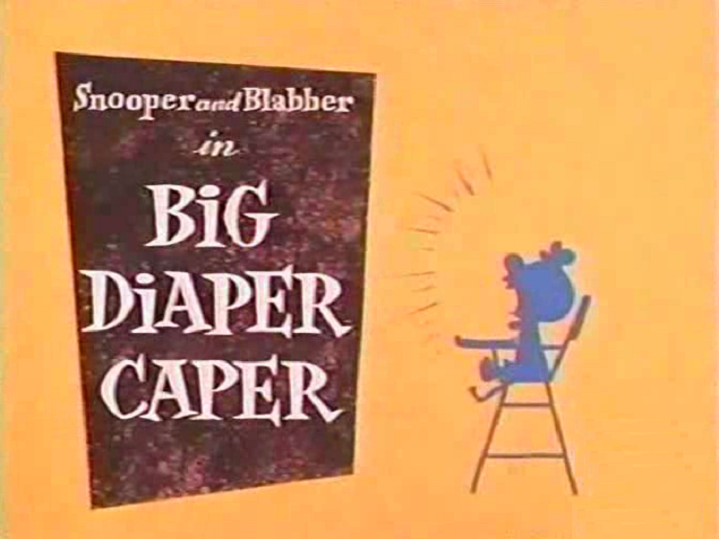
Snooper and Blabber — Big Diaper Caper

Produced and Directed by Joe Barbera and Bill Hanna.
Credits: Animation – Carlo Vinci; Layout – Dick Bickenbach; Backgrounds – Bob Gentle; Story – Mike Maltese; Story Sketches – Dan Gordon; Titles – Art Goble; Production Supervision – Howard Hanson.
Voice Cast: Snooper, Blabber, Evil Scientist, Baby – Daws Butler; Mrs Evil Scientist – Jean Vander Pyl.
Music: Phil Green, Jack Shaindlin.
First Aired: week of November 16, 1959 (rerun, week of May 16, 1960)
Episode: Quick Draw McGraw Show M-008, Production No J-8.
Plot: Snooper and Blabber are hired to baby-sit by Mr. and Mrs. Evil Scientist.

Much has been made over the years about Bill Hanna and Joe Barbera’s love for The Honeymooners, and how it less-than-covertly found its way into their cartoons. Less is made about another affection which inspired animated material for the studio during parts of several decades—the work of Charles Addams.

It’s tempting to credit Barbera for this. He must have felt somewhat akin to Addams. Both were New Yorkers trying to break into the magazine cartoon business in the early ‘30s. Addams’ ghoulish humour became so imitated (and watered down) over the years people may not realise how original and quirky it was at one time. The others were merely trying, even straining, to be funny. Addams was simply observing things through his own odd natural sense of humour, sometimes with little unexpected extras. It wasn’t enough for Addams to draw a woman who appears to have skied through a tree. Addams added to the panel by placing a puzzled observer trying to make sense of it. He managed to maintain novelty when others could not.

Hanna-Barbera was ahead of the game when it came to television borrowing from Charles Addams’ most famous creation. The Addams Family sitcom wasn’t to air for another five years at the time someone in the H-B writing brain-trust of Barbera, Mike Maltese and Dan Gordon came up with Mr. and Mrs. J. Evil Scientist. Anyone remotely familiar with the old TV show or the even older New Yorker magazine cartoons can’t miss the Addams resemblance in the Scientist parents, scary exotic pets and even the rundown mansion. And, of course, they live in a world where ugly is beautiful and creepy is ordinary. Hanna-Barbera beat it into the ground, first turning J. Evil and his family into comic book stars and then churning out the knock-off Gruesomes who debuted on The Flintstones and then the knock-off knock-off Creepleys who popped up on a far lesser show in the decades ahead.


This was not only the Evil Scientist family’s first cartoon, it was also the first voice job at Hanna-Barbera for Jean Vander Pyl. Mrs. Scientist’s thin appearance and long cigarette holder apparently inspired Vander Pyl to give the character a Tallulah Bankhead-like voice, a perfect choice. Mr. Scientist isn’t named “J” yet. His first name in this cartoon is Boris, though Daws Butler’s voice evokes Peter Lorre instead of Karloff.

And this was also the first time Blabber was played by Daws Butler. Elliot Field provided the voice in the first four cartoons; Elliot has told me he and Daws did five cartoons together; you can hear him on a Quick Draw McGraw cartoon as well. It’s interesting to note that of the first eight cartoons on the Quick Draw show that went into production, five were Snooper and Blabbers.

While Mike Maltese provides the ersatz Addams, and a nice little ending, Carlo Vinci came up with the animation. It’s vintage Vinci. Snooper has a big, wide mouth and thick upper teeth during some dialogue, there are two-drawing, off-model scare takes and stretch-diving exits off camera.


You can tell this is a little early in the detective racket for Maltese. This is the first cartoon that opens in Snoop’s office. Maltese hasn’t worked out a rhyming phone answering gag yet. In this one, Snoop simply answers “Snooper and Blabbermouse, Private Eyes. Snoop speakin’” And Maltese ditched the “mouse” on Blab’s name not too many cartoons after this (it was never used in the titles).

The boys are offered a thousand dollars to babysit. “Lady, for that kind of dough, we’d baby-sit a bucket of bees.” Blab’s apprehensive when they drive to the home and read the name on mail box. But up a lovely, winding cliff they go along a spiralling road (there’s even a tunnel in the rock) and arrive at the front house. Much like the Addams and Munsters TV shows, the doorbell (it’s a skull and crossbones with a button on the nose) makes all kind of scary noise. The two are ushered in and we get scary/creepy-is-normal dialogue.


Mrs. Scientist: Boris and I are going to a horror movie.
Mr. Scientist: Yes. It’s very romantic. Rock Crusher in ‘Boy Meets Ghoul.’
Mrs. Scientist: You shouldn’t have any trouble with our little monster.
Mr. Scientist: But in case you do, scream for help. It never comes.

Snoop and Blab look in on the baby sleeping in his crib. “Cute, my toot. He looks the normal, obnoxious-type tyke to me,” offers Snoop. The two head to the TV set but walk by “a do-it-yourself mad scientist kit.” We get a close-up shot of glasses marked “Hyde Bitters” and “Jekyll Juice” that’ll enter into the plot in mere moments.

The baby saws his way out of his crib, grabs the two glasses, mixes them and drinks. You know what’ll happen next. The baby transforms into a large version of himself. The juice makes his clothes grow with him.


“We’re in luck, Blab. The Late, Late, Late Horror Show is just startin’,” says Snoop as he and Blab sit on the chesterfield in front of the TV. “Gee, Snoop, that’s my favourite programme,” says Blab, even though it gives him the “pollywogs.” The monster-baby grabs him and shoves him into the fish bowl. I like the dialogue:


Snoop: Quiet, Blab. I can’t hear the commercial. And pass me another sand-a-wich. Blab? Where are you, Blab?
Blab: Here I am, Snoop. And what happened in the commercial?

The smiling goldfish in the bowl is a nice touch.

Blab makes a return visit to the bowl when he is scared by the monster-baby’s face in the TV (it’s the old ‘stick-head-in-open-TV-set’ bit). And then we get another familiar routine where Blabber sees something that Snoop doesn’t believe until he sees for himself. Blab watches the baby transform back into a monster. Since Carlo Vinci’s at work, there’s a two-drawing scare take and a stretch-dive off camera. The scene cuts to Snoop watching TV. Blab is a line of brush strokes that goes to grab Snooper as he zips past. I wish these cartoons were restored because you’d be able to see the effect better.


Blab’s so afraid he can’t talk, so he does charades to explain what he saw (didn’t Lou Costello do that in Hold That Ghost?) He does a nice baby-monster impersonation. There’s about a minute left in the cartoon and the rest is almost one long chase scene. Snoop sees the “little ragged-muffin” transform, does a take and he and Blab start running to the strains of Jack Shaindlin’s ‘Six Day Bicycle’ race. They run out of the room and off camera. Back they come, being chased by a snapping crocodile. They run out of the room and off camera. Back they come, being chased by an “Octo-puss-puss-puss.” The Evil Scientists arrive home. More of the gruesome-is-normal gagging:


Mrs. Scientist: What a delightful movie.
Mr. Scientist: And loaded with laughs. Especially when the lovers were boiled in oil.

Carlo has Evil Scientist rubbing his hands as he describes the oil. Another nice touch. Snooper and Blab stop, then zip past them. Mrs. Scientist scolds the baby for having pets in the living room. I like Maltese’s final lines.

Mrs. Scientist: No wonder we can’t keep a baby sitter.
Mr. Scientist: But remember, darling, we’ve never paid one yet.

The usual routine, especially on the Munsters and Addams TV shows, was the characters were completely oblivious to the fact they were abnormal. In this case, not only are they aware of it, they take advantage of it for financial gain.

The Scientist family returned later in the season in Snap Happy Saps (Snooper agrees to take pictures in their home), Surprised Party (with a two-minute classroom opening which has nothing to with the plot) in the second season and Chilly Chiller (with a tic-tac-toe parody opening I don’t get) in the final one. If anyone has a copy of Snap Happy Saps, let me know. It’s the only pre-1961 H-B TV cartoon I don’t have (besides Ruff and Reddy, which I don’t have a lot of interest in).

Maltese doesn’t toss in a “Halt in the name of...” pun in this one.

The sound-cutter decided to use Shaindlin’s ‘Capers’ after the transformation from baby to monster. It works pretty well. The rest of the soundtrack is fairly typical for a Snooper and Blabber cartoon.


0:00 - Snooper and Blabber Main Title theme (Curtin).
0:25 - PG-161H LIGHT MOVEMENT (Green) – Snooper on phone.
0:41 - tick-tock flute music (Shaindlin) – Snoop and Blab in car, drive up to home.
1:11 - COMEDY SUSPENSE (Shaindlin) – Snoop and Blab at door, talk to Mr and Mrs Evil Scientist, go into home, “Search me, Blab.”
2:21 - GR-453 THE ARTFUL DODGER (Green) – “Leave us browse into the nursery,” Snoop and Blab look at child.
2:51 - jaunty bassoons and skipping strings (Shaindlin) – Snoop and Blab see potions, baby saws through crib, mixes and drinks potion.
3:29 - CAPERS (Shaindlin) – Baby transforms, frightens Blab, Blab in fish bowl, baby in TV, baby transforms back.
4:38 - PG-160G LIGHT MOVEMENT (Green) – Baby walks away, transforms.
4:45 - CAPERS (Shaindlin) – Baby grunts.
4:49 - GR-453 THE ARTFUL DODGER (Green) – Snoop and Blab watch TV, Blab goes to crib.
5:10 - COMEDY SUSPENSE (Shaindlin) – Blab shakes head, charades, baby transforms back.
5:47 - GR-93 DRESSED TO KILL (Green) – Snoop picks up baby, baby transforms.
5:55 - CAPERS (Shaindlin) – Snoop scare take, runs away, threatens spanking, baby transforms, Snoop and Blab scare take.
6:13 - SIX DAY BICYCLE RACE (Shaindlin) – Baby chases Snoop and Blab, crocodile, octopus.
6:31 - CAPERS (Shaindlin) – Mr and Mrs Scientist come home.
7:10 - Snooper and Blabber End Title theme (Curtin).

Monday, 12 September 2011

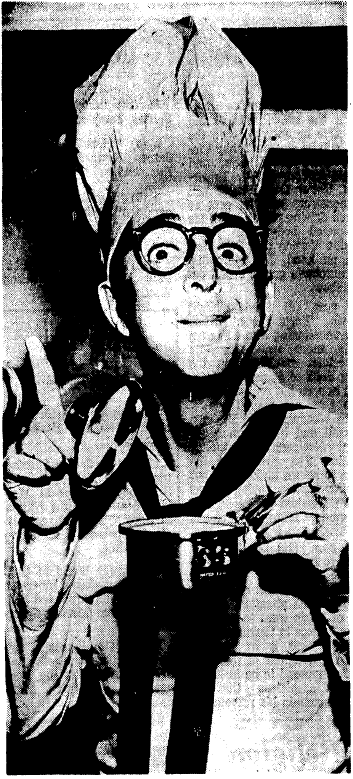
Arnold Stang and T.C.

No one is ever going to call Arnold Stang “The Man of a Thousand Voices.” But, then, he didn’t need a thousand voices. One was funny enough.

Stang shone on network radio. His New York whine leaping up high until it cracked, Stang’s Gerard related the pitfalls of his life to Henry Morgan, who forsook his acerbity and jadedness temporarily for the unaccustomed role of straight man. Morgan was smart enough to know the stooge would easily get the laughs and thereby make him look better. Stang shone on early TV as Francis the make-up plasterer with his boisterous cut-downs of the smug and mugging Uncle Miltie. Arnold Stang was, besides very funny, very distinctive, though columnist John Crosby once compared radio newcomer Jerry Lewis to him. Stang even shone, the critics nodded, opposite Frank Sinatra in a dramatic role in The Man With the Golden Arm (1955).

Stang also shone as the Katnip-besting Hoiman (as Stang preferred to call him) at Famous/Paramount studios. Perhaps it was Herman’s Brooklyn street-smarts that inspired Joe Barbera and Alan Dinehart to cast him as con-mannish lead in Top Cat, which debuted 50 years ago this month. Regardless, Stang led a small group of “Man of One Voices” actors, all with a distinctive sound—Maurice Gosfield, Marvin Kaplan and Allen Jenkins, none of whom had worked in cartoons—along with nightclub comic Leo DeLyon and actor John Stephenson, who provided extra voices when needed.

He almost didn’t lead them. Thanks to newspaper clippings, here’s a bit of a time-line. It’s quite unofficial and incomplete, but it gives you an idea.

● March 2, 1961. Richard O. Martin of the Salt Lake Tribune says ABC has bought Top Cat and will air it Wednesday nights.
● March 11. Bob Thomas of the Associated Press proclaims “the cast of one of next season’s most promising TV series: Top Cat, Choo Choo, Brain, Benny the Ball, Spook and Fancy Fancy.”
● April 24. Elayne Schwartz of the Provo Daily Herald states the show had been in production for six months.
● April 29. Joseph Finnigan of UPI interviews Stang about completing the role of a Chinese cook on Wagon Train. One newspaper’s sensitive headline: “Bulge-Eyed Arnold Stang Slant-Eyed”. No mention of Top Cat.
● May 5. David John Griffin of the Hearst papers says Michael O’Shea won the role of T.C.
● May 9. John N. Jones’ syndicated column indicates Gosfield, Jenkins and DeLyon (as Spook) had already been hired before O’Shea.
● May 17. Jones and Fred Danzig of UPI report Stang had replaced O’Shea.
● May 24. Jones says casting complete with Kaplan, Stephenson and DeLyon (Brain).

But picking Stang wasn’t that easy by his own recollection. This story from King Features Syndicate appeared in the papers around September 16, 1961.

Stang and Doberman Cavort as Cartoon Cats
By CHARLES WITBECK
HOLLYWOOD — Even though Hanna & Barbera have fooled around successfully with Yogi Bear, Huckleberry Hound and those sophisticated Flintstones, H & B are kings with cats. Remember the delightful Tom & Jerry movie cartoons, made by H & B that used to accompany M.G.M. musicals with Esther Williams and June Allyson? Well, the cartoons made most of the musicals look sick and Tom & Jerry even woke up the sleepers.
This October, on Wednesday nights over ABC, the sleepers should catch a new Hanna & Barbera product, “Top Cat,” or “T.C.” to all the kids. “It’s about cats who live in a New York back alley,” said T.C. voice Arnold Stang, the little turtle-like fellow who used to say “Big man, big deal” to Milton Berle.
Copy Cats
“As T.C., I have the mansion,” Arnold continued, “an ash can. I am the leader and these cats follow blindly. They’re not idiots just because they follow blindly either. I say let’s get on the ball. Go, go, go. Let’s do it and away the gang goes.”
Top Cat’s pals include Fancy Fancy, a very Cary Grantish type fella who wears a scarf. Then there’s Choo Choo, a dreamer, a Brooklyn poet who is played by Marvin Kaplan. Benny the Ball is a sweet little fat guy with the voice of Doberman from the Sgt. Bilko series, Maurice Gosfield. Officer Dibble is no cat but a man with a big stick and he’s played by Allen Jenkins. Other cats include Spook, a real beatnik and the Brain who is vague and dumb.
There are very few girl cats, says Arnold Stang, because the female characters are incidental. “One time I go for a cute nurse,” T.C. said, “when Benny the Ball has his tonsils out and I visit him at the hospital. But the affair doesn’t last.
“You see, T.C. comes up with the wildest dreams, but he never quite makes the dreams come true. I end up being most sentimental, I have lots of heart.”
Hip Cat
There’ll be other cats coming and going on the series, and one, A. T. Jazz for All That Jazz, (voice by Dawes [sic] Butler) got to Mr. Stang and he hopes A.T. will return often. “The kids will dig A.T.,” says T.C.
When Top Cat first got off the drawing board Hanna & Barbera began hunting for the right voices to fit these characters and half of Hollywood was called in to talk like cats. “These cats don’t think they're cats," explains Arnold. “They think they’re people.” Right away it begins to become confusing.
Cat-a-Rooney
Mickey Rooney was Top Cat for a while. Arnold Stang turned up and he was number one for a while. Even Jack Oakie stopped roller skating on his tennis court long enough to come into town and audition.
Judging from the list, the casting now seems topnotch, but H & B went to much trouble to get it right. Stang, for, example, was called back so often he finally said he wouldn’t come in again at night and audition. “Call my lawyer,” said Mr. Big Deal. 40 calls followed between the creators and the lawyer, and finally, Stang became the permanent T.C.
“I was playing a Chinese in Wagon Train (to be seen this fall), said Arnold, “and it took me two hours to put my makeup on. After playing a Chinese all day, I’d rush back to record for Top Cat and we’d stay until 3 a.m. I did that for a couple of weeks.
Then Stang moved over to Bonanza and became a little pickpocket. At night he’d record, changing dialogue when he felt like it. Officer Dibble became Officer Dribble, and phrases like “Oh, that’s beautiful—be-auti-ful” crept in. Or, “thank you very much. Now would you mind putting me down” was another Stang addition. “I like to fool around a bit with the dialogue,” says Arnold, who has a very good ear. This means re-drawing the storyboards, but H & B agreed.
Prolific Cat
It’s gotten to the point where Mr. Stang will also write a Top Cat, and this writing talent fits because Arnold is so immersed in the character and he has credit working on animated cartoons. One called Herman the Mouse, a theater cartoon, was sold to TV on the condition Slang’s name wasn't to be used. Why, Mr. Stang didn’t say.
“You have to think in terms of funny pictures in this business,” says writer-actor Stang. “T.C. has lots of right thinking in it.”

Say what? Mickey Rooney was Top Cat? Or the top Top Cat contender? Well, if Arnold Stang said so, it has to be true. But I’ve found nothing so far about it during my hunts in Old Newspaper Land. Hey, Mick, if you’re reading, drop me an e-mail and we can talk about it.

It seems odd the story would mention Stang’s lack of credit on the Herman and Katnip cartoons when they went to TV. He never had one when the cartoons appeared in theatres (did Paramount ever give a voice credit, other than maybe for singers?).

As you can tell by the time-line and Stang’s comments, he was auditioning for T.C. in April when he was doing Wagon Train before the role was handed to Michael O’Shea. We’ve talked about O’Shea before. If you missed the post, go HERE.

It’s inconceivable today that newspaper articles enumerating the accomplishments of someone involved in voice acting would omit a chunk of their career. But until Baby Boomers grew up and started writing about the cartoons they loved as children, that was the fate of one’s work on animated shorts, with the possible exception of Mel Blanc. Cartoons weren’t something to be taken seriously by feature-writing adults. They were old things that were run over and over and over on TV to keep kids occupied. Here’s an April 30, 1957 story with nary a peep about Stang as Cousin Hoiman.


Arnold Stang Is Handling Stable Of Personalities
By CHARLES BENTON

HOLLYWOOD, April 30—(INS)—Most of us have trouble enough handling one personality. Arnold Stang has dozens.
Some of them he developed himself. Some were created for him. Others just grew by themselves.
But basically they are all Arnold Stangs — pipsqueak-size characters with enough intestinal fortitude to look the world in the eye and deliver a resounding razzberry.
Should See File
“You should see the file of Arnold Stangs I have at home,” the diminutive, bespectacled, concentrated version of all these personalities said during a break in rehearsals for tonight’s Red Skelton Show on CBS-TV.
“You know what I mean—scripts where the writer has described one of the characters as ‘an Arnold Stang type.’ A lot of them I haven’t even played. They didn’t even bother to ask me. They call in 30 people to audition and never call me.”
Perhaps the best known Arnold Stangs today are the adenoidal character who specialized in gouging holes in Milton Berle’s ego on television and the odd, pathetic Sparrow of the movie “Man With a Golden Arm.” [sic]
The first Arnold Stang was a scrawny 10-year-old who walked into an audition for a children’s show 22 years ago and started chirping a serious dramatic reading. The audience roared.
“I.guess it was pretty funny all right—this little pipsqueak trying to give a dramatic reading,” Stang recalled with a shrug. “So they had me to do a comedy monologue. I just wanted to get into the business, so I went into the comedy.”
Remains Comedian
Stang has remained a comedian since then — although not because he wants it that way.
“The Arnold Stang I’m called on to do most really started on ‘The Goldbergs’ radio show,” recalled Stang, a serious, thoughtful and intelligent man.
“Then there was ‘Meet Mr. Meek,’ which has a variation, and ‘Duffy’s Tavern.’ Everything you do leads to another extension, you know. There’s a little bit of me in each character, along with many things that are foreign to me.
“Funny thing is that no one even remembers the best Arnold Stang I ever did. That was Gerard on Henry Morgan’s old radio show, a beautiful character.”
The Milton Berle-type Arnold Stang is probably the one to which Stang devoted the most attention—and is having the hardest time abandoning.
One Role Disappointing
The most disappointing Arnold Stang in the comedian’s brood of personalities is the one that brought him rave reviews in “Man With a Golden Arm.”
Stang had known about the story and the role for nine years—when Hollywood finally beckoned him to a sound stage for the part.
“I remember I said to my wife when I went to the studio that first day, ‘That’s the end of the Berle stuff. From now, even if I lay off for a year, I’m not going to take anything that doesn’t have my heart and interest.’”
Stang shook his head at the puzzling memory.
“Before the picture was finished, everyone was predicting that I’d win an academy award. The producer, Otto Preminger, was willing to bet money on it.
“I didn’t even get a nomination. The truth is, I guess, that The Sparrow was an odd-ball.”
After that, for a time, Stang clung grimly to his determination to switch to dramatic acting, or a least serio-comic parts.
“Then one day I said to myself ‘What is all this? What am I doing?’” he said. “I decided to go back to doing what they want me to do. I figure you’ve got to take it where it is and like it, and I’m having fun doing comedy."

Top Cat and the next two half-hour shows that Hanna-Barbera produced all seem to have this in common—they were prime time failures, but grew into successes when they moved to Saturday mornings and kids could watch them week after week after week. That took a bit of time. Perhaps that’s the reason only a few years later, Stang didn’t mention T.C. amongst his accomplishments in this June 26, 1969 interview. It was done by Newsday’s Leo Seligsohn, filling in for vacationing Gerald Nachman.

Arnold a Mighty Mite of Show Biz
Do you ever wake up in the middle of the night worrying about Arnold Stang, his pulse, his blood count, whether he could use a CARE package or maybe even just a nice bowl of hot chicken soup?
Don’t. The bantamweight Barrymore with the meanest snarl this side of Mickey Mouse doesn’t need help.
Towering over a cup of instant coffee he was preparing for a guest, the five-foot, three-inch actor stood in a dressing room recently in the Ethel Barrymore Theater in Manhattan, where he is playing in “The Front Page,” and dashed any fears that he needs tending to.
Unlike many a role-seeking leading-man type hiding a hangover behind a perfect smile, Stang is as fit as a miniature fiddle and as busy as an ant at a picnic. Since he made his first diffident appearance at the age of 9 on radio’s Horn and Hardart Children’s Hour, Stang has appeared in scores of television shows, Broadway productions, road shows, and films. Of the 20 movies he has done, including “The Man With the Golden Arm,” he has starred in 13.
♦ ♦ ♦
If, despite the long public exposure, Stang is still often recognized only as what’s-his-name, it doesn’t bother him. Pouring steaming water, into his cup, Stang explained that his image, if not his name, often precedes him on cross-country tours.
“I’m not a distant star,” he said. “Fans meet other actors after a show and ask for their autograph. To me they say, ‘You’re coming home with us for a nice home-cooked meal.’ Sometimes I go.
“Often people come to me with that knowing look in their eye and say, ‘Hiya, Woody.’ Or, if it’s not Woody Allen, then they think I’m Wally Cox.”
But, unlike the professional Stang who would probably whine and sound hurt in the manner of the Gerald [sic] he used to do on the Henry Morgan Show, or appear arrogant and carping, like the Francis he did on the Milton Berle TV show, the offstage Stang takes it all gracefully. “I never tell them they're wrong,” he said.
♦ ♦ ♦
Stang is as eager as anyone to joke about his might-mite image. In his dressing-room mirror is pasted a picture of his favorite hero, Charlie Brown of “Peanuts.” He lauded creator Charles Schulz as one of the country’s best psychiatrists. The cartoonist, the diminutive actor said, really understands how the little guy feels.
“Stang’s patience shows signs of wearing a little thin only at the assumption that Arnold Stang, married 19 years, the father of two teenage children, the owner of four basset hounds and a home in New Rochelle, is really the Arnold Stang type.
The offstage Arnold doesn’t look or sound like any helpless soul who needs his mother running interference. He looks far more mature than he seems onstage, though he prefers not to reveal his age. He operates without a press agent, writes when he’s not acting, and speaks of his wife and children with genuine pride.
Emphasizing that he leaves Arnold Stang, little guy, behind when he’s not working, he said, “I don’t feel that if I were playing the hunchback of Notre Dame I’d have to take the hunch home with me.”
♦ ♦ ♦
Nor does he see the images he creates on stage or before cameras as necessarily typifying the all-time loser. Referring to his role in “The Front Page” of a befuddled little process server seemingly intimidated by the mayor of Chicago, whom he eventually demolishes, Stang said,
“Actually, I’m Jack the Giant Killer, I can’t reach high enough to sock him in the jaw so I cut off his legs and lower him until I can.”
“No, I never yearned for a leading-man role. It’s illogical. I’d flunk the physical. Of course, I’m a great lover but when they cast romantic roles they usually want those big, California vegetables. They look beautiful but have no flavor.” It’s one thing you can’t say about the tiny titan of show business.

Let’s watch “one of TV’s brightest comedy lights” in 1954 as the subject of The Name’s the Same with Robert Guess-What-the-Q-Stands-For Lewis.


And here’s a great story from Michael Sporn about voice directing Mr. Stang which, under normal circumstances, shouldn’t be a problem.

Stang left behind some klunkers (Pinocchio in Outer Space is no It’s a Mad, Mad, Mad, Mad World) but who didn’t? Top Cat isn’t one of my favourite shows by a long shot but you can’t blame Arnold Stang. Nor the other voice artists, some of whom we’ll be talking about as we get closer to T.C.’s 50th birthday.

And, Stang-lovers, feel free to click on the “Topics” section of the blog for more.


P.S.: A big Yowp to Steve Sherman, from whom was extricated the TV magazine cover. You’re beautiful. Be-auti-ful.

Saturday, 10 September 2011

Huckleberry Hound — Spud Dud

Produced and Directed by Bill Hanna and Joe Barbera.
Credits: Animation – George Nicholas; Layouts – Dick Bickenbach; Backgrounds – Art Lozzi; Story – Warren Foster; Story Direction – Alex Lovy; Titles – Lawrence Goble; Production Supervision – Howard Hanson.
Voice Cast: Narrator, Spud, Housewife, Screaming People – Don Messick; Huckleberry Hound, Running Man. Screaming People, Radio Newscaster – Daws Butler.
Music: Bill Loose/John Seely, Spencer Moore, Jack Shaindlin, Phil Green.
First aired: week of September 26, 1960.
Production No. K-040.
Plot: Professor Huck takes on a potato that wants to rule the world.

A big Yowp to Errol C. who supplied a copy of this cartoon for me to review.

There’s something funny about a mad, rampaging potato that simply happens to be that way. It wasn’t turned into an evil beast by some crazed scientist like in another Huck cartoon, Science Friction. That’s just the way he is. I can imagine Warren Foster sitting in the story room thinking “Potatoes have eyes. What if they had real eyes? And a real mouth?” and then building and building until he got something ridiculous. And having a potato being crazed at the beginning eliminates the need for a set-up so the story can start faster.

This was the first cartoon aired in the third season of the Huckleberry Hound Show and one of the best of the year. George Nicholas’ animation isn’t as wacky as it could be, but there are some nice little touches, Daws Butler and Don Messick give fine readings and the ending’s appropriately goofy.

Foster started a bunch of his cartoons with Messick as a narrator intoning “This picture is dedicated to...” and that’s what he does here. We’re told Huckleberry Hound “saved this nation from a terrible fate” and the story is told in flashbacks. I like how Messick sounds startled when Huck answers back to him with a casual “Howdy, Mr. Narrator.” Before we get into a story, Foster fits in a gag that’s a pale version of the “chocolate malted” gag in Hot Cross Bunny (1948). He asks Huck if he’s working on a top secret experiment. “Shuckins, no” says Huck. It’s a “chocolate sody.” Daws gulps part of a line like he’s drinking something.

Bill Hanna now saves a pile of money by having 17 seconds of camera work over two backgrounds as Huck, in voice-over, explains how our story begins in Idaho, known for its potatoes. The rest of the cartoon cuts back and forth between the flashbacks and Huck in his lab talking to the unseen narrator. Huck explains that potatoes have eyes but one potato had a brain. “And he started using it.” Nicholas comes up with some circular brain waves coming from the potato with electronic beeping sounds coming out of Messick. The potatoes sprouts arms, legs and a mouth “then his brain started to scheme” to take over the world.


A silly little scene follows with the would-be King Spud talking to his potential subjects. “Potatoes, arise! No more will we stand for bein’ boiled, mashed and French-fried. We shall attack and win, win, win!” Of course, they’re just potatoes. They just lie there. So the evil spud decides to take on the world himself and grows into a huge, monster potato. How? Well, he just can. Huck’s pretty casual about it. “And you know, that potater grew so big, he started to, you know, attract attention to himself.” Like in any good ‘50s science fiction film, the citizenry runs in a panic. Being a Hanna-Barbera cartoon, that consists of four people in a cycle of three drawings on twos. Nicholas has the characters moving vertically in the cycle. I like the “what’s going on” look on the kid. The paint-rollered tree is pretty typical in Art Lozzi’s backgrounds.


Professor Huck gets a call from the White House. The one next to Snyder’s Bakery. Whoever lives in the white house asks Huck to capture the spud. So he does. And he provides us a running commentary as the potato knocks the crap out of him. “It’s only fair to warn you I have science on my side,” Huck warns. That doesn’t stop the potato from zinging him through the air. Huck avoids a chimney. “I didn’t miss that by much,” he remarks, looking back at it. Six frames later, he crashes into a taller chimney. “I didn’t miss that one at all,” he informs us. Huck hits the same chimney when he hides in a log but the potato picks it up and uses it as a blow dart gun. “I just gotta, you know, talk to the owner about this here chimney,” Huck tells us.


Nicholas cleverly uses Huck’s ears for effect. The potato grabs Huck around the head. Huck talks. We can’t see his mouth, so his ears flap in rhythm with Daws’ dialogue. Then, in a fear take, Huck’s ears go up and down, and his body stiffens.


Huck’s narration-to-the-narrator continues in the climax scene, where he tells us how he was in his scientific lab working out a plan to get rid of the potato. Fade to a short of Huck sleeping. The spud rips the observatory off its foundations. Huck wakes up. “I cain’t get a lick of work done under these conditions” and informs the potato, “You’re getting me all riled up. And when I riled, I start runnin’.” Off Huck runs into his experimental rocket. The potato follows him inside, Huck rushes out and slams the door to trap him. “Yer just small potaters now,” Huck chuckles. But suddenly the potato starts the rocket and it zooms into the stratosphere.

Cut back to the final scene in the present, with Huck and the narrator chatting away. Foster pulls off his biggest groaner when Huck explains “That spud is now a spud-nik.” And the rocket passes overhead, beeping just like the Sputnik 1 did in October 1957 (except the beeps for spud-nik were provided by Don Messick). Huck informs the narrator “there’s a powerful lot of explosives on that rocket.” Sure enough, there’s an off-camera explosion sound and a flash. I wonder if the effect was done by shining a light on the glass plate holding down the cel, though Nicholas draws a shadow whenever the strong light appears. Now comes the warped ending. Potato chips start raining down from the sky, with an appropriate shower sound effect. I suspect these are the first animated potato chips in history.


A couple of other oddities about the cartoon: it is the only Huck cartoon after the first season to be available on home video; it was released on an H-B compilation disc in 2001. And an internet site claims Scooby watched this cartoon in the A Pup Named Scooby-Doo episode ‘Wanted Cheddar Alive.’ As I’d rather be attacked by a giant, power-crazed Idaho potato than watch such a programme, I have no way of verifying the veracity of the statement.

The music’s pretty typical for Huck; we get both of Jack Shaindlin’s best-remembered cartoon chase cues.


0:00 - Huckleberry Hound Sub Main Title theme (with Clementine) (Curtin) – Opening titles.
0:26 - EM-147 DOCUMENTARY MAIN TITLE (Green) – Narrator dedication.
0:41 - MY DARLING CLEMENTINE (Trad.) – Huck mixes “sody.”
0:45 - TC-303 ZANY COMEDY (Loose-Seely) – Huck talks to narrator, pan over farm.
1:20 - TC-432 HOLLY DAY (Loose-Seely) – Pan over farm, potato had a brain.
1:47 - TC-22 SUBLIME GHOST (Loose-Seely) – Potato brain beeps, decides to be King Spud I.
2:11 - creepy reverb music (Kraushaar?) – “Today the potato field...”, potato grows.
2:41 - L-75 COMEDY UNDERSCORE (Moore) – Potato on street, radio, phone rings.
3:11 - TC-201 PIXIE COMEDY (Loose-Seely) – Huck on phone, spud lifts and drops Huck’s car, throws Huck.
4:21 - LAF-5-20 TOBOGGAN RUN (Shaindlin) – Huck flies through air, hits chimney.
4:34 - TC-437 SHOPPING DAY (Loose-Seely) – Huck in helicopter.
5:01 - LAF 2-12 ON THE RUN (Shaindlin) – Huck runs from spud, hides in log.
5:13 - LAF 5-20 TOBOGGAN RUN (Shaindlin) – Huck blown into air, hits chimney.
5:28 - L-75 COMEDY UNDERSCORE (Moore) – Observatory scene, rocket lifts off.
6:23 - L-1139 ANIMATION COMEDY (Moore) – Huck talks to narrator, explosion.
6:55 - LAF 72-2 RODEO DAY (Shaindlin) – Flash of light, potato chip shower.
7:11 - Huck sub-end title theme (Curtin) – Closing titles.

Tuesday, 6 September 2011

Music for Cartoons and Aliens

Stock music was as much a part of the Hanna-Barbera cartoons in the studio’s first couple of years as the animation or the sound effects (many of which arrived from the MGM cartoon studio film library along with Hanna and Barbera). You’ve read on the blog about some of the composers and a couple of the different music libraries that were used. We haven’t talked about the concept of stock music itself, though, because it’s a little off topic. However, I found a piece on production libraries quoting Bill Loose who, as you likely know, composed music that was used in Ruff and Reddy, The Huckleberry Hound Show and The Quick Draw McGraw. He was put in charge of studio operations for Capitol Records in February 1956, about the time the Hi-Q Library was being composed, arranged and assembled.

In this Wall Street Journal story from September 5, 1978, Loose doesn’t mention which library he’s referring to, but he was involved with a couple of different ones at Capitol. Cues from the OK and PMS (Production Music Services) libraries were composed by Loose (with Emil Cadkin or Jack Cookerly) in the late ‘50s, bought by Emil Ascher in 1967 and removed from the Capitol repertoire. But the story gives you an idea about the industry itself and what Hanna-Barbera might have paid to use stock music.


Need Music to Do Nearly Anything By? These Firms Have It
They Provide Recorded Tunes Quickly, Cheaply for Ads, TV Shows, Budget Films

By STEPHEN J. SANSWEET
The industry grosses only $2 million to $3 million a year and provides full-time employment for perhaps 75 people in a dozen companies. Yet nearly every man, woman and child in the U.S. is exposed almost daily to the product these firms turn out.
“People just can’t understand what I do or how I make money from it,” says the president of one of the largest companies in the field. “It’s usually easier to tell them I’m a bookie and let it go at that.”
What his and the other companies do is provide, quickly and cheaply, vast amounts of pre-recorded music that accompany television and radio shows, commercials, documentaries, industrial films and slide presentations, to name a few of their activities The clients of the music-library or production-music business are advertisers, producers, governmental agencies, universities and most large companies with audiovisual facilities There is a lot of international business. The industry may be small but for an increasing number of clients, it has become essential in helping them get their messages across to the public.
“Music is really an integral part of making any production look and sound expensive and professional,” says Ed Hansen, head of an independent film-production agency in Studio City, Calif. “But the cost of using all original music for a half-hour show might run $10,000 not counting any residual payments to the musicians for subsequent showings. That’s hard to justify when library music provides such a good alternative.
A Sour Note
Some people, however, aren’t so pleased with music libraries. Victor W. Fuentealba, in fact, wants to put them out of business. Because Mr. Fuentealba is president of the 300,000-member American Federation of Musicians of the U.S. and Canada, his position isn’t easily dismissed. “A couple of people are making a lot of money with products made cheaply overseas that displace our members here,” he complains. Library operators counter that if the residuals problem could be worked out they would record in the U.S. and provide more work for musicians.
The controversy between the union and the music libraries has been under way since the libraries sprang up in the U.S. 30 years ago. Many observers believe that it was costly union demands during television’s infancy that helped solidify the position of the libraries in the first place. Hundreds of independent stations working on shoestring budgets decided they couldn’t afford musical groups, so they switched to recorded music.
The heart of every music library is hundreds of hours of specially written musical pieces, often no longer than one or two minutes each. “These aren’t songs or tunes or even necessarily formal pieces of music with beginnings, middles and ends,” says Everett Ascher, president of Emil Ascher Inc. and its West Coast affiliate, Regent Recorded Music Inc. But the snippets can be cut blended or added to the narration skillfully enough to make the listener believe the music is an original composition.
While corporations are the heaviest users of library music for such things as training films, much of it finds its way onto television and radio, particularly as the background for local commercials. Theatrical films use mainly original scores, but library music shows up in many X-rated movies and occasional general releases like “The Blob,” which starred a then-unknown actor named Steve McQueen. It is also used extensively by background-music services such as Muzak and has provided themes for several television shows like “Mary Hartman Mary Hartman.”
Rising Costs
Because the musicians’ union won’t let its members record music for libraries, all the recording is done abroad, mainly by full-time orchestras in Europe. Costs have risen sharply there in recent years; today the cost of producing and recording one album with a 50-piece orchestra is $7,000 to $10,000. Libraries constantly have to add new albums to keep up with the latest musical tastes or fads. Most composers are European, but Americans also write for libraries, sometimes using pseudonyms. “The union called me in once and told me to stop,” one US composer says, “but I told them where to go.” William Loose, a 60-year-old Hollywood writer who composes mainly original scores, is among the more prolific American tunesmiths. He once spent three months writing, arranging and supervising the recording of five hours of production music. The score covered 2,400 pages.
Library usage fees vary. Thomas J. Valentino Inc., a long-established New York library that produces all its own music, allows clients to buy all its 157 albums for $754 and then to make unlimited use of them for $500 a year. Other libraries charge $60 to $70 for commercial use of each cut. There aren’t any residual payments. Besides the large amount of money saved, clients say the use of production music saves time and lets them know in advance exactly what they’re getting.
All the musical pieces are indexed to help the user. The 194-page Ascher catalog, for example, is broken down into 158 categories, ranging from ceremonial and funereal to eerie and outer space. Mr. Ascher says his library contains the music of 14 production companies on 900 albums containing 16,000 individual tracks written by more than 1,300 composers The titles of the selections range from dull (“Product Efficiency”) to weird (“Dracula’s Kitchen”) but are rarely descriptive enough to provide more than a clue to the client. However, since Mr. Ascher has an uncanny ability to remember most of the music in his library he is able to pull out records for suggested listening.
Picking the proper music is something of an art. “You have to keep in mind the visual what the announcer’s saying and what you’re trying to sell,” says Robert Canning, broadcast-production assistant for May Co., a Southern California department store chain. “Sometimes, I’ll spend a couple of hours looking for the perfect 30 seconds of music, although after the first seven or eight cuts everything starts to sound the same.”
In more complex projects, where several pieces of music have to be blended and cut to fit the screen action, expert editors such as Richard R. McCurdy are called in. “You have to make every effort to avoid a canned music sound,” he says. “But the quality of library music is excellent and as getting better all the time.”
One of the problems with production music is that the same piece may be used unknowingly by two or three different sponsors or shows. Another criticism is that some of the music sounds disturbingly close to popular hits. “We aren’t ripping off any composers,” says Roy Kohn of the Peer-Southern Organization. “Just because a piece has the feel of Glenn Miller or sounds like Count Basie doesn’t mean it’s a copy. We had library music that sounded like the themes from ‘Jaws’ and ‘Star Wars’ even before those two were written.”
There’s little ego satisfaction or public acclaim in the music-library business. One recent exception was a disco-classical number, “A Fifth of Beethoven,” which Walter Murphy, a young pianist and composer, originally wrote for the Valentino library. “I thought a couple of his pieces had commercial potential, so I pushed them,” says Thomas J. Valentino Sr., the 71-year-old founder of the library. Still, Mr. Valentino was surprised when “A Fifth” became so popular that it was added to the soundtrack of the movie “Saturday Night Fever” and the repertoire of the Boston Pops. “Everything is a gamble in this business,” he says.

My thanks to Bill M. for helping fill in some blanks in the article above, clipped together from Google News, and to Your Pal Doug for the pictures. They’re kind and generous people.

Now, I know you’re saying “Yowp, don’t you always have cartoon music in those posts about production music?” Well, for the most part, you’re right. And today is no exception. Unfortunately, I don’t have anything from the Langlois Filmusic library, though I do have a post on Langlois’ Jack Shaindlin coming. The majority of the cartoon cues that haven’t been posted here are from his library. However, I’ve managed to dig up some music from Ruff and Reddy.

As you know, Ruff and Reddy was Hanna-Barbera’s first effort after the studio formed in July 1957; some artists say they worked on it while still at the about-to-close MGM cartoon. Like The Huckleberry Hound Show and The Quick Draw McGraw Show, it featured music from the Capitol Hi-Q library. Several cues, like ‘TC-304 Fox Trot,’ ‘TC-215A Chase-Medium’ and ‘ZR-53 Comedy Mysterioso’, have already been posted here. They rarely or never were used in the other shows. We’ve got some more now.

As far as I know, all but two are all from the ‘D’ series, which I don’t have a lot of interest in. ‘D’ is for ‘dramatic’ and the music was perfect for westerns, detective shows and low-budget outer-space/horror feature films. And that brings us to our first set of cues.

The first Ruff and Reddy adventure (each was a 13-part cliff-hanger) involved an unexpected trip to the planet Muni-Mula (“That’s ‘aluminum’ spelled backwards”). Fortunately, Hi-Q had suitable scary space music, 15 pieces on two sides of an album, all by Spencer Moore. The first cue can be heard in production A-1 (Planet Pirates), the second in production A-4 (Mastermind of Muni-Mula) and the third in production A-5 (The Mad Monster of Muni-Mula).


L-1203 EERIE HEAVY ECHO
L-657 EERIE DRAMATIC
L-653 EERIE DRAMATIC

Here are the two ‘L’ series cues from the The Chickasaurus Egg Caper, animated by Carlo Vinci, the first cartoon of the fifth Ruff and Reddy serial. The first one is by Loose, who wrote at least a half-dozen reels with mechanical beds in a couple of different tempos featuring strings and/or horns meant to evoke chugging sounds. I’ve heard them in numerous industrial films from the late ‘50s/early ‘60s, which was the heydey for Hi-Q. The second was originally in the C-B music library by Harry Bluestone and Emil Cadkin and was repackaged in Hi-Q reel L-2A. You may recognise snatches of it from a couple of the “Seely Six” cartoons at Warners that used the Hi-Q library during a musicians strike (Seely was an executive at Capitol at the time, so that’s why his name was the one on the credits).

C-43A UNDERSCORE
CB-88A PUZZLED PUP

There are other Ruff and Reddy cues I haven’t been able to find and identify. To be honest, I have trouble sitting through those cartoons, though I saw some funny Ed Benedict people designs in one the other day.

While we’re at it, let’s give you a cue from Phil Green, originally found in the EMI Photoplay library. You’ll have heard this in Space Bear, when the quivery-voiced alien is pointing to a slide show of Yogi. Hi-Q put it in reel D-40 Dramatic.


EM-131I EERIE

And, finally, some bonus cues. These weren’t in Hanna-Barbera cartoons, they were either in live-action TV or movies and some you may have heard before. Here’s more of Spencer Moore’s work. The first two are from reel D-24 Dramatic, the next from D-1 Suspense Underscore and the last one from D-2 Dramatic.

L-1214 EERIE HEAVY ECHO
L-1216 EERIE HEAVY ECHO
L-2 SUSPENSE UNDERSCORE
L-7 SUSPENSE UNDERSCORE

These three are from Bill Loose and John Seely, the first from reel D-6 Tension, the second from D-3 Light Dramatic/Suspense and the last from D-4 Suspense/Mysterioso/Somber.

TC-52 TENSION aka FOREBODING DANGER
TC-69 SUSPENSE aka ANXIOUS EVENING
TC-73 MYSTERIOSO aka SPELLBOUND NIGHT

Finally, a cue originally from the Sam Fox library. It’s on Hi-Q reel D-27 Mysterioso. Evan Schaad has discovered it is a Lou DeFranceso cue called "Atomic Age."

SF-83 MYSTERIOSO

These are a little sampling. I haven’t bothered with more because, as the article says, the cues do sound alike after awhile, and you’d get weary listening to a bunch of not-always-melodic music anyways. However, we can only hope we may soon be able locate, and pass on, more of the music you heard in those earliest Hanna-Barbera cartoons of the ‘50s.

Saturday, 3 September 2011

Pixie and Dixie — The Ace of Space

Produced and Directed by Bill Hanna and Joe Barbera.
Credits: Animation – Ken Muse (Mike Lah uncredited); Layout – Walt Clinton; Backgrounds – Bob Gentle; Dialogue and Story Sketches – Charlie Shows and Dan Gordon; Titles – Lawrence Goble; Production Supervision – Howard Hanson.
Voice Cast: Mr Jinks, Dixie – Daws Butler; Pixie, Captain Micestro – Don Messick.
Music: Geordie Hormel; Bill Loose/John Seely; Spencer Moore.
Episode: Huckleberry Hound Show K-10, Production E-22.
First aired: week of December 1, 1958.
Plot: Pixie and Dixie rescue an alien mouse and use him to teach Jinks a lesson.

Nothing says the 1950s like space explorers and aliens. Next to cars with huge tail fins, that is. Sure, Buck Rogers and Flash Gordon date to about the mid-‘30s, and the flying saucer craze erupted in June 1948. But add to that a huge heaping of paranoia (né “Stop the Commies From Taking Away Your Freedom!!!”), and the decade that brought you the pleasant suburban misadventures of Beaver and Wally Cleaver also generated wild fear via seemingly endless numbers of outer space invasion movies.

Animated cartoon writers were, no doubt, pleased with all this, as it gave them something to gently lampoon. And what cartoon character in the ‘50s didn’t meet up with some kind of alien? Bugs and Daffy did, Popeye battled some, Woody Woodpecker vanquished termites from Mars. Perhaps significantly, Hanna and Barbera’s Tom and Jerry did not. But Bill and Joe made up for lost time when they got their own studio. Ruff and Reddy, Huckleberry Hound, Yogi Bear, Augie Doggie, Snooper and Blabber, and the Flintstones all had encounters with beings from another planet. And so did Pixie, Dixie and Mr. Jinks in Ace of Space.

But Barbera and dialogue writer Charlie Shows also gave a nod to space explorer TV shows (and their comic book spin-offs) like Tom Corbett, Space Cadet; Rocky Jones, Space Ranger and Captain Video as the cartoon opens. Pixie and Dixie are reading a Captain Blastoff comic book. Whether Shows is covertly commenting on the triteness of the writing on those early series, or he simply thought being repetitious was funny, I don’t know.


Dixie: “Captain Blastoff, callin’ Earth.” “Come in, Captain Blastoff.” “This is Captain Blastoff preparin’ to blast off.” (to Pixie) Love that Captain Blastoff.
Pixie: Stop blastin’ off and keep readin’, Dixie.
Dixie: “With a mighty roar, the rocket ship Blast Off blasted off from the planet—what else?—Blast Off.”

Jinks is watching this less-than-action-packed scene and it gives him the idea to “blast” the meece as “Captain Jinks” (though he’s not trying to convince them he’s actually from outer space; maybe he’s just breaking the monotony). He uses a fish bowl as a space helmet and a suction-cup dart gun to “capture” Dixie by pinning him by the tail with a dart above his mouse hole.


Ken Muse gives us a silly Jinks run cycle, six drawings on twos. Dixie rescues Pixie before the cat can grab him. There are thumping sound effects as Jinks’ feet hit the floor. By the way, ever noticed how entrances to mouse holes in cartoons are always neat and tidy? They all look like someone has used a circular saw and sander to create a perfect arch. And have you noticed how mouse holes only have doors when it’s convenient to the plot (the same as how characters have bare arms except when the scene calls for a watch)?

Sorry, I drifted off there because I haven’t decided whether to cut Charlie Shows some slack. I haven’t been too kind to him at times about his work on Hanna-Barbera cartoons. Some of his dialogue is either banal or just not funny. And in the next scene of Shows has crafted a whole scene of dialogue that’s redundant. Pixie and Dixie describe what we can see on the screen for ourselves. I suspect it’s not altogether Charlie’s fault. Joe Barbera was so used to writing continuity without words for Tom and Jerry that he’s done the same thing here; this could be easily handled simply with visuals (and accompanying sound effects). So Charlie’s got to write words for a scene that doesn’t need them. On the other hand, you’d think a cartoon writer could come up with clever phrases or puns or something other than superfluous blabber.

Pixie and Dixie hear something outside. It’s not “another Captain Jinks gag” as Dixie disgustedly speculates. It’s a small spaceship that crashes against the base of a garbage can. Inside is a little green mouse wearing either a see-through helmet topped by a TV antenna, or a mutant version of the Nabisco logo.

For you kids reading, there was a time that it was thought little green men lived on Mars, hence we have a little green mouse. The idea of aliens who were little and green seems to have come into being simultaneously with the flying saucer craze; I’ve found references to them in the late ‘40s. Prior to that, little green men were gnomes or fairies or other earth-bound mythical creatures.

Pixie and Dixie react to the alien in a typically ‘50s way—they run away in fear. Or try to. The alien freezes them in mid-air. Then the green mouse walks toward them in a mechanical four-drawing cycle on twos, with a little pat-pat sound effect accenting the steps. “Howdy, stranger. You from out of town?” is the best the apprehensive Dixie can ask. The mouse doesn’t disintegrate him for asking such a stupid question. He nods his head and goes “Binka, binka, binka” (bringing to mind Augie Doggie’s alien friend Boinka Boinka). The alien and the meece become friends; the alien even has a business card in English. “Golly, he’s a space mouse!” says Pixie. Gee, no kidding. I’ll have to rethink my comment about cutting Shows some slack about his dialogue.


Captain Micestro, as the business card names the green space rodent, demonstrates why there are no cats on the planet Mousestro (“How come, chum?” is the Charlie Shows rhyme in this scene). He zaps a letter box in the middle of the yard and it disappears. How will Pixie and Dixie get their mail now? We’ll have to worry about that later. On to the next scene.


Dixie (as in many cartoons, Pixie doesn’t really do a lot in this one than comment) enlists the alien’s help in “teachin’ a smarty-aleck cat a lesson.” He borrows Captain Micestro’s helmet and ray gun then stomps out after Jinks when the cat nails him with another suction-cup dart. Ken Muse has given Dixie a stride of eight drawings on twos. “Well, now, don’t tell ol’ Jinksie you’re going to disseminate me,” says the cat. No, he does it to Jinks’ milk dish instead. The cat bares its claws and charges at the mouse, who temporarily freezes him in mid-air. Jinks decides its best to hide. First, the closet. The ray gun makes the door disappear. Then behind a chair. The ray gun makes it disappear.

Jinks grabs a sword over a fireplace. “Step up and get sliced, moon mouse,” says the cat. The ray gun melts the blade of the sword. Wait a minute. Something’s different here. Jinks doesn’t have his little half-row of upper teeth. And his head is still but his mouth moves around his face during dialogue. Why, that’s not Ken Muse animating now. It’s Mike Lah making a guest appearance.

Want to see the difference? Muse’s Dixie is on the left and Lah’s is on the right. Notice the mouth placements are different, too.


Lah graces Dixie with a basic, unexaggerated walk cycle, but it’s the closest thing to full animation in a Hanna-Barbera cartoon. It’s in 16 drawings on ones. Nice and smooth. I’ve slowed it down so you can see it better. That distracting splotch on the wall is on the cartoon; Dixie passed it twice.


“You can not escape, you cowardly Earth-cat. I will find you, wherever you are,” says Dixie in somewhat deliberate syllables. “Ho, ho, ho. There you are! Hiding under the pinanno.” The ray gun zaps away the legs of the piano, which falls on top of Jinks. Time for a Charlie Shows rhyme.


Jinks: This space ace is going to race for the great open spaces.

The ray gun makes the piano disappear. Apparently Dixie’s vocabulary is catching as Jinks looks around and asks “Hey! Where went the pinanno?” I suspect you can credit Daws Butler for the mangled word.


Jinks runs away, leaving orange circles behind. Muse takes over to animate Jinks skidding, trapped, in a corner, then back to Dixie’s eight-drawing stride cycle, as the mouse threatens to blast the cat. But Joe Barbera now twists the story. The cycle fades overtop of Dixie walking on his bed. Out of nowhere, it turns out there was no alien mouse. It was all a dream. Huh? Dixie was dreaming about reading a comic book? What the? Oh, well. “That settles it, Dixie,” says Pixie, dragging the Captain Blastoff comic along the floor. “No more space comics for you.” He drops it out the window into the garbage can below. But then Jinks pops up out of the garbage can, reading the comic. “Love that Captain Blastoff,” he tells us as the iris closes.


So ends another cartoon where a fourth character arrives to help the meece take on Jinks (Judo Jack, Cousin Tex, Boxing Buddy among them).

The version of this cartoon on DVD has my favourite arrangement of the Pixie and Dixie theme. I don’t know if Hoyt Curtin hired a marching band, but he’s got a tuba, triangle and (I think) a celeste in here. Noticeable by its absence on the soundtrack is any music by Jack Shaindlin; the music’s all from the Capitol Hi-Q library. It’s a shame the sound-cutter didn’t use any science-fiction type music like in the Ruff and Reddy Muni-Mula adventure; perhaps it was only in the contract with Capitol for that series alone.


0:00 - Pixie and Dixie Main Title instrumental (Curtin).
0:26 - ZR-51 LIGHT ANIMATION (Hormel) – Meece read comic book, Jinks nails Dixie with dart.
1:31 - TC-303 ZANY COMEDY (Loose-Seely) – Jinks laughs at capturing Dixie, space ship crashes, alien mouse emerges.
2:44 - TC-202 ECCENTRIC COMEDY (Loose-Seely) – “I’m getting’ out of here!”, meece make friends with alien; Dixie asks about “teaching a smarty-alec cat.”
4:04 - TC-201 PIXIE COMEDY (Loose-Seely) – Captain Micestro nods, Jinks zapped, door, chair vanish; sword melted.
5:21 - no music – Jinks grabs rifle, makes threat.
5:32 - L-1154 ANIMATION COMEDY (Moore) – Rifle zapped, “Where went the pinanno?”
6:24 - no music – Jinks runs into corner, starts pleading.
6:31 - L-1154 ANIMATION COMEDY (Moore) – “Dixie, boy. I’m you’re buddy,” Dixie wakes up, comic book in garbage can, Jinks reads comic.
7:09 - Pixie and Dixie End Title theme (Curtin).

Thursday, 1 September 2011

Yogi Bear, Sunday, September 1961

Hanna-Barbera had a great stable of funny animals, so why not take advantage of it in comics? That seems to have become the attitude around the studio by September 1961, as “friends” of Yogi we all know and love from other cartoons started appearing in his Sunday newspaper comics.

(The less said about the fact this concept morphed into inexcusable TV shows like Yo Yogi!, the better).

Courtesy of black-and-white scans of the archives of the Ogden Standard-Examiner (Salt Lake City’s channel 2 broadcast Yogi on Wednesday evenings), here are the Yogi Sunday panels for 50 years ago this month. Mark Kausler has taken the time to scan each of the comics in colour and has them HERE.

There were golf games on a couple of episodes of The Flintstones, but I don’t recall one with Yogi Bear. This one is from September 3rd. Still, jokes around the idea “play it where it lies” were not uncommon; they were easy on network radio when you only needed sound effects. Maybe this inspired the mini-golf at those Jellystone tourist spots. Boo Boo underwater is a great drawing. Why couldn’t he have been this active in the cartoon shows?


There’s a touch of Flintstones in the September 10th where Fred is turned into temporary rock star Hi Fye, mobbed by teenagers. In this Yogi comic, he does it purely by accident. Gotta love the Boo Boo dance. I hope the kid in the last panel means Avalon. Sinatra would be about 15 years out of date.


Yogi had a birthday party in a one-story, half-hour edition of his show on the week of October 2, 1961. Naturally, the promotional people promoted the crap out of it, with Yogi Bear parties (some in studio at the local station that ran Yogi). You can see in San Antonio, they had a TV give-away tie-in. An obvious place for a bit of a free newspaper space was in the Yogi comic, so Yogi’s birthday was the centrepiece of the September 17th cartoon, though the coming TV show isn’t mentioned and it was up to kids to make the oblique connection.

I love the last drawing, and not just because of the warped concept of a birthday cake-shaped stomach. It’s got just about everyone’s favourite H-B “Kelloggs” characters in one well-crafted place. What’s interesting is who it doesn’t include. Pixie, Dixie, Baba Looey, Snooper and Blabber are missing, but Harvey Eisenberg found room for them in a large panel in the missing top row. But we don’t get Yakky Doodle, even though he was featured in his own cartoons on Yogi’s show. My guess is he was being held between two pieces of bread by Fibber Fox, who was about to get pounded by Chopper, with the words “I’ve grown accustomed to your fist.” There are some subtle head tilts in different directions in the last panel.


Augie and his dad are back on September 24th. The yelling drawing is terrific. And a kid with a gun? How can you tell this is 1961? What’s odd, even for ‘61, is Augie keeps calling his father “Doggie Daddy,” not “Dear old dad” or “overdue library book-reading dad” or something like that. I don’t think he ever called him “Doggie Daddy” on the TV cartoons.


Harvey loved putting at least one silhouette drawing in each comic it seems.

As usually, the top row is missing (I wonder how many newspapers actually ran it). And you can click on the comics to enlarge them.