Sunday, 13 March 2011

Jerry Eisenberg, Part Two

When we last left young Jerry Eisenberg, he was waving goodbye to Chuck Jones and Warner Bros. on his way to a new job in the world of television animation.

Part of the interview talks about Dan Gordon, who worked with Joe Barbera at Van Beuren and then Terrytoons in the ‘30s. Barbera has a couple of funny Dan Gordon stories in his autobiography and writes:


Gordon was brilliant and impulsive, and went on to work for Hanna-Barbera when he created the first “Flintstones” storyboards.

Barbera also reveals Gordon was an aficionado of “Mount Vernon rye, neat.” And we don’t mean the bread kind. Unfortunately, Gordon had a problem with alcohol long before he was a charter member of the Hanna-Barbera studio in 1957. Iwao Takamoto related in his book about the days when Gordon worked at the Fleischer studio in Florida, circa 1940:

Stan [Green, Takamoto’s former assistant at Disney] used to drive Dan to and from the studio, because Dan was too inebriated to drive himself. One time, Stan said, Dan had not bothered to close the door after getting in, and when Stan took a sharp turn, the door flew open, and in a flash there was no more Dan. He had fallen onto the road. But he was so “protected” by alcohol he was not even hurt.

This part of the interview was intended to deal with the short cartoons like Huck, which is the focus of the blog, but Jerry jumped ahead several years, so we backed up in time a little later in our chat. That means you’ll be reading later about The Jetsons, including the work on the show by Bobe Cannon.

Yowp: Was Joe Barbera the one who hired you to do layout at Hanna-Barbera?

Jerry: Right. Yes. You see, the layout department was Joe’s department. Joe and Bill divided the duties. Joe was handling the creative end of things and Hanna was running the studio. The layout department was Joe’s because six months out of the year, several of us would do development work with him. And then, once the shows were sold, we’d work six months on production. And Bill would run camera, and ink and paint, and animation. But Joe reserved the layout department [for himself] which was good, because we didn’t have to deal with Hanna.

Yowp: Was Hanna-Barbera paying scale at that time?

Jerry: Well, whatever the union scale was, I guess so. There were probably some people making premium but, I think, when I started there I was at assistant animation scale—maybe it was a little bit more for layout—but then I remember after about four months, Joe Barbera called me in and said “We’re raising you to such-and-such.” And I guess in the contract it called for every so many months in layout and you get a raise. Then you become a journeyman.

Yowp: I was checking some credits on the cartoons after you arrived at the studio to find your name. There’s a Pixie and Dixie cartoon.

Jerry: I know I worked on some of the Pixie and Dixie shorts.

Yowp: It was called Magician Jinks and the thing that was really cool about it is Jinks conjures up a dinosaur with a rhinoceros horn. It has a very Flintstones look. I’m presuming you would have designed the incidental characters in it.

Jerry: In those days, we used to design the incidentals and the props and the backgrounds. We didn’t have a model department, although on some of the lead characters, Dick Bickenbach did some of those. Later on, I did some, Iwao Takamoto did some, and I can’t remember who else.
What I really liked the best as far as layout was laying out on The Jetsons series. I liked the future stuff. You didn’t have to follow any rules, you could really use your imagination on what things might look like or how they worked. I really enjoyed that but we only did it for one season, unfortunately.

Yowp: How long did it take to lay out the shorts?

Jerry: Most of them were like, five, six, seven minutes, maybe. Probably seven, because you’d do three in a half hour and you have to allow about nine or ten minutes for commercials. But I used to lay them out in a week or less. I remember Hanna started an incentive thing. He wanted to get work done quicker, so he said “Look, if you guys can lay it out in less than five days, you get extra money. So I used to average four days and get an extra day’s pay. Instead of five days, I get six days. And that was nice; the money came in handy. Willie Ito was pretty fast.
Bill Hanna did something I didn’t like. Are you familiar with Dan Gordon?

Yowp: Oh, yes.

Jerry: Well, his son Kevin came to work there; Dan got him in and he was going to do layout. And Dan was telling me that Bill was meeting with Kevin and somebody in accounting kept records of what everybody was doing. And Kevin was saying “How much time do I have? What’s the schedule?” So Bill said to the lady “What does Jerry do?” And, of course, I was one of the fastest there. And he wanted Kevin to do pretty much what I was doing. And that wasn’t fair because people work at different speeds. I really didn’t like that and Dan didn’t like it, either.

Yowp: I don’t recall Kevin’s name being on any credits at all.

Jerry: Well, I don’t know why not. Unfortunately, Kevin died back then [in 1964, age 28]. He was a smoker and he fell asleep with a lit cigarette. He was living in some apartment and probably died of smoke inhalation. That was a tragedy for Dan. And then Dan’s other son died in a car accident not long after that.
My father really liked him [Dan]. He was really a nice man and very, very talented. He was a big help. But I thought that was shtty what Bill did with his son. He should have gotten an average. Let’s say there was ten of us in layout, what was the average amount of time for laying out a short. I probably was averaging four days or a little over. Other people were maybe taking the full five days or longer. Or maybe someone was doing it in three and a half days. But it wasn’t fair to expect Kevin to do what I was doing.

Yowp: Had he worked in another studio before that?

Jerry: I really don’t remember.

Yowp: And in Dan Gordon’s case, and your dad’s, they worked with Joe Barbera back in New York.

Jerry: Well, yeah, that’s where they met Dan and his brother George Gordon and a lot of other old-timers.

Yowp: Art Lozzi was saying he and Monte [Fernando Montealegre] and Bob Gentle, who were painting backgrounds, all had different styles. Can you look at a layout and figure that it’s one guy’s style over another?

Jerry: Oh, yes, I could tell the difference, my style, Iwao’s, Willie’s, Bickenbach, Walt Clinton and there was a funny guy from Texas. Lance Nolley. He’d come over from Disney. I think there was a big layoff at Disney so Joe and Bill got the benefit of getting a lot of good people from there.

Yowp: Did the layout guys choose the colour schemes for the cartoons?

Jerry: Sometimes. I remember being involved when I was supervising layouts for some of the shows later on, I’d work with the ink and paint people selecting colours.

Yowp: I take it you’d get a board from, say, Warren [Foster] or Alex...

Jerry: Oh, Alex Lovy. His stuff was terrific. We loved laying out off of his boards.

Yowp: So you get boards from them. How much of what they put on the board did you hew to when you started doing the layouts?

Jerry: Well, if it was Alex’s board, his posing was terrific, you know. He didn’t really draw on model. Sometimes, his drawing we liked better than the official model.
Like, take Wally Gator, the alligator character. Alex used to draw Wally; his was so funny-looking, we preferred it to the original model. But we had to do it like the model.

Yowp: So, when you arrived, was there a head of layout?

Jerry: Well, Bick sort of was the head of layout, but it really wasn’t formalised that much, but we used to take our layouts for him to check and even Joe Barbera liked to look over our layouts once in a while; we’d take them up to his office. I learned a lot from Joe. And Bick. And Joe kept doing that up until, let’s see, in ’63 their building was built up from where we were on Cahuenga and we moved in there, and Joe was still looking at our layouts maybe for a couple of years or so, then he got too darned busy.

Yowp: How much direction did the layout guys give to the background people in putting together stuff?

Jerry: We would design the background and they would pretty much follow them. Sometimes, they would add stuff. I remember on The Jetsons, Monte and the guys were doing a beautiful job on some of our backgrounds ‘cause I remember Iwao and I would go and look at the finished backgrounds. I saved some, thank goodness, they’re just beautifully painted. But once in a while, they’d put in a plant, like a potted plant, and my criticism was sometimes it would be a little too strong and would distract from, let’s say, the characters. I always tried to be careful when I staged a scene that the background wasn’t overly busy behind the character or something wasn’t going to distract from the character. So once in a while we’d have to ask them to modify stuff like that, or tone it down.


Yowp: I imagine laying out a half-hour show like a Jetsons is somewhat different than a short. What kind of process was involved?

Jerry: Well, as far as the layout process, we had teams. Myself, Iwao Takamoto and Jack Huber were a layout team and there were usually three acts to a half-hour show like that. We’d each do an act. We’d do the characters and the backgrounds and the props and everything. Then, of course, it would go to the animation director who would do the exposure sheets and time it out, then it would go to animation and background.

Yowp: Can you clarify some of the titles for me? You’d see Alex or Paul Sommer get a ‘story director’ credit and Nick Nichols would get an ‘animation director’ credit. What’s the difference between the two?

Jerry: Nick, you might say, was the animation timer. He would do the exposure sheets, time everything out. And he was so good and so fast at that. He was amazing. He could do so much work. He came over from Disney; he was an animation director at Disney on a lot of their shorts. But he was very fast, he really developed in a different way on the television stuff. Of course, the story director was doing the storyboards. I don’t know why they used that term.

Yowp: They changed somewhere during the middle of one of the seasons [1959-60]. Originally, Dan Gordon got a credit to do story sketches and then suddenly Alex got a credit as a story director.

Jerry: I think the ‘story director’ title made more sense to me when they started doing storyboards from a script, rather than a writer’s storyboard. Once things started getting so busy, especially with The Flintstones, Joe was hiring writers who had written on The Honeymooners and they didn’t know how to draw so we’d just get scripts and the storyboard guy would be more of a story director when you’re doing a board off of a script.

Yowp: How long would it take to lay out one sequence from The Jetsons or The Flintstones?

Jerry: One week per act, I guess. Hanna was never that generous with the time. Later on, it was a little more generous after he and Joe sold the studio. Joe always regretted that.

Click for Part three ... including Lame Loopy and the creation of The Flintstones.

Saturday, 12 March 2011

Quick Draw McGraw — Treasure of El Kabong

Produced and Directed by Bill Hanna and Joe Barbera.
Animation – Ken Muse; Layout – Walt Clinton; Story – Mike Maltese; Production Supervision – Howard Hanson (no credits).
Voice Cast: Narrator, Walker de Plank, First Mate – Hal Smith; Quick Draw, Baba Looey, Goblet Owner, Mayor – Daws Butler; Mayor’s Daughter – Jean Vander Pyl.
Music: Phil Green, Jack Shaindlin.
Production No: Quick Draw McGraw Show M-019, Production J-55.
First Aired: week of Feb. 1, 1960 (rerun, week of July 4, 1960).
Plot: El Kabong sets out to rescue the kidnapped mayor’s daughter from pirate Walker de Plank.

Somehow, amidst all the silly dialogue, bad puns and shameless groaners in this cartoon, Mike Maltese fits in a plot to hold it all together. Though no one really watches an El Kabong adventure for the plot. They watch for the ridiculousness of someone getting conked with an out-of-tune guitar by an idiot. And Maltese doesn’t disappoint there, too.

There are some who churn out corn because they think it’s actually funny. Then there’s small-time vaudeville-loving Maltese, whose attitude seems to be “We’re pulling this old one on you and I defy you not to laugh at it.” Here’s an example:


Mayor: Please save her, El Kabong. Walker de Plank is holding her for ransom.
El Kabong: What’s the matter? Can’t Ransom get his own girl?

And that isn’t even the most outrageous one.

Filling a cartoon with this kind of stuff can be dangerous because the audience may simply get tired of it. But we’re helped by the fact the corn is played completely straight, and by Daws Butler’s wonderfully stupid delivery for Quick Draw/El Kabong.

Great thumbnails .jpgs of the storyboard for this cartoon once existed on the internet. I can’t dig up all of them, just the first seven. Sorry for the size; that’s all I have. Someone reading this will know if Dan Gordon or Alex Lovy drew these. Gordon had a “story sketch” credit on the first season of Quick Draw, but Lovy was listed as “story director,” which Mark Evanier once explained to me meant he “did most of the timing and a lot of the boarding.” I confess ignorance in how many steps there were between Mike Maltese and whoever did layout.


Maltese used a poetic opening for ‘El Kabong’ and ‘El Kabong Strikes Again’ and he does in this cartoon, the third of the series. Unlike the other two cartoons, Don Messick doesn’t handle the narration (or appear at all). Hal Smith does the job:


Narrator: Harken, friends, young and old,
To the tale of daring buccaneer bold.
Walker de Plank, that was his name.
Pirating gold, that was his game.

Walker now emulates Daffy Duck in ‘Daffy Dilly’ (1948), ‘Beanstalk Bunny’ (1955) and, especially, Bugs Bunny laying around in the opening of ‘Bunny Hugged’ (1951) by turning to the camera and casually saying “It’s a living.” Need we say who wrote those three cartoons?


The poetry continues as we’re told de Plank pillages for gold, then stops as a townsman gives up his gold goblet with regret because “it was great to keep old razor blades in.” Now, we cut to the town’s mayor tied to a stake, as his daughter (with thin arms and teeny hands) laments:


Daughter: Is there no champion of higher rank
Who fears not this villain, Walker de Plank?
Narrator: But, hark! In the distance...
(cut to Quick Draw caterwauling off-key)
...a sweet-rendered song.
Our troubles are over. It’s El Kabong!

Quick Draw belts out another one of his nonsense songs.

QD: Ohhhh, I’m a cowboy from ol’ Wyomin’
That’s why they call me Tex.

The song’s interrupted by the daughter’s screams. Quick Draw zips off camera in a swirl of lines, returns as El Kabong, then zips into scene as Walker de Plank takes the daughter hostage. You’ll notice the mutant trees. They’re transparent.


“What’s an El Kabong?” asks the villain. He finds out from a guitar on the head. All it does is make him rush into a rowboat with the beautiful daughter where his crew paddles them to his pirate ship. It’s at this point we get the corny dialogue we mentioned at the outset. Maltese follows it up with an even more obvious, old gag:


Mayor: You must save her.
El Kabong: And save her I will!
(Kabong rushes off camera then returns)
El Kabong: I’d ask you to come along but I see you’re tied up at the present.


El Kabong jumps off a conveniently-placed diving board at the end of a pier and flies into a cannon on board ship (“I geeve you zee one gun salute,” says de Plank) which promptly shoots him back onto the pier.

Baba: You thin’ you’d better quits, El Kabong?
El Kabong: El Kabong never quits. He rights wrongs. Punishes oppressors. Gives to the poor. Robs from the rich. Borrows from the middle class.
Baba: I thin’ that’s Robin Hood.
El Kabong: Quiet! I’ll do the thin’in’!

So Quick Draws uses “trickery, connivery and low-down skulduggery.” He and Baba disguise themselves as “two transient, freelance pirates.” (“Come aboard, transient, freelance pirates,” invites the bad guy.

Now we get a whole string of groaners as Quick Draw tries to convince de Plank to let him and Baba join his crew.


Quick Draw: There’s nothin’ we don’t know about ships.
Baba: Thass right.
de Plank: Then I will test you. What are we standing on?
Quick Draw: On the floor, what else?
de Plank: What holds the sails?
Quick Draw: A kind of a telephone pole, that’s what.
de Plank: What’s a mizzenmast?
Quick Draw: A mast that’s mizzen until it’s found.
de Plank: What’s a poop deck?
Quick Draw: A poop deck is a, uh, it’s a, uh, uh
de Plank: You two can have a conference if you wish.
Baba (whispering): It’s a place for tired sailors who are pooped.
Quick Draw: Yeah! That’s what I was goin’ to say.

That’s good enough for the villain. The exchange is interrupted by the daughter, who joyfully recognises El Kabong. After a quick “costum-ee” change, we get the inevitable sword fight, which gives our hero a chance to say “Oooh! That smarts.” Like the two earlier El Kabong cartoons that made fun of the dialogue between Zorro and his opponent during sword play, this one features a chummy conversation between the two after they discover they were both taught fencing by Old Scabbard Le Stick. They stop and gab until the imprisoned daughter watching it gets ticked off.

Daughter: Oh, come on. Knock it off you guys. How about me? I’ve got to be saved, you know.
El Kabong: Ooops. I’d better get on with my kabongin.’ It was nice talkin’ to you.
de Plank: The pleasure was all mine.


With that, de Plank gets kabonged for the second time in the cartoon. This time he dives overboard, but not before dropping a lit match in the gunpowder hold. Baba Looey dives through the hatch and retrieves it. But Quick Draw’s annoyed. He is the hero, after all. So he drops the match back in the hold and berates Baba long enough to allow the ship to blow up.


The next scene is of El Kabong, Baba and the daughter on a wooden remnant from the ship, with the kabonger being used as a paddle.


El Kabong: So, um, it was a short match.

The daughter is saved and, though the grateful mayor (still tied to the stake) doesn’t explain how, the town treasury is, too. The shot cuts to Baba and a puny guitar.

Baba: Hey, Quickstraw. I theen’ your kabonger shrunk to a ukulele. What we do now?
Quick Draw: We do a sequel, what else? El Kabong Goes to Hawaii! (looks at daughter and father) I’d ask you to come along, but I see you’re still tied up.

The final shot is of Baba using a long stick as a paddle with El Kabong laying on the wooden plank, strumming the ukulele and badly crooning about “rootin’-tootin’, pineapple-shootin’” in Hawaii.

There was one more El Kabong cartoon in the 1959-60 season that repeated some of the plot elements in this cartoon, only with funnier character designs.

The cartoon features a couple of familiar public domain sea-going melodies, perhaps from the Hi-Q ‘X’ series. As usual, I don’t have names for a bunch of the Shaindlin tunes.


0:00 - Quick Draw sub-main title theme (Curtin).
0:15 - Sailor’s Hornpipe (arr. by ?) – De Plank on ship, rows ashore.
0:42 - GR-96 BY JIMINY! IT’S JUMBO (Green) – De Plank robs goblet, daughter wishes for help, Quick Draw sings on hill.
1:11 - Wyoming Tex song (Maltese) – Quick Draw sings, daughter screams.
1:19 - tick tock/flute music (Shaindlin) – “Sounds like a female woman...” to “El Kabong kabongs again!”
1:32 - [blank] FIREMAN (Shaindlin) – de Plank holding daughter, kabong!, dialogue with mayor, El Kabong flies into cannon, shot onto pier.
2:34 - jaunty bassoon and strings (Shaindlin) – Baba thin’s, El Kabong pledges trickery, de Plank asks “Who is there?”
3:11 - A Life on the Ocean Wave (arr. by ?) – Quick Draw and Baba as pirates in rowboat.
3:18 - CRAZY GOOF (Shaindlin) – Quick Draw takes pirate test, daughter recognises El Kabong, “Shucks, m’am.
4:02 - GR-99 THE DIDDLECOMB HUNT (Green) – “How did you recog-niss-size me?”, Quick Draw changes.
4:12 - tick tock/flute music (Shaindlin) – de Plank shouts “En garde!”, sword fight, daughter demands to be saved, kabong!
4:58 - SIX DAY BIKE RACE (Shaindlin) – “Sacré Blue-y!”, de Plank drops match in gunpowder hold, ship blows up.
5:57 - CRAZY GOOF (Shaindlin) – El Kabong paddles back to shore, scene with mayor and daughter, scene on board going to Hawaii.
6:43 - Quick Draw sub-end title theme (Curtin).

Friday, 11 March 2011

A Few Words From Jerry Eisenberg, Part One

Iwao Takamoto once wrote it was difficult to get Jerry Eisenberg to stop talking. Iwao was wrong. It’s easy. You just hang up the phone. The only thing is, quite a bit of time may pass between the time you pick up the phone to the time you put it down. In my case, it was two and a half hours and Jerry protested he could have told me a lot more. I’m sure he’s right.

Jerry is a veteran of the Golden Ages of theatrical and television animation, having worked during the tail end of the former and close to the outset of the latter. Tom and Jerry, Bugs Bunny, Yogi Bear, the Flintstones, Jonny Quest, Dastardly and Muttley, Scooby Doo; he worked on them all. And a lot more. His connection with animation reaches back to the ‘30s through his father, Harvey.

The two of us chatted via phone last night in an interview that jumped back and forth through studios and time periods. It’s a little more disjointed than I like. I tried to focus on the making of cartoons we touch on here on the blog but we ended up discussing a pile of different things. Unfortunately, not as much of it dealt with personalities as I’d like and Jerry couldn’t remember some things. There are arcane, clinical questions about the making of cartoons which don’t make for exciting reading. And some of what he had to say is, no doubt, very familiar to readers.

Transcribing a two-and-a-half hour interview is a challenge, so I’m going to do it in pieces. Historians may cringe because it won’t be word-for-word. Parts of answers are repetitive or Jerry tries to recall and doesn’t quite get there. We chatted about personal stuff that’s not germane to the blog. So you won’t be reading that.

This is the first 15 minutes of the interview where Jerry deals with his pre-Hanna-Barbera work.

Yowp: How was it you ended up at the Hanna-Barbera studio?

Jerry: I went from art school. I was only in art school for about a year and a half and I had to go to work. My father, who was a cartoonist [Harvey Eisenberg], he and Joe Barbera both lived in Brooklyn, they met each other at one of the studios, became friends and used to go to work together.
I needed to get a job, so my father called Joe over at the MGM cartoon studio in Culver City and arranged for an appointment for me. So I went with my portfolio and Joe hired me as an apprentice in-betweener in the animation department. So that’s how I started.
Seven months later, MGM decided to close the cartoon division. So I was out of work for about four months and then I got a job as an in-betweener at the Warner Brothers cartoon studio. They had three units. Friz Freleng had one, Chuck Jones and Bob McKimson. I really liked what Chuck Jones’ unit was doing, him and Mike Maltese, the writer. And he had great animators. When this one assistant animator [Willie Ito] left—he was going to Bob Clampett’s studio which was called Snowball in those days—so his animator asked for me, which was great. That’s right where I wanted to be. So I started assisting Ken Harris. It was great to work with him. I must have been about 19 or 20 or something, and he was probably in his 50s, but he seemed so young. He was just a really neat person. He used to tell the other guys that I talked to him like we were the same age.
Since I’d already had my seven months experience with Joe Barbera [at MGM], I remember Joe called me when I was at Warner Bros. and he offered me a job to start in layout, that’s what my father was, a layout man. That always interested me, layout, design. But my father said “Why don’t you stay at Warners a little bit longer and learn a little bit about animation?” So I took his advice, and I’m glad I did.
I finally left Warners because I wasn’t getting enough animation. Once in a while, Ken would leave me a little scene to do or Phil Monroe, who was running the commercial unit which they added to the studio—I remember getting to animate on one or two of the Charlie the Tuna commercials—but I just had an itch to get into the design and layout.
Actually, I worked one week of my vacation [at Hanna-Barbera] and I loved it, so when I came back to work I gave my notice and went to Hanna-Barbera.


Yowp: Did your dad encourage you to become an animator or was this something you wanted to do on your own?

Jerry: I don’t remember whether he was encouraging me. I mean, I liked cartooning. In high school, I used to do sports cartoons. I even did sports cartoons for The Los Angeles Examiner; they had a high school page. It was through them that when I was a senior they awarded me a scholarship to Chouinard. But, no, I was very interested actually in advertising design and industrial design and I still am. But I love the cartooning and I have no regrets. I used to think periodically ‘Wow, how fortunate I am to make a good living drawing silly pictures.’ ‘Cause, you know, it’s rough out there for most people; not everybody likes what they do.

Yowp: At MGM, how many drawings would an in-betweener be responsible for?

Jerry: Well, it depends on the length of the scene. Let’s say a scene is comprised of about 50 drawings. The animator will do the key drawings which would probably amount to maybe 10, 11, 12 drawings. The assistant animator would then clean those up and then add more drawings. And the in-betweener does roughly half the drawings. So I would do 25.


Yowp: I gather you were working with both units, Mike Lah’s and Hanna-Barbera’s.

Jerry: Yeah, at MGM, Bill and Joe would have their unit. I think at that point, they became producers; they were running the studio. There was Mike Lah’s unit. Tex Avery wasn’t there. He had already left before I worked there. In fact, he had his own little commercial studio. I did some freelance work for him, some in-betweening.

Yowp: That was at Cascade?

Jerry: Before that, he had a little office in West L.A. I remember it was up on Santa Monica Boulevard right near the Mormon Temple, ‘cause I remember going there to pick up and deliver. Then he moved over to Hollywood, Seward Street, which is where Cascade was. In fact, that’s where Bob Clampett put together his studio.

Yowp: A bunch of the MGM cartoons at that time were in Cinemascope. Did you have to in-between differently, considering the size of the screen?

Jerry: I don’t remember doing any work on anything in Cinemascope. I think there was stuff done before I got there. There was a feature called Invitation to the Dance with Gene Kelly. It was live action and animation but I didn’t work on that.

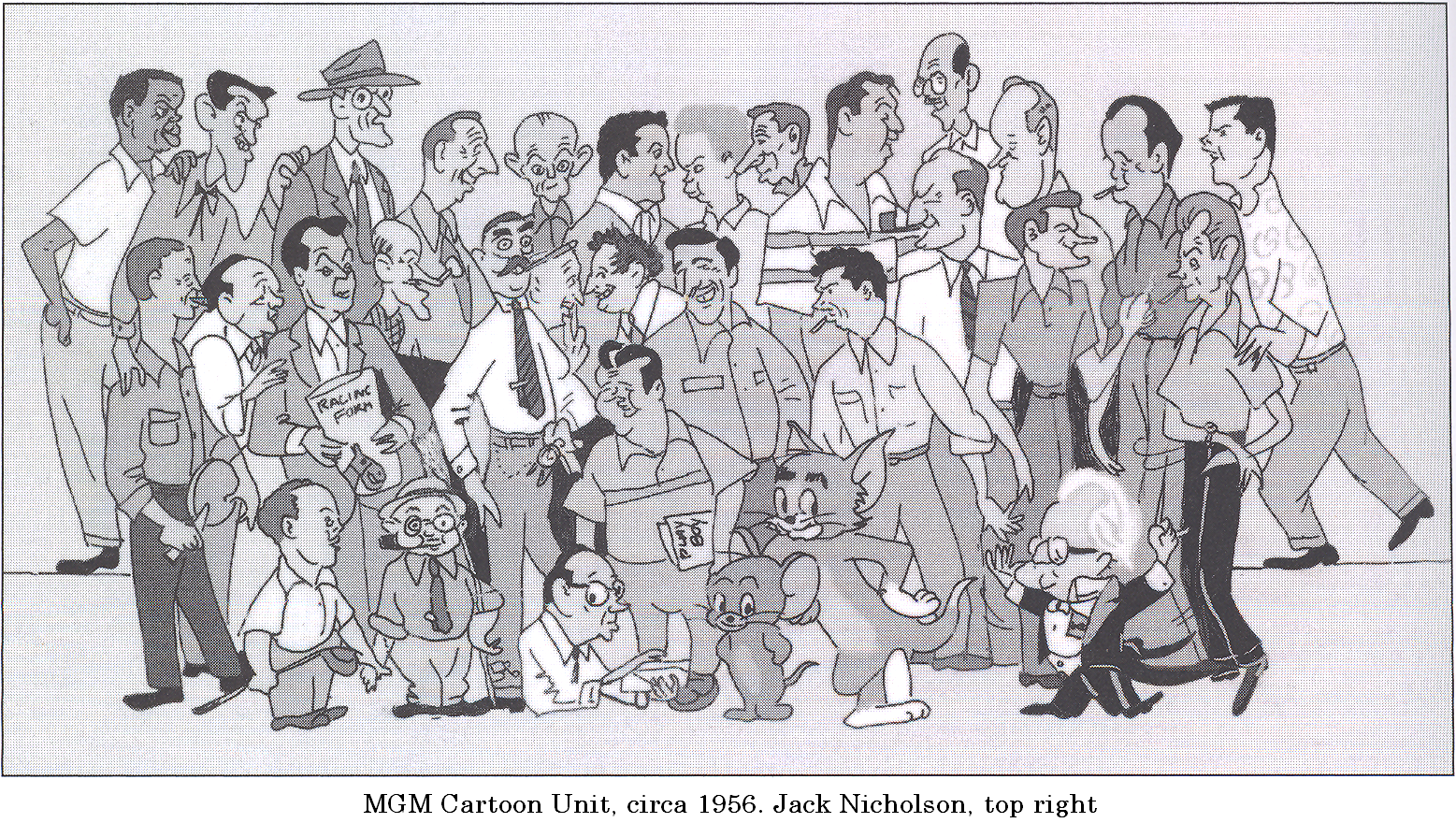
Yowp: Was Jack Nicholson at MGM when you were there?

Jerry: Yeah, I met Jack. He was like our messenger boy. We both joined the MGM basketball team because he loved basketball, liked to play it, so did I. When they closed the studio, one of our actor friends on the team had gotten a contract at 20th Century Fox. He wanted to form a team over there and there wasn’t much interest among the employees at 20th so Jack and I and two or three other fellows from the MGM team joined our old friend Gardner and we played there about three, four, five years. Later on, at Hanna-Barbera, I formed a team.
So that’s how I met Jack. We played ball together...and went different directions. I remember him telling me at MGM one day, there was the Player’s Ring Gallery up in West Hollywood. It was a theatre and they also had acting classes. And he said “I’m going to go there and take some acting classes.” And I said “Oh, that’s interesting.” Years later, I took some acting classes but I didn’t do anything at that time.


Yowp: What year was it you arrived at MGM?

Jerry: Either ’56 or ’57.

Yowp: They shut down in ’57 and you were out of work.

Jerry: I was out of work about four months and I got hired at Warner Bros. They were on the southeast corner of the main lot in Burbank. They had a nice building there.

Yowp: You were in-betweening for all three units. Did the directors work differently in how they handled their cartoons?

Jerry: I couldn’t really tell. You know, after a cartoon was finished they would screen it for everybody. I guess I liked the artwork that was done in Chuck’s cartoons. Friz did some wonderful things. He had a great writer called Warren Foster. But I just kind of preferred Chuck’s unit. I could stop by his office. He was like a teacher. He would spend time, he would show me things. He was very helpful.

Yowp: Guys like Friz and McKimson had a reputation of sending back animation they didn’t like to be redone. Did that happen with the in-betweening, too?

Jerry: I don’t think so. Probably they wouldn’t wait until the in-between stage ‘cause that was like the final stage, you would work clean. I think they would probably, maybe, when it was in the assistant animation stage where everything could still be kind of rough. They would do what we call the pencil test, you would just film the pencil drawings. They could do that also after the in-betweens were done but I don’t remember stuff being sent back. Especially when I worked for Ken Harris. He was so good, I don’t think he ever had anything sent back.

Yowp: What year did you replace Willie when he went to Snowball?

Jerry: I would say that was maybe late ’58, early ’59.


Yowp: Do you recall which cartoons you assisted on, maybe the first one?

Jerry: That’s a tough question. It would have been a Roadrunner cartoon or a Pepe LePew. That is so far back. My memory’s a little bit fuzzy, unfortunately. You know, years ago, I used to think “Why don’t I keep a daily or weekly diary?” and I wish I would have. There are so many things I forget.

Yowp: Chuck’s unit would have had Dick Thompson animating and Benny Washam...

Jerry: ...and Abe Levitow. And Abe used to do such great caricatures of me and Corny Cole. Corny was Dick Thompson’s assistant. And, somehow, he paired the two of us up. I saved a bunch of those things.

Yowp: Was Bob Bransford assisting at that time?

Jerry: Yes, he was Ben Washam’s assistant, unless Bob was Abe’s.


Yowp: I know Tom Ray came along.

Jerry: He had worked at MGM well before I did. In fact, he and my father worked together many years ago at MGM. There were four of us assistants. Now, I’m having trouble remembering who the fourth one was.
Mike Maltese was the writer, Phil DeGuard was the background painter. Joe Barbera hired Mike Maltese and Warren Foster, I remember that happened maybe ’58 or ’59. What a coup. He got two of the best cartoon writers. And they would draw their scripts. You know, most of the cartoon writers in those days could draw, and they would do like a storyboard script.


Yowp: I’m presuming Joe didn’t make an offer to Tedd Pierce or maybe he felt Tedd had his personal problems to deal with that didn’t make him a good hire.

Jerry: You know, it’s funny, I had many opportunities over the years to ask Joe Barbera about that and I never did. Oh, Tedd, he was just a terrific person. He and Mike Maltese used to entertain all of us at coffee break time. They were great.

Yowp: But I’ve read that two of them had a falling out at one time.

Jerry: Well, maybe the falling out happened before or after I was there
[Yowp note: it was before]. Of course, when I left, the studio closed the cartoon division at Warners in, I think, ’62, because I left in ’61.

Yowp: Dick Thomas and Bob Givens were in McKimson’s unit and they went to Hanna-Barbera about the same time.

Jerry: Oh, Bob Givens, he was a good layout man. A nice fellow. He finally retired but when I went back to work in ’97 at Warner Bros at the newer TV division, Bob was there. A couple of the oldtimers were there and they were in their early 80s.

click here for Part Two

Wednesday, 9 March 2011

The Gospel According to Hanna-Barbera

By 1990, Joe Barbera was used to having a huge audience of kids on Saturday mornings. But he had a huge audience of a different kind one Sunday morning that year. That’s when Barbera appeared on Robert Schuller’s Hour of Power religious broadcast from the Crystal Cathedral in Garden Grove, California.

At first, it would appear somewhat odd that Joe, the former Catholic school boy taught by nuns, should step foot inside the sanctum of one of America’s best-known Protestant televangelists. But perhaps there is a Gospel According to Hanna-Barbera that speaks to church-goers of all denominations. Yogi Bear teaches the consequences of disobeying Exodus 20:15, since he is caught and punished for breaking the Commandment about theft. (Does that make Ranger Smith God?) Huckleberry Hound perhaps epitomises the beatitude of St. Matthew 5:5. Granted, the meek Huck doesn’t inherit the Earth after seven minutes on screen, but he generally vanquishes the bad guy (snickering dogs excepted).

If one really wanted to be cynical, one could point out Barbera’s talk conveniently came not too many days before a TV special back-patting Bill and Joe for 50 years of Tom and Jerry cartoons. But if it started out as a commercial, it ended up unexpectedly becoming a lesson in a source of fortitude.

Doug Mason of the Scripps Howard News Service penned this feature story which appeared in papers during December 1990.


Making a mouse bash a cat’s head in with a mallet may not get you into Heaven, but it did get Joe Barbera into the Crystal Cathedral.
Barbera — half of the famous animation team of Hanna-Barbera — was the guest speaker recently at the Orange County, Calif., church, known to millions of Americans through the televised sermons of the church’s pastor, Dr. Robert Schuller.
As Schuller introduced Barbera, the evangelist dropped a few names: Yogi Bear, Huckleberry Hound, Fred Flintstone, Quick Draw McGraw, Scooby Doo . . . With each name, the audience got a little more rowdy.
“They were applauding like crazy,” Barbera says from his office at the Hanna-Barbera Studios in Los Angeles.
Barbera met his future partner in 1937 when both joined the MGM animation department. They teamed up two years later for the first Tom & Jerry cartoon, Puss Gets the Boot, which was released in February of 1940 and earned an Academy Award nomination.
Series
After the success of Puss Gets the Boot, Hanna and Barbera began a series of Tom & Jerry cartoons that lasted for 15 years.
Hanna and Barbera became the heads of the MGM animation studio. They were two of the most respected names in the business. Then in 1957, the mallet fell on their heads. Without warning, MGM closed the studio. The problem was money. The movie industry was in a slump in the late ‘50s, mostly because of competition from the free entertainment provided by television. All the studios were trying to economize. Somebody figured out that you could reissue old cartoons and make just as much money — so why make new ones?
As it turned out, though, closing the studio was probably the best thing that could have happened to Barbera and Hanna. Almost immediately, the newly unemployed animators got an offer to produce original cartoons for television.
“We didn't miss a beat,” Barbera says. “We went straight from theatricals to television.”
Still, it was a comedown for the former heads of the “best animation studio” in town. The budgets for TV cartoons were much smaller.
To meet budget, Barbera and Hanna once again became pioneers: They created limited-animation, or, as animator Chuck Jones calls it “radio with pictures.”
Fluid movement
Gone was the fluid movement, the delicate facial expressions, the elaborate action. But the talented Hanna-Barbera staff, which included many of the top animators, writers and designers from MGM and Warner Bros. (whose animation department was also in trouble), did their best with what they had.
The animation may have been jerky, simplistic and flat, but Hanna-Barbera’s early characters were beautifully designed; and their dialogue contained more humor and wit than a lot of live sitcoms.
The studio’s first major success came with the creation of The Huckleberry Hound Show, which also introduced Yogi Bear and Boo-boo, and Mr. Jinx [sic] and Pixie and Dixie. The show won an Emmy for Outstanding Children’s Programming.
Hanna-Barbera sold their studio in 1966, but have continued to help run it. In the past few years, they have had great success in the home video market, both with releases of their old cartoons and with new animation made especially for video.
The last venture — a series of made-for-video adventures from the Bible — was a personal triumph for Barbera. It took him 17 years to convince somebody that animated Bible stories would be a good idea.
“Everybody gets terrified when you talk about doing a Bible series,” Barbera says. “The networks were afraid to put them on. I told them ‘It’s not a matter of preaching. The stories are great!’”
Barbera’s instincts were right. The Bible adventures series has sold more than 2 million videocassettes and has won the praise of religious leaders throughout the country.
It was the Bible series that got Barbera invited to speak at the Crystal Cathedral.
Of course, when Barbera visited the church’s Sunday school, he found a few fans of Snagglepuss and Wally Gator, too.

It was deliberate that it was Barbera and not Hanna and Barbera at Schuller’s showplace. The Bible cartoons were Barbera’s baby. He devotes several pages about the concept in his autobiography and how he pitched them and pitched them to networks and everyone shied away from the idea (by contrast, you’ll be hard-pressed to find any mention of the cartoons in Hanna’s autobiography outside the appendix).

While the wire service story is fairly secular, Barbera reveals in his book he had a religious, albeit non-dogmatic, bent in his talk to the congregation:

Anyone who has seen one of Reverend Schuller's television programs has some idea of the immensity of the Crystal Cathedral, which, I believe, is the largest house of worship in the world. Standing with him in the pulpit, looking out at the cavernous structure, I felt about as significant as an insect.
“How is it you kept going back with the Bible series for 17 years? What made you do that?”
It was the first time anyone had ever asked me that question, and, in front of thousands of people in the Crystal Cathedral and hundreds of thousands of viewers to whom Schuller’s services are broadcast, a light bulb clicked on over my head.
“Look, I am an ordinary person—a human being. You don’t think it was me coming back for seventeen years, do you? Obviously, it had to be a force bigger, stronger, more powerful than I could ever be.”
I hadn't intended to say anything like this at all. I hadn't even thought about it. But here I was, preaching from a pulpit, telling the world that God had said, in effect, JB, get up, get that artwork, go out, and try to sell it again. What's even stranger is that it was all true.

When you watch the cartoons—and I say this at the risk of invoking St. Matthew 7:1—you have to suspend disbelief that characters in the Old Testament can understand modern American English. And there’s something jarring about a comic relief teenager with a baseball cap being plunked into the middle of Scripture. A couple of the half-hours I saw seem padded a bit with crowd reaction shots. But the cartoons are done with sincerity and are neither preachy nor overly pious.

There’s a Biblical analogy in Barbera’s travails, if you think about the story of Daniel and the lion’s den. An old Sunday School song goes “Dare to be a Daniel. Dare to stand alone.” Joe Barbera, the co-founder of the Snagglepuss den, stood alone to get a very non-Snagglepuss series in people’s homes. Standing alone for what is right is something people have to do in life sometimes. Just call it another lesson from the Gospel According to Hanna-Barbera.

Saturday, 5 March 2011

Augie Doggie — Tee Vee or Not Tee Vee

Produced and Directed by Bill Hanna and Joe Barbera
Credits: Animation - Carlo Vinci; Layout – Bob Givens; Backgrounds – Dick Thomas; Story – Mike Maltese; Story Sketches – Dan Gordon; Titles – Lawrence Goble; Production Supervision.
Voice Cast: Augie, Lion – Daws Butler; Doggie Daddy, Neighbour Kid – Doug Young.
Music: Phil Green, Harry Bluestone/Emil Cadkin, Jack Shaindlin, Hecky Krasnow.
First Aired: week of December 7, 1959 (repeat, week of June 6, 1960)
Episode No: Quick Draw McGraw M-011.
Plot: After bragging to a neighbourhood boy that his dad is on TV, Augie gets his dad to cut a demo film for the TV station.

This cartoon’s a little different than some of the previous outings in the series. Instead of Doggie Daddy reluctantly giving in to Augie to try to please him, Daddy does it this time because he has stars in his eyes. TV stars, that is.

Things start off with Augie and the new neighbour pup outside the Doggie home arguing about whose dad is better. The neighbour sneers that his dad is “Rattle Tin Can, the famous TV star” and demands that Augie confess that Doggie Daddy isn’t on television. Augie, of course, isn’t going to admit that his dad is inferior, and tries to stall with several “Well, uh”s. Finally, he’s had enough of the goading and informs the disbelieving pup Daddy will be on at 7 tonight and to “Come over and see for yourself. And bring your own popcorn, too.” All this is news to Doggie Daddy, who overhears it from the window.

Daddy calls Augie in to ask about his TV appearance, then hands his “imagin-a-tive” son a bar of soap to wash out his mouth “for tellin’ such fibs” (this is after Augie tells his “award-winning dad” that Rattle Tin Can “is a wash-out compared to you”). But Augie isn’t contrite. In fact, he says he’s not lying.


Augie: All I have to do is take movies of ya. And take it to the TV station.
Daddy (sceptically): And dat’s how easy it is for me to become a TV star?
Augie: You could become the idol of millions.
(Daddy looks surprised)
Daddy (to audience): Ya know, da kid might just have somethin’ dere. Yes, sir. Heh, heh, heh. He might just have somethin’ dere.

Incidentally, on the audio track of the version of the cartoon I have, it sounds like Doug Young is rattling his script at the end of the last line.

We now get a string of gags as Augie plays director and casts Daddy in a bunch of typical 1950s television fare. We’ll give you a summary in a second.

Carlo Vinci is the animator in this cartoon and he doesn’t seem to quite have a handle on drawing the main characters. You can see Augie has an angular snout in three-quarters view in a medium shot (Augie looks normal in head shots). And Daddy’s snout looks a little odd in this little scene. But you’ve got to love the modern art in the background. A couple of Warners’ people are at work; Bob Givens and Dick Thomas had both recently worked in the McKimson unit.


Writer Mike Maltese was at Warners, of course, and came over with Givens. He seems to be padding this cartoon with a bit of extra dialogue. It takes a minute and 52 seconds to set up the situation and during the poundings Daddy there’s a lot of extraneous action that really isn’t amusing. An example is in the first movie-shooting gag when Daddy is staring at his gun and Augie says “Pay attention, dad!” It doesn’t really add to the plot or suit Daddy’s personality that much. It could have been left out.


Here are the gags Maltese gives us:
Daddy as a western star. Somehow, Augie has gotten his hands on a pony (maybe it followed him home, like in ‘Nag! Nag! Nag!’) and Daddy is supposed jump from it onto a makeshift bad guy. But the horsie decides to stop in mid-gallop and Daddy goes flying onto what turns out to be a fire hydrant.


Daddy as a jungle hero. Somehow, a lion at the zoo is in a cage without any bars and Daddy is supposed to swing Tarzan-style in and do, well, no one really says. Daddy points out the lion to Augie. “Oh. I didn’t notice,” the boy replies. Daws gives a nice, casual read. Augie then explains the lion has no “teeths” and that’s all Daddy needs to know. Doug Young lets out with an ersatz Tarzan yell (“Say! That ain’t bad! I gotta admire myself for dat one,” Daddy tells the audience). As Daddy swings toward the cage, the lion rushes off to put in a pair of huge false chompers. The violence happens off camera. “It’s amazin’ what they’re doin’ with dentistry these days,” Daddy tells us. “A jungle hero you’re not, no-talent dad,” Augie observes.


Daddy as a hard-boiled detective. Doug Young gets to have some fun here, as he does his Jimmy Cagney-style voice that he later gave to Bigelow the mouse. Daddy’s supposed to bust down a prop door and that’s it. But he gets carried away with his own acting and ignores the fact he’s busted down the door and Augie has yelled “Cut!” All right, Rocky! I’m comin’ in. You dirty rat!” he exclaims over and over. He keeps running and bashes down the front and back doors to his own house and some inside along the way before coming to rest against a clothesline.

As a side note, Cagney would never have talked to Rocky. He played Rocky Sullivan in Angels With Dirty Faces, the classic movie that spawned one of the greatest cartoon parody titles in history. And he never said “You dirty rat!” But Al Capone did to Joe Aiello, according to biographer Fred D. Pasley.


Daddy in a war picture. Somehow, Augie has a live grenade (maybe it followed him home, too) which Daddy is supposed to throw at the “em-eny.” But Daddy forgets whether to throw the grenade or the pin. You can guess what happens.

Poor Augie. He laments “Some kids have great TV stars for fathers and some ain’t. I guess I’m just one of the ain’t kids.” Ah, but Daddy disagrees and pledges he’ll be on TV like Augie promised.


And he is. Augie and the neighbour kid watch Daddy go through parts of the routines he failed at miserably earlier in the cartoon. “Gee, do you think your dad will give me his autograph?” says the kid. The directors cut to a shot of Daddy standing in the set, with his head sticking out of the top. The part of his body in the set is in black-and-white, the part of him out of the set is in colour, a gag probably lost on most kids in 1959. Daddy finishes the cartoon with one of his “After all...” tag-lines: “How many kids can saw their dad’s not only on TV, but also in TV.

The music’s pretty typical for an Augie and Doggie Daddy cartoon.


0:00 – Augie Doggie Main Title theme (Curtin).
0:25 – CB-90 HAPPY HOME (Cadkin-Bluestone) – Augie argues with new neighbour’s kid, Augie and Daddy in living room.
2:17 – GR-472 HICKSVILLE (Green) – Augie explains western shot to Daddy, horse takes off.
2:38 – SIX DAY BICYCLE RACE (Shaindlin) – Horse gallops, Daddy flies off horse.
2:50 – GR-155 PARKS AND GARDENS (Green) – Daddy smashes into “bad guy”, Augie tells Daddy lion has no teeth, Daddy says he’s ready for his shot.
3:51 – LFU 117-1 MAD RUSH No 1 (Shaindlin) – Daddy does Tarzan yell, lion gets teeth, fight off-camera, Daddy flies through air.
4:23 – GR-155 PARKS AND GARDENS (Green) – Dental work line, Augie explains detective scene, rolls camera.
4:58 – EXCITEMENT UNDER DIALOGUE (Shaindlin) – “All right, Rocky” line.
5:03 – SIX DAY BICYCLE RACE (Shaindlin) – Daddy bolts for door, crashes through house, camera shake.
5:30 – GR-253 TOYLAND PARADE (Green) – “Dad! Oh, dear dad!”, hand grenade scene.
6:14 – THE HAPPY COBBLER (Krasnow) – Augie sighs his dad isn’t a TV star, Dad in TV set.
6:43 – up tempo show biz music (Shaindlin) – Kid wonders if Dad will give autograph. Dad signs autograph book.
7:09 – Augie Doggie End Title theme (Curtin).

Wednesday, 2 March 2011

Hey There, It’s Doug Goodwin

Hoyt Curtin is, arguably, the best-known name in television cartoon music. His theme songs have been instantly recognisable to several generations. Through the first half of the 1960s, he thoughtfully composed some marvellously appropriate cues for Hanna-Barbera’s half-hour shows—light, spacey sounding keyboard melodies for The Jetsons, roaring trombones and urgent strings for Jonny Quest, grunting bassoons for The Flintstones and jaunty jazz piano and clarinet underscores for Top Cat. But when it came to the studio’s first full-length feature, you won’t find Curtin’s name in the credits.

Hey There, It’s Yogi Bear had its world premiere in a drive-in in Salt Lake City on June 3, 1964, after a media preview on May 30, 1964 in West Yellowstone, Montana. Okay, the premiere also happened at a regular, screen-on-the-inside theatre, too. The cartoon featured background music credited to Marty Paich. There were also several songs. Not a note was by Curtin. All were composed by Ray Gilbert and relative newcomer Doug Goodwin.

The two of them had penned some music in 1958 but the movie was really Goodwin’s big break. He has a core of fans from his later work on DePatie-Freleng cartoons—Hoot Kloot, The Ant and the Aardvark, Misterjaw, Here Comes the Grump and Pink Panther shorts and specials, to name some. But Joe Barbera plucked him out of obscurity.

Here’s a wire service article, dated October 24, 1963, when the Yogi Bear movie was still using its working title. It’s the only story of any length I’ve been able to find about Charles Douglas Goodwin.


Doug Goodwin Combining Carpentry, Song Composing
By JOSEPH FINNIGAN

HOLLYWOOD (UPI) — Doug Goodwin is Hollywood’s musical carpenter, a talented young composer who pounds nails by day and a piano by night.
The music composing business in Hollywood is a tough profession to crack. New comers wait years before they get a break. Some would-be lyricists live a precarious financial existence.
Goodwin is a practical man as well as a talented musician. He wouldn't sit by life’s side-lines waiting for his ship to come in, a vessel that never docks for thousands of Hollywood hopefuls.
“I’ve been a carpenter for nine years,” said Goodwin during dinner in the Woodland Hills home where he lives with his wife and two children.
Composes At Home
Goodwin, who now has his own house remodeling business, composes music at home when his day’s work is done.
For years he pounded on Hollywood doors which are familiar to all musicians trying to make the grade here. Almost always, he was turned away. No newcomers were needed, he was told.
Doug's musical future is looking better these days. He has sold one song to “The Flintstones” television show [The Littlest Lamb in the Ann Margrock episode] and collaborated on tunes for “Whistle Your Way Back Home,” a “Yogi Bear” animated film.
In the movie, Doug collaborated with Ray Gilbert, an established filmland songwriter.
Joe Barbera, of Hanna-Barbera Productions which filmed the television show and movie, considers Goodwin a fortunate discovery for his firm,
“We’re going to use him more often,” said Barbera. “He plays beautifully and can put over a song. He and Ray Gilbert did five songs together.”
Practices Trade
The initial break for Hollywood talent doesn't always insure a bright and profitable future. Goodwin is aware of that fact. He still practices the carpenter’s trade while waiting for another assignment.
“I don’t want to be in the construction business all my life,” Doug says. “I want to write music. I hope that after the picture comes out somebody will be interested in Doug Goodwin the composer.”
During a visit to the Goodwin home we heard some of Doug’s music. It’s refreshing to hear new tunes by a composer who hasn’t bogged down in the morass of rock ‘n roll. One of his tunes is a love song called “On The Ninth of December I Met You.”
“This isn’t my song,” he says, as he described the melody in terms of a love struck youngster. “Visualize a man sitting someplace, and he says ‘of the days I remember, the ninth of December.’ It’s a thought, a feeling for romance. This man just met a girl.”
And Hollywood has finally gotten around to meeting Doug Goodwin.

A jaunt through newspapers over the first few months of release shows the movie relegated to double-bills (one theatre showed it with the 1951 Raymond Burr stinker Bride of the Gorilla), competing against family fare like Disney’s Thomasina and a Flipper movie, both of which had bigger ads in the entertainment section. Goodwin, though, started getting steady work with cartoon studios. Hanna-Barbera used him again in The Man Called Flintstone (1966) and he added songs to Tony Benedict’s Santa and the Three Bears (1970). Okay, he also composed cues for Super President and Bailey’s Comets, but not all cartoons can be winners.

Happily, Doug and his wife Joyce are still around and enjoying life in Calabasas, California, where Doug wrote the town song. You can check out his web site HERE. You’ll find he’s the man who wrote a song titled Is Chinese Food In The Stars Tonight? Even Hoyt Curtin couldn’t say that.