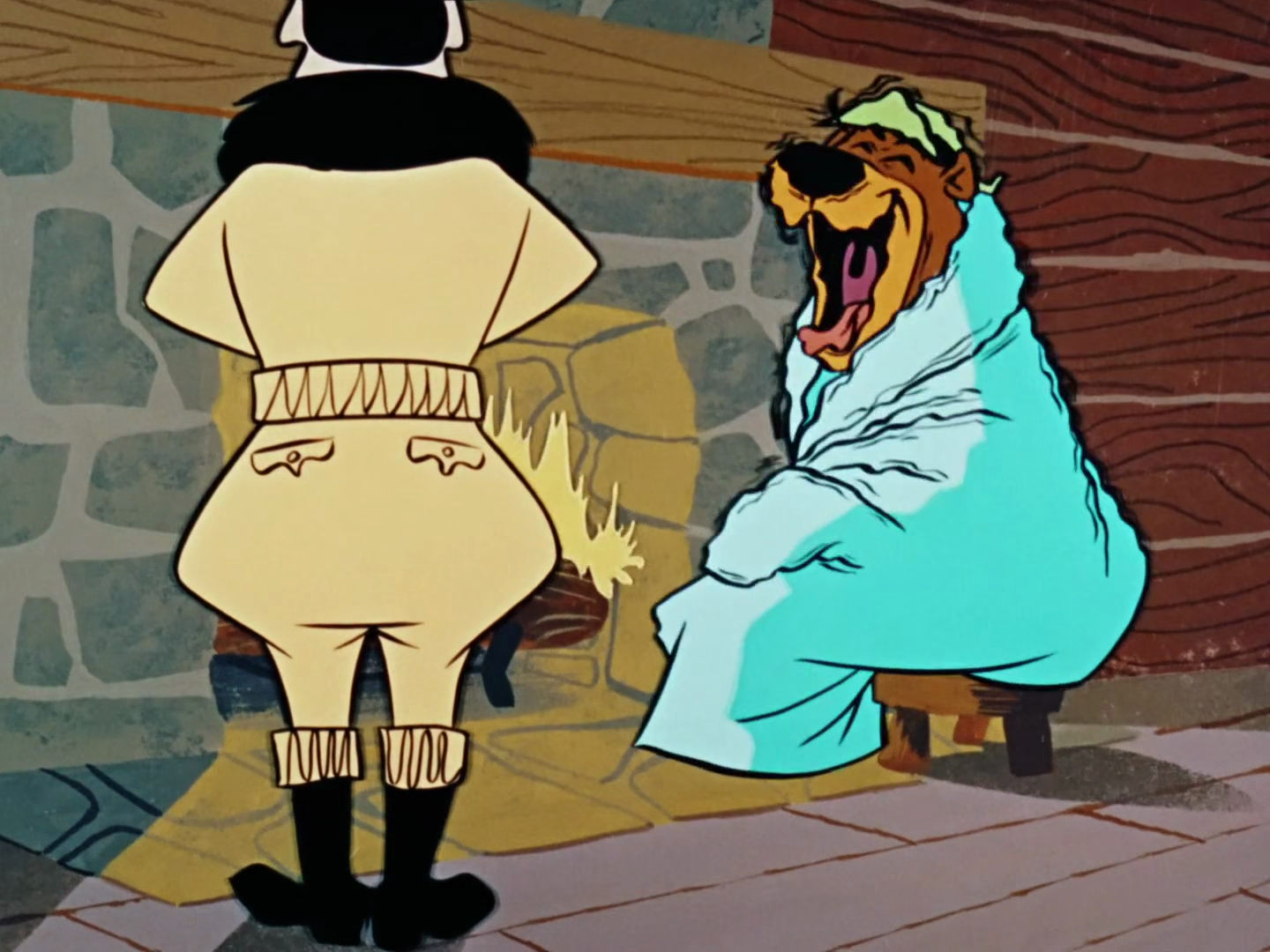
Saturday, 22 May 2010

Augie Doggie — Skunk You Very Much

Produced by Bill Hanna and Joe Barbera.
Animation – Carlo Vinci; Layout – Dick Bickenbach; Backgrounds – Fernando Montealegre; Story – Mike Maltese; Story Sketches – Dan Gordon; Titles – Art Goble; Production Supervision – Howard Hanson.
Voice cast: Doggie Daddy – Doug Young; Augie, Skunk – Daws Butler.
First aired: October 13, 1959.
Plot: Augie befriends a skunk while learning how to hunt birds and Daddy can’t get it out of the house.

Animators, much like the rest of the general population of a certain era, loved the Jack Benny radio show. Many theatrical cartoons of the Golden Age have references to it, some obscured today by the passage of time.

Jack’s writers over the years built up so many traits and secondary characters that, eventually, they had plenty of things to pick from and didn’t need to repeat themselves every week.

One of Jack’s secondary characters sort of found his way into this cartoon, likely for no other reason than Mike Maltese found him funny. “Sort of”, since Maltese doesn’t really use the full character, just a voice and a catch-phrase.

Among one of Benny’s characters was a race track tout, generally played by Sheldon Leonard. What made the bit clever is the tout gave Benny advice on anything but horse races (eg. which Christmas present to buy for a woman) but used race-track terminology to describe his reasons (eg. lingerie is a good show bet). So Jack would be in a store, a train station or some such place, then have a conversation unexpectedly interrupted by someone in a low, quiet tone going “Pssst. Hey, bud. Come here a minute. Whatcha doin’?” It was the tout.

I love the tout idea and his incongruous wordplay and Maltese, no stranger to wordplay, must have, too, because the skunk in this cartoon uses the tout’s catchphrase and confidential voice. But that’s where the similarities end. For the rest of the cartoon, Maltese bends a plot device used by Tex Avery—the guy you can’t get rid of. Avery used it in terms of the cartoon (and Hayes Office) credo that “good overcomes bad because that’s the way things must be” (the same reason Wile E. Coyote’s devices must ultimately fail). Maltese’s plot doesn’t involve some kind of cartoon karma; the skunk is simply determined to stay because he wants a friend.

The cartoon opens the same way as Fox-Hounded Fox—Augie is nagging dear old dad about something until he gets his way with an unexpected gag somewhere along the way. This time, Doggie Daddy promised to teach him to be a bird-dog but has decided now is not a good time because Augie has a cold. Augie won’t listen to logic and hauls out a protest placard. Chuckling Daddy gives in and decides to keep his promise, which is the thread that holds together the whole cartoon. Augie gags the scene by turning around the sign proving he knew all along what the outcome would be. And like in Fox-Hounded Fox, the Daddy home has late ’50s décor and avant garde art, though Bob Givens laid out the earlier cartoon and Bick Bickenbach did this one.
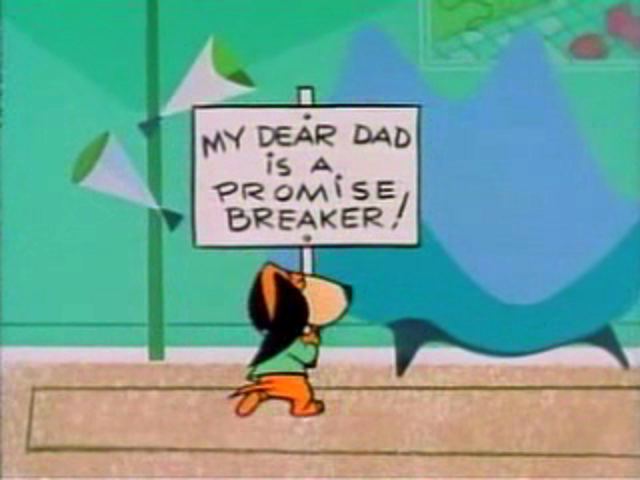


Perhaps Bugs Bunny sold the living room chair to Maltese, who brought it over from Warners to give to Doggie Daddy. Bugs has a similar one in To Hare is Human (1956), designed by Maurice Noble.

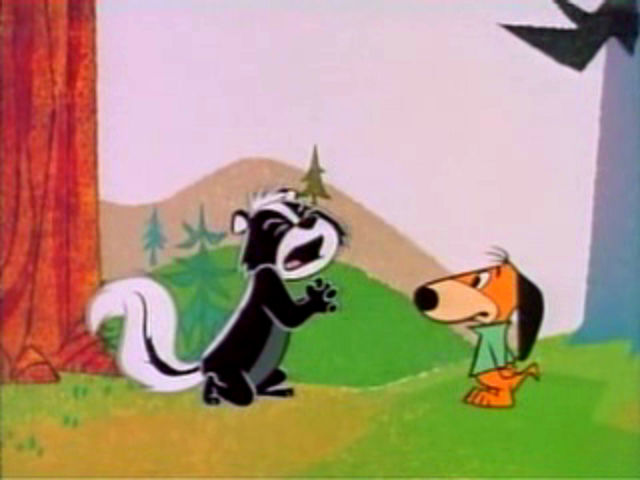
So off go the hounds into the woods for a bird-watching lesson. After a huge sneeze bashes Daddy against a tree, the cold-ridden Augie sniffs along the ground and goes right past the nicely-designed skunk who’s at the centre of the picture. Then we get the Benny tout’s catchphase. There are no birds around but the skunk pulls out “a for real, genuine eagle’s egg” (don’t ask why a skunk would be carrying one) and offers to exchange it for something. That’s when the skunk breaks character, goes down on his knees in four drawings and pathetically begs Augie to be his friend, then four drawings later resumes his original calm tout voice and position against the tree. The two make a deal and Augie promises to be his friend. The skunk now starts catching up on information because no one will talk to him, questions like “Did the Dodgers win the pennant? Are they still doin’ the Charleston?” Augie never gets a chance to answer the string of constant questions, as Daddy comes onto the scene, then grabs Augie and runs back inside their modern-furnished home.


The remaining three minutes are full of ubiquity gags. Maltese is sabotaged a bit by the even timing because he tries to structure them a bit. The gags start getting more ridiculous as the situation carries on, like how the skunk comes through the mouthpiece of the decidedly unmodern phone and then through the earpiece when Daddy shoves him back in the phone. Maltese tries an Avery-style build-up by putting the skunk in a jar, then rushes the jar into a garbage can, then drops the can down the well. Then there’s the old pops-up-from-different-drawers gag (while playing chess). And Maltese tosses in a completely goofy gag as the skunk sails in on a paper airplane.


Finally comes the climax gag as Augie actually saws down the wall of the house to let the skunk in. Why? “Because my daddy taught me to always keep my promise.” Doggie Daddy, as you might expect, gives in and allows Augie to keep his promise and overcomes the noxious skunk smell at the end. “When bringin’ up a boy, there are times when if you can’t lick ‘em, join ‘em,” Daddy tells the audience as the iris closes.


Carlo Vinci’s style is pretty evident here. We get a bunch of Vinci head-shakes and a diving exit off camera. And Vinci loved those two-drawing fear shake takes. Here’s one of them. My apologies that the frame grabs are so crappy; I haven’t got a great copy of this cartoon. I’ve slowed it down so you can see the drawings but still get the effect.


This head shake is in a cycle of three drawings. There are three drawings in a six-frame cycle; the head position on the right is held for two frames before the cycle starts again.


The music selection has a couple of oddities. The paper airplane jaunt uses what sounds a lot like a piece of music from the KPM library of England; the Hi-Q ‘L’ series featured at least two reels of music from KPM. There are also short snippets of a quick Jack Shaindlin piece used twice for quick hammering; H-B didn’t often use stock music for an effect like that. The rest of the music is atypical of an Augie cartoon. ‘Fireman’ is an incomplete name; I don’t know the rest of it.


0:00 - Augie Doggie main title theme (Hoyt Curtin).
0:26 - THE HAPPY COBBLER (Hecky Krasnow) – Scene in house with Augie’s signs.
1:11 - GR-258 THE TIN DRAGOONS (Phil Green) – Augie sneezes Daddy into tree; sniffs on ground; passes skunk.
2:27 - CB-87A COME AND GET ME (Bluestone-Cadkin) (Harry Bluestone-Emil Cadkin) – Skunk talks to Augie.
4:11 - LFU 117-3 MAD RUSH No. 3 (Shaindlin) – Daddy grabs Augie and runs into house with him.
4:19 - CB-90 HAPPY HOME (Bluestone-Cadkin) – Daddy and Augie talk about promise, skunk knocks on door.
4:49 - LFU-117-3 MAD RUSH No. 3 (Shaindlin) – Daddy smells skunk, skunk in window.
4:49 - unknown (Shaindlin) – Daddy boards up window.
5:02 - CB-89A ROMANTIC JAUNT (Bluestone-Cadkin) – Daddy smells skunk in fireplace.
5:10 - unknown (Shaindlin) – Daddy bricks up fireplace.
5:15 - GR-248 STREETS OF THE CITY (Green) – Skunk in phone, Daddy tosses skunk down well.
5:55 - jaunty bassoon and skippy strings (Shaindlin) – Daddy peers down well, skunk in dresser.
6:32 - light symphonic music with strings (unknown) – Skunk on paper airplane.
6:42 - ‘FIREMAN’ (Shaindlin) – Augie saws down wall; Daddy in gas mask.
7:11 - Augie Doggie end title theme (Curtin).

Wednesday, 19 May 2010

The Hanna-Barbera Smackdown

Who’s better—the blue hound from North Carolina or “the high-falutin’-est...”? Well, you know the lyrics.

Personally, Quick Draw is my favourite. Maybe the goofiness of the series appeals to my sense of humour. There’s El Kabong with his out-of-tune guitar bashing. There’s Snuffles mmm-mmming about dog biscuits more than any dog has a right to do. There’s Baba Looey with his Desi Arnaz-invoking mangling of the language. There’s the punny, deliberately redundant and occasionally incongruous dialogue that Mike Maltese invents for all the characters. And I say this as one who has no interest in westerns.

However, not all viewers agree. Here’s a piece from the L.A. Times of April 18, 1960 with an opposing viewpoint. It’s another column proving the incredible popularity of the early Hanna-Barbera cartoons with adults. Remember, these were not made for Saturday morning cartoons; such a children’s programming concept hadn’t quite been invented yet. They originally ran in the early evening hours just before prime time.

I’ve held off reprinting this story because I can’t quite decipher all the words. I don’t have access to the Times via Google on-line. If someone out there does and can help me fill in some blanks, the readers here would appreciate it. Because of this, one line doesn’t quite make sense but you can probably get the flavour of it.


THE TV SCENE
Huck Hound Has Everybody Treed

CECIL SMITH
An erudite friend of mine who spends most of his time exploring the political and social cancers in our society and writing eloquent prose about them suddenly broke off the other Tuesday from a lecture he was giving on the mating habits of the soldiers of Attila the Hun and, to the astonishment of the bartender and others there gathered, made a wild dash for the door. “I forgot it was Tuesday,” he cried departing. “Must get home. Can’t miss Huckleberry Hound.”
A few days later, a 3-year-old of my acquaintance who excels in finger painting on surfaces like my living room walls dashed toward me, his eyes fastened delightedly on a glass I held with cartoon characters running around it and cried: “Hoooound! Yogi Bear! Meeece!”
Television, I have always felt, makes strange bedfellows—particularly during the Late, Late show—but Huckleberry, who cavorts on Channel 11 each Tuesday night at 7, produces the strangest pairs of all. He and his animated friends are the darlings of the eggheads. Equally, they are the delight of the small fry, which, I suppose, only goes to show the similarity between the intellectual and the child—the intellectual because he sees clearly through the muddy blankets wrapped around him by parents, schools, advertisements and the other complications of civilization, and the child whose vision is equally clear because he has not yet been cocooned.
Find Opportunities to Be Absurd.
I asked my intellectual friend the other day over a dash of schnapps why Huckleberry enthralls him. His answer: “What makes Huckleberry Hound and his stock company so merry is that they don’t labor their satire. Maybe they start for an agreed destination but in their half-hour progression they find so many opportunities to be absurd that they forget their main point and, like Aristophanes, lay about at everything. You can almost hate children for enjoying Huckleberry so much; he is too good for the brats.
This naturally called for a reply from my 3-year-old friend who threw back his blond head and, in the chilling tones of an Apache, cried: “Hoooound!” For me, Huckleberry has in it the magical qualities that make “Alice in Wonderland” worth re-reading every year or two—just to keep your sanity in a world full of Bourbon Street beats. And, like Huckleberry, “Alice” is the delight of the egghead and the child.”
I don’t mean to slight Huckleberry’s pal Quick Draw McGraw, which bounces on Channel 11 tonight and each Monday at 7. But Quick Draw’s satire is a bit more current, a little more pat—and less wonderful to me—than Huckleberry’s. Both programs, as you know, Hanna-Barbera Productions. Bill Hanna and Joe Barbera first gained fame for their Tom and Jerry cartoons for MGM which won seven Academy Awards. The boys now have on their drawing boards a series called The Flintstones, an animated situation comedy aimed at adults which will occupy ABC next season on Fridays at the adult time of 8:30. It deals with family life in the caveman era and it rather distresses my friend at the bar.
“There go my Fridays,” he murmured.

Of course, as time eventually marched on (while actually marching back, in a way), it turned out the cavepeople jumped into the ring and, with the aid of foreign objects like bird record needles and Water Buffalo hats, won the popularity smackdown. Despite Gazoo.

Saturday, 15 May 2010

Yogi Bear — Lullabye-Bye Bear

Produced and Directed by Bill Hanna and Joe Barbera.
Credits: Animation – George Nicholas; Story – Mike Maltese; Story Sketches - Dan Gordon; Layout – Dick Bickenbach; Backgrounds – Joe Montell; Titles – Art Goble; Production Supervision – Howard Hanson.
Voice Cast: Yogi, Theodore Bear, Boy Tourist – Daws Butler; Sammy Bear, Ranger Smith, Boo Boo, Woman Tourist – Don Messick.
First Aired: week of September 21, 1959 (rerun, week of May 16, 1960).
Plot: Yogi tries to stay awake all winter.

Late note: Since this review, full credits have surfaced. Mike Maltese wrote this, not Warren Foster. It appears Maltese wrote the first two cartoons for the Huck show’s second season before Foster arrived from John Sutherland Productions.

Two people make their Hanna-Barbera debut in this cartoon and it’s a shame the two of them didn’t work as well together in later cartoons.

This is the first Yogi Bear cartoon to be drawn by George Nicholas after his arrival from Disney. And it is also the first cartoon with Ranger Smith. Before this, there were a variety of rangers with different appearances, voices and even names, but this is the first one where the look, sound and name of the character were put together. And Nicholas does something with him I wish he’d done more often.

Here’s a surprise take by Smith toward the end of the cartoon. Whenever I see this, I wonder what would have happened if Tex Avery had been producing these cartoons instead of the relatively tame Hanna and Barbera. Joe and Bill weren’t exactly known for their exaggerated takes—they still had a lot of Rudy Ising in them—while Avery could get over-the-top expressions out of a less-than-MGM-budget crew over at Walter Lantz. La Verne Harding once said he’d tell her to take a reaction drawing and double it.

There’s really no reason that same philosophy couldn’t have been used at Hanna-Barbera. You judiciously make one drawing in a take really wilder than normal, like Nicholas did above. Unfortunately, he didn’t do much of it again, though he came up with some good expressions in various H-B shows into the 1960s and is certainly the star of this cartoon.

Nicholas also developed a little loping walk cycle that he later used in Hoodwinked Bear. It’s right at the start of the cartoon and is used five times in the first three minutes (not including a sixth time when Yogi’s upper body is seen through the ranger station window). It’s on eight drawings on twos. You’ll notice Nicholas doesn’t move the left leg the same as the right.


I really like how the trees are together in the background. Monte did the same thing in ‘Foxy Hound Dog’ (starring Yowp) and it’s kind of what Chuck Jones tried, though more geometrically, in ‘Tom Turk and Daffy’ (1944).

Yogi goes calling on the homes of his bear friends. They tell him it’s winter and to get lost. The first bear’s head appears and there are several drawings of transparent heads swooshing into place. The second bear lives in a tree for reasons known only to Warren Foster.

The third bear is Boo Boo, who has moved up in the world since the first season’s cartoons and now has his own home. Evidently he was too poor to keep up the rent and moved back in with Yogi as he can’t even afford a blanket in this cartoon. But he can afford a two-toned back wall to frame Yogi in the shot. Yogi wakes him by popping a paper bag. He evidently saw Rosalind Russell in Auntie Mame (1958) because he quotes her line that “We’re going to live, live, live!” (skipping the next sentence about life being a banquet). Boo Boo politely but firmly tells Yogi he’s going to hibernate. Instead of having him walk out of Boo Boo’s cave, he ducks under the small opening and leaves. Yogi also has crooked fingers here and throughout the cartoon to add a bit more to the animation.


So Yogi decides to live it up himself. And that brings us to the debut of Ranger Smith, sounding blasé as he gives a weather report to someone on the phone. Perhaps Mike Maltese is commenting on the uneventful and dull world of the federal bureaucrat. Yogi lope-walks past the ranger’s rear window. Smith already knows this means trouble. He stops Yogi but, evidently new on the job and not familiar with all the bears, simply says “Hey, there, you!” When Smith suggests he hibernate, Yogi gets a stunned, small-pupilled, blinking expression and explains he’s studied the park rules “and there is nothing covering a non-conformist bear.” He carries on with his lope-walk and tells the ranger he intends having a ball. Then Nicholas gives him a crazy head-tilt expression.


First, Yogi decides to go skating. But he falls asleep. And falls through a hole in the ice. Here are four of Yogi’s expressions as the bear yells for help. Nicholas uses a sixth drawing cycle, and then slides the sixth down to simulate Yogi going under. The sound-cutter appropriately has ‘The Sailor’s Hornpipe’ playing in the background.


“It’s a shame to chop him out of there,” says Ranger Smith with the odd nose. Yogi warms up by a fire in the ranger’s cabin but refuses to admit his plunge through the ice was accidental. “I always take a brisk dip this time of year,” remarks the shivering bear, as he lets out with another crazy laugh.


So now, Yogi decides to go skiing. And it appears he’s not acquainted with Ranger Smith, either, because he calls him “that ranger” as opposed to “the ranger” in later cartoons. Of course, Yogi falls asleep and slides down the hill, with the sound-cutter using an airplane motor sound effect to emphasize the speed picking up. Then the shot cuts to Ranger Smith in a banal conversation on the phone. He looks out the window a couple of times and then we get the take that we showed you above. The Ranger realises he’s coming toward the cabin, so he does the old open-the-front-and-back-doors trick and Yogi sails through both doors. That works until the bear goes up another hill and the force of gravity sends him back to whence he came. Ranger Smith frantically decides to hammer shut the back door. All that does is stop the bear outside the back door with a bang but the force collapses the four walls of the cabin. The elk head on the wall is a nice touch.


Ranger Smith, looking a little pudgy, takes Yogi back to his cabin. Yogi gives his opinion of the development.


With Yogi confined to his cave, we get a few sight gags as he endeavours to stay up all winter. He tries clothespins on his eyes. They don’t stay on. He decides, like every other sleepy cartoon character from Sniffles onward, to drink coffee to stay awake. However, it’s winter and Yogi doesn’t have heat in his cave. “What a time for ice coffee,” he laments.


Alarm clock earmuffs and a contraption where an alarm clock springs a mousetrap which lights a match that gives him a hot foot are the other gags. And they work. Spring has arrived and Yogi is awake. Boo Boo comes calling for him, Yogi announces his success and immediately passes out. At that convenient moment, tourists ogle the pair of bruins and Boo Boo puts his buddy, emitting a weary sound, to smile for the cameras as the iris closes. There’s a great splooshing sound as Boo Boo hoists Yogi’s eyelids. Notice the flowers that look like plus signs? Joe Montell liked drawing those. There are plants in other scenes with a dot on the top, another Montell trait. So my guess is Montell drew handled the backgrounds.


The familiar Bill Loose-John Seely music is here. Jack Shaindlin’s ‘On the Run’ gets uses during the ski-cabin scene.


0:00 - Yogi Bear sub main title theme (Hoyt Curtin).
0:14 - TC-202 ECCENTRIC COMEDY (Loose-Seely) – Yogi walks to Sammy Bear’s cave and knocks.
0:20 - TC-303 ZANY COMEDY(Loose-Seely) – Yogi talks to Sammy and walks away.
0:30 - TC-202 ECCENTRIC COMEDY (Loose-Seely) – Yogi walks to Theodore’s tree, Boo Boo sleeping.
1:08 - TC-432 HOLLY DAY (Loose-Seely) – Yogi pulls out paper bag, Yogi leaves Boo Boo’s cave.
1:42 - L-81 COMEDY UNDERSCORE (Spencer Moore) – Ranger Smith in office; talks to Yogi, “There goes my winter.”
2:49 - LAF-21-3 RECESS (Shaindlin) – Yogi goes skating, falls through ice hole.
3:16 - SAILOR’S HORNPIPE (Trad.) – Yogi yells for help, Ranger on phone.
3:28 - LAF-10-7 GROTESQUE No 2 (Shaindlin) – Ranger chisels Yogi out of ice block, Yogi by fire in Lodge.
3:54 - ZR-50 UNDERWATER SCENIC (Geordie Hormel) – Yogi on skis, Ranger on phone realises it’s Yogi.
4:33 - LAF-2-12 ON THE RUN (Shaindlin) – Yogi going down hill, Ranger opens cabin doors, cabin collapses.
5:04 - L-78 COMEDY UNDERSCORE (Moore) – Ranger takes Yogi by ear to cave, Yogi sticks out tongue.
5:24 - TC-204A WISTFUL COMEDY (Loose-Seely) – Yogi looks out window, clothespins, coffee, alarm clock earmuffs, hotfoot.
6:19 - LAF-21-3 RECESS (Shaindlin) – Ranger on phone, Boo Boo poses Yogi for cameras.
6:58 - Yogi Bear sub end title theme (Curtin).