Saturday, 16 January 2010

Augie Doggie — Nag-Nag-Nag

Produced and Directed by Bill Hanna and Joe Barbera.
Credits: Animation – Dick Lundy; Layout – Ed Benedict; Backgrounds – Bob Gentle; Story – Mike Maltese; Story Sketches – Dan Gordon; Titles – Art Goble; Production Supervision – Howard Hanson.
Cast: Augie, Cyclone – Daws Butler; Doggie Daddy – Doug Young.
Production: Quick Draw McGraw M-003, Production No J-23.
First aired: week of October 12, 1959 (rerun, week of April 11, 1960).
Plot: Augie tries to sneak a horse into the house past Daddy.

There are several basic premises which pop up time and time again in Augie Doggie cartoons. One of them is the “Can I keep him, huh, can I, can I?” plot, where Augie makes a new friend or has a new pet and excitedly asks the reluctant Daddy if it can stay with them. This is one of them.

Several things really brighten this cartoon. Mike Maltese pulls some cute lines out of his crazy, fertile brain, Doug Young is always fun as Daddy, and—in this particular cartoon—we get some great Ed Benedict designs and little touches by Dick Lundy, both of whom spent time at Lantz, Disney and MGM.

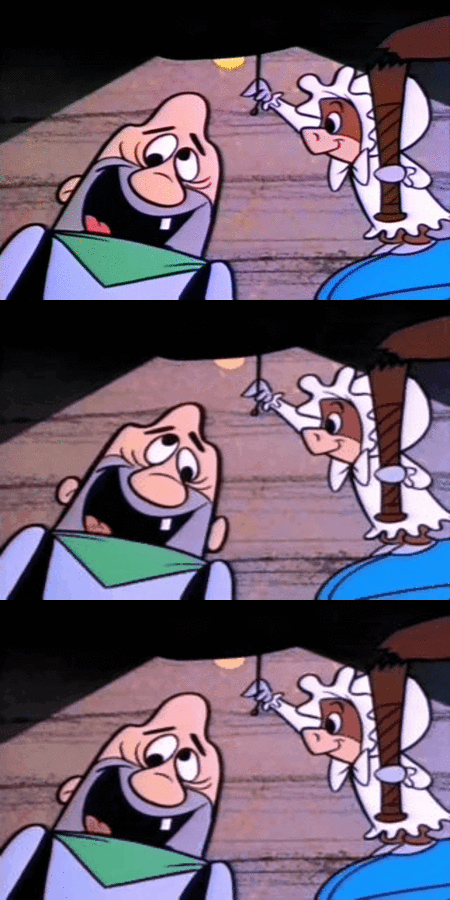
Here we have the interior of the Daddy family living room (what is their last name, anyway?). That’s where our scene opens as the worried Daddy pacing, wondering where Augie is. But we hear the door open and the scene cuts to Augie at the door holding a rope that is hanging out the door. What’s at the end of the rope? Augie struggles as he pulls and explains it’s “just an itty-bitty, stray, homeless pony that follered me all the way home, he did,” There’s a lot of head-shaking on twos going on in this scene. The first two frames below are when Daddy sees the off-camera door open and the two below that are of when the “pony” is pulled in. The second shake is accompanied by the sound effect of a door knocking to emphasize Daddy’s surprise. It’s a clever idea. Instead of re-using animation, Lundy comes up with two different shakes. You can see how he does them, two drawings for each shake.


“Can I keep him” etc. follows from Augie’s mouth, along with the usual kissing up. He calls him “animal lover dad” and “dear soft headed, uh, hearted dad.” When Augie corrects himself to say “hearted”, we get a dialogue head shake for emphasis. Lundy’s trying to toss in a bit of personality within the confines of limited animation. You sure wouldn’t see something like this in a Breezly and Sneezly cartoon. And notice the rectangular shadows to keep the background from being monotonous. I’ve seen this in other cartoons of 1959-60; I don’t know if Ed Benedict would have done this in layout or Bob Gentle decided on the colour separation.


Mike Maltese seemed to love dialogue word-play (witness the Bugs-Daffy-Elmer hunting trio of cartoons at Warners). “Can I?” “No!” “Can I” “No” “I no can?” Then we get a bad pun. The horse is named Cyclone. Daddy tells Cyclone to “blow.” Cyclone literally kisses up to Daddy, giving him one on the snout, and then breaks into a goofy grin. Daddy yells at him to get out. Maltese then audaciously hands this line to Augie: “But, Dad, baby, it’s cold outside.” How many references to pop songs do you hear as a throw-away gag in a Hanna-Barbera cartoon (other than a pun on a song title)?

“Poor old Cyclone can catch a cold,” Augie laments. The hammy horse nods in affirmation and tosses in some sneezes and coughs for good measure.


Daddy pulls down the window blind and tells Augie to have his milk and go to bed. Augie sadly drags himself into the kitchen, but then brightens when he sees Cyclone at the back door, panting and whimpering like a dog. Yes, I know that Augie is the dog in this cartoon, but let’s set that aside. Ed Benedict comes through with a flat-‘50s style kitchen.

“Who are you talking to?” the off-camera Daddy demands. Augie explains he’s talking to his glass of milk. “What won’t these kids do next?” Daddy says smilingly to the audience. But then we get yet a different two-frame head shake on twos as Daddy hears a muffled noise. The shot cuts to the fridge door, inhaling and exhaling. It blows open and there’s Cyclone. We get another goofy grin. Eating a banana is a nice touch. Daddy yells at him to get out, and he does so by running mid-air off-camera in a little cycle of drawings.

Daddy settles in his living room chair to read a book. There’s a sneeze. Augie admits it wasn’t him. “Well, who did snoze?” asks Daddy. There’s another sneeze and the two look up to see Cyclone hiding in a light fixture. The next sneeze rips the light off the ceiling and the horse land on top of Daddy, who kicks him out.

The next attempt has Augie with a fishing rod out of the upper storey window. He’s attached a string around the horse’s middle to try to raise him into the home. The string slips around a bit but Augie finally starts pulling up Cyclone, who doesn’t look too happy. A slide whistle accompanies a cell of the horse going up and down. Daddy shows up and asks “Now, how come you’re fishing this time of the night?” “Oh, I don’t know, dad,” Augie replies. “It’s just a hobby I guess.” Daddy grabs the “hobby” and his eyes grow, wondering what’s on the end of the line. He reels in the horse, who lands on top of him. “I have only one word to say,” the prone dog remarks. “Out!” And the horse runs off stage, presumably out the window, as we hear a whistle and a loud crash.


Daddy’s sleeping on his chair as the next scene opens. Augie and Cyclone are on the front sidewalk. Augie’s put roller skates on the horse to shove him into his room. But the noise from the passing horse wakes Daddy. “So, ho! It’s roller skatin’ you want, eh?” Daddy pushes the forlorn-looking horse from behind. “It’s roller skatin’ you’ll get.” You can hear the exertion in Doug Young’s voice. There’s even a little two-drawing vibrating animation cycle on the horse. Daddy shoves Cyclone out the back door, and the horse rolls down the street. Daddy now channels Jimmy Durante’s language-butchering as he bids “Aw rez-vore.” Not so fast, Daddy. The horse is stopped by a wire fence, which springs him back to the place whence he came. Well, almost. The force breaks down the back door, Daddy ends up on top of him but instead of rolling out the front, the horse has somehow changed direction, and rolls down the stairs as Daddy shouts the obligatory “Whoa!” They go past the same door and pictures in the background five times first. The crash is, naturally, off-camera, though Augie’s peering at it down the stairs. “Okay, Cyclone, I know when I’m licked,” says Daddy as we get a head-shake from Augie now. “Can I keep him, can I, can I?” excitedly asks the jumping Augie. We know the answer.


Maltese uses his standard Doggie Daddy wind-up question to the camera, which starts “After all, how many...” This time it concludes with “fathers have a live, horse-hair sofa?” And then Daddy does his usual laugh as the cartoon fades out (no iris this time).

Maltese re-worked the idea of Augie trying to keep a pet horse a year later in Horse-Feathers. The horse in that cartoon has pretty much the same design but is coloured blue and named Rosco.

As for the music, the sound cutter seems content to let most themes play on until the next scene. The “rising scale” music starts by going up nine notes, then in the next bar, doing it again a little higher. There’s a bunch of Jack Shaindlin pieces where for which I don’t have titles (one has ‘Fireman’ as part of the title); he seems to have written these for newsreels in the 1940s.


0:00 - Augie Doggie main title theme (Hoyt Curtin)
0:24 - GR-65 BUSH BABY (Phil Green) – Augie brings in Cyclone, Daddy kicks him out, Achoo!
2:07 - CB-89A ROMANTIC JAUNT (Harry Bluestone-Emil Cadkin) – Daddy pulls down window blind, Cyclone in kitchen, sneezing heard in living room.
3:48 - vaudeville rising scale music (Shaindlin) – Cyclone falls from light onto Daddy.
4:13 - CB-87A COME AND GET ME (Bluestone-Cadkin) – Cyclone on a fishing line, Augie puts roller skates on horse.
6:00 - fast show biz music (Shaindlin) – Cyclone rolls past Daddy, back into house and into cellar.
6:47 - ‘FIREMAN’ (Shaindlin) – Daddy says Cyclone can stay, horse-hair sofa.
7:09 - Augie Doggie end title theme (Curtin)

Wednesday, 13 January 2010

The Daws Bone’s Connected to the...

Daws Butler and Don Messick were the backbone of the body of voice artists in the first Hanna-Barbera cartoons. Actually, the first year that H-B Enterprises was in operation, they were the whole body, handling all the characters in Ruff and Reddy, though Lucille Bliss has revealed she was up for the role of Ruff and got screwed out of it.

When The Huckleberry Hound Show debuted in 1958, Daws and Don provided just about all the voices. Comedian Red Coffey was brought in to do his duck voice in a few. June Foray makes on appearance in a Yogi Bear cartoon. Ginny Tyler, who worked for Disney on children’s records, provides an annoyed housewife camper’s voice in a couple of other Yogis (at least it sounds like her). And a French accent is being faked in the Pixie and Dixie cartoon ‘The Mark of the Mouse’ by someone whose identity has escaped experts like Mark Evanier and Earl Kress.

The reasons for such a small stable would seem obvious. Theatricals didn’t employ more than a few actors in a short. And Daws and Don were terrific. Joe Barbera put it this way: “...it was like a gold mine with those two guys. Between them, they could do almost every voice you could think of.” Who needs anyone else, right?

Well, apparently there was another reason. One that Barbera outlined in a story to the United Press International wire service; this ran in a newspaper dated July 13, 1959.


Want To Crash Hollywood?
Use Your Head—And Voice

By DOUGLAS DILTZ
HOLLYWOOD (UPI)—A tip to those who want to crash Hollywood: The art of voice characterization offers a much better chance in the movie capital these days than the body beautiful.
Some of the most prosperous and highly-rated actors have hit the jackpot through their vocal impersonations. Most of these specialists, with the notable exception of Jim Backus (“Mr. Magoo,” etc.) live in a delightful world of almost complete anonymity, yet earn salaries that dwarf those of many glamorized personalities.
Artists like Daws Butler, Don Messick, June Foray and Patty Chapman [sic] can name their terms—the demand for their services is so acute.
According to Joseph Barbera, of the TV cartoon-producing company of Hanna and Barbera, there is a dearth of voice actors in Hollywood. The reason for the demand stems from a new surge in television cartoon production, not only in TV cartoon shows, but also for cartoon commercials.
For such TV cartoon shows as “Ruff and Ready” [sic] and “Huckleberry Hound,” there are more than 110 speaking characters. The voice specialist sounds off as many as 10 to 15 different characters for these cartoons.
Hanna and Barbera says it is always on the lookout for potential stars who have a repertoire of voices completely unlike anyone else’s. And, it won’t make any difference if you’re not pretty.

A dearth of voice actors? Like the hundreds, many of whom were amazingly versatile, who populated network radio only a few years before this news story was written? Call me Yowp the Sceptic, but it seems unlikely there was a “dearth of voice actors” in 1959. I say it ain’t so, Joe. Especially since Hanna-Barbera soon hired top radio character actors Alan Reed, Bill Thompson, Bea Benaderet, Janet Waldo and Penny Singleton. Oh, and some fellow named Blanc. Can’t remember the first name.

One thing is clear—the studio added artists as it added cartoons and voice artists were no exception, dearth or not. When The Quick Draw McGraw Show aired in 1959, several new actors came on board. Some lasted longer than others.

Peter Leeds, best known for narration and foil duties with Stan Freberg, narrated ‘Scat, Scout, Scat’ and vanished for good.
Los Angeles children’s TV star Vance Colvig appeared on ‘Bad Guys Disguise’ and disappeared until the following year when Barbera needed someone to say “Ain’t that cute” about a duck. Neither displayed much vocal flexiblity, surprising given Colvig’s pedigree.
Elliot Field, a disc jockey who had arrived in Los Angeles from a radio station in Texas, was the original voice of Blabber Mouse before Butler took the role after four cartoons. He later came back to do guest voices on ‘The Flintstones’ before his radio career took him to Detroit.

Barbera lucked out with several other actors.

Hal Smith, pre-Otis Campbell (the town drunk on Andy Griffith), lent his voice to a bunch of incidental characters for both the Quick Draw and Huckleberry Hound shows, then stayed with Hanna-Barbera through the ‘60s. Warners used him as Elmer Fudd after Arthur Q. Bryan died and he seems willing to accept work on the lamest of cartoons (like Filmation’s ‘Rod Rocket’ and Ken Snyder’s ‘Funny Company’ educationals).
Julie Bennett, who also worked briefly for Warner Bros. and Jay Ward, made a couple of appearances as Sagebrush Sal on Quick Draw before claiming the role of Cindy Bear a year later.
Jean Vander Pyl, the radio voice of Margaret Anderson on ‘Father Knows Best’, got most of the female roles, with some accents that would become familiar to viewers of Hanna-Barbera through the ‘60s.

But the only new regular voice actor on the Quick Draw show was a radio announcer and actor named Doug Young, who managed an amazing feat—he mimicked Jimmy Durante, keeping Durante’s humour but not overpowering you with the impression. You could watch Doggie Daddy and think of him as Doggie Daddy, not someone doing Durante. He added relaxed warmth to the voice and the role.

The surprising thing that you may not realise is when you watch the earliest cartoons on The Quick Draw McGraw Show, Don Messick is nowhere to be found. Why? That’s a mystery. Certainly no one at Hanna-Barbera could have been dissatisfied with him. It could be Don was busy with—CRINGE ALERT—the egregious ‘Bucky and Pepito’. Or maybe Barbara wanted to go with a bit of a different sound; certainly he did with the background music on the Quick Draw series. Whatever the reason, things seems to have changed about mid-season as Don’s familiar narration and incidental voices returned to add to his body of work as he and Daws Butler played off each other to delight cartoon lovers.

Good thing, too. After all, a body does need a backbone.


Yowp note: If you’ve never heard of Pattee Chapman in the wire story she, among other things, worked with Stan Freberg on the radio show ‘That’s Rich.’ Isn’t there always a Freberg connection?

Saturday, 9 January 2010

Quick Draw McGraw — Bad Guys Disguise

Produced and Directed by Bill Hanna and Joe Barbera.
Animation – Carlo Vinci; Layout - Dick Bickenbach; Backgrounds - Art Lozzi; Story – Mike Maltese; Story Sketches - Dan Gordon; Story Direction – Alex Lovy; Titles – Art Goble; Production Supervision – Howard Hanson (no credits).
Cast: Quick Draw, Baba Looey – Daws Butler; Narrator, Tombstone Jones – Vance Colvig.
Episode: Quick Draw McGraw Show M-002, Production J-4 (second Quick Draw in production).
Released: week of October 5, 1959, rerun week of April 4, 1960.
Plot: Quick Draw and Baba disguise themselves as a widow and her child to get stolen bank money from Tombstone Jones.

There’s something about Quick Draw McGraw bashing people over the head that’s funny. Probably because it’s so ludicrous. After all, who else do you know that dresses up like Zorro and yells “Ka-bong!” while bashing people on the head with an out-of-tune guitar? Just as ludicrous is Quick Draw in drag bashing a bad guy on the head with an umbrella. And that’s what you find in this enjoyable cartoon.

This is a little bit different than most Quick Draws. Normally, he fails miserably or wins and then there’s a twist at the end and things fall apart. But he’s a winner in this one. And while he’s stupid in parts, he pretty well has things under control when he’s disguised as the “poor defenceless widder woman.”

We open with a pan across a stylised map of western U.S. The narrator here is Vance Colvig who, for some reason, only voiced this one cartoon in the 1959-60 season. Despite the solo appearance, Joe Barbera must have liked him because Colvig was hired to play Chopper in the Yakky Doodle series the following year. He really isn’t all that versatile, because the narrator sounds like the bad guy, but the growly, twangy narration is perfect.


The narrator tells us “In the early days of the west, bad men swooped down towns, lootin’ and robbin’. Then they would high-tail it back to their hideouts in Bad Guys Territory.” And we can see where it is on the map. The next shot is of a walking cycle of Quick Draw McGraw and Baba Looey, who are after Tombstone Jones and his stolen bank money. A warning sign on a cactus lets them know where they are; Quick Draw even reads it for us as the camera focuses on it for six unanimated seconds.

Since it’s Bad Guys Territory, Quick Draw’s plan is to have him and Baba put on false handlebar moustaches and pretend to be bad guys. However, the disguises don’t fool an electric eye (in the early days of the west?), which signals its knowledge with a clang and a flashing sign.

Tombstone tells them to “stick ‘em up” and pulls the trigger on his gun, which merely extends the barrel a couple of yards into Quick Draw’s chest. Our hero assures Tombstone they’re “Shootin’ and Rootin’, the Tootin’ brothers. And doooon’t you forget it!” “Oh, yeah?” sceptically asks Tombstone. “How fast can you draw a gun?” And Mike Maltese draws out a gag he wrote for Yosemite Sam and Bugs Bunny in Hare Trigger (1945). It’s so corny it’s funny. Quick Draw whips out a sketch pad and a pencil. That brings gunfire from Tombstone. Quick Draw and Baba high-tail it away in one of those angular runs that Carlo Vinci loved to use. They slide to a stop, then both use the Vinci stretch dive out of the scene, first Baba, then Quick Draw.


Now Quick Draw comes up with a better plan. He and Baba dress up as a woman and her baby (complete with pram). The electric eye isn’t fooled again. But Quick Draw begs to Tombstone, “Please kind, sir, don’t shoot.” Daws Butler doing Quick Draw in falsetto is a real treat. Tombstone is fooled and touched. He shows his affection for the “hongry, homely youngin’” by going “kitchy, kitchy goo” under Baba’s chin. Baba shows what he thinks of that. Note the hand breaks classic animation convention as it has four fingers and a thumb.


“That youngin’s real hungry,” observes Tombstone, as he observes his throbbing finger. Quick Draw gives a lame acting job about how they have no place to stay. The enamoured villain invites them to stay at his hideout. Quick Draw and Baba settle in (Baba is in a high-chair), and Tombstone returns with a bouquet of flowers and a bag with the bank money “Oh, how sweet of you,” says Quick Draw, who even bats his eyelids for the camera. He grabs the bag and starts kissing it. “Just what I always wanted—money.” That results in gunshots from Tombstone, so Quick Draw zips out of the scene and returns with the flowers. “Just what I always wanted—uh, flowers.”

Tombstone admits he’s “shook up” by the widder’s beauty. “You remind me of my horse, you cute l’il old cactus.” Quick Draw does a stunned take for the camera. Baby Baba decides he wants to play with the bandit’s gun. “Ain’t that cute,” says Tombstone (Hmm. That read sounds awfully familiar). Look at the teeth Vinci draws here. Carlo’s having some fun with some huge mouth movements in this cartoon which adds to the silliness.


Baba shoots Tombstone in the puss. “Why you sawed off little...” The villain’s line is cut off by Quick Draw bashing him with an umbrella. “Take that, you beast!” yells the phoney widow. We get a reaction shot of the bad guy. The animation may be limited, but the take works. We know exactly what Tombstone is thinking without needing a lot of drawings. “Kiss baby and say you’re sorry,” demands the widder. “Kiss the baby?” replies the astonished Tombstone. He gets clobbered with the umbrella again and the happy sounds of Phil Green’s ‘Popcorn’ play in the background. “I’m sorry, brat,” says Tombstone before he puckers up. Baba stands on his tip-toes and the camera pulls. The burro opens wide for nine frames, puts his head back for four frames, then moves in (with one in-between frame) to bite the bad guy on the nose. The timing’s just great. After a two-drawing vibration take to emphasize the pain, Baba does a dive exit from the scene.


“Goo, goo. Money,” says infant Baba as he makes a run for the closet. Tombstone follows him inside and closes the door. We get more funny bashing. Baba’s standing on a blue crib with a baseball bat. He turns out the light and we get black on the screen for a couple of seconds. “All right, goo goo, where the money,” demands the villain. There’s a flash and Tombstone turns on the light to reveal a lump on the head. The shot cuts to Baba “sleeping” in the crib with the bag of money. “Aw, ain’t that cute,” says Chopper, I mean Tombstone, again. The bad guy turns out the light to let the infant sleep. There’s another flash. He turns on the light to reveal Baba with the baseball bat. Maltese turns it into a running gag. Baba shuts out the light and there’s another flash, then turns it back on. The woozy bandit says, “Ohh, put the saddle on the stove mother. We’re riding the range tonight.” (Was that ever used in a Warners cartoon?) Vinci uses two different drawings for the villain to get the dizzy effect, alternated on twos and threes, along with mouth movements. It kind of looks like what you see below.

Tombstone runs after Baba again and catches him. Suddenly, there’s a thwack of the umbrella again. Daws makes it even stupider by shouting “Take that, that, that, that!” to the melody of ‘Shave and a Haircut.’ “Oh, you got real spunk, m’am” compliments the lovelorn villain. “Lucky for me you cain’t draw a gun.” Quick Draw whips out his sketch pad and draws one. Suddenly, Tombstone realises they’re the phoney Tootin’ brothers. “How’d he figure that?” asks Quick Draw of the audience. But Baba grabs his gun to get the drop on him. “Now you wouldn’t shoot a ring-tailed varmint like me, would you.” A gunshot, a camera-shake and animated smoke evidently from Tombstone’s nether parts provide the answer.

So Baba has the drop on the bandit as Quick Draw pushes the money in the pram. “Honest, fellas, I’m ree-formed. I’m a good guy, honest,” insists Tombstone. But the electric eye tells a different story (with clunks on a muffled cowbell as a sound effect). Baba shoots him in the butt to keep him moving as the camera fades.

The music is a familiar mix of Phil Green and Jack Shaindlin tunes.


0:00 - Quick Draw sub main title theme (Curtin).
0:18 - EM-147 DOCUMENTARY MAIN TITLE (Green) – Pan of map, Quick Draw and Baba walking.
0:37 - tick tock/flute music (Shaindlin) – Quick Draw reads sign, Quick Draw and Baba disguise as the Tootin’ brothers, Quick Draw draws gun.
1:57 - LAF-2-12 ON THE RUN (Shaindlin) – Tombstone shoots, Quick Draw and Baba run away.
2:13 - GR-99 THE DIDDLECOMB HUNT (Green) – Quick Draw and Baba dressed as mother and child, activate electric eye.
2:28 - GR-80 FRED KARNO’S ARMY (Green) – Quick Draw pleads with Tombstone; he and Baba are in house.
3:14 - GR-93 DRESSED TO KILL (Green) – Tombstone at home with flowers, Quick Draw kisses $, asks Tombstone why he’s shook up about him
3:51 - GR-74 POPCORN (Green) – Tombstone says Quick Draw reminds him of his horse, Baba shoots him, bites him.
5:04 - SIX DAY BICYCLE RACE (Shaindlin) – Baba runs into closet, Tombstone follows.
5:11 - COMEDY SUSPENSE (Shaindlin) – Closet baseball bat scene.
5:47 - SF-10 SKI(ING) GALOP (Lou DeFrancesco) – Tombstone chases Baba out of closet, hit with umbrella.
6:01 - GR-472 HICKSVILLE (Green) – Quick Draw draws a gun, Baba shoots Tombstone.
6:31 - SF-10 SKI(ING) GALOP (DeFrancesco) – Tombstone insists he’s a good guy, Baba shoots him.
6:54 - GR-79 CUSTARD PIE CAPERS BRIDGE No 2 (Green) – “Okay, but watch it.”
7:01 - Quick Draw sub end title theme (Curtin).

Wednesday, 6 January 2010

You Can Be Mr. Jinks

Who wouldn’t want to make their own Huckleberry Hound cartoon? Or pretend they’re Daws Butler? Kids got the chance in 1960.

“YOGI BEAR COLORING CONTEST!!” screamed display ads in a bunch of newspapers on April 10 that year. And what a great prize! To quote further:

(Each prize winner wins 3 Huckleberry Hound Cartoon Films and a Complete Bell & Howell Home Movie Outfit)

Unfortunately, I can’t reproduce the ad—what you see to the right is another ad featuring the same home movie outfit (as best as I can tell; I’m not an expert on photography). But here is some of the sales-job text:

Think of the fun you can have showing your own movies of Huckleberry Hound, Yogi Bear, Mr. Jinks, Pixie, Dixie and all the Huckleberry Hound TV Show gang. These are special home-version cartoon films with titles and a copy of the actual script used to make the TV sound version. You can play-act the parts as you watch each cartoon! The Super Monterey Bell & Howell Projector you win will bring them to life right in your home . . . and with the Bell & Howell Sun-O-Meter Movie Camera you ll be able to direct and film your own movies, too! It's easy to win ... so, enter as often as you like.

Pick up a Kellogg’s OKs contest package, today! GET YOGI BEAR’S COLORING CONTEST PICTURE AND COMPLETE RULES ON SPECIALLY MARKED KELLOGG’S OKs PACKAGES AT YOUR GROCER’S.

The agency people at Leo Burnett—I’m presuming they handled this—outdid themselves putting together this promotion. Bell and Howell, as you can see by the unrelated ad, had some experience in distributing cartoons with its product (Castle Films reproduced Lantz and TerryToons cartoons in 8mm).

It sounds like a fun time for a kid, watching cartoons projected on the wall, then getting in front of the camera with Charlie Shows’ or Warren Foster’s dialogue in hand, shouting “I hate you meeces to pieces!” in a seven-year-old’s approximation of Jinks’ voice. Better than sealing themselves off from the world playing video games like they would today, we suggest. Then again, adults probably looked at all this in 1960 and lamented “Why can’t they stand around the piano and sing like we did as kids?”

I’d sure be interested in seeing what the “scripts” the winners got looked like.

Saturday, 2 January 2010

Yogi Bear — High Fly Guy

Produced and Directed by Bill Hanna and Joe Barbera.
Credits: Animation – Lew Marshall/Mike Lah; Layout – Ed Benedict; Backgrounds – Fernando Montealegre; Dialogue and Story Sketches – Charlie Shows and Dan Gordon; Titles – Art Goble; Production Supervision – Howard Hanson.
Cast: Yogi, Eaglet 2 – Daws Butler; Fly Guy (Eaglet 3), Mother Eagle, Eaglet 1 – Don Messick.
Production E-2; Huckleberry Hound Show K-008.
First aired: week of November 17, 1958.

Time once again to name that cartoon. Ready? Here’s the plot:

A mother bird watches her eggs hatch. The mother and siblings head away from the nest, but one bird doesn’t know how. He is taught by another character who happens to be nearby but fails until he makes a life-saving rescue. Then, he hears his mother and siblings and joins them as the camera fades out.

No, the answer is not the 1953 Tom and Jerry cartoon Just Ducky, where the Yakky Doodle prototype can’t swim, Jerry tries to teach him how, but his natural instincts only kick in to rescue Tom from drowning. But it’s a pretty good guess.

This time, Joe and Bill have ripped off their own cartoon, substituting an eaglet for the ducklet (don’t worry, they recycled him elsewhere), Yogi Bear for Tom and Jerry and flying for swimming. There are no Boo Boo Bear, Jellystone Park or Ranger Smith in this cartoon—partly because they didn’t have counterparts in the Tom and Jerry cartoon, but mainly because that whole plot device didn’t get codified until Yogi’s second season. Of the first ten Yogis that aired, only two are set in Jellystone and four have Boo Boo.

The other link between the two cartoons is Ken Muse, who animated on both, though the designer and animator on this one came from Tex Avery’s unit at MGM—Ed Benedict and Mike Lah. They have a really odd design for Yogi, who has goofy-looking eyes slanted outward and the light brown muzzle colour extends around the eyes. Yogi’s front eye also extends above the side of his hat. I realise model sheets today have him that way, but Lah is the only one I recall who drew him like that in the early cartoons. And he talks from the side of his face.

Since we’ve already gone through the plot, there isn’t a lot to say. Majestic music augments an opening shot of a majestic mountain peak. We zoom in on a mother eagle, with Don Messick’s standard-issue falsetto, watching her three eggs hatch. The little birds beg to go flying, so they follow their mother off the precipice.


All but the last eaglet. There’s a bit of clever camera-work here. The bird stops at the edge of the cliff and looks down. The camera trucks in and out of a background cell of the ground below, going in and out of focus. And it saves 3 ½ seconds of animation, too. As mom and his brothers fly away, the little eaglet cries for them to wait.“I can’t fwy!” he bellows (substituting w’s for l’s seems to have been mandatory for kiddies in cartoons and radio comedies back then). The eaglet gives it a try but zooms to the ground out of view, a six-second shot of a cell of the sky and a camera shake substituting for animation. We see the end result; despite being newborn he weighs so much, he makes a dent in the ground.

While all this is happening, Yogi is snoozing against a tree. He hears crying. The eaglet then relates his sob story. Like in other early Yogis drawn by Lah, the character pops from pose to pose with no in betweens. The eaglet does it here.


Yogi agrees to teach him how to fly. “I’ve been watching birds do it for years,” Yogi informs him as his qualifications as an instructor. First, he puts the eaglet on a sapling he’s tied down and undoes the knot. We get a Charlie Shows rhyming two-some as Yogi exclaims “Contact, Jack!” and another Jackie Gleason reference as he shouts “And away you go!” The little bird flaps his wings but stalls in the air and then drops. Yogi nimbly comes to his rescue beside a cliff.

“I’ll show you how it’s done, son,” rhymes Yogi as he slaps on some wings made of thick evergreen branches. Much like Wile E. Coyote in Gee Whiz-z-z-z-z-z-z (1956), Yogi gets airborne and isn’t paying attention when he flies into something, in this case a hollow tree stump. “Flyin’ is for the birds,” is Yogi’s witticism as the camera fades. Too bad Charlie Shows and Joe Barbera didn’t steal some of Mike Maltese’s funny dialogue along with his gags.

Yogi sets up a teeter board, holding a rope attached to a rock on a nearby small cliff. Lah has taken over the animation here. “I don’t get it,” says the eaglet, who apparently has never seen Scrambled Aches (1957) because we get another Wile E. gag. The boulder lands on one end of the board sending Yogi crashing into the cliff above, followed by the rock on top of him (even though he runs away from it and hides behind a tree).


A short scene follows, as the bear demonstrates a beanie with a propeller, only to drill himself into the ground. Marshall returns for the rest of the cartoon. Yogi makes a paper airplane as the little bird weeps. “For cryin’ out loud,” grumbles the bear. See? The eaglet is crying. Yogi says “cryin’.” Get it? That’s Charlie Shows idea of dialogue. Anyway, Yogi throws the paper airplane with the bird on it and runs after him. Unfortunately, Yogi runs off the edge of a cliff and falls (waving ‘goodbye’ upside down to the eaglet is a nice touch. It’s done in three drawings on twos).


The birdie stretches the cartoon with unnecessary chatter. “Yogi! Help! Oh, poor Yogi. I gotta do somethin’. (pause) Yogi, wait for me!” All they really need here is a shock take, a determined look, and a zoom into action like, well, like in Just Ducky. But H-B loved filling cartoons with dialogue and things only got worse as they headed toward the ‘70s. Be that as it may, we hear a skid sound and the shot cuts to the bottom of a cliff where the flying eaglet is holding Yogi’s butt in his mouth (say what?!) and has saved his life. Yogi reacts by smiling as he knows the little bird has learned to fly. Aw. Ain’t that cute? Oh, wait, let’s save that line for when they recycle that ducklet.


Yogi is made an “onnowawwy eagle” for his teaching abilities by the little bird, who spots his mom and brothers and joins them in the sky in some cycle animation. We get in one little bit of a gag. “Remember, keep flappin’ them wings,” Yogi shouts as he demonstrates. Suddenly, he realises he is airborne and grabs the side of a cliff in a nice bit of scrambly animation. “Like I said, flyin’ is strictly for the birds,” Yogi remarks to the camera as it fades.

There are a couple of unusual music selections in this one, probably because it was in production early. This is the only cartoon which uses ‘TC-308’ and one of few where you can hear the Bill Loose-John Seely ‘Waltz’ underneath the sobbing birdie. ‘TC-221A’ was used more in Ruff and Reddy than in the later comedy shorts. ‘L-1158’ is a series of bassoon effects, one of which is used here.


0:00 - Yogi Bear (Curtin, Hanna, Barbera, Shows) – Main titles.
0:16 - EM-147 DOCUMENTARY MAIN TITLE (Phil Green) – Shot of mountain, mother watches eggs hatch.
0:41 - TC-436 SHINING DAY (Loose-Seely) – Mom agrees to let eaglets fly, third eaglet falls to ground.
1:48 - TC-302 WALTZ (Loose-Seely) – Yogi talks to eaglet, launches birdie from branch.
3:01 - ZR-48 FAST MOVEMENT (Geordie Hormel) – Eaglet drops, Yogi grabs him.
3:20 - TC-308 WISTFUL COMEDY (Loose-Seely) – Homemade wings scene, Yogi explains teeter board.
4:19 - TC-221A HEAVY AGITATO (Loose-Seely) – Rock drops on teeter board, then on Yogi’s head.
4:45 - LAF-4-1 FISHY STORY (Jack Shaindlin) – Beanie-bonnet gag.
5:12 – TC-200 WISTFUL COMEDY (Loose-Seely) – Yogi tosses birdie on paper airplane.
5:45 - LAF-20-5 TOBOGGAN RUN (Shaindlin) – Yogi runs behind airplane, falls of cliff, rescued.
6:23 - L-1158 ANIMATION COMEDY (Spencer Moore) – Eaglet holds Yogi aloft,
6:26 - ZR-48 FAST MOVEMENT (Hormel) – Eaglet goes off with mom and brothers, Yogi flies and grabs cliff.
6:59 - Yogi Bear (Hanna-Barber, Curtin, Shows) – End titles.