Saturday, 9 January 2010

Quick Draw McGraw — Bad Guys Disguise

Produced and Directed by Bill Hanna and Joe Barbera.
Animation – Carlo Vinci; Layout - Dick Bickenbach; Backgrounds - Art Lozzi; Story – Mike Maltese; Story Sketches - Dan Gordon; Story Direction – Alex Lovy; Titles – Art Goble; Production Supervision – Howard Hanson (no credits).
Cast: Quick Draw, Baba Looey – Daws Butler; Narrator, Tombstone Jones – Vance Colvig.
Episode: Quick Draw McGraw Show M-002, Production J-4 (second Quick Draw in production).
Released: week of October 5, 1959, rerun week of April 4, 1960.
Plot: Quick Draw and Baba disguise themselves as a widow and her child to get stolen bank money from Tombstone Jones.

There’s something about Quick Draw McGraw bashing people over the head that’s funny. Probably because it’s so ludicrous. After all, who else do you know that dresses up like Zorro and yells “Ka-bong!” while bashing people on the head with an out-of-tune guitar? Just as ludicrous is Quick Draw in drag bashing a bad guy on the head with an umbrella. And that’s what you find in this enjoyable cartoon.

This is a little bit different than most Quick Draws. Normally, he fails miserably or wins and then there’s a twist at the end and things fall apart. But he’s a winner in this one. And while he’s stupid in parts, he pretty well has things under control when he’s disguised as the “poor defenceless widder woman.”

We open with a pan across a stylised map of western U.S. The narrator here is Vance Colvig who, for some reason, only voiced this one cartoon in the 1959-60 season. Despite the solo appearance, Joe Barbera must have liked him because Colvig was hired to play Chopper in the Yakky Doodle series the following year. He really isn’t all that versatile, because the narrator sounds like the bad guy, but the growly, twangy narration is perfect.


The narrator tells us “In the early days of the west, bad men swooped down towns, lootin’ and robbin’. Then they would high-tail it back to their hideouts in Bad Guys Territory.” And we can see where it is on the map. The next shot is of a walking cycle of Quick Draw McGraw and Baba Looey, who are after Tombstone Jones and his stolen bank money. A warning sign on a cactus lets them know where they are; Quick Draw even reads it for us as the camera focuses on it for six unanimated seconds.

Since it’s Bad Guys Territory, Quick Draw’s plan is to have him and Baba put on false handlebar moustaches and pretend to be bad guys. However, the disguises don’t fool an electric eye (in the early days of the west?), which signals its knowledge with a clang and a flashing sign.

Tombstone tells them to “stick ‘em up” and pulls the trigger on his gun, which merely extends the barrel a couple of yards into Quick Draw’s chest. Our hero assures Tombstone they’re “Shootin’ and Rootin’, the Tootin’ brothers. And doooon’t you forget it!” “Oh, yeah?” sceptically asks Tombstone. “How fast can you draw a gun?” And Mike Maltese draws out a gag he wrote for Yosemite Sam and Bugs Bunny in Hare Trigger (1945). It’s so corny it’s funny. Quick Draw whips out a sketch pad and a pencil. That brings gunfire from Tombstone. Quick Draw and Baba high-tail it away in one of those angular runs that Carlo Vinci loved to use. They slide to a stop, then both use the Vinci stretch dive out of the scene, first Baba, then Quick Draw.


Now Quick Draw comes up with a better plan. He and Baba dress up as a woman and her baby (complete with pram). The electric eye isn’t fooled again. But Quick Draw begs to Tombstone, “Please kind, sir, don’t shoot.” Daws Butler doing Quick Draw in falsetto is a real treat. Tombstone is fooled and touched. He shows his affection for the “hongry, homely youngin’” by going “kitchy, kitchy goo” under Baba’s chin. Baba shows what he thinks of that. Note the hand breaks classic animation convention as it has four fingers and a thumb.


“That youngin’s real hungry,” observes Tombstone, as he observes his throbbing finger. Quick Draw gives a lame acting job about how they have no place to stay. The enamoured villain invites them to stay at his hideout. Quick Draw and Baba settle in (Baba is in a high-chair), and Tombstone returns with a bouquet of flowers and a bag with the bank money “Oh, how sweet of you,” says Quick Draw, who even bats his eyelids for the camera. He grabs the bag and starts kissing it. “Just what I always wanted—money.” That results in gunshots from Tombstone, so Quick Draw zips out of the scene and returns with the flowers. “Just what I always wanted—uh, flowers.”

Tombstone admits he’s “shook up” by the widder’s beauty. “You remind me of my horse, you cute l’il old cactus.” Quick Draw does a stunned take for the camera. Baby Baba decides he wants to play with the bandit’s gun. “Ain’t that cute,” says Tombstone (Hmm. That read sounds awfully familiar). Look at the teeth Vinci draws here. Carlo’s having some fun with some huge mouth movements in this cartoon which adds to the silliness.


Baba shoots Tombstone in the puss. “Why you sawed off little...” The villain’s line is cut off by Quick Draw bashing him with an umbrella. “Take that, you beast!” yells the phoney widow. We get a reaction shot of the bad guy. The animation may be limited, but the take works. We know exactly what Tombstone is thinking without needing a lot of drawings. “Kiss baby and say you’re sorry,” demands the widder. “Kiss the baby?” replies the astonished Tombstone. He gets clobbered with the umbrella again and the happy sounds of Phil Green’s ‘Popcorn’ play in the background. “I’m sorry, brat,” says Tombstone before he puckers up. Baba stands on his tip-toes and the camera pulls. The burro opens wide for nine frames, puts his head back for four frames, then moves in (with one in-between frame) to bite the bad guy on the nose. The timing’s just great. After a two-drawing vibration take to emphasize the pain, Baba does a dive exit from the scene.


“Goo, goo. Money,” says infant Baba as he makes a run for the closet. Tombstone follows him inside and closes the door. We get more funny bashing. Baba’s standing on a blue crib with a baseball bat. He turns out the light and we get black on the screen for a couple of seconds. “All right, goo goo, where the money,” demands the villain. There’s a flash and Tombstone turns on the light to reveal a lump on the head. The shot cuts to Baba “sleeping” in the crib with the bag of money. “Aw, ain’t that cute,” says Chopper, I mean Tombstone, again. The bad guy turns out the light to let the infant sleep. There’s another flash. He turns on the light to reveal Baba with the baseball bat. Maltese turns it into a running gag. Baba shuts out the light and there’s another flash, then turns it back on. The woozy bandit says, “Ohh, put the saddle on the stove mother. We’re riding the range tonight.” (Was that ever used in a Warners cartoon?) Vinci uses two different drawings for the villain to get the dizzy effect, alternated on twos and threes, along with mouth movements. It kind of looks like what you see below.
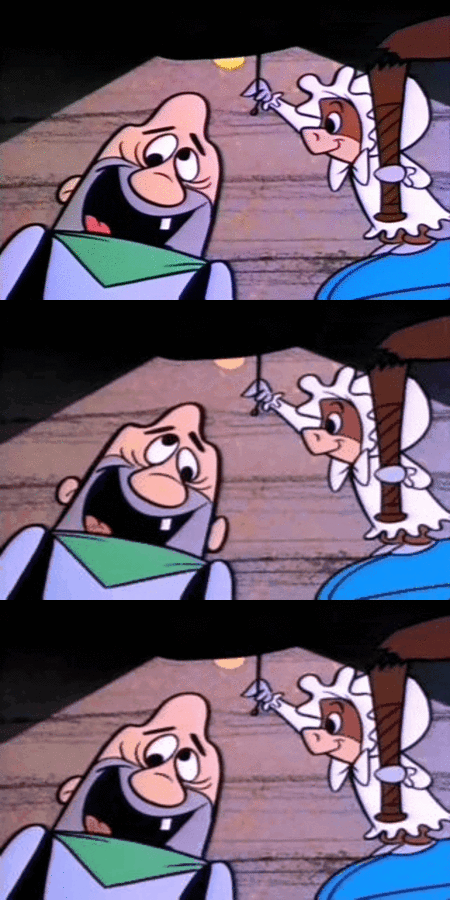
Tombstone runs after Baba again and catches him. Suddenly, there’s a thwack of the umbrella again. Daws makes it even stupider by shouting “Take that, that, that, that!” to the melody of ‘Shave and a Haircut.’ “Oh, you got real spunk, m’am” compliments the lovelorn villain. “Lucky for me you cain’t draw a gun.” Quick Draw whips out his sketch pad and draws one. Suddenly, Tombstone realises they’re the phoney Tootin’ brothers. “How’d he figure that?” asks Quick Draw of the audience. But Baba grabs his gun to get the drop on him. “Now you wouldn’t shoot a ring-tailed varmint like me, would you.” A gunshot, a camera-shake and animated smoke evidently from Tombstone’s nether parts provide the answer.

So Baba has the drop on the bandit as Quick Draw pushes the money in the pram. “Honest, fellas, I’m ree-formed. I’m a good guy, honest,” insists Tombstone. But the electric eye tells a different story (with clunks on a muffled cowbell as a sound effect). Baba shoots him in the butt to keep him moving as the camera fades.

The music is a familiar mix of Phil Green and Jack Shaindlin tunes.


0:00 - Quick Draw sub main title theme (Curtin).
0:18 - EM-147 DOCUMENTARY MAIN TITLE (Green) – Pan of map, Quick Draw and Baba walking.
0:37 - tick tock/flute music (Shaindlin) – Quick Draw reads sign, Quick Draw and Baba disguise as the Tootin’ brothers, Quick Draw draws gun.
1:57 - LAF-2-12 ON THE RUN (Shaindlin) – Tombstone shoots, Quick Draw and Baba run away.
2:13 - GR-99 THE DIDDLECOMB HUNT (Green) – Quick Draw and Baba dressed as mother and child, activate electric eye.
2:28 - GR-80 FRED KARNO’S ARMY (Green) – Quick Draw pleads with Tombstone; he and Baba are in house.
3:14 - GR-93 DRESSED TO KILL (Green) – Tombstone at home with flowers, Quick Draw kisses $, asks Tombstone why he’s shook up about him
3:51 - GR-74 POPCORN (Green) – Tombstone says Quick Draw reminds him of his horse, Baba shoots him, bites him.
5:04 - SIX DAY BICYCLE RACE (Shaindlin) – Baba runs into closet, Tombstone follows.
5:11 - COMEDY SUSPENSE (Shaindlin) – Closet baseball bat scene.
5:47 - SF-10 SKI(ING) GALOP (Lou DeFrancesco) – Tombstone chases Baba out of closet, hit with umbrella.
6:01 - GR-472 HICKSVILLE (Green) – Quick Draw draws a gun, Baba shoots Tombstone.
6:31 - SF-10 SKI(ING) GALOP (DeFrancesco) – Tombstone insists he’s a good guy, Baba shoots him.
6:54 - GR-79 CUSTARD PIE CAPERS BRIDGE No 2 (Green) – “Okay, but watch it.”
7:01 - Quick Draw sub end title theme (Curtin).

Wednesday, 6 January 2010

You Can Be Mr. Jinks

Who wouldn’t want to make their own Huckleberry Hound cartoon? Or pretend they’re Daws Butler? Kids got the chance in 1960.

“YOGI BEAR COLORING CONTEST!!” screamed display ads in a bunch of newspapers on April 10 that year. And what a great prize! To quote further:

(Each prize winner wins 3 Huckleberry Hound Cartoon Films and a Complete Bell & Howell Home Movie Outfit)

Unfortunately, I can’t reproduce the ad—what you see to the right is another ad featuring the same home movie outfit (as best as I can tell; I’m not an expert on photography). But here is some of the sales-job text:

Think of the fun you can have showing your own movies of Huckleberry Hound, Yogi Bear, Mr. Jinks, Pixie, Dixie and all the Huckleberry Hound TV Show gang. These are special home-version cartoon films with titles and a copy of the actual script used to make the TV sound version. You can play-act the parts as you watch each cartoon! The Super Monterey Bell & Howell Projector you win will bring them to life right in your home . . . and with the Bell & Howell Sun-O-Meter Movie Camera you ll be able to direct and film your own movies, too! It's easy to win ... so, enter as often as you like.

Pick up a Kellogg’s OKs contest package, today! GET YOGI BEAR’S COLORING CONTEST PICTURE AND COMPLETE RULES ON SPECIALLY MARKED KELLOGG’S OKs PACKAGES AT YOUR GROCER’S.

The agency people at Leo Burnett—I’m presuming they handled this—outdid themselves putting together this promotion. Bell and Howell, as you can see by the unrelated ad, had some experience in distributing cartoons with its product (Castle Films reproduced Lantz and TerryToons cartoons in 8mm).

It sounds like a fun time for a kid, watching cartoons projected on the wall, then getting in front of the camera with Charlie Shows’ or Warren Foster’s dialogue in hand, shouting “I hate you meeces to pieces!” in a seven-year-old’s approximation of Jinks’ voice. Better than sealing themselves off from the world playing video games like they would today, we suggest. Then again, adults probably looked at all this in 1960 and lamented “Why can’t they stand around the piano and sing like we did as kids?”

I’d sure be interested in seeing what the “scripts” the winners got looked like.

Saturday, 2 January 2010

Yogi Bear — High Fly Guy

Produced and Directed by Bill Hanna and Joe Barbera.
Credits: Animation – Lew Marshall/Mike Lah; Layout – Ed Benedict; Backgrounds – Fernando Montealegre; Dialogue and Story Sketches – Charlie Shows and Dan Gordon; Titles – Art Goble; Production Supervision – Howard Hanson.
Cast: Yogi, Eaglet 2 – Daws Butler; Fly Guy (Eaglet 3), Mother Eagle, Eaglet 1 – Don Messick.
Production E-2; Huckleberry Hound Show K-008.
First aired: week of November 17, 1958.

Time once again to name that cartoon. Ready? Here’s the plot:

A mother bird watches her eggs hatch. The mother and siblings head away from the nest, but one bird doesn’t know how. He is taught by another character who happens to be nearby but fails until he makes a life-saving rescue. Then, he hears his mother and siblings and joins them as the camera fades out.

No, the answer is not the 1953 Tom and Jerry cartoon Just Ducky, where the Yakky Doodle prototype can’t swim, Jerry tries to teach him how, but his natural instincts only kick in to rescue Tom from drowning. But it’s a pretty good guess.

This time, Joe and Bill have ripped off their own cartoon, substituting an eaglet for the ducklet (don’t worry, they recycled him elsewhere), Yogi Bear for Tom and Jerry and flying for swimming. There are no Boo Boo Bear, Jellystone Park or Ranger Smith in this cartoon—partly because they didn’t have counterparts in the Tom and Jerry cartoon, but mainly because that whole plot device didn’t get codified until Yogi’s second season. Of the first ten Yogis that aired, only two are set in Jellystone and four have Boo Boo.

The other link between the two cartoons is Ken Muse, who animated on both, though the designer and animator on this one came from Tex Avery’s unit at MGM—Ed Benedict and Mike Lah. They have a really odd design for Yogi, who has goofy-looking eyes slanted outward and the light brown muzzle colour extends around the eyes. Yogi’s front eye also extends above the side of his hat. I realise model sheets today have him that way, but Lah is the only one I recall who drew him like that in the early cartoons. And he talks from the side of his face.

Since we’ve already gone through the plot, there isn’t a lot to say. Majestic music augments an opening shot of a majestic mountain peak. We zoom in on a mother eagle, with Don Messick’s standard-issue falsetto, watching her three eggs hatch. The little birds beg to go flying, so they follow their mother off the precipice.


All but the last eaglet. There’s a bit of clever camera-work here. The bird stops at the edge of the cliff and looks down. The camera trucks in and out of a background cell of the ground below, going in and out of focus. And it saves 3 ½ seconds of animation, too. As mom and his brothers fly away, the little eaglet cries for them to wait.“I can’t fwy!” he bellows (substituting w’s for l’s seems to have been mandatory for kiddies in cartoons and radio comedies back then). The eaglet gives it a try but zooms to the ground out of view, a six-second shot of a cell of the sky and a camera shake substituting for animation. We see the end result; despite being newborn he weighs so much, he makes a dent in the ground.

While all this is happening, Yogi is snoozing against a tree. He hears crying. The eaglet then relates his sob story. Like in other early Yogis drawn by Lah, the character pops from pose to pose with no in betweens. The eaglet does it here.


Yogi agrees to teach him how to fly. “I’ve been watching birds do it for years,” Yogi informs him as his qualifications as an instructor. First, he puts the eaglet on a sapling he’s tied down and undoes the knot. We get a Charlie Shows rhyming two-some as Yogi exclaims “Contact, Jack!” and another Jackie Gleason reference as he shouts “And away you go!” The little bird flaps his wings but stalls in the air and then drops. Yogi nimbly comes to his rescue beside a cliff.

“I’ll show you how it’s done, son,” rhymes Yogi as he slaps on some wings made of thick evergreen branches. Much like Wile E. Coyote in Gee Whiz-z-z-z-z-z-z (1956), Yogi gets airborne and isn’t paying attention when he flies into something, in this case a hollow tree stump. “Flyin’ is for the birds,” is Yogi’s witticism as the camera fades. Too bad Charlie Shows and Joe Barbera didn’t steal some of Mike Maltese’s funny dialogue along with his gags.

Yogi sets up a teeter board, holding a rope attached to a rock on a nearby small cliff. Lah has taken over the animation here. “I don’t get it,” says the eaglet, who apparently has never seen Scrambled Aches (1957) because we get another Wile E. gag. The boulder lands on one end of the board sending Yogi crashing into the cliff above, followed by the rock on top of him (even though he runs away from it and hides behind a tree).


A short scene follows, as the bear demonstrates a beanie with a propeller, only to drill himself into the ground. Marshall returns for the rest of the cartoon. Yogi makes a paper airplane as the little bird weeps. “For cryin’ out loud,” grumbles the bear. See? The eaglet is crying. Yogi says “cryin’.” Get it? That’s Charlie Shows idea of dialogue. Anyway, Yogi throws the paper airplane with the bird on it and runs after him. Unfortunately, Yogi runs off the edge of a cliff and falls (waving ‘goodbye’ upside down to the eaglet is a nice touch. It’s done in three drawings on twos).


The birdie stretches the cartoon with unnecessary chatter. “Yogi! Help! Oh, poor Yogi. I gotta do somethin’. (pause) Yogi, wait for me!” All they really need here is a shock take, a determined look, and a zoom into action like, well, like in Just Ducky. But H-B loved filling cartoons with dialogue and things only got worse as they headed toward the ‘70s. Be that as it may, we hear a skid sound and the shot cuts to the bottom of a cliff where the flying eaglet is holding Yogi’s butt in his mouth (say what?!) and has saved his life. Yogi reacts by smiling as he knows the little bird has learned to fly. Aw. Ain’t that cute? Oh, wait, let’s save that line for when they recycle that ducklet.


Yogi is made an “onnowawwy eagle” for his teaching abilities by the little bird, who spots his mom and brothers and joins them in the sky in some cycle animation. We get in one little bit of a gag. “Remember, keep flappin’ them wings,” Yogi shouts as he demonstrates. Suddenly, he realises he is airborne and grabs the side of a cliff in a nice bit of scrambly animation. “Like I said, flyin’ is strictly for the birds,” Yogi remarks to the camera as it fades.

There are a couple of unusual music selections in this one, probably because it was in production early. This is the only cartoon which uses ‘TC-308’ and one of few where you can hear the Bill Loose-John Seely ‘Waltz’ underneath the sobbing birdie. ‘TC-221A’ was used more in Ruff and Reddy than in the later comedy shorts. ‘L-1158’ is a series of bassoon effects, one of which is used here.


0:00 - Yogi Bear (Curtin, Hanna, Barbera, Shows) – Main titles.
0:16 - EM-147 DOCUMENTARY MAIN TITLE (Phil Green) – Shot of mountain, mother watches eggs hatch.
0:41 - TC-436 SHINING DAY (Loose-Seely) – Mom agrees to let eaglets fly, third eaglet falls to ground.
1:48 - TC-302 WALTZ (Loose-Seely) – Yogi talks to eaglet, launches birdie from branch.
3:01 - ZR-48 FAST MOVEMENT (Geordie Hormel) – Eaglet drops, Yogi grabs him.
3:20 - TC-308 WISTFUL COMEDY (Loose-Seely) – Homemade wings scene, Yogi explains teeter board.
4:19 - TC-221A HEAVY AGITATO (Loose-Seely) – Rock drops on teeter board, then on Yogi’s head.
4:45 - LAF-4-1 FISHY STORY (Jack Shaindlin) – Beanie-bonnet gag.
5:12 – TC-200 WISTFUL COMEDY (Loose-Seely) – Yogi tosses birdie on paper airplane.
5:45 - LAF-20-5 TOBOGGAN RUN (Shaindlin) – Yogi runs behind airplane, falls of cliff, rescued.
6:23 - L-1158 ANIMATION COMEDY (Spencer Moore) – Eaglet holds Yogi aloft,
6:26 - ZR-48 FAST MOVEMENT (Hormel) – Eaglet goes off with mom and brothers, Yogi flies and grabs cliff.
6:59 - Yogi Bear (Hanna-Barber, Curtin, Shows) – End titles.

Sunday, 27 December 2009

Marvin Kaplan — The “Intellectual Close Friend”

Arnold Stang’s death has brought about the question about how many of the main voice actors are left from Top Cat. After all, all four main cast members of The Flintstones, which debuted the year before, are now gone.

Top Cat, out of plot necessity, had a much larger regular cast than any Hanna-Barbera show to that time; what kind of alley would it be with only one cat and a sidekick like in a Yogi Bear cartoon? Fortunately, several of T.C.’s gang are still with us—Marvin Kaplan, John Stephenson and, as Earl Kress reminds me, nightclub comic Leo de Lyon.

As a sidebar, all three had a connection with “I Love Lucy,” whose opening animation was done by Hanna and Barbera. Stephenson, according to Bart Andrews’ book on the show, was an announcer on it, de Lyon appeared on stage with Desi Arnaz in 1949 and Kaplan was signed by Desilu in 1963 for two sitcom pilots: one with Ethel Merman called “Maggie Brown” and “Hooray for Hollywood.”

I really like listening to Marvin Kaplan. Maybe I have an affinity for those New York accents from watching Warners cartoons as a kid. Kaplan’s longest role was probably his worst, on Alice, featuring one-note characters, a couple of overused catchphrases and the usual camera close-up “serious” moment that was requisite at the same spot in the plot of every episode of every ‘70s sitcom. Quite a fall for someone who played in Uncle Vanya on stage. I suppose one might consider a cartoon a bit of a career drop, but Top Cat had a tremendous voice cast, the first batch of really great music by Hoyt Curtin and, occasionally, inspired bits of dialogue.

It seems casting Kaplan as the usually well-grounded Choo Choo was a bit of stereotyping. I had no idea that he was a high school teacher at the same time he was in some pretty high-profile movies. But that’s what this syndicated column of December 2, 1962 reveals:


Comic’s Dual Life: He Teaches, Too
By ERSKINE JOHNSON
Hollywood Correspondent
Newspaper Enterprise Assn.

HOLLYWOOD (NEA)—Marvin Kaplan laughs off a double life with a stock answer when he introduces himself for the day in the Los Angeles city school system. The question is stock, too, from some always-curious student.
“Haven’t we seen you in movies or on television?”
When the question comes, Kaplan’s round cherubic face goes preposterously sad. He removes a pair of thick-as-bottle glass hornrims without which he says “I can’t even see the eye chart.” He wipes them with a handkerchief and as he says:
”I guess you all think I look like a certain actor. Well, I must admit I’ve been mistaken for Rock Hudson for years.”
It’s a sure-fire laugh—and getting laughs is Marvin Kaplan’s life in show business. In the classroom, where he leads another life, he knows exactly how far he can go. After that, he’s all academic business.
A movie and television funny-man, Kaplan just completed an all-star comedy, “It’s a Mad, Mad, Mad, Mad World” and another part in Jerry Lewis’ latest film, “The Nutty Professor.” For four years, Kaplan played the role of Alfred Prinzmetal, the poet, in the weekly television series, “Meet Millie.” He’s now the voice of Chu Chu [sic] in ABC’s “Top Cat” series.
BETWEEN ASSIGNMENTS some actors go fishing and others play golf and still others make headlines like Richard Burton. Kaplan, who trained for an academic career, teaches school. As a substitute for the last five years, he has taught 3,000 high school classes in the L.A. school system. He devotes about six month a year to the job about which he says:
“Why I teach is a hard question to answer without sounding corny, but I guess you’d have to call it a matter of good citizenship. Some actors dabble in politics, some do benefits. I teach. It beats driving yourself crazy with idleness between assignments and the kids are a great audience.”
Kaplan’s classes have ranged all the way from biology (“which I flunked in school”) to senior problems (“like smoking. Only all the students smoke and I don’t.”)
WHETHER RECOGNIZED or not, Kaplan’s wit and dramatic flair help him at his desk, where he says “the teachers of America win Academy Awards every day for audience-holding performances.”
To a would-be cut-up in a classroom, Kaplan flipped: “You have a sense of humor like an acid thrower.”
To an unruly lad in another classroom, he said: “You can’t be replaced but you can be tortured.”
To a drama class fumbling with “Julius Caesar,” he flipped: “I came to bury this class, not to teach it.”
Via laughs, he wins attention and respect. His assignments take him from tough “Asphalt Jungle”-type neighbourhoods to exclusive residential areas like Brentwood where “he” had a laugh. A mother whose child had been rude to the regular teacher introduced herself to Kaplan at a PTA meeting. After apologizing, she said about the boy: “I can’t understand why he was so ill-mannered. He’s always a perfect gentleman to the servants at home.”
Casting directors, naturally, never think of Marvin Kaplan for a teacher role. He played a beatnik in Lewis’ “The Nutty Professor,” has played only one school teachers in a “Dobie Gillis” television show.

“Yowp,” I know you’re saying, “Where’s the inside gossip? The drunken car accidents? The sexual sleaze? The swearing at the paparazzi? The meltdowns and rehab?”

Well, let’s see. Inside gossip. Hmmm. Okay, how about this: Kaplan inherited his grandfather’s pickle and sauerkraut factory in New York in the ‘50s. He actually sold sauerkraut before becoming an actor. Yeah, I know, not much. And we’ll leave the sauerkraut story for another time. About the only gossip—and it’s tame compared to what you find today on blogs written by people emulating Charles Pierce as Bette Davis—comes from one long-time wire service (and radio) columnist for papers of March 24, 1978:


Repairman eccentric off screen
By Vernon Scott
HOLLYWOOD (UPI)—Marvin Kaplan, who plays Henry, the telephone repairman on the “Alice” series, is considerably more eccentric off-screen than the nutty character he plays on the CBS show.
Kaplan was divorced recently after three years of marriage.
He apparently was the victim of the “too little, too late” syndrome. A lifelong bachelor, Kaplan marched to the altar for the first time at the age of 46. His bride, 47, also was marrying for the first time.
“It didn’t work out,” Kaplan says, apparently unfazed by the experience. “We both were so set in our ways it was ridiculous. We didn’t have any children.
“Now I’m going to write a book titled, ‘Listen, If You've Waited This Long.’”
Kaplan is a happy-go-lucky man who says he and his wife first met as schoolmates in a Brooklyn high school. They lost touch with one another for many years until he bumped into her in Indianapolis where she was a college professor.
“She expected me to be the same person she knew in Brooklyn,” Kaplan says. “I expected her to have changed. Both of us were wrong.”
Kaplan kept the couples’ two-bedroom Burbank home after the divorce. He had owned it for many years before his marriage. His wife took the furniture because it belonged to her for years before they exchanged vows.
Home is a modest California ranch-style stucco with very little furniture. It is also something less than a showcase.
“My house always looks as if it’s just been robbed,” says Kaplan. “It’s a mess. I’m not the best housekeeper and my wife was meticulously neat.”
Immediately after the 1971 earthquake a neighbor knocked on Kaplan’s door to see what damage his house had suffered. Kaplan says there was virtually no damage, but the neighbor took one look at the mess inside and assumed the house had been all but destroyed.
Kaplan said he is not entirely at fault for the constant disarray of his home. He had the same cleaning lady for 30 years and said in recent years she came to work in a wheel chair. But she disappeared recently without a trace.

If Marvin Kaplan has had a bad review, I have yet to read it. He got good ink from Bosley Crowther in the New York Times for his role in The Reformer and the Redhead which he shot 60 years ago. He got a few spotlight stories in Top Cat, but the best cartoon he was in didn’t involve drawings. It’s a Mad, Mad, Mad, Mad World is one long cartoon. It has over-the-top characters (the usually camera-hogging Uncle Miltie appears positively tame next to the unsinkable Ethel Merman), a crazy chase scene dispensing gags along the way, and even cartoon voices (Kaplan, Stang, Stan Freberg, Jim Backus, Edward Everett Horton and Terry-Thomas. And Jimmy Durante and Phil Silvers, once removed).

But, as the song says, if the most effectual Top Cat is going to have an intellectual close friend, none could possibly be better than the enjoyable Marvin Kaplan.

Saturday, 26 December 2009

A Final (?) Note About Arnold Stang

A couple of months ago I promised to reprint a news story about Arnold Stang and, with his passing a few days ago, now may be as good a time as many to pass it on.

The Hanna-Barbera PR machine was well-oiled by the time Top Cat was heading toward its debut. Unlike any of the previous series, where Joe and Bill did the talking to reporters, the star himself was enlisted to push his new cartoon show in media interviews. Maybe it was because of Stang’s name recognition.

Here’s the interview I promised, un-bylined in this version, from a couple of months before the show aired. You can see that the voice cast still wasn’t quite settled; I don’t think Bea Benaderet did anything on the show; Jean Vander Pyl did.


TV Toppers: Is He Man or Mouse?
NEW YORK, June 13 (UPI) —The usual question, “Are you man or mouse?” won’t do for Arnold Stang.
In his case, you have to ask, “Are you man, cat or mouse?”
And he just might have trouble giving a snap answer.
The complication in the career of the slight, begoggled performer arises from the fact that besides being constantly employed as comedian Arnold Stang, in person, or as an actor creating a human character for stage, screen or TV, he has become prominent in the animated cartoon field.
STANG HAS been the voice for “Herman the Mouse,” a series of filmed shorts widely used in theaters and on TV programs, and now he has the important assignment of voicing the title role in “Top Cat,” a half-hour weekly animated series made especially for television that will be a new entry on the ABC network schedule next fall.
“Actually, I received no billing from the ‘Herman the Mouse’ series,” Stang explained, “and now, of course, I’ll make no more of them.
“However, everyone who saw one of those shorts knew, right away I did them. On account of the voice.
“They recognized it.
“But I’m not using the ‘Stang voice’ for the ‘Top Cat’ series. I won’t sound like me. When we first started making them, the question came up as to whether I shouldn’t voice T.C.—that's the way the cat is usually referred to—in my natural manner, but I talked them out of it. I don’t think my natural tone quite fits the character of T.C.”
“TOP CAT” IS another major cartoon creation by the Hanna-Barbera Firm in Hollywood that made a splash this season with “The Flintstones” on ABC, the first “adult” animation series especially created for television.
“Top Cat” also is intended to be a bit above the “kiddie level,” with a certain sophistication.
T.C. is a big-city vagrant with a leadership quality that binds assorted felines to him.
They get involved in stories which might just as well be played by humans. A policeman will be the only regular human character of the show.
“Some of the other well-known actors providing voices for the show,” Stang said, “are Maurice Gosfield—you know, the Doberman of Phil Silvers’ old series; Allen Jenkins, who talks for the cop; Leo de Lyon, who speaks for a beatnik-type cat, and Bea Benaderette [sic], who also does one of the voices on ‘The Flintstones.’
“We have a dozen of the episodes completed, and I have to go right back to work this week.
“We record on tape from script in a studio, and the technicians blend the lines with the animation frames.
“I came back here for a few days to close up my home in New Rochelle and move the family out to Bel Air, where we bought a house.
“I’VE BEEN commuting so much in recent years between New York and Hollywood, as more and more of the television work centered there, that about the only way. I could expect to have much time with my wife and two children was to set up our home out there.”
Cat lovers will want to know whether Stang really likes cats.
“Well,” he replied cautiously, “let’s say I’m very fond of this cat character.”

Something just doesn’t seem right with the interview, though. The show is about a conning cat that uses Bilko-like flattery, has Bilko’s sidekick (Gosfield) and was written at times by a Bilko writer (Barry Blitzer)—but the studio wanted him to sound like Stang and not Bilko? Call me a little sceptical.

Top Cat debuted on Wednesday, September 27, 1961. The Big Cartoon Database says ‘Hawaii—Here We Come’ was the first show. But that’s not what the TV listings of the day say. You see to your left a TV ad which suggests the first show was really ‘The $1,000,000 Derby.’ In fact, a couple of newspapers in their “week ahead” TV listings the previous weekend give that cartoon in their plot summary. But on the day of the show, the papers changed their minds. Here’s a typical summary:

7:30—2 Top Cat: (Premiere) New half-hour animated cartoon series about the adventures of a band of felines in Manhattan. Tonight: "Top Cat Falls in Love" — Benny the Ball has his tonsils out but, after one glimpse at the nurse, smitten T.C. is stricken with a rare ailment to keep him hospitalized.

That, according to BCDB, was supposed to be the seventh episode. So which one aired? It’s tough to say. The Chicago Tribune’s Larry Wolters had this review the following morning:

Top Cat, also known as Ali Khat or alley cat, is a happy addition to all of TV's animated cartoon characters TV's animated cartoon characters. He gets mixed up with some pretty mixed up characters including "a compact horse" which he manages to run in a derby. Arabelle, the nag, came in second—she stopped to have her picture taken.

Whether Wolters actually saw the show the night of the debut or received an advance copy and wrote his column from that, I don’t know. But nowhere can I find evidence that ‘Hawaii—Here We Come’ aired first.

Incidentally, Jack Gould of the New York Times panned the show the following morning. He was the guy who called The Flintstones “an inked disaster” the day after its premiere. After moaning about how Steve Allen’s new show was too slapstick—yes, he panned Steve Allen, too—he wrote:


‘Top Cat’ in Debut
Following Mr. Allen's mishap on Channel 7 was another one: a cartoon series called "Top Cat." The central animal is an unattractive-Tommy-run feline and his bewhiskered minions are a dreary lot. Their adventures last night were dull enough to have been performed by humans.

And the Tribune capped the debut with this note in Herb Lyon’s column two days later on September 29th:

Silliest promotional stunt yet: ABC-TV publicized its new cartoon series Top Cat by sending TV critics, columnists, etc., jumbo sized garbage cans, with the lids done up in blue ribbons. Anybody need a JSGC? I can’t get past it to my typewriter!


Ah, but we’re getting away from the topic of Arnold Stang. Suffice it so say, he entertained many people in different media—radio, feature films, television, cartoons—for decades. Fortunately, his work is still around for us to enjoy even though he has gone.

Top Cat is a little beyond the time limit that this blog is supposed to focus on, but I’ll pass on one more set of clippings soon about Stang’s funny mate from Brooklyn, Marvin Kaplan.