Showing posts sorted by relevance for query dan gordon. Sort by date Show all posts

Sunday, 10 April 2011

I’ll Do the Drawin’ Around Here

Forty-five Quick Draw McGraw cartoons were churned out between 1959 and 1961, assembled as part of a half-hour show for Kellogg’s. They later found their way to television stations to be used on cartoon compilations or live, hosted kids shows, and each cartoon featured a title card revealing who did the art and story work.

Somewhere along the way, the opening credits were chopped for time and out went the title card. So Quick Draw was broadcast for quite some time without anyone knowing who painted the backgrounds or rushed with their pencil to get their footage out. This fate befell pretty well all of the Hanna-Barbera shorts of that era but many have had their credits restored, especially for DVD release.

Recently, your favourite TV cartoon dog of the 1950s (certainly I must rank ahead of Chopper) happened upon almost full runs of Huckleberry Hound and Pixie and Dixie cartoons from Italian television. Most of them had full credits. I was hoping for the same Italo-TV discovery with Quick Draw McGraw and, indeed, it has happened. However, it’s disappointing that only about half of them have a title card with drawing and story credits. So that’s what I’m going to bring you.

2026 NOTE: With the restoration of the Quick Draw series cartoons, the credits for each appears once again. Slowly we'll update this post.

The first 26 cartoons were originally broadcast on the first season, followed by 13 in the second season and the remaining six in the third. They’re in order of copyright though, as far as I can tell, they’re also in broadcast order; certainly the first season is. As you can see, the cartoons weren’t aired in the order they were produced.

Ex Warners’ layout man Bob Givens worked on at least two Quick Draws before vamoosing in the first season. It’s possible he also did layouts on others which don’t have credits available. Gerard Baldwin, who bolted for the Jay Ward studio in 1959, also animated a couple.

There were never any voice or music credits, but Hoyt Curtin’s underscores replaced the stock music for the third season, which is the reason four of that season’s cartoons are on DVD (though The Mark of El Kabong has the title cards for Lamb Chopped). And it took awhile for Joe Barbera to settle on new voices for his cartoons. The first Quick Draw in production featured Elliot Field, the original voice of Blabber Mouse; the second had Vance Colvig, who returned to the studio the following year to play Chopper, and the third had Peter Leeds, who lost the Doggie Daddy role to Doug Young. Young, Hal Smith, Julie Bennett and Jean Vander Pyl also provided incidental characters in the first season. And Don Messick, of course.

It’s a shame credits aren’t available for some of my favourite cartoons, including the first three in production. Another is the second-season closer El Kabong, Jr., where Daws digs up his Jerry Lewis voice for the title character. El Kabong is at his most stylised here and there are a couple of neat little dance scenes.


The backgrounds vary; most have a flat brown, blue or pinkish colour, occasionally with clouds, but my favourites are probably by Art Lozzi. In Ali Baba Looey, he indulges in various shades of purples in the sky. I think that’s Lozzi again in The Mark of El Kabong, where the sky is green. And he does some nice work on the background that’s panned in the opening of Chopping Spree, with Bick adding his flip-up branch trees in layout.

If anyone has a line on the actual cartoons with the credits—no web databases or wikis, please—let me know where I can find them. For now, this will have to suffice.


Late note: Rick G. has gone through some of the records of his friend, the late Earl Kress, and thoughtfully sent credits for Masking For Trouble. Earl got his information from Hanna-Barbera and is unimpeachable.

First Season, 1959-60

LAMB CHOPPED Show M-001, Production J-11
Animation – Ken Muse; Layout – Ed Benedict; Backgrounds – Bob Gentle; Story – Mike Maltese; Story Sketches – Dan Gordon; Titles – Lawrence Goble; Production Supervision – Howard Hanson.
Voices – Daws Butler.
Copyright 1959 by H-B Enterprises, Inc.

BAD GUY’S DISGUISE Show M-002, Production J-4
Animation - Carlo Vinci; Layout – Walt Clinton; Backgrounds – Bob Gentle; Story – Mike Maltese; Story Sketches – Dan Gordon; Titles – Art Goble; Production Supervision – Howard Hanson.
Voices – Daws Butler; Vance Colvig.

MASKING FOR TROUBLE Show M-003, Production J-10
Animation – Lew Marshall; Layout – Dick Bickenbach; Backgrounds – Fernando Montealegre; Story – Mike Maltese; Story Sketches – Dan Gordon; Titles – Lawrence Goble; Production Supervision – Howard Hanson.
Voices – Daws Butler, Don Messick, Julie Bennett.
Copyright 1959 by H-B Enterprises, Inc.

BOW-WOW BANDIT Show M-004, Production J-30
Animation – Ken Muse; Layout – Walt Clinton; Backgrounds – Bob Gentle; Story – Mike Maltese; Story Sketches – Dan Gordon; Titles - Art Goble; Production Supervision – Howard Hanson.
Voices – Daws Butler, Doug Young.

SCAT, SCOUT, SCAT Show M-005, Production J-5
Animation – Ken Muse; Layout – Dick Bickenbach; Backgrounds – Fernando Montealegre; Story – Mike Maltese; Story Sketches – Dan Gordon; Titles – Art Goble; Production Supervision – Howard Hanson.
Voices – Daws Butler, Peter Leeds.

SCARY PRAIRIE Show M-006, Production J-1
Animation - Carlo Vinci; Layout – Dick Bickenbach; Backgrounds – Bob Gentle; Story – Mike Maltese; Story Sketches – Dan Gordon; Titles – Art Goble; Production Supervision – Howard Hanson.
Voices – Daws Butler, Elliot Field.

EL KABONG Show M-007, Production J-43
Animation – Lew Marshall; Layout – Walt Clinton; Backgrounds – Dick Thomas; Story – Mike Maltese; Story Direction – Alex Lovy; Titles – Lawrence Goble; Production Supervision – Howard Hanson.
Voices – Daws Butler, Don Messick.
Copyright 1959 by H-B Enterprises, Inc.

CHOO-CHOO CHUMPS Show M-008, Production J-9
Animation – Ken Muse; Layout – Dick Bickenbach; Backgrounds – Fernando Montealegre; Story – Mike Maltese; Story Sketches – Dan Gordon; Titles – Lawrence Goble; Production Supervision – Howard Hanson.
Voices – Daws Butler, Doug Young.
Copyright 1959 by H-B Enterprises, Inc.

RIVERBOAT SHUFFLED Show M-009, Production J-20
Animation – Carlo Vinci; Layout – Bob Givens; Backgrounds – Fernando Montealegre; Story – Mike Maltese; Story Sketches – Dan Gordon; Titles - Art Goble; Production Supervision – Howard Hanson.
Voices – Daws Butler, Don Messick.

CATTLE BATTLE RATTLED Show M-010
(No credits. Animation – Dick Lundy; Voices – Daws Butler, Hal Smith.

DOUBLE BARREL DOUBLE Show M-011
Animation – Ken Muse; Layout – Dick Bickenbach; Backgrounds – Bob Gentle; Story – Mike Maltese; Story Sketches – Dan Gordon; Titles – Lawrence Goble; Production Supervision – Howard Hanson.
Voices – Daws Butler, Doug Young.
Copyright 1959 by H-B Enterprises, Inc.

SLICK CITY SLICKER Show M-012
Animation – Dick Lundy; Layout – Dick Bickenbach; Backgrounds – Bob Gentle; Story – Mike Maltese; Story Direction – Alex Lovy; Titles – Lawrence Goble; Production Supervision – Howard Hanson.
Voices – Daws Butler, Hal Smith.
Copyright 1959 by H-B Enterprises, Inc.

EL KABONG STRIKES AGAIN Show M-013
Animation – Carlo Vinci; Layout – Walt Clinton; Backgrounds – Joe Montell; Story – Mike Maltese; Story Sketches – Dan Gordon; Titles – Lawrence Goble; Production Supervision – Howard Hanson.
Voices – Daws Butler, Don Messick, Jean Vander Pyl.
Copyright 1959 by H-B Enterprises, Inc.

SIX-GUN SPOOK Show M-014
Animation – Gerard Baldwin; Layout – Bob Givens; Backgrounds – Dick Thomas; Story – Mike Maltese; Story Sketches – Dan Gordon; Titles – Lawrence Goble; Production Supervision – Howard Hanson.
Voices – Daws Butler, Don Messick.
Copyright 1959 by H-B Enterprises, Inc.

SAGEBRUSH BRUSH Show M-015, Production J-25
Animation – Lew Marshall; Layout – Robert Givens; Backgrounds – Dick Thomas; Story – Michael Maltese; Story Sketches – Dan Gordon; Titles - Art Goble; Production Supervision – Howard Hanson.
Voices – Daws Butler, Hal Smith.

GUN GONE GOONS Show M-016, Production J-49
(No credits. Animation – Dick Lundy; Voices – Daws Butler, Doug Young.

DIZZY DESPERADO Show M-017, Production J-21
Animation – Lew Marshall; Layout – Bob Givens; Backgrounds – Fernando Montelegre; Story – Mike Maltese; Story Sketches – Dan Gordon; Titles – Lawrence Goble; Production Supervision – Howard Hanson.
Voices – Daws Butler, Doug Young.
Copyright 1959 by H-B Enterprises, Inc.

DOGGONE PRAIRIE DOG Show M-018, Production J-42
Animation – Gerard Baldwin; Layout – Walt Clinton; Backgrounds – Joe Montell; Story – Mike Maltese; Story Direction – Alex Lovy; Titles – Lawrence Goble; Production Supervision – Howard Hanson.
Voices – Daws Butler, Don Messick.
Copyright 1959 by H-B Enterprises, Inc.

TREASURE OF EL KABONG Show M-019, Production J-55
(No credits. Animation – Carlo Vinci; Voices – Daws Butler, Hal Smith, Jean Vander Pyl)

BRONCO BUSTIN’ BOOBS Show M-020, Production J-60
Animation – Ken Muse; Layout – Dick Bickenbach; Backgrounds – Dick Thomas; Story – Mike Maltese; Story Sketches – Dan Gordon; Titles – Lawrence Goble; Production Supervision – Howard Hanson.
Voices – Daws Butler, Don Messick.
Copyright 1959 by Hanna-Barbara Productions.

LOCOMOTIVE LOCO Show M-021, Production J-56
(No credits. Animation – Carlo Vinci; Voices – Daws Butler, Don Messick)

ELEPHANT BOY OH BOY! Show M-022, Production J-66
(No credits. Animation – Ken Muse; Voices – Daws Butler, Hal Smith).
See note in the comment section.

THE LYIN’ LION Show M-023, Production J-61
(No credits. Animation – George Nicholas; Voices – Daws Butler)

BULL-LEAVE ME Show M-024, Production J-71
(No credits. Animation – Dick Lundy; Voices – Daws Butler, Don Messick, Doug Young)

KABONG KABONG’S KABONG Show M-025, Production J-72
Animation – George Nicholas; Layout – Walt Clinton; Backgrounds – Bob Gentle; Story – Mike Maltese; Story Director – Alex Lovy; Titles – Lawrence Goble; Production Supervision – Howard Hanson.
Voices – Daws Butler, Don Messick.
Copyright 1959 by Hanna-Barbara Productions.

CHOPPING SPREE Show M-026, Production J-65
Animation – Lew Marshall; Layout – Dick Bickenbach; Backgrounds – Art Lozzi; Story – Mike Maltese; Story Director – Alex Lovy; Titles – Lawrence Goble; Production Supervision – Howard Hanson.
Voices – Daws Butler, Hal Smith, Jean Vander Pyl.
Copyright 1959 by Hanna-Barbara Productions.

Second Season, 1960-61

EL KABONG MEETS EL KAZING Show M-027, Production J-79
Animation – George Nicholas; Layout – Walt Clinton; Backgrounds – Bob Gentle; Story – Mike Maltese; Story Director – Alex Lovy; Titles – Lawrence Goble; Production Supervision – Howard Hanson.
Voices – Daws Butler, Don Messick.
Copyright 1960 by Hanna-Barbara Productions.

BULLET PROOF GALOOT Show M-028, Production J-84
(No credits. Voices – Daws Butler, Doug Young)

TWO TOO MUCH Show M-029, Production J-85
(No credits. Animation – Ed Love; Voices – Daws Butler, Don Messick, Doug Young)

TWIN TROUBLES Show M-030, Production J-91
(No credits. Animation – Ken Muse; Voices – Daws Butler, Doug Young)

ALI-BABA LOOEY Show M-031, Production J-89
Animation – Dick Lundy; Layout – Walt Clinton; Backgrounds – Art Lozzi; Story – Mike Maltese; Story Director – Alex Lovy; Titles – Lawrence Goble; Production Supervision – Howard Hanson.
Voices – Daws Butler, Don Messick.
Copyright 1960 by Hanna-Barbara Productions.

SHOOTING ROOM ONLY Show M-032, Production J-95
(No credits. Voices – Daws Butler, Doug Young; Julie Bennett)

YIPPEE COYOTE Show M-033, Production J-101
(No credits. Animation – Dick Lundy; Voices – Daws Butler, Don Messick)

WHO IS EL KABONG? Show M-034, Production J-113
Animation – Hicks Lokey; Layout – Paul Sommer; Backgrounds – Dick Thomas; Story – Mike Maltese; Story Director – Alex Lovy; Titles – Lawrence Goble; Production Supervision – Howard Hanson.
Voices – Daws Butler, Don Messick.
Copyright 1960 by Hanna-Barbara Productions.

EXTRA SPECIAL EXTRA Show M-035, Production J-99 (or J-112)
(No credits. Voices – Daws Butler, Don Messick)

SCOOTER RABBIT Show M-036, Production J-106
Animation – Bob Bentley; Layout – Paul Sommer; Backgrounds – Art Lozzi; Written by Maltese; Story Director – Alex Lovy; Titles – Lawrence Goble; Production Supervision – Howard Hanson.
Voices – Daws Butler, Hal Smith.
Copyright 1960 by Hanna-Barbara Productions.

TALKY HAWKY Show M-037, Production J-116 (or J-109)
Animation – Ed De Mattia; Layout – Tony Rivera; Backgrounds – Art Lozzi; Written By – Mike Maltese; Story Director – Alex Lovy; Titles – Lawrence Goble; Production Supervision – Howard Hanson.
Voices – Daws Butler, Doug Young.
Copyright 1960 by Hanna-Barbara Productions.

GUN SHY GAL Show M-038, Production J-100
Animation – Paul Sommer; Layout – Tony Rivera; Backgrounds – Dick Thomas; Written by Mike Maltese; Story Director – Alex Lovy; Titles – Lawrence Goble; Production Supervision – Howard Hanson.
Voices – Daws Butler, Doug Young, Jean Vander Pyl.
Copyright 1960 by Hanna-Barbara Productions.

EL KABONG, JR. Show M-039, Production J-115
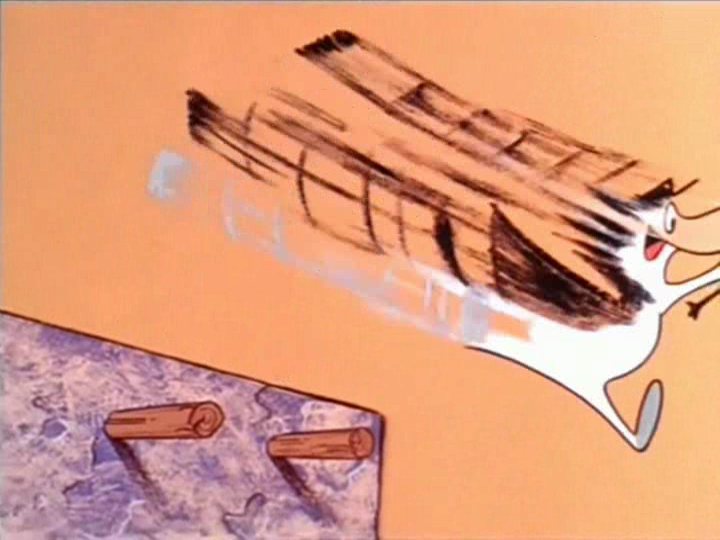
(No credits. Animation – Art Davis. Voices – Daws Butler, Don Messick, Jean Vander Pyl)

Third Season, 1961-62

BABA BAIT Show M-040, Production J-123
(No credits. Voices – Daws Butler, Don Messick; Music – Hoyt Curtin)

DYNAMITE FRIGHT Show M-041, Production J-110
Animation – Hicks Lokey; Layout – Paul Sommer; Backgrounds – Vera Hanson; Written by Mike Maltese; Story Director – Alex Lovy; Titles – Lawrence Goble; Production Supervision – Howard Hanson.
Voices – Daws Butler, Doug Young.
Music – Hoyt Curtin.
Copyright 1961 by Hanna-Barbera Productions.

EL KABONG WAS WRONG Show M-042, Production J-119
Animation – Hicks Lokey; Layout – Paul Sommer; Backgrounds – Vera Hanson; Written by Mike Maltese; Story Director – Alex Lovy; Titles – Lawrence Goble; Production Supervision – Howard Hanson.
Voices – Daws Butler, Don Messick, Jean Vander Pyl.
Music – Hoyt Curtin.
Copyright 1961 by Hanna-Barbera Productions.

MINE YOUR MANNERS Show M-043, Production J-130
Animation – Bob Bentley; Layout – Tony Rivera; Backgrounds – Art Lozzi; Written by Mike Maltese; Story Director – John Freeman; Titles – Lawrence Goble; Production Supervision – Howard Hanson.
Voices – Daws Butler, Don Messick.
Music – Hoyt Curtin.
Copyright 1961 by Hanna-Barbera Productions.

THE MARK OF EL KABONG Show M-044, Production J-136
(No credits. Voices – Daws Butler, Don Messick, Jean Vander Pyl; Music – Hoyt Curtin)

BIG TOWN EL KABONG Show M-045, Production J-126
(No credits. Voices – Daws Butler,– Don Messick, Jean Vander Pyl; Music – Hoyt Curtin)

If anyone has a line on the actual cartoons with the credits—no databases or wikis, please—let me know where I can find them. For now, this will have to suffice.

This brings to an end our little series of cartoons credits. There are some first- and second-season Yogis (from the Huck show without credits, but the Italian TV copies I’ve found have taken copies of American TV versions—not the originals—and substituted the language track, so they don’t have missing credits, either. Perhaps some day all these cartoons will be fully and completely restored for fans to enjoy, and to appreciate the artists who worked on them, knowing who they are.

Wednesday, 8 January 2014

Drawing and Drawing and Drawing

Mike Lah once said that if you were trained in Disney-style full animation, adjusting to Hanna-Barbera’s limited animation was fairly easy. But it was still a grind nonetheless. Ask Alex Lovy and Dan Gordon.

Lovy (in the centre of the photo) and Gordon (standing) both worked at the Van Beuren studio in New York in the mid-‘30s before ending up out West by the end of the decade. So they had plenty of experience working in full theatrical animation. Gordon was hired when Hanna-Barbera opened in 1957 to make story sketches (though story man Charlie Shows was quite capable of drawing). Lovy came aboard H-B in March 1959 as a story director, working on storyboards. Both talked about their jobs in this brief newspaper feature story that appeared in the Binghamton Press on September 30, 1961.


Monotony Is Biggest Peril to Cartoonists
By PEG STEVENS
It’s a well established fact that a daily comic strip artist leads a rugged life, but the daily hassle of turning out animated cartoons for television is equally as hectic.
Dan Gordon and Alex Lovy, story directors for Hanna-Barbera Productions, churn out close to 100 cartoons a day for The Flintstones.
“We get the rough story idea from the writer," explains Alex, “then it’s up to us to bring it to life with pen and ink. We average 500 cartoons a week, all with dialogue, in order to keep up with production schedules.”
The work demands precision and patience for one imperfect drawing can ruin an entire sequence and everyone down the line, from inkers to painters, gets thrown off their deadline.
The biggest occupational hazard in a cartoonery is monotony, according to Dan Gordon.
“It isn’t that you get bored,” Gordon points out, “but you can feel bogged down after a while when you’ve worked on one sequence too long.”
If this happens, the fellows switch jobs, completing what the others had started.
“Here’s an example of what we mean,” says Alex. “Imagine an artist having to sit at a desk and draw one figure on a celluoid [sic] plate. Then, when the basic picture is drawn, he has to draw a movement of an arm, leg or even the twitching of an eye. If a character points a pistol at an object, fires, then lowers his arm, an animator has to draw the various movements of the arm, which might be 25, 30 or even 40 frames. And the rub is that each movement has to be perfect. By the time you reach the 40th frame you’re a likely candidate for sillyville!” “What do you mean candidate?” injected Dan. “You have to live in sillyville to be a cartoonist!”

When Lovy says “cartoons,” I suspect he doesn’t mean a completed, 6½ minute cartoon. He must mean a story drawing. Still, if you have nine panels on a sheet and 16 sheets per cartoon, that’s a lot of drawing. And, of course, an awful lot more work is involved in a half-hour cartoon.

Lovy had a long career at H-B after spending time directing at Walter Lantz and Columbia in the ‘40s and ‘50s, as well as opening his own company with Sid Marcus in 1947 called Scientalks. After story directing at H-B, he was promoted to Associate Producer in August 1960 and retired in 1988. Lovy died February 14, 1992. Gordon, too, directed cartoons in the ‘30s at Van Beuren and the ‘40s at Paramount’s Famous Studios in New York. He spent some time drawing comic books. By November 1950, he was hired by John Sutherland to work in New York with agencies on prepping TV material. After a stay at Jack Zander’s Transfilm in New York, he ended up back at Sutherland in April 1954 dealing with commercial clients. In 1957, he was working for Bill and Joe. He left Hanna-Barbera around February 1961 to head the story department at Quartet Films but returned to the studio by the time Magilla Gorilla was in development in 1963. He provided story sketches for “Hey There, It's Yogi Bear” and his last job at the studio appears to have been on a 60-minute, Secret Squirrel/Atom Ant special that aired in September 1965. Gordon was born in Philadelphia in 1902 to John J. and Margaret Gordon but grew up in the Bronx. T.R. Adams’ book on the studio, quoting Bill Hanna, says Gordon died in 1969, other sources say 1970, but I’ve found no record of it.

Sunday, 13 March 2011

Jerry Eisenberg, Part Two

When we last left young Jerry Eisenberg, he was waving goodbye to Chuck Jones and Warner Bros. on his way to a new job in the world of television animation.

Part of the interview talks about Dan Gordon, who worked with Joe Barbera at Van Beuren and then Terrytoons in the ‘30s. Barbera has a couple of funny Dan Gordon stories in his autobiography and writes:


Gordon was brilliant and impulsive, and went on to work for Hanna-Barbera when he created the first “Flintstones” storyboards.

Barbera also reveals Gordon was an aficionado of “Mount Vernon rye, neat.” And we don’t mean the bread kind. Unfortunately, Gordon had a problem with alcohol long before he was a charter member of the Hanna-Barbera studio in 1957. Iwao Takamoto related in his book about the days when Gordon worked at the Fleischer studio in Florida, circa 1940:

Stan [Green, Takamoto’s former assistant at Disney] used to drive Dan to and from the studio, because Dan was too inebriated to drive himself. One time, Stan said, Dan had not bothered to close the door after getting in, and when Stan took a sharp turn, the door flew open, and in a flash there was no more Dan. He had fallen onto the road. But he was so “protected” by alcohol he was not even hurt.

This part of the interview was intended to deal with the short cartoons like Huck, which is the focus of the blog, but Jerry jumped ahead several years, so we backed up in time a little later in our chat. That means you’ll be reading later about The Jetsons, including the work on the show by Bobe Cannon.

Yowp: Was Joe Barbera the one who hired you to do layout at Hanna-Barbera?

Jerry: Right. Yes. You see, the layout department was Joe’s department. Joe and Bill divided the duties. Joe was handling the creative end of things and Hanna was running the studio. The layout department was Joe’s because six months out of the year, several of us would do development work with him. And then, once the shows were sold, we’d work six months on production. And Bill would run camera, and ink and paint, and animation. But Joe reserved the layout department [for himself] which was good, because we didn’t have to deal with Hanna.

Yowp: Was Hanna-Barbera paying scale at that time?

Jerry: Well, whatever the union scale was, I guess so. There were probably some people making premium but, I think, when I started there I was at assistant animation scale—maybe it was a little bit more for layout—but then I remember after about four months, Joe Barbera called me in and said “We’re raising you to such-and-such.” And I guess in the contract it called for every so many months in layout and you get a raise. Then you become a journeyman.

Yowp: I was checking some credits on the cartoons after you arrived at the studio to find your name. There’s a Pixie and Dixie cartoon.

Jerry: I know I worked on some of the Pixie and Dixie shorts.

Yowp: It was called Magician Jinks and the thing that was really cool about it is Jinks conjures up a dinosaur with a rhinoceros horn. It has a very Flintstones look. I’m presuming you would have designed the incidental characters in it.

Jerry: In those days, we used to design the incidentals and the props and the backgrounds. We didn’t have a model department, although on some of the lead characters, Dick Bickenbach did some of those. Later on, I did some, Iwao Takamoto did some, and I can’t remember who else.
What I really liked the best as far as layout was laying out on The Jetsons series. I liked the future stuff. You didn’t have to follow any rules, you could really use your imagination on what things might look like or how they worked. I really enjoyed that but we only did it for one season, unfortunately.

Yowp: How long did it take to lay out the shorts?

Jerry: Most of them were like, five, six, seven minutes, maybe. Probably seven, because you’d do three in a half hour and you have to allow about nine or ten minutes for commercials. But I used to lay them out in a week or less. I remember Hanna started an incentive thing. He wanted to get work done quicker, so he said “Look, if you guys can lay it out in less than five days, you get extra money. So I used to average four days and get an extra day’s pay. Instead of five days, I get six days. And that was nice; the money came in handy. Willie Ito was pretty fast.
Bill Hanna did something I didn’t like. Are you familiar with Dan Gordon?

Yowp: Oh, yes.

Jerry: Well, his son Kevin came to work there; Dan got him in and he was going to do layout. And Dan was telling me that Bill was meeting with Kevin and somebody in accounting kept records of what everybody was doing. And Kevin was saying “How much time do I have? What’s the schedule?” So Bill said to the lady “What does Jerry do?” And, of course, I was one of the fastest there. And he wanted Kevin to do pretty much what I was doing. And that wasn’t fair because people work at different speeds. I really didn’t like that and Dan didn’t like it, either.

Yowp: I don’t recall Kevin’s name being on any credits at all.

Jerry: Well, I don’t know why not. Unfortunately, Kevin died back then [in 1964, age 28]. He was a smoker and he fell asleep with a lit cigarette. He was living in some apartment and probably died of smoke inhalation. That was a tragedy for Dan. And then Dan’s other son died in a car accident not long after that.
My father really liked him [Dan]. He was really a nice man and very, very talented. He was a big help. But I thought that was shtty what Bill did with his son. He should have gotten an average. Let’s say there was ten of us in layout, what was the average amount of time for laying out a short. I probably was averaging four days or a little over. Other people were maybe taking the full five days or longer. Or maybe someone was doing it in three and a half days. But it wasn’t fair to expect Kevin to do what I was doing.

Yowp: Had he worked in another studio before that?

Jerry: I really don’t remember.

Yowp: And in Dan Gordon’s case, and your dad’s, they worked with Joe Barbera back in New York.

Jerry: Well, yeah, that’s where they met Dan and his brother George Gordon and a lot of other old-timers.

Yowp: Art Lozzi was saying he and Monte [Fernando Montealegre] and Bob Gentle, who were painting backgrounds, all had different styles. Can you look at a layout and figure that it’s one guy’s style over another?

Jerry: Oh, yes, I could tell the difference, my style, Iwao’s, Willie’s, Bickenbach, Walt Clinton and there was a funny guy from Texas. Lance Nolley. He’d come over from Disney. I think there was a big layoff at Disney so Joe and Bill got the benefit of getting a lot of good people from there.

Yowp: Did the layout guys choose the colour schemes for the cartoons?

Jerry: Sometimes. I remember being involved when I was supervising layouts for some of the shows later on, I’d work with the ink and paint people selecting colours.

Yowp: I take it you’d get a board from, say, Warren [Foster] or Alex...

Jerry: Oh, Alex Lovy. His stuff was terrific. We loved laying out off of his boards.

Yowp: So you get boards from them. How much of what they put on the board did you hew to when you started doing the layouts?

Jerry: Well, if it was Alex’s board, his posing was terrific, you know. He didn’t really draw on model. Sometimes, his drawing we liked better than the official model.
Like, take Wally Gator, the alligator character. Alex used to draw Wally; his was so funny-looking, we preferred it to the original model. But we had to do it like the model.

Yowp: So, when you arrived, was there a head of layout?

Jerry: Well, Bick sort of was the head of layout, but it really wasn’t formalised that much, but we used to take our layouts for him to check and even Joe Barbera liked to look over our layouts once in a while; we’d take them up to his office. I learned a lot from Joe. And Bick. And Joe kept doing that up until, let’s see, in ’63 their building was built up from where we were on Cahuenga and we moved in there, and Joe was still looking at our layouts maybe for a couple of years or so, then he got too darned busy.

Yowp: How much direction did the layout guys give to the background people in putting together stuff?

Jerry: We would design the background and they would pretty much follow them. Sometimes, they would add stuff. I remember on The Jetsons, Monte and the guys were doing a beautiful job on some of our backgrounds ‘cause I remember Iwao and I would go and look at the finished backgrounds. I saved some, thank goodness, they’re just beautifully painted. But once in a while, they’d put in a plant, like a potted plant, and my criticism was sometimes it would be a little too strong and would distract from, let’s say, the characters. I always tried to be careful when I staged a scene that the background wasn’t overly busy behind the character or something wasn’t going to distract from the character. So once in a while we’d have to ask them to modify stuff like that, or tone it down.


Yowp: I imagine laying out a half-hour show like a Jetsons is somewhat different than a short. What kind of process was involved?

Jerry: Well, as far as the layout process, we had teams. Myself, Iwao Takamoto and Jack Huber were a layout team and there were usually three acts to a half-hour show like that. We’d each do an act. We’d do the characters and the backgrounds and the props and everything. Then, of course, it would go to the animation director who would do the exposure sheets and time it out, then it would go to animation and background.

Yowp: Can you clarify some of the titles for me? You’d see Alex or Paul Sommer get a ‘story director’ credit and Nick Nichols would get an ‘animation director’ credit. What’s the difference between the two?

Jerry: Nick, you might say, was the animation timer. He would do the exposure sheets, time everything out. And he was so good and so fast at that. He was amazing. He could do so much work. He came over from Disney; he was an animation director at Disney on a lot of their shorts. But he was very fast, he really developed in a different way on the television stuff. Of course, the story director was doing the storyboards. I don’t know why they used that term.

Yowp: They changed somewhere during the middle of one of the seasons [1959-60]. Originally, Dan Gordon got a credit to do story sketches and then suddenly Alex got a credit as a story director.

Jerry: I think the ‘story director’ title made more sense to me when they started doing storyboards from a script, rather than a writer’s storyboard. Once things started getting so busy, especially with The Flintstones, Joe was hiring writers who had written on The Honeymooners and they didn’t know how to draw so we’d just get scripts and the storyboard guy would be more of a story director when you’re doing a board off of a script.

Yowp: How long would it take to lay out one sequence from The Jetsons or The Flintstones?

Jerry: One week per act, I guess. Hanna was never that generous with the time. Later on, it was a little more generous after he and Joe sold the studio. Joe always regretted that.

Click for Part three ... including Lame Loopy and the creation of The Flintstones.

Monday, 4 April 2011

Your Handy Guide to those Miserable Meeces

A little while ago, there was a post of full credits for all but one the Huckleberry Hound cartoons not available on DVD. The three seasons were restored but never released, but they have surfaced on Italian TV.

Reader Adel Khan alerted me to the fact almost all of the last three seasons of Pixie and Dixie from the same Italian TV channel are on line. And just about all of them contain full credits. So I’m going to post them here as a handy—and more importantly, accurate—guide. There are a couple of surprises.

A pleasant discovery is that Manny Perez worked on Hi-Fido, the first meece cartoon of the second season of the Huck show. The bulk of Manny’s career was spent dealing with the grouchy Friz Freleng, first at Warners and later at DePatie-Freleng. Hi-Fido has a really unusual opening running cycle for Mr. Jinks which doesn’t look like the work of the regular animators at Hanna-Barbera and had left me wondering who it was that had animated it. Now we all know. There are some nice expressions on Jinks in it, too.

Something else the credits reveal is that Paul Sommer arrived in time to do layout work on the last two cartoons that aired in the 1959-60 season, though his name is misspelled as “Sommers.” Individual episode production numbers are unavailable, so it’s impossible to say when he arrived at the studio or if he replaced Bob Givens, who was hired at the start of the season but seems to have left early. Sommer was originally an East Coast artist in the 1930s who came west and co-directed at Columbia during the war years. He had an extremely long career at Hanna-Barbera. It was long enough to enable him to work on the pointless (and this may be the only time you read these words on this blog) Yo Yogi!, along with fellow 1940s MGM artists Carl Urbano, Ray Patterson and Ed Love. As Doggie Daddy would say: “How humiliatin’!” Sommer was an art director for T.V. Spots in 1957 so perhaps that’s where he was before arriving at H-B.

Once again, part way through the second season, Dan Gordon loses his credit and Alex Lovy replaces him, though I gather at the end of the half-hour shows, both were credited.

Somewhere during the second season, the copyright on the title cards change from “H-B Enterprises, Inc.” to “Hanna-Barbera Productions.” For you obsesso credit geeks, you’ll notice at the same time, there’s mention of the AFL-CIO below the IATSE logo.

After the third season, there’s a bit of confusion. As far as I know, I’ve listed the remaining nine cartoons in running order. But some have 1961 copyright dates, others have 1962. By contrast, the final Huck cartoons only have 1961 dates. Unfortunately, the U.S Copyright Office only has what appears to be the running order, and not the productions wherein they were first broadcast.

Don Messick and Daws Butler appeared on all cartoons. There were very few additional voice artists, but I’ve listed the ones I can remember.

Stock music was used in the first three seasons. The remaining ones used the Hoyt Curtin tracking library. Thus you’ll hear Flintstones (minor key version of the theme when Jinks looks at his mansion in Fresh Heir) and Top Cat cues (like in Meece Missiles when the meece are floating over city and the cop’s on the phone).

The production numbers are for the half-hour Huck show, not for the actual cartoon. It means the cartoons likely aren’t in order of production.

Yowp note: Three years after this post was made, credits surfaced for “Strong Mouse” from a South American TV source. They’ve been included.


Second Season 1959-60
HI-FIDO Production No. K-27
Animation – Manny Perez; Layout – Ed Benedict; Backgrounds – Dick Thomas; Story – Warren Foster; Story Sketches – Dan Gordon; Titles – Lawrence Goble; Production Supervision – Howard Hanson. Copyright 1959 by H-B Enterprises, Inc.

RAPID ROBOT Production No. K-28
Animation – Carlo Vinci; Layout – Dick Bickenbach; Backgrounds – Joe Montell; Story – Warren Foster; Story Sketches – Dan Gordon; Titles – Lawrence Goble; Production Supervision – Howard Hanson.
Copyright 1959 by H-B Enterprises, Inc.

SOUR PUSS Production No. K-29
Animation – Ed Love; Layout – Dick Bickenbach; Backgrounds – Dick Thomas; Story – Warren Foster; Story Sketches – Dan Gordon; Titles – Lawrence Goble; Production Supervision – Howard Hanson.
Copyright 1959 by H-B Enterprises, Inc.

KING-SIZE POODLE Production No. K-30
Animation – Carlo Vinci; Layout – Dick Bickenbach; Backgrounds – Dick Thomas; Story – Warren Foster; Story Sketches – Dan Gordon; Titles – Lawrence Goble; Production Supervision – Howard Hanson.
Additional Voice: Hal Smith.
Copyright 1959 by H-B Enterprises, Inc.

MIGHTY MITE Production No. K-31
Animation – Lew Marshall; Layout – Ed Benedict; Backgrounds – Dick Thomas; Story – Warren Foster; Story Direction – Alex Lovy; Titles – Lawrence Goble; Production Supervision – Howard Hanson.
Copyright 1959 by H-B Enterprises, Inc.

BIRD-BRAINED CAT Production No. K-32
Animation – Don Patterson; Layout – Dick Bickenbach; Backgrounds – Bob Gentle; Story – Warren Foster; Story Direction – Alex Lovy; Titles – Lawrence Goble; Production Supervision – Howard Hanson.
Copyright 1959 by H-B Enterprises, Inc.

BATTY BAT Production No. K-33
Animation – Don Williams; Layout – Walt Clinton; Backgrounds – Dick Thomas; Story – Warren Foster; Story Direction – Alex Lovy; Titles – Lawrence Goble; Production Supervision – Howard Hanson.
Copyright 1959 by H-B Enterprises, Inc.

LEND-LEASE MEECE Production No. K-34
Animation – George Nicholas; Layout – Walt Clinton; Backgrounds – Art Lozzi; Story – Warren Foster; Story Direction – Alex Lovy; Titles – Lawrence Goble; Production Supervision – Howard Hanson.
Copyright 1959 by Hanna-Barbera Productions.

A GOOD GOOD FAIRY Production No. K-35
Animation – Lew Marshall; Layout – Dick Bickenbach; Backgrounds – Dick Thomas; Story – Warren Foster; Story Direction – Alex Lovy; Titles – Lawrence Goble; Production Supervision – Howard Hanson.
Additional Voice: Jean Vander Pyl.
Copyright 1959 by H-B Enterprises, Inc.

HEAVENS TO JINKSY Production No. K-36
Animation – Ken Muse; Layout – Ed Benedict; Backgrounds – Joe Montell; Story – Warren Foster; Story Direction – Alex Lovy; Titles – Lawrence Goble; Production Supervision – Howard Hanson.
Copyright 1959 by Hanna-Barbera Productions.

GOLDFISH FEVER Production No. K-37
Animation – Dick Lundy; Layout – Dick Bickenbach; Backgrounds – Bob Gentle; Story – Warren Foster; Story Direction – Alex Lovy; Titles – Lawrence Goble; Production Supervision – Howard Hanson.
Copyright 1959 by Hanna-Barbera Productions.

PUSHY CAT Production No. K-38
Animation – Carlo Vinci; Layout – Paul Sommer; Backgrounds – Dick Thomas; Story – Warren Foster; Story Direction – Alex Lovy; Titles – Lawrence Goble; Production Supervision – Howard Hanson. Copyright 1959 by Hanna-Barbera Productions.

PUSS IN BOATS Production No. K-39
Animation – Dick Lundy; Layout – Paul Sommer; Backgrounds – Dick Thomas; Story – Warren Foster; Story Direction – Alex Lovy; Titles – Lawrence Goble; Production Supervision – Howard Hanson.
Copyright 1959 by Hanna-Barbera Productions.

Third Season 1960-61
PIED PIPER PIPE Production No. K-40
Animation – Don Patterson; Layout – Walt Clinton; Backgrounds – Bob Gentle; Story – Warren Foster; Story Direction – Alex Lovy; Titles – Lawrence Goble; Production Supervision – Howard Hanson.
Copyright 1960 by Hanna-Barbera Productions.

PRICE FOR MICE Production No. K-41
Animation – Ken Muse; Layout – Walt Clinton; Backgrounds – Fernando Montealegre; Story – Warren Foster; Story Direction – Alex Lovy; Titles – Lawrence Goble; Production Supervision – Howard Hanson.
Copyright 1960 by Hanna-Barbera Productions.

PLUTOCRAT CAT Production No. K-42
Animation – Lew Marshall; Layout – Walt Clinton; Backgrounds – Bob Gentle; Story – Warren Foster; Story Direction – Alex Lovy; Titles – Lawrence Goble; Production Supervision – Howard Hanson.
Copyright 1960 by Hanna-Barbera Productions.

HIGH JINKS Production No. K-43
Animation – Dick Lundy; Layout – Tony Rivera; Backgrounds – Art Lozzi; Story – Warren Foster; Story Direction – Alex Lovy; Titles – Lawrence Goble; Production Supervision – Howard Hanson.
Copyright 1960 by Hanna-Barbera Productions.

PARTY PEEPER JINKS Production No. K-44
Animation – Dick Lundy; Layout – Tony Rivera; Backgrounds – Bob Gentle; Story – Warren Foster; Story Direction – Alex Lovy; Titles – Lawrence Goble; Production Supervision – Howard Hanson.
Copyright 1960 by Hanna-Barbera Productions.

WOO FOR TWO Production No. K-45, Episode E-119.
Animation – Bob Carr; Layout – Tony Rivera; Backgrounds – Bob Gentle; Story – Warren Foster; Story Direction – Alex Lovy; Titles – Lawrence Goble; Production Supervision – Howard Hanson.
Additional Voice: Julie Bennett.
Copyright 1960 by Hanna-Barbera Productions.

A WISE QUACK Production No. K-46
Animation – Bob Carr; Layout – Paul Sommer; Background – Vera Hanson; Story – Warren Foster; Story Direction – Alex Lovy; Titles – Lawrence Goble; Production Supervision – Howard Hanson.
Additional Voice: Red Coffey.
Copyright 1960 by Hanna-Barbera Productions.

KIND TO MEECES WEEK Production No. K-47
Animation – Hicks Lokey; Layout – Paul Sommer; Background – Vera Hanson; Written by Warren Foster; Story Direction – Alex Lovy; Titles – Lawrence Goble; Production Supervision – Howard Hanson.
Copyright 1960 by Hanna-Barbera Productions.

MISSILE BOUND CAT Production No. K-48
Animation – Lew Marshall; Layout – Tony Rivera; Backgrounds – Dick Thomas; Story – Warren Foster; Story Direction – Alex Lovy; Titles – Lawrence Goble; Production Supervision – Howard Hanson.
Copyright 1960 by Hanna-Barbera Productions.

CREW CAT Production No. K-49
Animation – Brad Case; Layout – Paul Sommer; Backgrounds – Dick Thomas; Written by Warren Foster; Story Direction – Alex Lovy; Titles – Lawrence Goble; Production Supervision – Howard Hanson.
Copyright 1960 by Hanna-Barbera Productions.

JINXED JINKS Production No. K-50
Animation – Art Davis; Layout – Paul Sommer; Background – Bob Gentle; Written by Warren Foster; Story Direction – Alex Lovy; Titles – Lawrence Goble; Production Supervision – Howard Hanson.
Copyright 1960 by Hanna-Barbera Productions.

LIGHT-HEADED CAT Production No. K-51
Animation – Lew Marshall; Layout – Paul Sommer; Backgrounds – Dick Thomas; Written by Warren Foster; Story Direction – Alex Lovy; Titles – Lawrence Goble; Production Supervision – Howard Hanson.
Copyright 1960 by Hanna-Barbera Productions.

MOUSE FOR RENT Production No. K-52
Animation – Bob Carr; Layout – Tony Rivera; Backgrounds – Dick Thomas; Written by Warren Foster; Story Direction – Alex Lovy; Titles – Lawrence Goble; Production Supervision – Howard Hanson.
Copyright 1960 by Hanna-Barbera Productions.

Fourth Season 1961-62
JINKS JINX
Animation – Emil Carle; Layout – Jack Huber; Backgrounds – Art Lozzi; Written by Warren Foster; Story Direction – Paul Sommer; Titles – Lawrence Goble; Production Supervision – Howard Hanson.
Music: Hoyt Curtin.
Copyright 1961 by Hanna-Barbera Productions.

FRESH HEIR
Animation – La Verne Harding; Layout – Tony Rivera; Backgrounds – Dick Thomas; Written by Warren Foster; Story Direction – Paul Sommer; Titles – Lawrence Goble; Production Supervision – Howard Hanson.
Music: Hoyt Curtin.
Copyright 1961 by Hanna-Barbera Productions.

HOME FLEA (copyrighted as MIGHTY MITE)
Animation – John Boersma; Layout – James Carmichael; Backgrounds – Dick Thomas; Written by Warren Foster; Story Direction – John Freeman; Titles – Lawrence Goble; Production Supervision – Howard Hanson.
Music: Hoyt Curtin.
Copyright 1962 by Hanna-Barbera Productions.

BOMBAY MOUSE
Animation – John Boersma; Layout – Tony Rivera; Backgrounds – Dick Thomas; Written by Warren Foster; Story Direction – Lew Marshall; Titles – Lawrence Goble; Production Supervision – Howard Hanson.
Music: Hoyt Curtin.
Copyright 1961 by Hanna-Barbera Productions.

STRONG MOUSE (copyrighted as HERCULES)
Animation – Hicks Lokey; Layout – Tony Rivera; Backgrounds – Dick Thomas; Written by Warren Foster; Story Direction – Art Davis; Titles – Lawrence Goble; Production Supervision – Howard Hanson.
Additional Voices: Doug Young.
Music: Hoyt Curtin.
Copyright 1961 by Hanna-Barbera Productions.

MOUSE TRAPPED
Animation – Ken O’Brien; Layout – Lance Nolley; Backgrounds – Art Lozzi; Written by Warren Foster; Story Direction – John Freeman; Titles – Lawrence Goble; Production Supervision – Howard Hanson.
Music: Hoyt Curtin.
Copyright 1961 by Hanna-Barbera Productions.

MAGICIAN JINKS
Animation – Ed Parks; Layout – Jerry Eisenberg; Backgrounds – Art Lozzi; Written by Warren Foster; Story Direction – John Freeman; Titles – Lawrence Goble; Production Supervision – Howard Hanson.
Music: Hoyt Curtin.
Copyright 1962 by Hanna-Barbera Productions.

MEECE MISSILES
Animation – Carlo Vinci; Layout – Tony Rivera; Backgrounds – Dick Thomas; Written by Warren Foster; Story Direction – Paul Sommer; Titles – Lawrence Goble; Production Supervision – Howard Hanson.
Music: Hoyt Curtin.
Copyright 1962 by Hanna-Barbera Productions.

HOMELESS JINKS
No credits (Music: Hoyt Curtin)

We hope the full run of Quick Draw McGraw cartoons in Italian (known for some reason as “Ernesto Sparalesto”) with credits surfaces to end a few more mysteries.

Saturday, 25 June 2016

Dan Gordon's Sketches

Dan Gordon was one of the originals at Hanna-Barbera, providing story sketches for the Ruff and Reddy series in 1957. Gordon was originally an architectural draughtsman (he was employed as one according the U.S. Censuses in 1920 and 1930). Whether he went into animation before his younger brother George is unclear, but the two of them both worked for the Van Beuren and Terrytoons studios in New York (with Joe Barbera) before he moved on to employment after the war on comic books, then with the John Sutherland and Transfilm industrial studios in the ‘50s.

Gordon seems to have worked on all of Hanna-Barbera’s series (possibly excluding Top Cat) until 1965 when he vanished from the studio. Heritage Auctions recently accepted bids on a number of items to which Gordon’s name was attached. Whether he drew them all is open for discussion.

First some great sketches that appear to have been made in preparation for The Jetsons (1962). There are some nice concepts here.


Next are some panels of either the Flintstones or Flagstones (the series’ original name). These drawings are definitely by Gordon, though the dialogue appears to have been scribbled in by Joe Barbera. They’re from “The Swimming Pool,” the first episode put into production, though the dialogue isn’t verbatim what’s in the finished cartoon.


Finally, some great sketches of Yogi Bear for a Kellogg’s Corn Flakes commercial. I don’t know whether these are Gordon’s. Yogi’s very attractively drawn and I like the crowing rooster on the package.


Gordon left the studio around the start of 1961 to work for Quartet, the commercial studio eventually run by Hanna-Barbera alumnus Mike Lah (he was Bill Hanna’s brother-in-law) but returned by the time Magilla Gorilla was in production then seems to have left again around the time Secret Squirrel and Atom Ant were being made in 1965. Gordon died five or six years later (I have not found a definitive source on when or where). He was one of a number of fine cartoon artists who put their stamp on the early (and best) Hanna-Barbera comedy series.

Tuesday, 29 April 2025

Iwao, a Happy 100

Iwao Takamoto would have turned 100 today. While this blog isn’t much on birthdays, Iwao’s career at Hanna-Barbera began at the tail-end of The Yogi Bear Show (he laid out Bear Foot Soldiers) and, as you likely know, carried on for a number of years. He deserves a tribute.

When Iwao arrived at the studio the senior layout artist was Dick Bickenbach, who was part of Hanna-Barbera on Day One (July 7, 1957), and had worked with Bill Hanna and Joe Barbera at MGM starting in the mid-1940s. Iwao became the head designer in the mid-1960s at the time the studio focused on Saturday mornings. He is known for designing Astro on The Jetsons, Mugger (the Muttley-esque circus dog) in the feature Hey There, It's Yogi Bear, The Great Gazoo on The Flintstones and a Great Dane who needs no introduction.

Iwao (I don’t understand why his name is pronounced EE-WOE) penned an autobiography with Mike Mallory. He talks of his time at Disney and, before that, life in an internment camp where Japanese living in California were forcibly moved after Pearl Harbor lest any of them be secretly in cahoots with Tojo.

This is a thoroughly lazy post as I’ve clipped short segments from the book for those of you would haven’t read it. About his arrival, he writes:


At the time I signed on in 1961, Hanna-Barbera's chief designers were Bick Bickenbach [left], Gene Hazelton, and the artist who really seemed to set the style for the studio, Ed Benedict. Ed had also come from the MGM short cartoon department, but there he had worked mostly in Tex Avery's unit instead of Bill and Joes. I did not have much of a chance to know or work directly with Ed, but I learned a lot just from looking at the work that he did, not so much in regard to his character designs, but his backgrounds. I loved his thinking process, and the simplicity in which he got across his ideas in shows like “The Flintstones.” Ed's designs made the homes really look like they were dug out of a boulder, with a flat granite slab on top, looking like it had just been lowered down there on the head of a dinosaur. The result was almost cave-like, but at the same time strangely modern; a real primitive but fun environment which set the pattern for visual stylings that are still being used today in animation.

One of the originals at H-B was Dan Gordon, who had worked with Joe Barbera at the Van Beuren studio. Both then moved to Terrytoons in 1936 and later did side-work in comics on the West Coast. Dan lost a son in an accidental house fire and his last years were far removed from Hollywood and anything to do with animation. Here are Iwao's stories about Gordon:

Among the hugely creative people who were there in the early years was Dan Gordon, who was a designer, an animator, a storyman, an all-around talent. He had been in the business for decades and was a great gag man, but he also suffered from the affliction that affected so many others in the industry: alcoholism. I don’t really know why drinking was so prevalent within the business, but I've often wondered if it had carried over into film from the newspaper trade. Quite a few of those who went into animation in the early years were cartoonists out of New York, and newspapermen of that era were known for their thirst. Perhaps they carried their drinking from the periodical end of the business into he animation end of it. At Disney’s, a large percentage of the fellows drank quite a bit because of the pressure that they felt. I might run into a group of them at an establishment called Alphonse’s, which was a favorite watering hole, but they would also have open bottles of vodka in their desk drawers in the office.

Back in the 1930s, Dan had been one of the artists who moved with Max Fleischer down to a new studio in Florida to produce the feature film Gulliver's Travels. Stan Green, my assistant at Disney’s, had also been down there at that time. Stan used to drive Dan to and from the studio, because Dan was usually too inebriated to drive himself. One time, Stan said, Dan had not bothered to close the car door after getting in, and when Stan took a sharp turn, the door flew open, and in a flash there was no more Dan. He had fallen out onto the road. But he was so “protected” by alcohol that he was not even hurt.

At the time I was working with him, Dan used to hang out in the Cinegrill, which was a famous club attached to the Hollywood Roosevelt Hotel, on Hollywood Boulevard. Sometimes after a late evening at the studio, I would go to the Cinegrill with Harvey Eisenberg’s son Jerry, who also worked as a layout artist at the studio, for dinner, and invariably Dan would be there, hanging out. We would go over and buy him a drink—Dan’s refreshment of choice was the boilermaker—and on one occasion I remember sitting with him and conducting an impromptu story meeting about how some project we were working on lacked a script. Dan always communicated with little drawings, rather than try to describe what he was thinking, and I remember that his hands were constantly shaking. I wondered, “How the devil is he going to draw anything with his hands shaking like crazy?” But he picked up a pencil, and brought his quivering hand down toward the paper, and as soon as the point of the pencil touched it, everything solidified. His shaking stopped and very quickly a little idea sketch emerged. Despite his drinking, Dan remained full of ideas.


I'm a little disappointed Iwao didn't have anything about Mike Maltese in the book, but he did say this about another former Warner Bros. writer who migrated to H-B after working for John Sutherland Productions:

Warren Foster was technically considered a writer, but like all cartoon writers from the old days, he drew his scripts. Warren had been on the staff of the Warner Bros. cartoon studio for decades, but once he moved over to Hanna-Barbera, he all but took over “The Flintstones” for its first season, and I believe his influence was one of the key factors for its success. I say this because one time Bill Hanna told me: “Joe and I wrote the first episode and Warren wrote all the rest of them.” He put it as simply as that. I remember Joe describing Warren sitting at his desk, working like crazy, drawing and writing a sequence down, and periodically breaking out in laughter. Warren just couldn’t contain himself, he was having such a good time, and Joe used to love to stand around outside his door and just watch him.

Hanna-Barbera took some knocks for its limited animation, the only kind practical for television at the time, though it looked an awful lot better than the almost static series for TV that came before. Iwao made this comparison:

Some people have suggested over the years that one did not have to be as good an artist for this style of animation than the full, elaborate Disney style, but that is not the case. Because many of the drawings had to be held on screen for a long time, as opposed to one-twenty-fourth or one-twelfth of a second, the poses had to be extremely accomplished and funny in and of themselves. That takes a lot of talent, and the Hanna-Barbera studio had it, with Bill and Joe themselves right at the top of the list.

Iwao passed away in Los Angeles on January 8, 2007.

You can read his book at Archive.org.

Wednesday, 16 February 2011

The Human Friends of Huckleberry Hound

Be at the mercy of Wrong-ipedia and internet Make-it-Up databases no longer. At least, when it comes to who did what on the Huckleberry Hound cartoons.

Viewers of English-language versions floating around in the not-all-that secret passages of the internet have had to settle for credit-less Huck adventures. The same in Spanish. And Portuguese. If you want to know who did what to Huck and when, you’ve had to rely on internet sites that are, at best, full of good intentions and sometimes fairly accurate. And sometimes not.

Ah, but I, Yowp, your favourite cartoon dog, have borrowed Snooper’s deerstalker hat and stalked down (okay, I found them by accident), all four seasons of Huckleberry Hound from Italian television. Yes, they have annoying cartoon bugs. But they all contain full credits, except for one cartoon which someone apparently recorded a little too late.

There are a couple of little surprises here.

2021 update: the Boomerang app has all these cartoons available, including the one with the missing credits. They have been added to this old post. Now, back to 2011....

Somewhere I had read that Mike Maltese worked on the Huck series and that is indeed the case. He wrote what turned out to be the second cartoon aired in the second season, Grim Pilgrim. We’ll never know why he only worked on one cartoon; it could be that Warren Foster hadn’t arrived at Hanna-Barbera yet. From what I can tell, the cartoon was the first one put into production that season. I don’t have a full production number list.

An unexpected name pops up as a layout artist on two of the cartoons—Sam Weiss. I haven’t found any of Sam’s pre-Hanna-Barbera background, but writer Earl Kress points out some people from Playhouse Pictures (at 1401 La Brea) freelanced for Hanna-Barbera (at 1410 La Brea). It could be Weiss was one of them. Like Gerard Baldwin, he found a home at Jay Ward Productions in 1959, was one of the designers of Mister Magoo’s Christmas Carol in 1962 and worked on the original Alvin series for Format Films and Roger Ramjet for Fred Crippen (who also spent time at Ward and UPA). He directed for Stephen Bosustow Productions in the ‘70s and ‘80s. His Los Angeles Times obit is here.

13 cartoons were made in the second season. Hanna-Barbera added to its animation staff that year but neither Baldwin nor George Nicholas was assigned a Huck cartoon. Another 13 cartoons followed in the third season (1960-61) and nine in the fourth and final one (1961-62). Of course, H-B expanded again in the final two seasons and you can see the names of ex-Disney people, including Noel Tucker, John Freeman and John Boersma, replacing familiar names like Carlo Vinci. Readers here are probably familiar with the backgrounds of many of the artists. Ralph Somerville had worked for Fleischer and Lantz prior to World War Two. Paul Sommer had been a director at Columbia during the war years. Don Towsley directed Bob Clampett’s solo effort for Republic, It’s a Grand Old Nag (1947) and animated on Chuck Jones’ Tom and Jerry cartoons in the ‘60s. Hicks Lokey had a long career at Lantz, Fleischer and Disney. Afraid I don’t know anything about James Carmichael. (Note: these are examples, and is not intended to be a full filmography of each and every person listed below).

Hanna-Barbera tried to expand its roster of voice talent in 1959. One of the new hires was comic actor Hal Smith. He appeared in six Huck cartoons, all in the second season. It could be that Don Messick was involved in other endeavours; Smith was used on the Quick Draw and Snooper and Blabber series where Messick didn’t play a main character. Vance Colvig, the voice of Chopper, makes an appearance as a gruff prisoner in the fourth season short Bars and Stripes. No women seem to have invaded Huck’s space; Jean Vander Pyl was restricted to incidental voices on other cartoons.

It’s probably a safe presumption that Warren Foster had his hands full in 1960 and into 1961 with The Flintstones, so Tony Benedict penned a couple of Hucks. Carl Kohler also gets one writing credit. He was a magazine cartoonist, one of the originators of CARtoons in the 1950s. His name appears on two late Warner Bros. cartoons, Chuck Jones’ Martian Through Georgia and Art Davis’ Quackodile Tears (both 1962). And, yes, the credit changes from “Story” to “Written By” in mid-third season.

All nine cartoons in the last season featured cues by Hoyt Curtin; some of them you’ll hear on Top Cat. But there was one cartoon in the previous season where Curtin’s music is hear as well. Otherwise, it’s stock music from Capitol and Langlois.

So, for your information, is a list of the credits of the final three seasons of The Huckleberry Hound Show. I’ve also listed the uncredited voice artists and which cartoons featured the Curtin cues.


SECOND SEASON
Ten Pin Alley Production No. K-027
Animation – Ed Love; Layout – Ed Benedict; Backgrounds – Dick Thomas; Story – Warren Foster; Story Sketches – Dan Gordon; Titles – Lawrence Goble; Production Supervision – Howard Hanson.
Voices: Don Messick; Daws Butler.
Copyright 1959.

Grim Pilgrim Production No. K-028
Credits: Animation – Ken Muse; Layout – Dick Bickenbach; Backgrounds – Dick Thomas; Story – Mike Maltese; Story Sketches – Dan Gordon; Titles – Lawrence Goble; Production Supervision – Howard Hanson.
Voices: Daws Butler; Hal Smith.
Copyright 1959.

Jolly Roger and Out Production No. K-029
Animation – Ken Muse; Layout – Sam Weiss; Backgrounds – Dick Thomas; Story – Warren Foster; Story Director – Alex Lovy; Titles – Lawrence Goble; Production Supervision – Howard Hanson.
Voices: Daws Butler; Hal Smith.
Copyright 1959.

Somebody’s Lion Production No. K-030
Animation – Dick Lundy; Layout – Sam Weiss; Backgrounds – Joe Montell; Story – Warren Foster; Story Sketches – Dan Gordon; Titles – Lawrence Goble; Production Supervision – Howard Hanson.
Voices: Daws Butler; Don Messick.
Copyright 1959.

A Bully Dog Production No. K-031
Animation – Ken Muse; Layout – Tony Rivera; Backgrounds – Joe Montell; Story – Warren Foster; Story Director – Alex Lovy; Titles – Lawrence Goble; Production Supervision – Howard Hanson.
Voices: Daws Butler; Don Messick.
Copyright 1959.

Nottingham and Yeggs Production No. K-032
Animation – Ed Love; Layout – Walt Clinton; Backgrounds – Joe Montell; Story – Warren Foster; Story Sketches – Dan Gordon; Titles – Lawrence Goble; Production Supervision – Howard Hanson.
Voices: Daws Butler; Hal Smith.
Copyright 1959.

Huck the Giant Killer Production No. K-033
Animation – Dick Lundy; Layout – Tony Rivera; Backgrounds – Bob Gentle; Story – Warren Foster; Story Director – Alex Lovy; Titles – Lawrence Goble; Production Supervision – Howard Hanson.
Voices: Don Messick; Daws Butler.
Copyright 1959.

Cop and Saucer Production No. K-034
Animation – Ed Love; Layout – Tony Rivera; Backgrounds – Joe Montell; Story – Warren Foster; Story Director – Alex Lovy; Titles – Lawrence Goble; Production Supervision – Howard Hanson.
Voices: Don Messick; Daws Butler.
Copyright 1959.

Pony Boy Huck Production No. K-035
Animation – La Verne Harding; Layout – Tony Rivera; Backgrounds – Bob Gentle; Story – Warren Foster; Story Sketches – Dan Gordon; Titles – Lawrence Goble; Production Supervision – Howard Hanson.
Voice Cast: Daws Butler; Don Messick.
Copyright 1959.

Pet Vet Production No. K-036
Animation – Carlo Vinci; Layout – Dick Bickenbach; Backgrounds – Dick Thomas; Story – Warren Foster; Story Director – Alex Lovy; Titles – Lawrence Goble; Production Supervision – Howard Hanson.
Voices: Daws Butler; Hal Smith.
Copyright 1959.

Piccadilly Dilly Production No. K-037
Animation – Don Patterson; Layout – Ed Benedict; Backgrounds – Joe Montell; Story – Warren Foster; Story Director – Alex Lovy; Titles – Lawrence Goble; Production Supervision – Howard Hanson.
Voices: Hal Smith; Daws Butler.
Copyright 1959.

Wiki Waki Huck Production No. K-038
Animation – Lew Marshall; Layout – Walt Clinton; Backgrounds – Bob Gentle; Story – Warren Foster; Story Director – Alex Lovy; Titles – Lawrence Goble; Production Supervision – Howard Hanson.
Voices: Daws Butler; Don Messick.
Copyright 1959.

Huck’s Hack Production No. K-039
Animation – Don Patterson; Layout – Dick Bickenbach; Backgrounds – Fernando Montealegre; Story – Warren Foster; Story Director – Alex Lovy; Titles – Lawrence Goble; Production Supervision – Howard Hanson.
Voices: Daws Butler; Hal Smith.
Copyright 1959.

THIRD SEASON
Spud Dud Production No. K-040
Animation – George Nicholas; Layout – Dick Bickenbach; Backgrounds – Art Lozzi; Story – Warren Foster; Story Director – Alex Lovy; Titles – Lawrence Goble; Production Supervision – Howard Hanson.
Voices: Daws Butler; Don Messick.
Copyright 1960.

Legion Bound Hound Production No. K-041
Animation – Ken Muse; Layout – Dick Bickenbach; Backgrounds – Dick Thomas; Story – Warren Foster; Story Director – Alex Lovy; Titles – Lawrence Goble; Production Supervision – Howard Hanson.
Voices: Don Messick; Daws Butler.
Copyright 1960.

Science Friction Production No. K-042
Animation – Ed Love; Layout – Tony Rivera; Backgrounds – Dick Thomas; Story – Warren Foster; Story Director – Alex Lovy; Titles – Lawrence Goble; Production Supervision – Howard Hanson.
Voices: Daws Butler; Don Messick.
Copyright 1960.

Knight School Production No. K-043
Animation – Lew Marshall; Layout – Paul Sommer; Backgrounds – Dick Thomas; Story – Warren Foster; Story Director – Alex Lovy; Titles – Lawrence Goble; Production Supervision – Howard Hanson.
Voices: Daws Butler; Don Messick.
Copyright 1960.

Nuts Over Mutts Production No. K-044
Animation – Ed Love; Layout – Tony Rivera; Backgrounds – Dick Thomas; Story – Warren Foster; Story Director – Alex Lovy; Titles – Lawrence Goble; Production Supervision – Howard Hanson.
Voices: Don Messick; Daws Butler.
Copyright 1960.

Huck Hound’s Tale Production No. K-045
Animation – Ed de Mattia; Layout – Tony Rivera; Backgrounds – Dick Thomas; Story – Warren Foster; Story Director – Alex Lovy; Titles – Lawrence Goble; Production Supervision – Howard Hanson.
Voices: Don Messick; Daws Butler.
Copyright 1960.

The Unmasked Avenger Production No. K-046
Animation – Don Williams; Layout – Paul Sommer; Backgrounds – Dick Thomas; Story – Warren Foster; Story Director – Alex Lovy; Titles – Lawrence Goble; Production Supervision – Howard Hanson.
Voices: Daws Butler; Don Messick.
Copyright 1960.

Fast Gun Huck Production No. K-047
Animation – Brad Case; Layout – Walt Clinton; Backgrounds – Dick Thomas; Written By – Warren Foster; Story Director – Alex Lovy; Titles – Lawrence Goble; Production Supervision – Howard Hanson.
Voices: Daws Butler; Don Messick.
Copyright 1960.

Hillbilly Huck Production No. K-048
Animation – Hicks Lokey; Layout – Paul Sommer; Backgrounds – Vera Hanson; Written By – Warren Foster; Story Director – Alex Lovy; Titles – Lawrence Goble; Production Supervision – Howard Hanson.
Voices: Don Messick; Daws Butler.
Copyright 1960.

Lawman Huck Production No. K-049
Animation – Bob Carr; Layout – Tony Rivera; Backgrounds – Bob Gentle; Written By – Warren Foster; Story Director – Alex Lovy; Titles – Lawrence Goble; Production Supervision – Howard Hanson.
Voices: Don Messick; Daws Butler.
Copyright 1960.

Huck and Ladder Production No. K-050
Animation – Hicks Lokey; Layout – Tony Rivera; Backgrounds – Dick Thomas; Written By – Warren Foster; Story Director – Alex Lovy; Titles – Lawrence Goble; Production Supervision – Howard Hanson.
Voices: Daws Butler; Don Messick.
Copyright 1960.

Astro-Nut Huck Production No. K-051
Animation – Lew Marshall; Layout – Paul Sommer; Backgrounds – Dick Thomas; Written By – Warren Foster; Story Director – Alex Lovy; Titles – Lawrence Goble; Production Supervision – Howard Hanson.
Voices: Don Messick; Daws Butler.
Copyright 1960.

Cluck and Dagger Production No. K-052
Animation – Art Davis; Layout – Paul Sommer; Backgrounds – Art Lozzi; Written By – Warren Foster; Story Director – Alex Lovy; Titles – Lawrence Goble; Production Supervision – Howard Hanson.
Voices: Daws Butler; Don Messick.
Music: Hoyt Curtin.
Copyright 1960.

FOURTH SEASON
Caveman Huck
Animation – George Goepper; Layout – Tony Rivera; Backgrounds – Dick Thomas; Written By – Warren Foster; Story Director – Paul Sommer; Titles – Lawrence Goble; Production Supervision – Howard Hanson.
Voices: Don Messick; Daws Butler.
Music: Hoyt Curtin.
Copyright 1961.

Huck of the Irish
Animation – La Verne Harding; Layout – Noel Tucker; Backgrounds – Bob Gentle; Written By – Tony Benedict; Story Director – Paul Sommer; Titles – Lawrence Goble; Production Supervision – Howard Hanson.
All Voices: Daws Butler.
Music: Hoyt Curtin.
Copyright 1961.

Jungle Bungle
Animation – Ralph Somerville; Layout – Dan Noonan; Backgrounds – Dick Thomas; Written By – Carl Kohler; Story Director – Art Davis; Titles – Lawrence Goble; Production Supervision – Howard Hanson.
Voices: Don Messick; Daws Butler.
Music: Hoyt Curtin.
Copyright 1961.

Ben Huck
Animation – John Boersma; Layout – Tony Rivera; Backgrounds – Art Lozzi; Written By – Tony Benedict; Story Director – Lew Marshall; Titles – Lawrence Goble; Production Supervision – Howard Hanson.
Voices: Don Messick; Daws Butler.
Music: Hoyt Curtin.
Copyright 1961.

Huck’ dé Paris
Animation – Ken Southworth; Layout – Tony Rivera; Backgrounds – Art Lozzi; Written By – Tony Benedict; Story Director – Lew Marshall; Titles – Lawrence Goble; Production Supervision – Howard Hanson.
All Voices: Daws Butler.
Music: Hoyt Curtin.
Copyright 1961.

Bullfighter Huck
Animation – Ken Southworth; Layout – Tony Rivera; Backgrounds – Dick Thomas; Written By – Tony Benedict; Story Director – John Freeman; Titles – Lawrence Goble; Production Supervision – Howard Hanson.
Voices: Daws Butler; Don Messick.
Music: Hoyt Curtin.
Copyright 1961.

Two For Tee Vee
Animation – Don Towsley; Layout – Tony Rivera; Backgrounds – Art Lozzi; Written By – Warren Foster; Story Director – John Freeman; Titles – Lawrence Goble; Production Supervision – Howard Hanson.
Voices: Daws Butler; Don Messick.
Music: Hoyt Curtin.
Copyright 1961.

Bars and Stripes
Animation – John Boersma; Layout – James Carmichael; Backgrounds – Art Lozzi; Written By – Tony Benedict; Story Director – John Freeman; Titles – Lawrence Goble; Production Supervision – Howard Hanson.
Voices: Daws Butler; Vance Colvig.
Music: Hoyt Curtin.
Copyright 1961.

Scrubby Brush Man
Animation – Edwin Parks; Layout – James Carmichael; Backgrounds – Dick Thomas; Written By – Tony Benedict; Story Director – John Freeman; Titles – Lawrence Goble; Production Supervision – Howard Hanson.
Voices: Don Messick; Daws Butler.
Music: Hoyt Curtin.
Copyright 1961.

Happily, there are also some Italian versions of Quick Draw McGraw and Pixie and Dixie on-line (for example, Bob Givens is credited as being the layout artist for Six Gun Spook, so he worked on more than just Augie Doggie). With any luck, complete credits are available for all of them somewhere that we can finally post so those who worked on cartoons that many of us have enjoyed for many years get the recognition they deserve.