Showing posts sorted by relevance for query Frank Nelson. Sort by date Show all posts

Friday, 25 November 2011

Dancing Girls and Storyboards

Pebbles was the beginning of the ruination of The Flintstones, but there are some episodes where she appears that are enjoyable. Daddies Anonymous immediately comes to mind. And I’ve always liked the running gag in Pebbles’ Birthday Party where the Boulderettes high-step their way through the cartoon. There’s a pretty funny scene—it looks like Carlo Vinci’s work—where Fred just can’t get rid of the dancers while trying to restore some kind of normality to the party at his home.

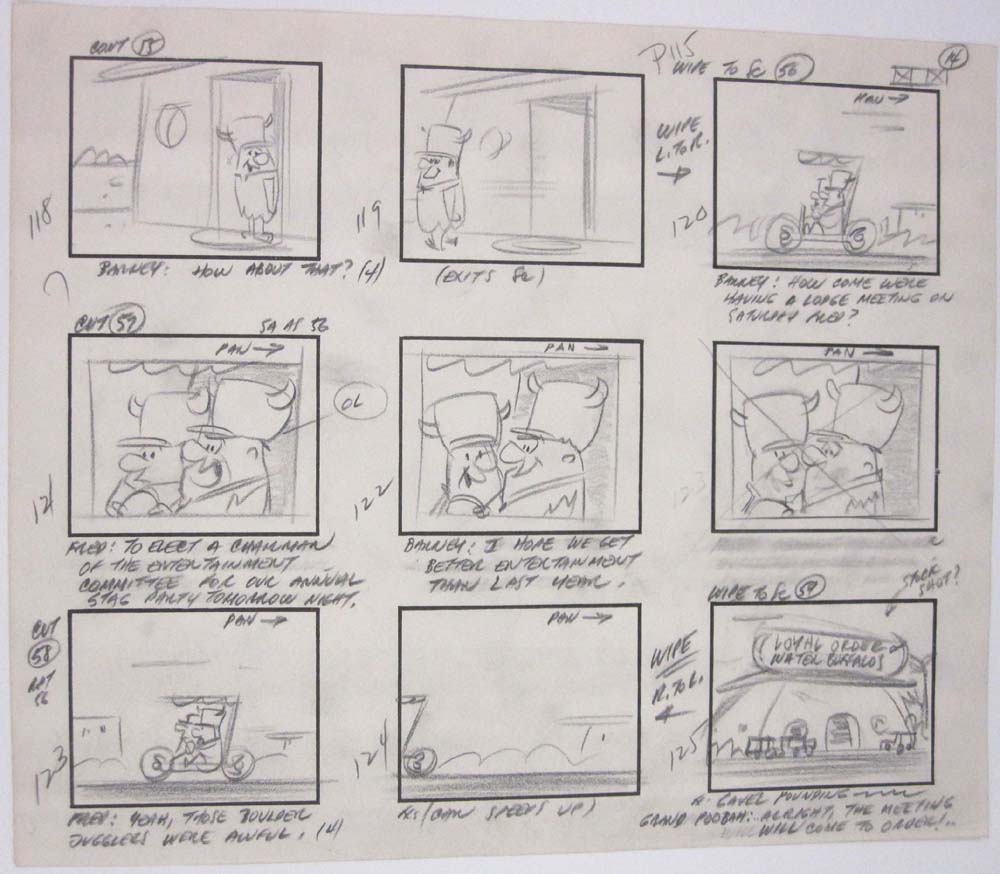
An auction house has some storyboard drawings from the cartoon for sale and you know I’ll use any excuse to post story panels. This isn’t the complete board but you can get an idea of the basics of how the scenes were set up. Fred looks a little overweight in some of these drawings, doesn’t he?


The story was by Tony Benedict. Tony was a more-than-capable and funny artist, but I was surprised when he told me he didn’t draw these. They were done by Alex Lovy, who was the story director on the cartoon. Tony was kind enough to e-mail me an explanation of what happened.


I asked Alex why he re drew my board. Staging for minimum production cost was something he excelled at I had to learn. My boards began sailing through with minimum changes after my chat with Alex.

Lovy had been around since the ‘30s and had directed at Lantz during World War Two, while Tony’s animation career was in its relatively early stages at this time.

A nice gag in the cartoon is where Fred tries to get the kids to play games and they start a round of poker. One of the kids is named Harvey and I note one of the layout artists is the kid of Harvey Eisenberg named Jerry.

The cartoon revolves around a standard plot where a caterer gets Fred’s order for the Water Buffalo Lodge party (where the dancing girls are supposed to be) with his order for his little series-wrecker’s birthday party. The caterer is a sarcastic lippy type, just like the floorwalker Jack Benny used to meet up with on his radio and TV show. I asked Tony about that.


...you are quite correct about the Frank Nelson character. I often wondered why we didn’t use the actors we had in mind when we wrote their parts. They in effect helped to create the characters. Perhaps labor agreements permitted one actor to do additional voices with no additional compensation. But I can't quite imagine money playing such a role.

What it may have boiled down to was versatility. Frank Nelson was a good dramatic actor, but when it came to comedy, he really could only do one voice. Doug Young was doing supporting voices in this cartoon so it was easy to add another character to his list, though Nelson did appear in the show’s first season.

Saturday, 30 March 2013

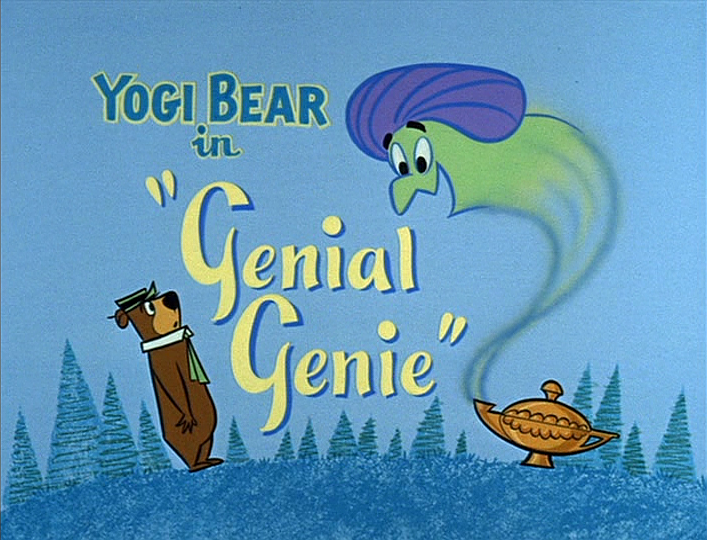
Yogi Bear — Genial Genie

Produced and Directed by Joe Barbera and Bill Hanna.
Credits: Animation – Dick Lundy, Layout – Paul Sommer, Backgrounds – Dick Thomas, Written by Warren Foster, Story Director – Alex Lovy, Titles – Art Goble, Production Supervision – Howard Hanson.
Voice Cast: Yogi Bear, Senator – Daws Butler; Boo Boo, Genie, Ranger Smith, NORAD officer, Jet Pilot – Don Messick.
Music: Bill Loose/John Seely, Geordie Hormel, Spencer Moore, Jack Shaindlin.
Episode: Huckleberry Hound Show K-048.
First Aired: likely 1961.
Plot: Boo Boo finds a magic lamp and Yogi wishes for a magic carpet.

At the end of “Genial Genie,” Yogi regrets to Boo Boo “That Mr. Genie, he talked me into wishin’ for a flyin’ carpet when I coulda wished for a five-year supply of pizza pie.” Quite true. But we wouldn’t have had much of a cartoon then.

Actually, we don’t have much of a cartoon anyway. It’s pleasant enough and Warren Foster’s story structure is good. But there’s no real bite to it—and Foster had a chance to bite during the NORAD scene. We mainly get some puns and a few of Yogi’s rhyming phrases; no great lines like “Oh, sweet spirits of Camphor! Can’t a man get any nourishment around here?” like Foster wrote for another genie in the fine Bugs Bunny cartoon “A-Lad-in His Lamp” (released 1948). And Don Messick comes up with a voice for the genie that evokes Frank Nelson’s floorwalker character on the Jack Benny radio show; Messick used it for a floorwalker in a Snooper and Blabber cartoon about a year earlier.

Oh, there’s another connection between this cartoon and “A-Lad-in His Lamp.” Both featured backgrounds by Dick Thomas. Here he provides a nice, pleasant one at the opening of the cartoon. Like many H-B efforts, there’s a slow pan over opening narration to start things off.


The animator is Dick Lundy. I’ve mentioned his three-drawing head roll before. Here it is, Genie-style.

Genie head roll

Well, maybe Lundy didn’t animate all of it. Yogi looks ugly in a few scenes. Look at his hand below. Does that look like something from a Disney animator and a top Walter Lantz director?


It looks like the legs are animated but you can’t see them because of the tight shot. That could have been on Foster’s storyboard or a decision made in layout. Paul Sommer is the layout artist here. He seems to have loved those little round eyes that Ed Benedict used on occasion. Take a look at the Senator and the NORAD commander.


In one scene, there’s a stupid-looking version of Ranger Smith, complete with overbite.


Sommer does try to make things a bit different in the opening. The narrator explains Jellystone has rustic tourist cabins that are thoroughly examined by that self-appointed inspector, Yogi Bear. Yogi and Boo Boo pop up in silhouette out of the bushes. Yogi’s rhymes: he calls Boo Boo “my fuddy-duddy buddy,” and “Old Mother Hubbard must have lived here. When Yogi got there, the cupboard was bare.” Ranger Smith catches Yogi sneaking out the back window, sticking his foot in a pail in the process. “Mr. Ranger, sir. Did you see the close call I almost had. I almost kicked the bucket.” Yogi repeats the joke twice in case we didn’t get it. Smith checkmates the year’s BS about checking for fire hazards by asking “And were there any matches left burning in the ice box.” A ship-to-the-St. Louis-zoo threat follows.

Boo Boo find “a metal teapot or something” in the next scene and misreads the inscription as “A lad’s lamp.” Yogi: “It’ll never replace the flashlight.” Boo Boo rubs the lamp and you know what happens next. “I am the genie of the lamp,” says Almost Frank Nelson, “And, please, no cracks about ‘Jeannie with the light brown hair.’ I’ve heard it a thousand times.” Yogi’s granted a wish by the genie. Yogi thinks. “Oh, come now. Don’t make me sorry I promised you,” says the annoyed genie. “How about a magic carpet? Get you around wherever you want to go. We’re featuring a new compact model this year.” Yogi’s sold. He asks for a red one. “You’ll take what I give you. You’re beginning to bug me already.” Yogi agrees to the genie’s request to throw the lamp away so someone else can make a wish.

Yogi decides to use his (blue) carpet to stage an air-raid on the pic-a-nic baskets. But the rug accidentally takes off. Foster reuses a sight gag from “A-Lad-in His Lamp.” Both Yogi and Bugs Bunny have their faces covered by their carpet after takeoff.


Ranger Smith laughs off Boo Boo’s plea for help as a “fable.” Meanwhile, NORAD picks up Yogi as a radar blip and launches missiles at him. Here was a chance for Foster to do some U.S military satire; he did it in other cartoons. If it’s there, it’s extremely weak. A Senator is being shown the latest NORAD equipment by a base commander, but all he does is repeat the commander’s words or say “Uh, huh.” He’s wearing a white suit and a cowboy hat for Daws doesn’t give him an accent of any kind; he sounds just like the Jellystone Park superintendent from cartoons earlier in the season. Anyway, the missiles rip through the carpet and Yogi finds himself riding one until the genie rescues him. Boo Boo had seen where Yogi threw the lamp, retrieved it and wished for Yogi’s safe return. The cartoon ends with Yogi crying that he wished for a carpet instead of pizzas. Yogi has a pretty thick outline when riding the missile. I wonder whether another animator did that bit.


The music is timed to fit a particular scene, for the most part, in this cartoon, though the cutter changes Jack Shaindlin cues in mid-sentence at the end “Rodeo Day” finishes with a bit more punch than “Recess.” The twinkling harp musical effect is heard twice; it was used for a few more years at Hanna-Barbera on The Flintstones.


0:00 - Yogi Bear Sub Main Title Theme (Curtin-Shows-Hanna-Barbera).
0:30 - C-3 DOMESTIC CHILDREN (Loose) – Opening narration, Yogi and Boo Boo talk.
1:09 - TC-201 PIXIE COMEDY (Loose-Seely) – Yogi goes into cabin, Ranger shows up.
1:43 - LAF-25-3 zig-zag string and bassoon (Shaindlin) – Yogi at back window, talks to Ranger.
2:27 - ZR-52 LIGHT QUIET (Hormel) – Yogi and Boo Boo walk, Boo Boo rubs lamp.
3:07 - harp music – smoke comes out of lamp.
3:14 - L-78 COMEDY UNDERSCORE (Moore) – Yogi talks about trimming the wick.
3:17 - ZR-49 LIGHT EERIE (Hormel) – Genie appears, floats over to Yogi.
3:22 - LAF-7-12 FUN ON ICE (Shaindlin) – Yogi talks to Genie.
4:26 - L-1121 ANIMATION NAUTICAL (Moore) – Carpet appears, Yogi tosses lamp.
4:46 - TC-201 PIXIE COMEDY (Loose-Seely) – “Nice throw, Yogi,” carpet takes off.
5:02 - ZR-47 LIGHT MOVEMENT (Hormel) – Yogi on carpet, Ranger and Boo Boo scene.
5:39 - C-19 LIGHT ACTIVITY (Loose) – NORAD scene.
6:06 - LAF-72-2 RODEO DAY (Shaindlin) – Yogi carpet/rescue scene.
6:46 - LAF-21-3 RECESS (Shaindlin) – Yogi and Boo Boo walk and talk, “When I coulda wished….”
7:04 - LAF-72-2 RODEO DAY (Shaindlin) – “For a five year supply…,” iris out.
7:10 - Yogi Bear Sub End Title theme (Curtin).

Tuesday, 24 July 2012

Making Census of Hanna-Barbera

Recently, the U.S. government was nice enough to release scanned copies of the pages of the 1940 Census Report. Unfortunately, the government doesn’t allow you to search for people’s names and unless you know a street name, you’re sunk. However, the folks at Familysearch.org are slowly allowing you to search by name and then click on the .jpg of the report’s page to see it. Not all of the country is searchable by name, but the Los Angeles area is. And as that’s where a number of the people who later worked at Hanna-Barbera studio were living, I’ve tried finding some of them. I didn’t hunt for everyone and didn’t find some people, so this post only has a random sampling. You can click on the images to make them easier to read.

Just a note about some of the entries. The first column is the house number, the fourth is the amount of money paid in monthly rent or the value of the home if it’s owned. The next set of columns is gender, race, age, marital status, then you’ll see place of birth. The next three location columns are where the person was living April 1, 1935. The number in the second-last column is annual salary. The Census apparently only went to $5000, anything above that is listed as “$5000+” although one census taker buggered things up and listed $11,000 for radio actor Frank Nelson. Frank was obviously very busy.

Let’s start with the studio heads and a few of the animators.


Joe Barbera later lived in Beverly Hills, but in 1940 he had a three-bedroom place at 2343 Manning Avenue in Los Angeles.

Bill Hanna’s family was at 6500 West Olympic Boulevard. Also living at the address were animators Mike Lah (Disney) and Carl Urbano (MGM). Lah worked for Hanna-Barbera on the side the first two years the studio opened; Urbano went there many years later. Hanna’s already listing himself as a producer.

The other three animators when the studio opened were Ken Muse, Lew Marshall and Carlo Vinci, all of whom came over from MGM. Muse lived with his in-laws on North Florence Street. Carlo was at home with his parents and another couple in a very Italian neighbourhood at 121 Warren Street in New York; he was still going by his birth name of Vinciguerra. He was toiling at TerryToons at the time. I haven’t been able to track Marshall.

Among the animators who arrived at the studio for the 1959 season were La Verne Harding, George Nicholas, Don Patterson, Ed Love and Dick Lundy. Harding was on Lake View Avenue, Nicholas was on North Beachwood Drive, Patterson was on Lyric Avenue and the Love family (note the listing for Tony) were on Davana Terrace in Sherman Oaks.

The Loves lived next door to Paul Fennell, the ex-Harman-Ising animator who was running his own studio. Next to him was radio producer Thomas Freebairn-Smith and who helped found the Academy of Television Arts and Sciences with Walt Disney. Love’s home was built in 1937 and has a guest house. Presumably, that’s where their housekeeper lived. Evidently Ed Love was making a good living.


Lundy, who directed at Disney and MGM but never at Hanna-Barbera, had a widow as his housekeeper at his home at 4516 Strohm Avenue in North Hollywood. Two doors down, at 4534, was Merle Gilson, who had been at Disney as far back as November 1929, then moved to Iwerks and Harman-Ising. Gilson had been animating for Walter Lantz in 1939 but the census says he only worked 28 weeks and was looking for a job, so he may have been caught in a studio shut-down. A block away, at 4472, was future Warners animator George Grandpré, who had also been at Lantz and was also looking for work at the time.

Ed Benedict gets most of the credit for the early Hanna-Barbera design style. He was living on South Sweetzer at the time, not far from Beverly Boulevard. His wife is missing on this page. Dick Bickenbach’s family was on Rosewood in Glendale. The third layout man, Walt Clinton, lived his father on Waverly Avenue and background artist Bob Gentle was with his father on La Maida in North Hollywood.

As for the other original background artists, Art Lozzi may still have been back east and I suspect Fernando Montealegre was living in Central America. However, Dick Thomas, who arrived for the 1959 season, was with his first wife on Fernwood Avenue. Thomas was at the Schlesinger studio at the time and just down the street from him was Schlesinger inker Martha Goldman (who lists her salary at $900 a year).

Unfortunately, the Census results available so far aren’t searchable for Daws Butler (in Chicago in 1940) or Don Messick (in Baltimore). I can’t spot Doug Young with any certainty. However, I’ve included Janet Waldo to show you how information can get misspelled. By 1940, she and her sister were supporting their retired parents, who came down from Washington State.

And, at first glance, Art Goble’s name looks like “Gobler” because of the way the ‘J’ hangs down from the above entry. But there’s no doubt it’s him as it matches his entry in the previous two censuses. Art and his wife bought a very small house (880 square feet) on Fischer in Glendale after 1935. Note how Goble makes less supervising ink and paint at MGM than Bick makes assistant animating at Schlesinger’s.


Mike Maltese moved around a fair bit upon his arrival in Los Angeles in 1937. The address in the 1940 Census is the third I have for him. Maltese should have been writing at the Schlesinger studio at this time but still lists himself as an assistant animator. The apartment building he and the family lived in on Gordon Avenue still exists. Another tenant at the time was an actor named Eugene H. Beaumont, better known by his middle name, Hugh.

Warren Foster and his wife lived in a subdivided home on Elevado Street. Note the difference in salary he received for writing than what Maltese got. No wonder Mike would be happy jumping into the writers’ room.

Charlie Shows and his wife Ida are living on Center Street in Indio in 1940 and he’s working as a brakeman on a railway. It could be the information was obtained from neighbours as it’s unusual his wife’s name wouldn’t be recorded. He may have just moved from Texas. His career writing for Jerry Fairbanks was ahead of him.

Dan Gordon had left Terrytoons in New York in 1937 to work at MGM but was working for the Fleischers in Miami at the time the Census was done. Check his salary figure to see why he moved. He was living at the Patricia Hotel at the time. Alex Lovy was the first story director at H-B starting in the 1959 season. He was living in an apartment building on La Mirada and had gone through one marriage by 1940.

Some mention has to be made of the composer of all of Hanna-Barbera’s early themes and incidental music, once the studio ended use of production libraries. Hoyt Curtin was a teenager living at home in San Bernadino when April 1940 rolled around.

The most interesting listing out of the lot belongs to Bob Givens, Tex Avery’s designer (including Bugs Bunny) at the time this census report was made, and an H-B layout man in 1959. Bob was living with a bunch of people who acquired varying degrees of fame. He was rooming at the home of David Swift, who rode the rails from Minnesota is pursue his dream of being a Disney animator. Evidently Swift’s father rode after him, as they were living in a huge house on Arbolada Road overlooking Griffith Park. If Swift Senior lost his money in the Depression, the neighbourhood indicates he gained it back. Swift later went on to create “Mr. Peepers” and direct several live-action films for Disney in the ‘60s.

Also living there were Rich Hogan, Avery’s writer who went with him to MGM from Schlesinger and John Freeman, a Disney animator who worked for Hanna-Barbera starting about 1960. But the surprise here is the name of radio director Rogers Brackett. Within the next dozen years, he became James Dean’s mentor, and something a little more if the stories are to be believed. As Brackett had family in Hollywood, how he ended up living with a group of animators is something a census report can’t answer.

Friday, 10 April 2009

Pixie and Dixie — Kit Kat Kit

Produced and Directed by Joe Barbera and Bill Hanna.
Credits: Animation – Ken Muse; Layout – Ed Benedict; Backgrounds – Frank Tipper; Dialogue and Story Sketches – Charlie Shows and Dan Gordon; Titles – Art Goble; Production Supervision – Howard Hanson.
Voice Cast: Pixie – Don Messick; Dixie, Jinks – Daws Butler.
Episode: Huckleberry Hound Show K-003, Production E-10.
Released: week of Monday, October 13, 1958.
Plot: Tired of chasing Pixie and Dixie, Jinks builds a robot cat to do it for him. The mice turns the mechanical cat against him with a makeshift mouse outfit.

This is an awkwardly written cartoon, and it may have been a case of Charlie Shows not having enough material for the main plot and needing to fill with other gags. Normally, a cartoon would consist of either a string of black-out type gags, or a premise at the outset and the gags are built around it. That doesn’t happen here. The idea revolves around Jinksie building the mechanical kitty—but it takes about three minutes to get into it.

And there are places where Jinks is oddly-designed, like Ken Muse hadn’t gotten the hang of the character or an assistant was given parts of the cartoon. To your left you see a pretty good-looking Jinks. It reminds me of a character design you might see in one of Joe and Bill’s M.G.M. cartoons.


Compare that to Jinks on the right. He looks like something from the cover of a public domain cartoon video. So this isn’t a terrific cartoon but there are some fun things that make it worthwhile.

We begin this cartoon already in progress, with the cat chasing the mice around some foreground slab pillars (one of them built over a rug?). Evidently, the home belongs to Jinks, judging by the pictures on the wall. His taste in decorating leaves a bit to be desired as the blue and tan is an, um, interesting colour choice.


Jinks chases Pixie and Dixie into their hole (with a broken teacup and a thimble as furniture). They’re pooped. Jinks figures “there must be a easier way to make a living.” He decides to build a better mousetrap.

The mice call Jinks and he answers with a long “Yeeeeeees?” just like Frank Nelson on the Jack Benny show. The cheap TV animation gets in the way here. Instead of following Daws Butler’s mouth movements, Muse just opens and closes Jinks’ mouth twice to supposedly represent the vocal sound. Jinks then explains the trap to the mice and with an expected result.

Next, Jinks demonstrates the firecracker-in-the-cheese method of catching mice. The mice are impressed and want to get a picture of it (note to you kids reading this: that thing Dixie is holding is called a “camera”). They ask Jinks to pose. You can guess what happens.


Finally we get the point of the cartoon. Jinks gets out the ‘Do It Yourself Kitty-Kat-Kit’ and builds a mechanical cat, complete with bow tie and a head that jumps up and down to the sound effect of a glass lid being clanked onto a casserole dish (I know this one from trying it at home when I was a kid).


The Robot-matic Mouse Trap paces back and forth. Wait a minute! Where have I seen that window, picture and rug before? Oh, right. In the opening scene. But cartoon magic has made the slab pillars vanish.

The tin-can cat captures Pixie via a trap door at its bottom then shoots a cork to knock out Dixie. Muse would have given this full animation at M.G.M. Here he just takes a cell of the mouse with grey trails and turns it around a couple of times to simulate Dixie flipping over. Pretty clever.


The mice are deposited outside by the robot. Jinks gloats out the window, and Dixie vows war in an interesting shot from Jinks’ perspective. Look at the plants. If there was any doubt Ed Benedict designed this cartoon...


Unfortunately, Dixie is caught before he’s able to sneak into the house in another one of Shows’ butt jokes. Then the mice are mashed with a mallet as they tried to bore their way into the home from a six-inch clearance under the foundation.

Finally, as Jinks sleeps, the mice realise the robot is only programmed only to catch mice, so they use some paper, tape and paint to turn the cat into a giant mouse. And they’re right. The mechanical cat can’t tell the difference and gives Jinks the patented Charlie Shows Ass Treatment as they run by the same Benedict-style barn nine times.


It’s only appropriate the cartoon score opens with Jack Shaindlin’s Toboggan Run (those mice look awfully scruffy in that frame to the right) and we get the circus chase cue by Shaindlin called On the Run. The musical selections work well in this one.

0:00 – Pixie and Dixie theme (Hanna-Barbera-Curtin-Shows).
0:26 – LAF-20-5 TOBOGGAN RUN (Shaindlin) - Jinks chases Pixie and Dixie into mousehole.
0:46 – TC 432 HOLLY DAY (Bill Loose-John Seely) - Mice and Jinks pant, Jinks builds trap.
1:57 – TC 303 ZANY COMEDY (Loose-Seely) - Jinks demonstrates dynamite-in-a-cheese.
3:18 – TC 221 HEAVY AGITATO (Loose-Seely) - Jinks tries out mechanical mouse
3:43 – LAF-4-1 FISHY STORY (Shaindlin) – Mice ask Jinks how mechanical mouse works.
3:58 – TC 221 HEAVY AGITATO (Loose-Seely) - Mechnical mouse captures Pixie and Dixie.
4:38 – LAF-4-1 FISHY STORY (Shaindlin) - Mechanical Mouse zaps then bashes Dixie.
6:02 – TC 300 ECCENTRIC COMEDY (Loose-Seely) - Pix and Dix turn Jinks into giant mouse.
6:34 – LAF-2-12 ON THE RUN (Shaindlin) - Mechanical Mouse chases Jinks.
7:10 – Pixie and Dixie closing theme (Curtin).

Sunday, 23 July 2023

Making The First Flintstones

“How long did it take to animate a Hanna-Barbera cartoon?”

That question has been put to the Yowp blog before. I could say “How should I know? I’m a cartoon dog,” but that answer is neither satisfactory nor altogether true.

Layout artist Bob Givens, who said he and Mike Maltese left Warner Bros. for H-B together in November 1958, recalled that Ken Muse was the fastest animator at the studio and could complete a 6 ½ minute cartoon (Huck, Yogi, etc.) in a week.

What about the half-hour shows, like The Flintstones or Jonny Quest? Well, we have a partial answer thanks to the late Earl Kress and his trusty filing cabinet.

Earl made copies of production records in the H-B file for the first dozen or so episodes of The Flintstones. These are invaluable as the episodes for the first two seasons had their closing animation removed in the 1960s and the same set of credits from one episode spliced onto the end of all of them. (As a kid, I was miffed. The voice credits said “Hal Smith – John Stephenson” and I knew they weren’t heard on some of the shows). When the DVDs were released, Earl oversaw new gang credits over the original animation (minus sponsor credits) so they were closer to how the shows originally aired.

More interesting, perhaps, are the dates (not always complete) about how long each show spent in layout and animation. These credits are not on DVD, either.

Unlike episodes in the fifth and sixth seasons, only one person animated each half hour. Unfortunately, the sheets don’t name any assistants; the studio had them, as a Variety story of Oct. 20, 1960 related how Bob Carr had been promoted from assistant to full animator.

You can click on each of these sheets to read them better. Regular readers here should know who the animators and other artists are who are recorded in these production logs, so I’ll skip commenting about them.


You’ll see it took about six weeks to animate each of the first two episodes put into production. Normally, the voice track is recorded first and then the animator goes to work. That isn’t the case here. It could very well be because the first few tracks were scrapped and the parts of Fred and Barney re-cast. Hal Smith related he was Barney opposite Bill Thompson’s Fred and Thompson (known better as the voice of Droopy at MGM) couldn’t maintain the growly voice that Barbera wanted for the character. (Barbera also wrote in his autobiography that Mel Blanc was not available when the show was first cast).

The animation checker for P-1 is Janet Gusdavison. A photo in the Mike Barrier collection shows she was at UPA in 1948. She can be found in the City Directory for Miami in 1941, so I presume she was working at the Fleischer studio then. She died in 1998.

The cameraman is Frank Paiker, who went back to the silent days in New York and the sound editor is Warner Leighton, who came to H-B from live action after time in the military. He was a Beverly Hills High School grad who died in 2005.

Emil Carle is the animation checker on P-2. He also animated a Pixie and Dixie cartoon. More about him in this post. Roy Wade was responsible for some of the camera work; he had been a cameraman at MGM and happened to be Bill Hanna’s wife’s brother. The sound editor is Joe Ruby, who should need no introduction, especially to fans of a cartoon Great Dane he co-created (make that “Rate Rane”).

P-2, “The Flintstone Flyer,” was the debut episode on Sept. 30, 1960. P-1, “The Swimming Pool,” was the third episode to air on Oct. 14, 1960.


By episodes three and four, the animators are working after the track is recorded.

The checker on P-4 is Annie Lee Holm, whose obit on IMDB says she started her cartoon career with Walt Disney. She died at age 61 in 1986.

Cameraman Vic Shank was a World War Two vet who worked for Austenal Labs in Chicago. In 1969, he was employed by a sports car dealership but the next year, he was the head of Animated Film Service, a film distribution company. He died in 1974. Sound editor Greg Watson had been with Hanna and Barbera at MGM under Jim Faris.

P-3, “The Prowler,” was the 14th episode to air on Dec. 30, 1960, while P-4, “The Baby Sitters,” was the 7th on November 11, 1960.


The voice cast list for P-5 is incomplete. Bill Thompson supplies his Wallace Wimple/Droopy voice as Mr. Slate. No, not the Slate who’s Fred’s boss. This one puts up his kids as collateral so he can buy a pop-up toaster (from the Buddy Buddy jewelry store run by Frank Nelson).

Remarkably, Don Patterson animated both P-4 and P-5 at the same time. It took about seven weeks.

The checker on P-5 in Pat Helmuth. A story in the Monrovia News-Post in 1980 indicates she studied at the Art Institute in Chicago before moving to California, and worked for the Disney studio. She opened her own shop in 1963 and made pottery as well as painted in acrylics. The sound editor on the cartoon is Don Douglas. He has the distinction of working on the last Warner Bros. cartoon, the Cool Cat epic Injun Trouble, which employed Bob Givens as its layout artist.

P-5, “The Engagement Ring,” was the ninth episode to air on Nov. 25, 1960 while Production P-6, “No Help Wanted,” was episode four, airing on Oct. 21, 1960.


P-8 should actually read “The Drive-In.” It aired Dec. 23, 1960, the 13th episode. P-7, “At the Races,” was the eighth episode, appearing on ABC stations on Nov. 18, 1960. It was written by Syd Zelinka, a radio writer for Groucho Marx and the team of Jimmy Durante and Garry Moore, who moved into television to work for Jackie Gleason (both on The Honeymooners and on his variety show) and Phil Silvers on Bilko. He died in 1981.


P-9 is the first cartoon where Jerry Mann provided voices for Hanna-Barbera. He was an impressionist and comedian who showed up on a number of Tom and Jerry cartoons in the 1940s. The cast list doesn’t indicate that Duke Mitchell sang as Fred Flintstone. And what is it with Hanna-Barbera characters and drums? Barney plays the drums in this cartoon and “The Swimming Pool.” Benny the Ball pounds a pail with drum sticks in Top Cat. Then George Jetson plays a drum kit in the Jet Screamer episode.

It took Ken Muse seven weeks to animate this episode. My guess is he was working on the Kellogg’s shows at the same time.

P-10 has Fred turned into the snooty Frederick, where Alan Reed digs his Falstaff Openshaw voice from the Fred Allen radio show out of retirement. Howard McNear uses his quirky Floyd the barber voice from The Andy Griffith Show on this cartoon as the doctor.

P-9, “Hot Lips Hannigan,” was the second episode to air on Oct. 7, 1960, while P-10, “The Split Personality,” was show number 5, airing on October 28th. I cannot explain why both were “approved” (or by whom) after the dates they aired.


Yes, Production 11 is the one where Dino talks like Phil Silvers, though you’ll notice the voice list calls the character “Snork.” I’ve always wondered if Jerry Mann auditioned for the Silvers-inspired lead in Top Cat months later (Arnold Stang was the third choice). This may have been the first Warren Foster-Mike Maltese team-up; they didn’t write together at Warners.

P-11, “The Snorkasaurus Hunter,” was the 18th episode to air on Jan. 27, 1961, while P-12, “Hollyrock, Here I Come,” appeared on Dec. 2, 1960, as the tenth episode.


Nancy Russell provides several voices in P-13. A wild guess is she is the Nancy Guild Russell in the 1950 census for Santa Monica whose occupation is “motion picture actress.” She appeared in a Life magazine article in 1945, was signed by 20th Century Fox, then married fellow contract player Charlie Russell in 1947 (they divorced 2 1/2 years later). She was 73 when she died of emphysema in 1999. You can read a little bit about Bob Hopkins of P-14 in this post, which also gives you a link to some things about Jerry Mann.

“The Girls’ Night Out,” was Production 13 but the fifteen show broadcast on Jan. 6, 1961. P-14, “The Monster From the Tar Pits,” aired on Nov. 4, 1960, as episode six.


John Stephenson’s long career at Hanna-Barbera began with Production 15. Eventually, when the series settled down to give Fred a regular boss, Stephenson was given the role. He had a fine career in front of the camera on sitcoms, as a narrator, as a commercial announcer on radio and TV, and even appeared on early television in Chicago while in university.

Norm Stainback shot some of the cels for this cartoon. He was born in Arkansas. In 1940, he was employed in Burbank by the company that makes Jergen’s Lotion. Ten years later he was a lab technician for a film developer in the Los Angeles area. He died in Dallas in 1984.

P-15, “The Golf Champion,” aired Dec. 9, 1960, the eleventh episode of the series. P-16, “The Sweepstakes Ticket,” was the twelfth show and aired the following week.


A new name pops up as the sound editor on P-17. Hank Gotzenberg later worked on the Grantray-Lawrence Spiderman cartoons and for Chuck Jones Productions. He served in Guam with the U.S. Marines and had worked at Lockheed Aircraft when he enlisted in 1941. The 1950 Census reports he was divorced, unemployed since at least 1948 and living with his parents. He died at Long Beach in 1978, age 58.

Earl didn’t have a sheet for P-18 “The Hot Piano,” animated by George Nicholas and written by Mike Maltese, known mainly for the cops singing “Happy Anniversary” (Earl does have a dub of the recording session for the song from Aug. 28, 1960). P-19 is the last one I received from his collection. Don Patterson must have been pretty busy at the time as it took him more than two months to finish animating it.

Arthur Phillips made his H-B writing debut on P-19, and his name appears on many more in the series. He had written for Jackie Gleason and Red Skelton on TV, and on films in the ‘40s. He died in 1990.

P-17, “The Hypnotist,” was the 20th episode to be broadcast on Feb. 10, 1961 while P-19, “The Big Bank Robbery,” was the 17th show, airing on Jan. 20, 1961.

Since you’ve read this far, let’s pass along some cues (from a cassette) from Earl. The titles listed below are what’s on the actual recording sheets. No date is listed, but the hand-writing is the same as cues recorded on June 10, 1960. The names are what Hoyt Curtin gave them.


6-1 SEGMENTED LITE SKIP IN PARK


6-2 LITE WALK + TALK – CUES AT END


6-3 ROMP IN PARK BRIDGE


6-4 DROLE INTRO TO DROLE WALK W/CUES


6-5 CUEY INTRO TO BUILD-UP BUTTON


6-6 FAST WALK + TALK TO CUES


6-7 ORGAN – SEMI-SOMBER – BRIDGE


6-8 NOSTALGIC – TO WALK TEMPO – HELD NOTE


6-9 SLOW THEMATIC FLINT TO CUTE ROMP


6-10 SLOW FLINT TRAVEL W/SLOW DOWN BREAK – HELD END NOTE


6-11 TUBA INTRO TO CUES – TO RUNUP + BUTTON