Wednesday, 30 September 2020

The Stone Age Starts In 1960

The real TV money is in prime time, thought John Mitchell at Screen Gems. So he approached Bill Hanna and Joe Barbera to come up with a cartoon show for night-time viewing.

All kinds of stories have popped up around the creation of The Flintstones, but it cannot be denied the show made its debut 60 years ago today and continues to be an evergreen for its owners.

Like the song in the musical “Gypsy” goes, you gotta have a gimmick. Somebody came with a gimmick for The Flintstones—it was to be the first “adult” prime time show. That seems to have given some critics the idea it would be sophisticated like a New Yorker comic, and when it didn’t turn out that way, Barbera flatly admitted to at least one reporter at the time that the “adult” idea was a publicity stunt.

In later years, Barbera bristled when comparisons were made between The Flintstones and The Honeymooners series that aired several years earlier. “Did The Honeymooners have a Stoneway piano?” Barbera rhetorically queried. He had a point. The Flintstones had some elements familiar to Honeymooners viewers—mainly a loudmouth, blue-collar know-it-all—but the suburban setting and the various animalised gadgets made it appear different enough. That’s even though the studio hired people who had written Honeymooners episodes (pretty soon, Tony Benedict was called in to add cartoon gags because none of the writers had worked in animation).

Reworking ideas, however lightly, came easy to Bill and Joe. They time-flipped The Flintstones into The Jetsons, put it in football garb to become Where’s Huddles? then transported it into another era as The Roman Holidays.

The series started out with the hoary battle-of-the-sexes concept before it borrowed from I Love Lucy and Wilma had a baby (a girl at the behest of Ideal Toys; Hanna-Barbera and Screen Gems weren’t going to waste that kind of merchandising opportunity). For good measure, the studio borrowed Dennis Day’s mother from the Jack Benny show to be Wilma’s mother. I’m among the people who think the show started its descent at that point. The decision to fire Bea Benaderet and then add a space alien were reflected in the show’s ratings. The Flintstones made it into a sixth season simply because its time period was swapped with Jonny Quest to give it a chance at better numbers.

Along the way, Hanna-Barbera realised there was big TV money outside of prime-time—in the virtually untapped Saturday morning time frame. It had mainly been a dumping ground for used cartoons and old black-and-white filmed series until Hanna-Barbera came up with shows inexpensive enough to air in that period. The comedies like Secret Squirrel were amusing enough for some kids and the action-adventure series like The Herculoids proved attractive to boys. Hanna-Barbera started minting money pretty quickly. And that’s where new incarnations of The Flintstones appeared.

Let’s go back to the series’ debut. First is a story from the St Louis Globe-Democrat of September 2, 1960. Its entertainment writer went on a junket to Los Angeles and caught some kind of PR presentation on The Flintstones. A lot of this stuff was in early publicity for the series, such as “Cobblestone County” and the play on the “YMCA” name that didn’t really become part of the series.

FLINTSTONES COMING TO TV
‘Huck Hound’ Creators Ready New Series

By PETE RAHN
Globe-Democrat
TV-Radio Editor.

When Friday, Sept. 30 rolls around, television fans will have their first opportunity to see a new series on ABC-TV called “The Flintstones.” It is, in my opinion, one of the brightest new program prospects to come down the TV pike since “Playhouse 90” was in its heyday.
“The Flintstones” will be television's first animated cartoon series devised for written for and produced for adults. A satire on modem family living created by William Hanna and Joseph Barbera, the two entrepreneurs who brought to TV such hit cartoon programs as the Emmy-award winning Huckleberry Hound series, Quick Draw McGraw and Ruff ‘n’ Reddy.
“As a matter of fact,” said Mr. Barbera when I visited their plant in Hollywood, “this ‘Flintstones’ series is really an extension of Huckleberry Hound. We pulled so many letters from adult fans of ‘Huck’ that we decided to turn out an animated series strictly for the grownups.”
‘STONE AGE’ SUBURBIA
Just what is this “Flintstones” show like? Let's take a look at the fact sheet.
First of all, remember it is an animated cartoon show. If you've ever seen Hanna and Barbera's Huckleberry Hound, you are familiar with their technique. “The Flintstones” will depict the trials and tribulations of a suburban couple named Fred and Wilma Flintstone. They have problems, ambitions and hopes, just like you. There is just one catch—the Flintstones live in the ‘Stone Age.’
Their home is a “split-level” cave in the city of Bedrock, county seat of Cobblestone County. Other than being Stone Age folks, they are perfectly normal suburbanites. They have newspapers, freeways, TV, telephones, cars and so on. Mr. Flintstone works as a dino (dinosaur-powered) crane operator tor the Rock Head Cave Construction Company. He belongs to the YCMA (Young Cave Man's Association), they attend dinosaur races together and they have nextdoor neighbors, Betty and Barney Rubble.
But wait until you see some of their Stone Age versions of modern devices that make our lives more pleasurable.
For instance, Flintstone family sing-feats are held around their Stoneway" piano (as depicted on the cover page of this section).
Fred has an electric shaver—a clam shell with a bee buzzing around inside. They read the Bedrock Bugle chiseled stone slab. They have cigarette lighters—two twigs rub together at the flick of a finger—and dozens of other Stone Age counterparts of modern gismos that are just as wild and weird.
SUCCESS STORY
The word, out in Hollywood, is that “The Flintstones” will bring a flood of animated shows to the home screens if the series rings the rating bell with viewers. And it is just such a possibility that wreathes the faces of Hanna and Barbera with happy grins.
Theirs is a fabulous success story.
At the present, they are bossing the biggest animated cartoon studio in existence. They employ over 200 people—writers, artists, animators, actors, actresses and various film technicians. Their organization has outgrown its present Hollywood quarters, so new and much lusher studios are abuilding.
It is also an almost unbelievable success story, especially when one considers that Hanna and Barbara were unemployed cartoonists just three years ago.
Sacked during an economy purge by the MGM Studio after 18 years of producing “Tom and Jerry" cartoons for movie theaters. A couple of animated characters that also sprang from their active imaginations, by the way, and won seven Oscars for MGM during the 18 years they headed cartoon production for the lot.
RED TAPE
“We submitted some of the ideas we are now using on TV to MGM many years ago,” says Joe Barbara, “but they wouldn't buy. It was a break that they didn't. The red tape that ties up cartoon production at a movie studio would have killed our operation.
At MGM your ideas for a cartoon went to the executive producer who would then mull it over or six weeks. Did that sort of stuff hold up production? Well, at top capacity we were able to turn out only eight six-minute ‘Tom and Jerry’ cartoons in our best year. Hanna and Barbera Productions in 1960 will shoot 52 half-hour TV programs—13 Hucks, 13 Quick Draws and 26 Flintstones."
“On top of that,” interjects Bill Hanna, “we’ve got more offers to do animated commercials than we can handle. Especially since ‘Huck’ won that Emmy.
“We've created a monster that's going to devour us from the standpoint of work. It takes 12,000 individual drawings (called cells) to fill one half-hour TV show. The work of 150 artists, lay-out men, editors, inkers and painters.
“And it is difficult to get these talented people,” he continues, “even though we pay top wages (up to $350 per week) and bonuses ($100 for a one-minute story idea) to anyone in the plant.”
Is there a moral to their story?"
“Sure there is,” says Barbera with a grin. “Raise your children to be animators, artists or inkers. If ‘Flintstones’ is a hit we'll need 10 times the manpower we’ve got with us now.”
After the series debuted, some complained about the ABC-mandated laugh track, while others didn’t appreciate Carlo Vinci’s thick ink-line or the lumpy character design. There were opinions that Huckleberry Hound was a better show; I certainly enjoy Huck more than the Flintstones. But viewers liked it and just as Pete Rahn predicted, it sparked a rash of animated prime-time series the following year (none of them finding a prime time audience).

Rahn wrote a couple of more times about the series. Here’s his “I-told-you-so” from December 19, 1960.

‘Flintstones’ Top-Rated TV Status
By PETE RAHN
Globe-Democrat
TV-Radio Editor.

A paragraph buried at the bottom of a page in a recent edition of Variety informs that “The Flintstones” comedy series (ABC and Ch. 2 at 7:30 p.m.) is riding up among the top 20 TV shows on the national Nielsen ratings.
Well, now, that is certainly a pleasant surprise. Especially in view of the fact that this columnist was numbered in a small group of hardy souls who went out on a limb early last fall with a prediction that “The Flintstones" would be a hit. That's the way this TV reporting game is played you know. When we call one right—take a bow. But when we miss a turn with the slippery crystal ball, we do our darndest to melt into the jeering crowd in the bleachers.
Seriously, if any show among the carload of newcomers to TV this season deserves continuing attention from viewers that show is “The Flintstones.” That tribute isn't offered because we consider the series the greatest piece of comedy entertainment ever to grace the home screen. It is satisfying to see the program up among the rating leaders simply because it is the first new comedy show idea to come down the TV pike since “I Love Lucy.”
For the uninitiated, “The Flintstones” program is an animated cartoon series tailored for the adult audience. A gently amusing burlesque of modern family life, the action is set in a Stone Age suburbia and the main players are four cartoon characters named Fred and Wilma Flintstone and Betty and Barney Rubble. “The Flintstones” episodes are turned out by the Hanna-Barbera Studios in Hollywood. Same production outfit, by the way, that pioneered several other cartoon shows for television, among them “Huckleberry Hound” and “Quick Draw McGraw.”
When the Hanna-Barbera company first announced last fall that it had sold an animated cartoon program for adults to ABC they were, as usual, immediately confronted with the industry doubters who predicted that the show would flop.
“You can catch the sand box set with cartoons,” went the reasoning, “but nowadays the big, big adult audience demands TV fare wrapped in a western or whodunit package. And comedy, by all means, must stick to the tried-and-true TV family yardstick. One mother (good looking and intelligent), one father (handsome but boobish), two children (one boy, one girl) but both extraordinarily precocious.
“The Flintstones” series was a monetary gamble that has paid handsomely for ABC-TV and the Hanna-Barbera studios. Its rating success will undoubtedly encourage others among the people who produce shows experiment with new or unique entertainment ideas for television.
Rahn had praised the show in print again on October 17, 1960, mentioning its inspiration from Honeymooners plots and deciding any fan of Ralph and Ed will enjoy Fred and Barney. He revealed the thought of his nine-year-old daughter Nancy: “ ‘The Flintstones’...is really funny, dad, because it has all those silly machines made from rocks and stuff. Did you see the ‘stupid’ (no greater compliment) wheels on their car?”

Pete spent 47 years as a radio and TV critic, was a local Emmy winner and was awarded a place in the St. Louis Media Hall of Fame in 2015, so he must have known his stuff. We don’t know if Nancy (who’ll be married 50 years this year, by the way) still watches The Flintstones but plenty of other boomers do. They’ll be rewarded with a BluRay release. And as the Modern Stone Age Family (with a dial phone!) continues to appear in new forms every once in a while, it is, perhaps, gaining new generations of fans, too. We’ll bet John Mitchell never thought of that.

Saturday, 19 September 2020

The Voice Called Flintstone

You know the voice of Fred Flintstone today—all because of pralines.

The main cast of The Flintstones were hardly neophytes when it came to acting without being seen on camera. All four had acted on top radio shows. Bea Benaderet’s career went all the way back to the mid-1920s in San Francisco. Jean Vander Pyl was the mother in Father Knows Best (she did not get the television role) and played characters on Amos ‘n’ Andy (and not sounding like something out of a minstrel show). Mel Blanc’s radio career is probably well enough known that all I need to mention is he began in local radio in the late ‘20s.

And that brings us to Alan Reed.

The Man Called Flintstone also acted on radio as far back as the 1920s when he wasn’t even Alan Reed yet. While he had funny voices inside his larynx, Reed wasn’t a “funny voice” on The Flintstones. He showed his great skill displaying a gamut of emotions that you wouldn’t find in your average, seven-minute cartoon short. His dialects may have been considered a little over-the-top for 1960 but for a cartoon comedy, they could still fit. And he revived a few voices he did on radio, especially that of Falstaff Openshaw, the high-brow poet on The Fred Allen Show as snooty alter ego “Frederick” in the first season. (Reed’s Flintstone voice can be heard on Allen’s show on occasion; you keep waiting for him to say “Just a rock-pickin’ minute”).

Reed’s fine acting made Fred Flintstone seem far more real than it would have under someone else. Remarkable in that Reed was not the first choice; Bill Thompson actually recorded some soundtracks as Fred but had to bow out because he couldn’t keep his voice as growly as the part demanded.

Let’s look back at Reed’s pre-Flintstone career. First up is an article (and photo) from the September 1933 edition of Radio Stars magazine. That’s followed up by a story in the Evening Independent of Massillon, Ohio from November 30, 1960; it certainly must be one of the first profiles of Reed after The Flintstones went on the air.


Ted Bergman is the Lon Chaney of the air
TED BERGMAN, the stuttering racketeer, Bolshevik, barking dog or what have you, in the [Hellman’s] Musical Grocery Store on the NBC chain is the Lon Chaney of the kilocycles. Give him any role you wish. He takes them as they come.
Since 1928, Ted has played a thousand and twelve different characters. And those parts included everything from a gangster on the Crime Hour to the romantic lover on the Pages of Romance program. Twenty-two dialects, including the Scandinavian, are at his command, so he feels at home in any crowd.
He's played as many as seven parts in one broadcast, using different dialects for each part. Such a talent comes in handy. Once there were only two people in a detective scene; Ted and another actor who was playing the part of his father. They were both Irishmen with a brogue so thick you could spread it with a knife. As the crisis of the scene approached, the other actor fainted dead away, leaving Ted soloing before the mike. Did he get all hot and bothered? He did not! Ted immediately picked up the other fellow's lines and finished out the scene, playing both parts, and nobody outside the studio knew the difference.
In addition to the roles he has created himself, Ted has appeared with Eddie Cantor, Rudy Vallee, Stoopnagle and Budd, Jane Cowl and many others. Do you remember on the Chase & Sanborn hour when Rubinoff started talking back to Eddie Cantor? Well, that was Ted talking for Rubinoff. Coming down in the elevator after the show Rubinoff said, "You did noble, Ted, but what am I going to say next week?"
There are other things Ted can do. When he was a student at Columbia University in 1923, he was the inter-collegiate wrestling champion in the heavyweight division.
Only once has he really been embarrassed. That was when he was playing with Jane Cowl in a radio version of the famous drama. "Within the Law." Everything was going along smoothly until Miss Cowl stopped right in the middle of the broadcast to ask for a drink of water. Ted got it for her, but he surely stepped fast.
With a fellow like Ted Bergman, in the case of the Musical Grocery Store (9 p.m. Fridays, EDST), you needn't be surprised to find anything from a Chinese laundryman to an English duke in the script. And if you hear some weird sound effects that you never heard before, the chances are at least fifty-fifty that it's Ted.

TV-Radio News Bits
By LAWRENCE WITTE

In singling out Alan Reed's voice as the perfect "Flintstone sound," producers Bill Hanna and Joe Barbera were confirming the judgment of many previous TV, radio, stage and motion picture producers.
Fred Flintstone is a lovable jerk, and for years producers have been buttonholing Alan to portray – among other things – lovable jerks. Fred is the caveman "hero" of ABC-TV's series The Flintstones, TV's animated cartoon comedy show.
Alan was born Teddy Bergman in New York City. As a kid he was bookish and so scholarly that he managed to graduate from Manhattan's Washington high school while still under age for Columbia university – his goal.
AS A LARK, he spent the imposed interim studying drama at the American Academy of Dramatic Arts in New York City.
While at Columbia, where he majored in journalism, he won the eastern intercollegiate heavyweight wrestling title and performed in the annual varsity show. He was spotted in the latter event by Ralph Rose, an Oklahoma candy tycoon, and he immediately dropped out of school and went to Oklahoma City to star in a stock company for which Rose was the bank roller.
Then (1927) the following occurred in relatively rapid order: Rose went broke and he had to dissolve the stock company; he and Alan returned to New York, pooled their meager funds to enter a crap game and won $2,400 enough to launch a whole candy company.
Business boomed for them briefly, but then one day a large inventory of pecan pralines turned from an appetizing tan color to a ghastly white that was unmarketable, their creditor closed in, they were busted again. Reed went back to acting.
During the summers of 1929 through 1930 he was social director, entertainment producer and actor at the Copake Country club, an upstate New York resort. Among the writers creating original plays and revues for him there were the later-to-be-famous actors and playwrights Moss Hart, Herman Wouk and Allen Boretz. MEANWHILE, and for the ensuing two decades, he devoted himself to radio, first in New York, then, after 1943, in Hollywood.
His career in this field flourished, and he frequently worked in as many as 35 broadcasts a week. There was hardly a single comedy or dramatic series in the heyday of radio that he did not appear in.
His most familiar roles included Falstaff, the Poet of Allen's Alley on "The Fred Allen Show” for 10 years, the voice of Rubinoff, the violinist and musical director (who "was afraid to speak") of "The Eddie Cantor Show" for five years; the original Daddy to Fanny Brice's Baby Snooks; Finnigan (a classic lovable jerk) and Clancy the cop on “Duffy’s Tavern” and Pasquale on “Life With Luigi.”
He was also featured at various times with such radio stars as Jimmy Durante, Tallulah Bankhead and Bob Hope. He also starred once in his own show – “The Blubber Bergman Show,” and during this period took part in a number of New York stage productions, as well as comedy.
He went to Hollywood on a 20th Century-Fox movie contract, and has since appeared in more than 50 films in all types of roles. They include “Viva, Zapata,” “The Postman Always Rings Twice” and “Desperate Hours.”
With the advent of television he continued performing in roles which included TV versions of his “Duffy’s Tavern” and “Luigi” radio parts.

If you look in the column on the right, you can see a link to other stories here on the blog about Alan Reed, including his decision to open a business because acting parts pretty much dried up until The Flintstones came along. Years later, Reed was not dismissive of being a cartoon star. Far from it. Fred Flintstone’s continued appearance on TV commercials gave Reed a comfortable life. More so, we suspect, he would have if those pecan pralines kept their tan.

Thursday, 27 August 2020

Joe Ruby

His first credits at Hanna-Barbera were as a film editor. You see one to the right from the “Elroy’s Mob” episode of The Jetsons. And if the screen credits still existed, you would see his name on the debut episodes of The Flintstones and Top Cat.

Joe Ruby has died at the age of 87.

A film editor is someone who splices sound effects and music into the soundtrack of a cartoon. That’s what Ruby was hired to do when he arrived at the studio around 1959, joining a team including Greg Watson, who was part of the Hanna-Barbera unit at MGM, and Warner Leighton. But he wanted to be a writer, so he was also entrusted with coming up with some of the ideas for the little cartoons that were between the cartoons on the Huckleberry Hound and Yogi Bear shows, along with another chap named Ken Spears.

I suspect anyone reading this knows that Ruby and Spears ran up a huge pile of credits at Hanna-Barbera and then at their own studio that they set up in 1977. Perhaps their lasting legacy was the creation of one of animation’s biggest franchises starring a cowardly Great Dane (originally named “Too Much,” according to Ruby) and some meddling teenagers solving mysteries. Scooby-Doo, Where Are You? debuted on CBS in 1969 and continues to appear in some way, shape or form more than 50 years later.

Spears once told writer John Culhane in 1969: “Joe and I have adapted. We can write adventure or go funny. We’ve just finished 17 ‘Penelope Pitstops.’ Actually, the traps in ‘Penelope’ are more violent than anything we had in Gulliver—but in comedy you can take it with a grain of salt. If it’s adventure, you accept it as real, even though it’s a cartoon.”

Ruby seems to have been interviewed only rarely. He faced reporters in 1986 while trying to explain his studio’s animated Rambo mini-series would not have anyone get hurt and John Rambo would actually help earthquake victims and children in need.

You can find a fine remembrance of Joe Ruby from someone who actually knew him, producer/artist Mark Evanier, on his web site.

Saturday, 8 August 2020

Astro By Nicholas

If you’ve visited our sister blog, Tralfaz, you’ve seen the masthead with the Jetsons’ Astro (nĂ© Tralfaz) on a circular dog-walk treadmill. It comes from Millionaire Astro and is one of a pile of scenes drawn by one of my favourite Hanna-Barbera animators, George Nicholas.

Nicholas arrived at the studio from Disney where he had worked on shorts. Before that he was an animator for Walter Lantz.

The original H-B animators could be pretty distinctive and came up with some funny poses. Unfortunately, as the studio added more and more work, the animation got more and more lacklustre. Still, Nicholas did his best. He loved beady-eyed, wavy-mouth expressions and you can see it in this cartoon.

I haven’t determined how much he animated—I’m not good at picking out H-B animators after about 1960—George Goepper and Bill Keil also handled scenes in this cartoon. But let’s look at part of the last third.

First up, Astro runs into a park, begging Elroy to save him from the dog catcher. Nicholas liked drawing cashew shapes for partially closed eyes. And he goes in for bending the muzzle and flopping down an ear to add to the expression.


Astro is shocked in court.


A defeated Astro is taken away by J.P. Gottrockets, who has been awarded the dog by a Jury-Vac (Gottrockets must be a futuristic J.P. Gottrocks from The Flintstones.


Astro’s expression after learning he will, here forth, be known as Tralfaz.


Here he is on the dog walk.


An in-between of him upset that he’s not at home with the Jetsons.


And angrily chasing Gottrockets.


You can read more about George Nicholas in this post.

As for the name Tralfaz, it had been imported by Mike Maltese from the Warner Bros. cartoon studio. The word had been used there, but dated back even further to Cliff Nazarro’s double-talk act. Read more here and in this follow-up post.

Astro, was more or less, created by Tony Benedict. Iwao Takamoto designed the dog first, then Tony jumped in to create stories for him and give him his personality. Tony was also the creator of Alfie Gator in the Yakky Doodle cartoons and had a hand in the evolution of Hairbrain Hare to TouchĂ© Turtle (Hanna-Barbera was never a place to waste ideas so Hairbrain was the basis for Ricochet Rabbit). Tony worked on the last of the Huckleberry Hound cartoons and is still with us. He has a book coming out which we’ll let you know about in good time.

Tuesday, 7 July 2020

Hanna-Barbera Birthday Did-You-Knows

63 years ago today, some forms were signed by George Sidney, Bill Hanna and Joe Barbera creating what eventually became the biggest TV cartoon operation in the world.

This is the birthday of H-B Enterprises, the original corporate name for Hanna-Barbera.

Sidney was more than a silent partner. Besides being the president of the Directors Guild of America at the time, he helped broker the deal with Columbia Pictures’ Screen Gems division to produce the studio’s first effort—Ruff and Reddy in 1957. It was a rarity at the time—a new cartoon show on Saturday mornings (some of the cartoons were old Columbia theatricals). H-B went on sign with Kellogg’s to put The Huckleberry Hound Show and The Quick Draw McGraw Show in syndication. Both were nominated for Emmys in 1960 and Huck won.

By this time, Hanna-Barbera had inked a contract with ABC to provide it with an animated series in prime time, The Flintstones.

This old blog has been put out to pasture but I have decided to post some trivia as a way to mark the day the studio started.

We mentioned the Emmys. The awards show resulted in a special broadcast of the Huck show. Kellogg’s, it seems, put up the cash to buy the 5:30 to 6 p.m. Sunday time slot on June 5, 1960 and took out ads urging members of the Television Academy to tune in. The Los Angeles Times called it “a special show” in its TV listings that day but it doesn’t reveal whether it was a broadcast put together with references to the Emmys or new cartoon footage.

The year after Huck’s Emmy win, he and Yogi Bear became the first animated characters to appear on an Emmy telecast. They starred in a little sketch making fun of how Neilsen ratings were tabulated. We wrote about it in this post. The broadcast was on May 16, 1961. But there was an earlier special appearance by the pair on TV. The Hollywood Reporter of February 14, 1961 revealed:

Three of TV’s top animated stars—Huckleberry Hound, Yogi Bear and Quick Draw McGraw—will join the rapidly increasing list of “human” stars appearing on Sunday’s “Stop Arthritis Telethon” over KTTV, 7 a.m.-5 p.m. Three special sequences featuring the Hanna-Barbera characters will be shown during a children’s section of the telethon.
Oh, if only the animation were discovered wherever what’s left of the studio’s archives are.

Hanna-Barbera’s TV cartoons aren’t exactly known for Disney-like fluid animation. Yet they were treated like Disney and other theatrical shorts on occasion. The Hollywood Reporter of May 23, 1960: “A segment of Hanna-Barbera’s ‘Huckleberry Hound’ TV series will represent the U.S. in the Journees du Cinema d’Animation festival in Paris, June 1-Aug. 15.” The trade paper dutifully reported on June 2nd: “Hanna-Barbera’s ‘Huckleberry Hound,’ U.S. entry in the Journess du Cinema film-animation festival in Paris, has won three gold medals in the following categories: (1) most original cartoon characters, (2) best original story, (3) best animation.”

We’ve had a few posts here about Hanna-Barbera on record. Greg Ehrbar is the undisputed expert on this subject and you can read his fine and detailed research at Jerry Beck’s web site. Originally, H-B characters appeared on Colpix Records (short for Columbia Pictures). Hanna-Barbera later started its own label but simultaneously, the studio signed a deal with New York-based Golden Records. Unfortunately, Daws Butler and Don Messick were signed to an exclusive contract with Colpix so the Golden Records had to do with phoney baloney imitations of the characters. Frankly, some are pretty lousy. You can listen to some of them with the otherwise fine actor Gil Mack in this post.

There’s a reason Bill Hanna and Joe Barbera put up with the not-so-soundalike versions. As Fred Flintstone once put it: “Do-re-mi-money.” Here’s the Hollywood Reporter again, from November 16, 1961:

Bill Hanna and Joe Barbera have been awarded a gold record from A.A. Records, Inc., producers of Golden Records, “in recognition of the sale of over 1,500,000 Golden Records featuring their Huckleberry Hound, Quick Draw McGraw and Yogi Bear” characters. Hanna-Barbera’s latest record release by Golden Records is “Songs of the Flintstones,” featuring the voices of The Flintstones, Alan Reed, Jean Vander Pyl, Mel Blanc and Bea Benaderet.
Evidently, some kids had more of a tin ear than I did as a child, or a larger tolerance level.

One thing Hanna-Barbera had in common with Disney—besides some employees who worked for both—was a belief that there was a ton of money to be made in licensed marketing. Screen Gems had a whole department devoted to it led by “Honest” Ed Justin. I’d have to go back through the pages of the blog to see when it began, but the Knickerbocker stuffed toys you see to the right date from 1959. (Humpf! Li’l Tom-Tom was acceptable but Yowp wasn’t. Humpf again, I say). Huck was coloured red, but as stations at the time were broadcasting the series in black and white, it likely didn’t look strange. You can click on the picture for a better view.

Anyway, Happy Birthday to Hanna-Barbera. Just think of the countless hours of entertainment that wouldn’t exist if Bill Hanna, Joe Barbera and George Sidney hadn’t put their cash together and jump into the new field of cartoons especially for television.

Thursday, 30 April 2020

Musings About Muse

The cartoons on the Huckleberry Hound, Quick Draw McGraw and Yogi Bear shows were, as layout artist Bob Givens recalled, 500 feet (without titles, I presume). He also recalled Ken Muse was the footage king. Muse would animate a whole cartoon in one week, 100 feet a day. Compare that to 35 feet a week at Fleischers, and that was considered a high figure.

Muse had been animating Mickey Mouse at Disney before he went over to MGM. He did some terrific work there; his animation of the hoity-toity Tom approaching and sitting down at the piano in Cat Concerto and the bee attack reaction on Tom in Tee for Two are excellent. Certainly he didn’t dash out that footage. But at Hanna-Barbera, rarely was his posing or animation expressive. For television, he relied on short cuts which began to epitomise the studio.

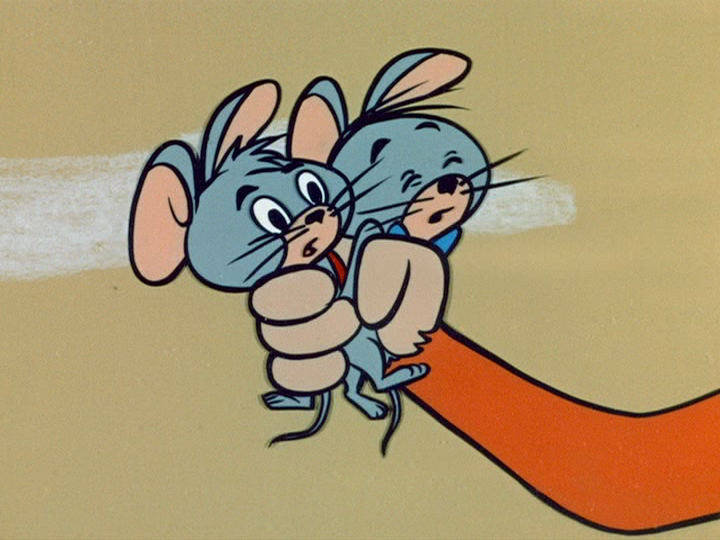
Here are some examples from the Pixie and Dixie cartoon Mouse Nappers (1959). First, we have a walk cycle animated on twos (each drawing is shot twice). Neither cycles nor animating on twos were unusual in the theatrical days. But in this case, director Bill Hanna has the background move very slightly behind each camera shot, enhancing the feeling of movement when the drawing is actually static. The arm, head and mice are rigid, only the body moves.


There are whole scenes at Hanna-Barbera consisting of several dozen frames where characters that are immobile except for eye blinks and very slight mouth movements. All dialogue is done off camera. This is a good footage eater because nothing is really happening. It’s also why Daws Butler and Don Messick were so important to the early cartoons. Their voices had to carry these scenes.


Here’s a dialogue example. Jinks doesn’t move. The only thing that changes are a few mouth positions that Muse uses over again for various vowels and consonants. You’ll notice the two-part upper lip. Muse drew his characters like that at MGM, too.


To make Jink look less static, our old friend the eye blink returns. Muse has open, half-open and closed positions only. The half-open is shot on twos.


As a side note, animator Mike Lah slid the mouth around a character’s face in odd geometrical shapes. His characters didn’t look as sophisticated as Muse’s but he animated extreme drawings which are far more funny to look at than these.

Here’s a six-drawing run cycle. See the curved greyish lines above the legs? Muse does this because the body shapes are on separate cels from the legs. The three body cels are reused to match how the legs are lifted on the left and right side of the meece bodies. Body position 1 is used in drawings 1 and 4, body position 2 in drawings 2 and 5, and body position 3 in drawings 3 and 6. Something difficult to tell below is the meeces are higher in the frame in some shots than others, enhancing the movement.

It’s an awkward description but I hope you get my point.


When you’re churning out footage, niceties such as having the characters in the same position when a shot changes from close to medium are tossed out. That takes planning. Planning takes time. Time slows down the footage count. Here are two examples. These are consecutive frames. The backgrounds don’t even match.


This is one of 66 cartoons made in the first season of the Huck show. Muse animated 29 of them (with assistance by Lah on some). I understand he was paid by the foot, so you can’t blame him for trying to maximise his footage. But, and it’s an age-old lament, you can’t help but wonder how much better the cartoons might have looked if there had been more time to work on them. On the other hand, kids, teenagers and adults laughed at them anyway and made the Huck show a brief, Emmy-winning, cult favourite through the late ‘50s.