Wednesday, 11 September 2013

Helpful Huck and Yogi

A lead character that’s a thief is a good example for kids?

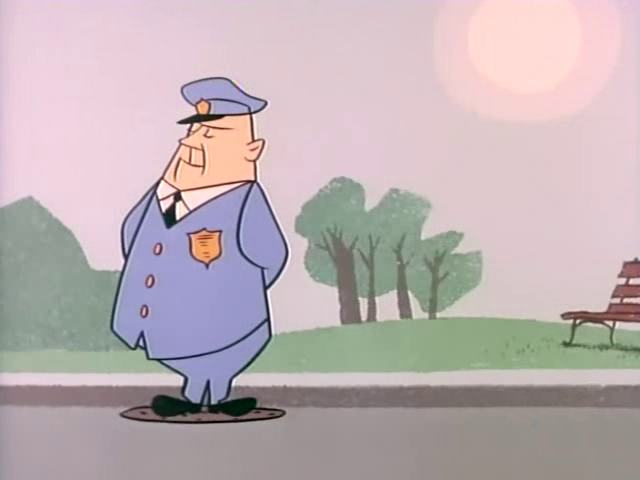
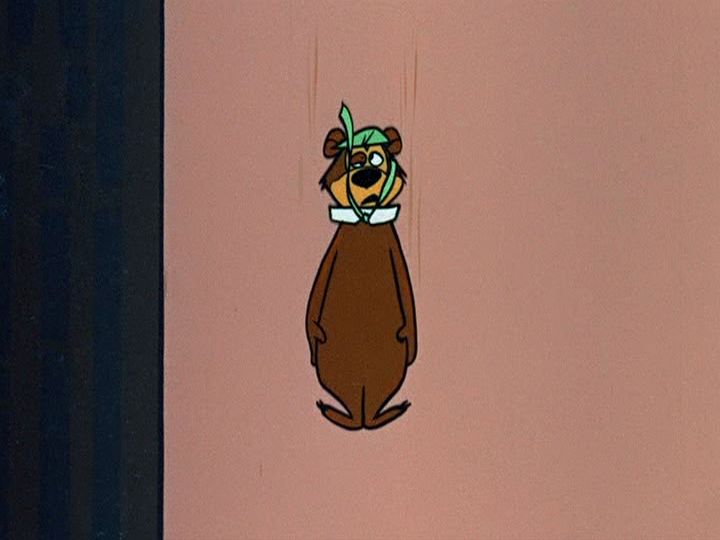
Today, someone would likely object, resulting in networks, producers and potential sponsors running around in fright, issuing panicked “cancel” orders to keep avoid upsetting even one crackpot. But in 1961, they gave the character his own show. His name was Yogi Bear.

Yes, in 1961, cartoons could show Quick Draw McGraw shooting a gun in his own face. Doggie Daddy could be clobbered with a mallet. And Yogi Bear could steal someone else’s food and even get away with it. It was just fine. It was all innocent fun.

Here’s a syndicated story that appeared in newspapers on December 15, 1960 praising the “child appropriateness” of the early Hanna-Barbera cartoons.


Best News for Children Since Big Bad Wolf Days
By DICK KLEINER
Newspaper Enterprise Assn.

NEW YORK - (NEA) –About the only good news for children since the Big Bad Wolf met up with the Small Smart Pig comes from Joe Barbera.
Joe is half of Hanna-Barbera, the outfit which produces The Flintstones, for adults, and Huckleberry Hound and Quick Draw McGraw for kids. The good news is that early in January, there will be a third children's show from Hanna-Barbera. Yogi Bear, one of the Huckleberry Hound people, will have his own show.
Now what makes this good news is that the children have become the neglected people on television There are shows for men, shows for women and even shows for bowlers. But the poor tikes and tikettes get short shrift on a large screen.
Of course, there have been exceptions. Peter Pan is one, even though it was on so late that by the time Captain Hook went over the side most of the youthful audience had conked out.
But, on a regular basis, you can count on the fingers of one dimpled hand the programs which are halfway decent for children to watch. There are Lassie and Rin-Tin-Tin and perhaps National Velvet. There are Fury and Casey Jones and possibly Dennis the Menace. (OK, so this a six-fingered dimpled hand.)
Then there is ‘The Shirley Temple Show,’ which generally provides a good story. But they had a ghastly slip a few weeks ago, when all of a sudden, in the middle of “Tom and Huck,” the plot thickened and we were in the middle of some business about grave-robbing.
Did you ever try to explain the fine art of grave-robbing to a five-year-old? The best thing to do is switch over to another channel and give the kid some tranquilizers. And take a few yourself.
But by far the majority of the programs which are supposedly designed for children should be shunned by all children and all but thick-skinned adults.
There is violence by the bucketful, blood is thicker than water and the writers out-do each other in inventing novel ways of committing mayhem. All this, of course, has been commented on repeatedly without any noticeable improvement.
And so it is pleasant to be able to report on Hanna-Barbera's progress. There is certainly nothing harmful for children in Huckleberry Hound & Co. In fact, it is all done with a good spirit and in language that doesn't talk down to children; these programs can be safely said to be helpful.
I remember talking to Walt Disney about the problem of children's programs on TV. I asked him about the criticism of most of his works—there is almost always a part of the show that frightens children.
"Children like to be frightened," Disney said, "and I actually think it's good for them. If they see the program with an adult, or go to the theater with an adult, they are OK. It's only the kids who watch by themselves who could be affected by it."
That's all well and good, of course, if your TV set has a governor on it, and doesn't function unless there is an adult within squeezing distance of every child. But most TV sets are not that advanced in construction. They work no matter whose hand turns it on.
And so we have the spectacle of kids watching old movies or new TV shows (about the same quality) and seeing things that children simply should not see.
Parents, of course, should assume the responsibility of censoring the set, but frequently they don't—the TV set is the best baby-sitter ever invented, and many grown-ups let their children watch anything and everything. They must pay the price for their indulgence.
It is the parents’ job, not the TV networks’. But the networks could, at least, hold a firmer hand over the programs which they bill as children's fare. If Hanna-Barbera can do it, so can the others.

Tony Benedict was hired as the third writer at Hanna-Barbera around the time this column was published. What guidelines did he keep in mind when writing those helpful shows done in a good spirit?

“I had to please Joe, he was the only one. And he spoke only to God.”

Leaving the cartoon-making up to veteran cartoon makers. Makes a lot of sense, doesn’t it? A shame it never stayed that way.

Saturday, 7 September 2013

Snooper and Blabber — Observant Servants

Produced and Directed by Joe Barbera and Bill Hanna.
Credits: Animation – Ed Love; Layout – Paul Sommer; Backgrounds – Bob Gentle; Story – Mike Maltese; Story Director – Alex Lovy; Titles – Art Goble; Production Supervision – Howard Hanson.
Voice Cast: Snooper, Blabber, Light Fingers François, Butler, Irish Cop – Daws Butler; Hazel, Mrs. Lavishly – Jean Vander Pyl; J.P. Lavishly, Parakeet, Insurance Agent, Bakery Clerk – Don Messick.
Music: Phil Green, Jack Shaindlin, Harry Bluestone-Emil Cadkin.
First Aired: 1960-61 season.
Episode: Quick Draw McGraw Show M-032, Production J-90.
Plot: Snooper and Blabber guard the Boon De Ay Tiara.

Yowp note: My thanks to Negrila Silvian who supplied some much better screen grabs for this cartoon 14 months after this was originally posted.

In his book “Chuck Amuck,” Chuck Jones relates a tale involving Mike Maltese as a boy in New York’s downtrodden Lower East Side dismissing the importance of wealth and station to some visiting society matrons from the Upper West Side. If it really happened, perhaps it prepared Maltese’s mind to write the lines in this cartoon spoken by Mrs. J.P. Lavishly after her birthday present was grabbed by a hand inside a cake.

Mrs J.P.:: Oh, my expensive gift. It’s gone. Get someone to scream for me.
J.P.: Don’t worry, my dear. It’s heavily insured.

All the while, they maintain their stiff, upper-crust reserve as if it’s beneath them to behave otherwise.

That little exchange may be the best one in the cartoon, but Maltese comes up with some other fun things in his story that make you overlook the dead spots. The idea of a guy disguised as a birthday cake for most of the cartoon is suitably off-centre and I still think it’s a stroke of punny genius to name the jewelled crown the Boon De Ay Tiara. There’s more silly dialogue in the scene with the predictably Irish cop (which ends in a predictable way) and Don Messick tosses in his voice inspired by Frank Nelson’s floorwalker on the Jack Benny radio show.

Light Fingers François is back as Snooper and Blabber’s adversary. Just like in “Desperate Diamond Dimwits,” he’s in disguise for much of the cartoon. He never appeared again after this cartoon.

The first scene is the weakest, though I like Prowl Cycle that Paul Sommer designed. It’s a bicycle built for two, except Blab can’t reach down to the pedals. It’s a not-great dialogue with Snoop’s secretary Hazel via a radio-telephone and the most amusing part may be when Hazel’s parakeet sneezes then thanks Snooper for saying “Gesundheit.” Snooper and Blabber ride past the same pair of brown buildings with lamp standards on either side 15 times before Sommer cuts to a close-up shot of Snoop.

The second scene is in the office of the All Out Insurance Company (a shame Maltese didn’t try some kind of pun on All State’s “good hands” motto) where Snoop agrees to go undercover with Blab as butler and maid to guard the tiara from Light Fingers François. No real gags; it just sets up the opening shot of the third scene where Blab is dressed as a maid and the houseman lets the two of them into the Lavishly mansion. Blab remains in drag for the rest of the cartoon.

The next scene opens with a long shot of J.P. Lavishly and his wife at the dinner table. It’s a long table and both are seated far apart from each other at either end. Lavishly rings for Snooper and asks him to take a birthday package to his wife. “Oh, J.P., you remembered!” gushes the wife. “I hope it’s expensive.” That’s when Blab brings in the cake and sings an off-key birthday song. It’s amazing how strong Blab is. He can lift the cake over his head with one hand even though François is inside. Of course, we don’t know that until François’ hand comes out of the cake and grabs the boxed gift and runs off. Snoop’s catchphrase this time: “Stop, thief, in the name of the Private Eye Group Insurance Plan!” Blab agrees because the high heels are killing him.

Now we get the Sceptical Hanna-Barbera Irish Cop scene. You know how this plays out. Snooper gives explanation. Cop makes fun of him. Cop suddenly discovers it’s true. Cop is shaken and mutters something to himself. Fade out. This time the cop facetiously says: “Say, how would you like to come along with me and see an apple strudel that speaks Portuguese?” “Gee, that sounds like fun,” says the clueless Blab. Suddenly, the cop is lifted into the air by François; he’s standing on a manhole cover under which the crook has been hiding. The cop lands with a thud and the birthday cake runs away. “Sure it’s meself who’ll be talkin’ Portuguese to that apple strudel,” the cop says to himself and skips away, having been turned into a mental case.

Cut to a drawing of a bakery shop, then back to the running Snooper and Blabber. “We’ve got him colder than a frozen custard pie, Blab,” says Snoop. By the way, the music playing underneath is Phil Green’s “Custard Pie Capers.”

“Take your pick,” says the bakery clerk, enthusiastic about the store’s selection of birthday cakes. Snooper’s actually pretty clever. “I’ll take me pick with this pick,” he says, and jabs each cake until he shoves the pointy blade into the cake where François is hiding. Snoop has him “dead to lefts and rights.” Well, not really. François tosses a blueberry pie at Snooper (“it goes good with your complexion”) and dashes off. The clerk is ecstatic. “Did we bake that cake? Ooooo! Aren’t we clever?”


Bill Hanna was no doubt delighted with the “folly that birthday cake” scene. Blabber tells us the cake jumped in a barrel to hide. We never actually see the jumping. The camera cuts to a background drawing of the barrel. But it closes in on the barrel (as indicated on Sommer’s layout perhaps) so there’s some kind of movement. Snooper has been running around all this time with bound sticks of dynamite which he “enlightens.” Kaboom. “[V]iola! No more barrel.” “My dear old mother always said I was a lot of noise,” Pierre tells us. “And she was right.” One wonders if Maltese’s mother told him the same thing once.

Now Snooper’s not so clever. The cartoon winds up with reused animation of Blab carrying the cake (which, somehow wasn’t destroyed in the explosion), reprising his song, but changing the last line.


Blab: Happy birthday, Mrs. J.P! Happy birthday, Mrs. J.P! Although you look like a million, you’re only 56.
Mrs. J.P.: Uh, 55.
Snoop: Leave us face it, Mrs. J.P., you’ll never see 60 again.


Snooper gets the cake tossed in his face by Mrs. Lavishly. It would have been funnier if she commanded her husband to ring for someone to do it, but there wasn’t time left in the story and that would have been more expensive to animate. Blab’s tag line to end the cartoon isn’t even a pun: “Snoop always was a stickler for figures.”

Snooper gets all his catchphrases in. As he doesn’t have a car or go to an office in this one, we don’t see the private eyeball on a door or window or so on.

The sound cutter times the music cues to end when a scene does whether they’re ready or not. You can hear the edit in “Streets of the City” at the end of the first scene. That little solo flute cue appears again; I checked my Q-2 EMI Photoplay discs but can’t find it. Wisely, no music is playing when Blab is singing his birthday song.


0:00 - Snooper and Blabber Main Title theme (Curtin, Hanna, Barbera).
0:25 - GR-248 STREETS OF THE CITY (Green) – Prowl cycle scene.
1:17 - GR-456 DR QUACK (Green) – Insurance office scene.
2:16 - GR-453 THE ARTFUL DODGER (Green) – Blab in heels, scene at door.
2:54 - GR-98 BY JIMINY! IT’S JUMBO BRIDGE No. 2 (Green) – Lavishly and wife in dining room ring.
3:05 - GR-74 POPCORN (Green) – Snoop at door, Blab with cake.
3:25 - No music – Blab sings, puts down cake.
3:36 - CAPERS (Shaindlin) – Hand in cake grabs present, cake runs.
4:11 - CB-85A STEALTHY MOUSE (Cadkin-Bluestone) – Irish cop, lifted up by Francois, crash.
4:55 - GR-77 CUSTARD PIE CAPERS (Green) – “What in the world…” cop goes crazy, Snoop and Blab run.
5:22 - GR-93 DRESSED TO KILL (Green) – Bakery scene, pie in Snoop’s face.
5:53 - “FIREMAN” (Shaindlin) – Pie dripping, Snooper and Blabber run, dynamite explodes, Francois amongst barrel staves.
6:43 - solo flute cue (Green) – Blab walks with cake.
6:47 - No music – Blab sings, puts down cake.
6:54 - GR-76 POPCORN SHORT BRIDGE No. 2 (Green) – Mrs. Lavishly says she’s 55, Snoop insults her, cake tossed in his face.
7:00 - Snooper and Blabber End Title theme (Curtin).

Thursday, 5 September 2013

High Fly Lah

In some of the earliest cartoons on the Huckleberry Hound Show, Mike Lah was called on to animate one or two sequences. Lah tended to give his characters google eyes (or teeny pupils in shock takes) and move the mouth on the face during dialogue (occasionally giving a character two upper teeth).

Lah animated all of the first Yogi cartoon put into production, “Pie Pirates.” I suspect “High Fly Guy” and “Tally Ho Ho Ho” were also early in the production run, as neither has “Yogi Bear in” on the title card (and there are some unique music cues). Lah worked on both.

In “High Fly Guy,” Lah handles the scene where Yogi uses a teeter board to launch himself airborne, only to be clobbered with a giant boulder, then the next routine where Yogi screws himself into the ground with a beanie-copter hat.

Lah always comes up with some simple but unique expressions. Here’s Yogi coming back down to earth after zooming up into the sky, only to bash his head against a tree branch. You’ll never find anything like this in a Yogi cartoon once he got his own series.


Lah liked to draw Yogi running away with his arms out (see “Pie Pirates”). Notice how Yogi’s mouth is just a squiggly line.


“Hey, little bird! Look out for that rock!” Yogi yells. Only the boulder crashes on him between the words “that” and “rock.” Here are the four drawings of the impact. Lah uses the second and third drawings on ones, then repeats them on twos before going to the last drawing for 11 frames.


Lah moved on to bigger things after H-B (his own company, eventually). A shame he didn’t stay longer. It would have been interesting to see how he handled the characters the following season when it seems budgets picked up a bit.

Tuesday, 3 September 2013

Yogi Bear Weekend Comics, September 1963

Kids, kids and more kids. Ordinary kids, puffy-cheeked kids, First kids. Readers got them all if they opened the weekend comic section of the paper and read Yogi Bear in September 50 years ago. Click on each comic to enlarge.


What detail we get in the September 1st comic! The bubbles in the final panel are great but the left panel in the middle row is really well thought-out. Note that the basement wall isn’t completely stone-faced. It’s partially blackened, because it’s a dark basement, but there’s enough light to see Yogi at work. Good balance on the ranger in the lower left hand panel.


Yogi met up with J.F.K. and Caroline Kennedy in a comic a year earlier. Now he chats with J.F.K., Jr. on September 8th. Less than three months later, the real J.F.K., Jr. would lose his father. Nice contrasting angles on the White House and the fence in the last drawing. The TV cartoons, unfortunately, would settle for something that looks like a flat stage setting; it would be easier to move characters horizontally that way. Boo Boo appears to have been forced to stay back at Jellystone.


On September 8th, we got “Lad, sad.” On September 15th, we get “Sad, lad.” Nice of Yogi to get mashed just help the forgetful kid. Ranger Smith’s kinda of a jerk in the last two comics. Maybe he’s still annoyed about the bubble joke in the first comic. Note the silhouette panel.


The September 22nd comic features Mr. Magoo McRidge. Nice reveal gag at the end. It seems there was still one railroad left in North America that used 1930s steam engines.


Again, some very nice angular layouts on the September 29th comic featuring an inventive Dutch trailer. The silhouette framing in the bottom left panel is attractive, too. Ranger Smith disappears after the top row. All just as well. He’s being pretty sour this month. Well, he’s sour next month, too. And we get an explanation for those native Indian stereotypes in Jellystone park.

If you want to see these in colour—the bottom two rows, anyway—Mark Kausler will be posting them on his blog, as usual. See his blog in the list to the right.

Saturday, 31 August 2013

Huckleberry Hound — Knight School

Produced and Directed by Bill Hanna and Joe Barbera.
Credits: Animation – Lew Marshall; Layout – Paul Sommer; Backgrounds – Dick Thomas; Story – Warren Foster; Story Director – Alex Lovy; Titles – Art Goble; Production Supervision – Howard Hanson.
Voice Cast: Huckleberry Hound, Instructor, Herald (off-screen), Blond Knight, Moustached Knight, Grey-Haired Knight – Daws Butler; Narrator, King Arthur, Dragon, Bearded Knight, Brown-Haired Knight, One-Card Knight – Don Messick.
Music: Jack Shaindlin, Geordie Hormel, Bill Loose/John Seely, Spencer Moore.
Episode: Huckleberry Hound Show No. K-043, Production E-120.
First Aired: week of April 24, 1961.
Plot: Huck earns his membership in the Knights of the Round Table.

Huckleberry Hound is a pleasant guy so his cartoons are pleasant, even when there’s nothing uproariously funny going on. There are a few good moments in “Knight School,” but it’s not a laugh-out-loud fest. Still, the cartoon’s hard to dislike because Huck’s personable enough to carry it off.

“Knight School” consists of an introduction and three vignettes. The last one is a reworking of the Huck vs Dragon idea in the first season cartoon “Dragon-Slayer Huck,” which, frankly, was more enjoyable than this little film. It involved a contest between Huck and a funny fire-breathing dragon that sold dragon souvenirs. Here, the dialogue-less dragon burns Huck a couple of times before his flame gets put out (an almost predictable conclusion) and he runs away. The humour in this scene is fairly typical of Huck—it depends mainly on Warren Foster giving him funny lines for his commentary to the audience about what’s happening in the cartoon. “He’d make a ginger-peachy cigarette lighter,” Huck tells us and “You don’t frighten me, Mr. Dragon with all your smart-alecky flamin’ and roarin’.” But there’s also talk for the sake of talk. “I think I’d better get out of here,” Huck says. As he has turned around and is running away, we can already see he’s “getting out of here.” It’s dialogue for dialogue’s sake.


The first vignette comes after a nice establishing shot of a Dick Thomas background (with transparent clouds) and a narrator telling us young men from far and wide desired to be knights of the Round Table. Huck corrects the narrator. He doesn’t want to become one. “I was drafted,” he says. I didn’t realise there was a draft at the time the cartoon was made that would be the subject of humour.

Huck goes to the Knight School that’s the title of the cartoon. “Hmm. Knight school in the daytime. It’s gettin’ confusin’ already,” he inevitably puns to us. “Private” Huck gets crushed a couple of times and comments to the camera. Foster pulls out the old “Just call me Shorty” line. The instructor has Daws Butler’s Phil Silvers voice except he adds kind of an English tinge to it at times. The vignette ends with a scene a fight we don’t see (it’s off-stage) that’s indicated by sounds and a shaking camera. But there is animation; Lew Marshall has the English sergeant turn to the camera and give us a goofy look. Huck wins the fight. Turns out a fat guy fell on him and by the time he got up, the rest had of the would-be knights beat each other up.


So the King knights Huck and leaves him with a bump on the head. “You ever think about usin’ an aluminum sword, sir?” Huck asks.

The second vignette is the best. The knights cut cards and the high-card holder must slay the fire-breathing dragon of Shropshire. “Thanks, your majesty,” says the nervous Huck, “But I never play cards.” Huck draws a three. But it turns out to be the high card. Three knights draw twos. One draws a one. Not an ace. A one. The card has a one on it.


The third vignette has the dragon non-fight and then the wind-up scene has another card-cutting for the honour of doing battle with an ogre in Chettingham. Huck is ready this time. “You know, you cain’t have a card lower than a zero,” he tells us as he pulls out a card with a zero on it. Ah, but this time, the low number goes. “Shucks. No wonder they use a round table. Nothin’s on the square around here,” laments Huck. And, with that, the cartoon ends.


The artwork is serviceable. Lew Marshall’s nose-bobs, though not as pronounced as in Huck’s first season, are still there. He avoids anything resembling a medium-sized take. When the sergeant is shocked to see Huck has survived the fight amongst the would-be knights, the guard’s eyes don’t grow big. Marshall merely has the guard lift his head up two positions with a blank expression (two frames per drawing), close his eyes for three frames then drop his head back down to where to was before. Marshall saves drawing, too. When the dragon shoots flames out of his nostrils at Huck, the drawings of the the dragon are merely flipped over and inked on the other side. Sommer’s layouts are never daring; his character designs and props work fine (though he has an Englishman wearing American sergeant stripes in the Middle Ages). I like his chairs and red drapes in the chamber of the round table. Dick Thomas takes the time to put a varnish shine on the various background drawings of the table.


I suspect the knights are not marked individually in the script. Two of the knights change voices in mid-scene; one talks like Daws Butler then Don Messick later in the scene and the other vice versa.

The sound cutter edits the stock music, when necessary, so it fits in a scene. Hanna-Barbera used three of the cues from the X-9 reel that contained Olde England-invoking cues and they’re all in this cartoon.


0:00 - Huckleberry Hound Sub Main Title Theme (Curtin).
0:22 - ZR-126 ENGLISH MAIN TITLE (Hormel) – Opening narration scene.
1:00 - LAF-10-7 GROTESQUE No. 2 (Shaindlin) – Huck reads sign, shield scene, helmet scene.
2:23 - LAF-25-3 bassoon and zig zag strings (Shaindlin) – graduate fight scene.
3:01 - ZR-103 PERIOD MAIN TITLE (Hormel) – Huck knighted.
3:23 - TC-303 ZANY COMEDY (Loose-Seely) – Knights at table, card cutting scene.
4:44 - C-19 LIGHT ACTIVITY (Loose) – Huck on horse.
5:11 - ZR-127 PERIOD CHASE (Hormel) – Dragon appears, attacks Huck, Huck jumps in lake.
6:00 - L-78 COMEDY UNDERSCORE (Moore) – Dragon puts head in lake, Huck: “And what do they do?”
6:23 - ZR-48 FAST MOVEMENT (Hormel) – Dragon runs away.
6:31 - LAF-25-3 bassoon and zig zag strings (Shaindlin) – Huck at round table.
7:00 - HUCKLEBERRY HOUND SUB END TITLE THEME (Curtin).

Wednesday, 28 August 2013

Hunter Huck Storyboard

Here’s a post where we get to combine two fun things—storyboards and the little cartoons between the cartoons on the old half-hour syndicated shows.

Here are storyboard drawings I snagged a long time ago for one of the Huck bumpers. I’ve blown them up about as much as I can before they get too fuzzy. Notice some colour instructions. I don’t know who the artist is; it don’t think it’s Dan Gordon or Warren Foster. Huck looks pretty good here. I like the poses on Jinks. He was funnier in these mini-cartoons than he was in some of the longer ones. (Note: see the comment section for more on this).
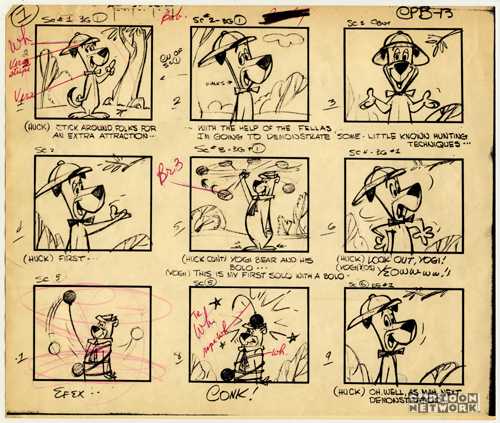


These little cartoons added a lot to the enjoyment of watching the Huck, Yogi or Quick Draw half hours. If you’ve seen the Huck DVD, you’ll notice more care was put into animating some of them than the actual cartoons; there’s far more body movement. Here’s one you’ve probably seen before. I’ve been told Ed Love animated this and others, although he did no cartoons in Huck’s first season, and his style is a lot jerkier in his first H-B cartoons (see Mike Kazaleh’s comment on who actually animated this).